Episode 1088 - Matt Sheridan
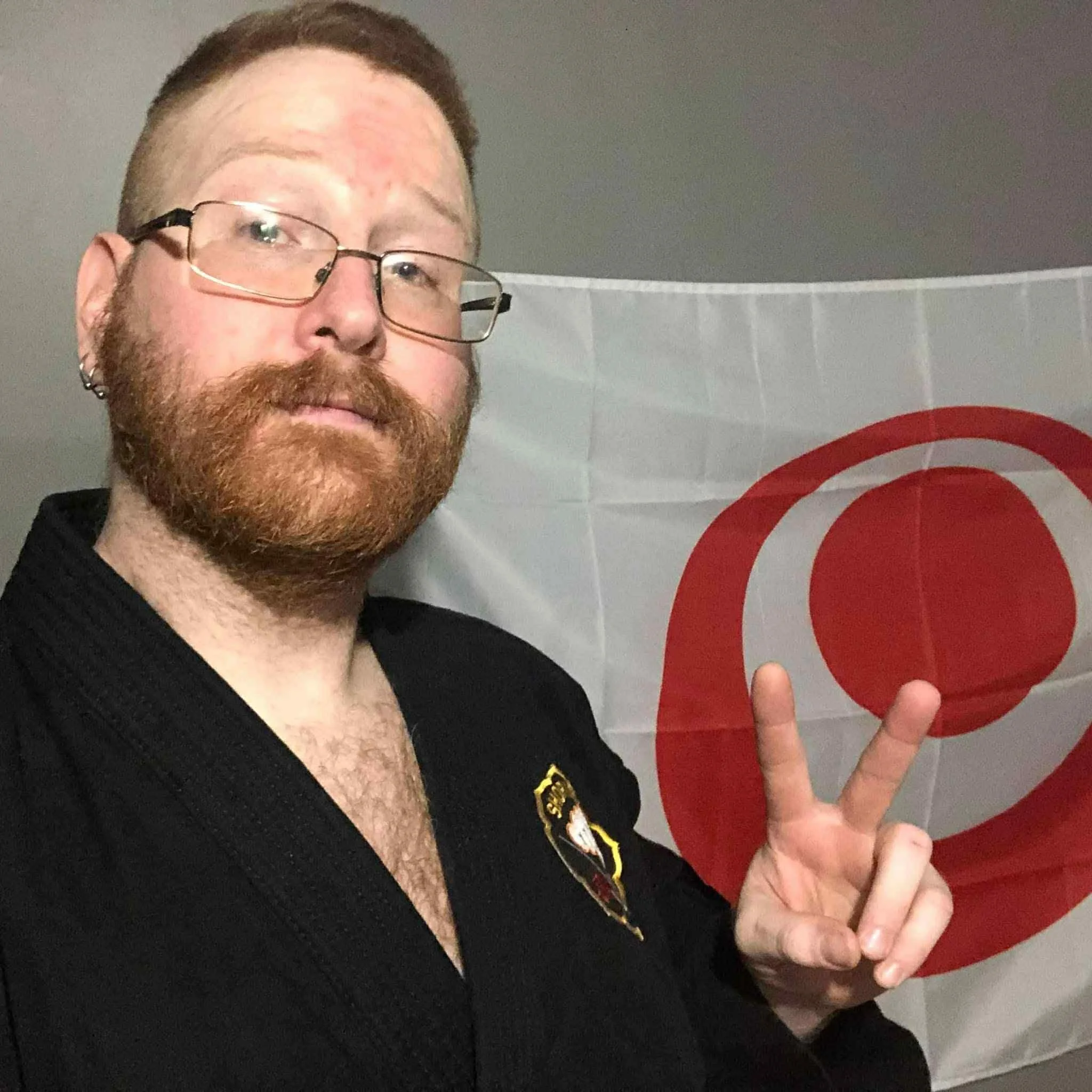
In this episode Jeremy chats with Matt Sheridan about rank, history, karate myths, and the similarities between Korean arts and Okinawan/Japanese arts.
Matt Sheridan - Episode 1088
SUMMARY
In this conversation, Matt Sheridan shares his journey through martial arts, starting from his childhood influences like the Teenage Mutant Ninja Turtles and Shaolin monks, to his experiences in Taekwondo and Karate. He discusses the challenges he faced, including financial constraints and personal struggles, as well as his commitment to maintaining integrity and high standards in martial arts training. The conversation also touches on the importance of myth-busting within the martial arts community and the evolution of his training philosophy over the years.
He also shares his experiences and insights regarding the politics of martial arts ranks, the myths surrounding belt systems, and the cultural nuances of titles. He discusses the evolution of martial arts uniforms, the impact of cognitive dissonance within the community, and the importance of motivation in training. Matt emphasizes the need for integrity and personal connection in martial arts, while also advocating for a reimagined rank system that prioritizes personal growth over titles. Matt and Jeremy Lesniak also delve into the complexities of rank and titles in martial arts, discussing the impact of ego, the importance of accountability, and the need for continuous training and learning. They explore innovative approaches to martial arts belts and emphasize the significance of intent and humility in practices. The dialogue culminates in a call for high standards and good choices within the martial arts community, highlighting the balance between training and discussion.
TAKEAWAYS
Matt's early influences in martial arts were shaped by pop culture.
He emphasizes the importance of integrity in martial arts training.
Matt believes in maintaining high standards for rank and training.
He has a strong interest in the history and lineage of martial arts.
He actively engages in myth-busting within the martial arts community.
Matt's journey reflects a deep passion for martial arts and personal growth.
The black belt was introduced before the white belt.
Cognitive dissonance leads to backlash in the martial arts community.
Titles and ranks can negatively impact identity and respect.
Motivation should come from personal connection, not just belts.
The original belt system was much simpler than today’s.
Cultural nuances in titles are often misunderstood in the West.
The rank system in karate maxed out at fifth dan before 1945.
Ego in martial arts can be mitigated by removing unnecessary ranks and titles.
Training should be prioritized over rank and titles.
Instructors must continue their own training to effectively teach students.
Discussion outside the dojo is essential for cultural growth in martial arts.
Intent behind actions in martial arts practices is vital for humility.
The best martial artists are those who remain students at heart.
High standards and good choices should guide the martial arts community.
CHAPTERS
00:00 Introduction
01:56 Early Martial Arts Influences
5:13 The Journey Back to Martial Arts
10:02 Experiences in Taekwondo and Karate
15:01 Myth Busting in Martial Arts
20:00 Integrity and Standards in Training
26:33 Navigating the Politics of Martial Arts Ranks
29:21 Debunking Myths: The Truth Behind Martial Arts Belts
30:10 The Evolution of Martial Arts Uniforms
35:30 Cognitive Dissonance and the Martial Arts Community
41:05 The Impact of Titles and Ranks on Identity
49:42 Cultural Nuances in Martial Arts Titles
56:17 The Role of Motivation in Martial Arts Training
01:04:51 Reimagining the Rank System in Martial Arts
01:06:25 Rethinking Rank and Titles in Martial Arts
01:10:56 Ego and Accountability in Martial Arts
01:12:30 The Importance of Training and Discussion
01:16:19 The Role of Instructors and Continuous Learning
01:18:39 Innovative Approaches to Martial Arts Belts
01:22:03 Intent and Humility in Martial Arts Practices
01:28:42 Closing Thoughts and Future Discussions
This episode is sponsored by Kataaro. Please check out their site at Kataaro Custom Martial Arts Products for your holiday gift giving needs. Be sure to check out their Martial Arts Belt Pagoda Display!
And use the code WK10 to save 10% off your first order. And be sure to ask them about a wholesale account for school owners!
Join our EXCLUSIVE newsletter to get notified of each episode as it comes out!
Subscribe — whistlekick Martial Arts Radio
After listening to the episode, it would be exciting for us to know your thoughts about it.
✅Subscribe to whistlekick Martial Arts Radio on the following platforms:
🎧Apple Podcasts: https://apple.co/3mVnZmf
🎧Spotify: https://spoti.fi/3yHVdHQ
✅You can find whistlekick on all social media platforms using the handle @whistlekick or visit our website at https://www.whistlekick.com or https://www.whistlekickmartialartsradio.com
Show Transcript
Jeremy Lesniak (07:05.871)
What's going on, everybody? Welcome back to another episode of Whistlekick Martial Arts Radio. I'm Jeremy Lesniak joined by Matt Sheridan. Thanks for being here, Matt. Appreciate you and your time. We're going to talk. Sometimes I say this, but it doesn't happen often. I think today is going to be interesting. I can just tell. I can just tell from the pre-chat that we had. This is going to be interesting. So I'm looking forward to it.
Matt S. (07:30.269)
you
Jeremy Lesniak (07:34.223)
For all of you out there, thanks for being here, whether it's your first time or maybe your 500th or we've got people out there who've watched and listened to every episode. Maybe it's your thousandth and something episode. Cool. Thanks for being here. We've been able to do the things that we do because of all of you, but we've also been able to do the things that we do because of some of our sponsors. And today's episode is sponsored by Kataaro. If you've been around, you know that Kataaro has helped us out a lot. K-A-T-A-A-R-O
They do some other cool stuff, all of it handmade in the USA. They've got wholesale. can, they've got, I'm looking at my notes here. They've got a brand new pagoda style desktop belt holder, some really cool stuff. Check them out. And thank you to Kataaro for their support. And thank you to Matt for being here. Matt, welcome to Martial Arts Radio.
Matt S. (08:26.756)
Hello, hello. When Andrew asked to interview me, I was kind of like hesitant, like, why? I'm a nobody from the middle of nowhere. I'm like the smallish fish.
Jeremy Lesniak (08:38.757)
But that's kind of our brand, that's me. I'm a nobody in the middle of nowhere. Like I can't even see houses out, all I see is trees.
Matt S. (08:47.028)
Yeah, right. Like I joke, I'm a hermit literally nowhere, you know, in the woods. So you guys want to know a little bit about my background, how I got started, stuff like that.
Jeremy Lesniak (09:00.655)
We can start there. We can start wherever you want to start.
Matt S. (09:08.989)
We just have a time limit.
Jeremy Lesniak (09:10.555)
Well, yeah, yeah, there's, mean, we can't go forever. There's another episode recording at some point, because we do four today because efficiency, right? But let's let's start here.
Matt S. (09:15.866)
wow.
Jeremy Lesniak (09:27.385)
When you, almost everybody has an idea of martial arts before they start doing martial arts. And it's usually from something in pop culture, right? TV, movies, comic books, video games. What was your source for what martial arts was before you started training?
Matt S. (09:33.64)
Hmm.
Matt S. (09:43.357)
So I had two. Number one, teenage mutant ninja turtles. I mean, that's a lot of people my age, you And number two, I loved the idea of Shaolin monks and being a monk and living out in the wilderness and, you know, doing not just the martial arts stuff, but also meditation and that sort of thing.
the monastic lifestyle. I thought that was so neat when I was young. Which is funny because I never got into Kung Fu. I've never gone down the Shaolin road. My path never took me in any of those directions. And even things like meditation, I've tried it. It doesn't work on me. My brain just isn't wired like that.
But yeah, my mom and dad took us to like a strip mall and at one end was a gymnastic studio and. strip mall, yes. Yeah, you know, six years old going to the club. No, strip mall. So one end was a gymnastic studio. The other end had a Taekwondo school. They like pick one and it's like, which will help me on my way to Ninja Turtle greatness? You know.
Jeremy Lesniak (10:45.999)
I'm glad you said strip mall. I was worried.
Jeremy Lesniak (11:07.45)
obvious.
Matt S. (11:08.881)
Right, because you gotta be able to do those flips and the gymnastics and, you know, as well as physically fight the Foot Clan and the evils of the world. I know, right? And it... Yes, so I have had an older brother and an older sister, a twin sister. So me and my brother signed up for the taekwondo, my sister signed up for the gymnastics and...
Jeremy Lesniak (11:16.581)
Right. Kind of a tough decision. You said we did you siblings?
Matt S. (11:37.0)
It boiled down to, as a little kid, I did not want to wear a leotard. You know, that's just... Even today, I don't want to wear a leotard. Right? Right? Which is funny now because training in rash guards is becoming so popular, you know, through no-gi jujitsu and stuff like that. So it's like, I've seen plenty of men practically wearing leotards.
Jeremy Lesniak (11:47.483)
would not be my first choice of attire.
Jeremy Lesniak (12:06.085)
Yeah, true story.
Matt S. (12:06.726)
Or even wrestling, you know, I did wrestling in high school and you wear that onesie, you know, so it's just funny how things go full circle like that sometimes.
Jeremy Lesniak (12:17.347)
right. Yeah. Okay. So six years old, taekwondo, you're going to be a Ninja Turtle. And what do you remember much of those early days and and no
Matt S. (12:25.159)
Mm-hmm.
Matt S. (12:31.173)
No. So, one of the only memories I have of that first school I went to was that they required us to wear a cup. And we had one class where I really, really had to pee. And practically peed my pants because getting the belt off and getting the top off and then struggling with the pants and underwear and the cop is... Yeah. Right. me neither. Me neither.
Jeremy Lesniak (12:54.529)
Yeah, it's a lot. I still don't like wearing a cup.
Matt S. (13:01.563)
I mean, I will if I know we're doing some dirty sparring, but other than that, So yeah, I have no memories of that first school other than what it looked like and whatever. My family moved when I was seven. I'm not gonna tell people where I live. We'll probably talk about that, why I'm like that later.
Jeremy Lesniak (13:25.701)
That's okay.
Matt S. (13:32.391)
I from the time I was like six until I was ten. That's when the big recession of the 90s, late 90s hit and mom and dad's like, can't afford to send you guys to karate no more. So when I was ten, I was forced to quit, you know, the four letter word, all the quitters, you know, I hate that stuff. So,
Jeremy Lesniak (13:54.256)
Hmm.
Matt S. (14:02.439)
I begged and begged and begged to go back because my middle school was close enough to the karate school that I could walk. And I'm like, you guys don't have to worry about taking me to karate. I can just walk there after school. It's a safe walk. You literally walk past the police station, walk past the courthouse, walk past the firehouse. it's a safe. It's a safe area. It's a safe route.
Jeremy Lesniak (14:27.395)
Sounds like a pretty safe area.
Matt S. (14:32.282)
And they're like, no, we just can't afford it. And I honestly don't think it was about the money. What happened around that time was my brother tested for a belt and my sister and I weren't allowed to. And I think that chuffed my parents, you know? Well, they're not improving, they're not showing improvement, blah, blah. So why are we going to keep paying for this when they're not?
taking it serious. Which is completely understandable. I mean, I've had students where I'm like, hey, obviously your kid doesn't want to be here. Obviously they're distracting class because they would rather chat than kick and do forms. So maybe take them out, wait a couple years. If they ask to come back and they want it, they want it, then bring them back and it'll be okay.
You know, so my 15th birthday present was karate tuition. That year I had, I signed up for football because I wanted to work out. And I was the only person on the football team who was fourth string because I didn't want to play football.
Jeremy Lesniak (15:54.011)
You
Matt S. (15:55.437)
I was only there to work out. wanted to... very much so. I was there for physical training, for weightlifting, for running, for cardiovascular...
Jeremy Lesniak (15:56.761)
And you were open about that.
Jeremy Lesniak (16:05.243)
That's a pretty mature perspective for a 15-year-old.
Matt S. (16:08.006)
Well, like, when I was really little, I was super skinny. I had a six pack up until I was like 11. And then I got into video games, I stopped playing outside and I got chunky. I was the redheaded, the chubby redheaded kid with glasses, you know? And when I got to high school, I was like, you know, I'm kind of tired of being that cliche.
the chubby redheaded kid with glasses. So I joined football, I worked out, and after the football season was over, mom and dad agreed to let me go back to karate because I showed that I was dedicated, blah, blah, you know, and I've been doing it ever since. my early karate experience was very positive. It was like going
to the dojo. Well, I'm using, I'm using Japanese terms because that's what I train in now, but the style I trained in was Korean. Okay. I don't hide that. My black belt certificates say Taekwondo on them because politics.
Jeremy Lesniak (17:17.743)
Okay.
Jeremy Lesniak (17:23.127)
OK, so you're so you're you that second school that you went to from like seven to ten. That was that was a Taekwondo school. OK.
Matt S. (17:30.147)
Mm-hmm.
Technically. So I'm not sure if you are familiar with the history of taekwondo outside of the BS, but you know, karate was brought to Korea. The Koreans learned a combination of Shotokan, Shudokan, and Shitoru. And then years later, know, hostility between Japan and Korea, they wanted to Korea-fy everything. So they created their new forms.
Jeremy Lesniak (17:39.769)
I am. I am.
Matt S. (18:02.073)
The term Taekwondo was coined in 1955. The founder of my old style, his ranks up to like fifth or sixth on were all Kong, Sudo, karate. You know, he learned the Pinankata, the Naihanchi, Basai, Kusan-ku. He learned all the karate forms and he was part of that movement from
Jeremy Lesniak (18:21.787)
Yeah.
Matt S. (18:29.796)
Tengsudo, Kongsudo, into Teisudo, into Taekwondo. So, the style I trained in had like...
Pen Karate Kata and then they had the Taekwondo forms like we did the Pogwae forms which are the older Taekwondo forms. did like Koryo. I learned Pyongwon, Sipjin. Eventually in college I learned Taebaek and Kun-Gong which my style didn't do. So...
Jeremy Lesniak (18:44.334)
interesting.
Jeremy Lesniak (18:59.643)
Mm-hmm.
Matt S. (19:09.636)
We had a combination of karate forms, taekwondo forms, and then our lineage is also through Yun Byung-in, who trained in China before going to Japan and Korea. So we also had a few Chinese forms. So that style had like 31 forms.
Jeremy Lesniak (19:27.899)
That's a lot of forms, but that's pretty cool that they were so different.
Matt S. (19:32.343)
Right, and it's hard to explain that to people nowadays because there's so much bias, you know? Taekwondo's not karate and anything Korean's not karate and it's like, well, Tang Soo Do is straight up old school Shudo-Kang. know? Kong Soo Do is straight up old school Shudo-Kang from Kanken Toyama. Like, so if you look at lineage, have Gichin Furukoshi, Kanken Toyama,
And then you have a whole slew of Koreans that trained under them, like our lineages through Yun Byung In, Yun Byung Gwae, who's his cousin, those two trained under Kon Kanto Yama, and then Chun Song Sup, who trained under Gi Chen Funakoshi. So those were the founders of the...
Jeremy Lesniak (20:10.235)
Mm-hmm.
Matt S. (20:23.981)
what would eventually become the Jido Kwan, the Kang Duk Kwan, and the Changmu Kwan, and Grandmaster Han trained in the Kang Duk Kwan and the Jido Kwan. Okay, so the majority of what we did was karate, and then implemented some Taekwondo, implemented some Chinese arts. And I got all the way up to Fourth Don.
and I didn't want to test for fourth Don. So this is where my story is kind of odd in that when I was a third degree black belt, that's when the bad stuff started to happen. Second, third degree black belt.
Jeremy Lesniak (21:07.707)
Hmm. No, this I just want to be clear. This is the same school, the school you were at for a period of time, stepped away and stepped back at 15. OK, and you were there from 15 through this time you're talking about.
Matt S. (21:16.545)
Yeah, yeah, yeah.
Matt S. (21:21.847)
Well, it was the same association, so...
I started under Sherry Jordan, who's now passed away. And then when I came back at 15, Sherry Jordan and her son Seth Jordan were running that school. So I trained under them until I left for college around 20. And then I trained under two of their students in the town where I went to college. So I stayed in the same association.
becoming a high rank and this is when the internet forums started to lift off. You had Bushido, you had the karate forum, you would have stuff like that. I would get on these forums and there'd be people talking about my style. They had no clue. No clue. They just believed the myths and they would pass on the myth as if it was the facts. And I'm like, that's not how it works. That's not what actually happened.
Jeremy Lesniak (22:12.634)
Hmm.
Jeremy Lesniak (22:23.483)
Hmm.
Matt S. (22:26.9)
No. So very early on when I was still in high school and college, I was doing myth busting for the style I trained in. you know, people like, he was a high rank in this, this and this. I'm like, no, he wasn't. No, he wasn't. So Grandmaster Han, his highest official rank in Taekwondo was through the Jido Kwon and it was an eighth dot.
He was awarded a ninth don like 15 years later by his students. Which is not something I agree with. Well, I don't think it was him. I think it was the students. You know what I mean? Because in Asian culture, it's very impolite to deny a gift. So these are his students.
Jeremy Lesniak (23:03.779)
one of those.
Matt S. (23:24.491)
Gifting him a ninth dawn
Jeremy Lesniak (23:27.835)
But I guess the question that some would ask is what rank were they?
Matt S. (23:28.418)
That's it.
Not very high. So it was awarded by the Black Belt Council, which included one fifth on
three fourths dons and a couple thirds dons. And they're awarding him a ninth don. Which happens quite often nowadays. It's becoming more more common. I don't agree with it. but it is what it is. In most cases, right.
Jeremy Lesniak (23:55.351)
It sure does.
Jeremy Lesniak (24:00.388)
I don't either.
I should say I don't agree with it in most cases. There are some odd exceptions that we don't have to belabor.
Matt S. (24:11.81)
Right. And like, you know, he'd been an eighth Don for, like I said, 15, 16 years. So did he put in the time? Yeah. Did he help spread the style? Yeah. Like, was he doing stuff for the martial arts community? Absolutely. Has very many people heard of him? Probably not, you know. Bless you. So when I was still a second Don,
I started training in Shorinru. And I've been training in Shorinru since 09. So, what, that's going on 17 years now?
So.
Matt S. (25:00.481)
Sorry, I have to organize my thoughts. Yeah, so I started training in Shorinru. I was noticing some very negative things in Yanwaru, the Taekwondo school. And since I was ranking up, I outranked a lot of people and I knew more of the history than a lot of people because I trained as a kid. You know, I was there in the 90s.
Jeremy Lesniak (25:26.564)
Hmm.
Matt S. (25:29.566)
So when this sixth Don talks about the past, I was there when he was a blue belt. You know, like I'm not a sixth Don by no means, but I was there and I was a smart kid and I kept an eye on things. Like you said, I had a relatively mature outlook on certain things. So I started to lose
Jeremy Lesniak (25:33.723)
Hmm.
Matt S. (25:59.443)
my faith in the rank system and the belt system. Like when I was going up through the ranks as a teenager, we had what I would call belt waggers. They would wag their belt in your face. Well, you're a yellow belt and I'm a blue belt. Therefore, therefore shut up and train. You're not my instructor. You don't know
anything, you're a blue belt, shut up. Like, and when I got on the forums, that was the kind of people that were defending the style and spreading the myths. They were blue belts and red belts, which is essentially brown belt. And it's like, you don't actually know anything. You don't know anything. You've never done the research. You've never called and talked to the old masters. know, like
Jeremy Lesniak (26:29.882)
Hmm.
Jeremy Lesniak (26:53.285)
Hmm.
Matt S. (26:58.42)
What are you even talking about? They're the kind of people that still spread the 3,000 year history of Taekwondo. It's like, no, that's not how it worked. And I'm an academic, I'm a nerd, I do my own research. So one of the first things I noticed, when I took my instructor's course as a brown belt.
And I finally got a certified instructor when I was a black belt and they gave me an instructor's booklet. And in the booklet was information on where did our forms come from. You know, these are Okinawan forms, these are mainland Japanese forms, these are Korean forms, these are Chinese forms. Like they provided that information to instructors. Does that blue belt have that information? No. No.
Jeremy Lesniak (27:54.619)
I'm gonna guess not.
Matt S. (27:57.7)
And included in that was like time requirements for rank. So I got online and I researched time requirements for rank and I noticed that our time requirements were lower than most people. They were promoting people relatively quickly. And I know why. It's because when when Grandmaster Han was teaching in Korea, he taught military.
and those military guys trained four, five, six hours a day. They were in excellent physical condition and they also had a mentality for combat, you know? And these are things that civilians don't do, you know? Little Bobby and Susie who only train one or two days a week, well, if the minimums
testing every three months and you're only training two days a week, you shouldn't be testing at the minimum. You should be waiting longer. And that kind of thing bugged me because I went through the ranks relatively quickly, but I trained six days a week. I trained two hours a day, Monday through Friday, and then there was a Saturday class and I would train on Saturday. And I was relatively lucky that our school was like that, you know, because most
Like the school I train at now, it's once a week. It's like two hours on Saturday. You know? And so when you start to compare the differences and you do your own research, I'm someone who would much rather hold higher standards rather than lower standards. So like when I got my black belt,
Jeremy Lesniak (29:50.821)
Mm-hmm.
Matt S. (29:57.598)
It's a probationary black belt. In Korean, they call it a PUM. In Japanese, it's usually called a SHO DON HO, probationary whatever. So like my certificate says BOL DON on it, which is probationary DON, right? So we were supposed to stay that rank for one year. And one day my instructor comes up to me and he says, Matt, are you ready to test? And anybody would say what?
Yeah, yeah, yeah, I'm ready to test. My answer was no, sir.
Jeremy Lesniak (30:34.33)
Hmm.
Matt S. (30:35.09)
The time requirement is one year. It's only been six months. I would like to wait one year. And what sort of martial artist, that's disrespectful. I can't believe you would tell your instructor, no, blah, blah. Grow up, grow up. You know what the standards are. You know what your time requirements are. And that's part of integrity is holding yourself to
the standards, the rules, whatever. So that person that would, the, yes sir, sir, yes sir. That's not integrity. That's not honorable. That's not anything like that. So when my instructor asked me after six months, if I'm ready to test, I told him, no sir. And I think that kind of defines how I am. I am a
non-conforming traditionalist.
Matt S. (31:39.354)
I follow traditions, I follow standards, but they're not gonna be the same as Billy Joe's taekwondo, you know? So, I went with what you might be familiar with and what many of your listeners are probably familiar with. Your first don for at least a year, your second don for at least two years, your third don for at least three years.
I didn't wait four years before testing for a fourth don. Because of negative things in my association, there was a lot of politics and a lot of people trying to boss other people around. Well, I'm a fourth don and you're a third don, so you have to do what I say. And I'd sit there and go, you're not part of my chain of command. The only person who has a right to tell me what to do is my instructor, who's a fifth don.
So you little fourth don, go sit in your corner and shut up and train.
right? And it just got so bad that we were having testing and I just wrote a check for $540 and handed it to Grandmaster Han and tested that day with no preparation because I was so tired of all the politics and the bickering and the the rank jockeying and all that stuff.
You know, like some of these fourths dons that were trying to boss me around were yellow belts when I was a first degree black belt.
Matt S. (33:21.306)
and they didn't hold themselves to any sort of rank standard. They would promote early and then promote early again and promote early again. So they were a fourth down, but they didn't have their time. They didn't have the experience. They didn't have the maturity. And if the only thing that would prevent them from bossing me around is one more piece of tape on my belt,
That's worth $540 to me.
Here's half a grand, leave me alone.
Jeremy Lesniak (33:50.267)
Yeah. And did that work?
Matt S. (33:52.593)
Yeah, it did. It did until they ranked up again and now they're fifth dons and you're fourth don. Exactly. And then, and then when they get to fifth don, that style used a title. So they would use these titles to boss people around too. I'm a master and I'm this. So at this point in my life,
Jeremy Lesniak (33:56.155)
Because they're promoting early and you're not. So chasing that's not going to work out.
Matt S. (34:21.262)
I lost all respect for the rank system. I lost all respect for titles. I don't care what you want to be called.
I'm well known nowadays for my research on the history of belts, right? And the facts, not the legend. Screw the legend. We don't need legends up in here. We're adults. Legends are for children. If you're still believing these legends, AKA lies, and you're an adult, you have a lot of maturing to do.
And sadly, we have people that are 7th, 8th, 9th degree black belt still following these legends thinking they're true.
Jeremy Lesniak (35:10.415)
Now for everyone's benefit, guess, mine included, when you talk about legends, can you just give a little bit of a glimpse into what you mean?
Matt S. (35:17.308)
Oh, sure. The dirty belt myth, right? Everybody gets a white belt and through years of hard work and dedication, it gets stained. You have yellow stains for sweat and green stains for grass stains and red stains for blood stains and brown stains from dirt stains. And as you train, your belt becomes dirtier and dirtier and eventually gets closer to black, which is 100 % baloney.
Jeremy Lesniak (35:20.853)
yes.
Jeremy Lesniak (35:47.419)
Yeah, it would never work that way anyway.
Matt S. (35:48.025)
The black belt, right, the black belt was introduced before the white belt.
Jeremy Lesniak (35:55.405)
I thought Kano released both at the same time. No? Okay. Okay.
Matt S. (35:55.877)
So you throw that.
Matt S. (36:00.443)
Almost, almost the same time. So there was the competition in 1886 in October, and when they won, they got a contract with the Tokyo police. So the Tokyo police were going to the Kodokan to learn Judo. And the school itself went from like 27 students to over 130 students.
So no one knew who the instructor was. Well, they knew kind of who the instructor was, but they didn't know who to ask for help. So Jigoro Kano awarded two black belts. Tomita Tsunajiro, Seiguro Shirou. And Seiguro Shirou is really the only reason they won that competition anyways. He won like six matches or something. But so he awarded these black belts and then students complained about it. Well, they get belts. Why don't we get belts? I want a belt.
Jeremy Lesniak (36:34.907)
Mmm.
Matt S. (36:58.339)
So he awarded white belt later on that same year. So it's closed.
Jeremy Lesniak (37:01.977)
You know what I always thought as an aside there? I've done a little bit of Judo. I can't imagine getting thrown around without a belt. It's such an important leverage point. And the little ties on the Judo gi, I can't imagine that they wouldn't get torn apart.
Matt S. (37:12.15)
Mm-hmm. Well, yes.
Mm-hmm.
The funny part about the uniform is when the belts were introduced, there was no uniform. There wasn't one. A lot of these guys just trained in their underwear, or they would just wear a heavy coat or something. So the belts were introduced in 1886. The uniform didn't come around until 1907-ish. So we have a 20... Right. So, and then...
Jeremy Lesniak (37:43.429)
Really? Okay. So my timing is backwards on that. Interesting.
Matt S. (37:49.562)
Again, this comes back to the legends, you So we have a 20-year gap between when belts were introduced and when uniforms were introduced. So when people think the uniform's older, no it's not. When they think white belt's older, no it's not. So the uniform got, there was a meeting in 1906 and they were trying to discuss Jiu-Jitsu competitions. All right.
Jeremy Lesniak (37:51.642)
Great.
Matt S. (38:18.89)
And they agreed that everybody needs to have an equal opportunity for competition. So the solution was, if this guy's training in just a fundoshi, and he competes in just a fundoshi, and this guy's competing in hakama and kimono, that's not a fair fight. So...
To make it fair, they introduced a competition uniform, which was a standard jacket, standard pants with standard lengths. So like, you know, in Judo they're very strict about you have to have less than three inches from the wrist and blah blah blah. And that's why this was originally a competition uniform. So the whole karate gi came from Judo. This training uniform was originally just a competition uniform.
And if you're going to compete in the uniform, you might as well train in the uniform so you know how to use the uniform to your advantage. Right. So... And originally it wasn't white either. This is another one. we wear white for purity, blah, blah, blah. No, no. Well, no, it was unbleached cotton.
Jeremy Lesniak (39:24.729)
sense.
Jeremy Lesniak (39:35.717)
Probably like a brown, right?
Okay, that's kind of what I was thinking. Yeah, like a potato sack brown like that kind of Yeah, yeah.
Matt S. (39:41.773)
Yeah, so that yellowish cotton color. So what happened was Jigoro Kano was teaching all these schoolboys and all these college-age men and they weren't washing their uniform. So they were getting wrestling transmitted infections, ringworm, all that. So he started requiring them to bleach the uniform just so it's clean.
Jeremy Lesniak (40:01.507)
Oof. Yeah.
Matt S. (40:11.961)
So the white uniform for purity is simply because nasty college boys weren't watching their ghee between practice.
Jeremy Lesniak (40:12.421)
makes a lot of sense.
Jeremy Lesniak (40:21.015)
I'm gonna guess that we've got at least a few BJJ instructors out there that are nodding along so hard to what you're saying, they're hurting themselves.
Matt S. (40:30.455)
yeah, clean your mats, wash your belt. Can I get an A myth? Wash your belt. that's another myth, the dirty belt myth, right? In Japan, when clothing gets soiled, it gets washed. And that includes silk belts, that includes cotton belts. It is standard Japanese practice to wash your belt.
Jeremy Lesniak (40:36.389)
Yeah.
Matt S. (41:02.275)
So even though Don't Wash About Niff, we know where that comes from too. It comes from Okinawa. So after World War II, they redesigned the belts. It used to be just a kakuobi that was folded in half and stitched. Right? So was four layers of thick cloth. When World War II hit and there was less fabric because we're making uniforms, military uniforms rather than whatever,
they had to find a cheaper way to produce the belts. And that's when that inner core got introduced. So the belt went from being one, like four inch piece of fabric folded over, well, technically 3.75 inches folded over, right? To being just a sheath with an inner core. And when you wash that inner core and you're in a humid place like Okinawa, it mildews.
So you only wash it sparingly because otherwise it's going to mildew. Right? And that's where the never washer belt comes from.
Jeremy Lesniak (42:11.355)
That makes sense. I've never heard that one before, but I can see that.
Matt S. (42:16.428)
Yeah. So, one thing that happens, and you're probably familiar with this word, is cognitive dissonance. Uh-huh. So I'm, in my early 20s, myth-busting things, proving the old master's incorrect.
Jeremy Lesniak (42:27.515)
Sure am. Great word. Great term.
Matt S. (42:43.96)
and I was given so much hate. Like, I've received, this is where we're digging down into the dark pit, right? I've received over 100 death threats from the martial arts community.
Jeremy Lesniak (42:59.195)
That's a lot of death threats. I think I've only gotten three. Yeah. Clearly. Am I am I even a martial artist on the Internet if I've only been threatened with death threats? Clearly not.
Matt S. (43:01.886)
I have three amateur. What? Are you even out there on the internet? What are you doing?
Yeah, are you even a karate cup if you've only gotten three death threats? So, I'm gonna try not to drop names, we talked about this, but there is the head of a research society. And it was brought to his attention that his people were sending me death threats and that I have no respect for this individual. And he is a 10th degree black belt, world renowned, published so many books, some of those books are sitting
Jeremy Lesniak (43:21.381)
Your choice.
Jeremy Lesniak (43:40.633)
I know who you're talking about, don't I? Okay. Okay.
Matt S. (43:43.305)
you know, I'm sure, yes. So when it was brought to his attention, I'm in the hospital being treated for suicidal depression, and I'm in the hospital for five days, and him and his goons spend six days trying to drag my name through the mud. Now, reminder, libel is a crime.
It's a federal offense, you can go to jail. Slander is a crime, it's a federal offense, you can go to jail. Cyber-voting is a crime, it's a federal offense, you can go to jail. And these guys, fifth, sixth, seventh, eighth, ninth, tenth degree black belts, are trying to draw this little fish's name through the mud, because it was brought to their attention that they were sending me death threats.
while I'm in the hospital being treated for suicidal depression.
And in that conversation, Jeremy, is a death threat.
Don't you worry, Honshi. If Matt ever shows up in the Philippines, we'll make sure he disappears. No autopsy.
Jeremy Lesniak (45:06.509)
Matt S. (45:07.112)
and that the president, the head of this research society thought it was hilarious. He laughed and encouraged it.
while denying that his people had ever sent me a death threat.
Jeremy Lesniak (45:21.453)
which I'm sure you had screen-shotted.
Matt S. (45:24.618)
yeah, I have screenshots of the entire conversation. 150 comments. In those comments are several of my abusers who are part of the reason I have PTSD and suicidal depression. Now, I used to be a school teacher. I taught middle school math and science. You know what you're not allowed to teach with PTSD?
I lost my career simply because these men were so offended that I proved them wrong.
Matt S. (46:05.502)
I work a factory job now. I run a machine. I can't even be a school teacher anymore because I have PTSD and suicidal depression.
And I'm supposed to respect these people. Respect the rank. Respect the belt. No. No, no, no. I have no respect for anyone. So when you guys ask me to interview, one of your questions is like what titles to use.
Right? So, so I'd already mentioned I never got to Fifth Dawn because, well, I don't know if I mentioned it. So when I was a Third Dawn, there was people wanting to do a skip promotion. So the Kukiwan allows you to skip promotions and you can skip from Third Dawn to Fifth Dawn. And if I skipped to Fifth Dawn, I would be made a, oh, I know, I know, I know, I'm right there with you. I would be made a...
which is a master, which translates to Japanese as shihan. So as a third don, at the age of 25, people wanted to make me a master.
Matt S. (47:24.829)
And instead, I tested for my fourth degree black belt so people would leave me alone. And as a fourth degree black belt, years later, I'm 29 and people want to promote me to fifth don and make me a master. I told them no. I'm under the age of 30. By the standards I'm following that I'm enforcing to myself, I cannot be a fifth don until I'm 30. And they're like, Matt, we're going to
We're gonna get you certificates and we're going to send you a new belt, one of these fancy white and red belts. They called it a candy cane belt. They didn't even know the official name for the belt. Like, I'm the guy who researched this belt and you don't even know the official name for this belt and you're trying to award it to me? Please, please. I told them, if you send me a Kohaku obi, I will burn it and I will make a YouTube video of me burning it.
to prove the point that it's not about getting more rank. It's not about the fancy belts. It's not about titles. It's about living with integrity. You know? And then I turned 30 and no one wanted to promote me because I told them all no. Whatever. So like...
titles, that's where I was going with this. So we have, Sabaam-nim, usually used in Korean. you have, Dojang-nim, usually used for like the head of a kwon or the head of a style, you know, ninth degree black belts. so you have your masters, your grandmasters, whatever. And then Japanese, you have your shihans, which depends on association. Some styles awarded at fourth dawn.
some at fifth, some higher than that. You have your Ren Shi title, your Kyoshi title, and your Han Shi title, right? There are other Shi Han titles like...
Matt S. (49:30.985)
can't think of them right now. But there's two others. One for like a 10th on and one for like the absolute top guy in a style.
Jeremy Lesniak (49:40.751)
You mean like a soca? No.
Matt S. (49:42.78)
No, no, no, so Soke is another terrible one. We can talk about that one afterwards. But, no, it's like Shuseki Shihan. Something like that. And it's like,
Jeremy Lesniak (49:46.543)
Hey.
Matt S. (49:59.687)
The translation is very similar to Grandmaster, but it's essentially the highest ranked individual in a lineage. So you have Goju-Ru, and you have all the Goju-Ru schools, and you have one guy who's above them all. And that used to be...
Brain went blank. Can't think of it. well. Doesn't matter. So the thing with Rencci, Kyoshi, and Hanchi is they are what we in the United States call a written title. Okay. They're not verbal forms of address. So the easiest way to think of this is doctor. Your degree is a PhD. Your title, your verbal honorific is doctor. Right?
So Renji, Kyoshi, and Honshi are like PhD. They're not like doctor. Okay.
Jeremy Lesniak (50:58.819)
We'd put it on your business card, people aren't supposed to call you that.
Matt S. (51:02.076)
Yes, yes, if you write a book, put Rencci on it. yeah, if you write a magazine article, put Rencci on it. Yeah, that's cool. If you're doing seminars and you're advertising a seminar and you want to put Kyoshi up there, fantastic, do it. But the moment you ask to be called Rencci, Kyoshi, and Hanchi, you are both ignorant and egotistical. Ignorant because you don't understand that these are written titles.
So back to PhD and doctor, right?
Jeremy Lesniak (51:34.811)
I want to make something very clear. Because you and I are on the same page.
Matt S. (51:42.269)
Okay.
Jeremy Lesniak (51:44.943)
I'm gonna carve out, I'm not gonna call it an exception, but I just wanna make sure the audience understands my perspective here.
things can change.
But if the justification of using those titles and having people call them is because that's what is done in Japan, that is a fallacy and you need a different justification.
Matt S. (52:06.322)
Yes.
Absolutely. Alright, so PhD in Doctor.
Jeremy Lesniak (52:12.347)
Please continue.
Matt S. (52:17.135)
In Japan, the correct verbal honorific for a doctor is sensei.
So if John Tanaka gets his PhD and he becomes a medical doctor, he is Tanaka Sensei. Okay? If he comes to the United States, he is Dr. Tanaka. Okay?
Japanese honorifics and titles always come after the name in both English and Japanese. So the placement is the same. If you were to call me Sensei, which please don't, it would be Matt Sensei, not Sensei Matt. And if you did it incorrectly as the Sensei, I would correct you because that's my job.
My job is to pass on the cultural elements of karate as well as the physical elements of karate. So, and you never introduce yourself as Sensei either, right? You never say, my name is Sensei Matt. No, bad, bad dog, no biscuit, right? So in Japan, Dr. Tanaka is Tanaka Sensei.
John Smith, Renchi 6th on, verbally, is Smith Sensei.
Matt S. (53:53.49)
Okay. So only someone who is ignorant of the cultural nuances would expect or ask to be called Renji, Koshi, or Anji.
Jeremy Lesniak (54:08.461)
I think there's another case where someone would want that and it's not ignorance.
Matt S. (54:13.806)
Ego. Yes. So they're either ignorant or they're egotistical. Now if I'm supposed to expect my Kyoshi to be humble and knowledgeable, and they expect me to call them Kyoshi, they are neither humble nor knowledgeable.
Jeremy Lesniak (54:14.821)
Yeah, there you go.
Matt S. (54:35.078)
They are ignorant and egotistical.
Jeremy Lesniak (54:35.323)
Or we got to throw in the kind of third category exception. You're using the same terms, but you've decided to operate them under some different rules that do not include because that's what has been done.
Matt S. (54:49.499)
Yes.
Matt S. (54:53.007)
Yes, correct. So the important part is, are we connecting it to the original culture? If we claim we are, then we have to use these correctly. If we say, no, this is just the American way, then that's fine. These are now American words. They're English words. They're no longer Japanese. So you would not tell people that this is a Japanese title.
you would tell them this is your American Karate title.
So I was in the Shoren-Kan, and the Shoren-Kan in the United States uses a Renchi belt. Red, white, black on the back. In Japan, in Okinawa, the Shoren-Kan does not use a Renchi belt. This is an American tradition.
And all these American wrenches who expect to be called wrenchy are going to Okinawa to train, doing things wrong, and the Okinawans don't correct them because we have to save face. We don't want to embarrass this instructor by telling him he's wrong, ignorant, egotistical, etc. I would because that's what I want someone to do for me.
If I'm doing it wrong, please let me know.
Matt S. (56:24.131)
If I'm doing it different, you can go jump off a bridge because there is a difference between different and wrong. Okay. So I hate belts. I hate titles. I hate legends. I hate myths. And I hate
Jeremy Lesniak (56:45.859)
And why do you hate them? I think I know the answer, but I want to hear from you.
Matt S. (56:48.304)
I think the reason I hate them is because of the negative uses of them. There are pros and cons to the belt system. It's nice to be able to look at a yellow belt and go, okay, I know for a fact that you know fukigare ichi, fukigare ni, pinachou da. Cool. But if I'm running my own school, I already know that information without looking at your belt.
In my club, we have white belt and black belt for adults and that's it. That's it for adults. For children, the official youth system is white and brown. However, I allow myself the flexibility to use more belts. So if that child needs more motivation, if they need that tangible aspect,
Jeremy Lesniak (57:25.562)
and for the kids.
Matt S. (57:47.63)
I have no problems with awarding a yellow belt, with awarding a blue belt, with awarding a purple belt. I have no problems with that, especially if there's special needs children. So I think so many instructors are inflexible, but my belt system's very flexible. I have three separate systems for youths, white and brown, white, green and brown, white, yellow, green,
blue, purple, and brown. Okay? And all of these are based on tradition. The original belt system was white and black and nothing else. That's what we do for adults. When the white belt, when the colored belts were brought to Japan, it was rejected. Jigoro Kano accepted white and brown for adults. He accepted white and purple for kids. And then they had women's belts which had the white stripes.
Jeremy Lesniak (58:46.393)
Matt S. (58:47.343)
So, women were not considered the same belt system as adults. Or, sorry, as adult men. Right.
and
I have no problems using the belts so long as they're only in a positive manner. So my system is based upon, yes, you can use more belts, but these are for special needs children. Now, if I tell your average child that, do they want to use the yellow belt? Probably not. Do they want to use a purple belt? Probably not. And this is all about motivation.
Motivation Theory. How are you as the instructor motivating your students? If the only motivation you have is, here's another belt, here's another belt, here's another belt, you're a bad instructor. And I don't mean you personally, Jeremy, like...
Jeremy Lesniak (59:43.311)
No, I've said the same thing.
Matt S. (59:46.531)
Like, you should find ways to motivate your student outside of the belt system. You should have a personal connection with your student that exceeds objectifying them. You're just a yellow belt. You're just a green belt. You're just a blue belt. No. That's Samantha. Okay. Treat Samantha like Samantha.
Treat Frances like Frances. Don't treat Samantha as if she's just a yellow belt. We're better than that. So all these instructors are objectifying their students. All right, white belt's over here, yellow belt's over there, green belt's over here. How hard is it to say, okay, if you have a seventh, a seventh cue, go over here. If you have a sixth cue, come over here. If you have a fifth cue, come over here.
Jeremy Lesniak (01:00:46.277)
have versus are.
Matt S. (01:00:48.256)
Exactly. You have the belt. You have the cue. You are not a belt. You are not a cue. Okay? You have a Renchi title. You are not a Renchi. You have a Honshi title. You are not a Honshi. Your name is not Honshi John Doe. Okay? Your name is John Doe.
Jeremy Lesniak (01:01:04.379)
It's important to think.
Matt S. (01:01:17.423)
You are not a hanshi. You have. You have a PhD. You are not a PhD. Do get the difference? Right. So this is part of where my dislike of belts come from. It's, in my opinion, objectifying. It's belittling. And it's divisive in a negative manner.
Jeremy Lesniak (01:01:27.44)
I do.
Jeremy Lesniak (01:01:43.387)
It's the, the, what I'm hearing is that it's using the word divisive, you know, it, separates people. It's a boundary. The red, the what I'm hearing in your words, everything that you're, you're finding fault with. It's the, it's the way some, maybe even some cases most are using these things to divide, to separate, to create boundaries rather than to unite.
Matt S. (01:02:08.536)
Yes. Yes. And that goes to the mainland Japanese mentality of Kōhai-senpai, right? So there's a lot of schools that, if you're a brown belt, you're a senpai. Well, you can't assign senpai. That's like saying November 15th is tomorrow.
No, tomorrow is tomorrow. My senpai is my senpai. It's based on personal relationship. Tomorrow is based upon what is today. Today is the 25th, then we know that tomorrow is the 26th. If today is the 15th, we know tomorrow is the 16th. So, if you've been training for six months,
and someone else has been training for eight months, they're your senpai.
regardless of what belt they're wearing. You might be the same belt, but they came first, therefore they're senpai. Right? So when I was... Yes, it's relationship. It's a personal thing. Right? And you also, you don't call people kohai either. That's rude and disrespectful. It's demeaning. Right? Even in Japan, the only time you call someone kohai is when you're reminding them of their place. Listen here, kohai. Right?
Jeremy Lesniak (01:03:14.809)
The title is about the relationship rather.
Matt S. (01:03:37.256)
Otherwise, you call them song, koon, chan, right? This is Billy Koon. He's my cohi. He's my cohi. He's not a cohi. He's not kohai. He's my kohai. Okay? So when I go and I train, the guy who runs the dojo is a third don. Okay? When I started in Shorinru, I started over. I went back to the beginning.
I didn't drag my rank along with me. I had the option to. When I joined the Shorencon, they wanted to make me an honorary fourth don. And I told them no. I told them no. I did the thing you're supposed to do with integrity. Tell them no. No, thank you. I would like to start as a white belt. Well, Matt, you know, you're more knowledgeable than a white belt. I think that might confuse some of the students. I'd really like it if... Okay.
I'll start as a showdown home. I'm above the queue because I already know the information. I already have the ability, right? But I'm not officially ranked. So I don't want anything above that. I will start over. I will do my time. And then when I test, I'll become an official showdown, right? And that's what I did in the Shoren Con.
I eventually left the Shoren Con because they were trying to get me to commit suicide and all that bad negative stuff and there's more terrible things in the Shoren Con that I could talk about in a moment but I'm not going to right now. So I started over. When I joined, I'm currently part of WMKA, the World Matsubayashi Guru Karate Do Association, and I rejoined as a Shodan Ho. And I did my time. I tested for my official Shodan.
tested for my official need on. So back to this school. The guy who runs the school's a third don. I don't call him Sensei. He's not my Sensei. My Sensei is a sixth don. It's his Sensei. His Sensei is my Sensei. But to all the students at that school, that third don is their Sensei.
Jeremy Lesniak (01:05:44.763)
Mm.
Jeremy Lesniak (01:05:51.803)
So what do you call him or do you? Okay.
Matt S. (01:05:53.654)
He's my senpai. Okay, so I'm a second don, he's a third don. We're both instructors. We could go the route of I call him sensei, he calls me sensei. I have no interest in that. Because I'm not his sensei. He's not my sensei. We're more closer together than sensei and students.
So if I was a brown belt and there was a first don, that brown belt shouldn't call that first don sensei because they're too close together. That first don is senpai. To the second don, that first don is not senpai. It would be inappropriate to call them senpai. That's like assigning, you know, November 15th is always tomorrow. Doesn't work like that.
Matt S. (01:06:49.003)
So, Sokei. You want to talk about Sokei? Okay. Sokei is a legal title in Japan. There is paperwork involved. So let's say you want to get married. You have to go to the Sokei of your family and have them fill out the documentation and then you take it to the town hall of your hometown
Jeremy Lesniak (01:06:51.205)
Let's talk about Soka.
Matt S. (01:07:17.811)
and have it submitted. The Soke is the legal head of a Japanese estate. It's the head of the family. It is not the head of a martial arts. It is not the founder of a martial arts.
Jeremy Lesniak (01:07:35.099)
then why do we keep using it?
Matt S. (01:07:36.927)
Because Americans are dumb.
Jeremy Lesniak (01:07:38.988)
Okay, that's as good an explanation as I think.
Matt S. (01:07:42.795)
I'm like... So there's some martial arts where, you know, this person is the 37th Soke of this style, blah blah blah. Only if they're the head of that estate. If it is a family style and they are the head of the estate, then they are the Soke. Okay. But you don't call them... It's like Renji, Kyoshi, Honshi. You don't call them Soke. You call them grandpa or uncle.
know, Ojisan, Ojisan. Okay, so like I do Matsubayashi-ryu. Shoshin Nagamine is the founder of Matsubayashi-ryu, right? His son, Takeyoshi Nagamine, everyone called Soke, because there was the legal process where Shoshin Nagamine made Takeyoshi Nagamine the head of the Nagamine family.
So he became Soke of that family. But then he made all of his martial arts student call him Soke, which was considered extremely egotistical. Because, well they're part of my family. No they're not. They're your students. Or they're your student's student. They're not part of the Nagamine family. You did not adopt me into the Nagamine family. Thus there is no reason I would call Takeyoshi Nagamine.
Jeremy Lesniak (01:08:51.675)
Hmm.
Matt S. (01:09:10.12)
sense our sake I call him sensei and I know that irks a lot of Matsubayashi ru people because of course he was he was the soke he's dead now there's a new soke in town right I know who that is the guys in Okinawa know who that is most the Americans do Matsubayashi ru have no clue he's a fourth Don right now
The official Soke of the Nagamine family is a Forstahn. He's not the big honcho of the WMKA. You know, he's the secretary. Eventually, he might become the head honcho. But not yet. This is Boots. She has that nice turtle color. And she's trying to learn that she's not supposed to be on the table.
Jeremy Lesniak (01:10:00.955)
high boot yeah it's beautiful
Jeremy Lesniak (01:10:07.152)
Matt S. (01:10:08.905)
So that's the thing with Soke is it's not the founder of Asyle. There's other names for that. It's not the president of association. There's other names for that.
Jeremy Lesniak (01:10:13.103)
Mm.
Jeremy Lesniak (01:10:22.683)
So we've spent some time talking about what you see as a problem. And a lot of what you're saying, we've actually done episodes on. Andrew and I just recorded an episode on some issues that I have with titles. We've done a separate episode on my issues with the titles of Master and Grandmaster. And I've speculated several times on the show that we have diluted rank.
to the point where something else is gonna have to happen, because it's become all but meaningless in a lot of contexts. I don't imagine that you have spent so much time looking at this from the problem side without also thinking about solutions. I wanna hear those.
Matt S. (01:10:58.441)
So, yes.
Matt S. (01:11:07.303)
Yes, I have. Okay, so solution number one. Prior to 1945, again, I'm a non-conforming traditionalist, prior to 1945, the rank system in karate maxed out at fifth down.
Everything above that was a title. I have no problem going back to that system. And most people talk about this. Oh, the highest technical rank in a style is... da da da da... Ifhtahan.
Jeremy Lesniak (01:11:39.941)
Fifth. So this is where the, I've heard from multiple people, up through fifth rank is about your skill, sixth to whatever is about what you've done to spread your art and grow things and all that. Okay.
Matt S. (01:11:55.857)
Yes, absolutely. So I would have no problems with the rank system maxing out at 5th Don and the titles only being used for instructors who promote the association or the style. I have no qualms with that. So long as they know I ain't gonna call them Rinchy and I ain't gonna call them Honchy and they can suck a little if they think otherwise, right?
I have no problem with the titles if they're used correctly.
It's the abuse of them that I don't like. So my school only has six Q. That's it. Right? So most schools have seven, eight, nine, 10, 12, whatever. So part of my solution was to get rid of half the Q, to get rid of the belts, to focus it back onto training rather than what's around your waist. Okay.
So one of my solutions was simply get rid of colored belts for adults. Get rid of rank stripes. I was required to wear rank stripes up to fourth degree black belt. And I removed my rank stripes in defiance of the politics and the rank jockeying. So if you and I are training together, we're both wearing black belts, I don't care what rank you are.
You don't care what rank I am. We're just training.
Matt S. (01:13:37.855)
And a lot of Okinawans kind of did this with the title stripe system, know, one stripe for Renchi, two stripe for Hanchi, or for Kyoshi, three stripes for Hanchi. And it's more subtle than walking around with a Kohaku obi, right? It's more subtle than walking around with a red belt. There was a guy, he was teaching a seminar.
Jeremy Lesniak (01:13:45.283)
Hmm.
Matt S. (01:14:06.469)
And he's an old guy and he has two stripes on his belt and some fifth degree black belt with five stripes on his belt walks up and goes, well, you know, if you keep working hard and you're dedicated, you'll be a fifth on like me someday. And the old guy he's talking to is a seventh degree black belt who's there to teach the seminar.
You know, so just removing stripes from belts helps remove the ego associated with rank. Removing title belts helps remove the ego associated with title belts. Educating people on the correct method to use titles helps remove the ego associated with them. And I think the last step, which is a far stretch,
Jeremy Lesniak (01:14:34.35)
I agree.
Jeremy Lesniak (01:14:42.085)
Mm-hmm.
Matt S. (01:14:55.651)
is if we could get global standards for rank, it would help. It's never going to happen. But if we could, it would help. Like there's instructors in Okinawa who are awarding 10th Don to people in their 60s.
Matt S. (01:15:16.641)
And according to most rank systems, you can't get that rank until you're 70.
Yet, if you look at Kendo in Japan, the Kendo Federation no longer awards 9th Don and 10th Don. They max out at 8th Don. So there's already a precedent for removing ranks from the system, and it's working.
So I think if karate were to remove some ranks, it would alleviate the ego in a lot of people's hearts.
Matt S. (01:15:56.275)
And the last thing is, of course, holding people accountable for egotistical practices. So when I was in the shoram con, there was a high rank who's cyber bullying people. And I'm an admin on a lot of these pages at the time, right? So I called his instructor to tell him, hey, you have a guy cyber bullying people online.
He's creating fake accounts so that if they try to block him, he just goes around it with a fake account. And I know that there's people like me who have suicidal depression. And that's a really, when you feel like you can't escape, there's one last escape.
Matt S. (01:16:46.436)
and I'm talking to this Kyoshi and I'm pleading with him and he hung up the phone on me because I wouldn't call him Kyoshi. He did not care that one of his top ranked students is pushing people to the brink of death because that title was more important than other people's lives.
Jeremy Lesniak (01:17:00.912)
Yeah.
Jeremy Lesniak (01:17:12.475)
I've said it before quite a few times, not so much on the show. If you have a student and they're a jerk, don't promote them. I don't care how physically qualified they are. Do not promote jerks because all it does is it makes it worse as it goes on. have never I've seen people that were promoted. Well, you know, they're we don't want to write any zero cases. Have they gotten better? They've only gotten if if they've changed, it's only gotten worse.
Matt S. (01:17:21.35)
Amen!
Matt S. (01:17:37.904)
So.
Matt S. (01:17:42.27)
We have some people in the WMKA who weren't allowed to test for like 8th Don for similar reasons. Ego and that kind of thing. So their solution was to leave the WMKA and then self-promote each other up the ranks. So I promote you to 8th Don, then you promote me to 8th Don, then I promote you to 9th Don, and you promote me to 9th Don.
Jeremy Lesniak (01:17:49.04)
Mm-hmm.
Matt S. (01:18:10.543)
that I promote you to Tempston and then wait a couple of years and you promote me to Tempston.
When, you know, Fifth Dawn is really where it stops. Everything else is just politics and BS.
Jeremy Lesniak (01:18:30.531)
You've said something a few times during our conversation that I want to highlight because I think it punctuates well here. Shut up and train. We actually had a shirt for a while and was the front was just excuses for not training and the big, big block letters on the front just said shut up and train or maybe it on the back.
Matt S. (01:18:30.66)
So.
Matt S. (01:18:40.357)
Shut up and train.
Matt S. (01:18:45.455)
Uh-huh.
Matt S. (01:18:50.595)
Right. So I started a Facebook page that was just shut up and train and the rule was no comments.
Jeremy Lesniak (01:18:57.179)
I love it.
Matt S. (01:18:59.961)
like post video.
and that's it. And no one would. No one would. So people would post videos and then people would share them talking shit about them behind their back. And it's like, sorry, Andrew. My bad. I told him I'd try not to cuss so he wouldn't have to edit too much. Right? So yeah, like we say it. I think there's a problem as well though with shut up and training. And that is discussions like this.
Jeremy Lesniak (01:19:04.301)
It's just video of you training.
Jeremy Lesniak (01:19:12.357)
Yep.
It's okay. It's all right.
You've done pretty well. You've done pretty well. We're well over an hour in. That's your first one.
Matt S. (01:19:33.079)
need to happen.
So if I'm talking about the bad things and you just say shut up and train, that's code for I'm just going to ignore everything and try to train. That's the bad part of that. Okay. In the dojo, during class, yes, absolutely 100 % shut up and train. Outside the dojo, on things like Facebook, which are discussion forums,
Shut up and train has no place.
Alright, you're not my instructor. One, shut up. You need to shut up so I can talk. It's my turn, you know? But, so there's bad stuff about that too. And it's, I think BJJ does a good job of on the mat, we're training, off the mat, we're discussing. And I think karate needs to get into that mindset too. Shut up and train only exist in the dojo on the
Jeremy Lesniak (01:20:39.739)
I feel like Shut Up and Train is...
the back half of a quote that doesn't yet exist, right? Because there are people who won't shut up because they don't train, right? All they do is talk, right? And I think something in there about, you know, if...
Matt S. (01:20:49.986)
Right, right.
Matt S. (01:20:58.328)
Right. Yes. Yes.
Jeremy Lesniak (01:21:05.313)
The answers are in the train. What's that? Yeah, I think that's that's probably what what there's a time to talk, right? There are circumstances like you're talking about. Discussions need to be had. But the beginning and the end of what we do needs to live in training. Otherwise, it falls apart.
Matt S. (01:21:05.422)
Talk less, train more or something like that would be better. Talk less, train more. Something like that, yeah.
Matt S. (01:21:23.438)
Right. Right. And these cultural elements, like I'm talking about, you can only pass those on through discussion. You know, the Renchi who thinks he should be called Renchi probably needed more discussion.
Jeremy Lesniak (01:21:40.665)
And I'm also going to guess that person spends very little time actually training. And so that's where for me, shut up and train becomes really.
Matt S. (01:21:45.761)
Right.
Or they got to the point where they're teaching but not training. Because that happens a lot too, you know.
Jeremy Lesniak (01:21:55.513)
Right. Yep, it does. And I've I've said before, because I work with a number of martial arts schools. And the thing I've said, I cannot help a school grow. I cannot help them do anything to grow until the person at the top loves training again. If that person doesn't love training, I can't I can't help them. It doesn't matter what marketing we put in place, doesn't matter any of it.
Matt S. (01:22:11.64)
Yes.
Matt S. (01:22:16.922)
And I think...
Part of it is life gets in the way. I had several Shorin-ru instructors. My first Shorin-ru instructor shut down his dojo, moved to Florida with one month's He told us on April 1st that April 29th was going to be his last day and he was leaving to Florida. So if you're a student like that where you got quote unquote abandoned,
Jeremy Lesniak (01:22:44.005)
tough.
Matt S. (01:22:50.403)
Who do you go to? Like, what do you do? What if the nearest guy in the same style is three states away? How do you deal with that? Nowadays, we have online training. We can do a Zoom discussion, whatever. But 20 years ago, we couldn't do that. So sometimes, and this is benefit of the doubt, those instructors just get stuck where they can't go and train with someone higher ranked than them. And I get that.
Jeremy Lesniak (01:22:56.517)
Hmm.
Matt S. (01:23:20.31)
But.
you should still be doing your own training outside of teaching. Teaching time is teaching time. You focus on the students. Training time is training time where you focus on yourself. If you're trying to train as you teach, you're no longer focusing on the students. Now, if you're just doing blank repetition and you're not necessarily focusing on correcting technique, then that's fine. Do a dozen kicks, do half a dozen kata.
with your students because that's again part of that motivation for them. It's encouragement for the students to see the instructor get out there and sweat and realize he's just human. You know, he's not, he's not this deified grand master of all things martial arts and everything he says is the whole truth. No, he's just human. know. So I think that's good too, but.
Yeah, there's a time and a place for it and it's hard for some people. Now there's other people where their instructor is still teaching in the same town and it's 10 miles away from your current dojo and you still don't go there to train? That's a problem.
Jeremy Lesniak (01:24:40.825)
I can see that. Everybody needs an instructor.
Matt S. (01:24:42.307)
Right, everyone needs an instructor. And I think it's very easy in Okinawa for this to not happen because there's so many high ranks in Okinawa and Okinawa is so small. But people don't realize, even Europeans don't realize how big the United States are. know, Texas is bigger than Germany and France combined.
The United States is bigger than Europe. So when you can jump on a train and go to the next country over in Europe, you can't really do that here in the States. Or Canada. Canada is huge too. It's bigger than the United States. So yeah, I think that comes to... Anyways, I wanted to talk about Kataro, our sponsor, because as you know, I'm a belt snob.
Jeremy Lesniak (01:25:39.939)
Yes.
Matt S. (01:25:40.994)
And you guys designed a cool looking belt. Feel free to... I don't want to take up too much time like you telling me the story, but...
Jeremy Lesniak (01:25:44.495)
We did.
Jeremy Lesniak (01:25:51.205)
But I'll tell you the story, because I don't know, I think we've only told it on the air like once. Okay. So I have also had some issues around rank.
Matt S. (01:25:55.38)
Okay, then yeah, go ahead. Let's hear the story of this belt.
Jeremy Lesniak (01:26:08.399)
because I've been doing this show for 10 years, know, spend a lot of time talking to people about martial arts. And I end up, you know, thinking and having great conversation and came to realize, you know what? The best instructors have remained students. And I hung out with more and more like really great martial artists. I realized none of them had any issue stepping out of the front of the room. In fact, they preferred to be.
Matt S. (01:26:23.199)
Yes. Yes.
Jeremy Lesniak (01:26:37.303)
in with the students because that's where they got to learn more. I was like...
Jeremy Lesniak (01:26:44.825)
So I started kind of thinking about this dynamic between black and white and realizing, wait a second, there's almost like a yin yang thing going on here. And so when we started working with Kotaro, I said, what I'd really love is one of your double layered belts, but instead of it just wearing through to the same color on both sides, I want the black to wear through to white and the white to wear through to black. And they said, we don't know how to do that yet.
Matt S. (01:26:53.255)
Mm-hmm. Mm-hmm.
Matt S. (01:27:10.405)
and
Jeremy Lesniak (01:27:13.657)
So they went and they made a few iterations because I guess it was too thick early on and they found a way to make that inner core thinner. And so that's what that belt is about. And so Andrew really does this more than more than I do. When we go to events, if he's leading the session, he'll wear it black side out. But if he's attending someone else's session, he'll take it off, flip it around and he's wearing white side out.
Matt S. (01:27:20.532)
Right.
Jeremy Lesniak (01:27:42.445)
And so that's become really fun. you know, I don't know how many of these belts Kataro has sold. You know, a number of people who hang out kind of in the whistle kick verse have them. And I think it's really fun because.
If you're gonna wear that belt, you probably have a similar opinion of that philosophy.
Matt S. (01:28:06.209)
So, my opinion, I think the belt is cool. It looks cool. However, however, I'm that non-conforming traditionalist. When I travel, I bring a white belt and I bring a black belt. I bring one of both. And I don't travel enough that I'm worried about space in my bag. You know what I mean?
Jeremy Lesniak (01:28:36.059)
I won't pretend that this belt exists because of space constraints.
Matt S. (01:28:36.522)
Don't.
Right, right, right. But we could make that argument if we had to. So when I saw it, kinda, this is how I met Andrew, I think, is I was teasing him about his belt, you know? And I don't like the idea of belts fading to a core color because I've seen enough of the negative of these high ranks who, I'm a master because I've
Jeremy Lesniak (01:28:43.769)
We could.
Matt S. (01:29:09.64)
gone full circle to white again. So belts with like the Kataro and Aeosin Panther and some of those other brands that have the edge is a different color. Kind of rim and looks like a faded belt, right? I hate that. I don't like it. I don't like it. I don't like it.
Jeremy Lesniak (01:29:27.515)
Mm-hmm.
Jeremy Lesniak (01:29:32.475)
So you could say it's a similar idea. Well, can we agree that the intent is relevant here?
Matt S. (01:29:41.384)
Yeah, I do. But I think it comes down to a little bit of humble bragging. Like, look at me, I'll wear a white belt. Like, everyone should be able to do that, you know? Like, that should be a requirement, not a brag point, you know?
Jeremy Lesniak (01:30:03.067)
I agree. so again, it becomes intent. Like I've never walked around at one of these events and said, look, I'm wearing a white belt. I don't care what anybody thinks. I don't wear a belt with stripes. I have them there in the closet. I've worn one of them once because that organization made me wear it at an event. OK. Wasn't thrilled about it, but I get it.
Matt S. (01:30:12.092)
huh.
Matt S. (01:30:19.945)
Bye.
Matt S. (01:30:24.639)
Mm-hmm.
Right, and like I said, I removed my shirt. So I had like a really nice faded belt and I retired it by fire. I burnt all my old belts. I had a ceremony. It was very peaceful out in the country, had a bonfire, enjoyed myself. And I burned all my old colored belts and I burned my original black belt. And I know there could be people
That's so disrespectful and rude and blah. How do you retire? How do you retire a US flag? You cut it apart and you burn it. So if you're telling me that I'm disrespectful for doing that with my black belt. I was a boy scout, you know, I know how to retire flag. It's it's all about intent. So I have like three new custom belts that are so nice. Blah,
Jeremy Lesniak (01:30:57.753)
depends on why you did it.
Jeremy Lesniak (01:31:12.411)
Intent matters.
Matt S. (01:31:27.845)
I think the amount of pride people put into a fading belt is a negative aspect as well. should be willing. People cling to belts like a child with a blankie. You know? It's tattered, it's tore up, it smells bad, it's stained. Your mom just wants to throw it away. But they still cling to it. And again, I think that's part of the...
lack of maturity in martial arts. A mature person should be able to say, okay, this belt's had its time. Let's set it aside and get a new one. Right? Or let's bring a white belt and a black belt to an event and just ask, yo, Sensei, which belt would you like me to wear? Nine times out of 10, they're going to say put on your black.
But you're going to get that one instructor where you're not a black belt in my style. So sometimes the belt is nothing more than a name tag. It has your name. It has the style you train in. If you walk into another dojo that's a different style, they can see that you train in a different style. And that's fine. It's just a name tag. So expecting someone to
put on a white belt proves that one, the person who put on the belt is humble, they are humble, but two, is the person that asked them to put on a white belt humble?
If they expect me to call it Honshu, the answer is no!
Jeremy Lesniak (01:33:15.535)
We could probably have you on. I'm watching time because I do have another episode coming. I hate that we're going to have to do this, but we will probably have to have you back on at some point to go deeper on some of this. You've got more data on the facts and the figures around some of this historical stuff than certainly the most people and probably than anybody I've met. So that's kind of fun. And maybe that's what you come back on to talk about.
Matt S. (01:33:19.901)
Yeah, we're close to an hour and a half.
Matt S. (01:33:42.717)
Thank
Jeremy Lesniak (01:33:45.743)
I don't know if you want to leave ways for people to get a hold of you.
Matt S. (01:33:50.493)
I not, just because like I said, I've had so many death threats sent to me. And I hope that no one gets on and, you I can't believe you let this person on, he's so divisive, he's so negative, blah blah blah blah.
Jeremy Lesniak (01:33:51.483)
Okay, fine. Yeah, and you know what? Totally fine. Totally fine. If somebody wants to email.
Jeremy Lesniak (01:34:06.073)
You know what? The ones that I get that about are never the ones that I think I'm going to get that about. It's it's it's there's one right now there's this one particular person who took over this one particular organization and it's an organization people have heard of. And we had somebody on and this person. It was great episode and so this other guy keeps emailing me saying you know some stuff is going to come out about them and you really should take down that episode, but they won't tell me anything else.
Matt S. (01:34:11.441)
Right, right.
Matt S. (01:34:35.706)
I? Yes. So, again, the Shoren Con. There's three instructors in the Shoren Con that are currently being investigated for molesting children.
Jeremy Lesniak (01:34:36.217)
Delete.
Jeremy Lesniak (01:34:49.152)
lovely.
Matt S. (01:34:50.779)
And again, I know names. I could drop names. People don't want me to drop names, but I could, you know?
Jeremy Lesniak (01:34:55.208)
No, no, let's let's not drop names about investigation. If it's conviction, that's a different story.
Matt S. (01:35:00.229)
Right, yes, one of them was convicted. Do you remember when there was a child molestation ring involving pizza parlors?
Jeremy Lesniak (01:35:12.717)
I remember that subject. Yeah.
Matt S. (01:35:15.193)
Okay, the only instance of that in the state I live in involved a Shorinkan instructor. And the Kyoshi who demands to be called Kyoshi and hung up on me when I told him people were trying to get people to commit suicide testified in court on his behalf as, he's just a great guy. I would have never expected this, yada, yada, yada. Yet three of those Kyoshi's students, one was convicted, are being investigated for child molestation, and I do not believe in coincidence.
Jeremy Lesniak (01:36:04.587)
Nope, that's a hard one. All right, so if people really want to get a hold of you, they can do it through me, jeremy at whistlekick.com. If you're just going to send me emails pooping on Matt, I'm just going to delete those. Don't waste your time. But if there's actually good stuff worth, yeah, we'll forward that on. I don't mind filtering that.
Matt S. (01:36:10.129)
But they can, yes. I love discussion. If there's great discussion points, absolutely.
Jeremy Lesniak (01:36:32.187)
How do we end? How do we end this?
Matt S. (01:36:34.639)
let's end it with my club's motto. Okay, so my club's motto is make good choices, maintain high standards. That's my encouragement to the martial arts community. Make good choices, maintain high standards.