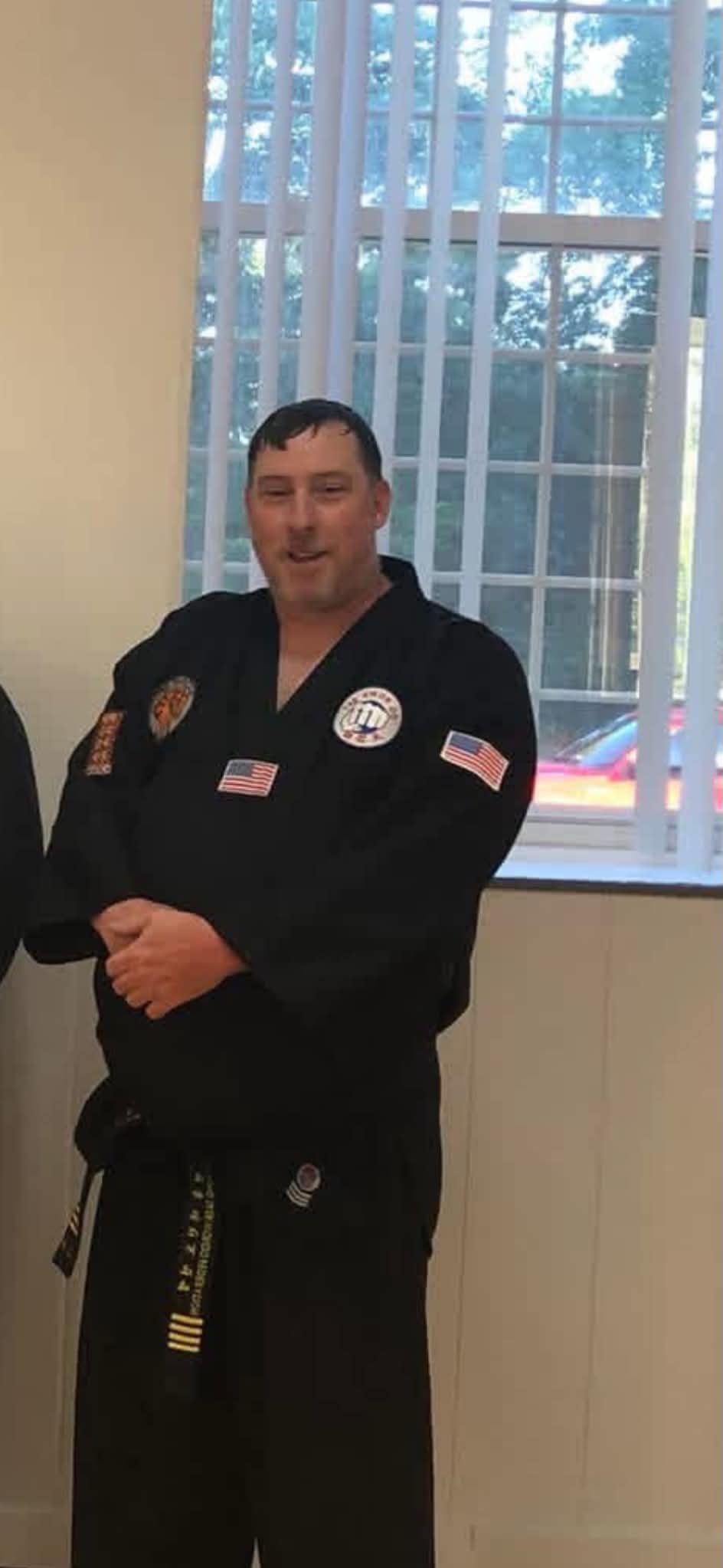
In this episode Andrew chats with Shane Sloan about his experiences in ITF Tae Kwon Do, his thoughts on teaching, rank, and participating in seminars.
Shane Sloan - Episode 1182
SUMMARY
In this episode of Whistlekick Martial Arts Radio, Shane Sloan shares his extensive journey in martial arts, starting from his early days in Taekwondo to his experiences as a black belt and instructor. He emphasizes the importance of enjoying each rank and the challenges of teaching martial arts without formal training in pedagogy. The conversation highlights the significance of positive vibes in martial arts and the dedication required to progress through the ranks. In this conversation, Shane shares his insights on the journey of teaching and learning in martial arts, particularly ITF Taekwondo. He emphasizes the importance of building confidence through teaching, the role of non-black belts in instruction, and the value of literature in martial arts. Shane discusses the significance of continuous learning, exploring other martial arts styles, and participating in seminars. He also reflects on his experiences in competition and the meaning of titles within the martial arts community, advocating for personal growth and the pursuit of knowledge.
TAKEAWAYS
Shane started martial arts at 16 in Lowell, Massachusetts.
Teaching martial arts presents unique challenges for black belts.
Positive vibes are essential in martial arts training.
Enjoying each rank is crucial for martial artists.
Different schools have varying teaching styles even within the same discipline.
Shane emphasizes the importance of community in martial arts.
Dedication and motivation are key to advancing in martial arts.
Teaching requires preparation and understanding of techniques.
Shane believes instructors should guide students in teaching rather than criticize.
The more you teach, the better and comfortable you'll be.
You can be an incredible doer and a horrible teacher if you're not given the skills to teach.
Your students are your foundation to keep your school going.
If you have the time to do another style out there that you enjoy, go and do it.
As long as you're going and trying at a tournament, you're a winner already.
Titles shouldn't mean everything, but they should mean something to you personally
Always try to better yourself every day.
CHAPTERS
00:00 Introduction
17:04 Teaching and Learning in Martial Arts
19:11 Building Confidence Through Teaching
20:53 The Role of Non-Black Belts in Teaching
24:40 The Importance of ITF Taekwondo Literature
28:33 Continuous Learning and Black Belt Development
30:05 Exploring Other Martial Arts Styles
33:47 The Value of Martial Arts Seminars
37:22 Weapons Training in Martial Arts
40:06 Experiences in Competition
42:30 The Significance of Titles in Martial Arts
To connect with Shane Slone:
Beckieandshane@yahoo.com
Join our EXCLUSIVE newsletter to get notified of each episode as it comes out!
Subscribe — whistlekick Martial Arts Radio
After listening to the episode, it would be exciting for us to know your thoughts about it.
✅Subscribe to whistlekick Martial Arts Radio on the following platforms:
🎧Apple Podcasts: https://apple.co/3mVnZmf
🎧Spotify: https://spoti.fi/3yHVdHQ
✅You can find whistlekick on all social media platforms using the handle @whistlekick or visit our website at https://www.whistlekick.com or https://www.whistlekickmartialartsradio.com
Show Transcript
Andrew Adams (08:18.036)
Welcome. You're listening to or perhaps watching on YouTube another episode of Whistlekick Martial Arts Radio. And today I'm joined by Shane Sloan. Shane, how are you today?
Shane (08:27.884)
I'm doing great. How about yourself?
Andrew Adams (08:29.574)
I'm doing excellent. I can't wait to chat. But before we get there, I just want to in case there's any new audience members today, I want to let you know about some of the stuff that we do. Whistlekickmartialarts radio.com is where you can go to find out all of the other episodes we've done. We have over eleven hundred and eighty episodes available for you to listen to and watch. And if you go to if you go to martial arts whistleclickmartial arts radio dot com
You can find transcripts, you can find show notes, you can find all the video links and and audio links for all of those other episodes. You can also join our exclusive newsletter so you will get notified when new episodes come out. You can also go to Whistlekick.com to find out about all of the other things that we do here at Whistlekick because we do more than just this podcast. Maybe you want to purchase some sparring gear, maybe you want to purchase a training program or some books or
Maybe you want to attend one of the many events that we host around the country. All of that stuff you can find at whistlekick.com. And we hope you go there and check out what we do. And we can share all of our stuff with you. So without further ado, Shane, you're has said you're having a great day. I'm excited to get into chatting today. and I think the best place for us to start, because our audience might know you, but they might not.
So let's start at the very beginning. How did you get involved in martial arts in the first place?
Shane (09:55.313)
Excuse me. So I started when I was 16 in Lowell Mass. I my mother's cousin actually, her, my mother's cousin's daughter and their son, they started doing taekwondo on Lowell. so what happened was my my cousin reached out to my mother and says, Hey, would Shane be interested in trying martial arts? And I said, Yeah, absolutely.
so I it was this basement downstairs in this school in nineteen ninety-two. That's when I started in the fall of nineteen ninety-two. And I started w going out there, you know, once or twice a week. Then it turned it to be two or three times a week, and then it turned four times a week, and it was two hours a night. It was from six to eight o'clock. my head instructor that time was Robert Matthews, Taekwondo and Lowell.
And I went through the ranking system with him. There was he had a bunch of black belts with him at the time. He had his wife, he had his son, a few other black belts with him. So back in those back in that times it was pretty it wasn't super strict, but it was strict enough where you you had to pay attention, really work hard, give your all every time. I mean there was no there was no messing around. but it was still fun in the same way.
So I got through the ranks in there, I had a great time. And then all of a sudden one day I get to Red Belt. So Red Belt is right before black. You had to go to Black Stripe and then and then Black Belt. So I got to red and I took a break for a while because of the fact that it was such a long period of time to get to your next rank from that point. So I think at that time I was like probably like 18, 19 at the time. And I said to myself, why is it taking so long?
Andrew Adams (11:42.437)
Mm-hmm.
Shane (11:51.464)
There was a reason behind it. I was like, God, I just want to get there. So I went back, I took a break for two years, came back, and then in 2021, excuse me, 2001, excuse me, I got my Black Stripe. And then it took a year and a half or so to get to my first degree. And that was around August of 2002. so at that point, then I took a real-long break for a while.
Andrew Adams (12:14.741)
Mm-hmm.
Shane (12:20.813)
And some one day I went back, I started doing Taekwondo again. And I got up to I went to a place in Hudson, New Hampshire. the instructors up there were with their their names were Master Sandy Bucknum and Heather Bucknam. They were they were in charge of school, and then there was two other people, Master McFadgent and Master Lemoyne. So I went up there for a while.
I worked out up there. I got to my second and to my third. Their school closed in 2017 just because of the lack of students and they wanted to eventually retire. Really, just really good people. And then from there, Matthews or excuse me, Matthews retired in 2009. So I left this school for a while. I was going with the school, went to college for a little take some classes and stuff. So that's why I continued at another place. So
I went to a school in Manchester, worked out there for six months. and instructor up there. I didn't give his permission yet to get to say his name, so I'll leave it out out of permission for him. respect. And he it's funny, I got up to that school and I'm working out, and a friend of mine, Josh Dore, he was living in Manchester at the time with his wife. So he was like the first black belt.
in the class. He was the first one in the line. at the head instructor of the school. So we're working out one day. And my first time I ever had somebody kick over my head before in a smart match. And I knew and I'm about six feet tall. So for we don't know each other. I think I was like in my 30s, late 30s, he's in his 30s. And all of a sudden I felt this wind pass my hair. And I'm like, God, what was that? So I looked at him, I go,
Andrew Adams (14:02.997)
Okay.
Shane (14:18.808)
Hey, what what type of move did you do? He says, I threw a kick. I Where? He says, Over your head. I go, I didn't see it. And we became such great friends. And I really enjoyed that school because it was a place I can go to, have a great time. You meet new people. I knew the instructor, head instructor for a while. And I'm working out and I'm saying to myself, I should be able to get, you know, pretty much everything here. He's didn't seem too bad. Boy, was I wrong. He worked I walked out of my first class of that school.
And I am drinks, sir, from head to toe. I come home, my wife's like, what is wrong with you? I go, Why are you all like it's not even raining out? I'm like, no, that's sweat. Like, it's like, wow. And so he closed in August of 2018. And that was kind of a bummer, you know. So my friend, my friend, my instructor, Josh Doer, he moved further up in New Hampshire and I worked out with him for a while.
Andrew Adams (14:50.664)
Yeah.
Shane (15:18.901)
And I tested under him for my fourth. And then a few years after I I my old instructor from Hudson tested me for my fifth. had it's been such an incredible career. And the one thing I certainly learned going for my last rank for the four years I was working out, so my instructor, Josh Dore, he moved to Maine for a while. He still lives in Maine, so he
I couldn't really reach him or work out with him for a while because it was such a difference. my other instructor that test that had the school in Hudson, they moved down down south towards eastern mass down that way. So I was working out of my own for four, four years in a hall all by myself. So I my my thing was I learned I learned a good amount just being who you who you are and how much you really know and trying to better yourself.
Andrew Adams (16:06.526)
Mm.
Shane (16:17.345)
But at the same time, it was kind of boring too, because you wish you had people around you. So the thing the thing with Taekwond, I reached out to one or two s one or two schools to come down and work out, but they wouldn't because unfortunately Taekwondo is kind of they everybody has their own way of doing things and it's just their choice or whatever. But there was it was all it was all good. It was still fun to work out. So I I the the one thing that I learned about Taekwondo would
Andrew Adams (16:33.407)
Yeah.
Shane (16:47.594)
Well, just not even just going through the ranks. That was always a great thing. But the teaching part of it was a huge challenge. And I actually had to teach my first class as a black stripe before I even got to my black belt test. which I was so nervous about because this my instructor one day said, you're gonna teach class next week. I said, in the back room, one on one. He No, no, you're teaching the full class. I'm like,
Andrew Adams (17:13.152)
Ha ha.
Shane (17:14.692)
my God, how like here I am. I'm like twenty five years old. Like how how how am I gonna do this? I was a wreck. And but they gave me they they it was a very good experience. I kind of break them all a little bit, I guess I should say. and then for as I got up to my third, I had to teach a few classes before I tested for my third. So that really changed my outlook on this challenge of of learning. Because now you have to demonstrate
your stuff that you that you've been tied. So my instructor says to me one day, he says, Well, he says, you can either read from the book that we have or you can make up your own workouts for the hour and a half class. So I did. I actually wrote up a a whole list of things that I wanted to do. And I was digging into the book more of different blocks and different kicks that nobody did. I'm like, you know what? Maybe we should try this.
So I did that and he he gave me great feedback. He says, How do you feel after my first full class going, you know? I said, I feel really good. I was, he said, Yeah, you're a little shaky on a couple of things, but we'll work on that. So the more I taught, the more I got confident. And I was like, wow, I can't believe this is this is so much fun. Because you you have the opportunity to dig into General Choi's book and to dig into different exercises in there.
Andrew Adams (18:24.885)
Sure.
Shane (18:38.185)
that nobody's done before. So that to me, that was so much fun to learn.
Andrew Adams (18:43.197)
Yeah, that's cool. And and I I just wanna be clear because the audience might be wondering the same question. So when you went to these different schools, they were were they all the same style? Was it all ITF Taekwondo?
Shane (18:58.036)
It was all the same style, but they all had a similar of doing s forms in a certain way of speed. So they you know, every my the one thing I I it's funny because all three four schools I've been to, I learned a different way of how they're doing things. And it's really just how to move, how to block, how to punch. there was a punch I was doing for twenty years and my instructor that moved to main
Andrew Adams (19:05.407)
Okay, sure.
Andrew Adams (19:17.021)
Hmm.
Shane (19:26.607)
One day it's like a it's like a greenball form. It's called yo guck. So I step out and I'm punching with my right fist and he looks at me and goes, You go you're going out why you going over your right fist for? I go, Well, I've been doing this for 20 years. And he smiles at me. He's like, Well, you supposed to go over your left left fist. I go, really? He goes, Yeah. So we started laughing and he shows me in the book. He says, There, there's your first movement. I was like, my God. So he just laughed.
Andrew Adams (19:52.255)
Ha ha ha.
Shane (19:54.205)
But he he all my instructors I had were just so some were a little more demanding than others to be the best you can be. But they all cared about your your workout and your your learning. So that was really, really important to me. So the the the when the last school I was with in Manchester, they did their forms really, really fast, but they were so, so good at what they did. So the head instructor goes, I he noticed I was rushing to him.
And he says to me one day, he's like, Why why are you rushing your forms? You don't have to. Just go with your own paste. And when you're done, you're done. So one day I'm up there, and here's a funny story. Those swooshy pads that you step on for balance that I'd never been on one before in my whole career. So he has everybody getting on these just a balance. My foot kept falling off the thing. So you and I'm the head.
Andrew Adams (20:40.417)
yeah. Yep.
Shane (20:51.285)
d black belt the school at that time in line. He looks at he says, Mr. Sloane he put his fo foot down again. Everybody start all I'm like, don't do this to me. He I did it twice and I finally bended my knees just enough. And he walks over to me, looks at me, he goes, All right, I want that slide.
Andrew Adams (21:12.061)
So and I I think it's it's a in it's a interesting distinction, not interesting distinction. It's interesting that you when you all of these schools were that were the same system, they're all ITF taekwondo. I think that's something because the reason I asked is for a lot of martial artists, when they leave one school and go to another one, it sometimes, even if it is the same style, the there's always the question of rank.
And you know, I earned my rank from this school, but now I'm going to a new school. And, you know, not that every single ITF school is this way, but as I understand it, most of them, your rank is going to carry over regardless of what school you had achieved your rank at. And that's why I that's why I asked that question. I was curious how how these schools handled you coming in as a ranked black belt. But if you were if they were all ITF schools, that's not a concern.
Shane (21:41.817)
Yeah.
Shane (22:01.082)
Yeah.
Shane (22:11.065)
Yeah, they were all ITF and two of know each other from pre from previously. So they excuse me, my first instructor didn't know them at all. but those d Master Sandy Bucknum and Heather Bucknam and Master McFadge and Keith McFadge and they knew the instructor up at Manchester. So they I I said to my head instructors there at at Tiger Clark.
In Hudson, I said, could I go to Manchester? Since you guys are retired. Says, absolutely. And I asked the head instructor up there, could I go? So sure. so it it's been it's been a journey. It's certainly been a journey. I could have kept going further. And at some point I still want to go, I still want to learn more. I still want so I go to a school once in a grade while in Dover, New Hampshire. and they're the guy
Andrew Adams (22:49.002)
Yeah. Yeah.
Andrew Adams (23:06.294)
Mm-hmm.
Shane (23:09.41)
That's in charge up there, the master instructor up there is a super, super good person, very, very welcoming. You know, obviously I've been going there for a few years now, just working out. but you know, you get to a p certain point at the ranking system where it's like, what can you afford now? Like so me and my wife sat down one day and she's like, we can't go any further. We just can't afford the prices anymore, the testing prices.
Andrew Adams (23:38.784)
Yep, yep.
Shane (23:39.615)
So I said, well, I says I still want to go through the rest of the forms in the system to learn. but it it's very but it's it's very difficult to keep other people going that you know. And but you can't force them to keep going with you. So I think that happens to every school too, sir, is because of the fact that you get up to a certain rank, you start to look around and it's like, where where is everybody? And I think there's always a there's always a
Andrew Adams (23:44.459)
Mm-hmm.
Andrew Adams (24:05.546)
Yeah, sure.
Shane (24:09.717)
A journey where sometimes that could be just you standing there, learning on your own. And as they say, getting up past second and third, it's very few that keep going because I think it just takes so much more dedication and motivation to keep going. But I apply of any anybody that gets up to first degree or any rank actually any ranking system anybody gets to.
Andrew Adams (24:26.696)
Mm. Yeah. Well,
Shane (24:36.608)
That's that's an honor in itself. It doesn't matter if you're going through the student ranks, going up to orange or green, or purple, or brown, red, black. You enjoy the one thing I The message I could send out there to martial artists is if you're just starting out, enjoy every rank you go through. Don't focus on black belt. If you keep continuing learning, you'll get there someday. But what I didn't do in the beginning of my journey was
Andrew Adams (25:00.288)
Yeah.
Shane (25:04.051)
I never enjoyed the ranks. right? I wanted to rush through em to try to get the black and I just focused on that. Enjoy every rank you go to 'cause it it really means something.
Andrew Adams (25:14.054)
Mm. Yeah. Now I think another reason that that some people get burnt out, and we this would be a great thing to talk about, is and you mentioned it already that you were as a black belt told, Okay, here you go, have class, you're in charge, take run this class, right? And there there we've talked about this on the show numerous times. There are not many disciplines and hobbies that you have in the world where you get to a certain ability.
Shane (25:29.899)
Yeah, yeah.
Andrew Adams (25:42.111)
And are just automatically expected to be able to teach it. You know, we everything else in the world, you go to school to learn how to be a teacher. And there are lots of martial arts organizations out there where you aren't necessarily given the tools to learn how to teach. You're just given a black belt and then said, Go teach. So let why don't we chat about that a little bit? Because I know that you I know that's something that that you wanted to get into a little bit.
Shane (26:12.36)
Yeah, I think well the thing I if I was an instructor of a school and I had you know, I think when somebody gets up to right before black, I would go up to that person and ask them, like, hey, how do would you feel about teaching teaching next class? Like how do you but what I would explain to anybody that would teach is say, listen, I'm not gonna come up and bug you. Even if you're doing the technique wrong, as a as an instructor
I would have a piece of paper and a pen and I would sit off to the side and I would watch either my advanced student or my black belt teach class. And even if they weren't instructed things the right way or demonstrating things the right way, I would just make notes off to the side of everything that I find they need to work on and then talk to them after class. I I think that's the most proper way.
Andrew Adams (27:07.637)
Yeah, yeah, yeah.
Shane (27:11.069)
To build their confidence, his or her confidence. I think every person that gets up there their first time teaching is a total train wreck because they're and I was too, and I'm I'm not perfect. I think I think as long as they have the material though to study, like General Choi, he's got books out there that the but the the books are pretty expensive actually. But
If you can get them and go through the books and learn them. in any art, doesn't matter what style you do, read through the books that that you can and educate yourself. But that's how I would watch those people grow, is because that gives them a chance to talk, gives them a chance to demonstrate what they know and builds that confidence to level to the where they're gonna say, Hey, I wanna teach again. And that's what did that for me because I
Andrew Adams (28:03.072)
Yeah.
Shane (28:06.329)
I was I wasn't sure if I could teach really good. And you know, there were moments, trust me, I was still struggling. But they they my instructor let me the one taekwondo ta they let me go and keep teaching. Even if I wasn't doing something perfect, they still would watch me and see how I demonstrate. And I I guarantee the more you teach, the better and comfortable you'll be as you the more you do it. So I highly recommend that.
If you want to teach, if you want to teach. That's a big thing. Yeah.
Andrew Adams (28:37.162)
Sure. now, what are your thoughts on non-black belt? Like obviously you said when you get to red belt, but what about green belts teaching, yellow belts teaching? How do you feel about that?
Shane (28:53.904)
So what my instructor would do, back when I my first instructor, Bob Matthews Taekwondo, what he would do, and I believe Tiger Claw did this as well. they would have yellow belt take a white belt in the back of the class. And they would say, All right, go work on this, this, and this with them or her. See how they're doing. So that way, I think that way when you're doing it one on one.
Andrew Adams (29:10.582)
Mm-hmm.
Shane (29:22.82)
That builds your confidence there. So I think the more you do that, going even, you know, even a yellow belt teaching a white belt or a green belt teaching a yellow belt, that builds their confidence level extremely. And it make them do that more and more if they if they want to. I mean, that's another choice that they have. I mean, you're paying a martial arts school where you want to learn. At some point, you do want to key, you want to have that in your system to to
To teach because it that's gonna build that builds your confidence right there, one on one. I would recommend that highly for a beginner student and somewhat advanced. Once you get an advanced, give that person the opportunity, hey, do you want to teach a full class today? How do you feel about that? And would you and like I said, I would recommend an instructor just sit back and just watch. Let them let them grow. Because that's what's gonna really make them better down the road. So
To me as an instructor. That's how I would work that.
Andrew Adams (30:22.346)
Yeah. Yeah. Yeah. I and I think that that prep prepping them ahead of time and and giving them the opportunity and the skills that they need to to do it. You know, n I have said this and will say this till I'm blue in the face. You can be an incredible doer at whatever the thing is, whether martial arts or anything. You can be an incredible doer and a horrible teacher. If you're not given the skills to teach
then you're not gonna be a good teacher and vice versa. You can be an incredible teacher and not be able to do as well as others.
Shane (31:02.603)
It's it's funny you say that because a guy in Dover I I go up to see once in a while. There's jumping kicks in a higher forms if for General Choi. And there was a day where I'm trying to go up in the air and I'm trying to jump, and the head instructor comes out to me and goes, Whoa, whoa, don't jump anymore. I go, What do you mean? He says, Y you're at an age where you could hurt your back. We're we're done jumping. Cause he's like two years older than me. And I'm like, I I said to him, my sister,
Okay, this guy already went through some you know some you know back issues or whatever. He's probably he's trying to look out for me. I says, even to the book, he said just stay on the ground. He says, You don't need to jump anymore. He says, I we're getting unfortunately we're not 25 anymore. You know what I mean? He walked on the week. I was like, okay. Yeah, I mean, I I think what General Choi.
Andrew Adams (31:50.58)
What?
Andrew Adams (31:54.388)
Yeah. Sad but true. Sad but true.
Shane (32:02.561)
is there's so much in his book. there's he's there's so much information and different workouts in there. Anybody that does some ITF is get get into the book and and grab as much different stuff in there you never did before. Different exercise, different kicks, different blocks, different punches. You know, d I recoura I encourage that for anybody that's that does ITF taekwondo and I still love it. I mean
I still enjoy doing it not as much as I used to anymore, but it's been it's been a an incredible journey. It really has.
Andrew Adams (32:40.181)
Now, in case we have listeners or watchers, if you're watching on YouTube or Spotify, you can watch us on Spotify too. but in case we have people listening or watching that are not familiar with ITF Taekwondo, talk a little bit about what this quote book is. I I know what it is, but I I know that we've got guest audience members that will not exactly really know how big of a deal this book is.
Shane (33:06.58)
Yeah, so i i the there's two sets of d there's two sets of different books. There's the encyclopedia, they call it, which is fifteen volumes. Actually it's sixteen volumes now. There's a separate book out there that they just made volume sixteen. that's out there. But there's those books for the set are really, really expensive. then you have a thing called the Bible. There's five con
Five separate books that are just single books. They're like, I think they're like maybe 500 pages in it, maybe. those are all online. if you can get them on Amazon or a bookstore, I I highly recommend just having one book. I mean, they're there, I think they're around some of them are two or three hundred bucks a piece. They're pretty expensive. But if you're definitely a full ITF goer, Taekwondo.
You really want to learn. I highly recommend those books because you can always go in there and dig out anything you want to look for. The only difference between the books is the encyclopedia, the 15 volumes, has more pictures in it and more showing what you need to do for every move, every block, every stance, and the forms wise. The single book doesn't have that. It's more of just step by step.
Andrew Adams (34:24.564)
Hmm. Yep.
Shane (34:32.264)
So they don't actually have full pictures in the single books. I think there's five different single books out there, condensed books. But if you can get them, I highly recommend it. Volume 16, that's that's I have this one actually right here. Encyclopedia Taekwondo, volume 16. That's that on that's on Amazon for $35. And that's got that's got the forms in it as well.
Andrew Adams (34:52.096)
Mm-hmm. Nice.
Shane (35:00.488)
So I fear if you can afford, you know, yeah, I highly recommend it. There's one book out there that I'm also all so curious about, but it's written in Korean. It's the first book that General Choi ever wrote. It's 1959. And it's got a wash form in there called U Nam. And it's a bunch of information there, but obviously I don't know Korean. So I can't I can't I don't know what's entailed in there, but yeah.
Andrew Adams (35:25.088)
Yeah.
Andrew Adams (35:28.907)
Yeah. Do you have a copy of the book? Okay. So that's the first step. You gotta get a copy and then you can figure out how to get it translated.
Shane (35:31.569)
I don't. I don't.
Yeah. Yeah. Yeah. But I I recommend, you know, I recommend keep going. Any any martial art you do, try to be better than the day you were before. I just think it's so important to you know, the other the other thing is with schools is which I don't it's so hard when you're an owner of a school. Your black belts are somewhat on your own sometimes learning.
But your students are your foundation to keep your school going. But I we used to do Saturday workouts as black belts classes. That was really fun because that way the black belts would have a chance to work on their techniques and learn something new. And I think a lot of schools sometimes they just don't have the time to just focus on their black belts because it's their their students, unfortunately, still need full guidance.
Andrew Adams (36:25.601)
Yeah.
Shane (36:33.359)
But I think even black belts as you're going through the higher ranks, you still need some guidance and some confidence from a higher instructor to say, Hey, keep keep doing this or do this or do this better. Try try this move. So that would that's I think that's a that's a thing that maybe down the road, you know, we schools can get hopefully more equipped and better at to help the black belts in the future.
Andrew Adams (36:57.493)
Yeah, and just have it be a completely separate class just for black belts.
Shane (37:01.678)
Yeah, so we had cla Taekwondo Tiger Claw had black belt classes on Saturdays. So that was really fun. Everybody worked on their forms, everybody worked on materials. the only difference is when have some people have injuries, so there's only some so much you can do sometimes. Some people can't be thrown around where the you know, takedowns or you know, stuff like that. So it's it depends on the school and who's available who's injured free, you know. I mean
Andrew Adams (37:19.692)
Mm-hmm.
Shane (37:31.554)
that's that's always you know, it's sometimes it just happens. It's in the arts, you know, you always get some injuries at some point in your career.
Andrew Adams (37:39.551)
Yep, yep. Especially when you get to our age and up.
Shane (37:41.99)
yeah. yeah. But I I find I had I've I still I still love Taekwondo. I still I still love the movements, the kicks, the punches, the friendships I've made over the years. I can't say enough about the sport. I mean it's it's been it's been a very interesting journey and I've al I always would treasure it forever. So yeah.
Andrew Adams (38:05.707)
Mm-hmm. Now, all of your training that you've talked about has been in ITF Taekwondo. Have you gone outside and and dabbled or worked out in anything other than ITF?
Shane (38:12.27)
Yes.
Shane (38:18.947)
I have. I actually I started working out in September at a school in Nashua. they do Chinese Kempo. And I went there for about a month. I went there twelve twelve times in a month. There I went Tuesdays, Thursdays, and Saturdays, and I had a blast. I walk in there and I'm wearing a white belt again.
So one of the black belts, they already kind of knew where I was from. He goes, he looks at me and goes, Well, when's the last time you were standing here in this line? I'm like, since 1992. He's like, How do you feel? I'm like, I feel great, actually. I have no responsibility. I can just have fun and learn something new. And I think that's so important too. If you're if you have the time to do another style out there that you enjoy, go and do it. Go and do it.
Nothing wrong with starting out as a wipe out again. I think it's it's a new journey. It's something fun. You can learn different blocks and different kicks in different ways, different movements. I mean, I really high highly recommend that for anybody that wants to try something new. Go go out go out do your research. Go to different schools. So I would go, I would I go to different schools and I would call them and say, Hey, can I come in and watch a class? And
Most of the time they do, some don't recommend it, which is that's their choice. I usually don't you know, I just don't water, which is fine. That's their rules. but the ones I do go, I'll watch and I'll be totally honest with them. I I'll say, you know, if if I really like the class or what I would I want to do, I'll let you know. If there's something I thought I I don't want to do, it doesn't interest me, I'm gonna be honest with you. I think that's important to the instructor. I think you're being honest with yourself too. So
Andrew Adams (40:04.172)
Mm-hmm, mm-hmm.
Shane (40:11.742)
Yeah, so Chinese Temple, I I took a break for a while because I got plant of fasciitis in my right foot. man, I did that for the end of September, my foot was killing me. And they you can't be on your bare feet anymore for a while until that gets better. So I told the instructor, they're like, Yeah, whenever you feel better, come back. And there my friend years ago that I grew up with, he
Andrew Adams (40:18.338)
I can relate.
Shane (40:38.72)
Him and his father and his brother went there back in the late and like eighties. And they were brutal back then, I guess. He said, Shane, my brother would come home and he would be all like stuff on his gi, you know, from you know, a bloody nose or something or whatever. Like, geez. So back then it was different back then. You know, they were a lot more stricter and more military wise, but the the g all the sports now, it just it's good to be in a a new environment.
Andrew Adams (40:51.956)
Wow.
Mm-hmm.
Shane (41:07.135)
As a new wipeout. Even it's sparring. I sparred a brown belt in September and I was, you know, I'm using my speed and the kid just kinda looks at and goes, You're not a wipe out. This is no way you're a wipeout. But obviously in control, just having fun. just a great, great way to start a new art. So but I'm still I'm still want train in Taekwondo. I still want to finish those forms up. I think that's still important to to treasure.
'Cause I've been doing it since I was sixteen. So yeah.
Andrew Adams (41:38.134)
Yeah. Now what about large training events? Like set like big seminars where lots of schools come together. Have you done much of that?
Shane (41:47.354)
It's funny, I'm actually going to the first martial arts summit that you guys are hosting in November. This will be my first time. Yeah, this will be my first time. I I can't wait. I I I I read the the the whole list of activities that's going on on that Saturday, and I can't wait to go just to I mean, unfortunately I won't be able to work out because my foot, but I want to go just to watch, meet new people.
Andrew Adams (41:53.593)
your your first one. It it's not our first one. Yeah, yeah. okay, great. excellent.
Andrew Adams (42:15.159)
Yeah, yeah.
Shane (42:16.764)
See what they just the different stuff they do. I mean, every every martial artist out there has something for you to offer to learn. That's how I look at things. And I'm super excited for this for this event coming up in November. Yeah.
Andrew Adams (42:24.012)
Yeah. Yep. Yep.
Andrew Adams (42:29.044)
that's great. I I want to be I want to be clear to the audience. I did not know that ahead of time. That was not a prepped question. but I I the reason I ask is as you mentioned a little earlier, that there are a lot of ITF schools that they do things their own way and they're happy to do it. And a lot of them seem to be a little insular and don't go out and do things with other groups. And so that I was curious how much of that
got got into you. I mean, obviously you go out and you go to other places, but I didn't know if you worked with other like big s seminars like obviously like Marshall Summit, but other things too.
Shane (43:02.545)
Yeah.
Shane (43:08.902)
Yeah, I I went to an ITF school in Hudson, New Hampshire as well. a woman that runs it up there and a another gentleman. they're very traditional, really good school. their their their space is a little small, but they give you they give you they give you one heck of a workout. They do the sine wave, which I don't do. but they they
Andrew Adams (43:31.223)
Mm.
Shane (43:38.236)
They they're very welcoming. I can still go up there for a single class and work out. So they're just I don't the so sine wave and non-sign wave. I learned non-sine wave my whole career. They say sine wave is definitely a law, they you it's a little bit more you get more power out of it. Everybody's got their own opinion. I I prefer non-sine wave, just how I learned, but it doesn't mean it's right or wrong.
Andrew Adams (44:05.718)
Yep. Sure. Now for our for our non taekwondo audience, talk about Sinewave, what it is, and what makes it different.
Shane (44:07.858)
But they're very welcoming there, so
Shane (44:17.52)
So a sinewave is a more up and body down motion. So you're every block or every punch or every kick you're doing, you're kind of going up and down with the movement. It's like a wave. A non-signwave is going straight forward with your own power using your body with your weight, with your fist, with your arm. That's the two differences. I think either way, you're going to learn something out of it.
I I don't think both are not right or wrong. I think it depends on the individual. I mean if I I think if I learned sine wave when I was younger, I probably would have obviously stuck with it. I did non sine wave my whole career. but that's the two most of the difference of non sine wave and sine wave. More of it's like it's up and down motion with the sine wave, come lifting your foot, your heel up and then coming down with the punch.
non sign wave, you're sliding into your stance, going straight forward. Yeah.
Andrew Adams (45:22.654)
now let's talk about something that I've I've enjoyed having this discussion with guests on. and and it's it's interesting 'cause it usually goes well well, obviously it's gonna go one of two ways, but it's never usually like, whatever. It's usually like yes, I'm I love it and I'm into it, or no, I'm not into it at all. And it's weapons.
Shane (45:42.447)
Okay.
Andrew Adams (45:43.618)
How are do you have you trained in weapons? Is it something you really love to do or is it like a
Shane (45:48.855)
It's funny because when I was in back in ninety three or ninety-four, I think I get up to my blue belt. I started learning nunchucks, nunchuck how to one. And I had a blast. So we weren't allowed to have full nunchucks until we get up to red. he gave us some like foam nunchucks, because he obviously he doesn't want anybody s you know whacking themselves in the head with a huge bruise on the head.
Andrew Adams (46:01.751)
Mm-hmm.
Andrew Adams (46:18.102)
Or their brothers.
Shane (46:18.286)
Yeah, yeah. so we learned nunchucks for a a period of time. And then when I was up in Manchester, I learned the bow staff. So I learned that as well. And also when I was with Tiger Clar, Master McFadgeon brought in Boken Sword. So Boken Boken Kata One. We learned that. So yeah, I learned definitely a couple of
Couple of weapons. Which will have fun. So Taekwondo originally they say General Troy would say your hands are your weapons. So in his book in his book he he's got weapons in there, but it's more about dodging them. If that makes sense. But I think every if you can incorporate weapons to have your students learn too, I think that's a great thing as well. I think it gives them something else to focus on. That way they don't get bored.
you know, I commend any school that wants to try to do something different to motivate their students to give be better every day. So yeah. But I learned nunsh, and I learned boken sort and also I learned BoSaf. Yeah, so I enjoyed it. I really did.
Andrew Adams (47:32.406)
Nice, nice. Yeah, and how about competition?
Shane (47:37.567)
Competition I never did weapons and competitions because I didn't work enough on the weapons part of it to comp to do competitions. I did form I did, I did sparring. I so my first tournament was in nineteen ninety five in NASHA. And boy, let me tell ya, my first spiring match my god, I boy, I had a wake up call. 'Cause that back then they were really brutal. You know, they were you know Yeah.
Andrew Adams (47:46.774)
Yeah. But you did but you did competition.
Andrew Adams (47:54.584)
Okay.
Andrew Adams (48:03.576)
Right. So there there's a story we can talk about.
Shane (48:06.804)
So I'm up as a greenbelt sparring in my first like match. I think it was my first tournament. And I remember this kid, he was he was a big kid. And I went to go throw a kick and the kid kicks me right in the chest and I fell down and landed in a bunch of chairs. I'll never forget it. I'm like, my God, that was a that was a kick. my god. I didn't know what to expect. So the more tournaments I went to, the more I I got used to turning it up and sparring more aggressively if I had to.
But I've been to I've been to probably about six, seven tournaments in my lifetime. Yeah. My best, one of my best tournaments, I sparred a friend of mine up. He lives in Conway, New Hampshire. He has a school in Conway. And me and him had a great, great match. We were we became f really good friends after. So every time I go up to North Conway, I visit his school and I work out. Me and him had a sparring match. I think it was like four four.
Andrew Adams (48:41.816)
Mm-hmm.
Shane (49:04.786)
I mean we were going back and forth one day and he was a lot you know smaller than me he was probably like five six five seven but he was fast as a cat so I we we were it's tied four four and he got me right at the end but remember you tell me let me tell ya I we became such good friends after that so but the tournaments I love and they the one thing I wanna say anybody that goes to a tournament everybody wants to get a trophy everybody wants to get a medal
Well, you're a champion already going and competing. So you don't have to walk out with a trophy or or a medal. It's always nice to have that, of course. But just remember, as long as you're going and trying at a tournament, you're a winner already. Compete.
Andrew Adams (49:43.661)
Mm-hmm.
Andrew Adams (49:50.176)
Yeah. I mean you you made it to the competition and so many people don't.
Shane (49:53.338)
Yeah. That's right. That's right. And I think and just have fun with the tournaments. Go and go and have a lot of fun. Meet new people and meet new friends and enjoy the atmosphere. That's what it's about.
Andrew Adams (50:06.978)
Mm. Yeah. Now before we started recording, you and I have we had a little you know, our our pre show chat and the subject of titles came up. and that, you know throughout the the decades things change and some some people are really into titles and some are not. Let's let's chat a little bit about that because I I think you might have some opinions there we can we can delve into.
Shane (50:16.496)
Yes, yes.
Shane (50:21.466)
Shit.
Shane (50:30.62)
Yeah. So it's funny, General Choi back in the days from what I heard, he had people that's a fourth degree and he was a sixth degree. So he said they said back in the days, I don't know how true this is, don't don't quote me on this. He said fourth degree is master, sixth degree at that time was grandmaster. Don't know how true that is. You know, obviously we'll never really know. It mentions something in the volume sixteen book.
But when you got into the ITF, seventh degree is mastering the ITF because I think of the fact that your last form, you're already at sixth degree, you're doing that for your seventh. So you completed all the forms in Taekwondo. But it doesn't make a master doesn't mean you know everything in the book. I think master for me is like
Andrew Adams (51:12.856)
Mm.
Shane (51:27.128)
you accomplished so much in that time frame and that that certain level you have knowledge to contribute back to your students. I think they so I got my master's rank at fourth. You know when I go to an ITF school, I don't they don't call me that, which is fine. I I I don't it doesn't matter to me. I I put on a belt, I go in there, I I just want to have fun and work out. The title
Really, the title, it still means something f is for you because you worked hard to get there, but it doesn't mean you know everything. And as long as you keep yourself in check, that goes a long way. So I there's so much of you know, always try keep your ego in check. And like the end of the day, when I used to teach classes by myself by myself at a hall for I had a few people for a while.
Andrew Adams (52:04.249)
Sure.
Shane (52:24.324)
I would take my belt off and I walk out and I all that mattered to me was I hope they learned something. That's what really that's what matters. So titles, some people it means to people. I mean, you would to get to that level. So an example, when I got to my black, my first instructor, he had a belt with a black belt with a red stripe around it. And I said to myself one day, God, how how does it take to get there? So I thought I learned everything as first degree.
Andrew Adams (52:29.944)
Yeah.
Shane (52:54.136)
And I'm like, I'm a black belt. I know everything. And I one day I'm standing with a bunch of black belts in Hudson. I'm looking around. I'm like, wait a minute, I don't know everything. And I I have so much more to learn. Like, there's there's a whole different journey here. so yeah, I think it it it as long as you enjoy yourself, titles should at the end of the day, titles shouldn't it it maybe mean something you personally off to the side, but a title is just
Andrew Adams (53:05.475)
Sure.
Shane (53:22.743)
something you can cherish, but always keep it keep it in check. Keep learning and try and always try to even your younger your younger students that are below you, always try to listen to them because you never know. They might have more different opinions of great advice than you've never heard before. So I think it we'll all students at the end of the day, we'll all all martial artists at the end of the day, enjoy enjoy every bit of time you have with each other because that's what matters.
Andrew Adams (53:26.616)
Hmm.
Andrew Adams (53:41.273)
Sure.
Andrew Adams (53:51.149)
Yeah.
Shane (53:51.393)
And having fun. That's that's the key.
Andrew Adams (53:53.834)
Having fun is important and I've definitely had a lot of fun with you today. let's let's in case there's someone in the audience that is it wants to hear more from you or hear from you or has thoughts on things, how can how can they reach out to you? How can how can people listening get in touch with you?
Shane (53:57.773)
P two.
Shane (54:12.711)
if they wanna reach out me on email, I email is B E C K I E A N D S H A N E at Yahoo dot com. I'm also on Facebook as well, Shane Sloan. if they wanna reach out to me, they can reach out to me that way. And once I get to know them more, you know, who knows? I'll I'll pass out my information more to them as I get to another person.
Andrew Adams (54:39.255)
Yeah. Well, and they know already that you're gonna be at Marshall Summit, so depending on actually I think this will come out after summit, I think. So they will have they will have met you last weekend.
Shane (54:48.042)
Okay.
Shane (54:53.985)
That's awesome.
Andrew Adams (54:54.871)
Yeah. So people listening or watching, thank you for being here. I appreciate you taking the time out of your day to hear this this chat with Shane. if you go to whistlekickmartialarts radio dot com, that's again where you can find transcripts, links to all of the episodes that we have. You can join our exclusive newsletter. And I wanna say that newsletter, we're not gonna send you forty-five emails a day. We're gonna send you one email every time an episode comes out.
That's it. We're just gonna let you know when it comes out. We do want to make sure you don't miss it. And in that email, you're gonna have a direct link to the audio, a direct link to the video, and a little short teaser clip to give you a heads up on what the guest is like. So just keep that in mind. And then if you go to whistlekick.com, you can find out about all of the events that we're doing. We can find out about Marshall Summit that happened last weekend. depending on when you listen to this. but all of that stuff you can find at whistlekick.com. Shane, I wanna thank you for being here.
This has been a g lot of fun.
Shane (55:53.739)
Thank you so much. This is seriously an honor to be on the show and I hope everybody gets a lot of good feedback from this and and enjoy enjoy the enjoy the podcast. I really I really do. So thank you.
Andrew Adams (56:04.459)
Yeah. Yeah. So so to close out, what what do you want to leave the audience with today? What what final words do you do you wanna give to them? Do you want them to take away from our chat today?
Shane (56:14.61)
I think is always when you're starting out in any art and you wanted can you want to learn something new as well, even if you wanted to start a new art as well, take your time and go out there and learn different things. I even if you want to stay into your own school, try to grab as much information as you can of learning. and you know, make sure you you always try to better yourself every day.
It doesn't matter if you're trying to be competition with somebody else. What matters you you. Trying to be you, the best version you can be. I think that's such important. But also go out of the arts as well. If you can learn something new in another style, always try to learn something different because, like I said, every instructor out there will teach you something different. So don't always as you know, always try to learn something new every day. I would think I would leave it at that and try to.
Be the best version of yourself.