Episode 1046 - Master Simon Rhee
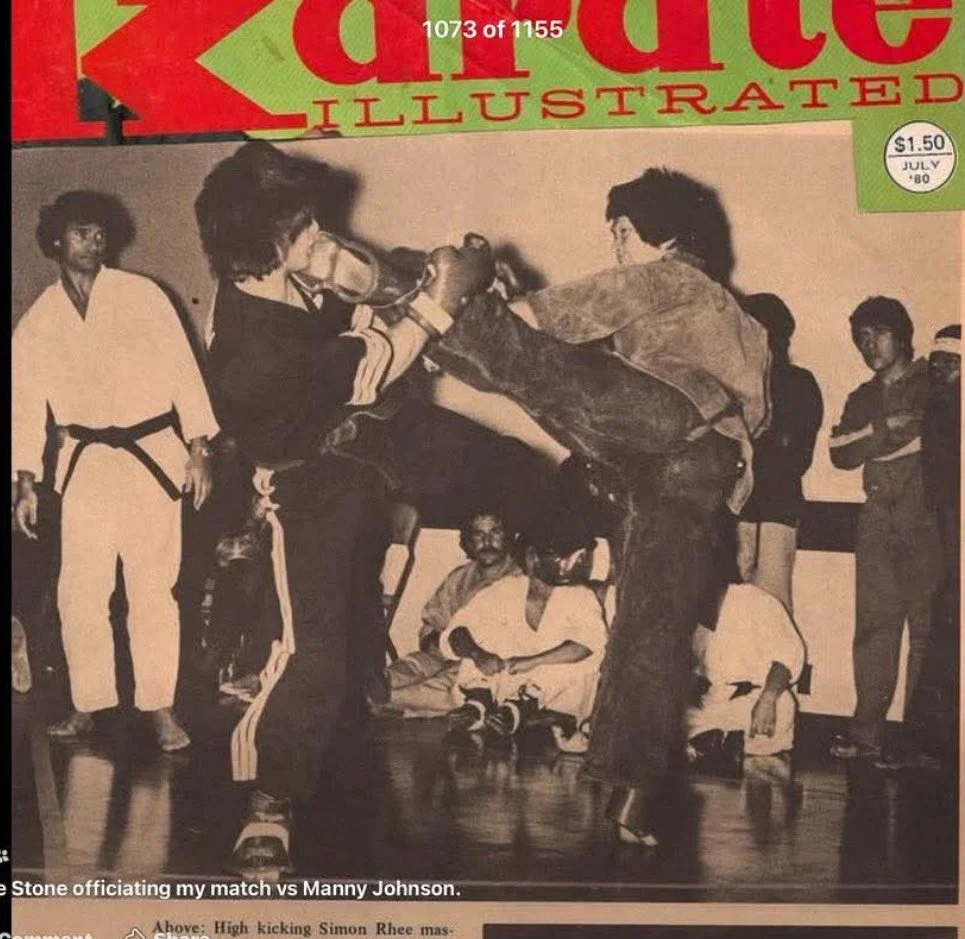
Mike Stone refereeing a match between Simon Rhee and Manny Johnson.
In this episode Jeremy chats with Best of the Best actor Master Simon Rhee, about movies, black belts, and much more!
Master Simon Rhee - Episode 1046
SUMMARY
In this engaging conversation, Master Simon Rhee shares his experiences in martial arts, from his early days of training and competition to his involvement in iconic films like 'Best of the Best.' He discusses the evolution of martial arts training, the impact of competition, and the influence of martial arts movies on culture.
Master Rhee emphasizes the importance of respect, humility, and continuous learning in martial arts, while also reflecting on the challenges of fame and mental health. The conversation highlights the legacy of martial arts icons and the significance of teaching the next generation.
TAKEAWAYS
Connections in martial arts can span decades and create lasting memories.
Motivation in training can come from competition and personal goals.
The evolution of martial arts training reflects changes in culture and competition.
Martial arts movies have significantly influenced public perception and interest in martial arts.
The legacy of films like 'Best of the Best' continues to inspire new generations.
Training the next generation requires dedication and a focus on technique.
Mental health challenges are prevalent in the martial arts community, especially among those in the spotlight.
The Hollywood environment can shape martial arts aspirations and training styles.
Respect and humility are fundamental values in martial arts that transcend rank.
CHAPTERS
00:00 Intro
01:42 Connections in Martial Arts: A Journey Through Time
04:22 The Evolution of Martial Arts Training
08:51 Motivation and Competition: The Drive to Improve
12:12 The Impact of Tournaments on Martial Arts
13:53 Creating 'Best of the Best': A Film Journey
16:56 Hollywood and Martial Arts: A Unique Intersection
21:24 Training the Next Generation: Insights from Experience
25:32 The Challenge of Learning Martial Arts: A Personal Journey
30:06 The Journey of Teaching Taekwondo
30:54 Passion for Learning and Sharing
32:16 Transitioning from Stunt Coordination to Conventions
34:25 The Impact of Martial Arts on Fans
35:15 The Legacy of Martial Arts Heroes
36:29 Respect and Legacy in Martial Arts
39:06 Understanding Titles and Respect
41:59 The Meaning of Rank in Martial Arts
44:44 Contributions to Taekwondo and Legacy
48:32 The Importance of Respect in Martial Arts
52:31 The Significance of the Black Belt
55:33 Honorary Ranks and Their Meaning
After listening to the episode, it would be exciting for us to know your thoughts about it.
✅Subscribe to whistlekick Martial Arts Radio on the following platforms:
🎧Apple Podcasts: https://apple.co/3mVnZmf
🎧Spotify: https://spoti.fi/3yHVdHQ
✅You can find whistlekick on all social media platforms using the handle @whistlekick or visit our website at https://www.whistlekick.com or https://www.whistlekickmartialartsradio.com
Show Transcript
Jeremy Lesniak (00:01.642)
Thanks for being here. Appreciate your time. And I was thinking, I know I told you before I started here to record, I didn't have anything planned. I have one thing planned, because I always try to come up with how do we start? And everything I came up with to start for you seemed really boring. So that's kind of what we're going to do. What's the worst question an interviewer has ever asked you?
Simon Rhee (00:34.457)
cannot remember. Because I probably have a tendency to forget bad questions.
Jeremy Lesniak (00:37.045)
That's good.
Jeremy Lesniak (00:44.75)
Alright, then let's go the other way. See, I had a backup plan. What's the best question you've ever been?
Simon Rhee (00:51.267)
can't remember that either. I feel like we're just talking and most of the time when I do this, the host would ask me questions and I would answer and then we just go back and forth.
Jeremy Lesniak (01:07.938)
Yeah, and that's what we do here. What I've found over the years is we've got to have a place to start, even if it's not a good one, because otherwise people just kind of sit there and we just kind of look at each other. And how do you start from nothing, right? It's like sparring. How do you start if both people bow and they just kind of stand there? Somebody's got to start moving. Somebody's got to do something. So that gives us our place to start.
Simon Rhee (01:19.353)
you
Simon Rhee (01:29.869)
Yeah. So we're both defensive fighters right now.
Jeremy Lesniak (01:35.618)
Yes, are you? I am. I absolutely am. And I just wait. Yeah. Yeah. And that doesn't always leave a lot of people with options, right? Like just kind of wait. And especially if you're a counter fighter and a better fighter, then they get nervous.
Simon Rhee (01:39.486)
I'm a count of five to two.
Simon Rhee (01:59.129)
So let's talk about Mr. Mike Stone. How's that? You know Mike Stone,
Jeremy Lesniak (02:06.126)
Okay, I do, I do. I had a great chat with Mr. Stone, maybe it's two years ago now? How do you know, Mike?
Simon Rhee (02:13.336)
Well, in 1980, well, I guess it's before, probably 79, I was competing in a tournament and I send you the picture. He's refereeing my fight and I'm kicking this guy in the face and somehow the Karate Illustrated Magazine caught that shot.
So I sent a picture to Mr. Mike Stone. said, Mr. Stone, you were referring my fight and I'm kicking this guy in the face and Karate Illustrated Magazine caught this picture and I've been wanting to share this picture with you. And so like in May of this year, we were both in England for UK martial art show.
So I was able to pull up their picture and show it to him after what 40, 50 years later, you know, and he goes, no, he hasn't seen it. So he was like, this is amazing, you know. And then another amazing thing happened like last week. He's visiting in LA and last was that last was last Thursday.
Jeremy Lesniak (03:23.042)
He hadn't seen it.
what a trip.
Simon Rhee (03:43.491)
He was gonna teach a seminar at his old student, Steve Fisher's school. So I went to see his teaching. So I went to Steve Fisher's school and guess who's there? The guy that I kicked him in the face, his name was Mary Johnson. He was there and he goes, Simon, I heard you have a picture of you kicking me in the face. Do you still have it? I was like,
Yeah, I do. And I was able to show it to him. And then Mr. Stone came in. It was very, very interesting moment to share that with Mr. Mike Stone and Mr. Manny Johnson. So that's how my last week was.
Jeremy Lesniak (04:31.126)
It's that's a I enjoy when things come full circle, right? It doesn't matter how long happens in between that that sort of synchronicity is really fun. And when all I can think when you're when you're when you're talking about these connections with Mike Stone is I've heard a number of people say, you know, martial arts. Yeah, there are a lot of people in martial arts. But the moment you get up even a little bit.
you move up a little bit in rank or time, it gets so much smaller. And when I've had folks on who were around and competing in the 70s and the 80s, you all knew each other.
and
Simon Rhee (05:18.498)
So Jeremy, are you a black belt? On what style?
Jeremy Lesniak (05:21.59)
I am. I've been very blessed. I have rank in karate and in taekwondo and with someone I'm going to guess you know from somewhere along the label Wallace.
Simon Rhee (05:36.316)
Bill gave you a black belt? Interesting. Where are you from? Where are you right now, Jerry?
Jeremy Lesniak (05:43.054)
I live in the northeast of the US. I'm in Maine right now.
Simon Rhee (05:46.712)
I see. And matter of fact, Bill Wallace was in UK too in the May.
Jeremy Lesniak (05:52.015)
I was pretty sure he's got a route that he takes annually. If I'm remembering correctly, I think I've heard him say it's 14 seminars in eight days. And I was pretty sure that that was the anchor.
Simon Rhee (06:06.54)
Yeah, yeah. Yeah, so Bill Wallace and I, go way back to like 1975, 1976, when my taekwondo instructor, Master Jun Chung, he purchased Chuck Norris School on Wilshire Boulevard in Los Angeles. So, you know, I would go there and Bill Wallace would come, Mr. Chuck Norris would come.
Mr. Joe Lewis would come and we would all spar, you know, and it was just the best of time. And I was like 18 years old, 17, 18 years old, and we were all in the.
Jeremy Lesniak (06:47.576)
people listening and not watching, you should see the grin on Simon's face right now as he's remembering this. Just ear to ear smile.
Simon Rhee (06:53.366)
Yeah, it's just, we were so like young and happy and fast and just, it was the best of my time, you know? And the one thing I loved about sparring with Bill Wallace is he's a left leg kicker and I'm a left leg kicker. His favorite kick is front neck hook kick. My favorite kick is front neck hook kick, you know? So we had a lot of good sparrings. And then when I opened my own school,
We had a sparring night, I think Tuesday night or something, and he would always come to my school and we would have sparring nights and it was so much fun. And then, you know, he moved somewhere, so I haven't seen him for a long time. And when I saw him again in England, I was really happy to see him.
Jeremy Lesniak (07:42.988)
Yeah, he's such a great guy turning 80 this year. Still kicks better than I ever have or will.
Simon Rhee (07:53.397)
Amazing.
Jeremy Lesniak (07:54.934)
Yeah. Yeah. You, you... Go ahead.
Simon Rhee (07:56.319)
Yeah. And no, go ahead. just, I had a text came in as I was reading my text.
Jeremy Lesniak (08:10.446)
You're my third of four conversations today. And there's a theme that's going through the first two that it's about the training. That when you, when you put yourself around people who love training, that the training is the priority. Things are very different than when you were with people who let's say rank or hierarchy or associations.
are the priority. Would you agree?
Simon Rhee (08:45.624)
Okay.
I I think the training comes from a motivation. Are you motivated enough to train? I mean, my motivation was, I don't know if you are aware of a author named Chung Li. He wrote Dynamic Kicks. I don't know if you ever seen that book.
Jeremy Lesniak (09:09.966)
I've heard of that book, I'm not familiar with the author.
Simon Rhee (09:13.72)
Okay, so I'm Korean, Chung-Need Korean. Back in like late 70s, we both had like really long hair, because that was in style, you know, and he was like, he had really, really beautiful kicks. And he came out with this book called, you know, Dynamic Kicks and in 1974, 1975, he wanted like a Korean style.
form competition in Long Beach International. So I moved to Los Angeles in 1976 and my motivation was to be better than him. So every night after I finished teaching, I'm not exaggerating, I think I threw about thousand kicks before going home. And just every inch, if I could tweak it, what can I do to make my kick look better than
know, Chung Lee, and he was my motivation. So by keep practicing my kicks for like, I don't know how many years, 1980, a Black Belt magazine picked me for having the most beautiful kicks in the nation. So I felt like I accomplished what I was trying to accomplish, but now at my age 68,
2013 I had to get a hip replacement surgery and 2020 I had to get my other hip replacement surgery. So, you know, when you train back in like late 70s, early 80s, we didn't have, I didn't have all the knowledge of medical, you know, the resources that you could look, I just trained like crazy and then now I...
I feel like, okay, I achieved what I wanted to achieve, but now I'm paying the price for what I've done. So training is good, but don't overdo it. Think about your life in the future.
Jeremy Lesniak (11:19.968)
Sure. Why was it important that you be a better kicker than Chung Li? Why him?
Simon Rhee (11:28.498)
Why him? Well, he had a school in Tarzana and I was teaching in Los Angeles and the distance was about 20, 25 miles. And in tournament circuit back in those days, know, everyone was saying, Chung Lee had the most, he's got the best kicks. And I wanted that to change. I wanted people to say, Simon, we've got the best kicks, you know.
So that's why I wanted to beat him. And then when I first started training and started competing, my instructor, Master Jun Chung, he was very traditionalist. like starting mid 70s, people were coming up with all this colorful uniform. George Chung was using music in a form competition. And my instructor wouldn't let me compete.
using my own form. I had to use traditional form and I wasn't winning. So I said, know, Master Chow, you know, please don't be mad at me, but I'm going to get a black pants and I'm going to start using some gymnastic moves in my form and I hope you don't get mad at me. You know, I just want to win and if, you know, I, if I win, I win for you. It's for me, you know? So he said, he softened up and he said, okay. So I was able to find a way like.
black pants with a white top and use a little bit of gymnastic moves. And I feel like George Chong, Ernie Reyes, Cynthia Roth Rock, like we were all competing against each other at the time. And John Chong from junior high school, East Coast. And those were the fun days.
Jeremy Lesniak (13:22.946)
You know, it's when I look at those times, when I look at that early, early to mid eighties competitive era, it launched so many people. And of course, know, plenty of people know you from what you went on to from your competitions. But I think people, I think, wondering if you agree, I think people underestimate how much
ornaments during that time changed martial arts.
Simon Rhee (14:00.707)
Do think tournament changed martial arts back in those days?
Jeremy Lesniak (14:03.662)
I think so good for the very thing that you said your instructor was such a traditionalist and he wasn't alone. I grew up in an environment like that. And we started to see what was happening in competitions. And. You had to start making some adjustments.
And I think in a lot of schools, some of those adjustments came back into the school.
Simon Rhee (14:31.64)
I feel like it was in the 70s, late 70s that tournaments started to change a little bit. But I think like martial arts started to change a little bit also when all the kung fu movies start coming out. And when my brother and I started watching these movies, like they were killing people, sex,
drugs, gratuity violence, fighting just for the of fighting. And my brother and I felt like this is not a true martial art. Martial arts should teach discipline and respect. And so we were kind of unsatisfied with those movies. I enjoyed watching the fight scene. It was cool.
Especially those Chinese kung fu movies when it's over the top, know, people flying all over the place and stuff, you know, and then just just for sake of fighting. I thought that was just not that cool. And then all the tournament that I've been to and the things that I experienced and all the tournament that my brother's been to and what he experienced, you know, we wanted to capture something.
really, really true in martial arts. So that's where the best of the best idea came. My brother, he's brilliant. goes like, you he went to compete in Korea and even though he was Korean, you know, he was representing USA. And so he felt some like hate from Koreans in Korea.
It was like, I never felt that before. And then all the things that we experienced, we sat down and we talked about it. And then Philip decided to come up with an idea of making best of the best. And yeah, that's how it came about.
Jeremy Lesniak (16:46.476)
Did you think it was a crazy idea, a great idea?
Jeremy Lesniak (16:53.292)
Something else?
Simon Rhee (16:54.552)
I like the idea and by that time that was like my third movie, second movie, one, two, three, so that would be my fourth movie.
I didn't know how the movie was going to come out. And another interesting thing was, you've seen the movie, right, Jeremy? At the end, when I'm giving the medal to my brother, I was supposed to speak in Korean. And Sally Kirkland, our lady coach, she was going to translate it in English. But somehow that day,
She wasn't feeling well. So my brother came up to me and goes, Simon, you're going to have to do your line in broken English now. And here I am, I've been practicing Korean, you know, to say all these things. I was like, OK. So it just kind of threw me off. But somehow I think that it worked out better that I did it in broken English and it was able to reach more audiences.
I mean, we made that movie almost about 40 years ago, you 1989, and we still get fan mails and emails and, you know, we're putting on like conventions and it's amazing what that movie's done for people.
Jeremy Lesniak (18:34.51)
Yeah, those 80 movies are absolutely golden. I have a few that I watched back in the 80s that I look at now. On the one hand,
Simon Rhee (18:35.256)
Thank you.
Jeremy Lesniak (18:51.074)
They weren't always great movies, but they meant something. And especially as a kid training in the 80s, it was a big deal. We would go rent a VCR and we'd rent a couple movies and I'd watch that movie two, three times over the weekend.
Simon Rhee (19:08.962)
What is your favorite ladies movie?
Jeremy Lesniak (19:14.604)
Probably Kickboxer?
Simon Rhee (19:17.25)
Jean Claude.
Jeremy Lesniak (19:18.786)
Yeah, it's probably kickboxer.
My mother was a big Van Dam fan. That was her vote whenever we would go rent movies. She said, you know, he's probably going to have a scene where he's not wearing a shirt. so that was, it was mom's money. didn't get to push back too often.
Simon Rhee (19:42.883)
So I work with Jean Claude on Universal Soldiers. And we did some sparring together. And he liked the way I sparred. So he goes, Simon, would you teach my kids? I said, sure. So I started teaching Christian and Bianca. Is that Bianca? It's been so long. Anyway, so I used to teach private lessons.
Jeremy Lesniak (19:48.468)
p-
Simon Rhee (20:12.856)
long, long time ago. And then one time, the kids were testing. So it was like Saturday afternoon or something. So Jean-Claude came to see his kids test. Oh, you should have seen the parking lot, Jeremy. Just people, people went crazy. There could have been a few car accidents that day, you know? So it was, yeah.
Jeremy Lesniak (20:30.156)
Believe it.
Jeremy Lesniak (20:38.824)
He was at his peak. I he had done something...
He had a certain kind of charisma on screen and I don't know that I can describe it. You can see it, but there was just something about him that seemed...
Jeremy Lesniak (20:59.34)
Genuine understated, think is the word I would use.
Simon Rhee (21:04.94)
I think back in those days, it was so brand new. Like, you know how Stephen Seagal came up, you know, doing Aikido. It was such a new art, you know. like, know, Chuck Norris was using just regular tangsuyo and I guess young Klaut was a little bit more karate, you know. So I guess.
Simon Rhee (21:30.263)
Yeah.
Jeremy Lesniak (21:33.494)
It was new, it was different, was fun. as much as it might be for me, as much as it might be movies on the weekends, was Ninja Turtles during the week.
Simon Rhee (21:47.862)
Ninja Turtles.
Jeremy Lesniak (21:48.608)
You had a school then, you know how big that impact was.
Simon Rhee (21:51.801)
Yeah, the funny thing is like, you know, couple of my students were Ninja Turtles, you know, and, and yeah, I mean, there were a lot and then like Power Rangers, couple of my students became Power Rangers and yeah, I've taught a lot. All the, what is it, Cobra Kai, like Zolo, Mary,
Jeremy Lesniak (22:00.313)
Not a lot of people get to say that.
Jeremy Lesniak (22:07.427)
Yeah.
Simon Rhee (22:20.546)
Tanner, Jacob, you I trained them like two weeks before their season would start. know, the stunt coordinator, Hiro Koda would call me and say, hey, can you train them before season starts? So I would train them also Martin Cove and William Zapka. You know, I would train those six people about two weeks before season start. And then the following seasons, you know, I trained them another two weeks, you know, so.
That's really cool.
Jeremy Lesniak (22:50.264)
When you're doing that, because I assume you're not teaching, you're not doing stunt work, you're not doing choreography with them. So what do you take working with them on?
Simon Rhee (22:58.808)
Well, of all, would make sure that their techniques are clean. And also they would know all the names of blocks and punches and kicks. And then after that, once they get proficient with that, then I would give them some fight choreography so that they learn to remember techniques and choreography. So I really had a lot of fun training with the Cobra Kai cast people. They were so nice.
you know.
Jeremy Lesniak (23:30.862)
It's.
those names, Cobra Kai was big, after season one, we had some almost with some interviews and just, couldn't get the timing right because everyone's schedule was just so swamped. But, you know, we've had a number of people, we've had a few people come on from various iterations of Ninja Turtles and Power Rangers and had one that would have come on, but of course he,
past before that could happen. You're, what's that?
Simon Rhee (24:06.401)
Ooh, is that Jason?
Are you talking Jason? Jason Frank?
Jeremy Lesniak (24:13.975)
We talked to Jason and Both Andrew and I and I think Andrew was even more excited than I was that we were gonna have Jason on the show and you know, just It's a reminder that we all we all struggle at times
Simon Rhee (24:34.833)
Did he have a depression? that what that
Jeremy Lesniak (24:38.23)
Yeah, that's my understanding. don't want to speak for him or his family, that was what came out was that he had been battling with depression and depression won.
Simon Rhee (24:43.192)
point.
Simon Rhee (24:53.698)
So I've worked with him when he was a Power Ranger, our director who directed Best of the Best. He was directing one episode of Power Ranger and he wanted me to come in, be a judge in a sparring competition. So I went and I think it was Jason who was sparring with some other person and I remember meeting him and he was...
Jeremy Lesniak (24:56.366)
Hmm.
Simon Rhee (25:21.381)
you know, very young at that time and he was good. He moved really well. And then, you know, many years later I hear that he passed away, so it's sad.
Jeremy Lesniak (25:39.064)
I'm wondering about being in LA and being around such a different martial arts culture because so many of the people out there, they want to go on to movies. They want to go, they want to make it that aspect of a profession. Whereas, you know, here I am in the Northeast and for most of us out here, if we have a martial arts dream, it's I want to open a school.
Simon Rhee (25:39.276)
So.
Jeremy Lesniak (26:06.008)
Do you think being so close to Hollywood changed what people wanted to learn?
Simon Rhee (26:15.44)
I that would have some kind of an effect on people in Los Angeles. I would agree with that. And also seeing in a lot of celebrities training, you know. But for me, Bruce Lee, watching him on the screen and going, hey, I know how to do those kicks. And that's why I wanted to get into the movies.
Jeremy Lesniak (26:27.384)
Mmm.
Simon Rhee (26:44.696)
It's not easy, Jeremy. Like, 1975, I was visiting my instructor in Los Angeles. Well, he wasn't my instructor yet, but Master Jun Chang came up to San Francisco when I was training in San Francisco and living there. And he taught a couple of classes for us. And I really liked them. I loved the way he kicked. So 1975, when I was visiting Los Angeles,
I called him, said, Master Chong, you know, I'm visiting Los Angeles, can I come and see you? And he goes, I'm glad you're here. I'm shooting a movie tomorrow in Long Beach junkyard. So stop by and do a little fight scene with me. So I said, yes, sir. So me and my brother, we went to a Long Beach junkyard.
Check out the name of this movie. It's called Bruce Lee Fight Back From The Grave.
Simon Rhee (27:41.763)
So this is like right after Bruce Lee passed away, they were putting in Bruce Lee's name in everything that they were making. So we did a fight scene at Long Beach and somehow that movie got released. the movie was with a Korean director. So I didn't think the movie was gonna be released in the United States, because I thought that movie was just for Korea.
And then the year after that, somehow that movie got released and we were able to watch it in Hollywood, on Hollywood Boulevard. So I was like, wow, so that's what I look like on a big screen doing all those kicks. And I really wanted to do it. So from 1975, I did the movie. 1976, our family moved to Los Angeles and it wasn't until 1986.
I was able to join Screen Actors Guild. So it took me 11 years after I did my first movie to be able to join the union. So yeah, it's not easy trying to get into Hollywood just so that everyone else would know. Unless you know somebody.
Jeremy Lesniak (28:52.173)
Yeah.
Jeremy Lesniak (28:56.142)
I've heard that from so many people, that it's... So many people have that dream and there are hundreds, thousands of hopefuls for any one role.
Simon Rhee (29:13.176)
Yeah.
Simon Rhee (29:18.69)
Jeremy, have you seen my YouTube show with Michelle Karen? Funny chance.
Jeremy Lesniak (29:26.126)
No, tell me about that.
Simon Rhee (29:29.666)
So there's a YouTuber named Michelle Carey and she has about 5 million followers. And she does this program called Challenge Accepted. And she trained to become Secret Service Agent, FBI Agent, Houdini Tricks. So she does a lot of these things. And she came to me.
And she goes, Mastery, I want to know if I could become a black belt in 90 days. So will you teach me? So I said, Michelle, you came to a wrong person because if you're trying to get a black belt in 90 days, you're not going to get it from me because I have would flunk my sons when they were testing and when they make three mistakes. So no, you know.
you came to a wrong person. And she goes, that's exactly what I want. I want somebody who's willing to flood me and don't just pass me. So I said, okay, well, if you're willing to take that risk, I'll teach you, but I'm not gonna guarantee you black belt. So then she agreed to that. So she started taking private lessons every day, every day.
Jeremy Lesniak (30:57.496)
For how long? An hour or two?
Simon Rhee (30:59.338)
One hour private lessons and one hour. Yeah. And then soon as we were finished, I could tell she was really dedicated. She would write it all down, everything that we did. And so in my system, you have to test like 13 times because we have 13 different belt systems to become a black belt.
Jeremy Lesniak (31:02.222)
How long were the lessons? Whatever, okay.
Simon Rhee (31:30.296)
So when we did the math, she had to test once a week to become a black belt in 90 days. So every week when I was testing her, I didn't want to test her by myself. I wanted to have someone who's like in martial arts for long time as a witness. So one of the testing I had, a couple of my testing I had my brother Phillip with me.
I had my good friend James Lu with me. I had Benny the Jet with me. I had George Chung, the owner of Black Belt Magazine with me so that every testing I had a witness to make sure that I wasn't just giving her the Black Belt. And this show came out a few months back and it came out.
so beautifully. If you sin best of the best, it has that tone from a woman's point of view. So please watch it when you get a chance.
Jeremy Lesniak (32:41.614)
And, you know, it's maybe it's my fault because Andrew had had has sent me the link and he said you need to watch this. He said it's really good. Yeah, yeah, he saw he.
Simon Rhee (32:50.804)
Andrew saw it? Andrew saw it. He saw it.
Jeremy Lesniak (33:00.366)
didn't tell me anything about it other than it was really well done and I needed to watch it. Andrew doesn't usually tell me I need to watch things. So it is on my list and you just moved it far up my list. So thank you.
Simon Rhee (33:14.584)
So by the way, I haven't met Andrew. Why is he not on the...
Jeremy Lesniak (33:19.982)
It's a one-on-one conversation. He does some episodes himself, he's more, he's the producer. He's more on the back end on things. He's a good guy. He's a great friend. Lucky to get to work with him.
Simon Rhee (33:32.427)
Okay.
Jeremy Lesniak (33:42.658)
He's in New Hampshire. So when you look at something like that project, like testing this woman weakly, and we don't have to give out spoilers, but when you see someone who, I imagine,
At least early on was able to hang. I don't know what my camera keeps going out of focus. Was able to move along. Well enough that there was a final product if she couldn't pass the first tester to you know, I would guess it wouldn't be a very interesting. Video. Did that? Change any of your thoughts on on people learning martial arts and.
how long belts maybe should take.
Simon Rhee (34:38.178)
Well, let me go back a little bit. So when she wanted me to teach her, I said no at first. And then she told me to watch some of her things that she did earlier. And one of the things that she did, was she took boxing lessons from this Olympian. And I think she did that same thing, 90 days worth of boxing training from this.
Olympian boxer and she went inside the ring and fought, competed against professional female boxer and she broke her nose and but she still won the fight.
So I said, well, this lady has something, you know? So that intrigued me. And then she also did some background search on me. She went around and asked, I wanna learn taekwondo and I wanna see if I could get a block, who should I go to? And I guess a lot of people told her to come to me, you know? So when she came to me, she started naming some of the people that I knew.
Jeremy Lesniak (35:31.277)
Yeah.
Simon Rhee (35:55.429)
This so and so told me to go to you, so and so told me to go to you. So I said, okay, well, let's try it. And like, you know, I had nothing to lose. If she wasn't gonna be good enough, I was gonna fail her and she was okay with that, you know? So I started teaching and I don't wanna spoil the ending, but you have to see it.
Jeremy Lesniak (36:20.131)
Yeah.
Jeremy Lesniak (36:27.522)
keeping you excited about martial arts. I can tell you're still excited. Okay. Okay.
Simon Rhee (36:32.492)
Learning new things. I love learning new things. Like I studied Taekwondo. I studied Hapkido. I studied Wing Chun. I took some private lessons from Jean Jacques Machado for some, you know, Brazilian Jiu Jitsu. Filipino martial arts under, you know, Guru Dan Inosantos. His son, you Ran Baliki. Diana Inosantos.
and Judah from Heiwa Nishioka. I just love learning new things and being able to share what I learned with my students. Because if you teach same thing all the time over and over and over, it gets boring. So I love learning new things and sharing new things. I mean, that's the reason why I went to go see Mr. Mike Stone teach a class last week.
Jeremy Lesniak (37:22.158)
it does.
Simon Rhee (37:33.152)
Here's Master Mike Stone, one and only original karate instructor. He got his black belt in six months. So I wanted to see him teach. And he's 82 years old and he still moves amazingly well. But yeah, that's what excites me.
Jeremy Lesniak (37:57.019)
So what are you learning now? Where is your training focused?
Simon Rhee (38:03.832)
Right now, my focus is, so I used to be a stunt coordinator for Warner Brothers, a TV show called Lucifer. I did season number six on that, little bit of season number five. As soon as I was done with that, I started to do American Horror Stories, season one, season two. And then now the business is really slow in Los Angeles.
not too many production is going on. So I'm getting a lot of interest from all the actors that I've worked with. They're saying, Simon, you should do conventions because you go to conventions, you sign pictures and you take pictures with your fans and the income is pretty good. And I've always kind of avoided that.
because I don't like crowds. So even though I've been invited to come to Comic-Con in San Diego, I didn't want to go because people tell me it's like thousands and thousands of people there. So this in May, when I went to England with my brother, I was taken back because
There was 500 people waiting in line that wanted to take pictures with Philip and I, and they were paying all this money. And Jeremy, I was like, wow. I guess because we always lived in Los Angeles, you Los Angeles, you see actors all the time, so you get kind of jaded. But you're way out in England and these people were just so happy to see you.
Meet you, talk to you, shake your hand, take pictures. I couldn't believe people were waiting in line for four or five hours just to take pictures with us. So now, after that experience, I talked to my brother, like, maybe we should go to book conventions, because it makes our fans happy, and we get to make a little bit of money. It's a win-win situation.
Jeremy Lesniak (40:27.946)
everybody wins. And I think that's great. And I think it's so
Simon Rhee (40:28.162)
That's what I'm concentrating on now.
Jeremy Lesniak (40:37.728)
I know what it's been like for me because of what we do and some of the connections I've made, some of the people who have been on the other side of the screen, or sometimes I even get to sit down with them in person and have conversations with people that have meant a lot to me. The one that was most important was Fumio Demura. When I got to talk to him, you know, meant, and I was thinking about him just yesterday.
and you know, pardon me, I'll probably tear up again. When I was done with my conversation with him, I cried. just, the recording stopped. I cried because he meant so much to me. He meant so much to me, both directly knowing who he was and the impact that he's had on martial arts.
Simon Rhee (41:19.54)
right? May I ask why?
Jeremy Lesniak (41:32.866)
but also indirectly because without him, how many of the people that meant a lot to me would never have trained or would have trained differently, would have had less competent training. And I imagine that every one of those people waiting in line five hours to talk to you and your brother felt something similar, that you, your movies, the contributions you've made mean something to them and better their lives.
So I think it's great that you're gonna do more of that because there are, I don't think there are a lot of places in the world where when you meet your heroes, we'll say, that they tend to be really good people. But the heroes that we have in the martial arts, I mean, you've named and talked about, trained with quite a few of them, they're good people. Bill Wallace is good people. Mike Stone is good people.
Simon Rhee (42:30.904)
Absolutely.
Jeremy Lesniak (42:32.064)
Joe Lewis, the stories that I've heard, the best stories I've heard about Joe Lewis are private stories that I can't even talk about about how good of a man he was.
Simon Rhee (42:43.512)
That's great. I love that. And that's the kind of legacy that me and my brother wants to leave behind too. Do you know who Master Bong Su Han is by any chance?
Jeremy Lesniak (42:59.808)
Yes, I do. Hip-hop keto guy and he did all the choreography on Billy Jack.
Simon Rhee (43:04.844)
There you go, So I did a movie called Kentucky Fried Movie with him. And there was a scene where he has to call all these Chinese names to go fight the prisoners that was coming out. So he goes, Simon, I don't know any Chinese names. Can you give me some recommendations? I don't know any Chinese names. So I said.
Master Han, why don't you just use Chinese food name? Like, know, Mu-shu pork, you know? Chow mein, you know? And I said that in a joking manners. And he goes, that's a good idea. I'm going to do that. And he really did that in the movies and they kept it, you know? And people, when they were watching, they were laughing so hard. And it was like, that was very funny. But...
What touched me the most was he was so gentle and like when he passed away, you know, I went to his funeral and before entering the funeral hall, all his black belts, there was about 20, 30, 40 black belts lined, you know, like outside, outside before you could walk in. And every time, you know, somebody came, they all like bowed at the same time.
as the guests were walking in. And it just touched me like how these students love and respect their teachers so much. They would do things like that for their instructor. And I felt that really deep. And I just hope that one day when I'm gone that my students would love me enough to do something like that.
Jeremy Lesniak (44:55.598)
I that's the case, yeah. There's something really interesting that I see in the arts, and it's that the people who ask...
Simon Rhee (44:57.164)
Respect and love,
Jeremy Lesniak (45:12.522)
most for respect are the ones that seem to have the least respect from the people around them. you know, we get a little bit of an inside thing, you know, the audience may not know. you know, of course there are emails or things that go back and forth. We ask you to fill out a quick form. How do you want me to refer to you? You know, what's your title? And most of the people that I get to talk to,
They'll say, know, here's my formal title, but as you did, just call me Simon. And.
Jeremy Lesniak (45:50.56)
I think that it's really difficult to feel the sort of love and adoration that you're talking about that, know, Mung Su Han's students had from, unless you can relate to that person as a person.
Simon Rhee (46:06.36)
So, there is a very famous DJ named Big Boy in Los Angeles. And he's syndicated, so he's all over the United States. He used to weigh like 600 pounds, now he's much slimmer now. So anyway, he's an African American, and one day he walked into my school.
So he goes, so if I want to take a lesson from you, do I have to call you Master Yi? Because I'm a black man and I might have a problem calling you Master. I said, I understand, I get it. The reason why you have to call me Master when I'm teaching you is because I'm going to start teaching you how to kick and punch. And when people learn
to fight and that's all you learn. It's a human nature to become aggressive. So to count, to balance that, we have to humble ourselves. That's why we bow. That's why we say yes or no, sir. That's why you say master or mister. And only time you have to call me master is on the mat. Outside of school, I'm just like you. You can call me Simon or you can call me whatever you want.
You know? So take a half an hour private lesson and see if you like the way I teach. And if you don't like the way I teach, you don't even have to pay me. Just, you know, go your way. So I gave him a private lesson and after that he signed up his whole family. And every time he calls me now he goes, Master Rhee, place to be, you know? Yeah. It's a nice, nice.
memory of someone that I taught before.
Jeremy Lesniak (48:08.696)
You know, that title master can, regardless of someone's background, can be a really difficult term. you know, maybe I'm, maybe lucky isn't the right word, but I don't have to face it as, I teach karate. I teach karate from an Okadawan tradition. So I'm sensei. You know, people don't have...
Sensei doesn't mean anything in English. We don't have to fight one meaning versus the next and how it works. But I've always wondered if Master maybe wasn't the best translation.
from Korean or from Chinese. Maybe we needed a different word.
Simon Rhee (48:55.896)
We have a point there, yeah. And I never liked being called master, you know. And there are people who has to be called by grand master or supreme grand master. And I hate that. You know, I used to like...
Jeremy Lesniak (49:16.846)
Thank
Simon Rhee (49:23.242)
insecure that you want people to call you grandmaster or supreme grandmaster. You know, we're all human being, you know, and if you're not my teacher, I don't need to call you grandmaster. That's just my feelings.
Jeremy Lesniak (49:43.284)
Too many people fill out, know, talking about that form. only had a couple people fill out the form and really insist on being called Grandmaster. Who I felt, and I hope I'm not forgetting anyone, and to the audience, if I'm forgetting someone, please forgive me. But there are two people who really wanted to be called Grandmaster, who had made significant contributions, and one of them shares your name.
Simon Rhee (50:14.968)
Are you gonna name him?
Jeremy Lesniak (50:16.866)
Jewellery.
Simon Rhee (50:18.704)
Okay, you interviewed Grandmaster June Reed before, he passed away?
Jeremy Lesniak (50:23.778)
Yeah. Yeah.
Simon Rhee (50:28.024)
I have no problem calling him Grandmaster.
He thought of me like a son, because we had the same last name. A lot of people thought I was his son. But he's the first person to bring Taekwondo to the United States. And he did a lot of good things for Taekwondo by teaching the senators and all that. And he was ahead of his time. He was like teaching Taekwondo
with using classical music and stuff like that. So I met him in 1986 and I went to his seminar in Dallas, Texas. And we had to sleep at the Tacoma School. It was like weekend seminar. And I've learned a lot from him.
Like at that time in my mind, you if I have a taco in the school, if the school next to me is charging $100, my mind was maybe if I charge $90, I would get more students. That was my thinking. But he taught me something else because no, no, no, no, you don't want to do that. If the person is charging $100, you want to charge $150. I'm going, grab my degree, then no one's going to sign up.
they would sign up if you prove to them that you are better than them. That's why you gotta, they're paying more. And then he told me about people driving Toyota and Mercedes, the difference and like, that's when I opened my eyes like, okay. And I wasn't afraid to charge more, you know, after that. But yeah, I think, I think he deserves that title, don't you, Jeremy?
Jeremy Lesniak (52:29.312)
I do. I do because I think I was brought up that the further your progression into the martial arts, the more the broader your responsibility got. When you're when you're young, when you're a low rank young in your training, you're responsible for you. Maybe you get to, you know, red, brown, showdown.
and you start being responsible maybe for a few other people, maybe for some younger students, you keep going. Maybe you're an assistant instructor, maybe you open your own school, but as you go up in rank, your responsibility grows. And I think very few martial artists make a substantial contribution at that level. And he did. He made a huge contribution. I don't think there are too many people in the history of martial arts.
that made a bigger contribution than Junrey.
Simon Rhee (53:28.216)
Yeah, also the safety equipment that he came up with. Remember we used to spar with bare hand and bare knuckles? Yeah. So who's the other person that wanted to be called Grandmaster?
Jeremy Lesniak (53:39.192)
Yeah.
The other one I don't want to say, because we've had others that I did call grand master because especially in the early days of this show, I wasn't as confident in what I do. so I took the way I would, I handled the show the way I would handle training in a class. so whatever someone's title was, I used that. And now I've learned.
Simon Rhee (53:45.184)
Okay.
Jeremy Lesniak (54:12.674)
the title, because we're not training, is actually a barrier. It's hard for me to have the kind of conversations I wanna have with someone when I'm nodding my head, bowing from a chair and yes sir, yes sir. And sometimes I'll have a guest who thinks of me that way and I'm like, no, please don't. We're two martial artists having a conversation.
Simon Rhee (54:25.72)
you
Simon Rhee (54:38.092)
I mean, like especially in Taekwondo, one experience that I felt was that...
If let's say you're a master or grandmaster or whatever, then carry yourself like a master or grandmaster. I go to some Taekwondo tournaments and I see these masters wearing suit and tie and smoking cigarette outside. How does it look to a younger kid's students, you know, or they're out of shape? And one time there was a demonstration team from Korea.
they came to this stadium. So I wanted to see them. I got invited. So I went to go see it with my family. So as I was walking in, there was an arrow saying, masters only. So I was trying to go to the side where all the masters were sitting. And this person stops me because I'm not wearing suit and tie. I'm just wearing regular street clothes.
No, you can't go that way. This is for masters only. So I said, well, I'm a master. He goes, no, you don't understand. You got to be a real master. I was like, wow. But luckily, that was already sitting there, said, that's real mastery. Let him come in. So I went in and sat there. I just didn't.
Jeremy Lesniak (55:59.352)
Because if you take off your suit and tie, you're not a master now.
Simon Rhee (56:15.896)
I don't like that. Why do you have to be wear a suit and tie when you go to a tournament or see a demonstration? I think you should be yourself.
Jeremy Lesniak (56:29.954)
Yeah. You think there's something.
You can show respect in a lot of different ways. You can respect someone else, right, in a lot of different ways. You can make me act like I respect you, but you can't make me respect you.
Simon Rhee (56:50.795)
Absolutely correct.
Jeremy Lesniak (56:51.254)
I can pretend to respect someone and put on a suit and tie, or I can show up in my street clothes and be far more respectful if I feel it.
Simon Rhee (57:01.912)
totally agree with you. I totally agree with you. And my belief is just treat everybody with respect. know? Whether it's a white belt or whether it's a yellow belt or a black belt, I treat everyone with respect until they prove me wrong. You know? Then okay, I don't need to treat you with my respect. You don't get my respect. But you know, whoever I meet, I will always treat anybody with respect first, you know?
Jeremy Lesniak (57:32.494)
And then sometimes, and unfortunately this has happened in the martial arts world, maybe I don't respect the person, but I can respect the rank, can respect their accomplishments, I can respect their skill.
Jeremy Lesniak (57:53.367)
is.
Martial artists are human. They're not all perfect. Some of them forget the lessons they teach.
Simon Rhee (58:04.094)
And don't you question ranks sometimes? Like when somebody goes, I'm a 10th degree black belt. I laugh like, wow, you're a 10th degree black belt. Okay, you know, I'll just go with it. like, you know, who gave you that 10th degree black belt? Was there an 11th degree black belt that gave you a 10th degree? So yeah, we do have some.
Jeremy Lesniak (58:31.902)
I think we're going to end up with either 15th degrees or rank is going to blow up and it's not going to mean anything. I don't think we're too long from that because there are so many people I, you know, I'm, 46. I feel I've earned the ranks that I have. I'm not a 10th degree. I'm not on track to be one anytime soon. And I know people younger than me that have 10th degree black belts.
Simon Rhee (58:59.704)
You
Jeremy Lesniak (59:01.07)
Okay, you're not going to get promoted for the next 50 years? You've gone as far as you can at 38? That's depressing.
Simon Rhee (59:13.132)
Yeah. Yeah. Yeah. I know there's something wrong with the ranking system. wish it could be better, but I don't know how to fix it. I don't have the answer for it.
Jeremy Lesniak (59:31.744)
I think I don't know what the answer is either. You know, we're trying. We're doing some different things in our school. But I think what it really comes down to, I think. People recognizing that the rank in my school isn't supposed to equate to the rank in your school. You know, a blue belt in my school doesn't have to look anything like a blue belt in your school.
Simon Rhee (59:57.505)
Absolutely correct. I agree with you. And my ranking is different from traditional Taekwondo ranking because I adapted my instructor's ranking system.
Jeremy Lesniak (01:00:12.642)
How does it differ?
Simon Rhee (01:00:15.608)
My instructor's ranking system is like, white, yellow is beginner, purple, orange is intermediate, and then it's blue, green. But in Korea, it's green and blue first. But his system is blue, green. It's like beginning advanced level, and then red and black is advanced level. So that is a little bit different. then
When I was taking Taekwondo in Korea, I knew that green came before blue, but I noticed in Master Chung School, the blue came before greens. And I just took his system and I just kept it and using it. And just like you said, my blue belt might be different from your blue belt, but only thing that I love to to love to just...
really push my students is that especially when they're white belt I try to make sure that their kicks are correct. I cannot stand seeing a black belt that do not know how to throw a proper roundhouse kick. It kills me. So if you get a black belt from me you better know how to kick correctly.
Jeremy Lesniak (01:01:20.206)
Mm-hmm.
Jeremy Lesniak (01:01:36.974)
There's only one thing that I think bugs me more that I see wrong on black belts than when they very clearly don't know their basics. It's when they don't know how to tie their belt.
Simon Rhee (01:01:48.871)
my god.
Jeremy Lesniak (01:01:49.934)
That one hurts my heart every time.
Simon Rhee (01:01:52.441)
I can't believe there's instructors out there that are willing to just take their money and let them get away with that.
Jeremy Lesniak (01:01:57.175)
And I just.
Jeremy Lesniak (01:02:04.438)
Yep. It's.
I think in some schools the belt is just a belt. I don't think it's a symbol.
Simon Rhee (01:02:17.196)
Yeah.
Jeremy Lesniak (01:02:18.228)
It's the thing if this house were to burn down.
Jeremy Lesniak (01:02:25.612)
The thing that I would grab, I would probably grab my phone first because I'd want to call for help. But assuming I had my phone, it's nearby, it would be my original black belt.
Not because it has stripes or anything like that, but because of what it means when I look at it. And I bet you look at your belts the same way.
Simon Rhee (01:02:50.104)
I have a very sad story. My, you know, when I got my black belt.
Jeremy Lesniak (01:02:52.408)
Yeah.
Simon Rhee (01:02:59.158)
it got stolen in my studio. Somebody broke into my studio and just stole everything and took that black belt. And my black belt was like gray color. It's got like rips and it's been shredded, but I loved it. And ever since that belt got stolen,
Jeremy Lesniak (01:03:00.951)
Mm.
Simon Rhee (01:03:23.315)
don't have that attachment to the replacement black belt that I got. I don't even have a name on the black It's just a plain black belt. I just wear it because when it's time for testing, I have to wear a uniform, so I just wear the black belt. But when I go teach seminars or when I teach somebody else to school, I don't even wear it.
Jeremy Lesniak (01:03:36.59)
9-2.
yeah.
Jeremy Lesniak (01:03:48.418)
Really? Do people push back on that? No.
Simon Rhee (01:03:51.788)
No, no.
If they follow.
Jeremy Lesniak (01:03:55.816)
I have a good friend who's going to hear this and he's going to be very excited that you don't wear a belt either. He only wears a belt for testing. People know if he's wearing a belt, big and serious things are happening. If we're teaching, if we're doing an event together or something, he'll say, look, I put a belt on.
Simon Rhee (01:04:01.145)
You
Simon Rhee (01:04:15.595)
Yeah, ever since I lost that original black belt, it's just all the other black belts don't mean a thing to me. I got promoted by, was it Chungdeokwon or Mudokwon? I think it was Mudokwon, one of the branch from Taekwondo, because you know, Taekwondo is like Chungdeokwon, Jideokwon, Mudokwon, three different branches.
Jeremy Lesniak (01:04:36.846)
Seven? Is it seven quans?
Simon Rhee (01:04:39.44)
I don't know, I don't know how many. Three, four, five. So one of the Kwan decided to give me a nine degree black belt.
Jeremy Lesniak (01:04:40.822)
Is it? Okay.
Jeremy Lesniak (01:04:52.439)
It was nice of them.
Jeremy Lesniak (01:05:01.986)
Kaini.
Simon Rhee (01:05:04.47)
I haven't worn it yet.
Jeremy Lesniak (01:05:06.379)
Governor Warner. When, when would you consider that in honorary rank?
Simon Rhee (01:05:07.938)
This
Simon Rhee (01:05:14.774)
Yeah. Yeah.
Jeremy Lesniak (01:05:16.142)
How does that feel? What does honorary rank feel like to you?
Simon Rhee (01:05:24.438)
Well, obviously the movie best of the best, if you read the comments on YouTube or the emails that I get on Facebook or Instagram, it's that movie that made me start taking Taekwondo. And thousands and thousands of people started taking Taekwondo after seeing best of the best. So I guess that's why they want to
acknowledge what the movie has done and that's why they're giving me this belt. So I don't want to be rude and say no don't need the belt. You know they want to give it to me and have a little ceremony. You know I'll go then as a guest and I'll accept and be grateful and that's all I can do right? What else can I do?
Jeremy Lesniak (01:06:20.366)
We need a different symbol of thanks. Instead of a belt, we need to give, I don't know, capes or something.
Jeremy Lesniak (01:06:32.382)
Maybe a cape would end up going the wrong direction over time. People would start wearing capes. Alright, I take that idea back. Nobody's allowed to do that. Please don't.
Simon Rhee (01:06:35.46)
Yeah.
That's funny. Yeah so Jeremy let's finish this up pretty soon because I have another
Jeremy Lesniak (01:06:47.926)
So I'm, yeah. Yep, yep, was just about to move into the beginning of our close. if people wanna find your school or your social media or email or any of the things like that, where do they go, what do they type in?
Simon Rhee (01:07:05.57)
to Simon Re and Facebook or Instagram, then you should be able to find me.
Are you on social media as your name, Jeremy Lesniel? Okay, I'll look for you. Cool.
Jeremy Lesniak (01:07:13.717)
and
Jeremy Lesniak (01:07:17.314)
I am. I am.
Jeremy Lesniak (01:07:21.939)
thank you.
And how do you want to end today? You know, we've been all over the place, which is great, because that's what's fun for me. But what do you want the audience to remember or think about as they move on with their day?
Simon Rhee (01:07:41.752)
Just, you know, the conversation that you and I had was between you and I, the audience, whatever they, if they could get something positive from this conversation that you and I had, you know, please take it and use it. And, you know, if you didn't get anything out of it, then, you know, I'm sorry, and Jeremy, you should be sorry. The thing that I learned from Grandmaster Jun-Ri is like,
be honest, have a strong body, and be smart. So, you know, always learn new things, always be honest, and always keep your body healthy. Because if you take care of those three things, you you will have happier life. And that's what Grandmaster Juni preached to me. And I try to live like that.
I exercise and keep my body in shape. I try not to be dishonest. I'm always trying to learn new things and it's been keeping me happy. If that's the key to life, hope if you could use that information, use it and be happy with your life.