Episode 1049 - Martial Arts Teachers Need Teachers
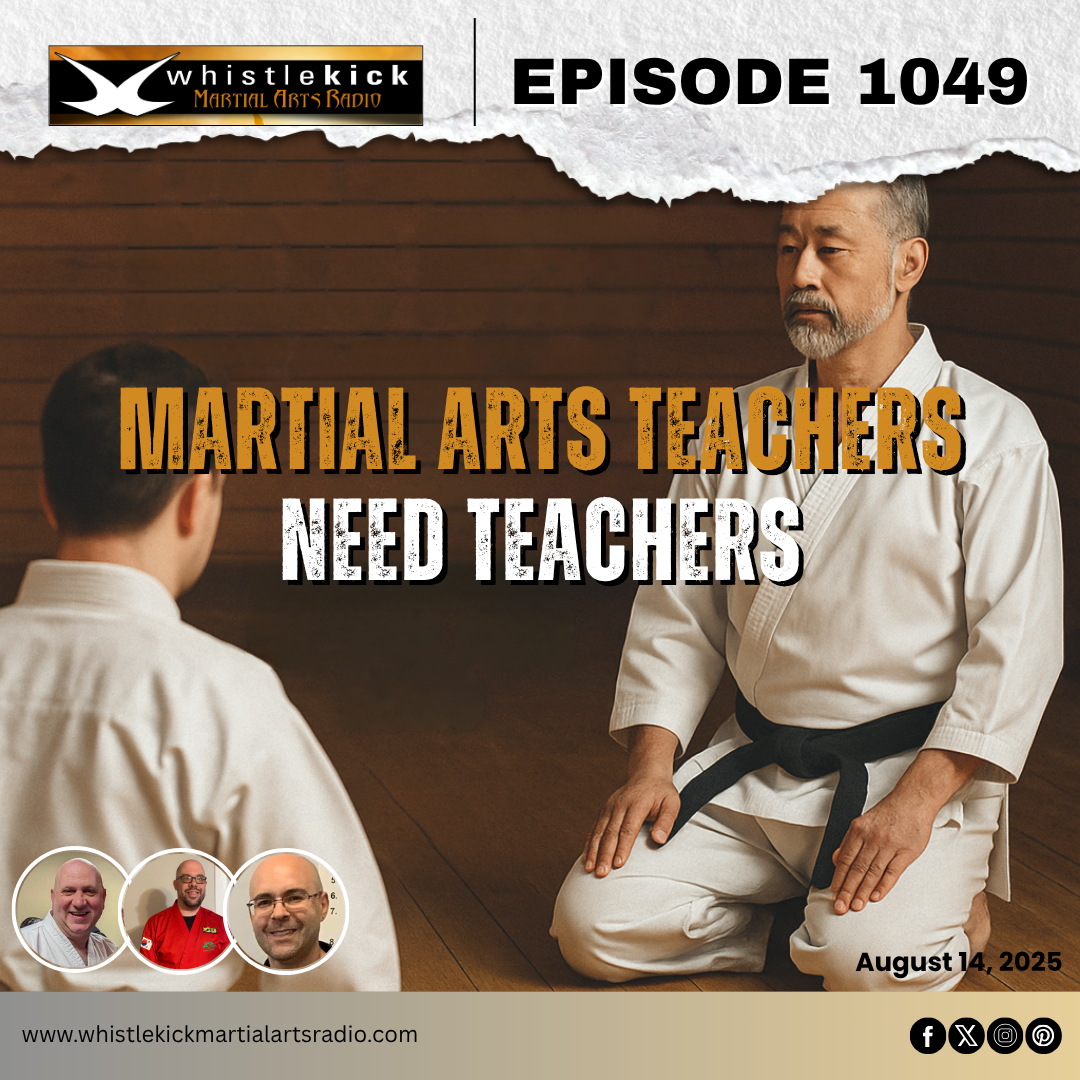
In this episode Andrew is joined by friends of the show Dennis Campo and Nick Taber to discuss why martial arts teachers need to have their own teachers as well.
Martial Arts Teachers Need Teachers - Episode 1049
SUMMARY
In this episode, Andrew Adams, Nick Taber, and Dennis Campo discuss the essential role of teachers in martial arts and the importance of continuous learning. They explore how martial arts evolve over time, the mindset of being a perpetual student, and the need for instructors to seek guidance from others. The conversation highlights the value of community and mentorship in martial arts, as well as the initiatives by Whistlekick to support teacher training and development.
TAKEAWAYS
Martial arts teachers need teachers to continue their growth.
The cycle of learning never ends; instructors must evolve.
Even masters should maintain a beginner's mindset.
Continuous learning is essential for personal and professional development.
Martial arts evolve over time, influenced by various factors.
Learning from students is as important as teaching them.
Whistlekick offers valuable resources for teacher training.
Instructors should seek external guidance to enhance their skills.
The mindset of a perpetual student fosters growth and improvement.
CHAPTERS
00:00 Introduction
02:37 The Importance of Continuous Learning in Martial Arts
05:20 The Role of Teachers in Martial Arts
08:11 Evolving Martial Arts Practices
10:54 The Mindset of a Perpetual Student
13:44 Learning from Students and Peers
16:34 The Need for External Guidance
19:18 Whistlekick's Role in Teacher Training
22:13 Conclusion and Final Thoughts
After listening to the episode, it would be exciting for us to know your thoughts about it. Don’t forget to drop them in the comment section down below!
SHOW TRANSCRIPT
Andrew Adams (04:02.956)
Welcome, you're listening or watching Whistlekick martial arts radio. And today I'm joined by great friends of the show and of mine, Nick Taber and Dennis. Nick, we'll start with you. How are you doing this morning?
Nick (04:14.994)
Absolutely great, man. Happy to be here. Thank you for always having me on the show.
Andrew Adams (04:20.504)
excellent. I'm so excited to have you and I said morning, but maybe you're listening in the afternoon. So we'll change it. Dennis, how are you doing this afternoon?
Dennis Campo (04:28.134)
I am doing amazing. If I was any better, I would be triplets, but looking at the screen, I see triplets, so I am awesome.
Nick (04:34.338)
you
Andrew Adams (04:34.414)
And if you are new to the show and you haven't seen us maybe you go to Facebook and you enough Facebook Maybe you go to YouTube and check us out on YouTube and you'll see exactly what Dennis is talking about So I've called you all here today. We're going to discuss why martial arts teachers Need teachers themselves, but before we get there I want to make sure people know about the stuff we do here at whistle cake You can go to whistlekick.com to find out all of the things that we do
I could give you a list. It's too many to list. I don't have enough fingers if I were to count them off. There's too many things that we do. You can go to whistlekick.com to find out all of the things that we do in the products that we offer. You can go to whistlekickmarshallarchradio.com for this podcast. We have over 1045 episodes at this point. All of those can be found at whistlekickmarshallarchradio.com. They're all listed there for free. You can find show notes and transcripts and
photos and all sorts of things on our guests as well. And all of that stuff is there. You'll also find a subscribe button to subscribe to our exclusive newsletter. You will get notified of every podcast as it gets released, as well as some bonus things. You'll get a free book, all of that stuff you'll find there. But here we are to talk about martial arts teachers need teachers.
And I thought this would be a good one to bring up because Dennis, last week, you and I talked about finding a good school if someone's looking for a school. And one of the things we talked about was finding an instructor that also has an instructor. And I thought, next week, let's record that episode. And so it also got me to thinking that Jeremy did another episode like this over eight years ago.
Episode 156 titled Everyone Needs a Teacher. Now, a lot has changed in nine years. Neither of three of us are Jeremy, so we might have a slightly different thought on it. So I thought, you know what? Let me bring Dennis and Nick on to talk about, Marshall, our teachers need teachers. So Nick, why don't we start with you? When I say that statement, what does that mean to you?
Nick (06:51.554)
I actually wholeheartedly agree with it because the way that things are going in the world, I mean, I started in 1991 in the martial arts world and the world is completely different. You know, we survive, we survive in this industry with each other. We don't have to be enemies. And I also think that as we get along, you know, past the color belt stage, under belt, go to black belts. We have to constantly train.
Our bodies change, things change differently, also it's also for our mental side of things. If we don't upkeep it, and we don't try to do things, we kind of get lost in the dust a little bit. We become a relic. We want to keep up, we want to keep going. So yeah, we do need teachers because we need to improve.
Andrew Adams (07:43.106)
Dennis, what about you?
Dennis Campo (07:44.968)
And the first thing that always comes to mind is Joe Hyams said in the martial arts, he has a chapter, even the masters need masters. And I agree 100%. It's Nick's point. An instructor should continuously be evolving, learning, and be a student. I recall my last Black Belt promotion. I was awarded a belt, a ceremonial belt that has alternating red and white panels, the red representing teacher and the white representing student.
Andrew Adams (07:51.31)
Mmm.
Dennis Campo (08:14.747)
And I was told the reason why that belt alternates teacher, student, teacher, student, because the cycle never ends. I think that's beautiful. And yeah, and as a teacher, you're learning from, of course, you have instructors, hopefully, but you should also be learning from your students. You should always have that beginner mindset. And that's where my mind goes to.
Nick (08:22.23)
Moe.
Andrew Adams (08:36.834)
Yeah. And you know, it's one of the reasons why we created with Kotaro the forever student belt, white on one side, black on the other, right? That's one of the reasons we came about that. But you know, I think it's important to consider martial arts change, right? And like Nick, Dennis, you've both been training for decades. And I think you would agree that the martial arts you started training in,
Dennis Campo (08:46.587)
Love that.
Nick (08:47.799)
love it.
Dennis Campo (08:57.307)
Yes.
Nick (09:02.103)
Mm-hmm.
Andrew Adams (09:06.764)
you started learning has changed since then, right? Your experiences has changed that martial arts for you. And I think most people would understand that and conceptually be able to agree with that when you really stop and think about it. know, Gishin Funakoshi, the founder of Shotokan Karate, what he started teaching when he first was a teacher.
Nick (09:24.246)
Right.
Andrew Adams (09:33.002)
changed. So his later students learned something that was very different. I mean, maybe very is not quite the word, but it was definitely different from what he taught his first students. So we have to recognize that martial arts change even through one person. And I think over time, it evolves even more. And I think the reason that happens is outside influence. Dennis, thoughts?
Dennis Campo (10:00.104)
So my original instructor Curtis Ennis, he was a black belt in karate and taekwondo and phenomenal martial artists, but he recognized there was more out there. So he started studying jiu-jitsu, Yamari U jiu-jitsu under Antonio Pereira and fell in love with the art and made it all the way to ninth degree black belt in that system, taking on just a brand new path, realizing that they were as...
good of a martial artist as he was, as strong of fighter as he was, there was more to learn and there was more beauty beyond just striking than he learned. later, he's about 12 years older than me, he eventually retired and moved to Florida and then he took up Tai Chi. He there's a whole new world of martial arts out there to learn and he and I stay in touch to this day and it's amazing that he continues to have, and I mentioned earlier and I Nick agree to it, with it, is having that beginner mindset that there's always more to learn.
And I can talk about my other two main instructors, Joe Lewis, who first world, how a kickboxing champion, 10th degree black belt. You can't go beyond that, right? Yet he continued to travel around the world. He would go to Thailand every year to learn Muay Thai. He studied under Dr. Mangy, Burmese boxing. was always a student. He always considered himself to be a student. He was a teacher.
always a student and that's just a tremendous mindset for someone of his level of expertise to have that always to be a student mindset is very motivating to all of us as his students. And to this day, one of your instructors, Andrew, Superfoot Bill Wallace, at his annual conference, when we train with his students who are his high level students, he gets on the floor and trains with us as a student. He said he's gonna be 80 years old this December.
Nick (11:46.722)
I'm
Dennis Campo (11:52.273)
but he's continuously trying to learn and get better. How can you not be motivated by that?
Andrew Adams (11:58.188)
Yeah, yeah, absolutely. Nick, thoughts?
Nick (12:02.438)
I absolutely agree with everything he, you know, Dennis is saying here. I think that we, as you know, one of the quotes that I learned from, you know, from my, my original sensei, Sensei Eric Gifford is the greatest teacher in the world is always a perpetual student. You know, we cannot know everything. We can not know everything. We can't, and it evolves.
Dennis Campo (12:25.126)
Beautiful.
Nick (12:30.654)
And he was, he also trained under super foot as well. and did there at several other places and we were encouraged, you know, once we did reach a certain point to move on. And, know, I was under another person since I, Jeff Curry under my underbell years, and he only had one person and he just kind of lived and he, he went on the wayside.
but now I train under another guy who went in my school and the, I rent space in a gym and he, some of my students want to have a rivalry. I said, no, we're not going to do that. You know, I, he teaches Thai cheese on St. Mike. And I learned from him. He learns from me, but also with the way that things evolve, just to your point as well, people have evolved.
a lot like since when I, when I was a student teacher under Sunset Gifford in the nineties, there was a way of doing things. He was an ex Marine. So do you take them through that? People leave, people go, but now you have a totally, totally different connected world. So when you have somebody like that and Sunset Mike's a little bit younger than me, but he knows like, he knows different connections than I do.
and then, different ways. So I can take from that to grow as well. And then, you know, also what we can do is as we evolve and pick up things, there's always a way to do it. And the way that I look at it, like, you know, you're going to learn in the garden of life. And if you go pick from one area of the garden, you're missing out on so much. You know, you're missing out on so much from there.
Paraphrasing from a friend of all of ours, Steve Watson, you you go and enjoy the soup of life, but it's missing, you know, you want to get that one thing, but you're missing all the nutrients and all the other stuff. So why not take the whole thing in? You know?
Andrew Adams (14:31.64)
Yeah. For me, when I think of why it's important to have your own teacher is I think we would all agree. And I think all of our listeners would also agree that is there an end to martial arts? No, there isn't. And we all know that. So if there is never an end to martial arts, if you don't have a teacher, if you are not learning
Dennis Campo (14:32.783)
beautiful.
Nick (14:49.708)
God. Yeah.
Andrew Adams (15:01.366)
martial arts from someone, you have just told all of your students that there is an end. There must be, because if there isn't an end to martial arts, why should you have an instructor that's not learning from someone else? Now, I want to be really clear here. You could be a 10th degree black belt in, or maybe in Master Ken's case, an 11th degree black belt in Ameridote.
You know, you could be a, you know, seventh, eighth, ninth, 10th degree level black belt in whatever art you're in. That doesn't mean you can't still have a teacher. Maybe you're learning a different style, right? And those things that you're learning in another style will start to impact what you do and how you learn. And sometimes those things are, and I'm going to say silly putting this in air quotes, sometimes the things you're learning are as silly as how to teach something, right?
Everybody has, and Dennis, I know you've said this, everybody has something to learn. Everybody has something to teach, rather, I should say. You know, everybody can teach something to someone. And if you don't have an instructor, what I read from that is there's nothing for me to learn. And I think we all would agree that that's not the right philosophy to have if you're going to be a martial artist. A little controversial perhaps, but
Nick, do you have thoughts on that type of statement?
Nick (16:31.362)
Yeah, I wholeheartedly agree with you. mean, I use the metaphor of the tree. You know, even where you have it, where the white belt signifies and trusts and though is the seeds are planted and the black belt is the hardening of the bark. But when you think about it, it's the hardening of the bark. The tree still has life. The tree can still grow and still give so much. And you know what we do if we're if we're not
Andrew Adams (16:51.852)
Mm-hmm.
Nick (17:00.93)
growing, we're stunted. And you're absolutely right. You know, if we're not learning and there's nothing else for us to learn, then what does that show a student who is coming up? You know, and it reminds me of like, you know, one of the things I thought of growing up where like, I remember being 10, 12 years old, somewhere around there. Like I had parents who were kind of miserable in life at that point.
You know, they had jobs that they didn't really like and they were kind of like, you know, what have I got to look forward to as an adult? But then I went to the dojo and I had a sensei who was constantly loving everything. I'd say, okay, there I have something to like, you know, and then a technique would start to join like, Chasindou is a build of many different arts. But then, you know, he started taking grappling courses and said, hey guys,
we need to do this. You know, and started learning little bits and little things here and then we got better because it's not just about points barring. Okay, you're the greatest fighter because you can get to three points in a match every Wednesday night. That's good, but are you able to handle yourself here? You know, was like, okay, now I can learn and constantly, it gave me that, you know, that constant explore mentality.
If I'm here, then I have to constantly figure out what there is because there's never if if I, you know, go to the end of it here, you know, I have, you know, I'm at the end of my life. I'm on my deathbed. OK, did I leave every stone? Did I turn over every stone? Did I leave anything unturned? If I know I didn't learn it, then I'm going to be disappointed at that point. That's a big driving force for me. I think most people have a similar thing like.
Andrew Adams (18:54.392)
Yeah, Dennis.
Dennis Campo (18:57.541)
So in 1997, I was a black belt for about 11 years. And I was named the head instructor, chief instructor of the school where I had grown up in and taught and learned. was lucky that we had different systems. I learned Judo, Jujitsu, karate was my thing. But I'm third degree, I'm head instructor. said, that's not the end. I said, have too many things to learn still. My instructor had joined the army and then eventually moved to Florida.
I said, I need to seek out more teachers. So it was 1997. And ironically, about two miles down the road from where I live now, I met Joe Lewis, going through Black Book Magazine, looking for seminars. And at that time, I wasn't living anywhere near here, but I drove the two hours to go and meet Joe Lewis and train with him. rest from there is history with Mr. Lewis. Through him, I met Bill Wallace and so many other great
instructors who I consider to be my teachers today. I've got a dozen teachers now and I couldn't be more thrilled and I'm a little bit higher than third degree today and I've got 45 years into this stuff but I consider myself to still be a white belt today. Every time I go on the floor with one of my teachers or even just a training session with my peers, I never walk away without having learned something and having spent time.
Andrew Adams (19:56.044)
to start.
Dennis Campo (20:23.565)
with time well spent. Select a editor.
Andrew Adams (20:26.668)
And I think that you bring up a really good point, Dennis, in that I don't think any of us are saying that it has to be a structured, go to your instructor once a week, every week. It doesn't have to be like that. And now it can be. My instructor just recently got promoted to sixth on, sixth degree black belt. He travels about two hours once a week.
every week to train with his instructor who is who just recently was promoted to eighth degree black belt when he was last in Okinawa. But even he eighth degree black belt just recently got promoted. He's still training with his teacher, right? There are other ways to do it. So it doesn't have to be and I don't think I never start saying it has to be a structured once a week, even once a month. But I think there just needs to be this this
Dennis Campo (21:10.309)
Yes.
Andrew Adams (21:23.394)
back and forth of knowledge. Like, yes, you're a teacher, you are giving stuff to your students, but you need to be learning as well. And yes, we would all agree, you learn from your students, but I think I look at it, when I say martial art teachers need teachers, yes, I'm learning from my students, but I think it needs to be more than that. needs to be, you still have to have someone that is teaching you something.
Dennis Campo (21:48.613)
Yes.
Andrew Adams (21:52.842)
outside of what you're learning from your direct students.
Dennis Campo (21:58.117)
Great. think we're talking, go ahead, Nicky, go first,
Nick (21:59.106)
I get it.
No, I got a story on that if I don't, if you don't mind. There's with a friend of the show, Kelly Thomas, who had been teaching with me and you know, we connected through Whistlekick, became good friends and she was, you know, was specialized in teaching women. And I've, know, growing up where I had, and I really started to learn how to teach and develop myself.
It was maybe 90 % boys, 10 % girls, roughly somewhere around there. I mean, now it's growing and I had over the years, I've had pretty much, you know, 60, 40, 70, 30. And, know, I'm like, okay, what do I do if something comes up? And at least having someone in the new wave and I say, okay, Master Thomas, what do I do here?
You know, and we sat and she sat with me for just about an hour and a half and rolled through many situations. I had no idea what to do. You know, I know I don't have say that, but just sometimes it's like, the beauty of it is the most freeing statement in the world, even though you're at this point where you have the knowledge is to say, I don't know. And then be willing to do it. And also it's like a thing that I've learned. My dad always said something like this, like,
The white, was a black belt, there's a white belt that just stuck around to get dirty. Like, so be the dirtiest one in the building. Just keep going. You got more to go.
Dennis Campo (23:35.397)
Absolutely.
Yeah, what was about to say, Nick, is the beauty of Whistlekick and this organization, we have free training days across the country every year. And it's my absolute favorite event. in terms of being teachers, really what I enjoy most of it is that all the instructors at these events or the presenters of these events, we take each other's sessions. And it's just a full day or, in this case, summit now, four full days of learning and growing. And while we might not be each other's formal instructors,
We walk away with so much new knowledge and because the relationships that we build, we continue to train together well beyond the one free training day. I think that's a beautiful thing and I love that Whiskick does this.
Andrew Adams (24:20.174)
Well, thank you. We certainly love hosting them and you can go to whistlekick.com to find out where all of those are. We certainly would love to see you there. I think we've hit a lot of the major points. know, the biggest takeaway for me is that if there's no end to martial arts, if we are telling our students, you can't ever stop learning this. If you have stopped learning stuff, that's a problem. So, you know, maybe evaluate that and, you know,
It can be a problem. I mean, I recently left a martial arts school basically because my instructor gave up and stopped training with anybody else and multiple people would, you know, came to him wanting to help and, you know, offered to help guide him and had he was basically had no interest in that. And all that told me was he was done and he didn't want to learn anymore. And that's a problem. I think that's a problem for me. It certainly was. So
If you are out there and you don't have an instructor, think about that. Maybe there's someone out there that might be able to help you out, even if it's occasionally and help you continue your art to grow. Because if our art doesn't grow, it stagnates and stunts your growth, as you said, Nick.
Andrew Adams (25:40.384)
Dennis, what have I missed? Anything?
Dennis Campo (25:43.277)
be remiss if I didn't talk about we as instructors continuing our education as teachers. Another great thing that Whistler does is we offer martial arts teacher training and certification. And to your point earlier, Andrew, you can go to the website and see what it's all about and what we offer. But as Black Belts and the time that all of us grew up as Black Belts, how many times were we put in front of a class and say, OK, go teach without a plan and without knowing how to teach?
Whistlekick does an amazing job of helping teachers develop, beginning teachers and experienced teachers like, becoming better teachers and become more invigorated to be the best teachers that we can be and give our best to our students.
Andrew Adams (26:31.02)
Yeah, I would say, and I've said this before, very few hobbies, very few things that we do is someone learning that thing. And then at one point, boom, okay, now go teach it. Like you would never expect a tennis player like, okay, you've been playing tennis for, 10 years. Great. Now go take this 12 year old and teach them how to play tennis. You don't do that, but it happens a lot.
Nick (26:57.801)
Right.
Andrew Adams (27:01.004)
Not all the time. It happens a lot in martial arts. so, you know, learning how to be a teacher is good, which is what the martial art teacher training and certification program is about. But it's about learning how to be a better teacher, not how to punch and kick. And you are right, Dennis, it is not just for inexperienced teachers of people that have taken this program that have been teaching for 50 plus years.
definitely got stuff out of it. for sure. Nick, is there anything else that we're missing?
Nick (27:35.202)
Two things I want to back up Dennis on that with Matic. I have my teacher certification behind this camera. It's higher than my black belt certification. I took the first one here and it was totally blown away and like elevated my abilities way beyond everything. And also, Dennis, thank you for doing that. And you know, head to head, you do an awesome job with it. You did great. Thank you.
Dennis Campo (28:00.868)
Thank you my friend.
Nick (28:03.618)
Also on the the fact that we need teachers, our bodies change as we get as we get older and we can go ahead and teach a technique like a spinning crescent kick or do those things that we do. But you know what? We don't notice if we haven't done that in a while, we don't notice that we're not doing it right. You know, or we don't notice and we need someone.
to look in and go, okay, you you did very well there, but your hip thrust is way off, let's practice that. And also learning, it also helps you mentally keep going, because as you're constantly learning, you can help with the new people, because you're learning from a different person, and you're learning, and then you can change your way of teaching, because you're still a student.
Dennis Campo (28:56.42)
Yes.
Nick (28:57.034)
And that's the only way we will grow.
Andrew Adams (28:57.166)
Great point.
Great point.
Dennis Campo (29:00.324)
That's a great comment.
Andrew Adams (29:02.466)
So thank you for joining me today to guys to discuss this. was really fun.
Dennis Campo (29:09.124)
Pleasure.
Andrew Adams (29:11.72)
And if you are new to the show, first off, know, great, glad you made it all the way through. You listened to, you know, three bald guys talk about getting, getting a teacher. but if that's the case, then you might not know all the stuff that we do. We already mentioned the martial art teacher training. We mentioned the free training days that happened throughout the country. There were other events as well. All of that stuff can be found at whistlekick.com. Maybe you want to purchase a shirt or a hat or anything. All of that stuff can be found.
whistlekick.com whistlekick martial arts radio commons where you'll find information on the show the podcast and all of the other Over a thousand episodes that we have at this point and if you like us would like to help connect educate and entertain traditional martial artists and help us Get to our goal of getting everyone in the world to train martial arts for six months. You can do that by Telling a friend about an episode you can share an episode with anybody
They're all free. So there's no paywall to get any of these episodes. So we would love for you to do that. Give us a review on Apple podcasts or Spotify rate and review us. It really means a lot. Go to YouTube and click the like and subscribe button, hit that notification bell. All of those things cost you nothing, but really help us out. If you would like to help support the show and make it happen on a financial basis, you can do that through patreon.com forward slash whistle kick.
Alright guys, let's try this all three at the same time. Here we go. Ready until next time train hard smile and have a great day
Dennis Campo (30:43.268)
Train hard, smile, and have a great day.
Nick (30:44.606)
Train hard, smile, and have a great day.