Episode 1058 - Sensei Christian Wedewardt
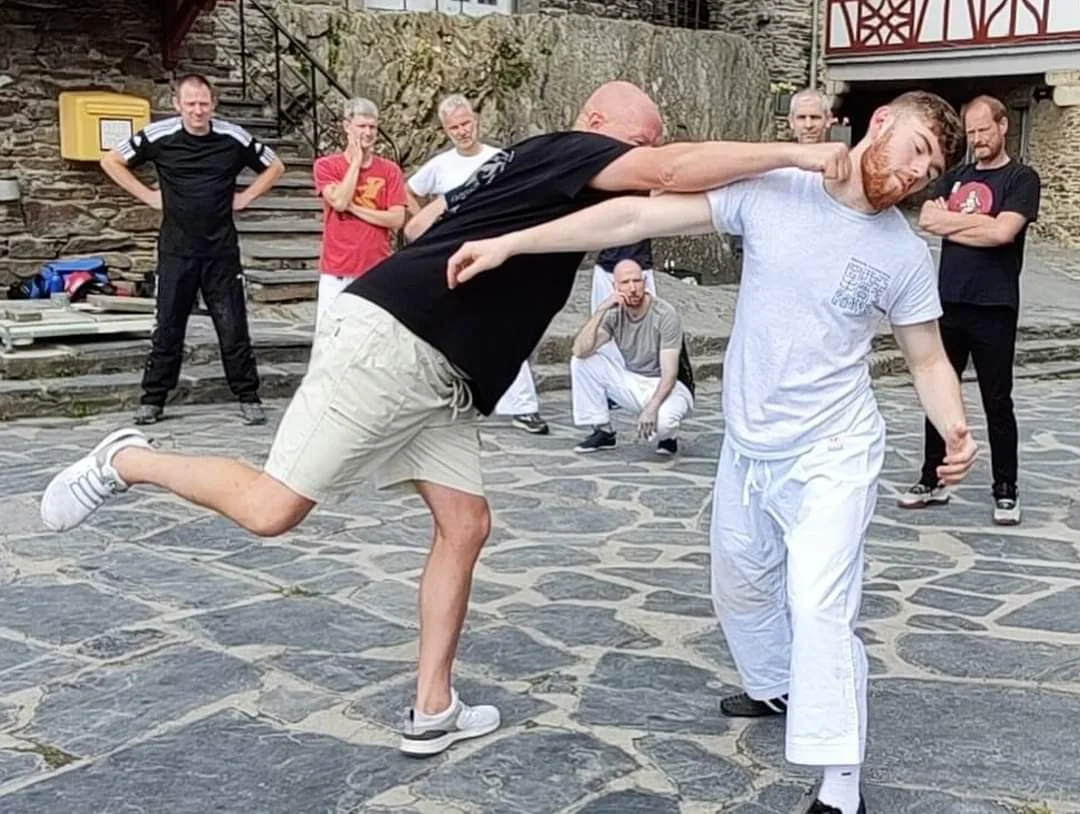
In this episode Jeremy chats with Sensei Christian Wedewardt about the evolution of karate, mentorship, and motivation in training.
Sensei Christian Wedewardt - Episode 1058
SUMMARY
In this conversation, Sensei Christian Wedewardt discusses with Jeremy the evolution of karate, focusing on his journey from competition to practical karate. They explore the influence of mentorship, the importance of kihon, and the role of motivation in martial arts.
Sensei Wedewardt shares his teaching philosophy, the impact of seminars, and the significance of tradition in karate. The conversation also touches on the importance of teaching children and building character through martial arts, concluding with a call to make karate attractive for future generations.
TAKEAWAYS
Sensei Wedewardt emphasizes the importance of mentorship in martial arts.
Kihon should be viewed as a tool for practical application.
The transition from competition to practical karate can be transformative.
Motivation and success are key components in teaching martial arts.
Teaching philosophy should focus on principles rather than imitation.
Seminars can create light bulb moments for participants.
Practical karate aims to make techniques applicable in real-life situations.
Children's karate should focus on personal growth and teamwork.
Tradition in karate should evolve to remain relevant.
Karate can serve as a management and leadership program for youth.
CHAPTERS
00:00 Introduction
02:36 Christian's Journey in Martial Arts
05:22 The Impact of a Mentor
05:40 Transitioning from Competition to Practical Karate
08:10 Defining Practical Karate
10:55 The Role of Kihon in Practical Application
13:13 Creating a New Teaching Methodology
15:47 Motivation and Success in Training
18:22 Experiencing Light Bulb Moments in Training
20:40 The Evolution of Karate Training
23:02 Modern Tradition in Karate
22:50 The Role of Competition in Karate Training
25:11 The Impact of JKA's Global Outreach
27:14 Redefining Traditional Karate
29:01 The Importance of Structure in Martial Arts
30:43 Karate as a Leadership Program for Kids
33:51 Teaching Practical Karate to Children
38:06 The Evolution of Karate Seminars
42:34 Connecting Through Karate: Building a Community
After listening to the episode, it would be exciting for us to know your thoughts about it.
✅Subscribe to whistlekick Martial Arts Radio on the following platforms:
🎧Apple Podcasts: https://apple.co/3mVnZmf
🎧Spotify: https://spoti.fi/3yHVdHQ
✅You can find whistlekick on all social media platforms using the handle @whistlekick or visit our website at https://www.whistlekick.com or https://www.whistlekickmartialartsradio.com
Show Transcript
Christian (02:47.574)
Let's start with karate praxis. That is what my passion is. I was a competition fighter like a lot of others.
did or do so too. And yeah, I was one of those guys going to the tournaments, fighting, winning and losing, depending on the very day. on one of these tournaments, I was lucky enough to win this day. And it was not a very high profile tournament, but a very well attended one. And the trophies people got on this tournament were
huge. my titles are smaller than this trophy from this tournament. And I won. And then there came this guy to me and said, I like the way you move. I like your approach on the mat and how you treat your opponents and so on and so on. And he said, I would like to invite you to my dojo. I said, OK, who are you? Where are you? And when can I come? And I went and this
was 1998. And I went to this dojo and telling this story in the first place, it sounds a little bit arrogant, but it's completely the truth. I entered the dojo like Master Ken. OK, enter the dojo. Yeah, yeah, I went into the dojo and he said, look, Christian is here. Everyone grabs a partner fighting. And I was the best. So.
Jeremy Lesniak (04:19.725)
I was thinking the same thing.
He's been on the show.
Christian (04:35.634)
I was able to kick everyone how and when I wanted. And then he said, OK, no kizami is OK, so no front punch, no cross punch, no roundhouse kick. And he took away my few tournament techniques, which made me a winner. And from this point on in time, everyone kicked my butt. And I saw a karate I haven't seen before with elbows, clinching, with close quarter combat
locks and throws and I'm getting goosebumps talking about this and I was so astonished seeing that my karate is so limited and seeing that there is this whole variety a new world and as it is this karate. Anywhere? Yes.
Jeremy Lesniak (05:20.577)
Was it exciting or was it embarrassing or scary or a mixture? You have goosebumps talking about it now, but tell me more about what you were feeling when it was happening.
Christian (05:35.963)
I was helpless. I was a good fighter, but all I knew was taken away. And so I was not allowed to use my best techniques. And so I was limited, limited to that. Let me put it that way. And on the other side, seeing how beginner belts, intermediate belts were way better than I was in this little bit left.
So, and I was surprised, I was excited. And I asked, this karate? And he said, yes, this is my karate. And I never left the dojo again. Up until now, he is my teacher, my mentor, my best friend, godfather of my children. Without him, and his name is Ludwig Binder from Germany, eight dan now, he was a second dan back in the days. And he said, I will never do a test. I'm ready, I'm done with tests.
And I convinced him to go. he went to the third Dahn test. I went to the second Dahn with him together. And so over the next years and years and years, we developed together. And yeah, up until now, he's a source of inspiration of, what is the right word?
Christian (07:00.751)
Yeah, finest, finest moves. He's very, very skilled and very smooth in every move he does. And everywhere he touches someone, hurts. So this is very, very inspirational.
Jeremy Lesniak (07:20.514)
Let's cook.
And it's amazing that you have someone like that. think those of us who have had someone like that, whether it's in martial arts or not, we recognize the value and how special it is. And it's clear that you see how special this person is, which is why you're still training with him. But I want to go back to this light bulb moment, because some of us have these. I've had one of these with regard to martial arts. And
I think quite often it ends up, the story ends up being fairly similar. It's not always around competition, but martial artists gets pretty good at a certain skill set with a certain group of people and they feel confident and they're proud of their skill and they're proud of the effort that they've put in. And they find themselves in a different environment, whether that's a confrontation on the street or a different style of competition or they
travel and they're at a different school and now all of a sudden the world that they thought they understood that they did very well in the world looks a little different and now the effort and the skill doesn't translate the same and I think for a lot of martial artists that is so big and so scary that they stop
And they say, OK, I don't want to do that. I'm going to go do this. Now, I've had that experience with students that come into my school from other training. And I'm thinking of someone right now. I'm going to be very vague. They're not training with me anymore. And to be frank. They thought they were much better than they were. Because what they were exposed to was very set, right? Hornament competition, competition sparring.
Christian (09:11.618)
Mm-hmm.
Jeremy Lesniak (09:20.557)
It is something and it is very specific in what it is.
Christian (09:26.594)
Yeah.
Jeremy Lesniak (09:28.887)
So now, so what I'm, I think most interested in from you is did you put down tournaments and did you just dump them off entirely and say, I want to do this, this is where I want to go. Or did you, as I do see, okay, there is value in different ways of approaching this.
Can I bring my tournament skill in and can I find a way to apply it?
I'm curious.
Christian (10:01.61)
Yeah, yes. When I, when I found this dojo, I wanted to learn this field, of course. And I went for several years to other tournaments, nationally and internationally. my, my interest shifted. So at a certain point I stopped competing and I wanted to learn more and more and more in this practical karate approach. So with self-defense, with
everything you need to apply your skill set with a with a physical demand. So power delivery and pet work, all the things in the WKF world where you fight without any heart contact was different. So I was looking for this. So and over the years it was
I think my teacher Ludwig was one of the first in the German Karate Association who trained like this with some impact, like a folk contact guy almost. And it was really inspiring. So I was underway in both worlds. And more and more I shifted over the years to the practical karate scene without going to tournaments. I'm now 51.
And I was never into going to the tournaments, getting older, 30 plus, 35 plus, and so on. Fighting the same guys who were 18 at the same time when I was 18. I didn't like this idea. So I stopped competing and started to work in the self-defense area, karate based.
And I learned and learned and went to different clubs and made an Kav Maga instructor intensive course, which was really a crazy time.
Christian (12:11.015)
Some of my friends joined me going to this intensive Krav Maga course. And most of them stayed. They left karate for Krav Maga because they said, this is way better. We don't have to do all the traditional stuff with all the rules of keeping the traditional parts high with all the bowing and ceremonies and, and, and, and, and, they just stayed in this
self-defense environment. For me, it was completely different. I was with all these Krav Maga specialists and I only saw karate. Probably because of things my teacher told me, I just saw them move how I move and I saw that it is pretty good to do it slightly different because they have got very good sense of making it applicable.
yeah, OK, just thought I lost you in the connection. And then I started to change my.
Jeremy Lesniak (13:14.945)
I'm still here.
Christian (13:18.509)
Yeah. And then I started to change my way of training for myself, the way I teach people. And I created processes. That was when I changed the way I teach karate. So I created rule sets of how we train, how we treat partners. I created processes. So I'm not one of those teachers.
who are in front of a group showing what I can do best and everyone has to copy me the best they can because no one will ever be a better version of myself than I am. So they are all copies if they try up until a certain point, of course, the copy thing has to be there. But what I do is I bring principles and processes into class and showing the principle everyone
can and should apply the principle a little bit to their bodies and possibilities to be an original in the end. So we're all doing kind of the same, following the same structure, but everyone is able to change it a little bit in order to their special needs.
Jeremy Lesniak (14:41.237)
I want to talk about the term practical karate. We've used it a couple of times and while we have had folks on the show like Les Babka and half a dozen others who have had a similar story, they came up as I did in a very traditional environment and found at some point along the way, hmm, maybe there's another way to look at this. What do you mean when you say
practical corruption.
Christian (15:14.169)
I'm a born Shotokan guy, let me say it that way. So when I started, I started karate in a Shotokan dojo. And Shotokan people, without being disrespected, are very, very good in technical details. But not usually, let me say it that way to be a little bit polite, in the way they apply it on pets.
making it functional in working with partners outside the tournament skill set. and what I describe as practical karate is making everything we learn in kihon techniques, kihon combinations, in syllabuses, in katas, given katas, in bunkai applicable in partner work up until the point that it has to work itself.
defense situations. That is the way I train. So for me, like Andy Allen put it in one of his texts, Keyhorn is a tool, not a goal. And that is how I work. So if we train Keyhorn, we are doing it not at a reason for itself. We are training Keyhorn for a little bit, say 10 minutes, 15 minutes, put out some important information, use it on pets, use it on sandbags.
in partner work and so
Jeremy Lesniak (16:48.353)
those out there in the audience who might not be familiar with the Japanese term, Kihon is basics, your basic techniques, your fundamental techniques.
Christian (16:54.304)
Qihon is basics. Yeah, yeah, yeah, exactly. And a lot of dojos I have for the chance to train in the past used Qihon, so basic training, as a goal in itself. So Qihon was for Qihon. Qihon was not to point out some things, to train some special influences in this techniques to be better at pads.
Jeremy Lesniak (17:00.919)
Okay.
Christian (17:23.209)
at Sandbag, at Makibara, in partner work, in self-defense. So for me, it's just a tool, like Andy put it in his text.
Jeremy Lesniak (17:34.677)
Yeah, yeah. And, you know, I think it's it's all tools. Right. That's that's kind of how I see it. Everything we're doing, because none of it is a real fight. None of the things that we train, no matter how hard we go, they're not real. So they're all tools. And
Christian (17:39.542)
Mm-hmm.
Christian (17:49.322)
Yeah.
Jeremy Lesniak (17:56.012)
We can only train so hard so often without being broken. So I. I've never I've never really made the separation you know that you I'm sure you think of of what you came up with. I spent some time in Shotokan as well. The 3K karate right? Kiho and Kata Kumite and again for the audience basics, forms, sparring and in a lot of schools they're trained.
In a very separate segmented way, this is the way we do our basics. This is the way we do our forms. This is the way we spar and you can see some overlap, but. What what I'm saying and Christian, what I think you're saying too is the line should be blurry.
Christian (18:41.814)
Mm-hmm.
Yep. Yep.
Jeremy Lesniak (18:45.165)
Is that a fair way of saying it?
Christian (18:48.566)
Yes, the question why should I learn this or this or that is something I was trying to find a reason over the last say 15, 15, 16 years when I started my project Karate Praxis in 2008 without being aware that praxis isn't a word, English
speaking people use every day. add to, to,
Christian (19:27.763)
I'm looking for the right word.
to describe what praxis means several times in the past. So praxis means application, practical. So I called it karate praxis. In English, practical karate. Without knowing that others are around there, I hadn't heard about Ian Ebernethy, for instance, in 2008 at all. I met him the first time in 2015 and we clicked immediately because same idea, same...
same foundation and so on. But we can speak about Ian and our connection later. So I started Karate Praxis to bring success. that was, let me go one step further back. When I made my fourth down in the German Karate Association, I had to write an essay. So, and most of these essays are written, handed over to the organization, and then they disappear forever. And like most of those essays do.
And I wrote it and the essay was called Karate Praxis. And the subline was everyone should know or understand that everything they learned in this session today is practical and self-defense matters. So, and what I was looking for was a way to motivate people because I'm a strong believer in this spiral effect of motivation and success. Every one of both.
helps the other. If you are successful, you are motivated. If you are motivated, you keep on going, you get successful eventually. So, and this is the foundation of all my teachings. That is the way how I approach a group with always with these two ingredients, motivation and success with some fun teaching. So every now and then a little joke, some, some
Christian (21:30.364)
something to get people attracted, to keep on going, to not feel that it hurts sometimes. And it does sometimes. So yeah, everyone should understand and learn that everything they do is practical in partner work. I wrote this essay, and then it was written. And I talked to my teacher, Ludwig, and I said, can you help me? I want to teach this way. I want to bring this idea on the map.
They know you. No one knows me. I'm this competition guy, fighter. If I put out a flyer and say, hi, I'm Christian. I want to teach a seminar and no one will come. And this was exactly what happened. My first seminar was six people. And then he started helping me. People came to see him. was his support. And over the years, people saw me regularly getting hit by him.
with his teaching, sometimes with my little idea. So I stepped by, by, by, by, by, now we are teaching equally. And the idea was always the same. Bringing the kind of success I had winning tournaments without going to tournaments, stepping on the mat, doing something practical with partners, understand that it works, that it makes sense to do it that way. And going home,
Christian (22:59.193)
to spouse parents, friends and telling them, hey, yesterday training, training was fabulous. I did it that way and see how it worked. That is what I'm looking for, to bring ambassadors out of the dojo on the street in schools and companies.
Yeah, he helped me being seen on the seminar. So I joined him. I supported him. People saw how he was teaching his influences on me, of course. And yeah, I stepped by. So I developed and nowadays we are teaching together equally. And he helped me to bring this kind of success. I experienced winning tournaments.
to the daily dojo floor for people who are not going to tournaments because I wanted to have them experiencing this kind of motivating moments, trying, doing something practical with partners that think, see, what I've learned today is really functional. It's practical, it works. Going home to spouses, to siblings, schoolmates, and saying...
Yesterday I was in my training and I did it like this and it worked and it's so great. Come and join me. Let's go to karate together. That is what I want to do and make karate friends, ambassadors for martial arts.
Jeremy Lesniak (26:03.117)
I would imagine that you've had some moments teaching where, you because you're teaching seminars I have in my notes that you've taught quite a few. And you've probably had people show up to these seminars and have a similar light bulb go off that you had those years ago. How do you feel when that happens?
Christian (26:07.279)
Thank
Christian (26:31.247)
Huh. Energized. Grateful. Thanksful. It's a very giving experience to meeting people, sharing my own passion, and making a difference. That is what happened to me back then. Meeting people and showing something they already know slightly different.
which makes a huge impact and they see things like a light bulb moment from another perspective and doing things differently from then on. That is very, very special. One moment, it happened in my dojo. There was a new woman coming to the training, black belt, and we did pet work, pick shields and training.
training goal was power delivery. So, and we just punched and I have this, I let this, training session and detail, detail, detail, detail. And in the end, everyone was able to hit the pad way harder than before, just by following this little, little steps. It was not something big. was just this little tiny screw and this, and then, and it's really true.
She hit the pad exactly like we trained it. She hit it, and then she looked at on her own hand and immediately water in her eyes and said, wow. And that was really amazing. And that was one of the very special moments when she experienced that she overcome something that she hadn't done before and experienced before. She was so overwhelmed in what she
is able to do and she never left the dojo again.
Jeremy Lesniak (28:37.069)
Here's a question. As the practical karate movement grows, there are more and more people who are changing the way they train from some of these. I don't even know that I want to call them traditional. I'm going to use the word contemporary, common, these common training methods. And they move to these different methods that
Christian (29:03.179)
Thank
Jeremy Lesniak (29:06.711)
people are calling practical. Some people are calling it an evolution of karate. I wonder if it's not more of a return to what karate used to be. What do you think?
Christian (29:23.403)
In this matters, I need to be very honest. There are people out there who have read every book available. I haven't. One day, someone said, I'm kind of the server in the karate teacher scene, like a punk. I'm doing things different. I'm trying to take the traditional content and
Jeremy Lesniak (29:34.913)
either.
Christian (29:50.367)
Yeah, again, turn the screw just a little bit, not too much to get rid of the tradition, but to use it, to present it in a modern way. And this is what my project, Karate Praxis, has as a subline, modern tradition. So I like to bring both together and...
I really think that the practical scene is the traditional, is more like the traditional side. And I don't think it is because of the training content. It is more because of we are not looking for tournament success. If you're going to tournaments in whatever association you are competing, there's a rule set.
And this rule set decides if you are getting some points for your actions, if you are winning or losing and following the given rule set in the association, you have to train. And if you need to train that way to make your points in the competition, it is the foundation for what you train daily. So I think the competition side of training.
is not traditional, but most of the associations out there are based on this so-called tradition, which is a sportive tradition.
So when the JKA sent out after World War II the instructors into the world, I'm pretty sure they didn't send the best teachers, they sent the most successful tournament winners in Qatar, in Kumite, world champions.
Christian (37:40.345)
in order to build a worldwide organized association to
Yeah, as a sports organization. This is what the JKA did. And this is a good reason to send out teachers into the world and spread karate worldwide. those teachers didn't show us the practical side of karate, the self-defense information of karate. They showed us what
they need to do to build up a worldwide organized sport organization. And I liked it. So competition is a good thing, but there is another side too. And since this so-called traditional teachers didn't show us the full picture, it's the practical karate scenes task now to redesign, redevelop
all this information and it is a what is the right word the word is missing it is
Christian (39:07.287)
Exciting, exciting. It is an exciting time to be and thing to be a part of this redevelopment of practical applications of moves, of cutters, bunkai, making karate self-defense applicable again, not just technically, but also tactically and mentally.
So the full side, there's more like in dietary, there's more than just eating something. You can have all sorts of dietary. And I'm not one of those who think or even say that one side is better than the other. It should be something available like in a good buffet for everyone.
Jeremy Lesniak (40:03.415)
You know, one of the things that I think is very important in martial arts is, you talked about this with some of your friends that went on the Krav Maga. There's no bowing.
In many of these schools there there's a.
there's not as much formality.
And what I've noticed is that it's from a lot of this formality, the bowing, the structure that people grow personally. Not to say that other aspects of our training don't help people with their growth. But when we think about children,
Featuring them to bow and use titles and follow these protocols is really important in their development.
Christian (40:57.63)
See ya.
Jeremy Lesniak (40:59.477)
And so I look at this and I like the way that you phrase it as a buffet and say, for some people, they want this much sport. Some people want this much sport. Some people want this much practical. Some people just want to know, you know what, when I'm done competing, yeah, I can I can take a path and make this work. And to me, that's the beauty of martial arts is that it can be so different. It is it is.
I don't think any martial artists approach their martial arts in exactly the same way. We're all a little bit different because we're different and our goals are different and our bodies are different. And I think that's a good thing.
Christian (41:35.956)
Thank you.
Christian (41:40.564)
Yeah, Yeah. Coming back to kids. I have a friend, friend of mine, she on Michelle Gay from Manhattan. She has a big dojo in Manhattan. She inspired me when I visited Manhattan as a tourist. As some of us do.
wherever I go, I've got my gi with me and I try to connect to people locally. And I did. I showed up in this dojo, which is an interesting story as well. and I trained there and I met very nice people. is a, a full contact dojo. And I, I'm this Shotokan based guy. So I'm coming into this full contact environment.
was special, inspiring special, very, very great karate, very great teaching. And she and Michelle said karate is a management leadership program. And that is exactly what I heard you saying, using titles, bowing, following, rule sets, and so on and so on. It gives structure.
forces respect, give and take, being responsible for things, taking it home, what you learn, being a good person in society.
It is exactly what we are doing and while at least in Germany, I think it is a thing all over the world. Nowadays, both parents have to work to make a living. normally grandparents are living somewhere else and who is raising the kids? Some nurseries, some schools, some kindergartens and those people
Christian (43:50.211)
are not allowed to force kids to follow the rules. They can set up rules, but they are not allowed to make the rules work. And so this is where karate or traditional martial arts with all these rule sets are coming into place. The rule set is given, the teacher is
The teacher, regardless of if woman or man, is the one who makes the rules, who takes care of the rules, who makes everyone follow the rules, should be the one who rules as an example, of course, not just forcing and being an asshole. Sorry for the word. Yeah, it's true. My information for my teacher was the highest rank
person should be the nicest guy around. That is my motto and his as well. so from my point of view, karate dojo is a place where kids can have a very safe environment since everyone is gentle, everyone is reliable, responsible, just be a good person. taking all the
traditional martial arts rules, rules sets, meaning from my point of view are meaning today. Just be a good person.
Jeremy Lesniak (45:30.849)
We agree and I suspect on the surface at least most people would agree. Maybe not always in the way that it's implemented, but people would agree. what about practical karate in kids? Do you teach children?
Christian (45:48.885)
Yes, I do. I do.
Jeremy Lesniak (45:51.628)
How do you, assume that you've got it, know, almost everything that we do in martial arts has to be at least a little bit different between adults and children. What's different about practical karate as you train it and teach it with your adults versus your children?
Christian (46:10.467)
Yeah, the first and biggest difference between adults and kids is the impact thing. So kids are training without impact, at least with me. I'm teaching kids with another goal. The goal for kids is not to be able to hit very hard, to kick very fast and hard. Of course, the physical part is always...
Jeremy Lesniak (46:18.509)
Hmm.
Christian (46:40.405)
I think in training because we are training. But what I'm trying to reach teaching kids is making them grow inside to be well aware, self-assure, to learn and live respect towards everyone, each other and to, and this is exactly the point I was speaking about two minutes before.
I can within the safe environment dojo on the mat force kids to overcome fear and borders. Sometimes, just as an example, I put a mat on the wall, a thick, thick mat. I don't know the English word for that, 40 centimeters thick mat. I put it on the wall, some soft mat and
I make them run against it without stopping, just run against it. Bounce in, bounce back, some fall on the ground and we make the rules before we start. If you bounce back and you fall on the ground and your knees hurt a little bit, don't cry, stand up and do it again. So dare to do things. Experience that sometimes it's a little bit hard to...
reach the next point and to understand that sometimes if things are a little bit difficult, little bit strange or hard to do, that it makes them grow and that they are getting stronger knowing that they can stand their ground and be strong. This is what I
want to do and I have certain seminar concepts. My kids program is called Karate Praxis for Kids. And there's certain seminar teaching concepts which I call inner power, which I call team building, like in a company. they learn to, on the seminar in one session that they
Christian (49:06.765)
have to work together. It's just a task. And I tell kids, this is a task and the task is too big, too heavy for one kid or two or three. They have to work all together to carry something heavy, to manage some things in the gym, like putting material from one place to the other.
building up something and so on. And they only can do it together and they have to arrange themselves without any adult to help them. To tell them do this, do this. I talk to them and say, okay, talk to each other, manage it. If you need help for your job, find someone who helps you and so on and so on and so on.
Jeremy Lesniak (49:45.645)
Hmm.
Christian (50:04.007)
And there are certain tasks where they have to be a little bit, what is the right word? They have to dare to do it. So this is a team building program. Then there's another program called Hollywood. This Hollywood thing is like in the movies. They are doing
several big combinations with kicks and spins and jumps and all the parents and grandparents can put out their phones and film it to show it all the other relatives afterwards. So what I want to do with kids is make them grow internally, make them proud, make them happy and let them know, understand and learn that they are great people.
Jeremy Lesniak (50:54.699)
Mm-hmm. That felt so.
Let's talk about your seminars a little bit because I know this is such a passion for you.
Christian (50:59.69)
Yeah, I just love it.
Jeremy Lesniak (51:07.725)
How long have you been doing seminars? It's been a little while, right?
Christian (51:13.221)
Excuse me, I didn't get the question.
Jeremy Lesniak (51:16.301)
That's okay. How long have you been teaching seminars? It's been, it's not, you didn't just start this. You've been teaching seminars for a while.
Christian (51:24.618)
Yes, as I mentioned previously, I started in 2008 with my project Karate Praxis, got help from my teacher, started and in the beginning only a few people gave me a chance. So first seminar was six people in December 2008. Now my biggest seminar I taught completely alone was 250 people, which is like a football stadium. Actually the people inside my dojo
Jeremy Lesniak (51:52.887)
Yeah.
Christian (51:54.376)
Who are filming with me for my online course system? I am developing from this dojo from Berlin so they drove 600 kilometers to help me filming and I I taught last year in in Berlin this seminar with
Jeremy Lesniak (52:07.543)
That's great.
Christian (52:15.527)
100 kids, 50 parents simultaneously on the mat. I think for three or four days they published the video. It's on my channel on Facebook and Instagram. People can see how many people were there and how much fun we had all together. And another 100 youth and adults in the next class.
That was pretty amazing. Yeah, back to your question. I teach 30 seminars a year all over the world. And this is what I love. I love sharing my passion for karate. I love to bring people to kind of the same light bulb moments I had by experience. what I'm doing is great.
What I can do is even more and so on and so on to motivate and to bring success and motivation to people. And the greatest thing I'm lucky enough to do is to host a castle seminar in Germany. I do this since 2009, Karate Praxis Castle Seminar, which is...
has been attended by 350 different people so far, not at the same time, so different people in the last couple of seminars. And last July, we were 110 people from 14 countries training, living, and socializing on the castle right next to River Rhine in Germany. That's really amazing.
Jeremy Lesniak (54:08.845)
wrong, Ebernethy was involved in that, wasn't he?
Christian (54:12.222)
Yes, we are sharing the summer retreat for a couple of years.
Jeremy Lesniak (54:15.661)
I thought I remembered seeing him post something about it.
Christian (54:20.607)
Yes, last July Master Ken was a part of it too. And Matt Page, without being in character, was teaching too his Kempelkarate. People loved it. Ian is great. And Matt has got the same passion for teaching Ian has and I'm having too. So people were so excited seeing, yeah, Matt.
outside of his character teaching Kempo Karate which was pretty cool and in 2027 both will be back so Matt and Master Ken.
Jeremy Lesniak (54:59.563)
That's great. Both absolutely wonderful people who have been on the show. And fun fact, I haven't brought this up in a while. Matt Page started his training 45 minutes that way.
Christian (55:13.376)
you're an albuquerque.
Jeremy Lesniak (55:14.605)
From what, from what, no, in Maine. He lives in Albuquerque now, he started in Maine.
Christian (55:18.2)
In May? I didn't know. Yeah, I remember. He told me he is originally from there. Okay. Fool. The world is a bitch.
Jeremy Lesniak (55:30.029)
I, the martial arts world gets very small very quickly. And yeah, yeah, I grew up competing with his instructor and some of the some of fellow students and yeah, he and I, I don't know, I didn't know him back then when when we were kids and we were competing, but we go way back. Indirect.
Christian (55:35.969)
yeah. yeah.
Christian (55:53.792)
So cool. Yeah. Yeah.
Jeremy Lesniak (55:55.948)
Yeah. If people want to find out about your seminars, where can they go to? mean, 30 of them. There's got to be one near most people. Where can they go to learn about them?
Christian (56:06.879)
on my website, which is lucky enough available in English now too. It has been a German website only for the most time, but four or six weeks, the site is mainly in English because when I started, I was just this German guy and I had no vision of teaching internationally somewhere in the future.
Um, yeah, to, to let you know this part as well. Um, I didn't know about Ian Abernethy and a friend of mine came to me and said, do you have you, have you ever seen Ian Abernethy? said, no, I've never heard of it. And he said, go, go on the internet, look it up. He's doing things similar than you do. And he's great. And I had some, some hundred followers on, the socials and I looked it up and Ian had 15,000.
back then, now it's way more. And I wrote an email to him. And I like to explain it that way. Internally, I'm an American. I know, I've learned as a kid that if I don't ask, I don't get any answer. So I ask. And when I ask, I can get three possible answers. Yes, no, or fuck no.
So, and Ian's answer was, as he is, very polite, very, very supportive. And I asked him how he became so visible on the socials. And if he can give me some support in getting attached to more people. And we clicked immediately as friends.
And up to now he supports me and he helps me and he invites me over at least one time a year to the UK to get in contact with the UK people, which is also helpful. Yeah, and then some weeks ago we changed the main language on the karatepraxis.com website. This is where people can find information about what I do and how I do and who I am and so on.
Christian (58:34.82)
And lucky me, now I am able to teach in several countries and I can jump into planes, go to nice places, meet nice people and share my passion for karate. I'm the happiest version I can be.
Jeremy Lesniak (58:55.885)
fantastic and and I hope I hope that our paths cross soon I'm gonna have to check out where your seminars are I'm sure I'm sure you've got one 30 30 a year yeah there's gotta be one that's not too far away to the audience I hope you'll you'll check those out as well we're gonna have that link karatepraxis.com as well as the social media linked in the show notes wherever you're gonna watch or listen to this episode and if you're listening remember we do video versions of all of these
Christian (59:10.427)
Happy New Year.
Jeremy Lesniak (59:25.805)
Christian, I really, really do appreciate you being here. And I'm going to have you close this up. What do you want the audience to come away with today? What are your final words to them?
Christian (59:36.26)
Yeah, friends, you probably have noticed that I can hold back my passion for what I'm doing. It is on us, on us learning karate today, teaching karate today to make it as attractive as possible for the next generations to keep on learning. And for this one friend of mine once said, tradition is an old fashioned. And if we miss the chance to always develop
it slightly and carefully a little bit forward, then karate could be an old-fashioned one day and we shouldn't let that happen. So turn the screw a little bit, make it attractive and make the dojos full of young people for the future.