Episode 1059 - U.S. Past Guest Panel Discussion
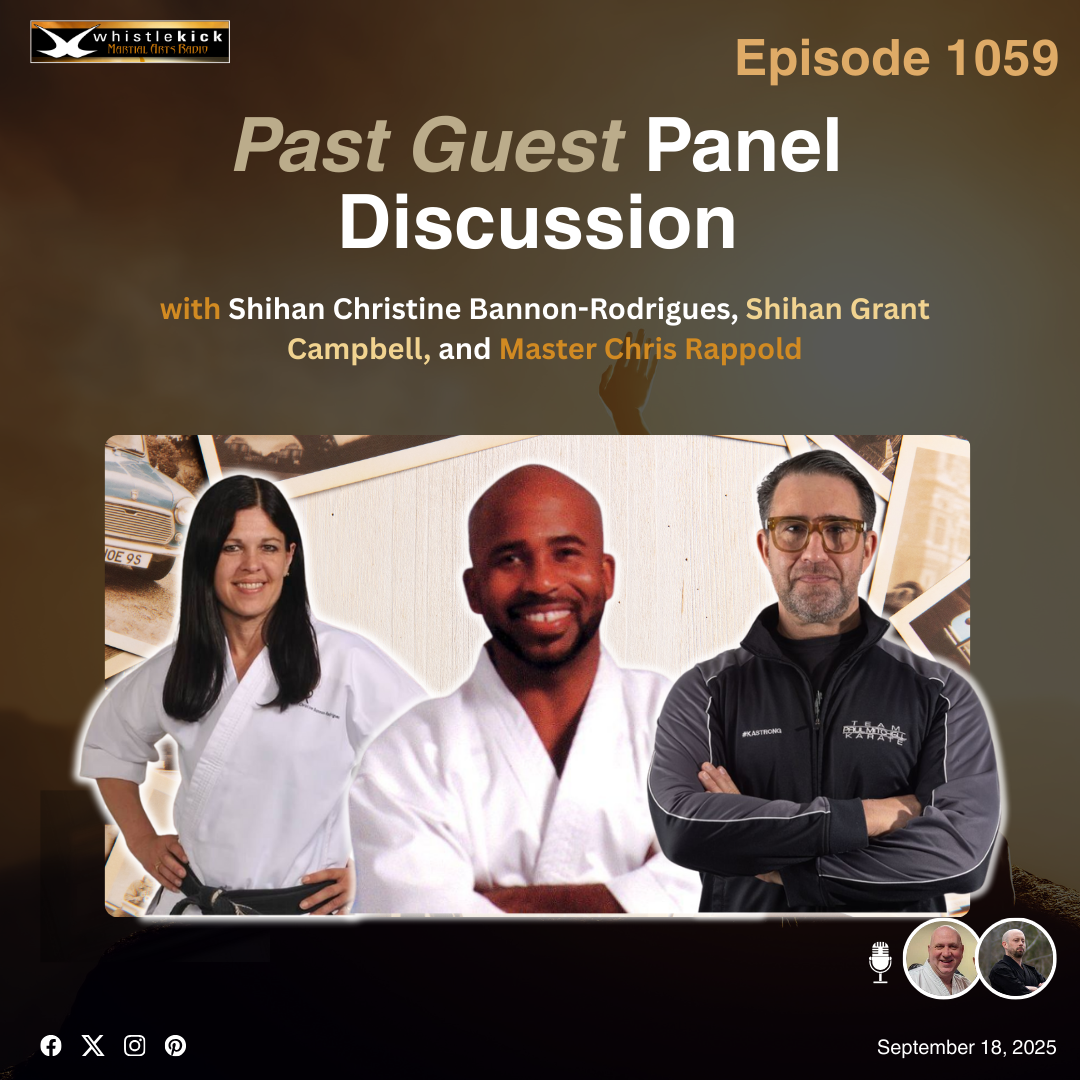
In this episode Jeremy sits down with past guests Christine Bannon-Rodrigues, Grant Campbell and Chris Rappold to discuss martial arts and how it has changed in the last 50 years.
Past Guest Panel Discussion - Episode 1059
SUMMARY
In this episode of Whistlekick Martial Arts Radio, host Jeremy Lesniak welcomes back three past guests, Shihan Grant Campbell (#124), Shihan Christine Bannon-Rodrigues (#26) and Master Chris Rappold (#950), to discuss the evolution of martial arts, the impact of technology on training, and the importance of relationships in coaching.
The conversation explores how communication and collaboration have changed within the martial arts community, the role of technology in enhancing training, and the significance of fostering trust and overcoming self-doubt among athletes. The guests share their insights on the current state of martial arts and how it has transformed over the years, emphasizing the need for adaptability and support in the journey of martial artists.
TAKEAWAYS
The level of competition in martial arts has significantly increased due to technology.
Communication among martial artists has improved, fostering collaboration.
Technology has changed the way martial artists train and learn.
Building relationships with students is crucial for effective coaching.
Self-doubt is a common experience among athletes, regardless of their level.
Surrounding oneself with supportive individuals can enhance performance.
The importance of trust between coaches and athletes cannot be overstated.
Online training has become a valuable tool for martial artists.
Maintaining original intentions can help overcome challenges in training.
The evolution of martial arts requires adaptability and openness to new methods.
CHAPTERS
00:00 Introduction
01:19 Evolution of Martial Arts Training
05:44 Impact of Technology on Martial Arts
10:41 The Shift to Online Learning
18:16 The Role of Relationships in Coaching
25:47 Overcoming Self-Doubt and Building Trust
After listening to the episode, it would be exciting for us to know your thoughts about it. Don’t forget to drop them in the comment section down below!
SHOW TRANSCRIPT
Jeremy Lesniak (00:01.058)
Well, welcome out there. Welcome to another episode of Whistlekick, martial arts radio. And I think this might be the first time we've ever had three past guests back at the same time in person. Absolutely.
So we'll start next to me, because there was some discussion beforehand of order and introductions and everything. So Grant Campbell, Christine Banner Rodriguez, Chris Rathold. I don't know what episode numbers they were. We will probably drop those in the show notes, but I think Christine, you were on forever ago. You were in the first 50, and I don't remember where you were. You weren't a whole lot longer after.
One of the great sins of my life is waiting so long to have you on. Well, I remember you saying that you really needed some better quality guests than those people that were in the... He didn't know that. you know, I think that came up with the idea. This might be the first episode that turns to a brawl, and you will watch me hide, because I don't want to mix it up with any of them, although the conversation earlier... Maybe this is my time.
We're gonna do it now. Now is the time. And you know, when we've done episodes like this in the past where there isn't really an agenda, we just kind of label it conversation. So what I'll throw out to the three of you that will likely give us a starting point is what do you see going on in the martial arts world, however you wanted to find that right now, that has both changed and is better than when you started training? That's very interesting.
Me? I don't know, make her start. That's what I just saw. I think the level...
Jeremy Lesniak (02:09.837)
especially in the forms with the CMX divisions. It's great to see the traditional divisions still pumping along and especially with the Olympics and stuff. But the CMX divisions, the amount of flips these kids are doing and kicks and before they land and it's just incredible. And I would definitely say that level and also technology. You know, back in the day it'd be like,
Grant, did you ever see that girl fight? You know, I'd ask him, you know, and, know, now you just Google them. You just Google them. The kids are studying each other. So I think it makes the competition tougher for these guys because people study every move they make. So they have to constantly be evolving and changing their fighting strategy. Chris, would you say that the technology elements, has that changed the way
teams, know, like Paul Mitchell and the members of that team prepare for competition? Absolutely. In the case of team Paul Mitchell, you have coach, coach Damon and he, I mean, he's got to do probably three hours of film study a week, you know, maybe more, both looking at tapes of our team members training, looking at past fights they've had, looking at potential matchups and such. that would,
Yeah, no, like Christine said, I think that's a big difference. The other thing that I would add is, and I think she's 100 % right, and I'll go to one event and I'll talk about two things that have changed. In 1995 was the year I won the first world title. I had been unsuccessful two times before, but the person I was fighting was a point karate champion and a full contact world champion at the time.
All I had was a VHS tape of him doing his full contact. So I had, you know, there's a different delivery system. had no idea when I got in the ring, his things were. just saw him killing people in full contact. Now, coincidentally, in that fight, within five seconds, he knocked me out cold. I went into the first exchange. When you won the title, you got knocked out?
Jeremy Lesniak (04:34.189)
Okay, that's an interesting path. Within five seconds of the first round, I went in and he leaned away and he caught me with a hook perfectly. And here's what's changed. I remember her husband saying, give him smell insults, Ted. We gotta get him back in this fight. They woke me up, gave me smell insults. I fought six more rounds and I won the world title. Now, 2025,
They would have that's criminal. you know, there's no way no medical staff is going to clear that these days. You wouldn't have been able to fight for probably three months at a Naska sanction or Waka sanctioned So I agree. Technology for sure. And then the second thing, and I think it is a good thing, I think the safety protocols. And you've fought all over world.
As things changed here in the US with those safety protocols, do they change everywhere?
Yes, in some ways, yes. In some regions like, let's talk about Japan, Indonesia, the issue of liability is quite different. So when people practice martial art, there are certain things that come along with it, and that's expected, it's anticipated. So there's no lawsuit because of contact in Japan, nothing like that. I think...
Personally, one of the other things, in addition to what the two sensei here said, I think the level of communication overall that has occurred within the martial arts community is much greater than back in the day when we all started. Specifically when I started, was almost like rival gangs. Each school is almost like a rival. You didn't even want to be in a locker room at the same time as another school. Yeah, was really a different period of time.
Jeremy Lesniak (06:37.131)
You know, not that there's each, there's still an element of competitiveness, but it is overall a lot easier to communicate within different schools, different styles, instructors communicating with students is different. You know, it's not just a grunt and this way, you know, that kind of thing anymore. think we all know that, but you know, in addition to the technical.
technological advances, think the level of communication is very, different. Would the two of you agree that that fracturing that you stay over there, I'm going to stay over here. Competitive side has has softened because from what I see, I see the top level competitors being the ones that are helping the most.
Because it creates that cycle of okay. Well, I need motivation to get better So I might as well help, you know number two and number three get better because then it pushes me Is that what you're also seeing? think so. I think someone now and then in the past I think you had more rivals and you know off the mat They continue that that rivalry where you don't see it as much off the mat Once they get on the mat, they all want to beat each other. Of course But there's know, it's one sport that
They bow, they hug each other after, and half the time you'll see them at the restaurant together, sitting together, you know? So it's different than other sports, I think. Yeah, I think with the onset, again, going to technology of Zoom, I can speak to Team Paul Mitchell. Our members are booked solid all week with Zoom privates, with people from all over the country. we look at it as our, you know, I guess we look at it as our responsibility of grooming.
the next and they take a great level of pride in that. That's my student. I've been working with him for about four months. Where that wouldn't have been possible in the past. Let's talk about video technology, Zoom. We're recording here. We're using a recording platform and it is...
Jeremy Lesniak (08:50.433)
Nobody's watching live right now, it has that capacity.
Jeremy Lesniak (08:57.421)
pre the period of time I'm going to try not to name because YouTube doesn't like when you do. Almost everyone was down on that notion of distance learning. You've got to be in front of them. You've got to see them. You've got to be able to walk around. You've got to feel what they're doing. And I don't think I saw any group of martial artists more rapidly toss aside something that I'd been hearing my entire life.
than through that period of time. Was that also your observation? And then would you all speak to that? you both OK? guess first of all, I think the experience is such that I think there were some of that that was perhaps a level of insecurity. And, you know, I'll include myself in in that because, you know, there was always such a level of pride that as they both said that
you only learned it at your school. And now all of sudden there's look into your school and all of these things that you had to work so hard to learn are just now out there. So I think there was probably a little bit of that. And maybe that's why it said, well, you can't learn from YouTube. You know what? You're not gonna learn martial art. You need timing and pressure and distance. You need the fine eye of.
masters, grandmasters to really hone that skill, but to give you a base to give you some idea of how to train. I think it's wonderful. I certainly I use it as a tool. And, you know, I think it's helpful. would I would. Yeah, I would be disingenuous if I said I haven't benefited from them. I would I would agree. You know, Jordan.
COVID time and that's all we had. And students were able to continue the training and stuff, but I think there's a lot to be said about studying online. You can learn a lot. That's really good. I wasn't even thinking about that, but the fact that you can't learn online and COVID, have to smash together. Now that we've named it, it's fine.
Jeremy Lesniak (11:20.941)
So no, it's okay. It's okay. You know what? We roll it. We're not gonna believe it out. Is that what you were talking about? So YouTube doesn't love it when you talk about the pandemic and cool things. So this will probably get and we'll probably not even see it. You probably won't even know this happens. We'll probably get some manner of manual review. Somebody's gonna watch some of this to see.
or they're spreading information or they talk about anything medical related and they'll see very quickly that we're not. But it does kind of segmented differently. But the reason I pull it to that time is that so many schools went, what do we do? And the very thing they said, you cannot do this. Most schools embraced it and the ones that didn't, most of them were not around anymore. And I just found that really fascinating because
You can't learn from books. You can't learn from magazines. You can't learn from VHS, DVD, YouTube. You have to be there in front of people. And then all of a sudden there were people who were taking their first classes over the internet. Yeah. My, my own experience with online instruction was a little different. Okay. I had my senior student, the student that I've had for the longest, he's been with me now.
nearly nearly 40 years. You don't look that old. I don't know how you pulled that off. had 35. That's amazing. He came to me in 2010 with this online idea and because it was new I didn't know very much about how it would be perceived but I certainly knew how the traditional martial arts community would view
learning online, learning on video, learning from a book, all of these things. Now, the truth that nobody says is you absolutely can learn that way. There is a difference between how you learn from a book or from a video. For example, a book and a video don't give you any measure of feedback. you can look at a picture, you can imitate what you see.
Jeremy Lesniak (13:44.64)
You can gain an academic understanding of perhaps the subject, but you don't know if you're doing it right or wrong. You don't know if your foot's in the right position. You can't see whether you're using the proper amount of force or these are the things that a watchful eye does. These are the things that a watchful eye will catch your posture, all kinds of things. You're breathing that kind of thing. Zoom and online instruction when done correctly.
eliminates all that. So it's a different method of communicating. Yes. And the history of, at least in the history of karate, specifically things like books were frowned on, know, karate is for doing not for writing and, know, and you don't want to put it in writing because the enemy will have the technology, you know, that kind of thing. But now we're in a different age and these are tools that
authentic teachers, good teachers can use to expand your reach and expand your ability to communicate with people. Because I can't count how many people have benefited from the new era. You know, at one time, at one time, only elite professional fighters would have the ability to review their performance with video feedback.
And now anybody with a phone can do it. Anybody with a phone can say, I'm leaning too much. Oh, now I get it. Now I see, you know. And these are, these are things that, you know, they didn't exist when I was coming up, you know, and it's a, it's definitely a step in the right direction and a direction that's going to make a difference for the next generation. I think it can definitely enhance your training. It can improve it. I don't think it should be the only training, you know.
And also from doing stunt work, you you learn about the camera and it has no depth perception. So if I throw, you know, a punch in front of his face, but that's this far away, the camera thinks if he reacts right, that I actually hit him. So as an instructor watching a student online, you also lose that depth perception. You know, if.
Jeremy Lesniak (16:06.605)
You can you can just see that car or this firing much better if it was in person man, please the two things One is that I agree with both of them There you know we the best coaches get to know their students in their Prescribing a certain I might learn sensei Campbell's form
but he might say, you you doing this move that doesn't look good or because of your hip, I think I might want to modify that. You know, some of the more linear teaching methodologies, you're not going to get that. I will tell you though, what is coming. I was talking to a dear friend out in California and the technology is there now between two companies. So if you can picture this, one of these two is up doing a form.
And then the camera is watching me do the form. And then the camera through AI, no, you need to take a little step to the left. You need to pivot your foot. camera is creating and comparing my body movements to the teacher that's teaching me. And that's that technology, even though it's not out, it exists now.
So that's the next wave that we all have to understand that's coming and embrace and be ahead of it so that we can use it. And that's not these two teaching live. That's these two teaching on a video. Right. And the AI is still correcting my posture based on what they're showing as this is doing the format 100 percent. It's giving me feedback.
That's excellent. What I'm hearing with that, that's really exciting. hadn't known that. When I think about where video and recordings kind of fit in, you know, we take the example of a form.
Jeremy Lesniak (18:09.269)
We've got all of our forms for my school recorded and available to my students, but that's a really hard way to blur. So we give them the initial exposure in class and then they can go home and they can practice because if you kind of get it a little bit, it's really hard to practice on your own. But if you put that video up and you watch, you can walk through and you can get some repetitions with it. But then with something more live like zoom, you can kind of go that next stage where there's some refinement because no, you're never going to catch everything.
on camera that you would catch live. But what I'm hearing with that AI, because it'd be very easy for it to construct a model and have like a translucent colorized model. So to show you this is where your posture should be and right. And you can see that that's another layer of refinement down the spectrum. And that's that's really exciting. It's exciting as long as we.
you know, figure how to best use it to serve, you know, the purposes. I don't think anybody is looking to replace a human being because there's going to be limitations on that. as a training tool, our athletes on Paul Mitchell are all over the world. you know, having a technology like this, could be important. Yeah, yeah. Nothing is going to replace.
The direct connection and that whole thing and the dynamic of that. But these, if we embrace them properly, like you were saying, this is going to be a tremendous asset. Just like what we do in a school, a modern school is not like ancient schools, right? We have different types of equipment that is able to help us to refine our art for people. They're not kicking trees, they can kick pads.
and stuff like that. So yeah, this is the same way. Yes, think it might. It's the thing that I think no matter what technology exists, I mean, we could have something we'll have, know, holograms projecting, you know, the instructors here, I'm modeling and maybe that instructor even has holograms projected back on a floor and they're watching those students. But no matter how far you get down that line.
Jeremy Lesniak (20:34.169)
No technology is going to replace a great instructor's ability to feel what that student is feeling and give them that individualized next step. Right? We can do it like me. can, we can do that. That's pretty easy to get someone to understand we're doing this thing. I want you to do it in this way. Okay, great. But what about that, that stage that again, I'm going to
drawlands and say a great instructor does this. I took it here, I think you should probably take it here, right? Those minor degrees of refinement because you're not me. That's right. A coaching example of that. If somebody said, coach Chris, could you coach my son? I can tell maybe him very general things.
But I really don't like to be put in that situation because I don't know that young man's temperament. Sure. I don't, can't tell if he's hurt. I can't tell if his best thing is working because I don't even know what his best thing is. I haven't looked at his opponent to understand how he's going to try to expose this a lot more.
And you have to have the knowledge of your athlete in the case of high performance coaching to really have a very positive impact on their performance in the ring. can't just take someone that knows the game and say, yeah, go tell them what to do. There's too many subtle factors that will change the outcome. Christine and we're best friends.
that aside but I never I could never kick like her so if she didn't know me yeah it's easy for her to look in the ring and say would you kick him in the head I'm heard I can't you know I have sciatica so there's there's that level of relationship right that that technology for it relationship that cannot be replaced
Jeremy Lesniak (22:53.261)
You've been through a few teams and been at it a while. When you think of that word relationship, you were all three of you were nodding, but start with Christine. When you think of relationship in the stack of things, an instructor, a coach, whatever label we're putting on it needs to do, how close to the bottom is fostering that relationship with the athlete or the student? Yeah, I mean.
from being on Transworld Oil and then moving on to Team Paul Mitchell. Team Paul Mitchell was, my husband was the coach, so that was an easy transition because he had trained me from day one. So that was a quick and easy transformation going over to that team. But being on Transworld Oil, mean, sometimes I wouldn't always have Chuck Merriman coaching me or Toki Hill. Sometimes...
you know, nasty Anderson jump in the ring and coach me and he'd be like, body punch, reverse punch. Like, I know I'm not a puncher, I'm a kicker. Yeah. Like you should know that, you know, so some coaches kind of like lean towards what they they do best instead of, you know, what you do best. And, you know, but I always worked well with Toki and with Chuck Merriman, you know, never was never really an issue with them.
But it does take some time for them, but they kind of knew me as a competitor and you kind of knew what I did and stuff like that. So, for them You put that pretty close to the bottom. It's pretty fundamental as you see it. Yeah. Yeah. And I see you nodding. It's number one, even when you come on to selection of your players. You know, people that are put on Team Paul Mitchell, I mean, we look...
It was probably 30 or 40 things, a list that we look at just in the selection process of getting to know them, even for them to get on that team. Because we want to make sure that that experience for them exceeds their expectations, not just our own. So foundational. I cannot do anything, at least the way that I approach it. I know Christina is very careful about the people that she puts on her team.
Jeremy Lesniak (25:15.679)
because there's a chemistry, there's a culture. So yeah, that is for me, that's number one. Yeah, I'll have you respond and then we're gonna start to align. Sure. I also agree that it's a foundation concept. think without the relationship, there can be no trust. And whether you're a coach or you're a teacher, a big part of helping people to...
maximize their ability and be able to break through barriers involves a level of trust because as their teacher, I'm seeing something in them or I'm seeing something that they're not able to see. If I'm coaching someone, there's a specific thing that I want to get through to them. The reason most people have these obstacles comes down a lot of times to self-doubt. How do you get through self-doubt? Well, sometimes having someone that
knows you and believes in you and believes in what your potential is can help you to break through a barrier. But if you don't have that relationship, you keep running into your own thoughts, which is a big point in the whole learning from a book, learning from a video. If there's no feedback, if there's no relationship, certain things can't be learned any other way. So by having
that feedback, being able to trust someone to help them to break through this barrier because they've gone through that barrier or they've assisted other people. This is, I think, a very, very important aspect that if it's not there, you'll see it in their performance and they won't really realize their potential. A quick story to reference what Sensei Campbell was saying, you know, I won't use the name, but she was getting ready to fight somebody in
incredibly formidable and her coach Saw that she was a little bit nervous And what did the coach do her coach? You fought her before no idea You fought her before how did I do you beat her like five nothing? What are you worried about? The fight never occurs No, I did occur, but I lost well
Jeremy Lesniak (27:33.6)
That I didn't know. The fight had never occurred. But the point is the coach knew her well enough to recognize in that moment. That's what she needed to hear to address that self doubt. Yeah, that's right. That's it's it's a human thing that we're all doing. That's 90 percent up here in the ring. That's right. You know, and after the match, he says.
Yeah, by the way, she beat you last time. I'm like, just like put my life on the line out there. He's like, why? He's like, you just did what you do. It's me ahead, you know? And I'm like, okay, all right, I'll give you that. So let's kind of wrap all that together. There's an audience out there that is watching it some point into the future because we don't have the technology for them to watch in the past.
Don't get anything. See when that caps. That'll change everything.
On these subjects of, I think we can wrap it into, to me, coaching is helping people perform at their best. Even if they don't believe it, even if they don't see their potential, I think that's the role that a lot of martial arts and frontiers take because we've been down that path. They're coming behind us. They don't know what it looks like where we are. So they have to trust us. given that context and what we've discussed today, what thoughts would you leave the audience with?
on maybe how to trust themselves a bit as they navigate their path because let's face it, none of us are with our instructor 24 seven. We have to trust ourselves for at least some part of this journey. I would say, you know, as martial artists, we were taught to walk through brick walls and fire and.
Jeremy Lesniak (29:27.895)
fight anyone, whoever signs up for the tournament, who's ever standing across from me, I have no idea who's at the tournament, I'm saying I'm fighting. So counter to that is vulnerability, fears, doubts, insecurities, we all have them, sorry everybody, I don't care who you are, I don't care how accomplished the person is. Everybody has a level of that, perhaps what I could say to somebody that's listening that might feel insecure that they think they're the only one,
You're welcome to the club for any welcome to the human experience. Yes. And be okay with that. I'm telling you it's okay. And then I'm telling you to align with people that can see more in you than you see in yourself. Trust that. And I think you're going to be very surprised and excited by what can happen. We'll come down the line.
I don't know what famous person said it, but they said, you know, the five people that you hang out with the most is basically what you're going to turn into. So surround, you don't want to be hanging around, you know, not the dumbest kids in the class, you know, or people that are getting in trouble and everything. You want to hang out and train and be with the people that are going to bring out the best in you. You know, and like he said,
Master Rap hold here said about having that vulnerability and doubt and not having that confidence. Everybody has it. It's all how you use that energy. It's all in your head, whether it's going out to perform, whether it's going on a TV set, if you're going to a test in school, whatever it is, we're all nervous. But it's the difference between the champion and non-champion is how they use that energy.
You know, I'm out there, I'm nervous, but I'm like, am gonna, I visualize, you know, I'm gonna smoke this flam or this person so much that everyone's gonna, you know, like I picture them, picture the flam being perfect. And even though there's that big of a crowd, you know, I can be like, my God, what if I fall? What if I slip? What if I, you know, if I keep thinking that, that's what's gonna be in my head when I'm performing. So it's how you use that energy. We all have it. We all have those thoughts.
Jeremy Lesniak (31:50.786)
before time, but it's how you use that energy and what you think about. In harmony with fellow sensei here, I think having a goal represents you walking towards something that is currently not at your level, or you currently don't have in your possession, right? So in order to do that, you're going to have to bring more of yourself.
into that experience. We all, all of us have gone through self-doubt, which comes down to, I really do this? Or, you know, those kinds of questions that we normally will ask when we're not sure if we can actually follow through on this. The people that you're around, that you surround yourself with, 100 % are part of your environment. Expecting that you're going to have that period of
Doubt is also a part of the path where you have to know that that's going to be an obstacle. You have to know when I have when I have new people sign up, you know, children to the school, I make sure that parents know there is going to be a day that they don't want to come to class, just like there is a day that you don't want to go to work no matter what job you have. Okay, there's going to be a time when you don't want to get out of bed. It's what you do in those moments.
that makes the biggest impact in Japanese, there's an expression, shoshin, wasure de karasu, right? That means basically, don't forget your original intention, which a lot of people will put up affirmations, they'll put up little vision boards and statements in order to remind them of what they're actually going after. And that creates that excitement, that creates that...
that feeling like, yeah, I want that Ferrari. my gosh, I want that. And they remind themselves of what they're doing in the first place. And that's an essential ingredient, I think, to breaking through that self doubt and all that. you stick to remember why you're here, remember what you're going for and why, you know, that increases the intensity that you bring into it and it will help you break through just fine. Sorry.
Jeremy Lesniak (34:11.502)
And that's a perfect way for us to close. I want to thank everybody for being here. Thank you to the three of you. Whistlekickmarshallarchradio.com and we'll get the episode numbers and links depending on the platform below for all three of you. Thanks for having us on. Thank you. Bye everyone.