Episode 1071 - Martial Things with Jason Brick
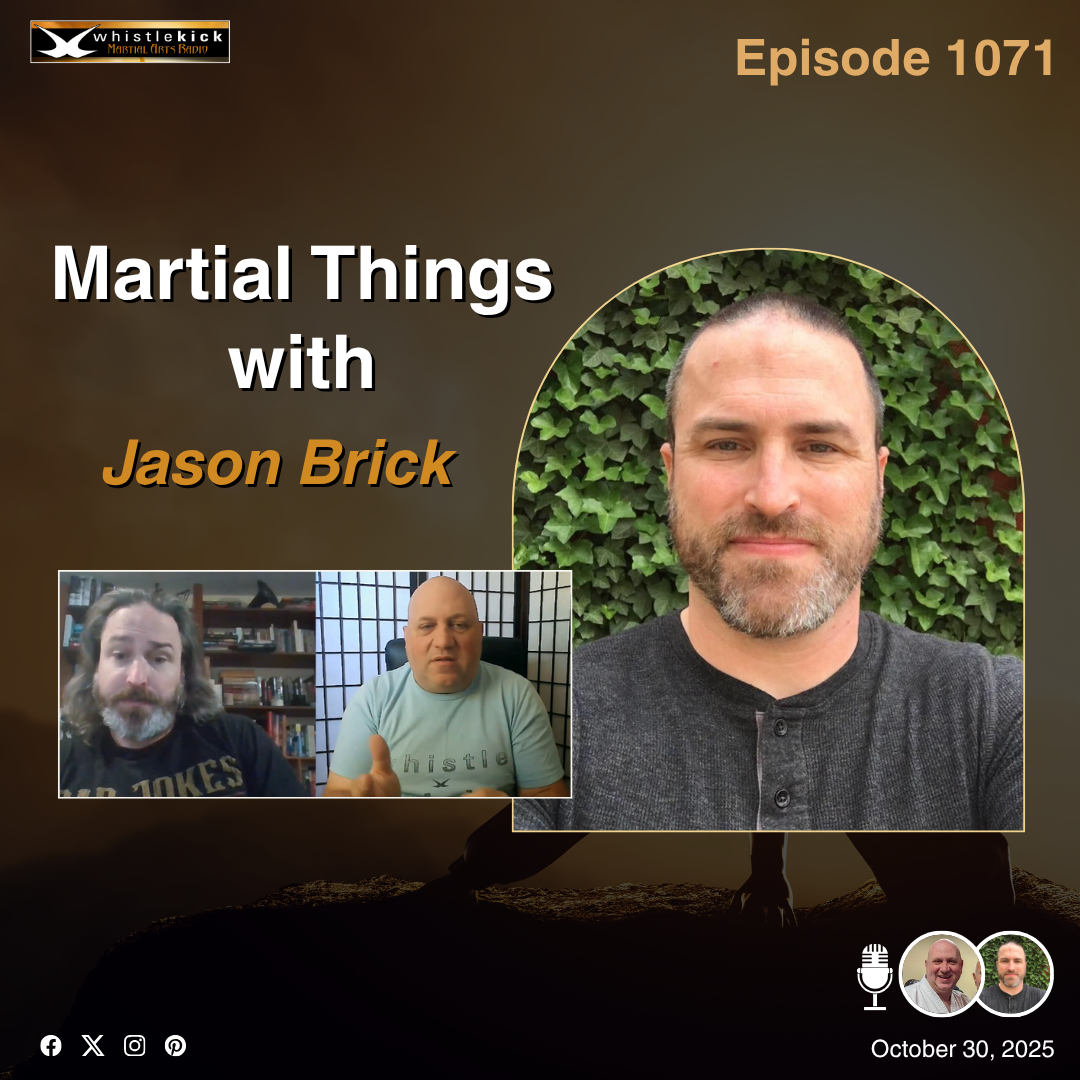
In this episode join Andrew in whistlekick’s Martial Things series. This week he sits down and chats with Jason Brick with a plan to talk about……. nothing. No plan, just a conversation to see where it takes them.
Martial Things with Jason Brick - Episode 1071
SUMMARY
In this engaging conversation, Andrew Adams is joined by Jason Brick and they explore various themes related to martial arts, including the importance of humor, the challenges of teaching, and the significance of context in self-defense. They discuss how public speaking and high-pressure situations can enhance martial arts training, as well as the role of everyday items as practical self-defense tools. The conversation emphasizes the need for instructors to understand their students' contexts and the benefits of gamification in learning.
TAKEAWAYS
Humor can enhance the learning experience in martial arts.
Public speaking skills are valuable for martial artists.
High-pressure situations can improve performance in martial arts.
Teaching martial arts requires understanding different contexts.
Everyday items can serve as effective self-defense tools.
Gamification can make learning more engaging and effective.
Being observant is crucial for personal safety.
Self-defense training should consider the context of the students.
The difference between self-perfection and self-preservation is important in martial arts.
Instructors should adapt their teaching to the needs of their students.
CHAPTERS
00:00 Introduction
02:24 The Importance of Humor in Martial Arts
05:25 Public Speaking and Pressure in Martial Arts
08:09 The Psychology of Public Speaking
10:43 Teaching vs. Doing in Martial Arts
13:20 The Evolution of Martial Arts Training
16:09 Innovative Weapon Systems in Martial Arts
19:26 Everyday Carry and Self-Defense
21:50 The Role of Humor in Instruction
24:52 Gamification in Learning
26:27 Navigating Safety for Trans Individuals
31:03 The Context Gap in Self-Defense Training
35:53 Understanding Different Contexts in Martial Arts Instruction
After listening to the episode, it would be exciting for us to know your thoughts about it. Don’t forget to drop them in the comment section down below!
SHOW TRANSCRIPT
Andrew Adams (02:00.373)
Welcome you're listening or perhaps you're watching the next episode of whistle kick martial arts radio and today you're in for a treat because We have no plan and you're along for the journey in another episode of martial things with and today I'm joined by Jason brick. Jason. How are you today?
Jason Brick (02:17.902)
Fantastic. How about your own cell?
Andrew Adams (02:20.313)
I am great. I woke up handsome just like I did yesterday. And when I wake up handsome, it's not just good for me. It's good for everybody in the world that gets to see me and interact with me. So you're welcome is I guess what I'm saying here. So if you're new to whistle kick, you're this is this will be a fun one because I just opened up with a really bad joke. But if you would like to check out some of the stuff that we do, whistlekick.com where you can find everything that we are involved with.
But if you want to hear more about this show and the podcast, whistlekickmarshallartsradio.com is where you can go. You can find pictures and show notes and transcripts and all kinds of stuff there. You can also find a subscribe button to subscribe to our exclusive newsletter so that you don't miss out on any of the episodes we come out. We'll send you a quick little summary about what it's about, what the episode's about. So maybe you get that email and you're like, you know what? Let me watch this little video.
This sounds great. I definitely want to hit this one. I don't want to miss it. So whistlekick martial arts radio.com is where you go for that. But Jason, we're here to talk martial arts, but I'm noticing that your shirt says dad jokes and I can't let it go. Dad jokes are how we. Or how.
Jason Brick (03:26.83)
Awesome.
Jason Brick (03:35.168)
how I roll as it's spelled. roll. Yeah.
Andrew Adams (03:38.317)
I roll EYE. So long time listeners of the show will know that I'm a huge dad joke fan. So I absolutely approve of that shirt.
Jason Brick (03:48.878)
I've actually put in a request with my son. So I've got this shirt and I have a shirt with a D20 that says this is how I roll. And so they're on tap for my birthday which is coming up to get me the trifecta and find me a BJJ pun shirt about I roll. So I have the, I've got the whole trilogy going on.
Andrew Adams (04:09.569)
That is hilarious. That's great. Yeah, I have lots of dad joke shirts. It has become a thing in my house now that that's what my daughter gets me for Father's Day every year is a dad joke shirt of some kind.
Jason Brick (04:22.604)
Yeah, my kids, pun game at this point. They're 15 now. It has gone from, that's my boy, to, dear God, what have I wrought?
Andrew Adams (04:33.549)
Now that kind of humor like we both kind of have that same dad joke humor does that carry over into your teaching or training at all?
Jason Brick (04:44.874)
As matter of fact, it does. I have that book, There I Was When Nothing Happened, that came out a few years ago about violence prevention. And one of my favorite de-escalation drills that you can do is to play pun tennis with people. Because, know, and for, I've encountered people who don't know what pun tennis is, so for those of you who haven't heard, it's when one person starts out a pun, and then somebody else does a pun on the same basic theme, and they just go bounce back and forth for as long as you can.
And what that is, is that's low pressure, but with some pressure, exercise in coming up with the right thing to say at the right time. And so it's actually not just hilarious, but it's also a form of self-defense practice. And it's a great one, you can just play with your kids in the car.
Andrew Adams (05:23.575)
Mm-hmm. Mm-hmm.
Andrew Adams (05:29.301)
Interesting. Yep. Yep. Now, if you're going to try this though, how would the other person know that that's where you're starting to instigate?
Jason Brick (05:41.068)
I mean, if you ever played pun tennis, kinda, what's the word? Implied, right? Like you'll say something like, you're making some kinda cow pun, right? And then say, yeah, that was kinda cheesy.
Andrew Adams (05:55.117)
I mean, that's utterly distracting to do that if you're, yeah.
Jason Brick (05:57.026)
That's right. See, now you're going to milk it for all it's worth. So you can just go on and on and on and on like that. And that's the game. And yeah, if you do that, you're practicing in a low pressure, but some pressure environment, coming up with the right thing to say at the right time. If you want to really advance your de-escalation, verbal de-escalation skills, what I dare you to do...
Andrew Adams (06:00.909)
that's Gotcha, gotcha.
Jason Brick (06:22.286)
is go take an improv class at the local community college or the local community center, preferably one where the final is in front of a live audience. Because if you want to talk about high pressure, adrenally loaded, coming up with the right thing to say at the right time, do it for a grade in front of 400 people you don't know.
Andrew Adams (06:35.437)
Sure.
Andrew Adams (06:43.051)
Yeah, no, that's, that's great. Great advice. And, know, I have trained in school, I trained in a school once where the instructor said there were basically three times when you were put in a high pressure environment, we're talking martial arts. and those three times are when you're testing, when you're competing or if you're actually in an altercation and, know, putting ourselves under pressure is not a bad thing. you know, feeling the pressure of
testing and having eyes on you and whatever, can be challenging and can be difficult to get over. So what you're expecting in doing an improv class is something similar. Like, yes, it is part of your grade, but you are performing in front of X number of people that are there to watch. getting used to those types of can be, for lack of a better word, nerve wracking.
Jason Brick (07:39.874)
Yeah, exactly. mean, that's one of the difficulties in self-defense training, whether we're talking physical, whether we're talking mental, whether we're talking emotional, is it is difficult to get that adrenal load that you will absolutely have if you're using it in real time in this situation. And in many ways, it would be unethical for us as instructors to introduce that kind of adrenal load on the mat. But public speaking is a really good way.
Andrew Adams (08:11.169)
Yeah, I would agree wholeheartedly. And it's one of the things that I find comes easy to me personally. Like I don't have a problem getting in front of a group of people and publicly speaking in front of them and whether it's, you know.
Jason Brick (08:25.614)
Folks on the folks who are listening instead of watching you can see my shocked face right now. The look of surprise that Andrew has no issue about being up in front of people.
Andrew Adams (08:31.821)
Hahaha
Andrew Adams (08:39.723)
Yep. but it is something that I would say probably a vast majority of people struggle with. And it brings a lot of anxiety of being in front of a group of people and having to talk or demonstrate or whatever. and it's something that if you are a martial arts instructor, one would hope you've gotten over that because otherwise you're going to have a really difficult time doing your job.
But I still think a vast majority of people struggle with that anxiety of having to be in front of people. And I think the scenarios where people have gotten over that, I think those people generally tend to appreciate what they got out of the experience.
Jason Brick (09:26.614)
I mean, one of the things is that we are 20th century software running on a quarter million year old hardware. And one of the reasons that warrior classes exist is because humans fear exile more than they fear death. Because for the overwhelming majority of human existence, exile didn't just mean death, it meant a slow, lonely, terrible death.
Andrew Adams (09:46.093)
Yep. Yep.
Andrew Adams (09:56.161)
Yup. Yup.
Jason Brick (09:56.582)
And going up in front of a large group of people and speaking, when we're talking about our quarter million year old software, we're risking exile, even though we know that's not the case with our 20th century software. But that's the psychology behind why so many of us are so afraid of publicly speaking.
Andrew Adams (10:08.491)
Yeah, that's a good point.
Andrew Adams (10:19.541)
Yeah, yeah. And Jeremy and I have definitely talked about that. That is, it is probably the biggest fear that people have is being exiled. You know, that's what it would have been back in caveman days, but even now today being alone. And obviously there are people for whom this is not an issue and they prefer to be alone and that's fine. But I would, I would agree with that as a general statement.
Jason Brick (10:44.408)
Yeah, absolutely. And that's another reason why those leadership classes, assistant instructor classes and such that a lot of judges have in place can give a tween or teen what amounts to a superpower by the time they're in college. You you get your junior instructor who starts out at about age 12 or so and spends those six years coming in and teaching small groups of kids, introducing the testing subjects or whatnot. Then they're used to public speaking by the time they're in college and they're
Andrew Adams (11:09.826)
Mm-hmm.
Jason Brick (11:14.215)
leg up ahead of everybody else.
Andrew Adams (11:18.731)
Yeah, yeah, it's a really good point. thinking about it for me, I was never officially at my school. When I was in high school training in martial arts, I was not officially an assistant, an assistant instructor, putting that in air quotes.
Jason Brick (11:33.122)
Well, we're of an age that we were teenagers before that became kind of a trend. It was much less formalized when we were, when we were kids on the deck.
Andrew Adams (11:37.577)
Yeah, Yep, yep, absolutely. But they were definitely classes where I, as a, you know, 15 or 16 year old would have been asked, hey, can you take these, you know, three, four people over there and work on this thing? And those three, four people were adults. So I was having to teach as a 15 year old people in their thirties and forties and
Jason Brick (11:58.21)
Yeah.
Jason Brick (12:03.16)
Yeah. Or, Adams, warm them up real quick. I need to make a phone call. Right?
Andrew Adams (12:07.241)
Yeah. And that's a difficult thing if you're not used to it. And it took me a little while to get used to it, but it's probably one of the reasons, one of the main reasons why I don't have trouble being in front of a group of people and demonstrating or teaching or public speaking or whatever.
Jason Brick (12:09.645)
Yeah.
Jason Brick (12:25.58)
Yeah, as you know, I transitioned from running a martial arts school about 10 years in that industry into freelance writing and journalism. And I almost immediately transitioned into speaking at conferences. In part because I was a middling public speaker by the standards of the martial arts industry. I'm top five percentile by the standards of writers, as it turns out.
Andrew Adams (12:50.391)
Sure. Yeah, yeah. And you know, it's all about, know, martial arts as we know doesn't end, right? There's no end to it. And the more you do something, the easier it becomes, you know? You know, that's something that I tell students all the time is that, you know, as a black belt, I might make it look easier. It's not easier. I'm just working on different things, you know?
But there's no end, so we're just continually working on it. Yes. my dog came in to say hi. I don't think you can see her. Hi, Daisy. You're a good girl. Yep. So, yeah, the more you work on it, the better and easier it will become. And I think it's all about stepping outside of your comfort zone. Just a little bit.
Jason Brick (13:21.058)
Hey there, puppy, how you doin'?
Jason Brick (13:40.654)
I mean, I think that's one of the occupational hazards of people who been training for a very long time. We can fall into a rut and not be pushing our own limits. I think that's especially...
especially risky for people who running a martial arts school because they've got all the stresses of the financial situation, all the stresses of running a business, all the not karate things a running a karate school does, and we're teaching yellow belts and orange belts, so we're spending a lot of our karate time on early material that we've really got and answering questions that we've answered. And so...
It takes even more when you're running a school to find the time, find the interest and get in there and tread ground that you haven't already stomped into mud.
Andrew Adams (14:31.745)
Yeah, yeah, that's a really good point. You know, know Jeremy and I have mentioned this before that, you know, there's as a martial arts school owner, there are so many facets to what you have to do way more than just you train at this school and the instructor asks you to teach that there's so much more. And we have often said that some of the best martial arts teachers in the world.
can be the worst martial arts school owners because they're really good at the teaching part and they've not learned the other parts.
Jason Brick (15:10.072)
Yeah, what was the book, the E-Myth that came out in the 90s? I want to say Gerber, Richard Gerber. His whole point was that, so you're an expert at something, you're a great software designer, you're a good martial arts teacher, you're an excellent electrician. Very few of the things of your traits, skills, or talents that made you excellent at that also mean you're going to be good at running a business.
Andrew Adams (15:14.733)
I don't remember.
Andrew Adams (15:34.957)
Hmm.
Jason Brick (15:36.943)
And that's exactly why. And it's very similar to how often champions make very bad coaches.
Andrew Adams (15:43.661)
Yep, yep. And just because you're a great champion, you're a good doer, doesn't mean you're a good teacher. And I absolutely think it goes the other way. You can be a great teacher, but not a great doer, right? I brought this up before on the show, but we may have new listeners. There is a famous woman in the Highland dance world. And in Highland dance, if you are unfamiliar,
Jason Brick (15:51.042)
Yeah.
Mm.
Jason Brick (16:01.058)
Yeah, absolutely.
Andrew Adams (16:12.461)
Basically picture yourself standing on one leg and jumping up and down for about two minutes. It's very physically demanding. And she continually every year would send students of hers to the world championships for Highland dancing and her students would win or be in the prize list all the time. She herself is a 450 pound woman.
She is not standing on one foot and jumping up and down for two minutes. She can't do that. But she is an incredible instructor. And you just need to watch her students to see that. you know, teaching and doing are two very different things. I would agree.
Jason Brick (16:59.694)
One of the reasons for that is that if you're a champion, often these things come to you very naturally. And so it only has to be explained to you once. Or if you're a dunderhead like me, you gotta explain something to me eight, nine, ten times. So then when I have to explain to somebody else, I've got eight, nine, ten ways of explaining it.
Andrew Adams (17:05.261)
Mm-hmm.
Andrew Adams (17:16.659)
Exactly.
Jason Brick (17:18.37)
And also I think there's a patience issue. A lot of people who are champions get a little frustrated when other people take longer to master something than they took.
Andrew Adams (17:27.917)
That's a really good point I hadn't thought of. You know, I've often said one of the best skills as an instructor you can learn is how to teach the same thing different ways.
Jason Brick (17:39.822)
Yeah.
Andrew Adams (17:42.187)
Yeah, and a lot of those champions, they only learned one way and that's the way that works for them. And if you haven't learned how to be a better teacher, learning those skills is important. One way you can do that, you could take our WhistleKicks martial art teacher training and certification course, just saying that's one way, not the only way, but check that out if you... I know, right? Wasn't even planned, just was there.
Jason Brick (18:05.442)
Look at you with segueing in the awesome little plug. Well done. You're well done. Yeah, I kid, but it is a great product. It's a great program.
Andrew Adams (18:15.149)
So what are you working on right now? I'm just curious like martial martial art wise. Where should we where should we take this? We talked about humor. We talked about teaching What else can we go?
Jason Brick (18:26.744)
So martial arts wise right now I've been getting more seriously involved with the Gojoshori Weapon System that was founded by Dave McNeil, one of my favorite humans ever. And I was involved with him back in the 2000s and then life. And then I decided I wanted to get back in. This system was designed by Dave McNeil, is since he's quote unquote retired but he's still very active. He was assigned by his teacher.
Andrew Adams (18:33.964)
Jason Brick (18:55.522)
based on the conversation they had about how bowstabs and katanas are cool, but they won't let you take it on the plane and they're not really useful on the subway. So they built a system, a weapon system based on things you can take through TSA.
Andrew Adams (19:08.959)
interesting. So give some examples. like, I mean, most of us listening would probably, when they think weapons, they're going to think if they're a Japanese or Okinawan practitioner, they're going to think bow or nan chaku or sai, tonfa, know, iekubo, maybe things like that. People listening might be thinking sword or iskrim sticks, know, kali sticks, things like that. What are some of the things that you're training with?
Jason Brick (19:36.654)
So originally the system was built around three weapons, which was the cane, a knife with a blade under three inches because this was originally developed in the 90s, pre-911 when that you can still take those on planes, and then also the Chinese fan. And since then it has evolved to the cane, the flashlight, and the carabiner.
Andrew Adams (19:51.197)
interesting.
Jason Brick (19:59.564)
Yeah. So they, they, prefer the smaller ones. Yeah.
Andrew Adams (20:02.849)
Yeah, yeah, yeah. just happened to, for those that are watching, you can actually see a flashlight I just happened to have sitting here, which I picked up the other day. was like, man, this is a pretty hefty flashlight. Yeah, but you're talking a smaller flashlight. One of, in my opinion, one of the best self-defense weapons.
Jason Brick (20:12.397)
Yeah.
Jason Brick (20:16.61)
Yeah.
Yeah, a little.
Jason Brick (20:23.212)
Absolutely, I'm a huge fan. I mean not only because of its effectiveness as a weapon, not only because you can also blind somebody in low light conditions, but also because it's really useful a lot of the rest of the time. It's a flashlight! And then the carabiner is just gross. So imagine, you you want a good rock climber's carabiner. One that'll fit over your paw, but not like brass knuckles here, but around the meat of your hand.
Andrew Adams (20:35.691)
Yep. Yep. Yeah.
Andrew Adams (20:53.548)
Okay.
Jason Brick (20:54.872)
So just think about having a good, you know, good D-ring carabiner right around the meat of the hand here. And a slap is dental work.
Andrew Adams (21:05.099)
Yeah, sure.
Jason Brick (21:06.892)
And then just think of three or four techniques you know, and what that would, you would, what happened if you had a nice ring of metal there.
And then if you really want to get owie, think about joint locks and grinding that across the back of the hand while you got them in a figure four. It's just, it's fun.
Andrew Adams (21:23.179)
Yeah, very interesting. Yeah, that's really interesting. And you you bring up a really good point that weapons, I personally am a big fan of training with weapons and my, the weapons that I typically train with are your traditional karate, Kobudo weapons. But I'm not often found on the street walking around with my Tonfa.
or walking around with my side. As much as I want to be Raphael from the Ninja Turtles, I'm not walking around all the time with my side. Now, I will say that there are a lot
Jason Brick (21:58.574)
And there's a lot of places where doing that, yeah, there's a lot of places where just doing that can get you in trouble. And a lot more places where if you are attacked and deploy that weapon, the fact that you were carrying it in the first place is gonna cast the attention of the prosecutor or the other guy's civil lawyer.
Andrew Adams (22:04.854)
absolutely.
Andrew Adams (22:17.127)
Absolutely. But one of the things I also teach is that a lot of the techniques that you do with certain of these weapons are translated something really easily to a large flashlight or other household hold objects or, you know, in my case, drumsticks, right? Drumstick is just an 18 inch small club, basically. So, you know, there's a lot of correlation there, but I have never thought of
Jason Brick (22:36.811)
yeah.
Andrew Adams (22:46.123)
designing a weapon system around everyday carry items which makes a lot of sense so that's pretty cool.
Jason Brick (22:54.796)
Yeah. It's very smart and and it's run by very good people. Soky McNeil, he's a really good, really giving, really kind human, one of the best people I know. And also he has a wicked sense of humor. The best the best story I have that really displays both of these things was I happened to be in town and I went asked to see if I could buy him a beer. And instead he has me out to his house and gives me like two hours of free instruction from the head of the system. However.
Andrew Adams (23:08.427)
Hmm, interesting.
Jason Brick (23:24.3)
During that, we've got a form that you go forward 16 steps and backward 16 steps and he says, okay, you're supposed to end and start at the same place, very common. Drops a quarter on the ground. Tells me to start standing on that quarter. And I go forward and backward and I'm six inches off. And we're doing it again. I'm four inches off in another direction. Back and forth, back and forth. Probably 15 minutes before I noticed he was moving the damn quarter with his toe while I was up forward.
Andrew Adams (23:48.183)
Ha ha
Jason Brick (23:51.682)
So those two things tell you most of what you need to know about Dave McNeil.
Andrew Adams (23:52.087)
So you don't
So, you know, it's interesting. We started off this episode talking about humor and a lot of the most enjoyable instructors that I have personally trained with use humor on a regular basis in their classes. they're, that's not to say you have to have that to be a good instructor. I have had really good instructors who aren't super humorous. But the ones that are.
for me tend to be the ones that stick out as being really good instructors.
Jason Brick (24:30.382)
Yeah, generally speaking, like you said, there are always exceptions. know, humor is sometimes necessary, especially when we're dealing with the emotional load of what we're talking about. If you're a serious martial artist, you understand that what you're training in is harming another human being. And a little bit of humor here and there is a good release valve for that emotional load. You know, I think a lot of us have, you know, we laugh at some pretty foul stuff as regards to...
what just happens to that guy. Recently I laughed very hard when an instructor I was talking to started referring to martial artists as natural consequence delivery engines.
Andrew Adams (25:11.373)
Yeah, yep.
Jason Brick (25:11.458)
Which is funny, but also if you think about what that really means, it is, I think it's a easy and I think almost necessary way of handling that aspect of what we do.
Andrew Adams (25:26.423)
Well, and I think there are definitely been studies done that people learn better when they're having fun. That if something is fun, they're enjoying it, they will retain it better. You know, my daughter comes home from school and is enjoying subjects that she didn't necessarily enjoy before because her teacher is, you know, occasionally bringing out a guitar, for example, and singing a song about
whatever it is they're learning and she's coming home and talking about it because she's remembering it and retaining it. Now that's not to say that this teacher spends an hour playing guitar for his students every single day, but I think in general using fun to relay information works and there's studies to back that up.
Jason Brick (26:19.374)
Yeah. Or if, if any of you anybody doubts it in your martial arts instructor, spend one week asking students, asking your kids class, Hey, everybody clean up the deck for a couple of minutes after, before we end class. And then the next week, just say, okay, everybody who can pick up 10 things and put them away fastest. And you'll immediately what we're talking about.
Andrew Adams (26:36.329)
Mm-hmm. Yep.
Yeah, absolutely. Well, and you made intentionally or not, you gamified it. You made it a game or you could, you didn't just there, you could, who can pick up the 10 things the fastest, right? Now you've made it a game. Yeah.
Jason Brick (26:47.726)
Yeah.
Jason Brick (26:52.674)
Yeah, exactly. And the studies on gamification as regards to speed of acquisition, length of retention, depth of understanding, it's relatively new data, but all of it is really strong.
Andrew Adams (27:02.605)
Mm-hmm.
Andrew Adams (27:09.259)
Yep. So if you're an instructor listening, think about those things when you are going about your class. I think they can make a huge difference for sure.
Jason Brick (27:17.09)
Now have to be a little careful. Back when I was running my school, we would take a Labor Day weekend and I did a camp where I took the kids camping out to the coast for three days. And the very first time we decided to do a litter patrol of the campground. Okay, everybody in the teams go out. We're gonna see in 20 minutes who can get the most, the largest number of objects. So one team kept picking up pieces of paper and then tearing them up.
Andrew Adams (27:48.735)
I mean, yeah, no, I get it. Well, and I think that is a martial trait though, is learning to pivot when something doesn't go the way you expect it to. know, we, when you're sparring and you're trying this same move over and over and it doesn't work, you've got to pivot to something else. You know, if you're teaching and students aren't picking it up or they find a loophole,
Jason Brick (27:49.282)
Like, you win this round kid, but second round, new rules.
Andrew Adams (28:16.939)
which they did in that particular example, you gotta pivot and find a different way to get the same thing done. I think that's a really good martial lesson.
Jason Brick (28:26.424)
Absolutely.
Andrew Adams (28:29.465)
the, I had a train of thought and it choo-chooed right out of my head.
Jason Brick (28:29.582)
tour.
Jason Brick (28:37.592)
Did it get derailed? So you had your train of thought. I was trying to decide whether to not make any changes and run over five people or make a change and run over one.
Andrew Adams (28:39.24)
It did.
Andrew Adams (28:46.365)
one person. Yeah. Yeah. yeah, I don't remember where I was gonna go. That's all right. No biggie.
Jason Brick (28:53.784)
It happens. It happens. Yeah, my train of thought is usually still boarding at the station.
Andrew Adams (28:59.199)
Yeah, yeah, I get that that load really is weighs really heavy on me sometimes.
Jason Brick (29:05.612)
Yeah. So other than that, other things we're working on is I'm working on more with, you know, on the family safety thing. Had an interesting conversation, had an interesting client recently who wanted advice about trans safety for their kid. It's interesting there because there's no experts in that. The phenomenon is new enough. Trans people have existed forever, but the current
Andrew Adams (29:32.289)
Yep. Sure.
Jason Brick (29:35.832)
context in America is so new that anybody tells you they're an expert in that is fibbing. But their challenge was that they thought they had a boy and then senior year found out they had a girl. And she decided that when she went to college that following year, she was going to, you know, from day one, just live as a girl. And the mom's question was, so, you know, we respect this, we
support this, but our child, there's, we have an 18 year old girl going to college who has not spent 18 years internalizing how to be safe as a woman. And so they're like, Hey, got anything for me? I'm like, well, I don't got anything for you. Let me see if I know anybody who does. And, you know, we came up with a few things and mostly drafting, right? Pay attention to the women you're hanging out with. Do what they're doing.
Andrew Adams (30:18.829)
Sure, sure.
Andrew Adams (30:32.407)
Mm-hmm. Mm-hmm.
Jason Brick (30:34.894)
You
Andrew Adams (30:35.819)
Yep. One of the best, I've always often said one of the best self-defense tools, air quotes we have, are our eyes. Just being observant is super, super important.
Jason Brick (30:44.322)
Yeah. Yeah. And if you're not, you know, there's the idea of baseline about, you look for things you don't expect. You look through things that are aren't normal. When I teach that, I talk about a bar, right? Where you walk into a bar, it's quiet. Doesn't tell you anything about safety. Walk into a bar that's loud. Doesn't tell you anything about safety. You're in a loud bar that gets quiet. Or you're going into a bar that you know is usually quiet, but it gets but it's loud. That gives you important safety information.
Andrew Adams (31:10.721)
Yeah, yeah.
Jason Brick (31:13.056)
So if you're, example, somebody who's recently living as a woman, so you don't know the cues that you would that a woman who's been a woman that whole time knows, pay attention to them and see, see what they're doing. Watch the locals when you travel and don't know whether this bar is supposed to be loud or not. You watch the locals. If you don't know if this neighborhood or this park is safe for you to go through with your family, you scan around and see if there are any families there.
Andrew Adams (31:42.465)
Yep. Yep.
Jason Brick (31:43.266)
And so that's kind of what we talked about. Had another interesting, yeah, carry on.
Andrew Adams (31:46.358)
And that's.
I was gonna say, you know, that's for in other contexts as well. If you are a karate practitioner and you're going on vacation and you say, I'm gonna go to this Taekwondo school because I'm on vacation for a week, but I don't practice Taekwondo. I don't know how they do things. It's the same idea. You're gonna look for context clues from other people as terms of, how are you lining up? Like, what do you, you're rebelling at this point? Okay.
being observant is really important. You were gonna say you had another client?
Jason Brick (32:24.798)
not another client, but another situation with drafting that happened. This is a while back. wife and I were going to a concert and the venue was in a kind of sketchy part of Portland. know, Portland's not the terrible roiling mess that people are saying, but you know, every town's got sketchy neighborhoods and the best concert venues tend to be in those neighborhoods. And we parked about eight, nine blocks away and we're walking there. And I noticed this is about seven o'clock at night.
Andrew Adams (32:30.879)
yeah.
Jason Brick (32:52.654)
that a young woman probably in her late 20s had sped up to until she was about eight feet behind us, seven feet behind us, and then slowed down and just kind of stayed there while we were walking around. I, you know, I didn't communicate with her. I didn't want to bother her or anything, but I asked my wife later, but I think she is drafting off us. I said, oh yeah, no, I do that all the time. And I asked a couple of other women self-defense.
experts that I know and apparently this is a thing that if you're alone in an area and you're not sure about things go walk close enough to a group of people that you look like you're with the group and there you go.
Andrew Adams (33:33.697)
Hmm. Yeah, very smart. Something that I, as a heterosys man, would never have necessarily thought of.
Jason Brick (33:42.22)
Yeah, exactly. Like there's there's things like that where, know, you and I are both kind of in the same boat. We're large and large ish, sis, white guys with athletic backgrounds and our safety context. And this is a pet peeve of mine in the martial arts community in general. The number of 250 pounds, six foot three Marines who are now sheriffs who are teaching women's self-defense. And so it's a
Andrew Adams (34:09.485)
Hmm.
Jason Brick (34:11.642)
I'm actually starting work on a book or something that I'm titling The Context Gap, where one of the biggest problems in the self-defense industry is that people are teaching who have such a fundamentally different context of safety and violence from the people taking their class that they're not giving, they're not charlatans, they're not lying, but they're not giving good advice.
Andrew Adams (34:26.166)
Yes.
Andrew Adams (34:33.389)
Mm-hmm. Mm-hmm.
Yeah, they're not going to come at it. They are probably, because there are always exceptions, they are probably not going to come at it from the angle that makes the most sense for the people taking the class. It's, I will not teach a women's self-defense class without a woman instructor assisting me or saying directly, you're teaching class. They've asked me to come in and teach us this seminar to them. But instead I want to bring you in to teach it and I will assist you.
Jason Brick (34:38.936)
Yeah.
Andrew Adams (35:05.782)
But I wouldn't do it by myself. And I also think, and Jeremy and I have talked about this, we've had an episode on it, and I couldn't tell you the number, but we did an episode on how martial arts instructors are some of the worst self-defense instructors.
Jason Brick (38:43.404)
No, absolutely. There's a guy, Paul Vunak, who, you he's a Bruce Lee lineage guy. And I don't agree with everything he says. I don't agree with a lot of what he says. But he does, one of the smartest things he points out is that there's a difference between self-perfection drills in study and self-preservation drills in study. And martial artists, we generally, most of our term, what we do is self-perfection. We drill...
Andrew Adams (39:03.487)
Mmm.
Jason Brick (39:12.59)
specific techniques to reflex. We train our bodies to be strong and agile. We do a lot of complex patterns to keep our minds nimble, whatnot. Very few of those, get, know, the tussles I've been in in my adult life have always ended with a cross face and a throw from my wrestling days in high school because they're simple, they're effective, they get the job done.
And it's what my body remembers the most, even though I haven't been on a wrestling mat in more than 30 years. But if you want self-defense, often the keys are simpler and more direct and less valuable for training a whole body system, training and serving the nerdy that is our martial arts study, where we like complex things.
Andrew Adams (39:48.649)
Mm-hmm. Mm-hmm.
Jason Brick (40:09.614)
So I agree with you entirely and that's one of the reasons I agree with you.
Andrew Adams (40:12.809)
Yeah, yeah, so if you want to check out that episode, go back through and look up the, I don't remember the number, but you'll find it in our back catalog, which is quite extensive at this point. This being episode 1071.
Jason Brick (40:32.44)
You've been out of the minute, guys.
Andrew Adams (40:33.439)
There's the repetition, right? That we just talked about, you you do something so often that you get, you know, it becomes ingrained in part of you. know, Jeremy jokes often that, you know, when he started doing the podcast 10 plus years ago, he didn't know what he was doing, but he was, you know, there's no end to martial arts. So there can't be any end to this either, because this is a martial arts podcast. just was too dumb to figure out how to give up.
Jason Brick (40:59.438)
I think a lot of us suit that and yeah that that kind of training but yeah you are absolutely right kind of like we were talking about with champions and teachers you know and there's I'm not here to say that martial arts are good or bad I'm a big I'm a big believer in the idea that there's that there isn't a martial art that is better than another martial art their instructors are better than other instructors and there are martial arts that are better for specific goals than other martial arts but it gets back to you know as in
Andrew Adams (41:01.951)
Ha
Jason Brick (41:28.938)
as martial arts instructors, if we are asked to go teach a self-defense class or whatnot, we really need to examine how the context of our students in that self-defense class is different from the context of the students on our mat. And then when we teach, serve that, and if we need to, and we probably will, find somebody to help us. Like right now, my main Kempo instructor is a very brilliant woman named Rebecca Knight, who's five foot three, five foot four, and if she weighs 100 pounds, she's holding a cat.
Andrew Adams (41:58.845)
You
Jason Brick (42:00.027)
And I chose to work with her because her context of physicality is so different.
Andrew Adams (42:05.405)
Mmm, yep, yep.
Jason Brick (42:07.054)
Alright, I'm a middle-aged high school jock who is really struggling to get under 200 pounds. So the way she throws an elbow is very different from the way I throw an elbow. And I think it's important for me to know that.
Andrew Adams (42:18.057)
Sure, absolutely.
Yeah, that makes a lot of sense. a lot of sense. Well, Jason, thank you so much for coming on and chatting. This was a lot of fun.
Jason Brick (42:24.632)
Mm-hmm. Yeah.
Jason Brick (42:31.31)
Absolutely Andrew, thank you so much. You know, I always love to hang out with you guys.
Andrew Adams (42:33.863)
Yeah, it was great. was great. For anyone, again, new to the show, whistlekickmarshallartsradio.com is where you can go to find out all of the things about this show, the podcast, transcripts, pictures. You can sign up for our exclusive newsletter there by hitting the subscribe button. And if you want to see all of the stuff Whistlekick does, which is a lot, we have a book division, we we run an online journal called, magazine called Marshall Journal.
You can sign up for any of our Matic teacher training certification programs, apparel, sparring gear, all of that stuff. You'll find it at whistlekick.com. And if you use the code podcast one five, you can save yourself 15 % on almost everything, but not everything. So thank you so much for being here, Jason. Super glad to have sat down and chat with you and until next time train hard smile.
Jason Brick (43:25.56)
Thank
Andrew Adams (43:30.195)
and have a great day.