Episode 1099 - 2026 State of the Martial Arts
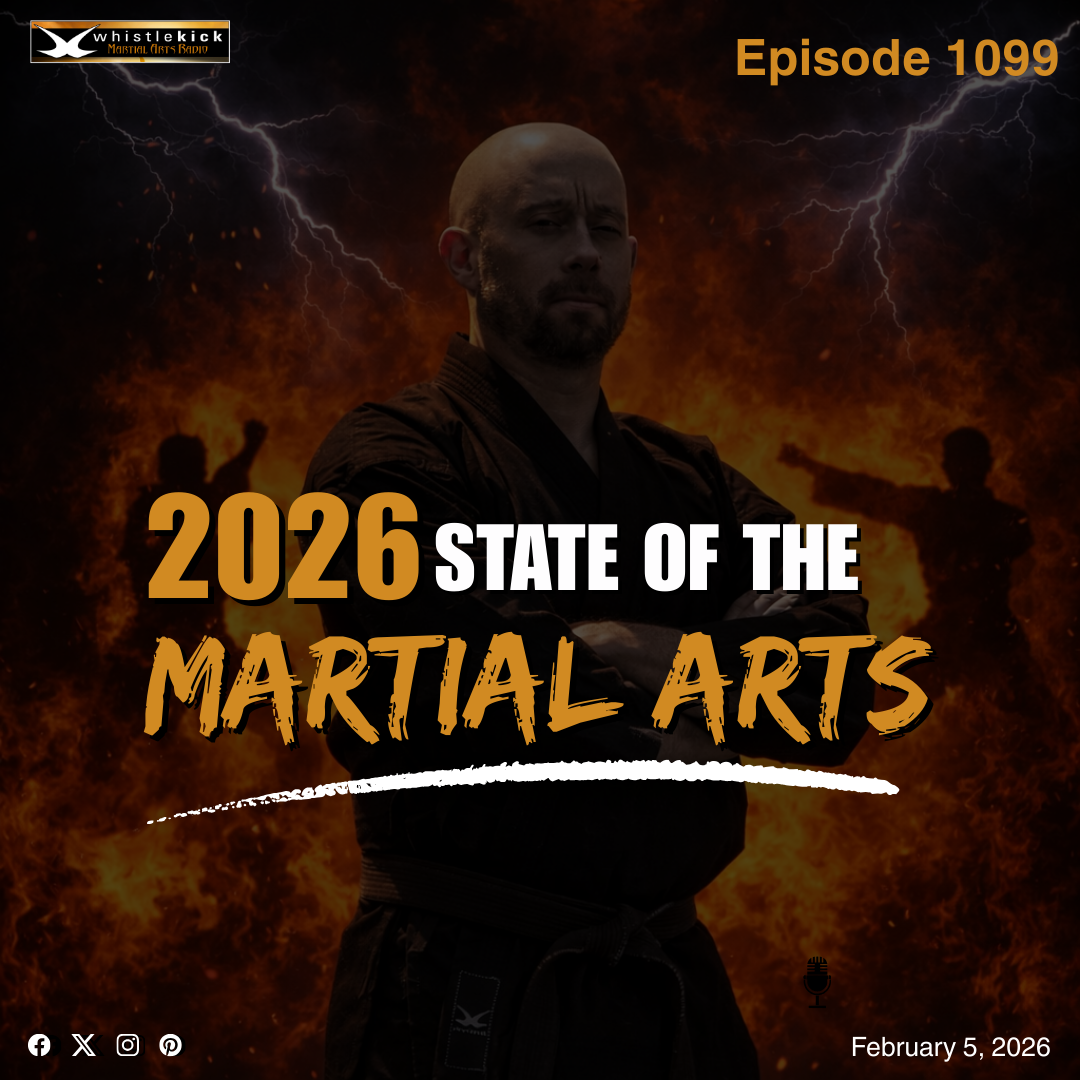
In this episode, we’re bringing you Jeremy’s 2026 State of the Martial Arts Address and what we could do to move forward.
2026 State of the Martial Arts - Episode 1099
Martial Arts, just like any other sport, is not perfect. That’s the very reason why we need to recognize and accept that as a fact so we can improve it for generations of Martial Artists to come. In this episode, Jeremy talks about where he thinks Martial Arts world is and what we could do to move forward. Listen to learn more!
After listening to the episode, it would be exciting for us to know your thoughts about it. Don’t forget to drop them in the comment section down below
After listening to the episode, it would be exciting for us to know your thoughts about it.
Join our EXCLUSIVE newsletter to get notified of each episode as it comes out!
Subscribe — whistlekick Martial Arts Radio
✅Subscribe to whistlekick Martial Arts Radio on the following platforms:
🎧Apple Podcasts: https://apple.co/3mVnZmf
🎧Spotify: https://spoti.fi/3yHVdHQ
✅You can find whistlekick on all social media platforms using the handle @whistlekick or visit our website at https://www.whistlekick.com or https://www.whistlekickmartialartsradio.com
Show Transcript
Jeremy Lesniak (00:07.326)
Okay, and it's time. Hello everyone. Welcome to Whistlekick's 2026 State of the Martial Arts. I'm Jeremy Lesniak, your host for today's live stream. I'm the president and founder here at Whistlekick. I'm a school owner. I'm a passionate martial artist. And what are we doing today? Well, we're going to bring you some data-driven observations.
from some surveys we've conducted recently. We're gonna bring you some videos from other notable figures in the martial arts. And hopefully you'll find this interesting and actionable. Whether you're watching live or perhaps later, thank you for being here. If you are watching live, I would ask and encourage you, leave comments, discuss with each other. Some of those comments may end up featured on the live stream.
Others will just help me understand what you're hearing and thinking and better respond to your words, your observations, your experiences. And this is not an advertisement for Whistlekick. We're not going to talk about anything that we do as an organization. think that hat there in the corner, which honestly I just put there because I needed something to fill the space, is the closest you're going to get to promotion for what we do.
as an organization.
So who is this for? This live stream, and by the way, shout out and thank you to StreamYard for what they do, is for martial artists. Whatever you train, wherever you train, however you train, do you want to school? Do you not want to school? It doesn't matter. Okay. What we're going to do today is we're going to give you information that you can use. Use to help guide your own training, help to guide others training, potentially guide your organization, your business.
Jeremy Lesniak (02:08.043)
And thank you to all, see a bunch of people chiming in in the chat now. Thank you. Thank you for being here.
What is today not? It's not hype. It's not doom. It's not a pitch. I'm not selling you anything. There's no point in here where I'm going to tell you to buy something or go somewhere. No, take that back. At the end, I'll give you my email address. So I guess that counts. But that's it. A lot of what I'm going to talk about today came out of our annual survey of school owners. And
As we've grown as an organization, we end up with more reach and we'd finally collect enough data to really make some observations. And that's what we're bringing to you today. The videos that we're going to play from others, we did not edit them in any way. We make no representations of them at all. were simply submitted within the criteria. We did not have to cut anybody's videos out because we had too many.
We've got four videos that we will be playing for you. And next year when we do this, everyone is again, welcome to submit videos for this event. Okay. So let's move along.
Jeremy Lesniak (03:33.08)
You know what? I was supposed to be showing you these. Here we go. On today's live stream, we will share important data coming from the martial arts industry, bring you the opinions of others viewing video.
and give you some thoughts on what you do next. Okay, there we go. This is where I'm supposed to be. I'm a little rusty on the live stream. So optimism, optimism does exist in the world of martial arts, but it's not naive. What do I mean by that? Well, from our survey data, we had quite a few things that we're gonna talk about today. And the first one is...
Those who responded, there were quite a few people. So I think we can make some good generalizations here.
The average satisfaction with trading, how satisfied are you with your training? That came in a bit over four out of five.
I think that's good.
Jeremy Lesniak (04:28.504)
But the excitement about 2026 and training was even higher than that. That's something I really enjoy. I appreciate that.
Jeremy Lesniak (04:41.784)
But the satisfaction with training.
Across the whole year. Under four. So we're seeing some momentum, some progress. Martial artists are becoming. More. More optimistic, more dedicated, more something something is leading to how they feel about their training in a positive way. It's showing some momentum. It's a good thing we want to see momentum moving in that right in that direction. Now the optimism exists today. It's there.
now. yeah, optimism generally increases when people look forward. That's a good thing. We want to have that happen. We don't want to see people sad about the future. That's never a good precursor to any action. It's kind of necessary. But it's also not a spike. We're not seeing that people hated 2025 and they're stoked about 2026 because when those numbers change that dramatically, start to get a little bit nervous.
Jeremy Lesniak (05:48.982)
Now, martial arts is still a source of, and I'm choosing these words carefully, stability and meaning. So what do we find in there? And I do want to apologize. The formatting on these slides is a little bit different than I had it laid out. It doesn't look like it's cutting anything off, but aesthetically, it's not ideal. because this was survey-driven,
I waited as long as possible to complete this and it meant testing wasn't the highest priority. I wanted to give you the best possible data. So when we look at the survey data, because it wasn't just questions of this or that, rate this, we also gave people the opportunity to contribute their thoughts and leave some open-ended stuff. And people are.
time and again, describing their training as a grounding presence, something meaningful in their life. And that goes along with my observations, both as a school owner and in some of my roles in Whistlekick as I work with schools. This is what the world is finding. The training that we're tends, the importance is focused on how training makes you feel rather than the physical self-defense skills that training gives you.
That's what I'm saying.
Jeremy Lesniak (07:25.88)
People are progressing even when it's slow. And that makes sense because the further we get in this, how most of us measure progress, whether it's rank, and actually we're going to talk about that a little bit, or actual skill or any other way, the longer we've been doing it, it's often much more difficult to assess that progress. So we've got to stick with it.
Jeremy Lesniak (07:51.382)
Martial arts is not an obligation. None of us have to do it. We might say we do, but we don't.
It's an anchor. It's grounding. It is a platform. It is our stability. It's our yard post, our sign post, our reference point, whatever we're going to call it. I think that's a really good thing. And one of the respondents said, gave me something steady when other parts of life weren't. Now, I don't know about you, but that very much describes the relationship I have to martial arts.
probably describes the relationship many of you have to martial arts. And if you have a business in the martial arts space, remembering this is core to your marketing and your onboarding and the way that you talk to and interact with your students.
Jeremy Lesniak (08:48.43)
Just going through my notes here to make sure I don't miss things.
Jeremy Lesniak (08:58.412)
It's important to remember.
I'm hearing this from some people and you'll see some of this a bit later on too. A lot of schools are talking about the challenges in running a school. People aren't questioning their martial arts. They're not questioning their training. They're not questioning whether or not they should do it.
They're questioning other things. Other things are becoming more important. Other things are becoming more significant. Other things are consuming their attention. And again, this is stuff we need to remember. I've seen a bunch of great comments in the chat here. Thank you, everyone. Thank you for being here. I appreciate you all.
Jeremy Lesniak (09:46.606)
Andrew, can you pull that banner down for a moment? looks like it's, I don't know if it is, but it looks like it's cutting off my slide. And shout out, some of you know Andrew, my co-host, producer for Martial Arts Radio. He's behind the board, so to speak, making sure that I get to focus on talking to all of you and giving this presentation.
So training goals, when we think about training goals within martial arts, there are a handful of things that you probably would expect to find. And yes, we found them in the survey, but we found some other stuff.
three quarters of people's training goals had nothing to do with Ray.
That's awesome. You know my opinions on this subject. You know how excited I am for this.
Jeremy Lesniak (10:35.296)
less than one third focus on promotion, advancement, know, those typical tangible things that we think about. Now, if that's true, and again, I believe it's true because the survey says it's true. If you have a school or a business at all related to martial arts, you have to know this because people are becoming less and less interested in that, which makes sense because there's a
there's more more conversation about the dilution of rank within our industry. What does it mean? The inconsistencies, et cetera. So that means two thirds of people are focused on other things.
Jeremy Lesniak (11:20.95)
Most goals are around the sustainability of their training or their bodies, their contributions to others, or the quality of their practice.
Jeremy Lesniak (11:35.596)
We live in a time now where lower end junk product stuff and even service is incredibly abundant and close to and even free in a lot of cases.
As that's happened, people have sort of pushed back. They want meaningful, positive, uplifting experiences that check a lot of boxes. Now we know that's martial arts. What do you do with that? How do you make what you do and how you do it and where you do it representative of that? I'm not giving any answers to that today. That's up to you. Every school is different.
Jeremy Lesniak (12:21.806)
When we've done this in the past, I've run PowerPoint on a separate monitor and it's great that we can run this through StreamYard, which is cool and I really love that. But it doesn't give me is what the next slide is.
Jeremy Lesniak (12:40.866)
Nope, where am I?
Here it is. I'm on this slide. Thank you. All right. Growth. School owners, and a lot of you out there I see from the comments in the chat, a lot of you are school owners. And time and again when we do this event, it's the school owners that are turning out and supporting it because they want to know what we think and what the information is showing on what the year is going to bring. And so we're releasing that information for the first time here.
Now, I know that these pie charts are small. There's going to be three of them, and I'll go over this for you. So the first question, do you think 2026 will bring more students to your school in 2025? And by the way, it was just shy of half the respondents to the survey were school owners. And the school owner questions, of course, were optional. An overwhelming majority, 73, what's that, 73.5 % said they're expecting more students in 2026. That's great. Awesome.
Do you think 2026 will be more profitable? 62%, 11 % fewer. So the same people that see more students coming, a good chunk of them do not see more profit from it. And how about revenue? Just about the same. bit more. A more people see more revenue coming. So what can we draw from that? We can draw.
One of two things from that, I think the majority of people are feeling pressured on the financial side and martial arts schools are no different. Everything costs more now. Rent is more, insurance is more, electricity is more, advertising is often more, depending on how you're doing it, right?
Jeremy Lesniak (14:31.33)
So you've got to bring in more people to kind of keep revenue the same, keep profit the same.
There are a million and one ways that these numbers can be more forgiving, more positive for you. And I hope that those of you out there who do fall into that segment of, yes, I'm going to see more students, but I don't think I'll make more money. I hope you will spend some time exploring that because there are, I don't want you to give up on that. I don't want you to quit that idea.
Jeremy Lesniak (15:18.296)
So we'll call them the peak moments. They're personal. The best moments are personal.
performance of being a martial artist for many of you.
Jeremy Lesniak (15:36.12)
us by cursing.
Jeremy Lesniak (15:40.418)
The standout training moments, the data showed it was personal milestones. Now that can be rank for people, but it can be so many other things. We saw a lot of people saying things about specific challenges with, let's say a weapon or a technique or learning a certain form, things like that. Or for some of you traveling to a certain location to train.
You know, maybe you train in an Okinawan karate style. Going to Okinawa is a big deal for you. Or maybe you train Taekwondo going to Korea is a big deal for you, right? So these personal milestones and this is important. Goals need to exist. We need stuff to achieve and it needs to be more than just rank. Those of you out there who who teach you know that only connecting goals to rank.
can lead to some challenges, especially as people progress in rank and those goals are further and further away.
Jeremy Lesniak (16:49.4)
Family connections, testing experiences, breakthroughs dominate responses. Yeah. To those of you out there who, just as an aside, if you're wondering why I'm reading most of this, I'm watching this because we also released this on our podcast feed as audio. So initially, I was trying not to read them, and I realized I kind of do have to read them. So that's why I'm reading slides too. And then I'm expounding on them.
Time and again, we see that people who train with others that they like makes a really big difference in retention. Those of you who have family programs or you train families together, you know that increases retention. There's a lot of good that comes from that. But family doesn't necessarily mean blood. A lot of you would define the people that you train with as your family. And we saw that time and again within the data.
And we saw so few people saying that trophies, titles, getting to say that you are such and such, so and so, wasn't important. Now, I will acknowledge that the reach that we have, there may be some skew there. The people that we interact with, just philosophically, we tend to have fewer people that put a priority on that public recognition.
It's certainly out there. I'm less confident in that statement than I am in some of the other things because of that.
Jeremy Lesniak (18:28.172)
And what happens when we connect these three points here? Training is personal. Training is emotional. Training is about personal progress. And even for those people who don't think of it that way or even acknowledge it that that is what it is, that is what the data is showing. That's what is resonant for them. And I think that that's really important. Just a reminder, if anybody in the chat has
Stuff questions relating to what I'm talking about. We can talk about it at the end, but if it's stuff that's got to hit during these slides, I'm totally open to that. Andrew, think we're going to go on. Yeah, we're going to play our first two videos now. Those videos are the first one we're going to play is from Dov Chelst. And shout out and thank you to Dov. I don't know if you're here, but we'll come back after Dov's video. And I'll chat with you a bit.
Hello, everyone. Dov Chalst here. A few personal thoughts on martial arts that are just my opinion. If you train regularly in a martial art, you are a martial artist, not someone who studies martial arts. Go ahead and call yourself a martial artist. That is sufficient. Whether you're a white belt, black belt, or no belt, go ahead and use the term freely.
To be clear, that is sufficient, but not necessary. Just as martial arts vary, martial artists train for various reasons. When I was younger, I used to think that everyone trained for the same reason. Over time, my own motivations changed. If my reasons can change over time, other people's can vary as well. In other words, your teacher, student, or classmates
can attend the same class for different reasons. If this makes you curious, I encourage you to ask them. Maybe what keeps me training matches your experience. I find that the focus required by my martial arts practice helps me manage the stress in my life. I enjoy seeing slow improvement through dedicated practice. Classes with other martial artists provide a social environment I enjoy.
Jeremy Lesniak (20:57.698)
When your martial arts practice matches your reason for training, it resonates with you. You enjoy training and that joy sustains you through the challenges placed in your way. A possible challenge you may encounter is a break in your training. You might move away from your club for work or to attend college. The dojang might close down. Perhaps the school stops meeting your needs or you can no longer attend for another reason. If you've been on a break,
whether for a few months or many years, I encourage you to consider finding a new school to continue your training. All those good reasons that you have remain. While it won't be the same, you can find another place that resonates with you. And when you're training regularly at that new school, wearing a black belt, white belt, or no belt, I'd be happy to call you a martial artist.
Good stuff, again, thank you, Dov, for that. One of the subjects that we've started to see more and more people talk about is this definition of a martial artist and who gets to use the term. Now, I wholeheartedly believe that if you consider yourself a martial artist, you are a martial artist because I don't get to tell you and you don't get to tell me.
That's something that we have in our six freedoms of martial arts that anybody wants, can check that out on our website.
I think having that identity available to you is really important. When we think back to what we saw in the survey data before, we see that people need this connection to their training. They need this stability and more and more schools are training without rank, without uniforms. And in the absence of that formality, what is your identity? Your identity is
Jeremy Lesniak (23:02.432)
as a martial artist. So my hope is that just as Dov said, his words are his own, but they reflect my own views here, I think the ability to claim the title of martial artist is so important that I hope fewer people will try to take that away from others as we move forward.
And our next video is from Jason Brick. Hi, everybody. Jason Brick here, author and martial artist of more than 40 years at this point. I think everybody watching this is going to agree with me that the best parts of our martial arts journey, it wasn't the kicking and the punching and the stabbing and the shooting. Although all that's a lot of fun. It was the lifestyle changes that made us healthier, made us more centered, made us more able to be the best parent.
child, friend, partner, community member that we can be. And even more than that, it was the people that we met along the way, the folks who shared this journey with us.
And with that in mind, I'd like to, I've got, it's a question for you, maybe it's a challenge, maybe it's a dare, I don't know, but like I said, the kicking, the punching, the stabbing, and the shooting is what has gotten in the door, it's what's kept us on the mat. But for most of it, it's not what's saving our lives. What's saving our lives are those other safety things, our cardio. You know, that cardiovascular endurance, no matter how much road work sucks, that helps us.
can save us from seven out of the 10 most common killers of adults in the civilized world. And our diet has our diet, which battles the other three and overlaps. And being able to do proper first aid, when was the last time we re-upped our first aid training? Worked with the fire extinguishers, did a safety sweep of the house, all those little things, those non-combat safety things that are what's more likely to save our lives because fortunately we live in a relatively peaceful world. So.
Jeremy Lesniak (25:09.326)
to all you out there, all my martial arts friends and family. Like I said, kind of a dare, kind of a challenge, kind of a question. What's your non-combat safety stuff look like these days? And what might you do in the next year? So when we have this conversation next February, your ass is a little bit different. Just some food for thought. Thank you so much. Keep training.
Jeremy Lesniak (25:34.246)
This is a subject that I've talked about. I've talked about it with Jason. Jason and I have talked about it together. When we think about martial artists, martial artists tend to value their self-defense skills. When we look at the data, which was not part of this survey, but you can find it because it's out there, the data around violence, you'll see that most people will never have to use their, as Jason put it,
kicking, punching and so forth, self-defense skills. But when we consider the attitude, the independence that martial arts fosters in so many of us, the idea of making sure we are prepared for a fire that we are remaining or at least working towards better health, all becomes so important, makes sense. And it lines up again with what we're seeing in the survey. People's reasons for training,
vary and it's not one sided. It's not one reason. People have many, many reasons for training martial arts. To me, that's the beauty of it is that it can be so many things to so many people. We can develop a cardio benefit from it. We can develop better friendships. There was a piece Jason mentioned in the middle there about the connections, the family, the people that help keep us around. It's the
kicking and punching that brings us in the door. But it really is the relationships that we build that keep us around. If you're a school owner.
help foster those relationships and you'll see people stick around that much longer.
Jeremy Lesniak (27:15.251)
All right. So as we move on to our next slides.
Jeremy Lesniak (27:22.478)
So we talked about this a little bit earlier, school owners' expectations, additional complexity, as well as what we're doing around the money side. We talked about the financial side of things. But school owners are expecting some complexity. What can we suss out from that? So here's a chart for those of you who might be listening now or later. Again, thank you to everyone who's here.
40 % of school owners, expect that 2026 will be a more challenging year versus 2025.
Over 25 % think it's going to be the same.
15 % say unsure, the remainder, just shy of 20 % say less challenging.
So what do we do with that?
Jeremy Lesniak (28:15.598)
It's 27, say about the same. And the part that I think of all the things that came back in the data, this was the part that had me the most concerned. Only 18.7 % of school owners think 2026 will be a less challenging year.
Now, the last thing that we talk about on anything, whistle kick, relates to politics or world events. It's just not what we do. However you perceive the world, you likely see shifts. You likely see the challenges of a changing sociopolitical landscape.
Those changes impact the people around you, the people that train with you, the people that train you, the people that have direct and indirect influence over your school, your insurance rates, things like that. Now, the reason that this is concerning to me is because none of the stuff that is happening is new. Now, a lot of it's happening in greater fashion. There's been some momentum.
to some of these things.
But if we approach running a martial arts school the way we approach our martial arts training, we have tools. We have the ability to make some changes. And I hope that the schools out there that are not in this 18 % group, what is that? 81.3%. 81.3 % of school owners who don't think that 2026 will be less challenging.
Jeremy Lesniak (30:05.218)
We'll take a big step back. This is my encouragement to all of you. Take a big step back. What are the things that are driving this expectation? How can you mitigate some of it? I'm not saying you can solve it. Most of the stuff out there, we can't solve. But we have options on how we approach it and how it comes into play. One of the things that I had to get involved with in a couple schools
in my role in 2025 was the declaration that politics doesn't come into the door. If you do not have this rule, I would strongly encourage you to have this rule because a lot of the challenges follow those conversations and discussions. Hello to everyone who is here. Some more comments coming through.
Jeremy Lesniak (30:58.19)
I'm gonna star that one from Jenny for later.
Jeremy Lesniak (31:06.318)
I guess what I'm really trying to say here is you have more control over your school and how you handle things than you realize. So when you acknowledge challenges, I hope that it is also coming with a commitment to make 2027 a less challenging year.
Jeremy Lesniak (31:30.688)
And now we're going to move on to our next two videos, videos three and four. This first one here, gentleman is in the chat. Thank you for submitting and thanks for being here, Cole Stanley.
Hey everyone, Sensei Cole Stanley here, student first martial arts and fitness in Monroe, North Carolina.
Second Degree Black Belt and Judo and I'm coming to you today from my new dojo. Now, the state of martial arts. Wow, what a great topic. There's two different sides that I'd like to talk about for this and they both involve technology. Number one, martial arts is more widespread, more eyes are on it, there's more available content.
than ever before in history. Wow, what an awesome opportunity for martial arts and what a great day and age that we live in, that we can see, view, and participate in martial arts today. But, that being said, the double-edged sword of this technology is in today's day and age, more and more people
are making a recreational hobby of sitting behind a computer screen or looking at their phone. They aren't as interested as getting out, playing in the yard, doing physical activity, exercising, riding their bike, anything that gets them off the couch. Today, we have one of the highest obesity rates ever in the United States history. So,
Jeremy Lesniak (33:21.762)
How can we take this technology and motivate people to get off the couch and to get involved with martial arts? That is the question that we are going to have to face as martial arts instructors today. Now, we all know martial arts is a great physical fitness activity. We all know the philosophy that it teaches you on how to become a better person.
And we also know the deep history and culture of martial arts. All of these things can be used as tools that we can use as instructors to try to get people off the couch and into the dojo. So thank you everybody. And the last thing that I'll leave you with is as martial arts instructors.
need to figure out how to use technology to get more people into this wonderful world of martial arts. Thank you very much everybody. Bye. Thank you, Cole.
The word that comes to mind for me is apathy, technology-driven apathy. People are less active because they don't have to go very far to get all the stimulation that they want.
Jeremy Lesniak (34:50.574)
Teenagers are less excited about getting their driver's license. When I was a kid, we all wanted our driver's license because that represented freedom.
This is doing the same thing.
Jeremy Lesniak (35:06.136)
So we can do a couple things with that. We can watch people get bigger, unhealthier, I should say less healthy, let's use some proper grammar, and just sit on the sides and we can complain about it. Or we can recognize that traditional martial arts training is what I like to call the magic puzzle piece. It fits into whatever gap exists in someone's life.
Jeremy Lesniak (35:38.829)
is a few hours a week or even an hour a week of training going to completely revolutionize somebody's life? No. But it can start gaining some momentum. It can give them something that they appreciate, something that they can find progress in and maybe rework their life. If you've been teaching for a long time, you've had several people come through, maybe even dozens of people come through.
And you've watched this very thing happen. Now, how do we do that? A lot of ways we can do it. But Cole challenged us to use technology to better traditional martial arts. And to me, that's about switching up our marketing methods. Now, the marketing that I'm involved in, what I'm finding is most effective is less advertising around.
learn how to kick and punch and protect yourself, even less about physical health, losing weight and all that. It's more about community and mental health. And again, these are the things that we're seeing come through in the survey data. People are saying that their training is their bedrock. It is the place from which they can, excuse me, launch to the other areas of their life. Well, if we know that that's what people want and we are able to provide that, we simply need to get in front of people.
Again, maybe through this in various ways, and there are plenty of platforms out there that will help you do that, and reach the people who need what we offer and start creating some momentum.
Now our last video contribution comes from Tyler Duda. So Tyler. Hey everyone, my name is Tyler Duda and I'm an American Kempo and self-defense instructor here in Massachusetts. I want to take this time to talk real quick about something that I feel is really important to the state of martial arts, but is often overlooked or undervalued and that is culture. It's the culture of our studio. It's the culture that we build, even if it's in a small period of time, like a seminar, right?
Jeremy Lesniak (37:51.82)
It's the vibe and the feel that we give and that our studio gives to our students and to the people that we interact with. The thing about culture is that it can kill your studio straight up. It can make you or break you. And when we first start out and we first open our studio, we're all very excited always to, you know, instill a new culture, the culture that we want to make our studio ours and make it look and interact with people the way that we want to. But over time, it is really easy to
Allow that to kind of slip to let things start to slide and you know when things happen in incremental Small changes it's easy to kind of lose track of that and not notice those changes happening ourselves when we're in it every single day The good thing though is that we can change the course of our culture towards a more positive direction with incremental changes It doesn't have to be a big thing that happens now. It's little things that we do
habitually over time that can help us change the course of our school, the course of our culture, and make it something that's more appealing to people, make it something that is more motivational to people, because the thing that we really need to remember is that the culture of our studio spills over into everything that we do. Everything like our social media posts, both the content, the pictures and videos that we post, to the text that we write, to...
The text that we put in a text message, maybe when we reach out to somebody that requested information or the way that we answer the phone and talk to people on the phone. The first time someone comes into the studio, whether just off the street or for their first time trial. Culture is something that can be seen and felt in all those different aspects of communication with people. making sure that it's something that is appealing to people and that's welcoming and also just shows what our schools represent and what we stand for is so important because
If the culture of our studio is not good, one, we may lose students long term because they may be dissatisfied with their experience in the school. We also may lose potential clients right off the bat because they come into the studio and they're like, I don't know if I like the vibe in there. I don't know about how they teach or how they address each other. So we could spend hours talking about this and that's not what I'm here to try and do. The culture that you want for your studio is up to you as an instructor and a school owner.
Jeremy Lesniak (40:09.282)
But just something that I like to bring up in every now and then to people is, is the culture of your school great? Is it what you always wanted? Is it trending in a good direction? And is it something that you could work on? And if it's something that you need help with, we all know that Whistlekick has great resources for studio owners. And I'm sure that they can help out with those sorts of things to anyone that needs it. thanks for listening. Something I'm passionate about is the culture within the martial arts. So I just want to touch on that real quick.
And I hope this gets you guys thinking and maybe helps out a little bit. Thanks. Have a good one. Thank you, Tyler. The phrase that I wish I knew who to attribute this to, and I apologize that I don't. But the phrase that came up for me as Tyler was talking about culture was, what you tolerate, you invite more of. When I think about culture, and obviously culture exists in every group of people, if there's more than one person
in an environment, there's a culture, right? Every martial arts school has a culture. So does every grocery store. So does every gym. So does every car dealership. If there's a group of people, there's a culture. And what I've found time and again is that the school, the martial arts schools that have the best culture are the ones that are doing two very important things. They are aware of their culture and what they want their culture to be, number one.
Number two, anything that compromises that culture is not tolerated. Now, like Tyler said, maybe you need to make some incremental progress. Maybe your culture has gotten away from you. You can't come out and make huge changes all at once. I like to use the analogy of a canoe for something like this. If it starts getting too tippy, it's taking on water, and you're going to be at the bottom. But you can make small changes over time.
Especially when you identify. The gaps between where you are and where you want to be, just like with our training, just like with our training, you can get help from people both within your school and outside of your school. And I hope that you do because again, this reflects back on what we've been talking about. What is the common theme today? From the data.
Jeremy Lesniak (42:28.992)
It is the culture, it is the people, it is how they feel during their training that keeps people training. It is not the physical skills. They come in for the physical skills or less so than they used to. They stay for the other reasons. And most of those other reasons can be summed up under the heading of culture.
Okay, so our next slide here, challenge and hope. There is significant excitement.
about what 2026 will bring for training for people. Higher, significantly higher, I shouldn't say significantly, I should say notably higher than their satisfaction in 2025. Where are we? Which one am I on? Hold on. I just wanna make sure I'm not. Yep, yep, yep, yep, here we go. Okay.
4.3 for the excitement versus the satisfaction with 2025 was 3.9. So 10%, 10 % is a notable bump.
3.3 3.8 8 there we go. OK.
Jeremy Lesniak (43:49.666)
When we start to look at this in conjunction with the idea that running a school is feeling more challenging with time, it's not easier.
more than twice as many school owners expecting 2026 to be a harder year rather than an easier year when compared to 2025. But we had this anecdote come through. Things feel solid, but they take more effort than they used to. And I think that this is a good way to look at a lot of the things that we saw come.
Just because a school owner, and we saw this in the comments too, just because school owners were saying that they're expecting 2026 to be more challenging, doesn't mean horrendously more challenging. It doesn't mean twice as challenging. And we didn't ask them to quantify that, because how do you quantify challenge? I mean, we could have a little more challenging, a lot more challenging. But again, it's still so subjective. But it's true. Things do take more effort than they used to.
Jeremy Lesniak (44:58.786)
We have more entities vying for the attention of our students, our potential students. We have more activities to choose from, more options. I saw one, this isn't in here, but I saw one respondent comment that it feels like school sports are longer and longer periods of time each year, right? What we're up against,
as an industry is, as Cole said, it's the apathy. It's the other things. It's all the other things. Which is why I get so bummed out when I see martial arts schools competing with each other. Ugh, you're not competing with each other. You're competing with life, all the other things. Focus your attention on that. Where is every Burger King built? Next to a McDonald's. Why?
Because by having that gravity of both of them in one place, both of them do better. What would it look like if you and the other martial arts schools in your area got together and did some collective bargaining? Wouldn't you rather somebody train with them than not at all? The answer is no. I think you should go take a look in the mirror. And I guess the last point I want to put in here is that
We often see when things get hard, people get sad. But the data shows things are getting harder, but people are still optimistic. And that's exactly the attitude that I would expect to see from martial artists. Events. Martial artists love our events, don't we? We love the tournaments and the seminars and all of those things. And, I certainly love them. Whistlekick loves them.
45 % of people had attended tournaments, travel seminars, or some sort of multi-day event in 2025. Half, half of people. Now again, this is a place where I'll point out the data skews a little bit. We don't have a whole lot of white belt, yellow belts filling this out. We didn't ask for their rank. We didn't ask how long they were training, but our reach does tend to skew towards the more passionate or professional martial artists. So.
Jeremy Lesniak (47:23.36)
we're gonna see higher numbers on something like
We're expecting similar participation levels for next year.
Jenny says, of course I love events. And this is something that I think we're going to continue to see as a theme. We've been seeing it. Mixed discipline events moving to 60%. This idea, it's not even just this style, but this systems interpretation of this style event. Now we've got this, that, and the other training together. And I love seeing that. I'm a huge proponent.
We get better that way.
Jeremy Lesniak (48:07.916)
And as much as events matter, and this isn't a surprise when people talk about what they value about the events, it's the connections and the conversations. It's the notion that they go to these events and they meet great people. They meet people outside their school. They meet people outside of what they train. They make these friendships. mean, the chat is full of people that I know most of them. And
They met each other at events and they all train different things, but they love and support each other and.
That's why Whistlekick is Whistlekick Martial Arts, not Whistlekick Karate or Whistlekick Taekwondo. And it's why we don't segment. We don't have a karate division or a Taekwondo division like some companies do. And if that works for them, that's awesome. But that's not what we want to do. We want to see these relationships foster because of what we have seen the benefits to be. And again, the data proving that out.
Jeremy Lesniak (49:11.724)
and coals chiming in what I want to see and what I've been trying to do is cross over these boundaries, include grappling and striking arts in the same event. Absolutely. We do that at a lot of our events as well.
Jeremy Lesniak (49:28.248)
So resolve is the appropriate response, not urgency. Nothing is broken within martial arts. Nothing's falling apart. Nothing is on death's door. But it doesn't mean there isn't room for improvement. And if we don't want things to get to the state of urgency, we have to make some changes.
Martial arts is still worth doing, still worth believing in. I still believe in martial artists. I still believe in the powerful transformational ability of traditional martial arts.
Jeremy Lesniak (50:09.934)
schools have to and are adapting to a more complex reality. It was just a few years ago, we saw some massive shifts and we're still dealing with some might call it the fallout, some might call it the adaptation that came out of that time.
Jeremy Lesniak (50:31.416)
But staying steady with intentional effort matters more than reaction or panic. Sounds like sparring, doesn't it? Or rolling or...
Jeremy Lesniak (50:47.608)
free sparring, free form.
Jeremy Lesniak (50:53.366)
Randori, trying to come up with other words for it, right? We don't freak out. That's not productive. We take a step back. We look at the situation. We find something we can do because something is better than nothing, right? What's the only wrong? I've never met anyone who disagrees with this. What's the only wrong action in a self-defense situation is to do nothing. There's always better, but wrong?
is doing nothing. When there are problems with your training, with your relationships with training, your relationships with your training partners or instructors, with your students or your school, doing nothing is the only wrong answer. Don't do nothing. Pick one thing, fix it, and then move on to the next thing. What's coming next?
I want you to trust your training. The answers to many of your problems are in your training.
Maybe even some of your life's problems were in your training.
Unless your problem is that you're training too much and other things are falling aside.
Jeremy Lesniak (52:13.08)
I want you to support your school or your schools.
That means showing up. It means paying your dues. It means encouraging other people.
It means thinking about what your life would look like if you're that school or schools. They weren't there. If that would leave a huge hole in your life. Then maybe it's time to ask what more you could do.
Jeremy Lesniak (52:41.784)
and you've got to encourage others.
Jeremy Lesniak (52:46.198)
If you're a school owner, already know this, for those of you who aren't.
It is the recommendation, the personal appeal of people who are training that most frequently get the best people into training. Bring your friends. Help them understand how it will make their life better.
ask them and then ask them again and then ask them again and eventually they'll show up. You know that training would make their life better. They may not understand it.
Jeremy Lesniak (53:23.51)
It's worth the effort.
Jeremy Lesniak (53:28.672)
And finally, stay positive. Stay positive and committed to your training and to the arts in general.
Jeremy Lesniak (53:37.986)
Because without that, what do we have?
Everyone sits down on the positivity. If everyone takes a break, martial arts goes away. Every single one of you has a hand in continuing this thing that we all love so much.
I appreciate you all. I thank you for being here. I'm going to take questions. There are some questions in the chat, and I'm going put those on screen. We'll talk about them. Those of you in the chat, if you have questions that you want to ask or comments to make, drop them in. I'll put them on screen. If you want to reach me, jeremy at whistlekick.com. And of course, the organization Whistlekick behind all of this.
whistlekick.com, all the things that we do. yeah, so thanks for being here. Thanks for doing all that. Thank you to Andrew. Thank you to those of you who have chimed in. And I've got this comment here from Jenny.
There we go. As we change and grow and evolve through our training, shouldn't our goals evolve? Shouldn't our reason for wanting to be a martial artist evolve as we learn more?
Jeremy Lesniak (54:55.202)
Goals, I would say absolutely. But the reasons may not. It depends on what those reasons were.
Jeremy Lesniak (55:04.696)
But they can, and I think more important than should is recognizing that they can. I think when we put up boundaries around what we do and how we do it and why we do it, this is the reason. This is the way.
It becomes very difficult for someone who has drawn an identity from that reason, location, style.
to change because those boundaries are so wrapped up in their identity. And the moment it becomes identity, it's challenging. And that's why I think drawing identity to the term martial artist is the most important one. I think it's really the only one. I am a martial artist. I train primarily karate. I'm a karateka, but I'm a martial artist because there have been times
when karate training did not work for me because of logistics and such. So I started training Taekwondo. Then a time came when Taekwondo training wasn't working. And it's not to say anything negative about anyone or any place or anything, because that's not what it is.
It's about adapting because that's what we do as martial artists.
Jeremy Lesniak (56:35.374)
You're welcome to Jenny. And Cole says, as martial artists, our goals should always evolve and grow because we should always be trying to grow. We make goals, we reach goals, we make goals. Yeah, it's that cycle. It's that cycle of identifying something we want to get better at or do or learn or try. And then we do or learn or try it. We get there. What's the next one? What's the next one? What's the next one?
If you don't have goals for your training, I'd like to encourage you to come up with some. If you have a school, I'd like you to come up with some goals around your business. They don't have to be big. They do have to be there.
Jeremy Lesniak (57:18.425)
and
Jeremy Lesniak (57:23.118)
I guess that's what I have for you today. So we will be releasing a deeper analysis that you can go through from that survey data. You can find it on our website in the blog section. It'll be out in a little bit. I don't know when. It'll be out. And you can find that over there. We have some other stuff that you might find interesting over there. Not a plug. Actually, Tyler made the best plug for what we do today, which I thought was kind of cool. Thanks, Tyler. Did not ask him to do that.
Yeah, I just appreciate everybody being here. We'll do this again next year. If you want to go back and look at the previous ones, this is the fourth one. So 543-23-24-25. You can go find those on our podcast feed or on our YouTube page. And that's what we got. So thanks for being here. Jeremy Lesniak, quietly joined by Andrew Adams. Thanks, Andrew. He's back there.
I can see him. see his face. He's giving me a thumbs up and yeah, take care everybody. And if I can be of help in any way, jeremy at whistlekick.com and that.
Brings us to the end.