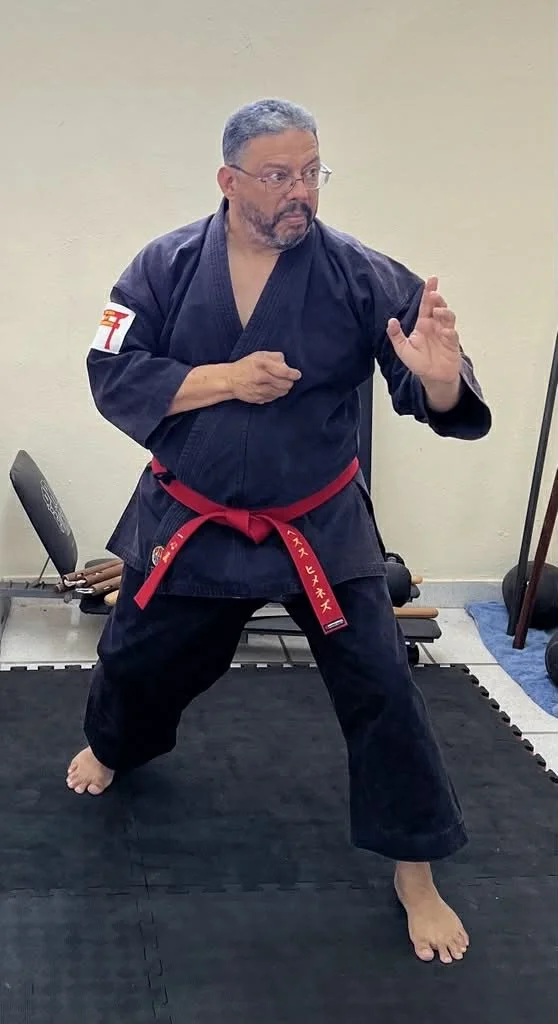
In this episode Andrew chats with Jesús Jiménez about his martial arts journey in Puerto Rico, starting with Judo and his move to Isshin Ryu Karate.
Sensei Jesús Jiménez - Episode 1108
SUMMARY
In this conversation, Sensei Jesús M. Jiménez shares his journey through martial arts, beginning with judo at a young age and transitioning to karate. He discusses the impact of martial arts on his confidence, discipline, and academic performance, as well as the challenges of teaching and learning different styles. The conversation highlights the evolution of his understanding of karate from a sport to a deeper, more scientific approach. Jesús also emphasizes the importance of understanding movement, the role of a sensei, and the cultural differences in training between Puerto Rico and the United States. He discusses his experiences with various weapons, the evolution of his training methods, and his aspirations for the future of karate. Jiménez encourages continuous learning and adaptation in martial arts, highlighting the significance of basics and practical application in self-defense.
TAKEAWAYS
Martial arts began for Jesús at age 11 with judo.
Karate helped him gain confidence and social skills.
He transitioned from judo to karate at age 18.
Family support was minimal, but he persevered.
Tournaments in the past were bare knuckle and intense.
He learned more from teaching than from his own instructors.
Karate is a science involving body mechanics and physics.
He found a love for kata later in his martial arts journey.
His academic performance improved significantly due to karate.
He integrated lessons from various martial arts styles into his teaching.
Weapons training enhances martial arts skills.
Training across borders offers diverse experiences.
Puerto Rico has a unique martial arts culture.
Karate training in the U.S. is often more sport-oriented.
Evolving training methods reflect personal growth.
Continuous learning is essential in martial arts.
Adapting to different cultures enriches martial arts practice.
CHAPTERS
00:00 Introduction
02:15 Early Experiences in Judo and Karate
06:06 Transitioning to Karate and Its Impact
10:14 Family Dynamics and Support in Martial Arts
11:02 Tournaments and Competitive Spirit
14:11 Discovering the Essence of Karate
18:12 Teaching and Learning Through Experience
20:37 Integrating Different Martial Arts Styles
22:47 Understanding Movement and Techniques
25:00 The Role of a Sensei
27:43 Weapons Training and Preferences
31:03 Training Across Borders
34:18 Martial Arts Culture in Puerto Rico
39:06 Differences in Karate Training
42:44 Evolving Training Methods
47:10 Future Aspirations in Karate
51:13 Connecting with the Community
Join our EXCLUSIVE newsletter to get notified of each episode as it comes out!
Subscribe — whistlekick Martial Arts Radio
After listening to the episode, it would be exciting for us to know your thoughts about it.
✅Subscribe to whistlekick Martial Arts Radio on the following platforms:
🎧Apple Podcasts: https://apple.co/3mVnZmf
🎧Spotify: https://spoti.fi/3yHVdHQ
✅You can find whistlekick on all social media platforms using the handle @whistlekick or visit our website at https://www.whistlekick.com or https://www.whistlekickmartialartsradio.com
Show Transcript
Andrew Adams (04:20.598)
Welcome you're listening or watching the another episode of whistle kick martial arts radio and today I'm joined by Sensei Jesus Jimenez. Jesus, how are you today?
Jesús M. Jiménez (04:31.771)
I'm very good. I'm honored to be here with you and chat with you.
Andrew Adams (04:37.23)
Thank you. Thank you. Well, I'm excited to chat with you as well. But before we get there, maybe we have a listener or a person watching who's never seen an episode of the show before. And if that's the case, welcome. Thank you for joining us for this conversation. If you would like to check out all of the other shows that we've done, you can check out whistlekickmarshallartsradio.com and you can find the over 1100 other episodes that we have available. You can find them all there for free.
in or in any podcast player Spotify, you can watch the videos on YouTube. All of that stuff is there. And at that website, you can also find a link to sign up for a newsletter so you can get notified when every email an email when every episode comes out.
can also find show notes and transcripts of every episode. It's all there. And if you want to find out about all of the stuff that whistle kick as a company does, you can do that at whistlekick.com. Maybe you want to buy some sparring gear. Maybe you want to buy some, some apparel. Maybe you want to buy a training program or some books, all of that stuff you can find at whistlekick.com, but enough about us. Let's talk about you. Hey, Sue's how you're having a good morning. hope.
Jesús M. Jiménez (05:46.629)
I am, today is a great day for me. I start very early this morning here in Puerto Rico at three o'clock. It's two o'clock for you, but I like to, I'm an early guy. I like to wake up early and go with my life around.
Andrew Adams (06:04.47)
Yeah, well, you know, they say the early bird catches a worm. So you're out there catching worms.
Jesús M. Jiménez (06:10.723)
Well, I tried to. I tried to.
Andrew Adams (06:15.368)
let's, let's start at the very beginning. It's a very good place to start as Julie Andrews has told us. So when you look at your life and how martial arts came into it, what's your origin story? Where did martial arts start for you?
Jesús M. Jiménez (06:33.071)
Wow. it started thanks to my sister. My sister took me when I was 11 years old to a judo class. And I start I start practicing judo at 11 up to maybe my 15 years old. And then my father moved to my hometown that I live now in Guayama, that is in the south.
part of the island in Puerto Rico. As a matter of fact, the sense, my sense in Yudo, his brother was a black building karate and he was a black belt in the state that now I practice issue karate. I never practiced with him, but he was one of the first in Puerto Rico to be a black building karate. So maybe I, I, my story started there relating to karate.
Andrew Adams (07:32.82)
And what was it like doing judo as a child?
Jesús M. Jiménez (07:37.731)
It was very good. I was a very shy child. And my sister wants to to put me in the move and try to show me how to defend myself. So she took me to this Yugo class and that improved my my personality. I get more confidence and I.
And I start socializing more with people because I didn't go out of my house.
Andrew Adams (08:17.582)
Gotcha. And when you then started training karate, Judo and karate can be very different. And I say can be because there are a lot of karate classes that use a lot of Judo as well, but it can be very different. Talk about that transition a little bit for you because that's, know, 15 years old, that's a pretty pivotal age.
Jesús M. Jiménez (08:37.969)
Well, let me tell you this. I stopped practicing karate at 15 because as I told you, I moved to Wayama. And in Wayama, there was a judo club, I, but I didn't win there because I used to live in the country of my hometown. And if I want to go to the town, then I have to take car or a bus and in class where at night and my father say, no, I'm not going there. So.
Andrew Adams (08:56.622)
Hmm.
Jesús M. Jiménez (09:08.143)
So I stopped practicing until...
My 18, I was a senior in high school or a junior, a junior in high school when a friend of mine told me they're open. There's a new school of karate here. They open it and I'm going to visit. You want to go with me? Say yes, let's go. But that time, but that time I was a basketball player. was in the varsity and also I was a setter in the volleyball, in the volleyball team.
So I said, well, let's go there. It was a summer. said, that will help me to be in shape if I want to join them. So I went and I saw the class, and I like it. So I joined the class. And from there, his history, I have been there since 1978.
Andrew Adams (10:06.476)
Wow. And talk a little bit about what that was like. So 1978, that's, you know, in the seventies training back then ran the gamut in terms of the type of training you were doing. So talk a little bit about what it was like for you as an 18 year old starting karate in Puerto Rico.
Jesús M. Jiménez (10:24.561)
Well, I started karate at 18 and. You know, by that time you never use you, you will. We never use hand gloves. We never use shin protectors. It was burn, burn knuckles, you know, and that my sense in that time was very concerned in basics. He he he made you practice basics and.
for a while, then when you have a little bit more knowledge, then you start practicing the comite. In that dojo, we used to practice comite only on Fridays. So you have the regular class, Monday and Wednesday, and Friday was the fighting class. That class was packed. Everybody wants to fight in that time.
The discipline that I didn't have, maybe in judo because I was 11, and the discipline that I didn't have in my basketball experience, I had it in karate. I got it in karate. So it wasn't that difficult for me to make that transition from judo to basketball to volleyball and to karate. It wasn't that difficult.
Andrew Adams (11:36.11)
Mm.
Andrew Adams (11:48.366)
Now did that discipline that you had for karate, did it transfer over? And did you start to have more discipline with your basketball and volleyball?
Jesús M. Jiménez (11:58.385)
I was so disciplined that I quit basketball and volleyball. I love, you know, it's like a first love, you know. I love so much karate. When I started, then I started forgetting about basketball. I started forgetting about volleyball and period. I studied karate.
Andrew Adams (12:04.738)
Wow, okay.
Andrew Adams (12:23.918)
And, what did your parents think of you starting, you know, they obviously were okay with you starting judo at 11. They had to have, right? They're, they're bringing you there and now you're starting to become an adult. did they play any part in helping shape your, you know, getting there or things like that?
Jesús M. Jiménez (12:43.397)
They did not forbid me to practice karate, but they did not support me practicing karate. So if I want to practice karate, I have to make all the work in my house first. Then I have to make to study. And then I had if I have time, then I can go to the to the karate school, to the dojo. And I because I want to be in karate, I did I did everything.
And if you translate that to discipline, yes, it was a discipline. But it's the only way I can show my father that I was committed to my martial arts. yes, and it helped me also in high school because I was a very poor average student.
Andrew Adams (13:28.172)
Mm. Did they, go ahead, sorry.
Jesús M. Jiménez (13:41.913)
And believe me, when I say I'm a very poor average student, I was a very poor average student. When I start karate, my grades went up.
Andrew Adams (13:52.494)
Mmm.
Jesús M. Jiménez (13:53.585)
and that helped me to get into the university.
Andrew Adams (13:59.405)
Now, did your parents ever get on board? I mean, they must have. Did they have anything to say after your grades started getting better? Did they ever make the connection that you're doing better in school because of karate? Wow. OK.
Jesús M. Jiménez (14:14.213)
Nope. Nope. My father was a doctor in anesthesia and a sociologist and he was always he was in the hospital. So my mother was the one who was in my house the most part of the time and she was not interested in learning something about karate or how I was. She didn't was aware of that and she didn't want.
Jesús M. Jiménez (14:43.173)
There we
Andrew Adams (14:43.518)
now in port, I've never been to Puerto Rico, so I don't know the demographics very well, but were there tournaments or things like that? Did you, you know, for a lot of, for a lot of, martial artists here in the States, there's lots of tournaments all over. Is that something you ever got into?
Jesús M. Jiménez (14:52.953)
yeah.
Jesús M. Jiménez (15:02.007)
Yes, if you go back to history in karate in the late 70s and the early 80s, the tournament were were bare knuckles. You don't have a chin protector. The only thing you have was a mouthpiece and a groin protector. Everything was almost bare knuckle. There was a small glove that you put it in your hand.
but your knuckles were exposed. So it doesn't matter. You were getting hit with the knuckles. So the tournaments were that way. And we used to go to tournaments a lot from the end the And I learned a lot and I knew many people in those days that were terrific fighters. As a matter of fact, my school, in my high school, with me was studying
Chiquisolier that he became a full contact champion later. And we used to practice together sometimes. But it was a very sporadic, very rare times when we practiced. But that experience helped me to go through my life in karate, the tournaments, the people you know. And...
The vision that I had of karate was in those days was a sport one. It was a sport oriented practice. I just like to go to tournaments and perform katas and fighting committee. But the essence of karate came later in my life.
Andrew Adams (16:53.582)
So I definitely want to talk about that, but really quickly you're talking competition, doing forums and doing sparring, which was, which was your favorite? Were you, were you a kata guy or were you a kumite guy?
Jesús M. Jiménez (17:09.039)
Well, I was a committed guy. I was a committed guy, but then I started loving Cata. And now I think I am more Cataman now, but more oriented to to basics. And I I and I use I love the cat because the cat that everybody say is the book of the of the Bible, of your techniques and your karate. And it's true, but we have to go.
Andrew Adams (17:16.718)
Mmm.
Jesús M. Jiménez (17:38.609)
to the simple. First, you have to know the ABC and then you can write your sentence. You can write your paragraph. And for me, the cat is the paragraph is the whole the whole book. And you have to go to basics always.
Andrew Adams (17:57.633)
Now you mentioned that at that time it was all about the sport karate, but it was later on that you really found the essence of karate for you. So talk a little bit about that and how did that come manifest for you?
Jesús M. Jiménez (18:06.609)
Maybe.
Jesús M. Jiménez (18:11.473)
Well, that came to me when I was in the university. And it was because when I got to university, I was brown belt. And by that time, as a brown belt, my sensei left the dojo. And he gave the dojo so I can take charge of it.
So I was a college student or a university student with now a new debt in my shoulders and I have to take care of a dojo. I didn't want the dojo to be closed. So I have to commute from my university to my hometown. And my teacher's teacher that was Walter Toby Cooley, Grandmaster Cooley.
He allowed me to open the door, you're a sabrano.
And he appoint two other black belts that were in the north part of the island to take charge of me so that I can advance in my karate. And they were Juan Francisco Lopez and Juan de Dios Lopez. were brothers. And they helped me to understand kata. They helped me to love kata, how to perform.
how to analyze the catas. For me, they were advancing their time in dissecting and bringing something from the catas that you didn't saw, that you have to look for it and you have to discover. And by that time, they were very young. Juan Francisco was studying medicine and Juan de Dios, the younger brother,
Jesús M. Jiménez (20:10.319)
He was studying engineering. So they were young, but they were very bright, and they're still very bright. And they helped me in that aspect of karate. Then in university, I met another black belt from Hyakushinkai. And then I started practicing at the university with them. Two days, I used to have class.
Monday, Wednesday and Fridays. And I practice with the Kyokushinkai in the university Tuesday and Thursdays. So they also gave me another version of karate and kata. Kyokushinkai is a more, it's almost like weishiryu, a more physical style. And I made very good friends with them.
Andrew Adams (20:51.139)
Mm.
Jesús M. Jiménez (21:08.771)
friendship with them and they they show me so many things, small things about kihon, about basics that I never experienced. So then I start doing that and they introduced me to other people from Shotokan and then I start just
combining what I learned from them with what I learned from Master Coolean and trying to figure out my personality in martial arts and my belief.
Andrew Adams (21:51.065)
Hmm. Now you open your open the, or needed an open the school, but you were, you were set in charge of running your school as a Brown belt up until then, you know, you're in your early twenties. Probably you said you were at university. How much teaching had you done up until that point?
Jesús M. Jiménez (22:07.472)
Yes.
Jesús M. Jiménez (22:12.837)
Wow. I had my dojo when I got to the university, I had my dojo for maybe one year before that. Then when I took my black belt in university, when I was promoted to black belt,
the fees of the school went up and I couldn't pay. So I closed the school. I moved to a community center that I didn't have to pay. And in college, I opened a school. I talked with the administrator of the university and he allowed me to use a room near the gym.
And I started having my class there. And I think that was the moment that I learned more from my students than from my teachers. Because you can expect everything from a black girl, but you can expect nothing from a white girl. And from there, then I started learning from there. And I got this motto, if we can say it.
that the technique is only good if a weak person, a woman or a very young guy can perform it against a bigger guy or a stronger opponent. So I started to concentrate in that when I was in university.
Andrew Adams (23:54.829)
Now you mentioned that you had your school, at university you're doing your classes Monday, Wednesday, Friday, you start working with the Kyokushinkai students on Tuesdays and Thursdays, and then branched out into Shodokan, met other people. Can you talk a little bit about how you were able to differentiate learning these different arts, but teaching one art and
Did you work towards really keeping those arts a little separate from your students? Or did some of that training in the Kyokushinkai, did it start to bleed a little bit into some of the stuff that you were teaching your students?
Jesús M. Jiménez (24:36.561)
Magnificent. like that question a lot. It's very, you know, perfect. I kick. I'm going to if you if you read the book of Jit Kundu of Bruce Lee, he said he says that at first a punch for me was a punch. Then it became more than a punch. Then now that I know martial art, a punch is punch. So for me, karate,
At that time, a kick was a kick. A punch was a punch. The only difference was if we see what vertical, this was the difference. So.
It makes a complete sense when they were explaining to me how to move and how to fight. So it's no difference. We see karate as sometimes as a sport, sometimes as a personal personal defense thing. But for me, it's a science. You have to learn body mechanics. You have a
You have to learn physics. You have to learn how the body reacts to a punch. You have to understand angles. You have to understand gravity. have to, you have when you see that you say, hey, what I have here, I have extension contraction. I have, you know.
I have so many things that I have to learn that that I don't have time in one day or two days or in a class. So. When you when you when I discovered that, said, now what I'm going to do, because I discovered that thanks for Shotokan and for Kikushinkai. And I say, excuse me, you know where I am now, and I knew that I can apply that basic things to my karate.
Jesús M. Jiménez (26:47.909)
Then I say, now I understand my cat. That's why why I make this movement, this shift in here. But they didn't explain that shift in. And, you know, in in Okinawa, they call Tenshin when you move from one from one place to the other and when you change angles, then why why move to the front and not to to the back? So.
It was a, it was a salad of techniques and questions that came to me in that part of my life that it made me study. It made me go and sit down and study a little bit of physics that I hate physics, I have to tell you, but then I have to read about it. I hate medicine, but
If I want to hit the makiwara, I have to learn the impact, what is it going to cause on my knuckles. So I have to read, I have to study about the human body. And that makes me go from there, then to the pressure points and then to the joint manipulation. And from there, was a very slow.
period of time of learning by myself because my sensei wasn't here in Puerto Rico. He was in Maryland. when, thanks God, he traveled to Puerto Rico twice in a year and I didn't have to pay nothing to him. He did it for free, he did it for me and he was a father figure for me of all these days.
Sadly, he died. But it was a good experience. It was a learning experience. I learned that in one time of your life, you become your own sensei.
Andrew Adams (28:59.246)
Now, when he would come down to Puerto Rico, I would assume he was there for more than a day. So talk about what that training was like for you because you only had him a couple times a year. And so you're teaching your own students and then he comes down and all of a sudden, not, and I don't want this to sound like when you're teaching students, you're not learning from them. I recognize you definitely are learning from your students, but now
Your instructor comes twice a year. You get to be a student. That's a very different experience, especially for someone who only gets that a couple of times a year. So, and at that time, I can't imagine that, you know, it was as easy as it is today to just jump on a video conferencing software like we are now. So what was it like for you when he came?
Jesús M. Jiménez (29:50.617)
Well, when he told me that he was coming to Puerto Rico, I do nothing only to be with him. He stayed in my house. So we wake up early and we start, he will start, the first thing he will start checking my positions, my catas. If I have a double, have to discuss it with him. So that requires
It requires me to two weeks prior his his his flight. I was working with all my my doubts with with everything that I have to have in a paper so I can ask him and not forget and do not forget. But he was a very good teacher and he didn't and he didn't want you. To over learn if you cannot handle. But.
He was when he showed you something, he was sure you got it. Then he moved forward. So I learned that my best way to learn from him was I told him only show me three steps.
It was easier for me showing three steps and repeat those three steps 10 times, 20 times. Then I told him, give me three, two more steps. And that way I, I suck it into my body and, and, and develop them. So it was easy. He was very strict in basics. He was very strict in catas. When he was here, we didn't make kumite because he was concentrating more.
in advancing me through my weapons, through my character.
Andrew Adams (31:43.008)
And so you just mentioned weapons for the first time. Did you have a favorite? What was your favorite weapon to work with?
Jesús M. Jiménez (31:50.717)
I like. Well, let me make a. A short note here is you have weapons like children, we have weapons. And when she knew and go, you know, they don't have weapons, they have to go outside the door to their computer. So I learned my weapons. Of issue, you.
with my sensei and the bow was my favorite weapon.
Andrew Adams (32:23.181)
Mm-hmm.
Jesús M. Jiménez (32:25.131)
And then I went to a seminar with a guy called Kimo Wo. And Kimo Wo was a student of Seiko Higa and Shinpo Matayoshi. And he was a 70 degree black belt from both of them. And Kimo Wo, he lived in Okinawa for 15 years. Then he came back to the States, but he married a Puerto Rican woman and he came to Puerto Rico. And he brought
Andrew Adams (32:52.43)
Mmm.
Jesús M. Jiménez (32:54.851)
Matayoshi Kubu to Puerto Rico and he brought Goyo Ryu from the line of Seiko Higa. So I had the opportunity to know him in that seminar. Then I liked the way he showed Kubu and I started practicing with him. And he went back to the States. Then 2000.
Jesús M. Jiménez (33:19.149)
nine or ten, I don't recall the year. He came back to Puerto Rico and he contacted me. And then I just get involved with him in karate. I retake the classes and the pass and all this stuff and my notes and discuss it with him. And I start Matayoshi Kobudo. And my favorite weapon to answer your question.
is kua, is kua, the the hook. Is that what you say in English?
Andrew Adams (33:51.566)
Hmm.
Andrew Adams (33:56.087)
Yep. Yep. Just describe it for the audience. Cause not everyone will necessarily know what that is.
Jesús M. Jiménez (34:00.881)
Okay, kua is a garden tool that you can use to scratch the floor. And for me, it's the most dangerous weapon that you can have.
Andrew Adams (34:16.75)
Hmm. Yep. In a lot of schools, the English word would be a hoe. Hoe. Yep.
Jesús M. Jiménez (34:21.945)
yeah. So thanks for the correction. You know, it's a very dangerous weapon when you you learn that weapon. A block is as dangerous as a strike, you know, and it might like it, but the other weapon that I like is the. The or the or the orc, right? Yes, is
Andrew Adams (34:26.882)
No, no, no, that's okay.
Andrew Adams (34:49.057)
The or? Yep.
Jesús M. Jiménez (34:51.929)
I like that, that weapon. Awesome.
Andrew Adams (34:53.102)
Now, so your instructor would come down to Puerto Rico a couple of times a year. Did you ever head to the U S and do any training there with him or with others?
Jesús M. Jiménez (35:03.889)
yeah, I used to travel every year to the Hombu Doyo. So my teacher comes twice to Puerto Rico, I go one to practice with him. And at first I stood with him two or three weeks in his house, and he stood in my house two weeks at first. Then that changed for one week and one week from each other. And...
Andrew Adams (35:09.912)
Mm-hmm.
Jesús M. Jiménez (35:33.187)
And the good thing is that the more you practice with your sensei, you know where he's going. And it's easier when you stay with him in his house. So those things help me a lot. Rico is a very small island. It's smaller than Lake Michigan. You can put Puerto Rico in Lake Michigan.
And we, because we're so small, we have this gift that when other style brings their sensei, they make seminars and you can go or they invite you to their school so you can be with their sensei. So I had that opportunity and I grabbed that opportunity. I practiced with Aikido with Yamada. I had that opportunity to practice with him.
There's a 90 degree black belt, think a 10 degree black belt now. His name is Hector Negron. He's from my hometown, but he lives in New York and he practiced Jiu Jitsu. So when he came here, he introduced me to Jiu Jitsu. So I learned from him. So it was very easy for me to learn from others. In the States, I went to New York. I practiced with Maria Melendez.
She was a black belt, official Rio Karate of course. I practiced in California. I forget his name. He was a Kung Fu guy and I had the opportunity to go there and practice with him. And the good thing is that I was short of money in my pocket. And he told me, go and sleep in my dojo and clean the dojo and classes are free. So I did it.
I remember going to Long Island and of course I was a student, I didn't have money and I used to buy this small burgers that they sell and I bought a bunch so I can eat it during the day. And I practiced there and I went to the seminar there with a guy whose name was Chamberlain.
Jesús M. Jiménez (37:55.227)
but this was a Kofu guy in Chinatown. And it was very interesting. It was very interesting learning from them, having other experience. And the karate in the United States.
And the karate that I practiced were different because there were different cultures. Yes.
Andrew Adams (38:17.71)
So you I was gonna say that leads perfectly into the next question I was gonna ask which is you you talked a little bit about the martial arts culture in Puerto Rico and it sounds very inclusive it's obviously as you mentioned Puerto Rico is a very small island so I have to imagine you know pretty much probably all the martial arts schools around
And it sounds like you have a very different culture and, and a respect of working with each other. And I'd love for you to get into that a little bit, because most of our audience that will be, could be a foreign concept to them.
Jesús M. Jiménez (38:57.669)
Well, I don't know everybody. I know a lot of people, but I don't know everybody. And I don't like to practice with everybody. But I learn from everybody. The good thing about being small, when you go to other other other other people that learn different styles. You have you you have the opportunity to learn from them what they like and what and what's the more important part or what's the
how they emphatic something. For example, I have a very good friend of Taekwondo. And you know the Taekwondo people use a lot of legs. And I want to improve my legs. they showed me styles, some exercise so I can be more flexible. But I learned from them. From Jiu Jitsu.
I want to learn how to make a Kotagesh. So I went to them and they showed me how to make a Kotagesh. In Aikido, I asked the sensei, I want to learn Irimi Nagi and he showed me Irimi Nagi. I didn't want, of course, I go to this school as a student. I don't go as a sensei.
I say always that you don't have to lose your enthusiasm to learn something new. So you cannot be a teacher going to another school to learn from something. You have to go as a student. And when you're a sensei, you're used to tell people what they have to do. When you're a student, now you receive the command. And you receive the explanation.
And that's the moment when you learn and you can compare what you know, what they're telling you. You are not going to argue. Just you take it, you analyze it, and then if it's good, you are going to have it in your repertoire. If it's not good, you throw it away. And that's the way it is. In the past, if you go to Okinawa history, the teachers were able to get together and practice.
Jesús M. Jiménez (41:24.673)
And here I have to make a jump and tell a story that Kimo Will told me. Kimo Will told me that when he was in Okinawa, he got to say, Cojiga, as a second degree black belt. And he was only allowed to be at the children's class. Then he moved to the senior class. And there, and then he noticed that there were a group
that practice late in the day with everything closed. And he went to his sense. said, I want to meet those guys. He said, well, I cannot. have to talk with them. everybody allowed you to be there, then you're welcome. And when he go there, he say, when they allowed him to go there, say, there was old t-shirts practicing. There were no rank. There were
no leader, they were no sensei, they were just practicing their techniques. So if that's my goal in my karate, yes. Because everybody wants to be a boss, the boss. Everybody wants to be in command, but not everybody wants to be a student. I like to be a student.
Andrew Adams (42:30.348)
Mm.
Andrew Adams (42:49.07)
Now you mentioned the karate that you were learning in Puerto Rico. When you would come to the States, it would be different. Maybe not the karate itself, but the culture. Can you talk a little bit now about the differences between training in Puerto Rico and the training you did in the States?
Jesús M. Jiménez (43:06.685)
Yes, there was one in the state was more sport oriented. My sensei, Tommy Cooling, he told me, like sports, but I'm not in it. So for me, that was good because I didn't like that orientation of sport. I like more self-defense. I want my karate to work in the street.
If I show something to you, I want you to come and say, Sensei, I survived this, this situation. And for that, you have to show your student that he have to think. Sometimes a punish don't solve things. You have to think.
And my sense told me when I talked to him about that, about how I see karate, he told me karate is only as good as the brain that tells the hand when and how to hit. And that explained, that's my philosophy. Toby Cooley used to me always that, always. And the other thing that I love about
Andrew Adams (44:12.078)
Mmm.
Jesús M. Jiménez (44:25.573)
the state of, and I'm talking about the order of issue in which I start, it was a family-oriented group.
And when you put in a group, politics, when you put in the group...
rules that are really makes no sense sometimes, especially in martial arts, the family concepts start to dilute. And that happens in every place. That happens in every place. So what grabbed me with my sense was his family-oriented vision of karate. And yes, it's very different, the state, from Puerto Rico. In Puerto Rico,
We used to use more self-defense training. If you follow what I told you, you see that I talk to you about jiu-jitsu, aikido, judo, and karate. But if you see the main goal is to defend myself, be able to do something in street. So that's what I saw that difference. And it's still a big one.
Not in Puerto Rico, there's a lot of sport in karate. But in the United States, there's a lot of sport. And it's not that it's not bad. It's that the life of a sport man is a short one.
Jesús M. Jiménez (46:04.721)
You know, when I was 18, can flip, I can make flips, I can jump. At 65, I can do that. You know, so it's very difficult.
Andrew Adams (46:18.126)
Yeah. Now, what is your karate training like now? You know, I know that Sensei Kuling passed away a few years ago. Your training and what you're teaching now, I suspect is very different from what you were teaching 25 years ago. Talk a little bit about what is it like now for your training, both your training and your teaching.
Jesús M. Jiménez (46:44.865)
Well, let's go first for the teaching. If you take one of my black bills, of my first black bills, they're more aggressive. They are more fighters.
but talking about the sport vision.
If you take now one of my black bells, you see a guy that want to finish the fight as soon as you can lose your life. So you have to be like that. And it's more practical, my karate now. I really believe that my hands have to be strong. If I hit you, at least you can...
You can feel something. So I train makiwara. I make a lot of training in makiwara. I make a lot of poteki tai, body condition of the body, because everybody wants to hit, but not everybody wants to like to be hit. So you have to train your body so you can absorb that hit that a lot of person is going to give to you. I make my student be more
intelligent in a way that they have to study. You know, sometimes you don't want, but you have to study. And when you go back and when you go to the Kinnau and you see what they do, they have books for the old guys, for a century or two centuries ago, they have books and they read those books. They have the Bubishi, they have the Gorri No Sho of Miyamoto Musashi, the Art of War.
Jesús M. Jiménez (48:33.061)
They learned, they read it. So they learned because you have to be, you have to educate yourself so you can be, to bring something good from your students. So you have to make your students study. I don't like essays. I don't like to make students to write essays because it's like, I want to hear from you what you think by writing. don't like that. I want to learn that talking to you.
Andrew Adams (49:01.838)
Mm.
Jesús M. Jiménez (49:02.481)
Tell me what you know. There's a lot of history in martial arts. Yes, it's good to know it, but it's good to know because you want to learn from them how they deal with our situation so you can deal now. Kimuwe used to tell me, and I talked about Kimuwe because he lived in Okinawa for 15 years, he used to tell me that in Sekohiga, Dojo, they used to have a doctor there.
So if somebody gets hurt, the doctor take charge of the person. And the doctor was a black man also. So we don't have that in the States. We don't have that in Puerto Rico. So we have to be more aware of the health of our students than something else. Then, you know, if you have a...
Andrew Adams (49:38.446)
Hmm.
Jesús M. Jiménez (49:58.689)
a very good class, a very good student, you have to take care of him. a good class is the class that nobody gets hurt.
Andrew Adams (50:06.99)
You
Jesús M. Jiménez (50:09.393)
So, you know, it's quite different, we are, it's because culture. It's because culture. And you have to adapt to the culture. When I go to the States, I adapt to the culture. know, if I go to, if you go to New York, they practice much are different from South and North Carolina. Completely different. If you go to the...
Tennessee, they practice different because it's their culture. Because that part of the environment getting to the people. And you have to deal with it.
Andrew Adams (50:54.476)
Yeah. And that, that makes sense. That makes sense. Now, what does the future hold for you? If you, know, what, what do you hope to be training the next, like, if we get together in five years, what do you hope that we talk about?
Jesús M. Jiménez (51:10.737)
I like, I hope to people to understand that Cata is the vehicle, but the engine is basics, are the basics.
And we perform gatas in front of a mirror, but we don't see our techniques.
We perform basics in front of a mirror, but we do not correct our techniques. So we don't know how to use the mirror. And what I want from here to five years, if we met together, we practiced together, I only want you to get from that experience.
All that I can give you that makes sense. For example, if I want to put a pressure point in to hit a pressure point, I have to tell you, if you want to use a pressure point, it doesn't work when somebody is attacking you. It doesn't work. Because if the person comes fast to you,
it will be very difficult to you to hit a pressure point. If you want to make a joint manipulation, if the person is attacking you, you're not going to be able to do a joint manipulation. You have to hit first, then make the joint manipulation. So you have to combine. So the older you get, the more accurate you have to be. Because you're getting slower.
Jesús M. Jiménez (53:05.615)
weaker, you're getting more experience, you have more experience, so you have to use that in your advance. And one thing that that karate kata do to you, you see the positive thing in katas. Everybody see, kata is good because it shows you techniques, yes. But also the kata creates bad habits.
And one of the bad habits is making the hikite, going to the waist to control the punch. So you don't do that in a real fight.
So when, how I go from here to here and make my student understand that it's not comite because it's muscle memory. When you throw a punch, then you see the student doing this. And there's a gap. And we have to build on it. In five years, I want you, when we talk, we say, hey, Jesus, I learned now that I can do my classes from here. Good.
You know, but if you want to learn your catas from here, then you have to learn how to use your shoulder, your elbow, your head, your wrist. Everything is linked. And we forget about that. And I want to use in five years saying, Jesus, I learned how to use the hip or I learned how that a block is not a block. It's just a deflection or I learned how to use angles.
instead of going straight because the cat that shows you in a straight way. But you don't find the straight way, you find angles.
Andrew Adams (54:54.446)
Mm.
Jesús M. Jiménez (54:55.889)
And that's all that I want you to learn from here for the five years.
Andrew Adams (55:01.686)
Awesome. Now, if our listeners want to reach out to you, maybe you said something that resonated with them or maybe they're they're visiting Puerto Rico and want to reach out. How can how can people get a hold of you?
Jesús M. Jiménez (55:13.625)
All they can, my phone number is 787-422-9222. Very easy. And I learned that I took that phone number because I forget numbers. So that's why they can call me. They can call me 24 seven. I can answer the phone and go back to sleep very easy.
The thing is this, they can contact me if they... I used to like to work out not in the dojo. The dojo is a place that you can train and you can sweat. I prefer the beach.
I prefer we go to the beach. I prefer you to practice in the sand. I prefer you to practice over stones. I prefer you to taking a swim in. You know, I prefer to do that because you have to change. When you are in the sand, your dachshunds are not the same. When you practice over stones,
your foot is so hurt that you have to shuffle and move different. So that shows you the real thing, how to move in different environments when you're in them.
Andrew Adams (56:46.07)
Excellent. All right. And I'll, we'll put that phone number in the show notes as well. So anybody can, can find it and get ahold of you and, and, know, for the audience listening or watching, go to whistlekickmarshallartsradio.com. The show notes for this episode will be there. And for every episode that we've done, you can sign up for our newsletter there, whistlekick.com to find out about all the other things we do. Maybe you want to check out one of the events that we host around the country. All of that stuff can be found there.
Jesús M. Jiménez (56:52.1)
yeah!
Andrew Adams (57:14.488)
Hey, Suze, I want to thank you for coming on the show and I want to throw it back to you now just to kind of close us out. What do you want to leave our audience with? What words do you want our audience to resonate? Anything maybe that resonates with you that you want them to know.
Jesús M. Jiménez (57:17.201)
to it.
Jesús M. Jiménez (57:30.165)
Learn from everybody and take the good things and throw the things that don't work for you. Karate is an open book. The only thing you have to do is read it. And there's a different people who write the books. Don't be ashamed to go to a school and say, I want to learn from you. Nobody knows everything.
So you practice, you have to practice hard and practice often. If you don't have the time to practice, at least throw a punch 10 times, which is a At least practice one technique a day. That's all I can tell.