Episode 1107 - Leaving Your School: Why, When & How
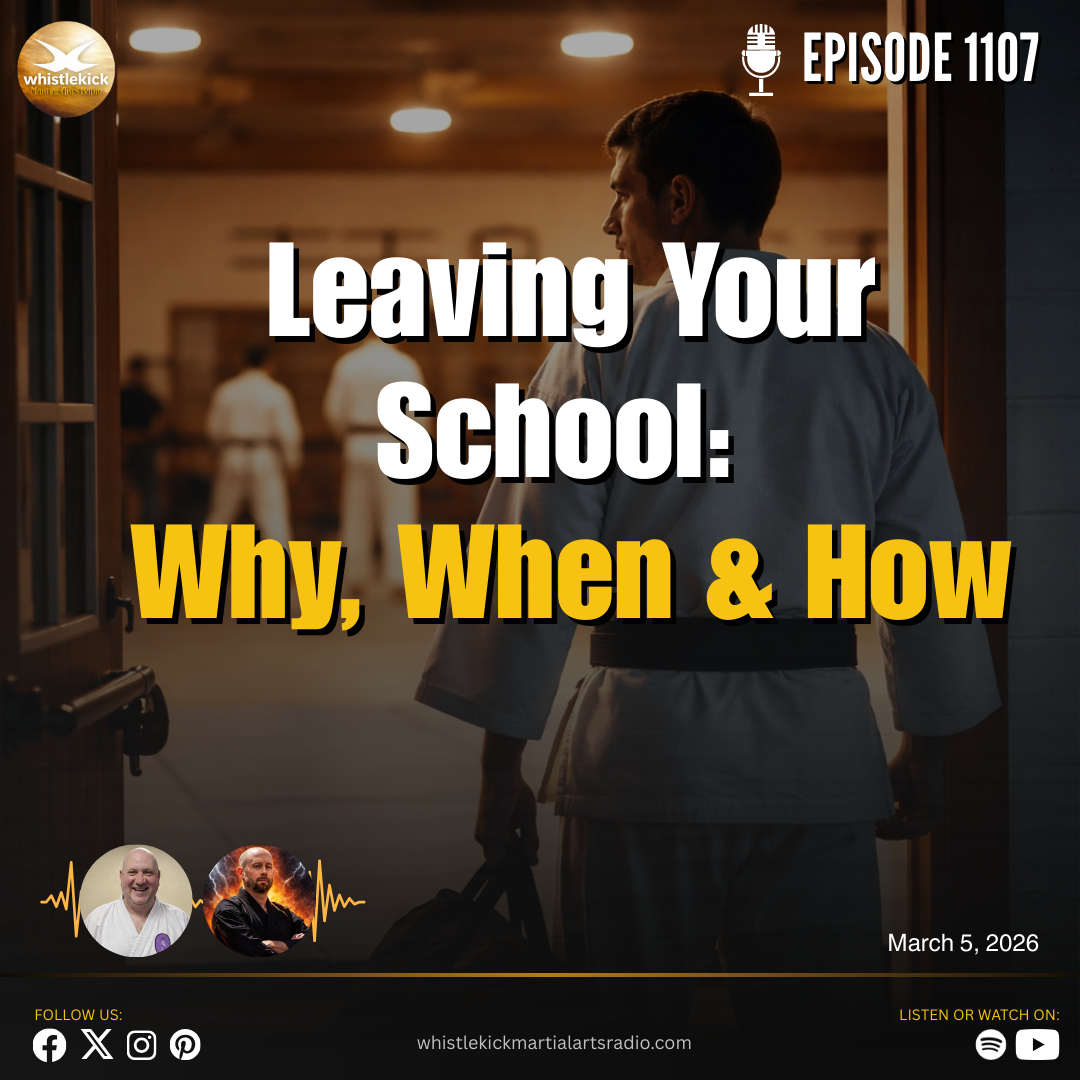
In this episode Jeremy and Andrew discuss some of the reasons why you might want to leave your martial arts school.
Leaving Your School: Why, When & How - Episode 1107
SUMMARY
In this episode, Andrew and Jeremy discuss the complexities of leaving a martial arts school, exploring the reasons, timing, and methods for making such a significant decision. They also brainstorm creative collaboration ideas for martial arts podcasts, reflecting on their experiences and the importance of community in martial arts training. In this conversation, Andrew Adams and Jeremy Lesniak explore the various reasons why martial artists may choose to leave their schools. They discuss the importance of aligning personal goals with the training environment, the necessity of communication with instructors, and the respectful ways to exit a martial arts school. The conversation emphasizes the significance of feeling valued and safe in training, as well as the common mistakes individuals make when departing from their martial arts journey.
TAKEAWAYS
The decision to leave a martial arts school should not be taken lightly.
It's important to communicate concerns before leaving a school.
Understanding the timing of leaving is crucial for personal growth.
Mistakes made by instructors can impact students' decisions to stay or leave.
Establishing oneself in a school creates responsibilities when considering leaving.
Exploring the 'why' behind leaving can help clarify personal values.
Alignment between personal goals and the training environment is crucial.
Feeling stagnant in growth can lead to a desire to leave.
Safety and health should always be prioritized in training.
Instructors should be open to communication about student concerns.
Feeling taken advantage of can be a significant reason for leaving.
Respectful communication is essential when exiting a school.
Avoid ghosting; communicate your departure respectfully.
Recognize the importance of belonging in a training environment.
It's okay to seek new experiences in martial arts.
CHAPTERS
00:00 Introduction
01:01 Exploring the Decision to Leave a School
05:47 Understanding the Reasons for Leaving a Martial Arts School
15:01 The Importance of Communication with Instructors
20:34 Navigating the Departure: How to Leave Respectfully
27:31 Common Mistakes When Exiting a Martial Arts School
Join our EXCLUSIVE newsletter to get notified of each episode as it comes out!
Subscribe — whistlekick Martial Arts Radio
After listening to the episode, it would be exciting for us to know your thoughts about it. Don’t forget to drop them in the comment section down below!
SHOW TRANSCRIPT
Jeremy Lesniak (12:01.464)
Hey, what's going on everybody? Welcome back. It's another episode of Whistlekick, martial arts radio. And on today's episode, Andrew and I are talking about kind of a sensitive subject, but one that unfortunately quite a few people will face throughout their martial arts career. When, why, and how to leave your martial arts school. We're going to unpack all three of those. It's a subject that frankly, I'm surprised we haven't done an episode on this before. We've touched on it at times, but...
Doesn't look like we have. At least that's what our scan of our 1104, right? 1104 episodes told us as we prepped for this episode. Now, if you're new to the show, welcome. Thanks for being here. Thank you for spending some time with us. I'm Jeremy Lesniak, founder here at Whistlekick and co-host for Martial Arts Radio, joined by Andrew Adams, my good friend, the other half of the co-hosting duties, producer for the show.
and he wears a whole bunch of other hats, which is good because neither of us have any hair. Andrew, how are you?
Andrew Adams (13:03.556)
I'm great. I'm doing great today.
Jeremy Lesniak (13:05.806)
Awesome. Thanks for being here. What should we tell them? What should the audience know about what we do before we dig into this important subject?
Andrew Adams (13:16.646)
First off, thanks for being here. If you're new, we appreciate that. As Jeremy, as he mentioned, we've got over 1100 episodes. I think this will be like 1107, I think. So we've got 1106 other ones to listen to and even some bonus ones. So there's actually more than that, really. And all of them you can find at whistlekickmarshallartsradio.com. Whistlekick.com. Yeah, we've got an email.
Jeremy Lesniak (13:19.214)
Hmm.
Jeremy Lesniak (13:28.269)
Mmm.
Jeremy Lesniak (13:35.115)
Yeah, that's true.
Jeremy Lesniak (13:42.306)
They should sign up for the email. Yeah.
Andrew Adams (13:45.252)
there you can get you know sign up for that so you can get notified of every episode as it comes out which is pretty cool.
Jeremy Lesniak (13:51.274)
And there's bonus content in there too. Yeah, you put some bonus stuff in there, which is pretty cool.
Andrew Adams (13:57.446)
Absolutely.
Jeremy Lesniak (13:58.55)
It's nice and easy. It's easy to sign up.
Andrew Adams (14:02.063)
Nice and easy. That's my style.
Jeremy Lesniak (14:03.106)
And if you can't find the form or maybe you're super duper lazy, you could email or message one of us and we'll add you to the list. Andrew at Jeremy at whistlekick.com.
Jeremy Lesniak (14:16.098)
Anything else we should tell before we start? Okay. Leaving a school, the decision to leave a school is one that should not be taken lightly. And I want to be clear, we're not, we're not, for this episode, we're not going to be talking about, I'm trying out a school, I'm three weeks in, it's not a fit, I'm not going back. Like, that's not what we're talking about. We're talking about
Andrew Adams (14:17.807)
No, let's go. Let's get into it.
Andrew Adams (14:41.787)
Hmm. Yeah, yeah.
Jeremy Lesniak (14:45.384)
You have signed up. You have established yourself in that school. It is a thing that you have committed to, whatever that means to you and to the school.
Andrew Adams (14:55.631)
Yeah, you've been there an extended period of time. More than a, I would say even more than a few months.
Jeremy Lesniak (15:04.608)
Yeah, I think the responsibilities and the leeway for not honoring the responsibilities when you leave, I think it's a more serious decision the longer you stay. And I don't think it ever stops. I don't think it plateaus. And it's got to be done the right way.
Andrew Adams (15:24.485)
Yeah, yep. And you know, we'll talk about the when, the why, the how. And you know, I can't speak for you, but you know, I will definitely be interjecting some personal experiences because I left a school. And you know, the other thing I'll say is we are also not talking about leaving your school because you're moving across the country.
Right, that's, mean, there are lots of reasons to leave your school that we are not going to discuss. But that's, the ones that, you know, those ones that are like obvious. You got married and you move 4,000 miles away, you're going to leave your school likely. So like, we're not going to discuss that sort of stuff.
Jeremy Lesniak (16:07.106)
Yeah. And I'll have some personal anecdote. I'm actually, think your personal story much more closely aligns with what we're talking about than any of the stuff that I've done. So I'm glad that we have that personal experience.
Andrew Adams (16:15.429)
Mm. Yeah.
Jeremy Lesniak (16:22.646)
The title of the episode is When, Why, and How? Is that how we ordered it? Okay. So let's break it up into those. When it's appropriate to... Okay. Why, when, and how. The why and the when could be a little blurry between the two. Because we could use the term when interchangeably, let's...
Andrew Adams (16:28.091)
Yep. Yep.
Andrew Adams (16:33.831)
actually we did why, when, and how.
Jeremy Lesniak (16:51.116)
Let's leave when as the more of the time, the timing of it. Okay. So let's talk about why. Why should someone leave a school?
Andrew Adams (17:00.177)
Well, I think we are going to find that there are lots of whys. One could be you don't respect your instructor anymore. And there could be a few reasons why, you know, maybe they were involved in something nefarious and you are choosing to not associate. Yep.
Jeremy Lesniak (17:04.878)
I agree.
Jeremy Lesniak (17:12.14)
Hmm.
Yeah.
Jeremy Lesniak (17:19.116)
Mm-hmm.
Jeremy Lesniak (17:22.59)
Martial artists are people. People make mistakes. Sometimes those mistakes are such that you don't want to associate with them.
Andrew Adams (17:33.125)
Yep. So I think that is one, you know, and sometimes mistakes are forgivable and sometimes they're not. you...
Jeremy Lesniak (17:38.499)
Mm-hmm.
And so you could still forgive and choose, you know what? This is not someone I want to be associated with anymore.
Andrew Adams (17:47.132)
Yep, absolutely. Absolutely. So I think that's, that's one. think another, why could be that you don't in fa you don't find enjoyment training with this particular school or person anymore.
Jeremy Lesniak (18:04.556)
Yeah.
Jeremy Lesniak (18:09.818)
I think when we take a look at why, everybody has a reason for training. When you're reason for training.
Jeremy Lesniak (18:21.772)
and the reason that you are training at this place are no longer aligned. Right? I think that's really, we could sum it up under that, because everybody's got more than one reason for training and everyone has more than one reason for training at the place they are. And the greater the distance between where you are and where you want to be in terms of your why, the more that becomes an obvious decision. And it's a very personal decision.
Andrew Adams (18:26.343)
Mm-hmm.
Jeremy Lesniak (18:51.51)
and no one else can make it.
Andrew Adams (18:55.749)
Yep. Yep. I think another why could be you could feel stagnant in your growth as a martial artist, where you're at.
Jeremy Lesniak (19:03.662)
There are plenty of schools out there that repeat the same stuff over and over again. And it's almost like you're on a 6, 8, 12 week cycle and you go through enough of those cycles and you're going, OK. Or you're at a school where every time a new student comes in, the whole class goes back to day one. I've seen that happen.
Andrew Adams (19:23.911)
Mm-hmm. Mm-hmm. Yep. I have a few more, but I'm wondering if you have any as well.
Jeremy Lesniak (19:33.134)
When it is not safe, when it is not physically safe and conducive to your health, I think that is an important one. And this doesn't change often. Usually the culture around, let's say, physical contact remains fairly consistent, but it could change. You could have an assistant instructor that's taking more of the lead with class. And now all of sudden, you know, that person likes to, as we used to say, they like to bang.
Right? Like they used, they like to, they like to hit hard and maybe that's not what you want or what you're able to do for any number of reasons.
I think one of the ones that we talk about often within the context of Whistlekick is you're trying to do some things outside of that school and the school is trying to mandate that you do not. You cannot cross-drain, you cannot go to that competition, you cannot go to this event. And if those things are important to you, then that's a problem.
Andrew Adams (20:28.636)
Yep. That's a pretty common.
Andrew Adams (20:37.48)
Yeah, yeah, I would agree. And, you know, we both know people that that has happened to that they have they very much enjoy training at their school. But they also enjoy events, whether those events are whistle kick related or not is irrelevant, but they enjoy going to other events and tournaments and competing against their peers and learning from other individuals, other things and the
that person's association or instructor has a problem with that. And when those two things come to a head, one of two things happen. The instructor makes it difficult for the student or comes right outright and says to the student, you can't do this anymore. Or the student realizes it's going to come and they leave on their
Jeremy Lesniak (21:29.624)
We know people who no longer come to Whistlekick Things because their instructor said they could not. And we know people who left their school because they told them they couldn't come to Whistlekick Things.
Andrew Adams (21:41.033)
Yeah. I think another reason that people, another why people might want to leave their school is they feel taken advantage of, especially at the higher ranks. I mean, I will, I will speak, this is where I will speak for myself a little bit. At the school that I had been training in, I was the top ranked student. I didn't feel like I was getting any, any
I don't want to sound like I needed specialized attention, but like I wasn't getting to work on things to progress my own training very much. And I was constantly consistently helping teach at the school. And sometimes short notice, sometimes it was, I would get a text message at three o'clock saying, Hey, can you teach class tonight at five 30? And, you know, the first
Dozen times that happened. said yes. And then after a while it began, I began to be like, you know what, even, and even if I could, I sometimes I got to the point where I was like, you know what, this isn't fair to me. And so I would say, I'm really sorry. It's, you know, two and a half hours notice. have other plans, even if I didn't, because I didn't, I felt like if I continually said yes, I would get taken advantage of even more. And you know, I left for many reasons, but that was certainly one of them.
that I felt taken advantage of.
Jeremy Lesniak (23:06.35)
And that is one that I think plenty of people have felt. And it can be a delicate balance, right, as someone with a school, with kind of a co-instructor who is also a student and making sure that time is balanced between responsibilities as student and instructor. And it's something that I spend a lot of time talking with her about to make sure, because I don't want her to feel
taken advantage of. But not every school communicates that. And there are a lot of ways to do it. I know a lot about your personal story, and I can say point blank that I don't think I would have suffered what you did as long as you did.
Andrew Adams (23:53.929)
And I want to be clear, it would have been very different had I been compensated for that. I mean, I continue, there were eight classes a month, roughly, because there were two a week. And I would on a regular basis be teaching basically three classes a month. Almost half of the classes I would end up teaching, but I didn't get any compensation for that. And I still had to pay. I still had to pay my dues as well. So, you know, that can be another reason to leave if you're not feeling, you know, feeling
Jeremy Lesniak (23:59.32)
Sure.
Jeremy Lesniak (24:16.216)
when you see it as a student.
Andrew Adams (24:23.162)
respected in that way.
Jeremy Lesniak (24:26.07)
And so that's where, for me, this all comes back to this, the gap between where you want and need to be and where you are. And you could come up with a thousand more reasons. We had a recent episode where the guest left in large part because of a single student, how that student treated her and how the instructor managed that.
And I've seen this happen before. I've seen people, I once lost a couple of students because I said...
I jumbled my words. They were looking at leaving, but the final straw was I said something and it came out wrong and I tried to catch it. I don't blame them. Everybody's gotta be, everybody deserves the right to train. We've talked about this, right? Six freedoms martial arts. Everybody has the right to feel like they belong where they're training. And if you do not feel like you belong.
Andrew Adams (25:09.66)
Mm.
Jeremy Lesniak (25:36.81)
And this is where I think kind of the subtitle to the why becomes about.
creating the opportunity to go elsewhere. If your why is entirely, if the end result of your why is that you stop training, that's a very different why. Because there are many, many people out there who have cultivated a why because they want an excuse to stop training and they don't want to feel guilty. Why don't they want to feel guilty? Because they know martial arts is benefiting them. I see this all the time, not all the time.
Andrew Adams (25:56.648)
Yeah, good point.
Jeremy Lesniak (26:14.444)
But this is the common refrain for youth martial arts and parental conversation.
Jeremy Lesniak (26:25.74)
Little Timmy's doing great. They're excelling in school. They're better at home. They are achieving so many things. Life is really busy right now. We're going to take a break.
Andrew Adams (26:37.671)
Mm-hmm. Yep.
Jeremy Lesniak (26:41.624)
That's your why. I disagree with it, but that's okay. Because just like everything else, we don't have to agree with the reasons. Do we have enough reasons on the table? I think we do.
Andrew Adams (26:45.522)
Mm-hmm. Yeah.
Andrew Adams (26:55.897)
I think so. I think so. Now the next thing was the when.
Jeremy Lesniak (27:01.506)
when. And this is probably the simplest part of this equation.
As soon as you are sure.
and you've tried to remedy the situation.
Andrew Adams (27:17.928)
Yeah. The biggest thing I wanted to bring up is in most of the cases that we've talked about, I think a conversation needs to happen with your instructor. Now I want to say, I want to be clear. I'm not saying in every single case, but I think in most cases, I think a conversation with your instructor, especially if you feel like your training has plateaued or you're a stagnant.
Talk to your instructor because maybe there's something that they can do to like alleviate that issue if that's the only issue
Jeremy Lesniak (27:53.711)
There's a difference between the conversation as an attempt to remedy and the conversation about the actual departure. And the conversation about the actual departure is going to be a big part of what we'll talk about in the how. But if you have been training somewhere a long time and you have received value and you like and respect the people, or you at least did at one point.
Andrew Adams (28:00.553)
Correct.
Jeremy Lesniak (28:16.334)
I'm gonna say nine times out of 10, a conversation should happen to attempt to remedy the situation. And let me be really, really...
I'm going to attempt to be clear and sensitive all at the same time. If you have spent years with a group of people, if you have spent years with an instructor, you value that instructor, you have paid them money, you have spent time with them, and you are not comfortable telling them, I'm having a challenge, I'm going to guess that most of the time that is upon you.
Some of the time it could be them. I've known instructors that don't want to hear it. Classes at this time, this is what we do. You show up, you wear your uniform. We're not going to have personal conversations. When we're done, you leave. I'll see you at next class. I've known instructors like that. They don't want to break the barrier. That's fine. But that's not most instructors that I know. Most instructors, if one of their students is struggling in some way,
and struggling so much that they are strongly considering leaving the school would be hurt that they were not given prior knowledge and an opportunity to make things better.
Andrew Adams (29:38.909)
Hmm. Yep. Yep. I would also say talking about this reminds me of another why, which is that you don't feel valued as a student either. Again, using myself as the example we already talked about, I was teaching almost half of the classes on a fairly regular basis. But if I had ideas and opinions on things that we might be able to do better to help grow the school or make the school better,
Jeremy Lesniak (29:46.35)
Mm-hmm.
Jeremy Lesniak (30:04.781)
Mm.
Andrew Adams (30:08.872)
My previous instructor had very little interest at all in hearing any of that. And so you reminded me of that as well. I think, you know, not being, not respecting your instructor, not being valued, feeling, taking advantage of all of those things. And the last one I'll bring up and we can continue with the why is that maybe your instructor, you as a student might feel like you have become stagnant in your growth.
But for some students, and I am one of them, it is important to me that my instructor is also continuing their practice. And that was one of the other, another reason why I left my last school, that my instructor didn't have a karate instructor and hadn't for about six years or so. And I wanted to continue in an association where there was still forward progress and movement for all, including my instructor.
Jeremy Lesniak (31:08.782)
So when we go back to this conversation, what we'll call the remedy conversation, if you're not willing to have that conversation, in most cases, it's because you're looking for a reason to leave. You're not looking for a reason to stay. And that is a very important distinction. There are and I think we've all had experiences with this in various ways, maybe not in martial arts, but perhaps in a personal or romantic relationship or maybe in a professional setting.
where you just want to go, you want to do something else, you want to try something else, you want something new, you want whatever, and you start making up reasons. I think it's important to be honest because maybe there isn't a when conversation here. Maybe there isn't a remedy conversation. Maybe it just goes to the how. Maybe you say, you know, I'm training in Taekwondo.
And I've had a really good run in Taekwondo and it's been nine years. And I've got a few friends that are training Krav Maga. And it's different and it's kind of neat. And I don't have the ability or the energy or the money or whatever to do both. And I want to go try that. That's okay. It's okay to say that. And you can say that without disparaging your school and instructor or belittling.
undervaluing the time that you spend training.
Andrew Adams (32:39.356)
Yeah, yeah, yeah, I think so.
Jeremy Lesniak (32:39.854)
So are we ready for the how? OK, I think how is pretty simple. Respect what you do should come from the same ideals of your training and your school. If you are training to be more disciplined, more respectful.
Jeremy Lesniak (33:01.664)
more resilient, then you damn well better have a conversation with somebody. And I don't mean, I'm a green belt. I'm going to talk to that brown belt on the way out the door. Hey, it's my last class. Peace out. No, I mean, hey, I mean, I don't know of too many schools where the contact information of the instructors isn't available. I would like to have a conversation with you.
When can we chat?
And again, this should not be an email. In fact, I have a personal rule. Nothing that has emotion should ever be an email or a text because it is far too often misconstrued.
I under it is difficult. It is really hard to sit down with someone to tell an instructor like I've it hurts every single time one of my students leaves it hurts it sucks But I'm not mad at them It hurts because I like them. It hurts because I'm seeing their progress and other progress with me will stop
Andrew Adams (34:07.484)
Mm-hmm.
Andrew Adams (34:15.014)
Yeah, I'm, I'm going to disagree with you a little bit is that I think that using email or text is fine. And I think it comes down to how much you respect you have for the person that you're leaving. If you let's use the example of they, they are someone that you no longer respect and you don't want to be around them anymore. Maybe you don't feel comfortable talking to them face to face. And, and, know, in my case, I.
Jeremy Lesniak (34:17.912)
Okay.
Jeremy Lesniak (34:39.79)
I totally agree with that.
Andrew Adams (34:44.262)
I didn't feel respected by my instructor. So I didn't feel I needed to give them the respect of talking to them in person. I communicated over text and I texted them and just say it. And all I said was that, I felt for, for quite a while we've discussed that I feel like my journey is taking me down a different path. And I feel like my Marshall journey is taking me elsewhere. And so I thanked him very much for all that he's taught me. And I wish him and the school,
well wishes, but I will no longer be attending classes.
And for me, I felt like that was fine because there wasn't emotion to be given. I wasn't heartbroken over it. And I didn't feel like I, to be honest, that I really had the respect from him. And so I didn't feel a need to sit down with him in person.
Jeremy Lesniak (35:29.303)
sure.
Jeremy Lesniak (35:38.616)
Yep. I, I get that. I totally get that. I think.
I don't know how many situations are going to be kind of deficient in respect in that way. Because if I was your instructor, I would want to know, okay, obviously something, I missed something. I could have done something better, right? And so it becomes kind of like an exit interview. And for me, it's, oof, this hurts, okay.
How do I make sure that my senior student doesn't leave again?
Right. And yeah, I think I think the important thing here is that how you depart aligns with your values and how you value the people.
I have seen people who just stopped showing up after a decade. I don't think that's okay. Where did they go? They're just not here. Whoa.
Andrew Adams (36:44.508)
Hmm. Yeah. And I, and I would agree. Yeah, I would agree. Yeah. I would never, I would never say just ghosting completely. I think that's a mistake.
Jeremy Lesniak (37:01.014)
I think under most circumstances, in person is best. Phone call is second best, email is third best.
Jeremy Lesniak (37:13.708)
Maybe even a letter is third best. A written letter might be better. If you're not comfortable talking to them in person, think a letter could be, right? Because letters always get opened.
Andrew Adams (37:15.847)
Mmm.
Jeremy Lesniak (37:28.359)
and letters show that you put in effort. And I think that that changes the way words are received.
You know, when I get an email or a text from someone and it's full of misspellings and I have to read it three times to understand what they mean, it tells me that them sending that to me wasn't super important. And it tells me everything that they're saying has to kind of be filtered through that knowledge. And that kind of stinks, right? Because then you're kind of, you're trying to piecemeal, like, what is this situation really? But if somebody sent me a letter and said, OK, hey, you know,
this has been great, you've been great, I'm gonna move on, or this has been great and it's been a few years, I wanna go try this other thing. I'll be like, all right, cool, more power to you. Thanks for letting me know.
Jeremy Lesniak (38:24.344)
How do they get it wrong? When we talk about the how, what are the wrong ways? Because we're having a, there's a lot of variability and I think the right way to do the how, to do that exit conversation.
Andrew Adams (38:36.774)
Yeah, I think the one way you can get it wrong, we already mentioned, which is just not showing up anymore. No communication whatsoever, just being gone as they, you know, just done and never, never coming back, never having any sort of conversation. That's definitely a wrong way to do it.
Jeremy Lesniak (38:56.632)
Yeah, I would agree. I don't know too many people who teach.
without loving the teaching and loving their school. It's not just a job. And I think you have to remember that. what your... It's important and it's important to make it about you. I think that's critical. This is not a fit for me. Not, you suck at teaching.
Andrew Adams (39:23.1)
Yep. Yep.
Jeremy Lesniak (39:26.36)
Those are really different things.
Jeremy Lesniak (39:31.528)
and at the same time, not delaying any of this. That's the part that we really didn't talk about.
Andrew Adams (39:37.948)
Yeah. And that's a hard one. The longer you've been with that school.
Jeremy Lesniak (39:46.078)
Jeremy Lesniak (39:51.891)
What I have found historically is that people come to a decision and they wait a very long time. They usually wait until they have. There's something that happens that they can point to. And they blame that thing. So instead of saying, I felt like I was stagnating, you know, my training wasn't really going well or doing the same thing over and over again. Did you talk to the instructor? No, I didn't really want to. But then.
the instructor took a month off because they were sick. Well, I'm not going to pay if they're not going to be there. And they blame it on that. Right. I've seen that sort of stuff happen. And that's just kind of gross because everybody knows, you know, you got to stay true to yourself. You have to.
Andrew Adams (40:24.326)
Hmm.
Andrew Adams (40:30.12)
Sure, sure.
Jeremy Lesniak (40:40.586)
If martial arts makes us better, the actions that we take as martial artists should be from the best place, the best part of us. And when possible...
Jeremy Lesniak (40:56.726)
that best place should meet someone else in their best place, which means respectful whatever, right? However that disconnect is.
Andrew Adams (41:01.32)
Mm.
Andrew Adams (41:10.418)
Yep, yep, I get it.
Jeremy Lesniak (41:15.424)
Anything else?
Andrew Adams (41:16.336)
No, think that's good. I certainly would love to hear from anybody listening and or watching on their thoughts. And if you are not watching, just know that all of these episodes are available on YouTube. Even if you don't watch, go to YouTube and find our channel and like and subscribe. It costs you nothing and it really helps us because it helps our videos be shown in front of other people and helps us get out.
Jeremy Lesniak (41:20.437)
Yeah.
Jeremy Lesniak (41:34.478)
Please.
Jeremy Lesniak (41:40.056)
Yep.
The hardest thing about what we do is getting it to new people. Once you've already watched or listened, it's pretty easy. The algorithms know, they find you. So many of you are in the martial arts radio, Facebook page. So many of you are subscribed to the emails. It's easy to get a hold of you. But getting new people to see what we've done and show them. I saw recently two different people.
Andrew Adams (41:47.42)
Mm-hmm.
Jeremy Lesniak (42:11.446)
responded to two different past episodes shared by two different past guests over the last few weeks. they're still at it? So people that were familiar with us in the first hundred episodes somehow lost touch with what we've been doing. And you might think, well, how? The internet's a big place.
Andrew Adams (42:25.832)
Hmm.
Andrew Adams (42:30.428)
Yeah. So go to YouTube, like, and subscribe to us. It'll really help us out. And if you truly like what we do, if you want to help promote traditional martial arts, which is what we do, go to YouTube, like, and subscribe. It helps us a lot and it costs you nothing. It costs you zero. And it really does help us out. and if you want to help us out even more, share the episode directly, take the link.
Jeremy Lesniak (42:50.606)
Goose egg.
Andrew Adams (42:59.772)
the YouTube link or any other, you know, go to our, our whistle kick martial arts radio page, share that on your Facebook page or on your Instagram, all of that stuff. Again, it costs you nothing and you are doing a small part to help promote traditional martial arts.
Jeremy Lesniak (43:20.718)
Thanks everybody for being here. If you want to get a hold of us, Andrew at Jeremy at whistlekick.com. All of our social media is at whistlekick. Whistlekickmarshallorchradio.com for all the episodes. Whistlekick.com for all the things that we make. And that brings us to the end of another episode. Until next time, train hard and have a great day.
Andrew Adams (43:39.741)
Smile.