Episode 1117 - Martial Things with Andrea Harkins
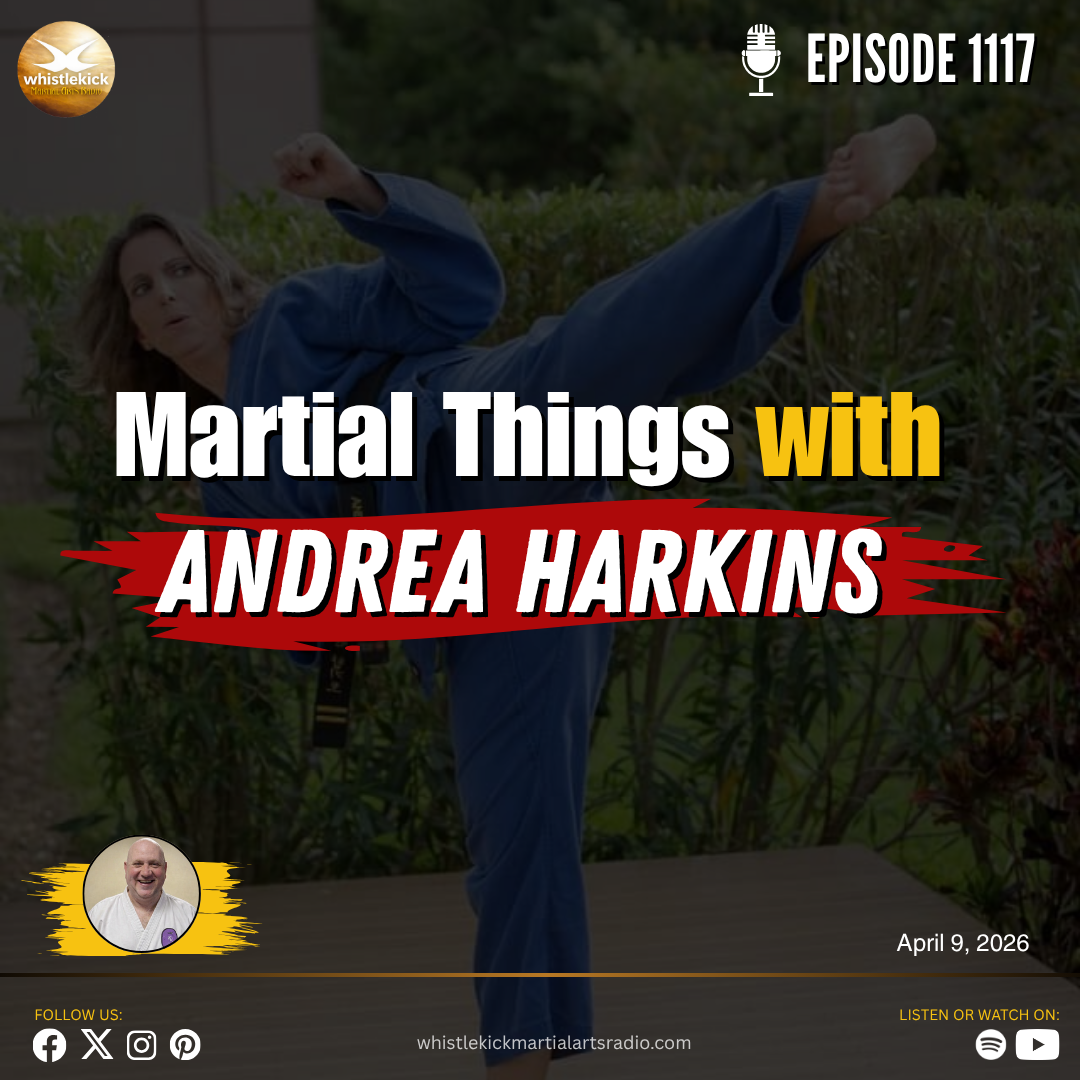
In this episode join Andrew in whistlekick’s Martial Things series. This week he sits down and chats with Andrea Harkins with a plan to talk about……. nothing. No plan, just a conversation to see where it takes them.
Martial Things with Andrea Harkins - Episode 1117
SUMMARY
In this episode, Andrea Harkins and Andrew Adams engage in a free-flowing conversation about martial arts, social media, and the importance of community engagement. They discuss the evolution of Andrea's social media presence, particularly on TikTok and Facebook, where she poses thought-provoking questions to the martial arts community. The conversation also delves into the role of competition in martial arts, the definition of greatness, and the importance of motivation and inspiration in the martial arts journey. In this conversation, they delve into the multifaceted world of martial arts, discussing personal experiences, the significance of history, and the evolving nature of training. They also explore the importance of individual journeys in martial arts, the relevance of the belt system, and the value of personal growth over competition. The dialogue emphasizes that martial arts can serve various purposes beyond fighting, including self-awareness and confidence building.
TAKEAWAYS
Social media can be a powerful tool for community engagement.
Posing questions can spark meaningful conversations in martial arts.
Competition is not a requirement for being a great martial artist.
Greatness in martial arts is subjective and personal.
Motivation and inspiration are key to encouraging others in martial arts.
Engaging with different opinions can broaden perspectives.
Martial arts can be pursued for various personal reasons.
Martial arts can be a personal journey rather than just a fighting art.
Understanding the history of martial arts can enhance appreciation but isn't essential for practice.
Competition can provide valuable pressure testing for skills learned.
The belt system in martial arts is often misunderstood and varies by school.
Martial arts training can lead to personal growth and self-discovery.
The reasons for training in martial arts can change over time.
CHAPTERS
00:00 Introduction
03:00 The Evolution of Social Media in Martial Arts
05:55 Engaging the Martial Arts Community
08:59 The Impact of Competition in Martial Arts
11:58 Defining Greatness in Martial Arts
14:57 Motivation and Inspiration in Martial Arts
21:01 Exploring Martial Arts Perspectives
24:37 The Importance of History in Martial Arts
27:12 Personal Journeys in Martial Arts
30:12 Pressure Testing and Real-World Application
32:43 Defining a Martial Artist
35:23 The Belt System and Its Relevance
40:36 The Value of Personal Growth in Martial Arts
Join our EXCLUSIVE newsletter to get notified of each episode as it comes out!
Subscribe — whistlekick Martial Arts Radio
After listening to the episode, it would be exciting for us to know your thoughts about it. Don’t forget to drop them in the comment section down below!
SHOW TRANSCRIPT
Andrew Adams (03:42.745)
Welcome you're listening or perhaps you're on YouTube and you're watching the next episode of Whistlecake martial arts radio. Today I'm joined by Andrea Harkins. Andrea, how are you today?
Andrea F Harkins (03:53.07)
Hi, I'm great. How are you?
Andrew Adams (03:54.674)
I am doing excellent. I'm excited to sit down and chat about something, but we don't know what, which is what I love about this martial things series we have going. If you are new to the show, we love that you're here. Thank you for being here. You can go check out this, everything about this episode, transcripts, timestamps, everything at whistlekickmartialartsradio.com. You can also find every episode we've ever done over 1100 at this point.
All of that stuff you can find whistle kick martial art creator comm you can also go to whistle kick comm to find out all of the other things we do Maybe you want to purchase some sparring gear. Maybe you want to purchase some some t-shirts or some hoodies or a hat or a Training program all of that stuff you can find whistle kick comm and if you use the code podcast one five You can save yourself 15 % on almost everything over there Okay, that's a mouthful. I know right
Andrea F Harkins (04:47.01)
Take a breath. Take a deep breath. By the way, I like your t-shirt. That's awesome.
Andrew Adams (04:50.867)
thank you. Yes, Marshall Summit, one of the events that we host every year here in New England. Marshall Summit is in November every year. And we're looking forward to a big Marshall Summit in 2026 this year because we are celebrating Whistlekick Marshall Arts Radio's 10th anniversary. Huge.
Andrea F Harkins (05:10.378)
I remember when it started, I met Jeremy years and years ago, just on a whim. Like I was living in Florida at the time and he was, I believe that's what it was. He was in Florida, some little hotel, I don't know, he's doing something. And I was like, Hey, I see you're in talents. And that's the first time I met him like years and years ago. And I can see how much he's grown and evolved. And this is so fun. And whistle kick has been.
Andrew Adams (05:16.261)
Mm-hmm.
Andrew Adams (05:32.025)
Wow, that's funny.
Andrea F Harkins (05:39.052)
an evolution in itself. So I'm happy to be here in a chat about nothing, anything, whatever.
Andrew Adams (05:45.392)
Yeah. So one of the reasons I mentioned this before we started recording, like one of the things that I love about this type, this format, which is we don't have an agenda. There's no bullet points we're going to talk about. There's no specific topics. And it's really a plan to have no plan, which is what's more martial arts than that, right?
Andrea F Harkins (05:55.96)
Yeah.
Andrea F Harkins (06:09.334)
Yeah. I mean.
Andrew Adams (06:10.095)
You know, we are more friends on Facebook. And one of the reasons I reached out to you to have you on the show is that you recently have been posting and I've noticed it more in the last couple of months. And I don't know if it's because you started a couple of months ago or if the Facebook algorithms just showed me more, but you have been posting. Yeah. A lot more reels and content online asking very poignant martial arts questions and looking for people's feedback. And I'm.
Andrea F Harkins (06:24.884)
Yes, yes, yes, the real, yeah.
Andrew Adams (06:39.473)
I'm curious what made you decide like have you been doing it more than a couple months and I just didn't notice or is it kind of a new thing?
Andrea F Harkins (06:45.088)
No, not really. all started on Tik Tok. I started posting more on Tik Tok, but at first it was just photos. It was photo, kick photos mostly, cause over the years I've been a kick enthusiast really just on flexibility and balance as opposed to powerful kicks or, you know, fighting kicks. just kind of had
I just kind of use them as an artistic thing for myself to be able to do a high kick, especially as an older person, you know, to be able to show that you can still be flexible and have balance and stuff like that. So that's what I was posting on TikTok, but I knew in the back of my mind that this is really, TikTok is really more for videos. It's not as much for just the standard photos. And while I had a small following, I just thought, you know, I need to think about a way to actually interact.
better, both here and on Facebook. And so it's really started on TikTok, where I thought what kind of videos without being negative, without, you know, just doing the hooks all the time, you know, like a hook meaning capturing everybody's attention within the three seconds by saying something outrageous, you know, what, what can I post that's going to actually be meaningful and grab people's attention?
Andrew Adams (08:02.747)
Yep.
Andrea F Harkins (08:09.518)
And that's when I started posting questions that were coming into my mind about martial arts, but not about technique and all of that, more about you as a martial artist. You, what do you think about this topic? And that seemed to kind of kick off a lot of discussion and conversation. I thought this is really cool. This is a positive way to impact martial arts.
to make people think about things outside the box. Everybody has their own opinions, right? What's the best martial art? What technique is the best? Everybody has their opinions on those things. And sometimes the opinions are silly, or they're egotistical or whatever. And that shows up in the responses. Yeah. I know you don't believe it. It shows up in the responses, which is interesting because...
Andrew Adams (08:59.046)
No, I don't believe it.
Andrea F Harkins (09:08.844)
And then I just took that reel and I, and then I just took those videos and I use them as reels on Facebook. And it really caught a lot more traction on Facebook. So, I mean, I've had like 150,000 views on a couple of them. Couple of just really took off, especially for the number of followers I have, which is like 10,000. So anyway, it's just been an interesting concept. And I think as martial artists, we need to continually think outside the box and outside of our
own opinions because guess what there's a lot of good knowledge and other people's opinions out there that are important or suddenly make sense so that's how that all evolved.
Andrew Adams (09:48.197)
Yeah, absolutely. Jeremy and I have said on the show often that we don't expect everybody that listens or watches our show to believe and think what we think. But what we hope is that what we talk about at least makes you think. And you don't have to agree with us. That's OK. But at least we're hoping the gears are turning.
Andrea F Harkins (10:05.836)
Yes.
Andrew Adams (10:14.245)
Now, I'm wondering if you had a specific question because you usually pose them as questions. Do you think this or whatever? Have you had one or two that you didn't expect to do as good as it did, but did? And what was that question? Or maybe responses that you're like, I hadn't thought of that.
Andrea F Harkins (10:22.829)
Yes.
Andrea F Harkins (10:35.682)
Yeah, I wasn't really, I don't know what to expect with any of the questions that I post. Is this going to hit big or am I going to get 500 views or typically they're between two and 4,000 views. So, you know, it's not like a huge thing, but it's, you know, it's decent traction. I never know which one is going to be the most well responded to.
Andrew Adams (10:52.953)
Yeah, sure.
Andrea F Harkins (11:02.25)
Oftentimes, honestly, based on algorithms, it's the shortest question. So it's not even the topic. It's the amount of time somebody has to look at the video. so I'm not even sure which ones I was surprised about, but I do try different lengths of videos. And this is just good social media kind of knowledge out there, often the shorter.
Andrew Adams (11:07.569)
Interesting.
Andrea F Harkins (11:29.442)
videos that are like 20 seconds long with a quick question are the ones that do the best. But I've just asked a lot of questions from a lot of different angles. And I try to be kind of specific, but yet general. And I don't usually post my particular opinion, right? Which is good and bad. So sometimes people will respond and they're actually cordial and they'll say,
Andrew Adams (11:48.945)
I've noticed. Yep.
Andrea F Harkins (11:58.658)
Well, what do you think? And I'll respond. Other times people are very negative, like, well, you obviously don't know anything about martial arts if you're asking this question. And so it's kind of funny. But the questions, I just come up with two or three at a time. And it's usually things that I'm thinking about, like, you know, why did you start martial arts really? You know, or have you been?
Have you been bullied in the past and has that made you want to start martial arts or are martial arts only for fighting? Are they only for street fighting? Those often get a lot of views because there's a lot of people out there into street fighting. Okay. And so I try to say, I am not into street fighting. Yes, of course. I want to save myself. It's just not something I study in practice. I study traditional martial arts. That's what I.
Andrew Adams (12:42.544)
the I am.
Andrea F Harkins (12:55.246)
do. It should be okay with you that I do what I want to do. But that always prompts a lot of traditional martial arts questions. I never realized that there were so many people against belt systems. I never I didn't realize that. And still I started asking questions and people like, Oh, a belt is something you're ever on your waist. And I'm thinking, well, I worked really hard for my belts.
Andrew Adams (13:12.144)
Mmm.
Andrew Adams (13:21.424)
I'm
Andrea F Harkins (13:22.988)
You know, I was in my twenties, it was back in the late 1980s. I mean, it was not easy. I did a lot of work for it. So I consider it more than just, and so those are the questions that seem to pique people's interest, like the traditional martial arts, they're not effective, or, you know, then you do have the group of people who are more traditional and like, you know, we can.
still fight, we can still do all these things, we've learned the, you know, the foundations. So yeah, always interesting. I never know what I'm going to get for a response.
Andrew Adams (13:57.123)
Yeah, know one of the one. Yeah, no, well, that mean that's true with anything. You never know what you're to get. But I guess you could probably say, you know, that you're always going to get good comments and you're always going to get bad comments. Like, it doesn't matter what you post, what the topic is, you're always going to get people that are against whatever it is. Even when you're it's a question, right? There's no you did. You're not saying in the question what the right answer is.
Andrea F Harkins (14:12.054)
Yes.
Andrea F Harkins (14:26.326)
I'm not, no.
Andrew Adams (14:27.428)
But you know you're going to get those comments. I understand that. One of the ones I saw recently, which I think did pretty well, can you be a great martial artist if you've never competed?
Andrea F Harkins (14:39.95)
Yes, that was one of the ones that took off.
Andrew Adams (14:43.044)
And I'm curious what the, didn't, did not go through and read all of the comments. just, saw that and I'm curious what the responses were. Like what did people see back and notice audience? I'm not asking Andrea what her thoughts are. I'm curious what the responses were.
Andrea F Harkins (14:56.398)
The responses were really mixed. But of course, the reason I asked this is because I tend to see this topic come up on Facebook. Like, if you never competed, can't, you you're not, you're not a great martial artist. And of course, so the questions, a lot of the questions came back were things like, well, first of all, what makes a great martial artist? And I said, good question, because that's up to you. It's not up to me. And if you never competed.
Andrew Adams (15:18.265)
Thank
Andrea F Harkins (15:25.654)
And the questions that would come back would be like, what do you mean by competition? you mean like actual tournaments or do you mean like competing in class or competing with other schools? And I said, again, this is your, your response. So you define it however you want. And so that had a lot of, of comment, but, there was a quite a bit of people are like, yes, you always, you need to compete. And I think some traditional martial arts require you to be in some competitions as well.
I never competed. And that's one reason I asked a question because I was not a competitor. I was happy and lucky if I could just get through the things that I needed to do in class and earn my belts and keep pushing forward. And competition was not something important to me. it wasn't really, there were people in my, in the martial art program that I was involved with who did compete. It just wasn't something for me. And so in the back of my mind, I always thought,
people feel like I'm not a good martial artist because I never competed. So it was kind of a self-exploration question. Like, other people think that? And that did have a lot of responses to it. Yeah.
Andrew Adams (16:27.473)
Hmm.
Sure.
Andrew Adams (16:35.473)
Yeah, interesting. I will answer your question here live on the radio, right? Yeah, live. I mean, we're not live. No one's seeing this until it comes out in a week or so. But I think absolutely you could be a great martial artist if you've never competed. Do I think that competition, and I'm talking about going to tournaments and competing, you know, I just came back from a tournament this past weekend. I'm not a
Andrea F Harkins (16:41.006)
All right, all right, a live answer. Well, not live, sorry. A videotaped answer.
Andrea F Harkins (17:01.9)
Yeah, yeah. Yeah.
Andrew Adams (17:05.475)
And I have said on the show many times, I'm not a big tournament person. have probably competed at in my entire lifetime of martial arts. I think I've maybe competed six times at six tournaments, six or seven tournaments, definitely under 10. And when you consider the length of my time training, that's not very many. but the one thing I will say is that doing competition does
challenge you in a way that you don't typically get in a school setting, right? And there is a lot to be learned from going to competitions. But does that mean if you don't do competitions, you can't be a great martial artist? No, I think that's absurd. Like, absolutely, you can be a great martial artist, in my opinion.
Andrea F Harkins (17:54.254)
Yeah.
Yeah. Yeah. I mean, I kind of agree with you. I have not competed just for the various reasons that I stated or just never worked out for me to go that route. It was just not really something, you know, that we were totally had to do. And so I didn't do it. And I don't, but I also said, because somebody asked me how I felt about it, I also said, I don't feel like I'm a great martial artist. I feel like I'm a good martial artist. So, but is it because I didn't compete?
Andrew Adams (18:21.594)
Hmm, fair.
Andrea F Harkins (18:27.374)
sorry, I fix something here. Now, it was, you know, it was just because I did martial arts, like part-time, like I wasn't a full-time martial artist. I did have my own program. I taught for 25 years. It was not full-time though. It was part-time. So I'm like, you know, I am a good solid martial artist. That's how I see myself. I see myself more as a motivator.
Andrew Adams (18:49.359)
Yeah, absolutely.
Andrea F Harkins (18:56.456)
as someone who promotes martial arts or gives people the peace of mind that you can learn a martial art for any reason. You don't have to listen to people like, if you wanna learn how to fight, do martial arts. No, you wanna lose weight, you wanna try something new. I gotta fix, I'm sorry, I gotta fix something. I know you can edit this, on.
Andrea F Harkins (19:41.432)
So sorry. I have an old birthday balloon that's like floating around, you know, it's just distracting me. Anyway.
Andrew Adams (19:42.073)
Nah, no worries.
Ha ha!
Andrew Adams (19:50.8)
Okay, I'm not gonna lie, I might leave that part in, that's funny.
Andrea F Harkins (19:54.594)
Yeah, that's funny.
So anyway, that's.
Andrew Adams (20:00.625)
So we're talking competition.
Andrea F Harkins (20:04.14)
Yeah. So the competition stuff, yeah, I never did it, but I don't think it makes or breaks you from being a good or great martial artist without the competition. There's plenty of martial artists out there. And I was starting to say that really what I do more these days is just motivate and inspire people to learn martial arts for whatever reason that they want. You know, there's a lot of people like, well, martial arts or
Andrew Adams (20:28.59)
Mm-hmm, mm-hmm.
Andrea F Harkins (20:32.909)
They're fighting art, so you need to know how to fight. And I'm like, well, you know, maybe eventually, but to start, you can start for whatever reason that you want. And so that's kind of my goal with questions, with the things that I do is really just to inspire people. Hey, there's this woman out there. She's a decent martial artist. She has a good history of martial arts. She learns new things. She tries new things.
She's also vocal and has opinions, but respects other people's opinions and wants to learn more about martial arts through people and their experiences. So, you know, you can do all kinds of things with martial arts, including, you know, the things that I'm doing with it. So, sometimes, yeah.
Andrew Adams (21:19.436)
Absolutely, Now I'm wondering, and I asked this earlier, but I asked it with a bunch of other questions. Did you ever post a question and get feedback that you didn't expect? Like, I don't mean like, I never know what people are gonna write, but did anyone ever put a response that made you personally go, you know what? I haven't thought of that. Like, you know, something that made you think.
Andrea F Harkins (21:26.734)
Yeah.
Andrea F Harkins (21:44.342)
Yeah, yeah, I get a lot of those kinds of responses, actually. And that's why I'm so inspired by doing it. But people, some people will write a lot of information to explain, for example, why martial art history is important, like the history of your style. And I've learned a lot there because in the program that I was in, which was a Tengsudo program,
We did other styles. was kind of a mixed thing and it was a unique program to a certain, you know, a person who created it. And there really wasn't a lot of discussion about history of tuxedo. So I didn't really get that a lot in my training and never realized really how important it is to know that. And a lot of people took time and responses when we were talking about
Do you know the history of yours? And they would go into such great detail about the history and the importance and why it evolved and all of that. And I found that really fascinating for the most part. And people are very in tune with their history. Now, to caveat that maybe is I think you can do martial arts without knowing the history of it.
and it can become just as important to you if you don't know the historical context, where it evolved, why, and that kind of thing. So, you know, there was that question. I kind of, learned a lot of, context from people that I thought was really interesting. But every day there is a response that I'm like, wow.
Andrew Adams (23:27.109)
Yeah, I've really, I've always really enjoyed that kind of those kinds of topics. Like I personally enjoy learning the culture and the history of, mean, some of when I was a kid learning one, some of my favorite classes were the ones where, you know, it's an hour long class. I'm, you know, a 15, 16 year old kid and sitting in class in on the dojo floor for like an hour.
Andrea F Harkins (23:39.233)
Yeah.
Andrew Adams (23:54.018)
not doing anything other than listening to my instructor talk about history or whatever. learning who all these people are on the walls. know, our school had bunches of pictures of different people and he would go through and tell who they're... I personally enjoy that. Does that make me a better martial artist? I would argue not really. I mean, in my opinion, knowing who that person is isn't going to make me punch stronger.
Andrea F Harkins (23:54.445)
Yeah.
Andrew Adams (24:23.893)
or make my form necessarily look better. It makes me more well-rounded, I think, but it doesn't make my martial arts better on the outside.
Andrea F Harkins (24:27.33)
Yeah.
Yes.
Andrea F Harkins (24:37.974)
Yes, I agree with that. I think it's important. And they did talk about, I do recall some discussions about history, but it wasn't something that was really like talked about a lot or whatever. And so wasn't, that never became a really important piece for me personally. And I think that I often see martial arts a lot differently than other people. For me, it's a very personal experience. I do see the art.
part of it, sometimes more than the martial. Like I understand that some martial art is a fighting art, but I really do enjoy personal practice that calms me or brings me to a different space in my mind or allows me to explore. You know, when we talk about kicks, for instance, I've always done these high round kicks. Are they technically perfect? No.
Are they high? Yes. Are they flexible? Yes. Am I a woman in my sixties who can still do that? Yes. I think that's cool. But for other people, they're going to look at it and pick it apart. And so I have to say to people, I didn't say I'm doing a perfect kick here. I didn't say I'm doing a tutorial on a kick. I just said this is a kick picture that I did today.
Andrew Adams (26:00.753)
Thank
Andrea F Harkins (26:04.334)
And a lot of that will also be very controversial for people. Well, you're not you're not gonna have any power that high You're not gonna have any power of your foot to not this way. I'm like, I know all those things. Know all that I am exploring something further for myself Because we're all different and maybe you can't do a high kick but I can do a high kick or maybe I can't do a Really powerful certain this or that kick that you can That's like a personal thing
for me. you know, it's kind of interesting conversations about who does what better, you know, are you doing it the right way and all of that kind of thing. So.
Andrew Adams (26:34.267)
Yeah.
Andrew Adams (26:45.241)
Yeah, I do think people forget oftentimes that martial arts is a personal thing. I'm, I'm not learning martial arts for you. I'm learning it for me for whatever reasons I have. And those reasons can and have changed in the course of my training. And, but never at any point was I learning martial arts for someone else. And I think people forget that.
Andrea F Harkins (27:01.922)
Mm-hmm.
Andrea F Harkins (27:11.758)
I think that's the big thing that happens is people, they want to apply their expectations to you. And there's a lot of controversy when I ask those kinds of questions like, but martial arts is not for that. Martial arts is for fighting. Martial arts is for being, know, street fighting or whatever it is. I'm like, well, it's a difference of opinion.
Andrew Adams (27:37.253)
Yeah, you know, exactly.
Andrea F Harkins (27:38.55)
Of course it is. Yes, I learned martial art to protect myself, but that's not why I started. That's not why I continue. So, you know.
Andrew Adams (27:46.224)
Yeah. And, and your reasons for training are allowed to be different from my reasons for training. So if someone's like, you're, know, you're not a real martial artist. If you don't do XYZ, well, you're allowed to do whatever you want in your martial arts training. And if that's a reason for you to train martial arts, that's great. It's not a reason for me. My reasons are allowed to be different from yours because guess what? We're two different people.
Andrea F Harkins (28:12.184)
Thanks.
Exactly. I don't know why that seems so difficult for some people to understand, but you know, it's just something that's out there. And I mentioned a lot of the context around street fighting. I don't expect to ever be in a street fight. I guess it could happen to anyone, but I I've trained in what I've trained in and hopefully that it helps me, but you know.
Andrew Adams (28:18.864)
Yeah.
Andrea F Harkins (28:41.558)
I've done martial arts for my reasons and I did self-defense. So I'm hoping that that together would help me in a situation. I know it would, you know what I mean? Just from understanding awareness and verbal de-escalation and...
Andrew Adams (28:55.333)
Well, statistically, you are less likely to get attacked than someone else just because you are likely going to be carrying yourself differently and you're not going to be seen as a victim, so you are less likely to be attacked. Now, does that mean you'll never get attacked? No. But like, yeah, yeah, yeah, for sure.
Andrea F Harkins (29:14.348)
No, I know. I agree with those. Yeah. I mean, I had a friend who was talking about he and his wife were on vacation. She was actually on my podcast and they were on vacation walking around and some guy came up and went around in front of them and was verbally like getting in their face and harassing them. It can happen. She knows the of God. She was thinking in her head the next move she was going to do. You know, she was repairing mentally.
But yeah, so things like that can happen. But, you know, and they were aware and they were, you know, doing everything right. And things can happen. But the next step beyond the awareness is really the de-escalation phase, if you can do that. I mean, anything can happen so quickly that you don't even know what's coming. How are you going to respond? You know, I guess there's no, I think competition helps with
Andrew Adams (29:50.715)
Yep, it can happen.
Andrea F Harkins (30:12.91)
with learning that, you know, when you're sparring in a competition, for instance, you're learning right in that moment that you have to figure out a response. The other part, going back to that question about does competing make you a better martial artist? No one responded to it as if competing or competition would be taught as, or other types of competition. Everyone assumed.
Andrew Adams (30:15.163)
Mm-hmm.
Andrew Adams (30:21.231)
Absolutely.
Andrew Adams (30:39.365)
Mmm.
Andrea F Harkins (30:42.808)
fighting, inspiring. Yeah.
Andrew Adams (30:42.961)
Interesting, interesting. I've often heard, to some extent I agree with this, that within the martial arts, are really only a few times where you really get to put yourself under pressure and you get to test what you know. One of those times is for many schools, it's testing.
Andrea F Harkins (31:02.476)
Yeah, pressure, yes.
Andrew Adams (31:10.701)
line of people that are sitting at a table or whatever, you have to perform in front of them. That creates anxiety, that creates stress. So you are under pressure. That pressure is different from going to a competition, which again, that is going to give you stress and anxiety and you have to work through those things. Those are great skills to be able to have, which is why I am a fan of going to competitions, at least trying a few, because you get that
Andrea F Harkins (31:36.46)
Yeah. Yeah.
Andrew Adams (31:37.913)
And the other is to be actually assaulted on the street, right? You're definitely, you're under pressure, but if you at least have a little bit of experience doing testing and being, you know, put under the, I'm putting this in air quotes, under the gun, right? Trying these things at under a stressful situation, you will have a better outcome. So, I, totally get that.
Andrea F Harkins (32:00.834)
Yeah, yeah. And pressure testing was a word that a lot of people, or two words, that a lot of people mentioned when they talked about if martial arts really work. The only way to know that is under certain circumstances and to pressure test what you've learned.
Andrew Adams (32:19.152)
But again, define work. Maybe I'm not training martial arts to be a better fighter. Maybe I'm training martial arts just to get healthier, to learn about the culture. There are other reasons to train other than fighting. So the whole pressure testing thing is great if that's what you want, but you're allowed to want different things.
Andrea F Harkins (32:25.868)
Yeah.
Andrea F Harkins (32:37.325)
Yeah, yeah.
Andrea F Harkins (32:43.052)
Yeah, yeah. I understand that. I believe that. And I think that people have to, they want to categorize martial artists as a certain group. And we are not, we don't all fit into that, some kind of box of a definition of a martial artist. I wonder what the dictionary says just generally, martial arts, martial artist.
or Google or how it would define a martial artist because there are so many personal definitions of what that is that it's really an, is it just somebody who learns and practices the martial art? Okay. But is it somebody who's, you know, practicing martial arts?
Andrew Adams (33:18.736)
Yeah. Yep.
Andrea F Harkins (33:33.362)
using them somehow, using the martial art mentality in their lives. These are all the things that I've gained outside of the physical part of martial art practice. Yes, the physical part is difficult, it's strenuous, it's challenging, it's fun, it's great, you're learning, your body's getting conditioned. But the mental part is you walk away and you think, can do...
what I want. I believe I can do the things in my life that I really want to accomplish. I believe that now. I have the confidence to be a better person, to help other people, to make the world better. I have the ability to trust in myself now. I understand that I can do things that I thought I was never capable of. And all of that to me is almost more important than the physical piece. I don't train as
hard physically as I used to. I am getting older and I don't, you know, I'm not going to put myself in a situation where I'm going to like hurt myself training. Why, you know, and then get some kind of long-term injury or whatever. And, know, your body changes as you get older. I do more Tai Chi. I did the, the online kickboxing with Bill Wallace for quite a while. And that was a lot of fun because I do like kicks. so.
Yeah, your martial art practice evolves and changes for different reasons. Maybe because you're getting older, maybe because you now have a family, maybe because your work schedule, whatever. But, you know, there's the, these things outside of just the physical practice that some people don't get. And to me, a well-rounded martial artist, we talked about how competition, excuse me, makes you...
Andrew Adams (35:07.793)
Mm-hmm.
Andrea F Harkins (35:23.51)
more well-rounded, but I also think bringing the martial art mindset and concepts that you learn in the dojo into life, that's to me as a true well-rounded martial artist and person.
Andrew Adams (35:30.801)
Mmm.
Andrew Adams (35:36.722)
Yeah, I would agree. That makes sense. I get that. You know, the other thing that we talked about, you were surprised that so many people were against the belt system. The thing that gets me with the whole belt system and the thing that I don't think people get, and they try to equate your black belt to someone else's black belt, to someone else's black belt, and trying to compare, like,
Andrea F Harkins (35:48.536)
Yeah.
Andrew Adams (36:06.381)
I don't understand that. They're all different. Every martial arts school is different. You're going to have been tested on different things. The expectations at one school will be different from another school. And I don't get how people don't understand that.
Andrea F Harkins (36:25.962)
Yeah, I don't know why they don't, but there's no way to really explain it. But we just have to continue on in the paths that we're doing. I think because the concept of the McDojo has evolved, right, and the marketing, and that's another question I've asked people, are martial arts too commercialized? I think the evolution of all of that
commercialization or that what people see as commercialization for martial arts schools have made them think that the belt system is a diminished not really relevant system anymore that people sell belts and all of that I'm sure that happens but not every school like I always point out I taught martial arts for 25 years it was belts
We didn't, I don't recall taking advantage monetarily of anyone. And I don't recall giving anyone a belt of any level unless they had completed the curriculum that I was taught based on what I learned back in the 1980s and nineties. And, and, and so it was not like a handover and it was not a here's a black belt. If you give me $200 or a thousand dollars or whatever, I am just wasn't that.
Um, you know, we spent a lot of time just ensuring people could afford the lessons that the belt, the testing was not expensive. You know, it was like 15 or $20. You get in your belt, you're getting an hour and a half test, your family can come. mean, so it's just like, not everybody is in it just for the money. And, um, you know, I think that's why some people look at the belt system. Like it's just not important or it's not.
Andrew Adams (38:02.189)
Yeah.
Andrew Adams (38:11.536)
Mm-hmm.
Andrew Adams (38:19.941)
Yeah.
Andrea F Harkins (38:21.214)
accurate. I think of course there are some black belt schools and martial art instructors who don't do the right thing. I'm sure there are. It's that in every industry. Do you know of any industry where there's not certain people who are doing it wrong or for the wrong reasons? Any industry. Doctors, any you know car mechanics. I mean pick whatever industry you want.
Andrew Adams (38:47.632)
Yeah.
Andrea F Harkins (38:49.614)
Do you think everybody in that industry is doing things for the right reason and charging the right amount of money for it? mean, martial artists and martial arts schools is a lot of them and there's always going to be some deviation from what we feel like is the right thing. But that doesn't mean it's every.
Andrew Adams (39:10.138)
Well, and my response when I get people to say those kinds of things as well is, if that school across the street really is just selling belt, you can go there and if you pay them a thousand dollars, they'll give you a black belt. I don't care. It doesn't bother me. And in my opinion, it shouldn't bother you because they're not your students. What do you care? Like, I don't care what that school across the street does. Is it something I would personally do? No.
Andrea F Harkins (39:34.414)
Yeah.
Yeah.
Andrew Adams (39:40.176)
Would that person have a black belt if they came to my school? No, but I don't care if that's what they want to do. It doesn't harm me in any way. It doesn't harm my students in any way. So getting up in arms about it doesn't really solve anything. It doesn't do anything and it shouldn't affect them. But people have a hard time like letting go of they wouldn't be a black belt in my school. Okay, they're not.
Andrea F Harkins (40:08.142)
Yeah. Yeah. I mean, and the other thing we can say is, okay, this person, the student who has bought a belt, he has no knowledge. So, you know, it's not like he's going to do something right or wrong. He doesn't know one way or the other because all he's done is paid for something that he's never earned. You know, and again, I don't know. doesn't, like you said, it doesn't really affect me. This always brings me into another topic.
where I think about why people spend so much time trying to discredit other people when they could just simply be working on themselves and improving exponentially on themselves rather than taking all of this time to disprove another person. Like I've never understood the value in that. Some people say, well, it's a safety concern.
Andrew Adams (40:47.419)
Yeah.
Andrea F Harkins (41:02.68)
They're going to teach something and somebody's going to get hurt because they don't know what they're teaching. And I don't feel like that's a valid. I think that's just a response, but I just, yeah.
Andrew Adams (41:10.447)
No, and I have a counter argument to that. So my counter argument is, because people have brought that to me as well. And if that person across the street at that school, whatever that school is, I want to be really clear. I'm not talking about a specific school in my town, right? But this is a generic. That person at that school over there, they're learning
bad techniques, I'm putting it in air quotes for those that aren't watching on YouTube, or not effective techniques, right? But they're learning whatever they, they might think they're effective, which means they are going to carry themselves differently. Just like we talked about earlier, that you, Andrea, are not gonna present yourself as a victim because you feel confident in what you have learned, right? That's not to say you're walking around, you know,
Hey, everybody attacked me. don't like, but like you're going to carry yourself differently than someone who's never done any training whatsoever. The same is true for that person across the street is the stuff they learned effective. I don't know. I've never been in their school, but let's say it's not. They don't know that. So they're still going to carry themselves differently and will be less likely to be attacked. And I think that is a net positive.
Andrea F Harkins (42:07.788)
Hey!
Andrea F Harkins (42:32.354)
Yeah, I agree. There are some positives, even if the school is not a good one or the teacher is not a great instructor or whatever. They're learning some life skills, valuable safety life skills that can still actually help save their lives. Do I like it? Do I like the fact people might be taken advantage of? No, I don't. I'm of course not. I don't want that to happen.
Andrew Adams (42:55.313)
But if they're happy, but if they're happy there, then they're not being taken advantage of. That's the other big thing is that students at my school would might might go to that school and not like it at all. But if they do, if they're happy there, can you really say they're being taken advantage of? I don't know.
Andrea F Harkins (43:16.748)
Yeah. And that all comes down to, it all comes down to what we talked about earlier. Why are you going? What are your needs? And maybe your needs are not, I have to, you know, learn a certain system or, or, you know, a martial, certain martial art. I need to learn something for myself. I need to know that I'm a confident person. I need to experience something different because martial arts are completely different part of a person's life.
Andrew Adams (43:23.12)
Absolutely.
Andrea F Harkins (43:46.518)
If when there's a non martial artist and a martial artist, have vastly different experiences in our lives. And so they do, they could still be gaining that even from, you know, that type of school. Is it bad for the industry that there are people out there again, like I mentioned earlier, every industry has people who charge more money for less service or product than others. But, I mean, I think it's just important that.
Andrew Adams (43:52.379)
Very true.
Andrea F Harkins (44:16.408)
people find the right school for them for what they're looking for. And if you're just going and just want exercise and you just want to improve your confidence, you know, maybe that type of dojo or school will work for you. And, you know, that's, that's how it is. But yeah, just spending so much time though, trying to disprove every school, every other person, instead of improving you and improving your school, because that's time spent.
Andrew Adams (44:46.545)
Absolutely.
Andrea F Harkins (44:46.634)
on something that doesn't directly affect you and what you're doing. So that's my opinion. Yeah.
Andrew Adams (44:53.189)
Yeah, no, I love it. Absolutely. gosh. Andrew, this has been great. I bet we could probably go on for hours more. We're going to close out here. If people want to get in touch with you, how should they find you?
Andrea F Harkins (45:08.492)
Yeah. Well, I'm on Facebook. I think my main page is Andrea Harkins and it'll say like the martial arts woman, which is my sort of, I don't know what I go by. So we have Facebook, we have TikTok. I'm on LinkedIn. I have four books on Amazon, the martial arts woman.
Martial Art Inspirations for Everyone, a business related one, How to Start Your Own Martial Art Program. And then I have one about Wedding Vows, which has nothing to do with martial arts, but it is my fourth book on there, because I love weddings. So anyway, please go on Amazon, check it out. You can look for my name, you know, and you might see the books there too. So yeah, just that's where you can find me and I'm all around.
Andrew Adams (46:01.209)
Awesome. And if you're listening or watching and you want to find out more about Andrea directly, you can listen to her episode, which was episode number 55, a very early episode. So you can go there and hear all about her journey. Well, Andrea, thank you so much for being here. People listening, don't forget to go check out whistlekickmarshallarcheradio.com. You can sign up for our newsletter so you can get notified of every episode as it comes out.
Andrea F Harkins (46:15.318)
Yes.
Yeah.
Andrew Adams (46:30.929)
And then go to whistlekick.com to find out all of the stuff we do you can find out information on Marshall Summit Which we talked about earlier all the other programs Events we host events all over we've got one in Kentucky this year. We're doing a free training day in Kansas we've got one in the Mid-Atlantic all over and all of that stuff you can find at whistlekick.com Andrea, thank you so much for being here. This was a blast
Andrea F Harkins (46:57.07)
Thank you. And I gotta go do something about that floating around birthday balloon that was getting in my way. Take care of that now.
Andrew Adams (47:02.918)
All right, thank you so much.
Andrea F Harkins (47:07.65)
Take care.