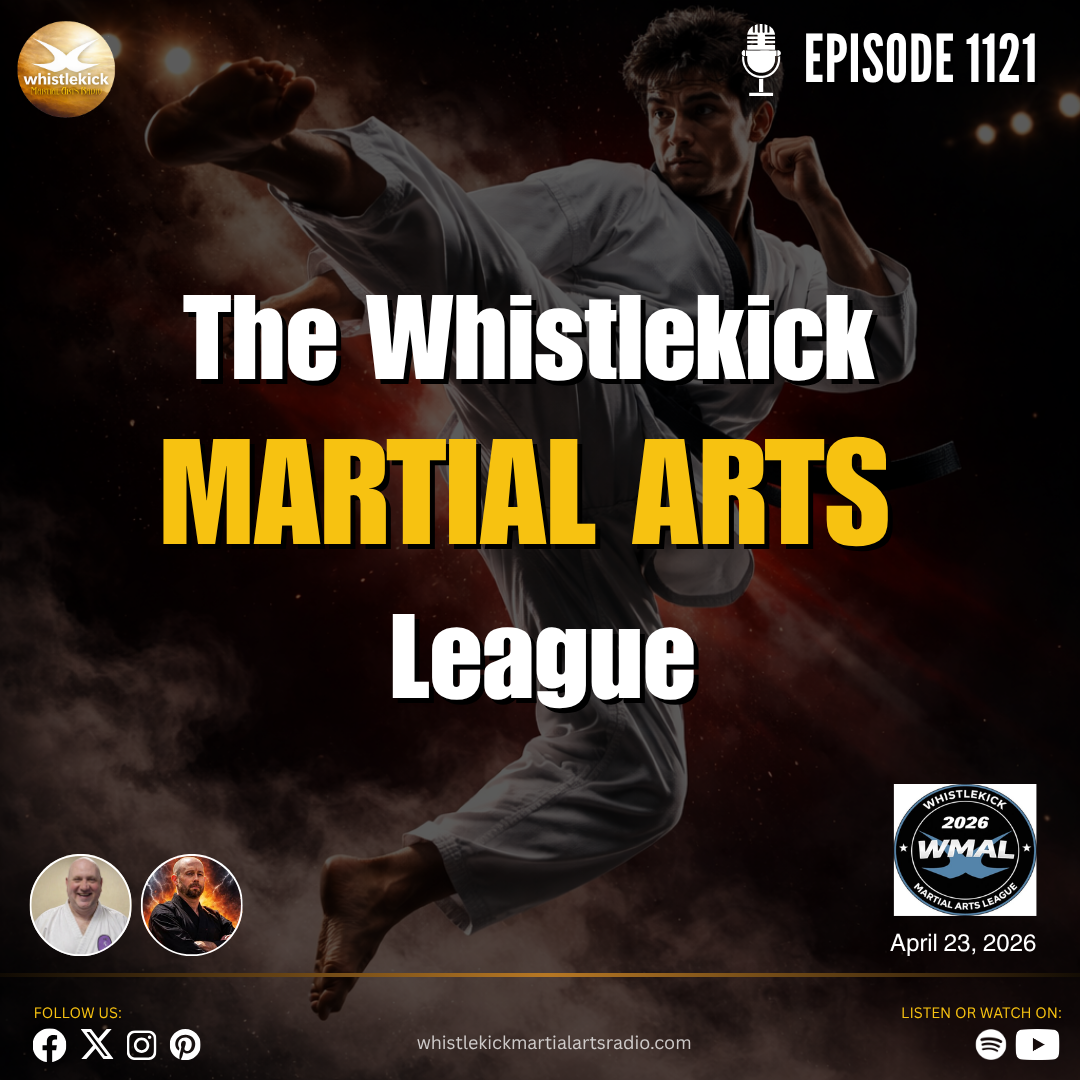
In this episode, Jeremy and Andrew discuss the Whistlekick Martial Arts League. Why it was created, what benefits it has for members, and what the tournament circuit will be like.
The Whistlekick Martial Arts League - Episode 1121
SUMMARY
In this episode, Jeremy Lesniak and Andrew Adams discuss the Whistlekick Martial Arts League, its purpose, and the growth of the tournament circuit. They explore the importance of building a community through competition, the significance of feedback and improvement, and how the league enhances the participant experience. Unique features such as trading cards are introduced as a way to foster connections among competitors.
TAKEAWAYS
The Whistlekick Martial Arts League aims to connect, educate, and entertain participants.
The league was created to provide a structured tournament circuit for martial artists.
Building a community is essential for fostering a positive culture in martial arts.
Competitors are encouraged to improve through participation in multiple tournaments.
Feedback from judges and peers is crucial for personal growth in martial arts.
The league offers awards to recognize achievements and improvements among participants.
Online registration and payment options streamline the tournament experience.
Trading cards are used to enhance connections among competitors and create a fun atmosphere.
The league is designed to be inclusive and accessible to all martial artists.
Creating a positive participant experience is a priority for the league.
CHAPTERS
00:00 Introduction
02:48 The Growth of the Tournament Circuit
08:08 The Purpose of a Martial Arts League
13:09 Building Community Through Competition
18:02 The Importance of Feedback and Improvement
22:54 Enhancing the Participant Experience
27:47 Unique Features of the League
33:05 Trading Cards and Community Connection
Join our EXCLUSIVE newsletter to get notified of each episode as it comes out!
Subscribe — whistlekick Martial Arts Radio
After listening to the episode, it would be exciting for us to know your thoughts about it.
SHOW TRANSCRIPT
Jeremy Lesniak (02:19.448)
Hey everyone, welcome back to another episode of Whistlekick martial arts radio. And today we are talking about another four letter acronym, not WMAR, but WMAL, the Whistlekick martial arts league. Some of you know what's going on with this. Some of you know what is happening. Well, we're going to tell you all about it. So stick around. If you're new to the show, I'm Jeremy Lesniak, founder here at Whistlekick, joined by my great friend, Andrew Adams.
who accompanies me on many of these shows and does quite a few of them without me too. Andrew, how are you?
Andrew Adams (02:56.428)
I'm great. I'm great. I'm looking forward to talking about the league.
Jeremy Lesniak (03:01.12)
The league as we've been referring to it internally. It is the league not to be confused with the sitcom
Andrew Adams (03:08.494)
Correct. Which is funny, but yeah.
Jeremy Lesniak (03:09.996)
Which is funny. This is a little less funny, but maybe one day we'll be able to introduce some humor to it. If you want to check out other episodes, all the things that we do, it's whistlekickmarshallarchradio.com for those episodes. Make sure you sign up for the newsletter so we can send you every episode in your inbox, video and audio version. You sign up at that website or anywhere you find the show notes. Video versions are on Spotify and YouTube and audio versions are everywhere. You might sign up for a podcast.
If you want to go deeper on the league or any of the other stuff we do, because we do a ton of stuff, whistlekick.com is where you want to go. And we're going to be referencing some, some pages over there as we talk through things. So with that, Andrew, Whistlekick, martial arts league. You of course are a member of the Whistlekick core team. So you have been around and since the pre-planning stages for this.
Andrew Adams (04:04.366)
Mm-hmm.
Jeremy Lesniak (04:06.67)
Probably should have gotten somebody who doesn't know anything about it to talk to me. I'm just kidding.
Andrew Adams (04:10.414)
I mean, I don't, here's the thing though. I am not a part of the whistle kick tournament division at all. Um, I mean, I know. I know the league exists. I'm a member only because I'm here, right? Just because I'm around and doing every, you know, lots of things, but, um, you know, it's really out of my domain in terms of what I do at whistle kick. So.
Jeremy Lesniak (04:29.293)
Yeah.
Andrew Adams (04:39.694)
You know, I'm not really in the know.
Jeremy Lesniak (04:42.798)
I was more trying to be playful with it, but it did sound a little serious. I didn't mean it. I promise. Please forgive me. Okay. So what is the Whistlekick Martial Arts League? We started a tournament circuit last year. So we're recording this 2026, 2025. We held a tournament in March. The showdown, it was the second ever showdown. Went a lot better than the first showdown, which was in 2016. The 2025 showdown,
Andrew Adams (04:46.958)
It's all good.
Jeremy Lesniak (05:12.12)
People said, hey, you did a really good job. And you know what? We gave people a good experience and we made a little bit of money. And as a business, making money is an important thing. Because if you're a business that doesn't make money, you are in trouble. And we said, you know what? Let's try it again. So we held another event in September, the Whistlekick Championship. We did some fun kind of different stuff. People had a really good time there.
And again, we made a little bit of money and I went, now if you've been around for a while, you can probably look through all the things that we do and go, that doesn't make any money. That doesn't make any money. That doesn't make any money. How are these guys keeping the lights on? Well, how are they keeping the lights on? Because frankly, I, I've put money into this business for a very long time.
And after that September event, we started talking internally. Nick Tabor and I, who was in charge of the tournament division, started having conversations about what would it look like if we expand it? What would we need to do if we had several tournaments in a year? Because if we can do something that people like, we do a good job of it, we make money at it. And it fits with our philosophies at Whistlekick of connect, educate, entertain.
then we should do it. Right? And one of the things that we found in the contrast between the March tournament and the September tournament was half the attendance.
Why was there half the attendance? Because the one in September was not part of, we speculated, was not part of a tournament circuit.
Jeremy Lesniak (06:57.358)
For those of you who may not participate in open tournaments, it is quite common that you follow a series of tournaments and you earn points for your participation. And at the end of the year, points are tabulated and people earn awards and claim titles. it's a fun way to do it.
And so the tournament that we've done in March the last two years is part of the twin state, the Vermont-New Hampshire circuit. Why the Vermont-New Hampshire circuit? Because I live in Vermont. Andrew lives in New Hampshire. We are definitely New England-centric. And we held this tournament in Concord, New Hampshire. OK.
So Nick and I threw this theory against the wall. What if we had a circuit?
Jeremy Lesniak (07:52.11)
We said, what's the minimum? Well, can't have a circuit with two or three. We agreed the minimum was five. So we launched a circuit this year, the Whistlekick Martial Arts League with five tournaments, one being run by a friend because I want to learn what it, is it like if we have a tournament on our circuit that we don't run? I don't know. How's that going to go? It's a long standing tournament. He's held well over a hundred tournaments in his career. He's better at it than I am.
And here we are, we're gearing up for our second one.
Andrew Adams (08:27.843)
Mm-hmm.
Andrew Adams (08:31.18)
Yeah, when you know, it's quite a growth model to go from two to five, you're more than doubling, right? And so I think it's smart to have. So, yes, there's five on the circuit, but whistle kick is by and I didn't even realize that one of them wasn't was on the last one or one of them, not the last one of us on the twin state circuit. But it.
It takes a little bit of that pressure off you. You're now only hosting four. One of them is part of the league, but you're not having to host all of them.
Jeremy Lesniak (09:08.428)
Right. And so this becomes an interesting part of what we're trying to do because if we were to host every tournament ourselves, that's a lot of work. Anybody who's put on a tournament knows that you can make good money hosting a tournament. There are people out there who do. But the tournaments that make a good amount of money, it is a year long process to put on that tournament.
Andrew Adams (09:37.292)
Mm-hmm. Sure.
Jeremy Lesniak (09:39.31)
because you're promoting it in a multitude of ways. There's a lot of preparation that goes into it. There's a lot of after action. And here we are. We, we had our first tournament on March 28th and our second one is on May 2nd. That's, it's not even six weeks. That's a very fast turnaround. And you know, shout out to Nick who's doing a phenomenal job.
running the events.
Jeremy Lesniak (10:13.358)
But what we're finding is we can dial things in and make this a pretty, efficient system. But is it ever going to be efficient enough to have, you know, 20 tournaments, 30 tournaments? I don't know. That means if we really want to expand it and we can, we can talk about why I want this to grow. We need to partner with other people on their events.
Andrew Adams (10:38.924)
Yeah. Yep. So the question that I have is why have a league at all? Why not? Why couldn't? And I think I know the answer, but I want to hear from you because I genuinely don't know. Why not just host five tournaments or, or like one of them isn't even hosted by us. Why don't, why, why don't we just have four tournaments? We held two tournaments last year.
You said they made money and I'm sure the tens of dollars that you made was great. But like, why not just host four tournaments? What is the rationale for creating a league instead of just hosting tournaments?
Jeremy Lesniak (11:10.478)
You
Jeremy Lesniak (11:23.042)
Yeah. So everything goes back to our mantra here at Whistlegate connect, educate, entertain. And.
If you think of tournaments as a series of one-offs, right? I can go to this one. I'm not going to go to this one. Maybe I go to that one. It becomes a lot harder to build momentum for that individual and for the arc that is the league. You know, know, cause we've talked about it, that the league will be giving out awards at the end of the year.
Well, it was kind of a no brainer. When are we going to do that? we're going to do that as part of Marshall Summit. It's another opportunity to connect people in to that great event that we host that also educates them and is an entertaining time. As an aside, if you want to learn more about Marshall Summit, you can find that information at whistlekick.com.
Jeremy Lesniak (12:26.226)
If and what is it that's going to drive people there the most earning an award? So they participate in these tournaments, they earn points. And then there are awards that are handed out at a dinner event at that event. They can still get them. We'll still give them the award if they don't show. But they probably want to receive it in front of the other people and in front of their their friends, their new friends, their old friends.
instructors, people they train with, people they competed with, right? It becomes a way of connecting.
Jeremy Lesniak (13:06.594)
There's also something very interesting from kind of a marketing side here.
Jeremy Lesniak (13:15.978)
If people are going to do a set of, do a group of things, they want it to be an actual group. They want it to be a set. They want some presentation of it being together.
Jeremy Lesniak (13:29.689)
Here's a random bunch of whistle kick tournaments. It's very different than here's a group of tournaments. Yes, you can attend any or all of them. If you would like to sign up to be part of the league, to earn points, to earn awards at the end of the year, you can also do that. And the response to that has been pretty positive.
So I think the easiest way to answer your question is I think it's just the way human psychology works. We're telling people this is a good idea. If you do this thing, you go to these five things and you participate in them and you will receive points. there's a validation or a social proof that comes from doing that that I think just resonates for a lot of people.
Andrew Adams (14:18.274)
Hmm. My, what I thought was going to be the answer. It was kind of the answer I thought I would get, but I thought it was going to do more with the culture of creating a culture of community. You're, you know, you're building a community of people that you will see at these events, which kind of is there, but, definitely wasn't quite.
Jeremy Lesniak (14:40.602)
And that happens anyway, right? What's interesting about the culture at tournaments, every tournament circuit has its own culture. And you have people that, you know, they may not be chasing points. They may not be members, but they show up to, you know, a third of a quarter or half of them. Because frankly, in most tournament circuits, if you're only going to half the tournaments, you're probably not going to earn an award at the end of the year. You know, it depends on the competitiveness of the league.
But they're still part of that culture. The parents in the stands are still part of the culture. And you know me well enough to know that building a positive, healthy culture is really important to me. And a lot of what we are doing with our league is not accidental. It's designed to foster that culture. I believe, and we've talked about this on the show that,
You can only go so far as a martial artist without having other people to train against. And for a lot of people.
Competition is pressure. It applies a lot of stress. They get anxious. And even if the physical risk is nowhere near what it would be in a street altercation, for a lot of people stepping out and point sparring at a tournament is the same sort of, even if it's not the same degree, for some it's even worse because there people watching.
Stress level as it would be when someone attacks them. So it's an opportunity to train Yes, you're presenting your skills. Yes, you are evaluating yourself. Hopefully getting better But there's real world transfer being able to perform your skills in a higher stress environment. I chalk up my
Jeremy Lesniak (16:40.846)
ability to stand in front of a crowd to do this, do all, to present who I am without getting super worked up about it, to doing tournaments through my youth.
Eventually you go, you know what? I've done this a hundred times before. I'm going keep doing it.
Andrew Adams (16:58.51)
Yeah. And it makes you better. know, I have an interesting story that I think might resonate in a different way for some people. when I, I have not done a lot of martial arts tournaments, but I have done a lot of competitions for my bagpipe drumming. So drumming, you stand in front of the judge, the judge is sitting in a table with a clipboard and a piece of paper.
Jeremy Lesniak (17:01.624)
does.
Andrew Adams (17:26.87)
You stand in front of him with your, there's a bagpiper playing a bagpipe tune and you drum and he writes down good and bad. And he'll listen to everybody in the division in your grade, in your, you know, ability level and we'll award for a second, third, fourth place. You know, you get placings and you, the difference with that as compared to going to a martial art tournament is in a tournament, you'll get a grade. You'll, you know, judges will, will score you.
if you're doing your forms or weapons or whatever, you don't get a written feedback, but you get some feedback on, you know, you get to hear that this judge thought you were 7.5 and he thought you were 7.9, whatever. So the very first year I did these competitions. I went out and went to the first contest of the year and I got last place and I went to the next contest and I got last place. I went to the next contest.
I got last place and most of these contests offered two or three events for my division and I entered them all and I got last place at every single one and the very last contest of the year I went out in front of the judge my bagpiper struck up his bagpipes I started drumming and when we ended I thanked the judge I turned around and I walked away and I had the hugest grin on my face and my bagpiper said
That sounded like it was pretty good. And I said, that is the best I've ever played in my entire life. Like, you know how some people say they sing better in the shower because there's no one there to listen, right? I've never played better in practice or getting ready ever. That was the best drumming I've ever done. And there were like, I think seven or eight competitors in my division. I, and I said, I might not win.
But I'm not coming in last place today.
Andrew Adams (19:25.76)
I at the in the afternoon I went and I got my score sheets Jeremy guess what place I got
Jeremy Lesniak (19:31.458)
Second to last.
Andrew Adams (19:33.069)
Last place. Yep. Here's the moral. And this is absolutely a true story. I tell this to my students all the time and it, I think it correlates to these, these tournament things. And maybe it doesn't correlate into this episode on the league, but I think, I think it does. I'm to tie it in. So I was really dejected. I was in my late twenties and I was just like, what, why, why am I doing this? I might as well quit drumming. Like I'm.
Jeremy Lesniak (19:34.435)
Really?
Jeremy Lesniak (19:48.782)
That's okay.
Jeremy Lesniak (19:54.499)
Hmm.
Andrew Adams (20:02.498)
This is is dumb. And my friend came over and said, you know, why are you so upset? And I told him like, this is the best I've ever done and I've never played better. And I got last place and he said,
If you're playing better now than you've ever played before, then doesn't it mean you're getting better? And isn't that what it's all about? And I was so pissed at him because he was right. That it's not about winning. It's about getting better. And the more you do it, the more comfortable I got it being in front of the judge. Cause it was nerve wracking, right? But the more I did it, the better I got. And I became a better drummer because of it.
Jeremy Lesniak (20:40.579)
Yeah.
Andrew Adams (20:46.584)
doing tournaments can do the same thing. And you're getting to meet these other people in, you I was meeting these other people in my division and we, there isn't, I mean, I guess there is a league in terms of it's the entire Eastern United States. But I was meeting all of these people in my division. I was getting outside of my comfort zone and it made me a better drummer.
because of it. And so the same thing I think is true with having a league that you are having these five events that you will not at every event have this exact same people, but you will likely have a lot of carry over and it will help make you a better martial artist because you're going to practice. you, know, why did I play best at the end of the season? Because I had practiced so much because I didn't want to be last. It just was kind of funny. I ended up being last again.
Jeremy Lesniak (21:40.206)
Mm-hmm.
Andrew Adams (21:45.59)
And so I think having the league helps that process for students.
Jeremy Lesniak (21:49.102)
Yeah. Yeah. Completely agree. If you if you put aside.
the awards portion of this. Showing up to a series of tournaments, what is going to happen over the course of a year? Whether this is our league or anybody's league. Well, you're probably practicing in between because you're probably getting some feedback. Hopefully somebody that's there with you is filming you because they should be. Everybody's got a cell phone. Go back, watch your footage, get better. You're getting to know people. People that you're competing against, people that are
you're not competing against the referees, staff, you're building friendships. And...
One of the things that we're working really hard to do is making sure that the spectator experience, what it's like for people when they are not competing, is as good as it can be.
Jeremy Lesniak (22:52.462)
Connect, Educate, Entertain. They're the three pieces. Tournaments do it so well. And if you're someone who's able to come out to one of these events, I think you'll see that we're doing some things that are very consistent with a lot of what we do in other divisions here. The thing I had to do before we even launched the league, we needed a common rule set. So I went and I did a ton of research and I talked to all my friends that are hosting tournaments and we put together what I believe to be
the most comprehensive sport martial arts rule set. At least it's in English. I'm unaware of one that is more detailed and has had more time. not. Some of them have been out there longer, so they've probably had more people look at them. But we developed the open tournament rule set, and that's at whistlekick.com. And I thought about us doing an episode on this, but they're just, I didn't think there was enough material there. But in short, we put out a rule set that is,
is open, take it, modify it, use it. Because what's one of the biggest hindrances to people getting involved in tournaments? Not understanding what's going on. And when a rule set goes on the back of a postcard, we do this, it's this many points for sparring and we do this. That's not enough information. People still have a million and one questions. So not only did we develop that rule set,
Andrew Adams (24:01.205)
Mm, yep.
Jeremy Lesniak (24:19.534)
We have found, because Andrew, you and I have put on quite a few events together, we know that clear, consistent communication is one of the things that we as an organization do incredibly well. So I said, if we're going to do this, how do we do this for tournaments? How do we do this for a league? Well, I took that rule set and I developed free courses because sitting down and reading a, you know, 15 page rule set isn't going to be super fun. So we put together some courses.
One for parents, one for competitors, one for referees, one for scorekeepers. And there's more that I'll do. I just haven't made them yet. So people can understand what is expected of them. Because when you know what's expected of you, you feel more comfortable. You can do a better job. You can show up to the event without as much anxiety. Now, those courses aren't hidden. You don't have to be part of the league or anything for that.
Andrew Adams (24:54.946)
with
Jeremy Lesniak (25:18.882)
But we're continuing to look for ways to make things run smoothly. You might find it, this is gonna sound really small and some of my friends out there that put on tournaments are gonna think I'm calling them out, because I am. It is 2026 and a lot of martial arts events do not accept credit cards at the door. If you wanna register at the door, pay for your spectator fee, they don't accept a credit
OK.
Jeremy Lesniak (25:48.76)
For most events, that might be a couple hundred dollars in credit card fees if it's a large event.
Andrew Adams (25:57.421)
Mm-hmm.
Jeremy Lesniak (25:59.19)
Everybody's happier, line moves smoother. Nobody can drop that $20 bill. Nobody can steal. In fact, why do we see more and more businesses saying no cash?
Cause it's a lot easier to move the money when it's paid in a credit card and online registration. Again, it's 2026. Make a Google form, take your payment on that. There's no reason you, I you don't have to have the big setup that we do at whistlekick.com, but we're doing everything we can from the participant experience, whether it's the spectator or the competitor. How do we make it as easy for them as possible? If you pre-register,
Andrew Adams (26:16.717)
Yeah.
Jeremy Lesniak (26:41.214)
If you've been to whistle kick events, you know that we like lanyards. So competitors that have pre-registered get a lanyard. Why do they get a lanyard? Because kids are less likely to lose a lanyard. It goes around their neck. So when they go up to their division, as a parent, you don't have to wonder, what did they do to the card? Did they drop their card? If you're a referee, I don't like the word judge. If you're a referee, you know that sometimes you get cards that have obviously been chewed on and crumpled.
Andrew Adams (26:45.038)
you
Andrew Adams (26:52.696)
Yep.
Andrew Adams (26:57.998)
Did they drop their piece of paper?
Andrew Adams (27:09.39)
Yeah.
Jeremy Lesniak (27:10.176)
It's gross. They don't chew on the lanyards. So it's a lot of little things like this that we're doing. And I want people to steal our ideas. You know, we've said this before. A lot of the things we do steal our ideas. We've got one coming up that I'm not going to talk about the specifics. I might as well. 5-2, May 2nd, 2026. The Mamamit. It's an event that we're doing. It's the week before Mother's Day.
So we're gonna do a bunch of things to honor the moms. We're giving moms a discounted registration.
All moms that walk through the door are going to get a crown. I just ordered hundreds of paper crowns that we can give the moms, right? Is it a big deal? No. Does it cost us money? Yeah, a little bit. But does it make the event fun? Right. Because it's not about us. It's, you know, we could we could put another 40 bucks on that bottom line if we didn't do that, Jeremy. Yeah. But I want them to come back the next time.
Andrew Adams (28:15.896)
Mm-hmm. Yeah.
Jeremy Lesniak (28:17.292)
I want to build a long-term experience. And so the biggest thing that we've done, and I think we'll kind of, we'll talk about this and we'll start to wrap up, are the trading cards.
Andrew Adams (28:26.636)
Yeah, because I, yeah, because I had, I, before we get into that, so if you don't mind, I want to quickly just go back and make a statement. And then I have a question, which will lead to what you were going to go into anyway. So, you made a statement and I want to clarify something. Not that I'm just gonna say, not that you said it wrong. I want to reiterate because you glazed over it very quickly. If you are doing online registrations.
Jeremy Lesniak (28:37.966)
Okay, awesome.
Andrew Adams (28:55.862)
I it's important or if you're taking registrations for your event, you can do it online through Google forms. And if you didn't know, you can set up your Google form to accept payment. Not everybody understands that or realizes that it is incredibly easy to do. You could just go on YouTube and look up how to do it. It'll show you a tutorial, but you can connect your Google form that anybody can go to and fill out and then they can pay.
That's huge. And if you didn't know you can do that, know that you can do that. Okay. So that's the thing I wanted to statement. I wanted to reiterate for people. And then my question is why should people join the league? If you're hosting five tournaments, why don't I just register for the five tournaments and go? What is the point of me actually joining the league?
Jeremy Lesniak (29:47.086)
So without joining the league, don't you're not eligible for end of year awards. And yeah, we're going to do the ones you would expect, you know, first place in this division and second place in that division. But we've also got some stuff that we're kicking around and it's not finalized yet because it's we're recording this in April. That as we get closer to the end of the year, we're going to do some voting, you know, member voting for fun stuff, healthiest rivalry.
most improved, things like that. Because we want to recognize the behavior and reward the behavior that you want people to take. We want people to improve. So let's have everybody recognize, hey, these are the people that are improved. Hey, these two pushed each other to be better all year long. Let's recognize that. Because sometimes that's not easy to do.
Jeremy Lesniak (30:44.898)
We're also, you as you might expect, you get a discount on registrations and we will be rolling out some additional benefits as we get through the year. trying not to overload people right at the beginning because we want to keep it simple. Now, one of the things that that everybody gets, they join the league, they want, I mean, you don't have to, but I personally am making a custom trading card of you and
Andrew, let's, you've got one of yours there. I made one of you, right? That's an Andrew Adams. Andrew Adams is a, that's a number 12 in the set, right? And they're all a little bit different. I've had a lot of fun with them and people are digging them. hear, this one's banged up because I keep showing it. you've got a Mark Warner.
Andrew Adams (31:23.24)
Yep, I'm number 12. There it is right in the back.
Andrew Adams (31:36.91)
I do look, have a Tushy. I have a Mark Tushy Warner one. Yep. And they're all, they're all different. The backs are a little different for each of them as well.
Jeremy Lesniak (31:40.174)
There you go.
Yeah, yeah, I've been kind of experimenting, know, keeps it keeps it fun, keeps it interesting. I don't know exactly what we're going to settle on for designs. And, you know, it's the first year you get to you get to do things that are a little inconsistent. For any of you out there with with businesses, one of my favorite sayings from Gary Vee, don't be afraid to do things that don't scale. Right. Doing a completely different card for every single person with different formatting and everything.
That doesn't scale, I'll tell you. This is mine. This was the experiment. If you look, you can see that the logo is off, right? The Whistlekick logo in there. It didn't come out great. But I didn't know what I didn't know. So, you know, I ordered from this one place. We're using a different place to print them now. And so we go back to, again, Connect, Educate, Entertain. The educate part of the cards isn't super high, right?
You might learn something about other people who are competing, but the connect and the entertain. Now the connect is easy. You open a pack of cards, everybody who signs up gets some of their cards and some of somebody else's cards, you know, other people's cards and. You have it there. You go signed Adam Beckley, right? How did you do that? You had to go up to Adam or Adam had to come up to you. There's connection. Now you happen to know Adam, but one of my dreams for this year.
Andrew Adams (32:55.562)
I have a signed Adam Beckley card right here.
Andrew Adams (33:05.631)
Mm-hmm.
Jeremy Lesniak (33:11.134)
is that especially some of the younger folks that are a little nervous might go, there's Andrew. I don't know him yet, but I've got one of his cards. It's definitely him. I'm going to go ask him for an autograph.
Andrew Adams (33:23.232)
It's funny because you're mentioning this in regards to kids and I'm like, I'm like, I'm to be at the next tournament actively looking. I don't know. Like I have, for example, random person. I don't know who this is. Lila Erickson, no idea who Lila is, but I have a picture of her cause she's on her card. And if I see her determined, I'm absolutely going to ask her if she'll sign it. Now I also have a Jaden DiMuccalli. I know Jaden. So like when I see him, I'm going to ask him to sign my card. Cause it'll be fun.
Jeremy Lesniak (33:35.554)
Yep. Yeah.
Jeremy Lesniak (33:50.734)
Yeah. So my hope is, and then you did something really cool that I want you to tell people about that I hadn't even thought of. My hope is that this is a little bit more juice to get people to connect. And as we roll out more cards and, you know, we had people, had packs of cards that people could buy. I don't where they went. They're somewhere. We had packs of cards that people could buy at the last event and they got them and they're like, oh, OK. And
As we make more cards, there'll be more packs and it's fun. Who doesn't like having a card of them? And then you got a pack with, I don't know, four or five of your own cards and you did something really cool with one of them that I hadn't even thought of. And maybe you'd share it.
Andrew Adams (34:38.518)
Yeah. mean, essentially in a nutshell, I gave it away. I just, gave it to somebody because I had, I had four of them. And I think the rationale for getting four of your own is so that you can trade with people. Like, you know, Adam Beckley happened to have an Andrew Adams card in his pack and I had an Adam Beckley, my pack. So we signed each other's, it was great. But if I didn't get an Adam Beckley and he has four of his, I could have.
traded one of my Andrew Adams for his Adam Beckley. Like that's, think that's the rationale, but I had four of them and I saw a competitor that I thought was exceptional for her rank. I thought she was great and I made it a point to go up to her afterwards and said, Hey, I just want you to know that was really, really good for your rank. You competed at a, what I think is a much higher level than your rank shows. And I want to reward that, you know, this is about connecting. And so.
I her for free here. I just want you to have my trading card because I do not believe she is a member of the league But I wanted her to see that like hey, this is a cool thing I think you did something neat and I just gave it to her
Jeremy Lesniak (35:49.098)
And that's what we're trying to do. Right. I didn't know how everybody would use their extra cards, but we, made sure we gave people and continue to give people extra cards when they sign up. And who knows what that turns into? You don't know what you don't know. It's our first year and it's been really exciting to see the response, to watch people open a pack of cards and see themselves in it. That's fun. So.
We're going to continue to do all the things that we're doing. If you want to learn more, go to whistlekick.com and on the left-hand side towards the bottom, you'll see the link for tournament league. And you will see in typical Jeremy fashion, like eight different pages of all the things that are going on really well broken out. And you can sign up and it's 40 bucks for the year. And by the time I create and buy a pack of cards.
Jeremy Lesniak (36:47.854)
We make like $8 on your membership. We don't make very much money at all. And that's okay. Because really the league is meant to run at at least this first year. I'm trying to put everything back into it. So we'll run it at a zero and get people to show up to tournaments. That's what it's all about. So if you are anywhere near New England, this next one is in Salem, Mass. Then we have one in Greenfield, Mass.
Then we have one in Keene, New Hampshire, and then the final one is Manchester, Vermont. Learn more, whistlekick.com. Feel free to reach out to me, Jeremy, at whistlekick.com if you have questions or concerns.
All right, Andrew, I think that takes us to the end. Let's see if we can do better than last time. I'm going to say until next time, and then we're going to do the thing together. Are you ready?
Andrew Adams (37:40.366)
Okay, as ready as I will be.
Jeremy Lesniak (37:43.978)
Until next time, train hard, smile, and have a great day.
Andrew Adams (37:45.88)
Train hard, smile, and have a great day.