Episode 1136 - Gerry Disanto
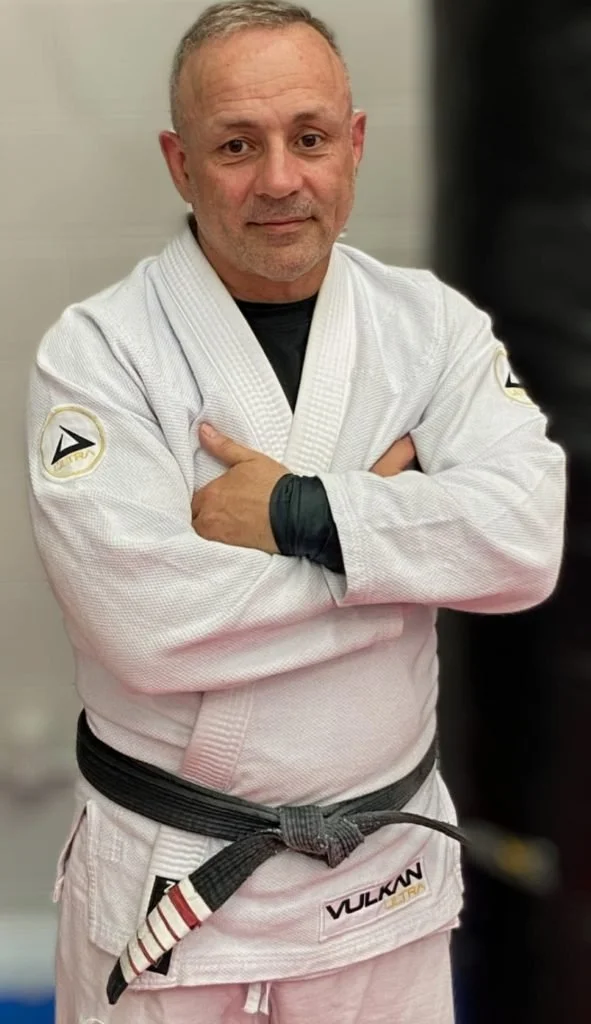
In this episode Andrew chats with Gerry Disanto about his journey into Goju Ryu and BJJ in his 20’s after soccer and how being a high school teacher has helped him teach martial arts.
Gerry Disanto - Episode 1136
SUMMARY
In this episode, Gerry Disanto shares his journey through martial arts, starting in his 20s after a background in soccer. He discusses his experiences in various martial arts, including Goju Ryu karate and Brazilian Jiu Jitsu, and his transition from student to teacher. Gerry emphasizes the importance of setting goals, the value of different martial arts styles, and the significance of teaching and curriculum development in martial arts education. He discusses how martial arts has influenced his teaching methods and personal growth. He emphasizes the importance of healthy outlets for stress, the value of competition, and the evolving perspectives on self-defense, particularly in relation to protecting loved ones. Gerry also reflects on his transition from owning a martial arts school to focusing on seminars and teaching, highlighting the challenges and rewards of both roles. The discussion concludes with insights on crafting effective seminars and the continuous journey of learning in martial arts.
TAKEAWAYS
Gerry Disanto started martial arts in his 20s after being a soccer player.
He earned black belts in multiple martial arts, including Goju Ryu and Brazilian Jiu Jitsu.
His fascination with martial arts began with watching movies as a child.
Gerry fought professionally in MMA, despite some fights being considered illegal.
He opened his own martial arts school, Defensive Arts Training Center, in Ontario.
Teaching martial arts was a natural progression for Gerry, who is also a high school teacher.
He developed a curriculum that integrates various martial arts styles for students.
Gerry emphasizes the importance of setting and achieving goals in martial arts training.
He believes all martial arts have value and can learn from each other.
Gerry enjoys being a student and learning new techniques, regardless of his teaching role.
Teaching and martial arts can enhance each other.
Competition is beneficial for personal growth.
Self-defense should consider third-party protection.
Transitioning from ownership to teaching can be liberating.
Seminars should be tailored to the audience's needs.
Continuous learning is vital in martial arts.
Healthy outlets prevent burnout in teaching.
CHAPTERS
00:00 Introduction
01:40 Gerry's Martial Arts Journey
09:03 Transitioning Between Martial Arts Styles
14:09 Teaching and Curriculum Development
19:30 Martial Arts as a Teaching Tool
22:39 The Balance of Teaching and Martial Arts
28:34 Competition in Martial Arts
34:41 Evolving Perspectives on Self-Defense
42:01 Transitioning from School Owner to Instructor
49:36 Crafting Effective Seminars
To connect with Gerry:
Gerry DiSanto Brazilian Jiu-Jitsu Network | World-Class Martial Arts
Join our EXCLUSIVE newsletter to get notified of each episode as it comes out!
Subscribe — whistlekick Martial Arts Radio
After listening to the episode, it would be exciting for us to know your thoughts about it.
✅Subscribe to whistlekick Martial Arts Radio on the following platforms:
🎧Apple Podcasts: https://apple.co/3mVnZmf
🎧Spotify: https://spoti.fi/3yHVdHQ
✅You can find whistlekick on all social media platforms using the handle @whistlekick or visit our website at https://www.whistlekick.com or https://www.whistlekickmartialartsradio.com
Show Transcript
Andrew Adams (07:43.996)
Welcome you're listening or perhaps watching another episode of Whistlekick martial arts radio. And today I'm joined by Gerry Disanto. Gerry, how are you today?
Gerry (07:53.454)
Good, thank you for having me, Andrew. I appreciate it.
Andrew Adams (07:55.8)
absolutely. I'm excited to get into chatting with you. But before we do, just in case we have any new listeners of the show, I want to make sure that you know about some of the stuff that we do here at Whistlekick. Obviously, Whistlekick, martial arts radio. That's where you're going to go to find out info on our podcast. We have over 1100 episodes. You can find all of those there at whistlekickmarshallartsradio.com. You can sign up for our newsletter.
But you'll also find transcripts of every episode. You'll find photos of our guests, contact information for them, all of that stuff you'll find there. And if you go to whistlekick.com, you'll find out all of the other things that we do because the podcast is only one aspect of what we do. Maybe you want to purchase a book. Maybe you want to purchase some apparel. Maybe you want to purchase some sparring gear. Maybe you want to attend one of the events that we host around the country. All of that information you can find at whistlekick.com.
Without further ado, Gerry, here we are to talk about you.
Gerry (08:53.041)
well, thank you. Let me just start off by saying I'm happy to be here. I appreciate the opportunity and the time that you're giving me. Gerry Disanto, I'm 54 right now. I've been doing martial arts since my 20s. I did not start as a child. I started much later, even though as a kid I wanted to start martial arts, but my parents wouldn't let me. And the reason for that is because I was a soccer player, I was an athlete doing other things.
And so I went through that career. And then when I was able to pay for it myself, I started. So it was about 23 when I started, 22, 23. I started with traditional Gojiru karate. Earned my black belt for that. And then during that time, the UFC occurred. So I started getting interested in Jiu Jitsu. So there were no Brazilian Jiu Jitsu clubs around me. There were just maybe Japanese Jiu Jitsu, but it wasn't the full Japanese Jiu Jitsu. It was...
I hyper it of it more like Japanese karate. And so I did that, earned my black belt in that. And then eventually I started down my road in, well, sorry, before that, before Brazilian Jiu-Jitsu, I decided to fight MMA because I thought, well, why not do that while I'm at it? So yeah, so I fought professionally. It says I have a one and all record if you Google me, but I actually had two other fights that were
Andrew Adams (10:11.831)
Why not?
Gerry (10:20.851)
consider it illegal, so just gotta emphasize the illegal part. Okay, good, thank you. Keep it between us, okay? So those fights don't, I did them, but they don't really count. So I guess I'm one and O still. And then I started pursuing Jutsu after that, because I do things backwards. I don't do things the proper way like most people do. My parents said I was hard headed, but I guess it's actually true.
Andrew Adams (10:23.936)
We won't tell anybody.
Andrew Adams (10:28.67)
you
Gerry (10:49.663)
But having said that, then I started Brazilian Jiu Jitsu. So I was doing Japanese Jiu Jitsu and Brazilian Jiu Jitsu and then decided to open my own club called Defensive Arts Training Center here in St. Catharines in Ontario. It's in the Niagara region. And started doing that. I've always had a fascination with martial arts. I thought it was the coolest thing in the world. When I was like eight years old, I watched a martial arts movie. One of those really bad ones.
where they fly through the air, they kill each other with stars and stuff like that. And I thought this was the coolest thing in the world. I want it, because it is, it is, it's 100 % it is. And I was like, my God, can people actually do that? I want to do that. I want to be a superhero. So always had the fascination. And then there was this thing called Martial Arts Matinee, where every Saturday at noon, there would be a bad martial arts movie dubbed terribly.
Andrew Adams (11:22.151)
Because it is.
Gerry (11:44.945)
but it was the greatest thing in the world. And I laughed and I enjoyed that so much. So that actually got me interested in martial arts. And I was not able to do it till I was a lot older. And I thought, hey, you know what? I'll start. There's a local karate place. I'm going to learn karate to start. And I did that quickly. took me only under three years to get my black belt. But you got to understand, Andrew, I dove into it with both feet.
I didn't hesitate. know, I did everything I needed to do to get there and I, I did, I worked my butt off to earn it. So, and then all the way through. So I have multiple martial arts certificates, multiple martial arts, black belts and degrees in black belts. I have other certifications in fighting. I've just done everything I could because I feel like I lost years. So I want to just absorb everything in. So every time something comes up or
when I'm starting getting a little bored, I go find another martial arts to master or to get a black belt in. And just because I think there's so much out there that we have to learn and there's not enough time. So.
Andrew Adams (12:54.738)
Yeah, yeah. Now, as someone who's done Gojiru as well, because I also, my first style of training was also Gojiru karate as well. And I've been to multiple other Gojiru schools and every school is different, obviously. It's one of the things that makes martial arts amazing, right? The school that I trained at did some Japanese Jiu-Jitsu as well. I'm curious your transition from Gojiru to BJJ, which is
to that can be two vastly different styles. What did, first off, did you do any the, any jujitsu stuff with your Gojiru school? And if not, how was that transition like from Gojiru to BJJ?
Gerry (13:41.573)
So one of things I did in high school is I wrestled in high school. And that gave me a big, big advantage. The other thing was I ended up with hanging out with a bunch of guys that for some reason, my one friend Mike attracted all the wrong people in the world. So for some reason, we would go out to as adults, we'd go out somewhere for a drink and we'll hang out. Guys, we'd always have a tradition. We'd hang out Friday night.
Andrew Adams (13:46.268)
Mmmmm
Gerry (14:11.372)
as the guys. That was our friendship group. And for some reason, Mike's ex-girlfriend or girlfriend or soon to be ex-girlfriend or gonna be ex-girlfriend one day was there and then she would cause a problem with her boyfriend and then we end up fighting or we get into an altercation. So anytime I was having to defend myself, I would double-leg take them down on the ground, sit on top of them, maybe throw a couple of punches. So I was doing
MMA before I may became popular. Does that make sense? So, and I kept thinking, well, I'm doing this. I gotta learn how to punch properly. Cause I was probably punching like, you my thumb here, my hand opens. I don't know. I was messing up my punches. Okay. But so by the end of it, I'm like, someone's got to teach me how to punch properly. And I always want to do karate. So let's put the two together. So I went to a Goju-Ru studio.
Andrew Adams (14:41.437)
Yeah, yeah,
Andrew Adams (14:58.301)
Hmm.
Gerry (15:06.961)
And Sensei Toth, was the, Bob Toth, was the teacher at the time, was, you know, took me under and kind of had a liking to me. And we got along really well. It was more of a traditional kata based Gojiru place. We did do some small circle Jiu-Jitsu, but not a lot where it actually caught my fire for doing Jiu-Jitsu. So that's, that's.
what I thought martial arts was. My living experience was in St. Catharines, Ontario, having this experience. And that's where I thought all martial arts was. So the transition didn't happen until I saw the UFC. And then I started seeing Japanese Jiu-Jitsu and started training Japanese Jiu-Jitsu as I did the karate. And I said, I really want to focus on the Japanese Jiu-Jitsu. So that's where we had some ground fighting. And that's how I expanded onto my martial arts career.
Andrew Adams (16:03.996)
Hmm. Yeah. Yeah. Yeah. No, it makes sense. and I think that wrestling background for sure. think everybody will recognize that's a huge advantage. Do you think that your time in Goju-Ru helped you when you like you transvestan Goju-Ru to Japanese Jiu-Jitsu and then BJJ, but how much of that training in that initial beginning in your early twenties of the kata based Goju-Ru did that help?
Gerry (16:04.599)
If that makes sense, does that make sense?
Andrew Adams (16:33.158)
Eventually when you when you did get to BJJ and and how did that manifest?
Gerry (16:38.659)
Here's the thing, what it did. And I don't think any martial arts is bad martial arts, by the way. I really don't. I think that we all have our own journeys and we all have our own place to go and things happen to us and with us for a reason. So that base got me, it did two things for me. Number one, by getting my black belt, it taught me that I do have the ability to do something, which is good, which is a part of martial arts that everyone should aspire to.
It's setting goals, accomplishing goals, etc. so forth. So I think that is probably one of the greatest things that that gave me. The other thing that it gave me was it gave me a foundation to understand that what we do in Brazilian Jitsu might be Brazilian Jitsu, but it has a translation in karate or Japanese Jitsu. What I mean by that is a simple X block, a high X block.
the way you cross your hands, that in Brazilian Jitsu, if you found foundational work, translates to our X choke, just our basic choke. what it does give me is the understanding to talk to people with karate backgrounds on how Brazilian Jitsu actually is in their art without them knowing about it.
Andrew Adams (17:51.294)
Mmm.
Gerry (17:53.225)
And that's where I think I've been doing a lot of seminars lately. It's been more traditional martial arts. And all I've been doing is just saying, we do the same thing as you do. We just have a different Bunkai for it. Your Bunkai means this, my Bunkai means that. But we're still speaking the same language. It's all martial arts. And I think that's where we have to, I don't think martial arts should be separate from each other. Like we shouldn't have, know, BJJ grapplers over here and strikers over here. I think what we need to do is come together.
Andrew Adams (18:08.978)
Yeah.
Gerry (18:21.224)
and find common ground where we could actually have these conversations and actually cross train without egos.
Andrew Adams (18:26.854)
Yeah, absolutely. You know, one of the things that I've often said, and I want to be clear for the listeners, I totally stole this. I first heard it from Jesse Encamp. Maybe he got it from somewhere else. I don't know. But one of the things that I heard that I love and I continue to preach is that if, first off, there's only so many ways you can punch and kick someone, right? And there's only so many, or choke someone. There's only so many ways and only some of those ways make sense through the lens of consciousness.
Gerry (18:50.163)
Absolutely.
Andrew Adams (18:56.382)
Right. That's first. Second is if learning martial arts is a mountain, right? We're all trying to get to the top, whether you're doing karate or whether you're doing BJJ or whether you're doing Kung Fu or whatever, it doesn't matter. And if you're all at the base of the mountain, judo's over here and BJJ is over here and taekwondo is over here, but you're all you're really far apart from each other. But as you climb that mountain, as you get closer to the top, taekwondo is not that far away from BJJ anymore.
Gerry (18:57.597)
Meh.
Andrew Adams (19:25.33)
Right? The closer you get to the top, the closer you are to all those other martial arts. And I think you're absolutely right. You are going to find some stuff from every style is going to connect to all these others.
Gerry (19:39.026)
Absolutely. And even taking it step further, what we need to do is also, I think, as martial artists, recognize that, you know, I've been a white belt again and again and again and again. And I have no problem with that. I really don't have a problem with it because I actually like being a student. don't want to be an instructor. Being an instructor is great. Don't get me wrong. But getting more new information really excites me. OK. And that's something that I think that
Sometimes we lose once we become instructors and run our own school and do that kind of stuff. But what I'm trying to get at is, I think we can learn from each other. And it doesn't have to be anything large. One of my students is a grand master in Arnis. And he started as a white belt. It's about to Tim Hartman. And the one thing I respect about him, and by the way, he's the guy on the internet that calls us BJJs. But anyways, that's another story. He...
And he's got a whole shtick behind it. you know, sometimes I give him a little bit of feed of what he should be saying. So therefore it gets more likes, but sometimes you got to help a guy out. even if I use him as an example, because he's a, he's a grand master in our niece under prices, our niece and the world modern or niece association. And you're talking about a guy that takes off his ninth Dan black belt, what's on a white belt whenever he can. And I totally respect that.
Andrew Adams (20:55.922)
Mm-hmm.
Gerry (21:07.342)
You know, and I try and emulate that as much as I possibly can. So what he does in Arnis and what I do in Jiu Jitsu, we actually have conversations about how would you handle this? How would you handle this? And that dialogue just enlightens us in different aspects of combat, which I think is great.
Andrew Adams (21:22.749)
Yeah. Listeners, if you're interested in hearing more about Dot2Tim, you can check out episode 102. He's an early interview on our show. So you can hear his interview in episode 102.
Gerry (21:39.81)
And he'll probably call us BJJs, so there you go.
Andrew Adams (21:42.397)
Yeah, it would have been almost nine years ago he was on the show but
Gerry (21:47.509)
That's awesome. So that's kind of the relevance of like what we're trying to get at that. We're not that far disconnected ourselves, even though this is our first time meeting that, you you had an association with Tim Hartman. I do have an association with Tim Hartman. I've been just recently attending the Superfoot Conference in New Hampshire. That's where you're from. I just like the little things like the 60 degrees separation of martial arts is actually really true. And I think it's awesome.
Andrew Adams (22:13.02)
Yeah. Yeah. It's a very small world for sure. And, and, it's nice that we have podcasts like this one and lots of others that helped to bring us all closer together. So let's talk about you now, you, you, obviously you're T you're going around and you're teaching seminars and stuff. Let's talk about the early days of your teaching. Like what was the transition like from you being strictly a student, recognizing that you're always a student.
But when did that transition happen to you starting to teach?
Gerry (22:46.419)
Hello, okay so probably in the, I was fighting in 2000 and I realized I needed my own place to train. So therefore, the big joke with all martial arts instructors, martial artists out there, if you want to hear the biggest fallacy, this is it. When you have your own place, you're gonna train more. You know what I mean? When you open up your own business, no, you have more time to train, that's a lie. You gotta run a business now, it's totally different.
Um, that's probably the biggest joke and all the martial arts owners out there are probably just nodding their heads. Yeah. Yeah. Yeah. Yeah. So I needed my own place. So I started, um, recruiting some of my training partners and I said, well, we have to split the bill for the renting of the place and the materials. So therefore we started splitting the bill and then someone had to govern it. So I ended up governing it and I was ended up being the head instructor. So when I started going to be an instructor, the other thing that I was doing at the time is I started my teaching career.
So I'm a high school teacher by trade and I was teaching full time while running Marshall Studio at night. And I still, I still have a wife. had my first son, Alex, and I had a second son on my way, on the way called Gabriel, who's now 23 and 26. So therefore I was working all day, having an hour break, running a club a couple of days a week, then expanded to several days a week. And one of the things that they all enjoyed
was the fact that I was able to write curriculum that was very linear and very direct. And what's important about that is I wanted to have a certain skill set all the way through. So I was teaching more Japanese Jutsu for the kids program because it's a well-rounded art that I think that teaches you kicking, punching, throwing, grappling, and self-defense scenarios. Okay, so I think that's very important. I was teaching BJJ to the adults and kickboxing to the adults.
Andrew Adams (24:21.533)
Hmm.
Gerry (24:44.587)
Okay, so my karate background basics on how to strike came back then, and then I amplified it with adding boxing and Thai boxing to my arsenal. So as we started growing, I started realizing that there was a propensity for me to be really good with kids. And our kids program grew really quickly, where I only had one kids program. And then in a month I had two kids programs going simultaneously three, four.
Andrew Adams (25:02.79)
Mmm.
Gerry (25:12.602)
And then I six kids programs at the same time during the week. So the club starts taking off and what I learned about martial arts is that that curriculum base that I had from teaching translated into martial arts, creating a proper curriculum. So therefore you can pose a proper black belt and a second degree black belt, et cetera and so forth. And then the BGJ was at night. So I got a chance to roll, practice my skills and work on my skills there.
Truthfully, the teaching was a game as a byproduct of me needing a place to train and actually experiment and do things and really foster techniques and theories that I had. And that's where the martial arts part came in and that's where the teaching part came in. And been able to do it for a while.
Andrew Adams (25:56.22)
Mm-hmm.
Andrew Adams (26:03.291)
Yeah, I think the one of the biggest benefits to being a teacher in a school setting, I don't mean martial arts teacher, but a regular, regular putting in air quotes, is you very quickly. Yeah, yeah. Is that you learn very quickly that not every
Gerry (26:17.373)
Yeah!
He's air-quoting for all you people listening, okay? He's air-quoting right now. He's doing the finger thing.
Andrew Adams (26:32.733)
person learns the same. Right. You know, and it's I think that's harder to learn if you are only a martial arts teacher, because you at least to begin with, you typically have smaller class sizes and you only work with a smaller number of people, whether it's kids or adults, doesn't matter. But in a public school setting or even a private school, just generally you're working with more types of personalities and learning styles. And so
Gerry (26:35.187)
Absolutely.
Gerry (26:41.961)
Mm-hmm.
Andrew Adams (27:00.911)
I have to imagine, and you already mentioned that your public teaching helped you be a martial art teacher. What about the other way? What about the other way? How did you being a martial artist help you be a better school? And was it high school or middle school, elementary school, high school? Okay.
Gerry (27:09.575)
Absolutely.
Gerry (27:17.583)
It's high school. It's high school. So, okay. How did it become, how did martial arts help me become a better teacher? Well, first off, I'm a hothead and I'm trying not to be. let's start there. when, so what it was was I couldn't get angry at my wife if I had a bad day at school. So I come to the club and take out my students, I guess was the way it was probably told, okay.
Andrew Adams (27:42.045)
Okay.
Gerry (27:44.527)
And everyone always said they liked summer Gerry better than school Gerry. And I don't know what that meant until the summer came along and I seem more relaxed. I don't know what happened, but school Gerry was angry. I don't know what happened. So, it gave me an outlet to, sorry, gave me a healthy outlet to express being upset, uncomfortable, angry, annoyed, etc. And so forth. That was in a healthy way. And that's probably the best. So all you school teachers out there listening.
go do martial arts, find a healthy way to not kill Jimmy in your class or Jenny, because I'm telling you, there are some days where you just look and you just can't get through to your child or, you your parent says something derogatory about your teaching methods or you as a person, and it's not meant to be that, but we take it personally. So you need a healthy outlet to express yourself and let it out. If you don't,
it's just gonna bottle up inside you and that's, you know, that's gonna stress is one of the major killers out there. So we've got to find a way to de-stress and kind of move on with our life. So it helped me as far as being able to de-stress and come back to my family in a more calm fashion. My wife might say not always, but you know.
Andrew Adams (29:04.04)
No, can totally relate. Listeners of the show will likely know that I was a teacher in a high school as well, a high school teacher, and I totally can relate, absolutely.
Gerry (29:16.325)
Yeah, and you know what? also coached football at the time, so I was coaching football. So during my football season, was teaching coaching football, then running the club. Okay. I pretty much, my wife was like, we don't see you tonight till the nighttime because I would just be running practice and then going to the club right afterwards and trying to run a program. And that was, those were like, I don't even remember what day it was. I would be like coming home going, what day is it? It's Thursday. Okay. Do I have a game tomorrow? I don't know if I have game. My wife had to remind me what day it was.
So I was just running on pure, know what I have to do and I'm just doing it. I don't know what day it is. That's a problem too. that actually did lead to, not that I had a breakdown or anything like that, but just led to like, man, I gotta get control of this. That's another thing. That was an indicator for me that I gotta get myself under control. So martial arts also helped with that too.
Andrew Adams (30:08.734)
Now, how often did you find yourself maybe not consciously but unconsciously trying to steer your students, your high school students to martial arts?
Gerry (30:23.287)
I never did publicly and I'll explain why. I literally, they never knew I was a martial arts instructor until they actually would come to the club and say, I want to sign up. And I'm like, what are you doing here? I'm like, I own the place. And they're like, you own this? I said, yeah, because I never wanted, I always found it as an issue that if I'm your school teacher, I never wanted that reputation. don't mess with him because he's going to kick our butt. I never wanted that. I wanted to be, I want to be treated on my own merits.
And I want to be respected on my own merits, not as a martial artist, but as a teacher and as a mentor. I did never wanted the two to collide. It's like a sci-fi episode. Worlds can't collide like George. You know what I mean? Like that's whole thing. I want to keep the two separate worlds. And it kept me grounded. It's good because of the fact that some reason as martial artists, people only talk to us as fighters. Oh, did you see the fight last weekend? Did you see this fight? What'd you think of the fights? There's more to us than just fighting.
and martial arts, we have other interests. Some people are musicians, some people are artists, know, like just because we teach martial arts doesn't mean we're always into fighting. We also have other avenues that we wanna express. So I always wanna keep that. I remember I had a conversation with a couple of martial arts instructors, a couple of high level ones that always, we had these private talks and they never wanted me to mention it. But one of the talks was,
They would talk to this one coach and they'd say, hey, did you see the fights this week? And he goes, no, I live it every day. I need a break. Do you know what I mean? So I wanted the same thing for myself. It's healthier to have a break from it. So I never, the school system never talked about my martial arts career. Some of the kids found out that they talked to me quickly, but I just said, let's move on. I kind of brushed it off. It's healthier not to always live it.
Andrew Adams (32:14.674)
Yeah. Yeah. No, I get it. I didn't have a choice because with the high school that I was in needed a they had a martial art club at the high school. And the minute someone found out that I did martial arts, they were like, we need an advisor for the club. And I couldn't I couldn't say no. Like, so so I didn't have a choice. It came out pretty quickly.
Gerry (32:26.346)
Yep. Yep.
Gerry (32:35.925)
no, no, I get it.
Gerry (32:41.492)
Well, that's an awesome opportunity because you know what? Because what I did is I coached football as my extracurricular. We never had martial arts clubs in Canada because they weren't allowed it due to liability reasons. In Canada, we could talk about Canada all day, but ever anyways. So therefore we never had that opportunity. I was asked to, hey, would you run a wrestling program? Like, I don't know if I have time to run a wrestling program because I have to also run my school after.
after school. there's conflict there. But having said that, I would love that opportunity to run a martial arts program in a school.
Andrew Adams (33:18.972)
Yeah, it was a real quick fun story. The year that I was hired, it was a private school. Actually, it wasn't a public school. And one of the students in my dorm, because it was a private school where they live in the dorm, and I was living in the dorm, and the student in the room next to mine was the son of the US ambassador to Iraq at the time. And I come into the school looking, you
Gerry (33:44.936)
Okay.
Andrew Adams (33:47.859)
bald head, you know, a little trimmer than I am now and teaching martial arts. I also got involved with the fencing club. And so for whatever reason, some kids got it in their head that I was secret service. And that was specifically brought in because I came in the same year as this particular student as well. I wasn't secret service, but everybody thought I was. Which is kind of fun. But anyway.
Gerry (34:15.304)
That's awesome. Did you, did you use that for a bit? Yeah.
Andrew Adams (34:20.819)
absolutely. In fact, now the student obviously knew that I wasn't Secret Service. But we definitely played it up and he would be standing with some students just hanging out and I would just walk up to him and be like, everything okay here? And he'd look at me like, yeah. And I'd be like, okay. And I'd walk away.
Gerry (34:28.594)
Right, right.
Gerry (34:41.31)
Did you walk away like we got everything good or such?
Andrew Adams (34:44.318)
No, no, I never did that but I just walked up like everything okay, and I would everything okay And I'd use this I will say his name is Frank Frank everything. Okay. Yep. Everything's fine. Okay I'll see you later and I'd leave so I definitely I played into it, but I never actually said I was
Gerry (34:59.869)
That's awesome. I would have totally used it. I would used it for a bit and I would have kept that joke running for a bit. Actually, funny enough, because the UFC just exploding during the time I was teaching, they would be like, hey, we know you do martial arts, but you look like Joe Rogan. I said, well, that's my stage name. And they go, what? They go, yeah. What do you mean? Because he had hair back then. I had darker hair back then too. He'd be like, you kind of look like him. I said, well, that's my stage name. He goes,
you talking about? said, do you notice how I disappear on certain Fridays when the UFC is on? I get flown out during that and they look at me and they go, really? I'm like, yeah. And I let it run for a while. So I was like, yeah, yeah. My stage name is Joe Rogan.
Andrew Adams (35:37.658)
hilarious. That's hilarious.
That's funny. Now you, you mentioned you did some MMA fights in your early days, which is a very specific kind of fight. What about traditional, traditional competitions, sparring competitions or other, other types of fights, non MMA fights.
Gerry (36:04.797)
I did like, I think I did one or two karate competitions, but.
I just, there was, there was the thing about like these chronic competitions were like, they weren't full contact. They were like touch, like touch. I was like, and you couldn't touch to the face. So I was like, there's something wrong with there. I understand. I came from a street fighting background and I just was like, that's not really fine. So I couldn't, I couldn't get my wrap my head around that just as a competitor. so therefore I didn't really do a lot of competitions. I, but I, having said that, I totally regret it.
and I'll explain why I regret it. Every time you have a chance to compete, you should compete because competition is good for everything you do. You know what mean? It's one of the things that's the foundation for all our societies to grow on. So I missed on the opportunity of competing and I compete in every other sport. I wish, going, thinking back now, I wish I did more. Do you know what I mean? But yeah, so I did like grappling competitions afterwards.
Andrew Adams (37:00.776)
Mm-hmm.
Gerry (37:08.538)
because I regretted that. I was like, you know, at the end of my black belt career, what's it going to say about me and go to your karate? I want a couple of dojo tournaments. I want some cut of tournaments. I wanted, I should have had more of an accolade. That's what I'm saying. Right. So it's kind of like one of the regrets. I wish you did more with it. And it's the same thing, like all the way through my life, but it also was timing was off too, you know, so I couldn't do as much as.
there is now. Like, don't forget, it was 1990, I want to say 95 is when I got my black belt in Gojiru Kuprati. 96, I was already starting to do Japanese jutsu further along on that. So I was working between the two arts. So I was actually not having time in my schedule to help teach at a martial arts studio and learn another art and still work full time and pay for stuff.
Andrew Adams (38:05.087)
Now, yeah, no, I totally get that. And that makes sense timing wise, because UFC would have come out in 93, so it would have started to get big. Now you say you regret it. Is it something that you help push your students towards now? Do your students today, do you push them to compete?
Gerry (38:06.904)
So it was just about time.
Gerry (38:24.76)
Actually, it's funny. During the time when I started the studio, we would compete all the time. And then I people were like, they started feeling pressure of competing. And I was like, Okay, listen, if you don't want to compete, don't have to compete. then I started realizing, you know what competition whether for myself, I would compete. But competition was not a good thing for a lot of my students. And I don't understand. And the reason for that is my school ended up being
the all year program that the kids did and the adults did, but they would break off for hockey, soccer or baseball, but I'd be the all year program. So adding more pressure to a kid's life was not ideal in the way we were structured our club. We still a lot of foundation and good stuff and we did in-house tournaments and we did by tournaments, but going to a big tournament, the parents never had time or the bandwidth for it because they had already too many things on the go. had, we've had.
We've had kids compete at the highest level for hockey, soccer, basketball, baseball. So they're already tapped out. They just need something that was structured for the kids. And that's where we came in. And that's how our club was based on good fundamental structures, good fundamental protocols, as far as like how we deal with people and creating that school structure in the dojo where, know, like all good martial artists,
Respect we have a routine. We have a structure in place We have a way we do things and they never faltered and that caused us to grow more Actually, because I do believe and and for the listeners out there I do believe even in the school system today kids are starving for structure They want to know minute by minute what they need to do to be successful. They don't want need to guess What they need to do they need to to? Have a guide
And that's probably the biggest thing that I find school systems and our society are lacking. They're like, well, let's them be creative, let them explore. Well, before you explore, before you find your way, you need a foundation of learning before you can explore. And I think that's being missed. So let us give them a foundation first. And as they get older, let's loosen the reins so therefore they can start exploring outside the boundaries that we've created for them. It's the same thing with parenting. Parenting.
Gerry (40:50.27)
You create a structure of how you want the child to live within the parameters. And as they get older, you loosen that structure so therefore they can start flying on their own and making good decisions. But we have to start with structure.
Andrew Adams (41:02.567)
Yeah. The analogy that I have often used is Lego, right? Most people listening will know what Lego are. And when you buy a Lego set as a kid, you get the book, then the book tells you what to do with each of those pieces. And you use the book and you put all the pieces together. And when you're done, you have a thing and that's great. But the more you get another Lego set and you get the book and you put it together, but the more that you do, you start to understand, I can use this piece in this way.
in this and you can start to put those pieces together in different ways, but you would never know how to do that if you didn't have that structure of knowing how to put them together in the first place.
Gerry (41:32.809)
huh.
Gerry (41:42.91)
Absolutely, absolutely. So one of the things besides doing the BJJ, one of the other things that ended up happening. after I started with my club, I actually sold my club. I'm still teaching at my club, which is ironic. I sold my club about, okay, so I sold my club, which is ironic because I'm still teaching at my club, but I've sold it and therefore I'm retaining a salary of royalties. That's another story, but anyways.
Andrew Adams (41:56.383)
I will talk we'll go back to that but keep going
Gerry (42:11.388)
for all you people listening, just hit me up about that one. However, so since then I've been doing, I had the opportunity to do this other art called Close Quarter Combat Sambo. Now Close Quarter Combat Sambo, I met a gentleman at the, it's called Capital Conquest up here. It's a big martial arts show that we do here in Ottawa. So I met this gentleman who's doing a gun defense and I said, hey, your gun defense is better than mine. So.
Can you show me what you're doing? He showed me what he's doing. He says, what I do is this thing called Close Quarter Combat Sombos. My instructor was a farmer special forces. Migrated to Toronto, had to leave Russia due to the Cold War. And we started talking. We started dialoguing. We started training. And then the Close Quarter Combat Sombos led me to executive protection, which is probably the most eye-opening thing I've done.
in my martial arts career. And what executive protection teaches me is when we do martial arts, we think of self-defense. And one of the things that I think that self-defense misses is because if I get an altercation, I'm thinking self, right? Myself. But if I'm with a partner, now I have to think of a third person. Now, third person self-defense is not taught. And if it is taught, it's not taught to the best of my ability.
because I've been trained by one of the people that actually do this for a living, executive protection. Having said that, that's probably an avenue that I think a lot of martial arts schools have to start exploring. And we have started to implement that, not just for ourselves. Here's another program for you, a million dollar idea, guys. Doing it self, third person protection and self-defense with a person, whether it's your wife, a child or whatnot.
in your schools and having a plan on how that needs to be addressed, having discussion. That ended up opening my eyes to other self-defense ideas. And I got to tell you, it's probably one of the best things I've learned because now I have those conversations with my wife about like, if we go somewhere and we get separated, whatever it be, it may be, you know, a fire alarm, you may be going shopping here, you go, let's meet at this location. It might be, God forbid, active shooter.
Gerry (44:36.057)
Well, for whatever reason, it gives us a plan now that we could actually operate with. So I think that's one of the coolest things that my martial arts journey has also given me is the new perspective on self-defense, which I think is great.
Andrew Adams (44:49.951)
Yeah, I would agree. It is something that I haven't heard talked a lot about. know, self-defense is often taught as a protecting yourself, but you are often not with your or rather you are often not just by yourself. You know, I'm often out and about with my wife. And so, you know, as an aside, I've always hated the term self-defense because if you have to defend yourself, it implies that you were already
Gerry (45:08.023)
Absolutely.
Andrew Adams (45:19.633)
in an altercation. And so I've always liked protection better than defense, like self-protection, you know, protecting that. And that starts long before someone gets close enough to hit you. But you're right. Defending someone else is something vastly different.
Gerry (45:36.481)
And you know what? think one of the biggest thing, even your listeners will agree with this. One of the things that we all fear is we're at home with our loved ones and then someone comes through the door. That right away is third person protection. Because you know, it happens in the middle of night, happens and whatnot. We're talking third person protection. Those are conversations we need to have with our loved ones. Like, where are you? Don't come out of your room. Stay, if you are coming to your room, don't like stay low. So I don't mistaken you for somebody else.
It's dark out, you all these things, you're not in an awareness state. These are things that we have to, as a society, start talking about, or as the martial arts community start talking about, because it, forbid, it ever does happen, but it could happen. And the biggest thing about martial arts is that we train years and years and years for three seconds. You know, that three second interaction that may go, you know, diffuse.
or escalate situation. And we got to be really smart about how we address those things. So I really think that my martial arts journey going from Goju-Ru karate, Japanese jiu-jitsu, fighting, doing Brazilian jiu-jitsu, opening up my own martial arts school, teaching all different types of groups, never once till most recently have I ever talked about protecting your loved ones. I always talked about it in passing.
I never talked about it as a direct plan. And after learning how to directly plan it, it's been probably the biggest eye-opener of subtlety, movement, and understanding of placement of person that you could ever do. So I think that's one of the things that as a society, we need to start addressing because it is the scary thing.
Andrew Adams (47:26.077)
Yeah. And I think scenario training is, you know, I think it's an overlooked aspect of martial arts training that, you know, we always train, here's, know, somebody grabs you, you do this technique, you do this technique. Someone kicks you, you do this technique. Somebody, you know, swings a club at you, you do this technique. But how about, how about you get, you train on what to do when they pick up the club, you know, work out scenarios there. I think, I couldn't agree with you more. That's great.
Gerry (47:57.04)
And you know what? I think that as our society continues to evolve and we're exposed to more, which we are. And you know, I always say that there's two worlds that we live in right now, BC and AC, before COVID, after COVID. Not to bring in the C word again, but our societies have vastly changed and we're just starting to come back to
Andrew Adams (48:13.673)
Hmm.
Gerry (48:26.344)
I guess, be normal is a lack of a better word. And what I by normal is just being out, not being tied to a device anymore, actually socializing with each other. So as we get out and socialize, we're starting to realize that, you know, we were withdrawn for several years, at least in Canada, we were withdrawn for several years. And now we are now starting to interact with people and we may not like who we interact with, but we still have to come up with a plan on how we deal with people.
Andrew Adams (48:36.915)
Mm-hmm.
Gerry (48:56.615)
Now that doesn't mean we have to be aggressive or whatnot, but it does mean that we do have to find common ground to live with each other. And that's part of being self-defense. Self-defense is also knowing who the person is in front of you and how you live with them, right, every day. Okay, so you can't yell at your neighbors for cutting the grass too early. You can't yell at them for like, you know, swearing or whatnot. gotta, you know, we gotta learn to live with each other. So that's part of being in the self-defense world.
Andrew Adams (49:23.455)
Yeah, and it costs nothing to be kind.
Gerry (49:27.88)
No, no. And that actually pays more dividends later on in life. So as I go through my martial arts world and as I did some serious executive protection with some celebrities, I gotta say that it does open your eyes to what threats can be out there and where the threats may be coming. So if you're doing traditional martial arts or you're more modern martial arts or you're doing just systems, I really think that self-defense scenarios
should include if there is a third person and how you get that third person out or what you say that third person. If you just do a little bit of playing like that, I think it's going to be very beneficial to everybody. It also makes your students better.
Andrew Adams (50:13.567)
Yeah, absolutely Let's go backwards a little bit. So you No longer own a school, but you're teaching a school, but you used to own the school Talk about that a little bit how that because that's a little Not completely bizarre, but a little different
Gerry (50:22.535)
Yes.
Gerry (50:31.697)
Okay, I'll explain quickly. What ended up happening was we grew our business quite a bit and I'm seeing back going, my God, and then opportunities were starting to come my way. What ended up happening was I started, because I worked on my craft so much and wrote down my craft, I started creating systems that are now able to be planned out and then implemented. during COVID, it's funny,
COVID actually helped me become a better martial artist. It sounds crazy. What I ended up doing was I started dialoguing with other instructors in BJJ and whatnot. And I started talking about what are you, like we started talking systems. How do you do, how do you take a beginner from let's say Deladriva guard or open sleeve collar guard or X guard? How do you, what is your system? And they're like, we don't have a system. These are our four techniques. Like, how do you not have a system?
Does that make sense? It's like, what's the entry level for those moves or that area? What's the more intermediate counters? Right? And then where's the advanced moves? So they couldn't respond to that. So I started having to put systems together that made more sense. And I would ask everybody, I had no qualms about going to interview someone and say, hey, I'm not good at this. Can you help me do this? And they're like, yeah, I'll share with you, no problem.
So I started doing that. At the same time when I got my 10th planet black belt, which is the BGJ equivalent of NOGI, because again, I was trying to learn something new. So what ended up happening was because I started following different systems, started developing things, more opportunities came my way for seminars. And I can't be doing a seminar.
eight, nine, 10 times a month and still run a school efficiently. So I knew that my bandwidth was only so much that we put the business up for sale and we had a buyer. And that's how it worked out. It was the fact of necessity. And then you start seeing the fact that the business can be its own entity and my seminars could be another entity, which took a lot of my time. And now
Gerry (52:52.941)
We're going into more media stuff. So there's only so much time in the day that I can handle, right? So I couldn't lose my day job. I did my martial arts. So I let that run by somebody and made that another entity. I love doing seminars because I love traveling and I love meeting other martial artists. I love having dialogue with people. So that became an entity in itself. then social media just happened, you know,
just happened because my son and were dialoguing and he said, I could do this stuff for you. Let's try to start it. And it became his own entity itself too. So it all kind of met at this beautiful crossroads that something had to go. And one of the things that went was the studio due to the fact that I needed to grow on other aspects of my life and that was holding me back. So I kind of had to let that go in my personal life and whatnot.
Andrew Adams (53:47.615)
Mm.
Gerry (53:53.442)
And it also at the time was wearing me down a bit because I was doing everything. all martial arts instructors who have their own club know this. If you don't have a program manager or whatnot and you're doing everything, you're the financial advisor, you're the membership salesperson, you're the head instructor, you're the planner, you're the curriculum expert, you end up being the HR person, you end up being the consultant and counselor to parents.
Andrew Adams (54:18.836)
Yeah.
Gerry (54:22.497)
Like there's so much, there's so much that we wear as martial arts instructors that something has to give. And the club at that time was more of a burden than a joy. And I think everyone's going through this at one time that sometimes it's more of a burden than joy and you have to remove yourself so you could fall in love with it again. Do you know what I mean? So by me disengaging from the club and then since then I've now picked up affiliate clubs.
It's kind of grown that way. So it's been one those strange trends. Again, I don't do anything normal. Things just happen to me where that's not the correct way of doing things, Gerry. I know, but it worked out for me. So that's how it works. So it's quite a, it's quite a, it's quite a change. So the person who's running it right now is running the club. I teach at it. So I don't have to worry about the other aspects. Okay. And therefore it allows me to do other things with peace of mind.
which is probably the best part. And you know this like everybody else, the one thing we hate about martial arts is the business of martial arts. We love martial arts, but we hate the business of martial arts. And that's probably where I was falling, that I loved the martial arts, but the business aspect of martial arts was really bringing me down.
Andrew Adams (55:24.127)
Yeah.
Andrew Adams (55:41.344)
Yeah. Jeremy and I have done an episode and I don't remember the number and I have to go back through, but we did an episode on martial arts instructors are some of the worst business people. So yeah, can really.
Gerry (55:55.634)
Yeah. My business, my business, business acumen was not bad. It could have been better. Yes. But we were successful to the point where my wife was not working. We were paying her salary, etc. And so forth. We're very lucky that way. But having said that, it does wear on you when parents are calling you or texting you in the middle of the night going, Johnny can't come to class Thursday. Can he come on Wednesday early? It's like, it's it's midnight. Why are you texting me?
Andrew Adams (56:23.71)
Yeah.
Gerry (56:26.494)
You know what mean? Or they send you emails and it's like at the weirdest times and or complaining about something that has nothing to with us. They're just complaining about their school. I'm like, why am I the sounding board? So therefore it's, it became more of the burden than it actually was a joy. So when I removed the business aspect, it allowed me to grow as a person.
Andrew Adams (56:49.428)
Yeah. Now you mentioned you were doing lots of seminars and things. You have obviously a breadth of knowledge from a multitude of different martial arts. How do you decide when you go off to a seminar, what it is you, you, you're going to teach?
Gerry (57:06.917)
Okay, so when I started a seminar, I actually asked the host what they want. And then the one thing I always hate is, do whatever you want. Okay, hold on a second, 10 on. If I do what I wanna do, your kids, you guys are not gonna learn anything. What do you need from me? Okay? And then I want to work off of that. So for example, last time I did a seminar at Horizon Martial Arts for Dato Tim,
they're doing their instructors or niece camp. So I said, okay, I'm gonna do a seminar, but it's based on how Jiu Jitsu is in our niece. So I'm not bringing our niece to Jiu Jitsu, I'm bringing Jiu Jitsu to our niece. It's a different way of doing things. And they were really blown away because I said, I know how you guys do your entries, how you guys do some of your self-defense. So I'm gonna teach you stand up Jiu Jitsu, our niece style.
And I can teach you the same techniques, the same methodology that actually applies to the ground. So I covered the Japanese Jiu-Jitsu and the Brazilian Jiu-Jitsu in the same seminar, but the techniques were all the same. So I said to them, I said, and I know some of your listeners will disagree with this, but it's a way you have to make people understand to come to your art is that horizontal Jiu-Jitsu or horizontal martial arts is also vertical martial arts. There is a difference between it.
Andrew Adams (58:12.736)
Mmm.
Gerry (58:31.42)
as far as the approach and the methodology behind it. So I did vertical jiu-jitsu and I horizontal jiu-jitsu with the same techniques. So therefore they noticed that it's not different, it's just on a different flame. That's it. And that comes back to my teaching background of seeing methodologies and how they all work. Okay, so that's why I think I was successful in doing seminars.
Andrew Adams (58:51.232)
Mm-hmm.
Andrew Adams (58:55.828)
Gotcha. Now, you know, want to start to wind down, but I have to imagine that people listening, hopefully we've gotten their gears turning and thinking of things, right? We've, one of the things we love about podcasts is that it engages your mind, right? And if, if you've said something today that people want that really resonates with them and they want to reach out to you, how's the best way for them to do that?
Gerry (59:14.01)
Mm.
Gerry (59:22.618)
You can reach out to me, Disantoo BJJ Network. That's our social media place. You get to see some videos and whatnot. You can message me through there, whether it's on Facebook, Instagram, TikTok or whatnot. If you're in Niagara region, just look us up. And I think we're pretty open with being accessible as much as we possibly can. Also, if I'm in your area, come check me out. Come say hi. I love meeting people.
Even if you're a stranger, just come say hi. I actually like meeting people. So therefore, I would love to hear about what you guys thought, what you think. Any feedback you have is great feedback.
Andrew Adams (01:00:02.431)
Awesome. Great. in just a moment, I'm going to throw it to you to close us out. But if you've made it this far, listener or watcher, thank you. We appreciate you being here. If you are watching on YouTube, please go to that like and subscribe button. It really helps the algorithm and helps us get introduced to more people, which is the best way that the best thing you can do to help our podcast out is share this episode with a friend or maybe a different episode that you've listened to that you really like.
Heck even if you hated it share it with a friend so tell tell somebody you're never gonna believe what these guys said Share it with a friend. It really helps us out go to whistle kick martial arts radio to find out every episode that we've Transcripts photos you can sign up for our newsletter there So you will get notified of every episode as it comes out. We send out two episodes a week And so you find that there whistle kick commas to find out about everything that we do. Maybe you want to
Get a training program. Maybe you want to learn to be more flexible or you want to be stronger or faster. You can get that there. Books, find out about all of the programs that we offer, the events that we host around the country, all of that stuff. You'll find it was okay.com. And the lastly, I'll say that if you do have the ability to support us financially, we would certainly appreciate it. You can go to patreon.com forward slash whistle kick. We're not asking for you to send us a hundred dollars a month.
Although if you do we won't say no to that five dollars give us five bucks five bucks a month would really go a long way all of our episodes over at that 1100 at this point completely free they will never be behind a paywall but this Podcast does cost money to create. So if you can help support it, that would be great Gerry I really want to thank you so much for your time. How do you want to close us out today? What do you what words do you want to leave our audience with before we finish up?
Gerry (01:01:56.862)
So first thing, first off, thank you, Andrew, for having me. I do appreciate it. It's a great platform for me to talk about what I love to do, which is martial arts. And one of my passions being Brazilian Jiu-Jitsu and self-defense. But what I would say to your audience is don't stop learning. I'm a white belt for life. I'm a black belt in life, but I'm a white belt for life. And I keep learning and keep loving. And if you guys are around...
Hit me up if you have any questions and I would love to come out to teach somebody anywhere. I will travel to come meet you. So, love to see you guys. Thank you very much for your time.