Episode 1138 - Sensei Dell Hamby
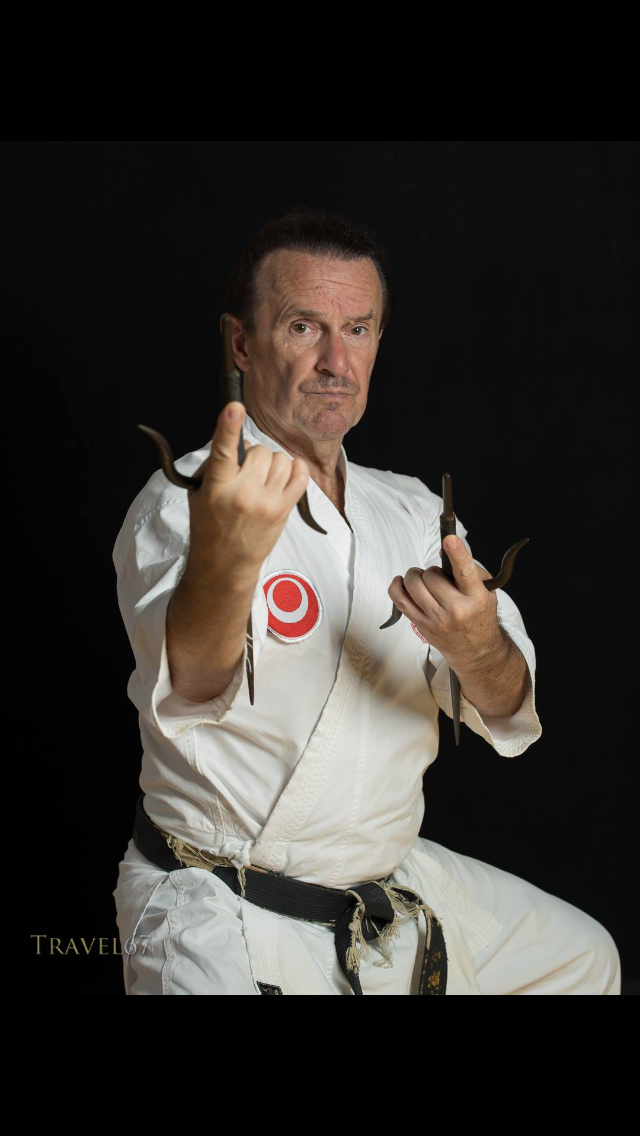
In this episode Andrew chats with Sensei Dell Hamby about his journey into the martial arts through Shotokan in Switzerland and becoming a Kobudo instructor in Okinawa.
Sensei Dell Hamby - Episode 1138
SUMMARY
In this episode, Sensei Dell Hamby shares his journey into martial arts, starting from his late introduction at 33 years old in Switzerland to his deep connection with Okinawa, Uechi Ryu karate, and Kobudo. He discusses the significance of finding the right dojo, the passion that drives his practice, and the cultural roots of karate that inspired him to pursue training in Okinawa. Sensei Hamby reflects on his lifelong commitment to martial arts and the joy of living in a place that he considers a paradise for training.
In this conversation, Dell Hamby shares his extensive journey in martial arts, detailing his transition from Shotokan to Kobudo, the establishment of his dojo, and the adaptation to online teaching in 2020. He reflects on the differences in training styles between Switzerland and Okinawa, his experiences with tournaments, and the joy of traveling to teach. Hamby also discusses the connection between music and martial arts, emphasizing the importance of concentration and rhythm in both disciplines.
TAKEAWAYS
Sensei Dell Hamby began his martial arts journey at 33 years old.
He started training in Shotokan karate in Switzerland.
His first trip to Okinawa was in 1996, marking the beginning of a lifelong connection.
He emphasizes the importance of finding the right dojo for training.
Sensei Hamby was inspired by the roots of karate and wanted to experience it in Okinawa.
He has been returning to Okinawa every year for 30 years since his first visit.
Living in Okinawa has allowed him to immerse himself in martial arts and culture.
He believes Okinawa is a paradise for martial arts training.
His passion for martial arts grew after his first training session.
Sensei Hamby has developed a deep appreciation for Uechiryu karate.
Kobudo fascinated him, leading to a deeper exploration of weapons training.
Online teaching became essential in 2020.
Tournaments shifted his focus from competing to officiating.
Training in Okinawa was more intensive compared to Switzerland.
Traveling allows him to connect with diverse martial arts communities.
Music and martial arts share a deep connection in terms of concentration and rhythm.
CHAPTERS
00:00 Introduction
03:13 The Journey Begins: From Switzerland to Okinawa
09:13 The Passion for Martial Arts: A Late Start
13:12 The Roots of Karate: Choosing Okinawa Over Japan
17:06 Finding My Style: The Impact of Dojo Choice
18:04 The Call of Okinawa: A Lifelong Commitment
19:12 Journey into Martial Arts: Early Experiences
21:39 The Fascination with Kobudo: A New Path
24:52 Teaching and Online Classes: Adapting to Change
32:47 Tournaments and Training: A Shift in Focus
38:54 Traveling the World: Sharing Knowledge
41:33 Future Aspirations: Continuing the Journey
44:07 The Connection Between Music and Martial Arts
Connect with Sensei Hamby through his Facebook page
Join our EXCLUSIVE newsletter to get notified of each episode as it comes out!
Subscribe — whistlekick Martial Arts RadioAfter listening to the episode, we would love to hear your thoughts.
Subscribe to whistlekick Martial Arts Radio on the following platforms:
🎧Apple Podcasts: https://apple.co/3mVnZmf
🎧Spotify: https://spoti.fi/3yHVdHQ You can find whistlekick on all social media platforms using the handle @whistlekick or visit our website at https://www.whistlekick.com or https://www.whistlekickmartialartsradio.com
Show Transcript
Andrew Adams (07:05.366)
Welcome. You're listening or watching another episode of Whistlekick Martial Arts Radio. And today I'm joined by Sensei Dell Hamby. Sensei, how are you today?
Dell Hamby (07:15.6)
Very fine. Thank you very much. It's pleasure to be with you and looking forward for an interesting conversation. Thank you.
Andrew Adams (07:21.428)
Excellent. Well, I am also looking forward to it. But before we get there, I want to make sure that if we have any new listeners or viewers on YouTube, I want to let you know about who we are here at Whistlekick Martial Arts Radio. You can go to Whistlekick Martial Arts Radio.com to check out all of the episodes that we've released, over eleven hundred at this point. And all of those episodes are not behind a paywall. You can get all of those episodes there and you can find transcripts, vi all the videos, audio.
pictures, photos, contact information for our guests, all of that stuff you can find there. You can also sign up for our exclusive newsletter. We're not gonna send you thirty-five emails a day. We're gonna send you two emails a week and we're gonna let you notify we're gonna notify you when every episode comes out so you don't miss any. So please sign up for that there. You can also go to whistlekick.com to find out about all of the other things that we do. This podcast is one part of what we do, but maybe you want to purchase some apparel
Maybe want to purchase some sparring gear. Maybe you want to purchase a training program or a book or uniform. All of that stuff you can find at whistlekick.com. and we would appreciate you to go there. You can also find out about all the events that we host around the country. So check out whistlekick.com for all of that stuff. All right, now that the business is out of the way, Sensei, I'm excited to chat with you. We've got a bit of a time difference here. So viewers and listeners, if there's a bit of a delay.
Dell Hamby (08:39.929)
It
Dell Hamby (08:44.271)
Yes, we do.
Andrew Adams (08:46.638)
you might understand why. Sensei, where are you joining us from today?
Dell Hamby (08:53.367)
I'm in from the Shimbukan Hombu Dojo in Okinawa. We're in Tomigusuku, which is just outside, just across the river from Naha, the main city. So the Kaikan, you can't see now when I look out my window here to the right in the dojo, I can see the Karate Kaikan. So we're basically right in the middle of Okinawa, in the southern section, yes.
Andrew Adams (09:17.196)
Mm-hmm. And anyone that's just listening might not know because they can't see you, but if they want to see you, you can go to YouTube and check it out. But you do not appear to be Okinawan. So so let's figure out we have to get to there. We have to figure out how you got there. But in order to figure that out, we've got to go way back to the beginning. So how did you first get involved in martial arts?
Dell Hamby (09:29.593)
No I'm not.
Dell Hamby (09:33.627)
Yes.
Okay.
In martial arts, okay. That goes back a while. I've been involved completely, my goodness, it's gonna be over 30 years now, okay, over 30 years. Originally everything began in Switzerland.
So I'm coming from Switzerland. So my martial arts began in Switzerland with the, as we call the sports side, Shotokan, this type of karate in Switzerland, because at that time that was basically all there was. That was in the time of K-1 with Andy Hoog and Peter Eritz and all of this thing is going on. there was no, actually at that time, very little around Europe or in Basel, in my hometown, no traditional.
Okinawan karate going on. So I started into a local school there and started training. So that's how I got started. I started very late. I think it was, my god, have to get back in the years, at 33. Yes, I began at 33 years old. And that's when I got started and I was practicing.
Dell Hamby (10:50.925)
in Switzerland and as everyone gets bitten by the bug I think there's a time when you want to get back to the roots and go to Okinawa and experience the roots of the karate. So that's when I made my first soldier into Okinawa which was my goodness. Will be 30 years this year I'm celebrating my 30th anniversary with contact with Okinawa Budo martial arts karate and kobudo. So
That's why I first came was 1996 to Okinawa. So at that time I was I think me second Nidan sandan in Shotokan and then I got involved with someone who took me to the dojo and chat down up in the just about an hour's drive here
from Naha, depending on the traffic. And there was an Uechiryu Dojo, Uechiryu Dojo, the karate, the style. I'd never heard anything about it. I came to Okinawa not speaking Japanese, anything, contact. I just showed up and I wanted to find a dojo, so to speak, okay? So, as fate, as we say in Japanese, ume, had it.
the hotel I was staying in, this was in Okinawa City, and I was walking around the dojo, sorry, outside of the hotel looking for a dojo. And because in this Chattan area, this area, there lot of dojos around there, but I didn't know at the time, this was kind of like the hub or the center for Uweichiryu, the dojos around this Chattan area. So, as it turned out, I was...
walking around looking just for a dojo and I was on the, it was near the Kadena Air Base and they call it Gate Dory. It's Gate Street, number two, just going back out into the, let's say the night activity section of Kadena Air Base going out on the backside, which we used to frequent too with the GIs really a long time ago, but it was a lot of fun, must admit. So anyway, there was a...
Dell Hamby (13:01.083)
on a telephone pole there, there was, because I was in English, because I wasn't reading Japanese at the time, or speaking it, so, and it was,
being taught by a gentleman who was at the Air Force Base there in Kadena. And I don't know, Andrew, if you remember, but the copies of the papers with the telephone number written here in a trip, and you could always rip off a piece of the telephone paper, sorry, the paper with the telephone number was there. So anyway, I gave this gentleman a call, and he introduced me to the chat tan to the Okiku Kai Ueichiru Dojo at the Chat Tan Dojo, and that was under Takemi Aki Shiguro Sensei.
This was an okiku-kai which the association is still exists now But this was back in the time when the association was all together with the sensei's like Takamage sensei Takara Shintoku sensei Nakauro sensei and all of the big sensei's at this time so I began studying Uechiryu karate in 1996 so that was my first trip to Okinawa and I go in not knowing anything about this style and it's one of the most
you say it's a very hard style. The hardening and this type of thing. So I started in that dojo. I went back to Switzerland after six weeks. I had a six weeks vacation and I went back. So I took off my black belt. This is my first belt I got in Okinawa. Still have it after almost 30 years. And I took off that belt and put on my white belt and began my whole journey in 1996.
through the Uechiru Dojo, the Chattan Dojo with the Okiku Kai. And that's how I began just walking around looking for a dojo basically and landed up in the...
Dell Hamby (14:53.626)
Thankfully, thank goodness, at the Chattam Dojo with the Oichiryu. And then afterwards, the year later, when I came back, I started going to the Kobo Do here with Akamine-sensei, with the Ryukyoku Shimbukan. And I've been with him now for 30 years altogether. very good friend, a great person, a fantastic gentleman. Love him as a friend, as a mentor, as a sensei, and also my good friend. So that was over 30 years ago, yes.
Andrew Adams (15:23.381)
Wow. Now, when you started at thirty three, it's it it's not that it's super uncommon to start that late, but it's not really common either. What was it that was going on in your life that at thirty three you just decided I wanna do this? 'Cause it's not super common, like I said.
Dell Hamby (15:27.246)
Yes.
Thank
Dell Hamby (15:43.019)
Exactly, mean it's kind of a late boomer as it were, as it turned out. Yes, well in Switzerland I was actually a professional classical guitarist, you know, I was a musician.
for many, years and I was studying and going around the world and doing concerts and playing and anyways I was a classical guitarist but I was doing some sport things like of course Switzerland I was doing cross-country ski, jogging when I was out in Southern California at the university there would jog you know all of this type of stuff I was always very active in sports but then one day a friend of mine said listen I'm going to this where I began my training in Basel there in Switzerland I'm going to do
karate lesson would you like to come along?" And I said, well why not? With a friend and we go, we took our jogging suits and went and that's yeah so I was 33 but I fell in love with it completely and I was like wow this is really really great stuff I was impressed you know being the movement and and it was I was just so enthralled we signed up for like maybe a five course thing there and then my friend did one
lesson it was from Ireland and he stopped and I continued in the rest his history I've not stopped training since that first training session which I began in Switzerland and that's what Lynn continued to Okinawa etc etc and so forth so yeah that was started very late but very passionate I must say very passionate yes
Andrew Adams (17:15.574)
And so when you started you started doing sh Shotokan karate. Yep.
Dell Hamby (17:19.108)
Shotokan. That was the style because I didn't have it was just it was like it was a karate dojo. Yes. Yes shops they're selling merchandise, geese, okai, this type of thing. So no idea. So that was it just happened to be a Shotokan club actually. Yes. Yes.
Andrew Adams (17:24.567)
It was your gateway.
Andrew Adams (17:37.58)
And how long were you there before you decided I want to go to Okinawa?
Dell Hamby (17:44.603)
It's a good question because like I said, was training, think it was 33, yes, I was about to turn 40 when I first came to Okinawa. So I was training and...
started reading up a little bit of course on the history and stuff like that. really was getting into it. started studying Japanese. I came back from Okinawa that first time and I enrolled in a Japanese class. I was studying Japanese and Chinese at the same time. So to get for the reading and the conscience sector. So that was, I always did that intensively. So when I do something, I do it intensively. I think it's probably coming from the, from doing so many 30 years of music, of classical training. So you're really concentrated in what you're doing. So.
That started because when I, sorry, after Okinawa, but before I went to Okinawa at that time, I was reading about history of the karate, about the nukoshi and all this stuff, I was, wow, I have to to Okinawa someday, so.
I thought about it a couple of years or whatever and then I even, I remember it was so funny. Higona Sensei, I bought a book of his and there was an address of his where he has, here at Makishi, his dojo now and I even wrote a letter and it was funny because I didn't know the difference between Shotokan or Gojiru at the time so I even wrote a letter out of English because I didn't know if he could English but because the book was in English but then I wrote a letter which I never got
reply from because it came back, returned a sender address and known something like that when it came back to Basel. So I became, said well maybe I should go to Okinawa sometime. So I planned to go. Now this was like I said this was after training about seven years of Shotokan. Then I really got, I've got to get to Okinawa. I hear about this beautiful this place with the birthplace of karate. So I was thinking about it a long time before actually going though.
Andrew Adams (19:42.572)
Now I'm curious because I I also trained Shotokan for probably sixteen years or so. And most people listening or watching will recognize that Shotokan is traditionally seen as coming from Japan, but obviously Funakoshi came from Okinawa to Japan, but Shotokan itself is is traditionally said to have come from Japan. What was it about Okinawa that made you say, I want to go to Okinawa instead of going to Japan, which
Dell Hamby (19:49.53)
Okay?
Dell Hamby (19:57.167)
Yes.
Dell Hamby (20:01.583)
Yes.
Dell Hamby (20:05.272)
Yes.
Andrew Adams (20:11.328)
Is the birthplace of Shokan?
Dell Hamby (20:13.261)
Right, yes, yes, okay, because of, yes, very good point, because I was doing Shōtokan, which was considered to be Japanese karate, but through my research, I was reading, but I was reading, okay, but Funakoshi Sensei, or he was Okinawan.
I don't know if I can adjust the camera here, we have the pictures of him right up here in the dojo. You see behind me, Akamene, just off to my right here, that's his case, Akamene Sensei's father, and Taira Sensei here to my left, the founder of our style. Now, he used to train and was teaching some with Funakoshi Sensei earlier, so they were all training together here in Okinawa. This was a very small group, Mabonii Sensei and Funakoshi Sensei.
Because, that's why I said instead of going to Japan for the karate, I would like to go back, back, back to the roots. That was my same approach with my music. I was going all around Europe, even going back to Lute before the classical guitar to get back to the roots. So I had the same approach with my karate too. I wanted to get back to the source. So that's why I to Okinawa to instead of going to Japan to get right to the source. I thought there would be just right at the
where the origin of the karate was coming from.
Andrew Adams (21:33.058)
Gotcha. And that and okay, and that makes sense, you know, because he studied Fudukoshi studied in Okinawa for years and years and years before taking it to Japan. So so that that makes sense. now I'm wondering you first when you got to Okinawa, you were looking around for dojo, you found a Weichiru dojo. what would have happened, do you think, if you had found a Goju Ru Dojo? We same?
Dell Hamby (21:40.749)
Yes, before taking to Tokyo,
Thank
Dell Hamby (21:52.813)
Yes, yes.
Dell Hamby (21:57.818)
That's what I say this word, ume, in Japanese, it's fate.
that first dojo I started training in, which I saw was at Oichu, if it had been a shorenkei or a goju, so then maybe I would have been so impressed that first time to continue training that style. But I was so impressed with this just hardness, I'd never seen this type of karate before, because know, in Shotokan you have sundome, you stop and stuff, but this was like, oh, full contact. I mean, the real nice, said that this must be the real stuff here. But if I'd gone,
ended up in another dojo.
I could have gone that route too, but as it turned out, which I know all the styles, I appreciate it, mean, fantastic. that's why I've never changed my karate style after all of the, even in Kobudo during 30 years, because Akamiri-sensei, the style of karate is the shoren-kei, okay? It's coming from the picture with the sensei right behind me here with the Gushiken-sensei, and this is all traced back to Funakoshi style, okay, to the shodokan style. So I stayed true to
I still practice my goju, sorry, my goju, my ui-chu up to this day. Although I'm living in a dojo, I've been living in this dojo actually for 10 years too. So I'm never late to practice, that's one good thing, because my room is just back here. can just walk right into practice anytime. But that's some benefits of living here. So I stayed true to my ui-chu, but that's the point. If I had landed in another dojo, perhaps I'd be doing another style of karate, absolutely, yes, yes, yes.
Andrew Adams (23:36.786)
And was there a specific thing you went to Okinado first for six weeks and then went back? How long before it was that you went back? I mean, you obviously were were, as you already said earlier, bit by the bug. Was there a certain thing? Was there a certain thing that happened that you were like, This is it, this is this is for me?
Dell Hamby (23:44.427)
Right, Yes.
Dell Hamby (23:53.956)
There you go. was that. Yes. Andrew, my friend, it's fantastic.
That's one of those, well can get into, I don't want to diverge too much, but you you've got the climate, it's beautiful. You've got the people, the food, it's fantastic. The training, the best, where else do you go for training except for Okinawa? You've got the best sensei's in the world. You've got all of the styles you need. So I was bitten by that bug. in it, but it happens to a lot of people. When people come to the dojo the first time, he says, be careful. It's going to catch you, it's coming to you. You're going to get caught. And what happens, when I got back to Basel, back to Switzerland, after that six week stay,
the first thing I did was book my flight for the next year. So I was coming back every year for 30 years I've been coming back to Okinawa every year.
Until 2016, that will be exactly 10 years this July, next month basically, June, July. That's my 10th year anniversary of living here the whole time in Okinawa. So I've been living in 10 years because of that initial trip and being bitten by the bug and coming back every year during my summer vacation from teaching in the music school system in Switzerland for practicing. So I was getting my Japanese going.
improving. learned Chinese, Russian, and all of these languages which I'm using these days now when I'm going around, sorry, going around the world teaching and stuff. So I even know the dialect of the Uti Nagochi, the Hogan, the language here and stuff. So it's just great living here. It's perfect. It's just, it's really, it's a paradise island. It's completely a paradise island, yes, for training and living, yes, absolutely, yes.
Dell Hamby (25:42.083)
From that first trip, from the first trip it was decided.
Andrew Adams (25:49.134)
So your first seven years you're doing Shotokan, you're in Switzerland, had you started teaching at that point, or were you still just completely a student before when you k went to Okinawa?
Dell Hamby (26:01.785)
of Shotokan, yes. I began with the teacher there. He was from French, from Alsace. He was out of Alsace. I can't remember the gentleman's name, was a long time ago. Anyway, very good teacher. I began and then I think up when I got my showdown, then I became like his assistant and started doing some teaching with him. And that happened up to the...
I that when the knee, yes, I had the knee down, that's right, the first time I came to Okinawa. So I was still in that school.
there in Switzerland, still doing the Shotokan when I'd come to Okinawa for the first time. So I began the Uweichiru, so when I went back to Switzerland, I was so animal, so loving of the style that I went back and was practicing that and trying to integrate some of this Uweichiru into the training there. I was...
Then I did my showdown in 1997 here, then the Nidan 1998, and then I started teaching Uwe Chiriu. I had opened my own dojo of Uwe Chiriu in 1998, yes, in Basel. So I had stopped doing Shotokan, and just in that school I was teaching it because the other teacher had retired. He was an older gentleman who had retired. So then it was a perfect timing so I could start.
teaching the Oichiro in that dojo at that time. So the new students coming began with the Oichiro. So I kind of phased that out in that school. then I think it was about a year or two there. And then I opened my own dojo in Basel, another building, another place, et cetera. And that's where I began teaching. think it was 19.
Dell Hamby (27:49.272)
1999, something like that, around the 2000s, yes, at that time. there was kind of that shift. So it was show to Khan, I go to Okinawa, and then it takes the OITU and takes over after about one or two years when trying to do both in Switzerland and Illinois and we're back to the school there,
Andrew Adams (28:08.366)
And when, where, and how did Koburo come into your life?
Dell Hamby (28:13.9)
Mm-hmm.
Okay, that's I was going back, it was my second trip to Okinawa, that would have been 1996, 1999, 1997. And then I was going to the dojo there and then I was seeing
Dell Hamby (28:35.524)
people doing this Kobudo and the other dojos, I was going around to lot of the other dojos and seeing these, working with the bow on the side, these weapons and I said, wow, this looks like really fascinating stuff. I'd love to be trying to do this and stuff. So I was one night at the dojo, at the Chachatant Dojo with Okiku Kai with Takamegi Sensei and he calls me into the office and afterwards he says, Hanbiya here, you're wanting to do some Kobudo? I said, yes, Sensei, I would like.
to do some I was at a dojo the other night with Okama sensei's dojo he's doing a different style as well we have someone in the dojo here Izumi sensei at that time he was a sixth or seventh dan in Kobudo and karate also
And he's a student of Esuke Sensei. Esuke Sensei is here on this, Now, Akamari Sensei's father, okay, the second president. So, Izumi Sensei was a student of Esuke Sensei. he started teaching me. had this, it was called the Kenju Kaikan. It was the study center of Okiku Kai.
which is a very big two-story building, huge, about 120 quadrometer dojo downstairs and a place upstairs to stay, et cetera. So Izumi-sensei would come down almost three four times a week when I was staying there, that six weeks, after training. I'd do the training sessions in the evening, every night at Chattano Dojo, and then in the day he would come down and teach me Kobudo.
So I did about two or three weeks absorbing as much as I could and then he says, okay listen we're gonna go down to Hombu.
Dell Hamby (30:12.844)
where I am right here. But this is the newest, the newer dojo. The older dojo was here. So I was training. That was when the organization was called Hozon Shinkokai. Now it's Shinpokan. It was after 2011 there was a split. But this was in the old dojo, the old dojo. So we started coming down and training here. That's where I met all of the senseis here and now Akamini Sensei. Eisuke Sensei had just passed away the time I began. He was sick for quite a while. So, but I began with his son who is now the president and leader.
since 1997, yes, Aqabin is my, I've been with him now for 30 years basically. So that's, I came down just right away and started, was able to start teaching, because again this word, I keep on going back to umme, fate. There was someone in the dojo in Chattan who was in this organization.
So he introduced me through his training so I could come down and start training in the Hombu Dojo here. And I've been with him now, it's exactly 30 years with the dojo here now. So that was a good stroke of luck too, if I may say. It's a great organization, fantastic organization.
Andrew Adams (31:22.795)
Now, one question that I usually ask someone who's who's heavily and deeply involved with Kobodo do you have a favorite? Favorite weapon?
Dell Hamby (31:29.281)
Okay?
Dell Hamby (31:33.284)
That's a good one, man. Ask me today and tomorrow, maybe changes. No, of course I love the bow. But the eikuri, the aura, that's fantastic. I love that too. Well, they're all good. See, now you're getting me on a 10. Here's the thing. Size, good. have the kama. I'm doing about almost 10 weapons basically, and a lot of the kumite weapons and stuff. if I had to have a choice, would probably be either bow and kama, the long weapons, as it's called, the long weapons. I really like the bow because
we have the most kata. We have about 15 different kata, 15 bow kata from the beginning all the way to the... I have them all now after 30 years. So from let's say from Q up to the ninth dan I have all of the kata here and also taped or written down. we have a lot of... the bow is a very versatile weapon and there's so many kata available. But the eikori, the oar is very good too because of the technique involved. There's only one kata.
you have a potpourri, it's a tool of the force. You have everything going on in the kata, so it's great too. if I have to go to that deserted island, or that paradise island which I'm already on anyway, I think I'd take a bow after, yes. I'd have to say bow is the favorite, yes. But it's still hard to say. It's hard, it's hard. Sure.
Andrew Adams (32:47.126)
Okay. So now there I know it's hard. You're right. And now there's a follow up question, and I wanna preface the question by saying that if someone asks me what my fave if I if I have two pizzas offered to me and I've got a regular plain cheese pizza and a pepperoni pizza, I'm gonna choose the pepperoni pizza, but that doesn't mean I don't like cheese pizza. I like cheese pizza fine. Yeah.
Dell Hamby (32:57.25)
Okay.
Dell Hamby (33:04.984)
Yeah. Yeah.
Dell Hamby (33:12.952)
Absolutely, the margaritas are good too, yes of course.
Andrew Adams (33:16.608)
So my follow-up question is of the ten you said you have ten Koba weapons you train, which one, if you were to rank them, was is your least favorite? That doesn't mean you don't like it. Doesn't mean you don't like it.
Dell Hamby (33:22.7)
Right, right.
Dell Hamby (33:27.096)
Oh, that's, oh my God. Maybe I shouldn't say it too loud here. just say, least favorite. Oh, oh, that's a good, I've never thought of it like, but that's a good question because I don't, the least favorite, so you're going, I see where you're going. have all of the, and here's the number of, the top 10, you got number 10 here with the bold, the least.
You know, we have the te kudi, know, the knuckle duster, we have the nun chak, we have the tonfa, sai, timbe, roshin, kama, that's... Oh my goodness. You stumped me on that one, mate. I would have to think about that. Maybe I'll tell you at the end of the interview. I don't really have, because I really like them all, because they're all so important.
to the syllabus, to the growth of the system. Every weapon, using the nun chak, using the te ko, every weapon is very important. Although the bow is the most difficult because of its length, and you have two hands on one weapon as opposed to holding two sides, two tuan fa, two whatever. Yeah, the nun chak is together, two te ko's. that's my least, I don't have a least favorite. I really don't.
Andrew Adams (34:42.606)
All right.
Dell Hamby (34:43.841)
Well, he don't. I'll be fair with you about that, yes. They're all... Yes.
Andrew Adams (34:45.678)
No, that's okay.
now I know that you teach a lot of classes all over the world on but you're you're in your whole in your dojo there. You teach them online. How did that come up how how did that come about?
Dell Hamby (34:58.507)
Yes, I do online. The teaching online, that was easy when that all got started because of Corona. Corona, that's Covid. That began with the Covid. So that was a big problem, of course, we couldn't travel. Luckily, I was in Okinawa because all of my friends and stuff, couldn't come to the island for three years. I was living in Dojo all time. So thank God I was here when that Covid thing broke out.
to help the association, people couldn't be coming for training, so we started going online to keep the association, helping out the people who couldn't make it to the island, to keep the testing going, to keep their katas growing, just to keep the ball rolling as it were, because no one was coming to the island for that, was almost a full three years, we had no one coming to the dojo. We would train here, a couple times, you they weren't so strict, you weren't arrested or you
going out and the police coming around and seeing what you're doing. But there were only a few times that they would say it, okay, please, maybe even in the dojos, don't go. So I think one or two times in that three year period, I was here alone in the dojo for about two weeks, but I was training all the time, so it didn't disturb me. But.
Otherwise, we were training with masks. When we'd get together and start training and the government said, okay, as long as you're training with your mask, maybe you probably you looked how was it training with masks? Terrible. I'll tell you that in advance. was terrible with masks because it's so hot here too. anyway, the that whole thing with online got started with the covid and it keep it was it's continuing now because I go around. I'm leaving for Europe again at end of next week. I travel every month basically going
around the world because we have about 150 dojos around the world now.
Dell Hamby (36:51.125)
connected with the Shambhala Kamsa. It's a lot of teaching. A lot of people can't come, so we try to get out abroad as much as possible. Kaicho goes about, Akhmini Sensei Kaicho, goes about four times a year abroad. I go every month abroad and try to, sometimes I'm away for a month. I just got back in April, I was gone the whole month. I was in Italy, Switzerland, and England for two weeks. So that takes a lot of time. So, but when you go
a lot of people can't maybe they can't come to the seminar they can't maybe come to Okinawa maybe it's a question of time finances etc so we do I do about maybe 10 zoom sessions a month it could be Argentine it could be somewhere in Europe people getting ready for testing people learning new committee but new cut that anything going on so it's people who are who probably never even been to Okinawa or people who come regularly so it's
It's a very useful tool during these zooms. must admit it's a very big help, but that really started because of COVID actually, yes. That's how that kicked off.
Andrew Adams (38:00.943)
Okay. And so what I'm hearing is it started as a way for you to stay connected with those students that were already coming to your dojo and now they can't, but it also sounds like it has grown because you are now having students who've never been to Okinawa. So it the program itself sounds like it's grown.
Dell Hamby (38:07.465)
Exactly. Yes. Yes. Yes.
Dell Hamby (38:19.895)
There you go. It has, it has. Through the zooming, of course, through the social media, through Facebook, started posting these little clips up on. You've probably seen my Facebook. I'm posting basically every day a little bit of snippet of this and that. And probably I would say about of the new students and new dojos, which I've originally helped to get going, I think maybe 80 % or more, 85
have been the result of the social media thing, doing the zooming, putting up the clips, etc. on Facebook or on Insta or YouTube and stuff. So the social media has been a huge, huge support of growing the association massively, must say, completely, getting this out there. It's been very helpful, very helpful.
Andrew Adams (39:17.79)
And what has your experience been like with tournaments? You know, you st you started in Shotokan, which is a a as you bet as you said, a sport a slightly more sport oriented karate. tournaments are are some are in many Shotokan dojos a a big thing. Was that something that you have a lot of experience with then and what about now?
Dell Hamby (39:25.121)
Yes.
Yes.
Dell Hamby (39:36.438)
Mm.
Dell Hamby (39:40.437)
Yes, okay, good point. I had a lot of experience doing that because I was also younger, well younger, mean was beginning of 33, that was young as opposed to now, but at that time the emphasis was in the Shotokan, in the trainings in Switzerland was doing your training and you had your competitions and you're always training for that. So a lot of kumite, kata, and this style like that, okay? When I got to Okinawa and started doing the traditional...
And getting, there was also tournaments, I've done some tournaments on, like when I was coming, maybe the first 10 years or so up to maybe around 50 or something.
some of the tournaments, but then I was starting I was officiating I became a shim pam I was starting to doing a lot of officiating so I was spending more time doing judging instead of the instead of competing so that turned out now and since now I think What if I turn 71 now in July so the last 10 10 years being here. It's all been judging. It's been judging judging for over 10
10 years now and before. So the last competition for me was probably the early 2000s.
Andrew Adams (40:59.754)
And the train I don't know what the training in Switzerland is like, but I ha have to imagine, like the US, the training in Switzerland is probably very different than it is in Okinawa. Can you talk a little bit about the differences in what you felt when you first started training in Okinawa compared to when you were in Switzerland?
Dell Hamby (41:04.308)
Mm.
Dell Hamby (41:19.964)
Okay, good point. Yes. I noticed a big difference is for example When I first began training the Shotokan in Switzerland, okay
you would have a little bit of a kihon warming up and then get right in doing your kata and a lot of kumite which I liked at that time. It was very interesting and very good because we were doing tournaments there and this Andy Hoog and K-1 and Peter Aerts and all this thing was very big at that time. is back when he was alive and he was very well known in Switzerland doing that big K-1 thing. So a lot of people were trying to do that type of thing. So then I got to Okinawa and started doing the training here and I liked
But the way they were doing the training here, it was...
First of all, it's a lot more intensive. The training, when I started going to the Ui-Chu dojo, the training was very intensive, which means on the aspect of the conditioning, the hardening, the san-chins, the contact, I mean really contact, the full contact, the hardening of the arms, the legs, this was it. No one was doing this in Switzerland. Maybe some of the K-1 people, but this was Shotokan, this was karate.
It was not a lot of contact. And know the sun, me, there was really no contact going on, or very little, just stopping, et cetera. I mean, there was contact going on in the way to dojos and stuff. the training was, it went up quite a bit on the meter as far as the hardness, okay? And they're following the regiment. They were doing a lot of, I like that, that.
Dell Hamby (43:02.078)
repetition they were doing a lot of repetitions they weren't doing changing
Sometimes in Switzerland they would change the training a little bit. You go in and do this and maybe for a few trainings and then change doing another way of doing it. But in Okinawa, I like the system. It was set and you were just doing this repetition incessantly. And I like that because it reminded me of the way I used to practice my guitar and music. There's so many hours of repetition to get the perfection of your Bach or your Mozart and then Schubert and
getting this all on the classical guitar and this was very appealing to me because it was the same concept which I was used to after doing 30 or 40 years of music starting as a child with the classical music and the classical guitar so that was very appealing and this regimen of training which they have here of covering the kihon, the katas and also the kumite etc but it was so the regimentation it was just so regimented and that's what was
was really, I found, was different than, it was a little bit more lax in Switzerland. We still train, but it's just, you come in here in the dojo and it's, from the time you started, it's very, just concentrated. That concentration, I really, really enjoyed, yes. And I was to do, yes. After 30 years. No.
Andrew Adams (44:25.326)
Now, are you still playing guitar? Obviously not professionally, but do you still play it all?
Dell Hamby (44:32.534)
I always get so, I put down the guitar 10 years ago. I don't even have my guitars here. My guitars are still in Switzerland. Two beautiful Spanish Luthier guitars. had a proverbial, the burnout. I was doing that so many years, so many days of six and seven hours of practicing. So I just, no.
I haven't touched a guitar in 10 years now. I don't miss it, that was an entry for my God. 40 years of my life was basically almost, well, good 35, let's say half of it, yes, was with the guitar, but no more guitar. I have enough to do with the bow and the weapons now. In the case we, it's from one business into the other business. It's okay,
Andrew Adams (45:20.524)
Now you mentioned that you are traveling quite a bit. you obviously you're you're teaching in your school there in Okinawa, and then you're traveling, you know, once a month or so. What's your favorite aspect of traveling and doing teaching as opposed to teaching in your own dojo?
Dell Hamby (45:24.242)
Yes.
Dell Hamby (45:33.142)
Thanks.
Dell Hamby (45:39.289)
That's a good question. okay. Well, I love to travel. I love to travel. Since I was a kid, I've been traveling, always since I was kid, been traveling. Continued that through my music, traveling all over the world because of the music, concerts, the courses of doing these types of things. so that became very natural when I started
doing my travels going around the world teaching the Kobudo now. do more, I don't teach karate actually, I'm doing the Kobudo because I've spent most of my time doing Kobudo and probably there's enough Uwechuru teachers around the world but...
There's not a lot of cobol, there are cobol, don't get me wrong, there a lot of cobol teachers, but in our organization now it's grown, but by the time I, when I began teaching, and earlier, 15, 20 years ago, it was a much smaller organization. Now we've got about 150 dojos around the world. It's boom since the social media thing has kicked in, et cetera, but.
The aspect, I love to travel, meet the people, meeting, do dojos, helping people to get started. You're meeting people from all different walks of life. mean, you have musicians together, maybe a carpenter, maybe a PhD in astrophysics. mean, it's really interesting. You get so many combinations of people. But you're sharing this love for the martial arts, so that common thread keeps.
keeps you working together very much as you know yourself. I you can be from a different complete different society, a culture, but that one line, that one thread of doing the martial arts kind of weaves you and keeps you together and when you're...
Dell Hamby (47:28.531)
doing your tour, your martial arts tour together. It's very interesting. But I just love to travel, so it enables me to meet a lot of interesting people and to share that what I love doing here, giving back what I've been able to learn from my Okinawan teachers here. It's just a natural thing, think. Yes, it feels very natural doing it like that, yes.
Andrew Adams (47:52.714)
And where do you think your martial training is gonna go from here? Right. It's we're recording this in late May two thousand twenty-six. if if we got together for another interview in five or ten years, what what are we gonna be talking about? What what will you be doing in the next five or ten years? Or what do you hope to be doing?
Dell Hamby (48:02.005)
Okay.
Dell Hamby (48:08.116)
Yes.
Dell Hamby (48:15.286)
Yes, Andrew, that's my hopes, my wishes to be doing the same thing. I moved to Okinawa, so I retired. I retired from my teaching in Switzerland.
at 61 and early retirement because I just want to do martial arts now the whole time. So that worked out well. I've been here now. In the beginning I thought, well, maybe come for half a year and go between Switzerland and then Okinawa. But now the six months or three months trip has turned into 10 years now because I was here, started the training, meeting the people. The association was starting to grow, helping Akamini Sensei. I could go more
brought more often than he could because he has his dojo here, his family doesn't want to be living in every month, he has his obligations here, plus a lot of meetings with the associations and the prefecture, cetera, here. So that would say this...
10 year, if I can continue this for another 10 years, I wouldn't complain at all. Now, like I said, I'm turning 71 in July, it's the Independence Day in America, so that would be the 4th of July. So at this moment, as we say in German, Langholz an, I have a wooden table here. So.
just praying for good health and good luck. So if I can continue doing this in 10 years, I'll be doing exactly the same thing in 10 years. So the next, when we do again the whistle-click interview in 10 years, we'll be talking about the same things basically, I hope, yes.
Andrew Adams (49:53.999)
Well that's great. That's great. and and I guess I hadn't pieced together until something you just said, but you were before you retired, you were also a you were a music teacher. You were teaching guitar, correct? So okay. So one of the things that we have found here at Whistlekick that there is a la more than average number of
Dell Hamby (50:08.265)
Yes, yes, that was my profession. I was professional guitarist. Yes.
Andrew Adams (50:21.698)
high level, high ranking, exceptionally experienced martial artists who are also musicians. A larger portion than normal have been really good at doing music as well as martial arts. And I'm wondering if you have any thoughts on why that might be. You know, the the commonalities between music and martial arts.
Dell Hamby (50:37.225)
Harsher Arts.
Dell Hamby (50:41.397)
You
Dell Hamby (50:46.099)
Yes, okay, that's a very easy question when you do both, okay? Like if you're doing both, you'll understand exactly, okay? Because, okay, when you're doing music, what have you got? You've got your martial arts and your music, okay? So what's one of the main things you have to have is a very good, as you say in Japanese, shuchu. Your concentration has to be just like that, okay? That's what you need.
in music. I'm speaking of what maybe rocks the same thing or whatever but classical music is very difficult because there's so much concentration because you know with the classical guitar for example we do
95 % when we're doing concerts, we're doing it from memory, not using music. Now, I do chamber music, like I've had experience a lot, classical guitar with flute, classical guitar with violin, with orchestra, etc., where we're using music. Solo.
guitar solo, playing solos, Bach and Sord and Giuliani and all of these things, it was all up here in the nagin, as you say, up here. So you take this, now I compare this, just the memorization part, and everyone says, Hamdi, why do you never make mistakes in kata? Or rarely, because I can go through all of my kata, 30 or 40 kobudu kata, without doing one mistake, because the way I learned the kata was the way I was learning the music too.
going through piece by piece by piece by piece, taking it out and just the same as preparing your measure, per measurement measure, putting it into grouping, putting into rhythmic groups. So music and Budo, so much in common because of the flow.
Dell Hamby (52:37.682)
the rhythm, the kankyu, all of these things, it's very, very similar. So getting into the martial arts was coming from music and maybe you can ask the other people who speak about this, it was a very easy transition about picking up the flow of the kata, the flow of the movement, the flow of it. It was very easy to get that and understand about it.
And to break down the kata and the training, the kihon, the bunkai, whole thing, by applying that the way I did with my way of practicing my guitar, my music exactly. That was very similar, very similar. Even to this day, I do my counting. get sometimes I use, look at the metrics. know, if you're doing da da da da, da da da, some Beethoven's fifth.
But you can apply that to your kata. Look to where you're pacing. Look to where you put your emphasis. Oh, there's so many correlations. We could spend a whole hour just talking about the thing going on between the music and the budo. Absolutely, absolutely. I agree 1,000 % with that, yes.
Andrew Adams (53:47.647)
I think I think we could probably spend more than an hour because many many of our listeners and viewers will know this, but you wouldn't. I am a professional musician myself. So so we could spend we could spend many hours talking about music.
Dell Hamby (53:59.024)
are, okay. There you go. Okay, what's your instrument? What is your metier? good, good, good, good, good.
Andrew Adams (54:07.992)
Percussion.
Yeah. Yeah. And so your answer was something that I could certainly relate to, especially the rhythms of things and the flow of going through. Yeah, it was great, great answer. I loved it. Loved it. It was really good.
Dell Hamby (54:16.649)
Yes. my goodness. Well, you, this percussionist, my God, my God, my God. I mean, you're right at the source with what is, as for the rhythm and stuff. Fantastic. Yes. That's you know exactly what I what I mean when we're talking about that.
Andrew Adams (54:30.958)
Mm-hmm.
Andrew Adams (54:35.778)
Yeah, no, that was great, great answer. Now, we we've been having a lot of fun here chatting. All kinds of stuff has come up. If someone wants to reach out to you, what how's the best way for them to to connect with you? Something you said may have resonated with them and they want to reach out, how should how should they do that?
Dell Hamby (54:41.779)
Yes, ma'am.
Dell Hamby (54:46.845)
and
Dell Hamby (54:53.694)
Sure, no problem. Most of my contact is through my Facebook page. My name, I'm the only one. It's with the Kobo Do picture. I think at still the moment, last time I checked, the only Del Hamby on Facebook. So if anyone has any questions or wants to reach out, any information pertinent to whatever, music or even the training, please contact me through my Facebook. No problem there, yes.
Andrew Adams (55:21.964)
Yeah, we'll and and I will I'll link that and I know you mentioned your Instagram and whatnot. I will I will definitely post all of that in our in our show notes as well so people can connect. Yeah. but I I want I want to start to wrap wind down here and wrap up, but before we do, I want to make sure that all of our listeners or viewers, if you made it to the end here, thank you. We appreciate you being here. Our goal at Whistlekick is to connect, educate, and entertain.
Dell Hamby (55:25.3)
You can, yes.
Dell Hamby (55:29.95)
Thank you.
Thank you. Thank you.
Dell Hamby (55:40.318)
Yes.
Andrew Adams (55:50.233)
traditional martial artists of the world. And if you feel the same way, we would love for you to go to whistlekick.com, check out all of the things that we do, attend some of our events that we host around the country, purchase something. All of that stuff can help us get our message across. And one of the easiest ways that you can help us out is by sharing and telling a friend about the show. Share this episode if you've enjoyed it. Hopefully you enjoyed it. I know I certainly have.
but share this episode with someone else, or you know, any of the other eleven hundred plus episodes. Tell people about it. The the more that we spread the word about traditional martial arts, the better the world in general will be. And so help us do that. And if you would like to help support us financially for as little as five dollars, five US dollars a month, it would really go a long way in helping us. And you can do that at patreon.com forward slash whistlekick.
Dell Hamby (56:18.645)
Like I said.
Andrew Adams (56:45.536)
This show has its own home, whistlekick martial arts radio dot com. You can go there to find all of the other stuff. Sensei Hambi, thank you so much for being here. this has been a lot of fun. How do you want to close us out today? Where what do you want to leave our audience with today?
Dell Hamby (56:54.708)
My pleasure.
Dell Hamby (57:01.882)
that's okay. First of all, I thank you very much. was very fascinating, very, my God, I just looked at the clock. didn't notice that the time had gone by just like that. I hope we more time. Just thank everyone. I hope everyone enjoys listening to this and the folks doing martial arts and stuff.
wish everyone continues on their path, on your path for training. And as we all know, as you all know, it's just fantastic to be a part of doing the martial arts and anything connected to Okinawa or martial arts in general. I wish everyone good luck, good health and I hope we can meet up sometime around the world or anyone coming to Okinawa are always welcome in the Honbu Dojo in Okinawa. So please, say kodosai. It's Arigato. Thank you very much.