Episode 1139 - What Makes a Real Martial Artist
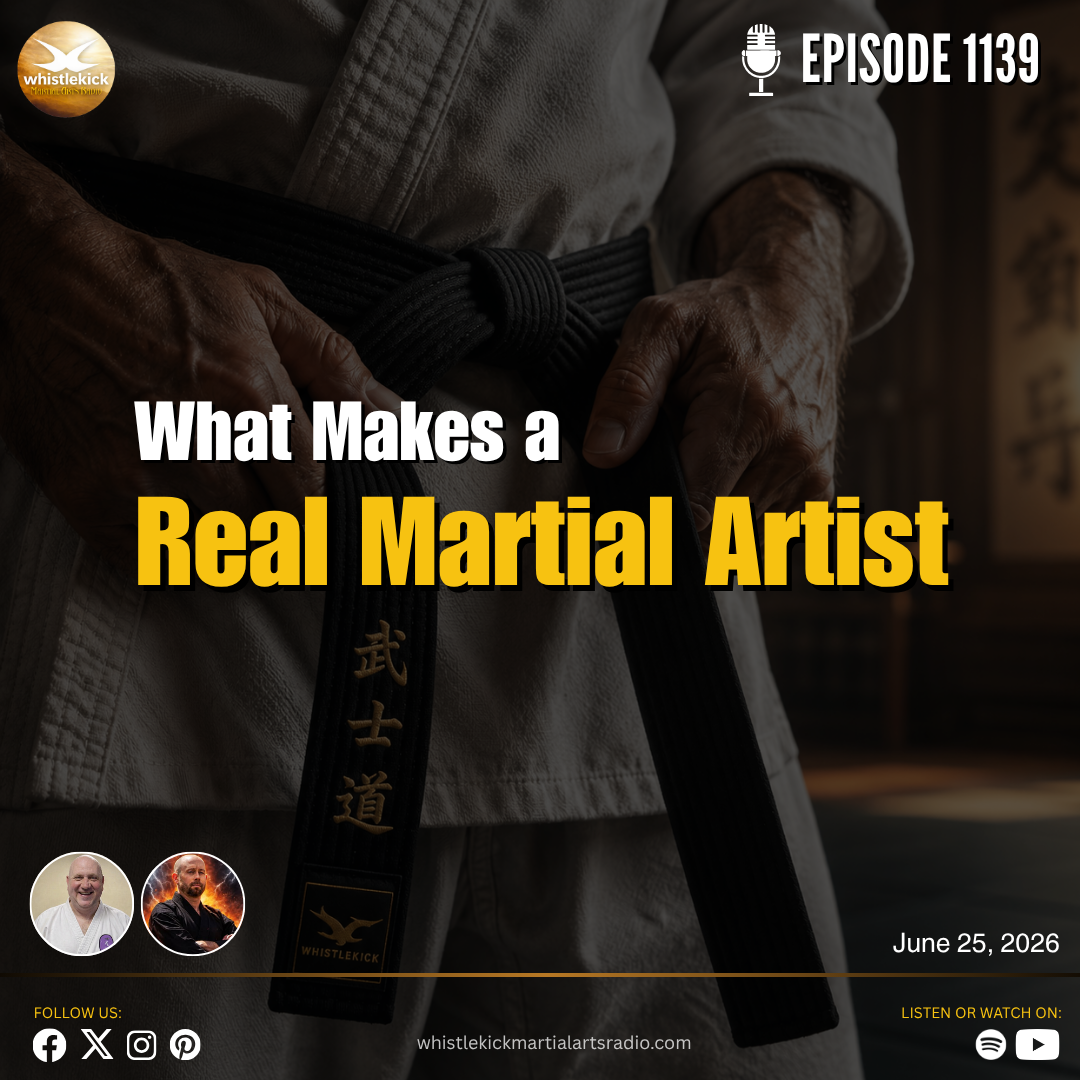
What makes a “real” martial artist? Listen is as Jeremy and Andrew discuss their thoughts on the origin of the question and their answers.
What Makes a Real Martial Artist - Episode 1139
SUMMARY
In this episode of Whistlekick Martial Arts Radio, Jeremy and Andrew explore the question of what defines a real martial artist. They discuss the importance of personal definitions, the role of discipline and character, the significance of rank, and the impact of social media on perceptions of martial arts. The conversation emphasizes that being a martial artist encompasses more than just combat skills, highlighting the importance of personal development and the need for a supportive community.
TAKEAWAYS
Training makes us better and can improve lives.
The definition of martial arts varies for everyone.
Martial arts is not solely about fighting.
Discipline and character are key components of martial arts.
Rank signals progress but does not define character.
Social media has distorted perceptions of martial arts.
Real martial artists should uplift others, not tear them down.
Personal definitions of martial arts are essential.
Engagement in training is what makes a martial artist.
Criticism of others often stems from personal insecurities.
CHAPTERS
00:00 Introduction to Martial Arts and Its Essence
02:10 Defining a Real Martial Artist
09:27 The Role of Discipline and Character in Martial Arts
12:53 Rank and Its Significance
15:40 Social Media's Impact on Martial Arts Perception
20:51 Personal Definitions of Martial Arts
24:56 Conclusion and Call to Action
Join our EXCLUSIVE newsletter to get notified of each episode as it comes out!
Subscribe — whistlekick Martial Arts Radio
After listening to the episode, it would be exciting for us to know your thoughts about it.
SHOW TRANSCRIPT
Jeremy (00:11.202)
Hey, what's going on, everybody? Welcome to an episode, hopefully back to another episode of Whistlekick Martial Arts Radio. And on today's episode, Andrew and I are tackling the question: what makes someone a real martial artist? Stick around for that. I'm Jeremy Lesniak, joined by my great friend Andrew Adams. Andrew, how are you today?
Andrew Adams (00:37.417)
great. I'm I woke up this morning, so that's a good sign.
Jeremy (00:42.114)
Well, if you hadn't, we probably wouldn't be recording. And I say probably because I don't know, maybe maybe you'd inhabit the computer as a ghost and we'd still record. I don't maybe you are. Maybe you woke up a ghost.
Andrew Adams (00:46.113)
That's true.
Andrew Adams (00:56.833)
maybe.
Andrew Adams (01:01.203)
let me, I'll have to wake myself up and see.
Jeremy (01:05.4)
Maybe this is some Bruce Willis stuff.
Jeremy (01:11.538)
Anyway, we're here to talk about martial arts. And if you're new to what we do, thanks for being here. Thanks for joining us for in another episode of the world's number one, our the top-ranked traditional martial arts podcast. And we drop two episodes every week for you, the traditional martial artists of the world, because we believe that training makes us better. We believe six months would make everyone's lives better, and everyone training for six months would make the world better. So we are here.
With this show and the other things we do at Whistlekick to connect, educate, and entertain all of you. Sometimes more of one than the other. You'll have to decide which is which on any given episode. And if you want to check out all the episodes, it's Whistlekick MartialArtsRadio.com, as well as finding us on YouTube, Spotify, any podcast player, pretty much anywhere you find podcasts, you're gonna find us. But if you want the full deal, all the show notes and everything, that's what you're gonna find at Whistlekick.
arts radio. And with that, let's jump in with both feet and answer the question, what makes someone a real martial artist? Andrew, why do we even have to ask and answer this question?
Andrew Adams (02:28.395)
Well, I think because it is often brought up usually online, people commenting online about various different degrees of whatever, effectiveness that wouldn't work. Your martial arts is a joke. You don't deserve that rank, blah, blah, blah, blah, blah, all that stuff. That comes up all the time.
Jeremy (02:55.757)
It does.
Andrew Adams (02:56.053)
And I think, so why do we have to do this episode? I think it's important that we as Whistlekick do our best to connect, educate and entertain.
Jeremy (03:15.094)
By labeling someone as an illegitimate martial artist, whether they themselves are, they train in an illegitimate style, their rank is illegitimate, their skill is illegitimate, right? That that's kind of the opposite of real. plenty of people call it fake. Same word, right?
It it it's become this this broad attack. And anybody who's been around a while knows how both you and I feel about this whole subject. And this is it it is in direct response to this this that the six freedoms of martial arts exists, which you and I and and the rest of the team hammered out years ago. by the way, that's available on our website at whistlekick.com. If you want to look at the six freedom of freedoms of martial arts, it's kind of our
Bill of Rights that we put forward.
And
You know, really I I think I think what it comes down to, I think the very thing that makes this p this attack possible, it's coming from one of my favorite aspects of martial arts, which is there is no overarching guiding authority that says this is and this is not. And in fact, we have a million and one different ways.
Andrew Adams (04:41.205)
Yeah, yeah. mean, I keep coming back to and we we're not going to hash out all of them. But the biggest one for me of our six freedoms is basically number three, the freedom to determine what martial arts means, you know, and that it's going to be different for everyone. I've actually gotten into this this debate once with someone online, unsurprisingly, about whether something was or wasn't a martial art. And and I said,
It's not up for me to, tell you, it's not up to me to tell you if what you do is a martial art. I said, you might feel that basketball is a martial art. Now I myself might not feel that basketball is a martial art and peek behind the curtain. don't know that I would consider basketball a martial art personally, but if that person over there.
Jeremy (05:35.116)
I don't. But that's okay.
Andrew Adams (05:40.108)
wants to think that it is, it doesn't hurt me for him to think that. It doesn't change how I teach my students. It doesn't change what my students learn. It doesn't mean I'm going to start teaching dribbling in my martial arts school. It doesn't change anything. I'm not going to try and convince them that they're wrong because what is the point of that? They can continue to think what they want. You know, it's like when someone tells me,
You know, The Lion King is the best Disney movie ever made. They're allowed to be wrong, because we all know it's the original Robin Hood animated version. That's the best Disney movie ever made. People are allowed to be wrong.
Jeremy (06:24.558)
Y you know, it it's funny. You s you started with that basketball example and the first place I was going was there's no way and then I said, wait a second, actually.
Jeremy (06:35.991)
Dribbling two basketballs with footwork would be an amazing sparring drill. If you can dribble two balls while you're navigating some cones or something, is that in and of itself combat? No.
Andrew Adams (06:41.271)
Sure, sure.
Jeremy (06:51.874)
But is it combat adjacent? Yeah. Right? And right.
Andrew Adams (06:54.679)
But my point still stands, like, you know, if someone wants to think martial arts is them playing basketball, they can think that they are allowed to. They have that freedom.
Jeremy (07:02.99)
Absolutely. And it's you know, there are plenty of people who say, well, you know, it's if it's not about fighting, they focus in on martial. You know, they they get really wrapped around the axle on the word martial. And you know, that that combat skill is not enough to comprise a definition. Martial arts is not fighting. I don't know anybody who says martial arts is fighting.
Andrew Adams (07:14.476)
Yeah.
Jeremy (07:30.156)
So they will borrow the word martial, but they leave out the rest of the that that noun, which is art, martial art or martial arts, right? And you know, depending on your definition of art, we're not going into that today. But here's the example I always offer. Okay. So if if what we do has to be combat related and effective, fine. and and I also have to be really good at it to be a martial artist.
And there are plenty of people who say, yes. Okay. So if I'm a small child, I can't be a martial artist. No. Okay. So I'm not a martial artist, my first, you know, days, weeks, months, maybe even years of training. No. Okay. so someone who is an amazing martial artist and the head of a system, and and as they age and their skill degrades, they are no longer a martial artist. And that's usually where I catch people. And they're like, well, right.
The definition starts to get really fuzzy, and we have enough counterexamples that most people will agree it's not just about fighting skill, that being a martial artist, being a real martial artist, is about something far more than just your ability to successfully apply what you have learned in theoretical situations that we're all training to never have.
Andrew Adams (08:57.705)
Exactly. Yeah. And if people want to hear you and I go a little more in depth on this particular topic, they can go to episode 1119, where we talk all about how martial arts is not fighting. But I would agree there are so many aspects to martial arts. Is fighting one of them? For some, for many people it is, but it's not the only thing. And I think that's where people often get bogged down.
Jeremy (09:27.5)
And and I think you don't have to look any further for all of the things that martial arts is other than combat related, than to look at the way a typical martial arts school that teaches kids talks about the benefits of training. I have I have never seen a school that says, you know what, we're gonna teach your kid to be the toughest on the playground. Maybe it's happened, but what I do see is schools saying,
Andrew Adams (09:44.34)
I was gonna say the same thing, yep.
Jeremy (09:56.569)
You know, there's a significant role here for discipline and humility and consistency and self-esteem and all these other we might call them soft skills that we all know people are struggling with with developing today, especially kids. And so being a real martial artist means incorporating all of these things that we know everybody that has any familiarity with martial arts.
Andrew Adams (10:13.942)
Mm.
Jeremy (10:26.24)
Ascribes these qualities to martial arts. Imagine someone saying, you know, we've got a great martial arts school full of world-class martial artists, and none of my students have any sense of discipline.
Andrew Adams (10:37.952)
Yeah. Yeah. And you know, all of the schools that do promote all of these soft skills that you talked about, know, discipline, building better character, all of these things. They don't that I have seen anyway, they don't say we're going to teach your child how to do this by teaching them how to fight. Now that doesn't mean that they don't have sparring in their classes. They certainly might, but that's not the, the
capital T-H-E, that's not the way that they're teaching those skills or those, you know, soft things. They are doing it through a myriad of other things. Myriad. Good word. Yeah. And all of those things help make up a martial artist. It's not just one thing.
Jeremy (11:15.672)
Good work.
Jeremy (11:25.23)
True. It's true. You know, one of the one of the things that comes into play when when we're having this debate, and again, inevitably online, as you said, is is this this tension between rank and attitude and and behavior, right? We can imagine that an early practitioner, whether or not we're gonna call them a martial artist, I would, but
An early practitioner, they have low rank, they may not have a great attitude, and their behavior, both in the implementation of their skill and outside of that, may not be ideal. But what we can almost definitely say about the vast majority of schools is that the quality of all of those things increases or improves depending on how you're gonna make your sentence.
Together. Most people in most schools become more skilled and thus higher rank, along with a better attitude and their their behavior is is better. Right? People act better. Now, somebody out there is jumping up and down in their chair or their car.
Right now, because they know someone or several someone's or a school that doesn't fit this mold. Yeah, I know. I've trained at these schools. They exist. I'm not saying it's 100%, but when something is happening, 70, 80% of the time, and I would actually probably put that number in the 80s, more than 80% of people are building better cur better character as they develop martial skill.
Andrew Adams (12:57.048)
you
Yeah.
Jeremy (13:21.964)
Then you can't ignore it. You can't say that they're that those things are happening independently. That one is happening because of the other. Right. Yeah.
Andrew Adams (13:30.176)
Yeah, it's all connected. Yeah, for sure.
Now here's a question, here's a question, and some people listening may have this question as well. Does rank have anything to do with it?
Jeremy (13:35.071)
It yeah.
Andrew Adams (13:47.447)
Like, you know, rank, it can signal progress, right? But it doesn't prove character, which we've talked about is something that's so important. So where does rank fall in this discussion?
Jeremy (14:01.42)
I I think I think rank has to do with
The tangible reward. There are plenty of schools that don't have rank. And most people, we've talked about this over the years too. Most people struggle with doing something that is indefinite. Schools that do not have rank
I would get, I'm gonna guess. I I cannot prove, and again, this is one of those places I don't we I don't think anybody has data on this. Somebody out there is gonna say, but Jeremy, you're wrong because I knew or I'm at a school, shut up, okay, just shut up. All right. I'm going to guess that retention at schools without rank is lower than schools with because of human nature and the desire to accomplish goals.
Andrew Adams (14:56.119)
Yes.
Jeremy (15:00.66)
If we ask someone, practice these skills, do these things that lead to humility and discipline and self-esteem and all these things, and we are not giving them a way to measure that, outside of actually getting into fights, that becomes really difficult. Rank, even though it is a dramatically imperfect way of measuring anything.
Is still the best form we have, hence it exists and most of us use it.
Andrew Adams (15:31.096)
Mm-hmm.
Jeremy (15:40.041)
he muted for the coughing. You you brought up at the top that most of the arguments on this subject occur online. And you know, if it if it weren't for social media, we probably wouldn't even be doing an episode that says what makes a real martial artist. What is it about social media that's distorted public perception of martial arts and martial artists?
Andrew Adams (15:41.92)
Yeah, yeah, I did. I muted for the cough.
Andrew Adams (15:50.808)
Mm-hmm.
Andrew Adams (16:10.52)
I mean, I think that the Gracie starting up the UFC, I think that had a big part to play because it became way more visible to the non-practitioner.
Jeremy (16:27.116)
Hm. We we st yeah.
Andrew Adams (16:29.304)
Right? to that, know, 92, I think, was the first UFC, 92, 93, something like that, early 90s. I'm thinking 93. Prior to that, what martial arts did people see on TV? Well, obviously they saw, I'm going to put this in air quotes, fake martial arts, meaning movie stuff. You know, whether that was realistic looking or whether it was fantastical, like kung fu flicks, wire work and stuff like that.
Jeremy (16:34.134)
You're right.
Jeremy (16:57.07)
Mm-hmm.
Andrew Adams (16:58.826)
You know, people would see that you, were occasional kickboxing matches that you would see televised on ESPN, but it wasn't a lot. was definitely not nearly as mainstream as it is today. And I think the UFC is to, we have the UFC to thank and slash blame for that.
Jeremy (17:06.03)
Mm-hmm.
Jeremy (17:18.976)
Mm-hmm. For for sure. And because that is what most people connect to, a large portion of the population sees martial arts as that. It is the expression of martial arts through mutual combat, aka competition. That is what martial arts is. And thus, to be a real martial artist, you have to be some certain level of competitive skill.
And
Jeremy (17:52.855)
So these folks will will make these claims. Try that in the UFC. That's one of the ones I see often. That wouldn't work in the UFC. And I'm going to say 99 times out of 100, those people don't train, have never trained, will never train. They just like raining on other people's parades. But here's the other other side of that because the only reason these people are able to continue making these claims is because real martial artists are insecure. Not all of them.
But enough of them are insecure that they feel the need to defend themselves. I was having a conversation with someone the other day, and this is always the example I give. If if someone walked up to you on the street and said, the sky is green, you would not waste time arguing with them because they're insane. You would walk away. But if someone walks up to you and says, You're not a real martial artist, and you feel the need to engage,
Andrew Adams (18:40.896)
Yep, good point, good point.
Jeremy (18:50.538)
You don't believe they're insane. You think they might be right. You're afraid they might be right. This is why personal attacks work because there's enough truth in them, or we fear there's enough truth in them, that we we want to change their mind because we don't know that we can change our own.
Andrew Adams (18:56.364)
Hmm. Interesting. Yeah. I hadn't thought of it that way.
Andrew Adams (19:17.688)
Yeah, I would agree. it, I saw recently a great quote from, uh, gosh, I can't remember who it was, but the quote was people who are truly strong, lift others up and people who are truly powerful, bring others together.
Jeremy (19:39.931)
It
It is so true. This is the the bucket of crabs metaphor, and and that's the other side of it, right? We've talked about that. And for those unfamiliar with the metaphor, it's one of my favorites. If you put a whole bunch of crabs in a bucket,
with rare exception, you don't have to put a lid on it because as they start to crawl out of the bucket, the others that are near them will pull them back in because they're trying to pull themselves up.
And
Jeremy (20:12.214)
I I think we all have our insecurities in martial arts, out of martial arts.
Jeremy (20:19.682)
But I'll I'll tell you my definition. And Andrew, you've got your definition. And I want to encourage everybody, you need to define what martial arts is for yourself so you can determine whether or not you're a martial artist. My definition of martial arts is hand-to-hand combat. I'm sorry, personal development through the training of hand-to-hand combat.
Jeremy (20:51.938)
When I look at the term martial arts, art is the noun. It is the more important component. It is a physical expressive component. And art is not standardized. If you and I train together, you and I can come up under the same instructors. Things better be a little different. We've talked about that too. The idea that complete efforts for imitation actually degrades martial arts over time. We we proved that with logic.
Andrew Adams (21:03.234)
Mm-hmm.
Jeremy (21:22.392)
But what is a martial artist? In my definition, a martial artist is someone who trains martial arts and plans to train again.
Jeremy (21:36.654)
It's pretty broad. It's broad intentionally.
Andrew Adams (21:37.75)
Yeah, yeah, it's very broad. Yeah, yeah. And you know, and it's so hard to define art. You know, as you mentioned, art is a, it's a broad term. it's, it's hard to define, you know, and what is art to one person is not, may not be art to another person. Guess, yeah.
Jeremy (21:55.959)
Music's a great example. How many of us have a genre of music that we're like, ugh, that's terrible. I hate it. I never want to hear that again. And yet that genre exists. There are people who make a career producing that music, and others who spend a significant amount of their time and money consuming it, either, you know, because they love it or they go to shows, profit they're buying it, you know, whatever, right? Like it that's music.
Andrew Adams (22:23.084)
That's such a great analogy because I think everybody listening can relate to that. Everybody has, I have never met a person on planet who likes all music and there's nothing wrong with that. That's great.
Jeremy (22:35.308)
I've had people tell me they do, and then I challenge them. I'm like, opera? Okay, I don't like all music. I just like, you know, almost all music.
Andrew Adams (22:38.508)
Hahaha
Andrew Adams (22:43.998)
Yeah, absolutely. so, and there's nothing wrong with that. You are allowed to not like some kinds of music, but what is the point of trying to bash someone who does like that kind of music that you don't like? You're not going to change their mind. They like it. Like they're happy doing it. So let them do, let them like that music.
Jeremy (23:06.658)
Just just as liking some music, you don't have to like all martial arts. You don't have to like what other people are training. You have to find, at least you should find, the style in the training environment and the people that make you happy and dedicate your time to that. And if you have that much time to go around trashing other people, you have more time to train.
You do not make the world better. And I will I will say this again. So a real martial artist, one, you have to define for yourself, but a real martial artist is a real person who is engaged in training martial arts. That's that's how I would define it. And to those of you out there who are investing time in tearing down what other martial artists do.
Andrew Adams (23:53.399)
Mm-hmm.
Jeremy (24:02.86)
Because you don't agree with it or don't understand it or don't like it or some other thing, you are wasting your time. You are not making anyone or anything better. It is about your own ego. Because you know what? You know who I don't see investing any time to publicly tear down what other martial artists do? People at the top.
Andrew Adams (24:28.962)
Hmm. Yep.
Jeremy (24:30.678)
I don't see any of them doing that. Why? Because they know the sky isn't green.
The people that I see tearing others down in almost every case are less well known than the people they're tearing down. They're trying to climb the ladder by tearing others down. You know what? That's bullying behavior.
Andrew Adams (24:47.938)
Mm-hmm.
Andrew Adams (24:52.566)
Yeah, really good point. Really good point.
Jeremy (24:56.696)
So stop it.
Jeremy (25:02.209)
Anything else? Did we miss anything?
Andrew Adams (25:03.232)
No, I think that's a great way to end it. I hope lots of people get something out of this and it makes you think. We're not telling you what to think, we just want you to think.
Jeremy (25:16.878)
We just want you to think. And if you think that the people who are doing the things you disagree with are somehow harming you or this industry, I will tell you point blank, you are doing far more harm by pointing out their flaws than they have ever done.
You are not the white knight you think you are.
Andrew Adams (25:36.532)
Amen.
Jeremy (25:41.484)
And if you have hate mail for me, send it over. Jeremy at whistlekick.com. If you want to email Andrew, it's andrew at whistlekick.com. Our social media is at whistlekick everywhere you could think of. And if you want to make sure you never miss a single episode, sign up for the newsletter. Easiest way. Go to the show notes. Anywhere. For the last, I don't know, 100 episodes or so. We've had a link in there that you can sign up for the show notes. And if you don't see that,
Go to whistlekickmarsharts radio.com and there's a subscribe link at the very top, no matter what page you're looking at. And you can get those emails twice a week with every single episode, the audio and video version, and the full batch of show notes.
Jeremy (26:26.53)
Anything else? We call on it? All right. Until next time. Smile.
Andrew Adams (26:27.552)
No, think that'll do it.
Train hard and have a great day.