Episode 1155 - What Parents Get Wrong When Choosing a Martial Arts School
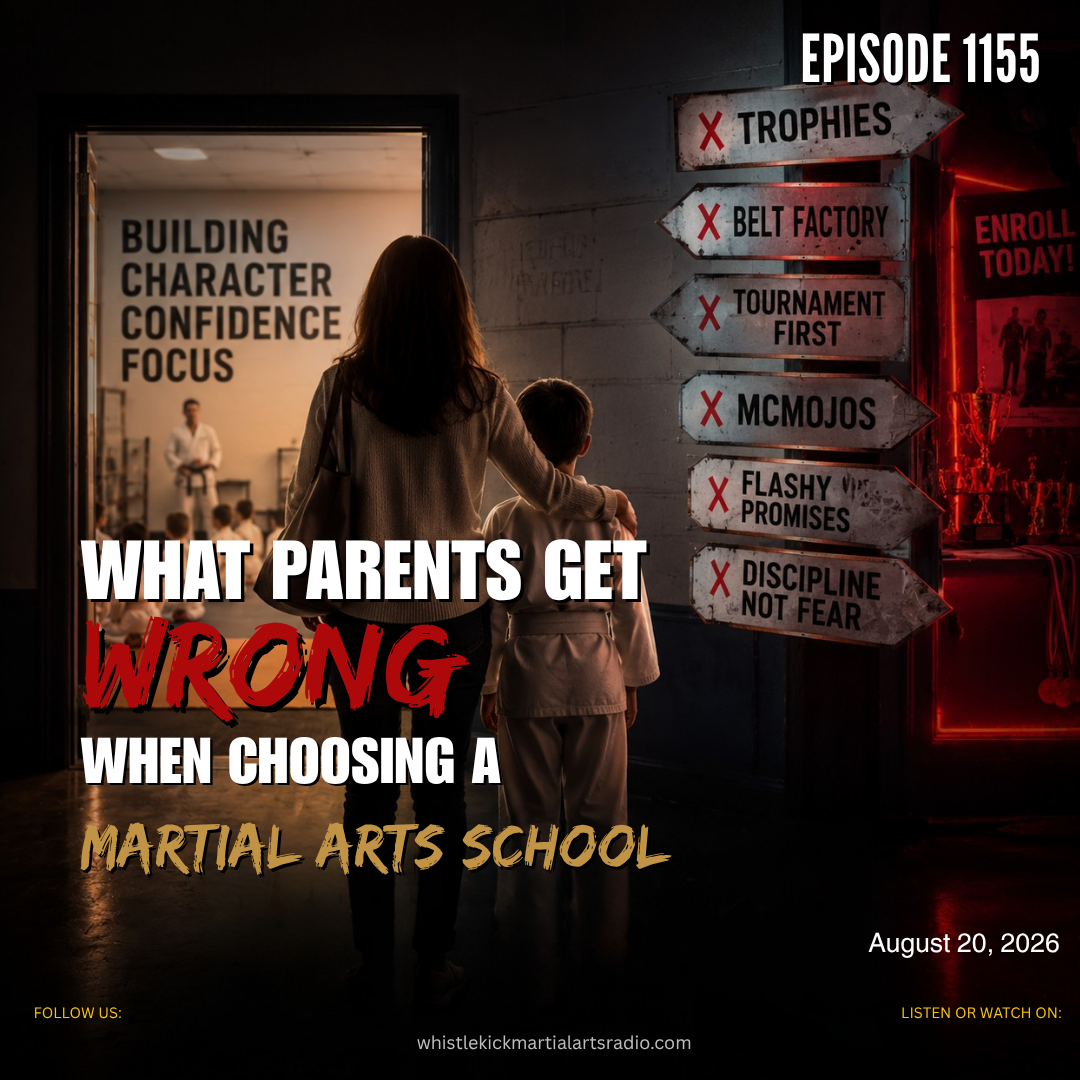
Jeremy and Andrew discuss the different things that parents should consider when choosing a school for their child, and how school owners can better address some of those things.
What Parents Get Wrong When Choosing a Martial Arts School - Episode 1155
SUMMARY
In this episode of Whistlekick Martial Arts Radio, hosts Jeremy Lesniak and Andrew Adams discuss the common mistakes parents make when choosing a martial arts school for their children. They emphasize the importance of considering factors beyond convenience, such as school culture, instructor quality, and the fit for the child. The conversation also highlights the need for fun in classes, the significance of long-term progress over short-term results, and the questions parents should ask when evaluating schools. The hosts encourage martial arts instructors to set clear expectations for both students and parents to foster a successful training environment.
TAKEAWAYS
Parents often choose the first school they see without proper research.
Logistics should not be the only factor in choosing a school.
The fit between the child and the school is crucial for engagement.
Classes must be fun to keep kids coming back.
School culture significantly impacts student experience.
Instructor quality varies; not all instructors are equally effective.
Short-term results can help maintain student interest.
Parents should ask about how disruptions are handled in class.
Clear expectations for students and parents are essential for success.
Long-term growth is more important than immediate results.
CHAPTERS
00:00 Introduction
01:54 Choosing the Right Martial Arts School
05:10 Understanding Fit and Engagement
08:03 The Importance of Fun in Martial Arts
11:08 School Culture and Instructor Quality
14:02 Short-Term Results vs. Long-Term Progress
17:02 Questions Parents Should Ask
19:58 Handling Disruptions and Expectations
23:00 Setting Expectations for Success
Join our EXCLUSIVE newsletter to get notified of each episode as it comes out!
Subscribe — whistlekick Martial Arts Radio
After listening to the episode, it would be exciting for us to know your thoughts about it.
SHOW TRANSCRIPT
Jeremy (01:12.206)
What's going on, everybody? Welcome to Whistlekick Martial Arts Radio, the world's number one traditional martial arts podcast, brought to you twice a week by Whistlekick. Little little project I started a while ago. My name's Jeremy Lesniak, and I am joined by my great friend Andrew Adams, who wears a whole bunch of hats, which is funny because neither of us has any hair. Andrew, how are you today, buddy?
Andrew Adams (01:37.542)
I'm great, I'm great.
Jeremy (01:41.372)
it's a good day because we get to talk about martial arts, and that is the beauty of martial arts radio. I think that's why we're successful because we love talking about martial arts, and so many of you also love talking about martial arts. And you you might not know this, but you can talk. You can talk during this episode. You can talk as loudly as you want, at least from our perspective. We're not gonna hear you. But you can still talk, you can still chime in.
And if you actually want to chime in, the best thing to do is go to the Facebook page martial arts radio. If you're not a Facebook person or maybe you want to share your thoughts privately, email us, Jeremy at or Andrew at whistlekick.com.
And I hope you do, because these episodes are better with you. We are we are committed. There's the good there's the word I was looking for to bringing you content every week that helps you deepen your experience and connection to your martial arts training. And the more we hear from you, the more you become part of the conversation, the better a job we can do. And on today's episode, we're talking about what parents get wrong.
when choosing a martial arts school. So Andrew, let's let's let's start. Let's start with the first one. What do you think the first, what would you say is the first thing that parents get wrong when they're choosing a martial arts school, obviously for their children, because we said they're parents. So we're not talking about their own training.
Andrew Adams (02:54.568)
Mm.
Andrew Adams (03:09.329)
Yeah. Yeah, yeah. So I think what parents get wrong, one of the things is that they just go to the first school that they see and think, no, they're all the same. This one is is close, it's convenient, that's this is the one I'm gonna go to. they're not I this is the one that I'm going to send my child to.
Jeremy (03:18.647)
Mm.
Jeremy (03:28.737)
Yep. They make it about them and logistics. Now, admittedly, that has to play a role. If the bright school, if the best choice for your kid is a four-hour drive, you're probably not gonna make that work. Logistically, that's that's as close to impossible, I think, as we're gonna get.
Andrew Adams (03:32.681)
Mm-hmm.
Jeremy (03:52.194)
But we do have to consider beyond logistics. We have to consider culture. We have to consider goals. Here's a great example. Our youth class is ages six to eleven. Most of our youth are in the six to eight-year-old range. We had a dad bring his 11-year-old. 11-year-old I walked in, went, walked right out. Dad was like, where are you going?
Kid walked right out to the parking lot. He barely, I don't think he got more than three steps in. Why? Because on that particular day, we didn't even have anybody over nine. We we have some older students. They just weren't there yet. And some of them were out that day. So he didn't look like a fit. Wasn't a fit. Now, dad could have forced him. We ultimately found a way. He's in the family class where he's around adults and kids, and that's so that's worked well.
But put that aside, the fit matters. Because if the kid doesn't fit, they're not going to be engaged. They're not going to learn as much. They're not going to be as committed. They're not going to get as much out of it. And if it's not a fit, they're going to quit.
Andrew Adams (05:08.327)
Yeah. Yep. And and you don't know what that is until you've you know until you try it out. But you know, the easiest school to attend is not necessarily going to be the best school for your for what you are looking for. And it might be, you don't know, but the the other analogy that I that I have brought up with parents before is that when you if you're if you need to buy a new car, do you go to the dealership, draw test drive one car, and that's the car you buy?
Jeremy (05:38.38)
Hopefully not.
Andrew Adams (05:39.23)
Typically not, right? You do research on looking at, I mean, at least in our family, we do research on looking online at different cars, seeing what this one had what features this one has, what features this other one has, you know, reading reviews from other drivers that have driven the car. We then we'll go to the dealership with a rough idea of what we're looking for, and we test drive a number of cars. Then we make a determination as to which one is the best one for our family.
So that that that's important.
Jeremy (06:11.597)
Right. Now, this is where one of my recommendations to to everyone, not that you know, the the percentage of non-martial artists that watch and listen to the show is very small. So we are we're not talking to the parents, we're talking to the martial artists, we're talking to the school owners. And our goal here is to give you information that helps you adjust your marketing and your conversations to hopefully get more students in and keep them longer. And one of the bits of advice that I think is a
Jeremy (06:44.293)
Making it easy for them to fill in the gaps of what they don't know. Now, maybe that's you're encouraging the parent and the child to come in and watch a class, or the parent to come watch a class and the child to try a class. Maybe you have trial classes that are relevant. Maybe depending on the child's needs, the parent needs to observe a class without the child. Because you know your program.
The parent knows the child. You don't know the child. They don't know the program. You've got to find some way for each of you to understand what you don't know yet.
Andrew Adams (07:18.396)
Exactly. Yep.
Andrew Adams (07:25.223)
Yeah. Yep. And and I would say that with rare exception, the child doesn't need to s to know the like the the parent needs to know the program, understand what it is you're doing. The child usually doesn't, right? They're the child is going because they want to do it, but they don't know what it is in most cases.
Jeremy (07:49.002)
And this this is where we end up in this really delicate subject around motivations. Why do kids want to do anything because it's fun?
I know very, very few kids who
Are willing to do very hard things simply for the delayed gratification result.
Andrew Adams (08:20.807)
Hm. Good point.
Jeremy (08:22.977)
that's part of our job as adults is to push them to to sometimes mandate what they do.
Brushing your teeth. I don't know a single child that, unless they are conditioned to brush their teeth, will wake up one day and say, you know, I want to brush my teeth. I'm going to start brushing my teeth. I know plenty of households where getting your kid to brush their teeth is is an argument. I'm I'm thinking of a child now who will put in more time and energy faking brushing their teeth than actually brushing their teeth.
Right? It's it's crazy to me, but I'm also not a kid. And so when we look at this in the context of martial arts, the classes have to be fun, but we have to make sure that there's some substance.
Andrew Adams (09:19.411)
Exactly.
Jeremy (09:21.943)
But that's subjective, isn't it?
Andrew Adams (09:23.721)
It it is, it is, absolutely. You know, a class that looks fun is not automatically a class that's gonna teach your child, might not be a class that teach your child what you want them to learn.
Jeremy (09:39.266)
And you and I actually, I'm sure you'll remember this. You and I had a conversation with someone, someone who's been on the show, someone who I think we both respect very much about the place of fun in youth classes. And this is this goes back to someone who I tried to get on the show and he he wouldn't do it. But he and I had a conversation because his classes were much more fun forward for his kids. I mean, it was dramatic.
Difference between his kids' classes and adult classes. And I asked him, I was like, I I I don't know how to say this in a in a nice way, but we're friends and you're awfully loose with your kids and your adults. You're much more strict, like, what's going on? He's like, If they're not here, I can't teach them. And so he found a way to create a culture in each of his class age breakdowns that worked for those groups. And he was actually quite successful for a long time.
you know, this was some pandemic era stuff that that took him out.
Jeremy (10:45.357)
But if it's not fun, they're not gonna show up. There has to be enough fun that the kids show up and they want to come back, but there has to be enough substance that over time they feel, I I think they need to feel accomplished in their progress. And the adults also need to notice that.
Andrew Adams (11:07.784)
Hmm. Yeah, that's a good point.
Jeremy (11:16.181)
That leads into some culture stuff. And I don't know, how how important do you think the culture of a school is?
Andrew Adams (11:26.632)
The culture of the school. I think it's immensely important. I I mean, in fact, I would go so far as to say it's one of the most important things.
Jeremy (11:28.332)
Yeah.
Jeremy (11:37.429)
What why why is that?
Andrew Adams (11:39.261)
because the culture of your school will dictate what your students feel about the school and how they relate to others their thoughts on the school. And I think it's really important to work to have the culture that you want. And we've talked about this a lot on the show that if you don't work to cultivate the culture that you want, a culture will happen whether you want it or not. And if you don't have control over it, it's
could very easily become a bad culture and that could hurt you. So I I think your culture of your school is very, very important.
Jeremy (12:17.901)
Yeah, I I would agree. And kind of hand in hand with that is
The instructor quality, right? Not all instructors are created equal. All instructors are not great. They can't be. Half of instructors are below average, right? That doesn't, however, mean that they can't do an adequate job for your child.
Jeremy (12:51.411)
If you are an instructor that knows you're not a great instructor, I'm okay with kids. I'm very aware. I am not great at working with kids. I think I'm pretty good working with adults. But when it's my days for the kids' class, I'm I'm still learning. Does that mean that I can't help a parent's children move forward? Of course not. Why? Because my
Andrew Adams (13:18.281)
Yeah.
Jeremy (13:20.841)
my primary goal is helping them get better. And because that's where my my my focus is set, I find a way.
Andrew Adams (13:33.246)
Yeah, and and we've done episodes on, you know, how what makes a good instructor, so I would encourage you to go back. I'm I'm a link it in the show notes. I don't remember the numbers off the top of my head, but you know, I think the instructor quality is important for sure. and you wanna keep that in mind as well. And that's all.
Jeremy (13:54.241)
Yeah. Absolutely.
I I think one of the other places that you know, I'm looking at our outline here that we need to chat about is
short-term results versus long-term progress. You know, it and and this is a double-edged sword because again, in the same way that kids need to have fun in class, yes, even if it's at the expense of technical progress.
'Cause otherwise they're not there. Adults need to be able to see progress.
Even if it does not perfectly align with long-term growth. Because we are talking about a demographic of people who don't understand what we do. The whole premise of this episode is that parents are choosing the wrong schools because they have the false understanding of some of the realities of what we do. But you can't stuff information into their brain.
Andrew Adams (14:44.361)
Mm-hmm.
Jeremy (15:02.145)
And if they show up asking you questions about your school and you just yell at them about why they're wrong, right, that school's not gonna last very long. So we have to meet them where they're at. That's part of being an instructor. We meet our students where they're at. We have to meet the parents where they're at as well. And that means maybe we're putting stripes on their belt if you didn't want, even if you didn't want to. Maybe it means you're doing other
Andrew Adams (15:07.293)
Yeah.
Jeremy (15:31.528)
recognition elements.
Maybe you have to take a step out of what you think of as real training.
To help kids be kids and
Show some compassion.
Andrew Adams (15:50.601)
Yeah. Yep. And I think that that you as a school instructor should want your students to have long term growth. Right. You and not just from a financial standpoint, I I think that's the furthest from, but you know, you want these students to continue to grow and get better, and that means keeping them engaged, keeping them involved.
You can't like you already said, you can't teach a student that's not there.
Jeremy (16:25.469)
Now that we've kind of beat up this topic, let's let's talk about questions that parents should be asking. Now, obviously, this episode is unlikely to make it to the parents. So we're doing this in the hopes that you can preempt these questions in some of your marketing. Maybe you have an FAQ section on your website and you can have, you know, the questions and the answers and you can help them. that is a good question. this is the answer, right?
Andrew Adams (16:53.162)
Mm-hmm.
Jeremy (16:55.115)
So Andrew, what's what's the first question you've been training a while. Let's say you woke up tomorrow with a seven year old and you were gonna enroll them in martial arts and for whatever reason it wasn't going to be where you train or anywhere that you knew that that you okay, you wake up with a seven year old and you're living in
Andrew Adams (17:16.394)
Timbuktu.
Jeremy (17:18.101)
Sure, Timbuktu, great. You're in Timbuktu. You have a seven year old, and you're not gonna be training because you're the new king of Tim. I don't know, my metaphor is falling apart. What are the questions you're gonna ask as you evaluate martial arts schools?
Andrew Adams (17:35.253)
So one of the questions I would ask is how long has the school been open? Like how long if you not that there's anything wrong with schools that opened last week, but if you have a martial arts school that has been around and in the same town for thirty-five years, they've been doing something right.
Jeremy (17:42.379)
Why is that an important question?
Andrew Adams (18:02.822)
If because if they were doing something wrong, one would think other parents would have no longer had their children train there, or adults wouldn't train there anymore, and the martial arts school would go out of business. So that's not to say a school that has been around for a long time is going to be a great school because what you're looking for might be not be what they offer, but I think it's important to understand.
Jeremy (18:02.935)
Yes.
Andrew Adams (18:28.968)
We've been around teaching in this in this town for thirty five years. That's that says a lot.
Jeremy (18:33.229)
Yeah. A longstanding school is a green flag, but a not longstanding school is not necessarily a red flag. In fact, it's not a red flag. There may be other red flags. One of the questions that that I would ask if I was in a similar situation would be what kind of students do best in your program? And what kind have the hardest, you know, what what personality types have the hardest time? Because not every school is a good fit for every student.
Andrew Adams (19:03.112)
Yep. Yep.
Jeremy (19:03.883)
And that's okay. And knowing what your strengths are, what kind of students you do best with, is pretty important. If your school specializes in work helping kids who are already really focused and disciplined go to that next level, it's okay to be honest about it.
Andrew Adams (19:29.994)
Mm-hmm, mm-hmm.
Jeremy (19:33.087)
If you specialize in
more free form, you you play more martial arts adjacent games, and the martial impact of your six to eight year old class is pretty minimal. It's okay to say that. The goal the goal of our six to eight year old program or our three to five year old program is teaching them to pay attention so when they age up into the next program, we can actually teach them martial arts. Right? There are schools that do it that way. Nothing wrong with it.
Be honest about it.
Andrew Adams (20:08.606)
Yep. Yep. I think another interesting question that you might want to consider asking, I had on the tip of my tongue just a second, I was like, I gotta remember this. And and I forgot what it was, but it was a good one. It was a good one. It was
Jeremy (20:27.511)
Does it have to do with what's expected of the students?
Andrew Adams (20:31.081)
No.
Jeremy (20:32.493)
Because I I think there's something in there. The w what do you expect of of your students? And that that's a broad question. We, you know, that could involve uniforms, that could involve competitions, that could involve social events, that could involve the number of classes per week that they're training. There's a whole bunch in there because let's face it, every instructor has expectations. Even if it's as simple as, I want you to show up.
Andrew Adams (20:58.782)
Mm.
Jeremy (21:02.419)
On time, as often as you can.
Andrew Adams (21:04.84)
Yep. Yep. So I remember I remembered my question. and I wrote it down in case you kept talking and I got it again. a question that I don't think is asked, but I think as a parent is very important is how do you handle disruptions in your class? Now granted there are lots of different kinds of disruptions and they'll be handled differently, but I think as a general
Jeremy (21:08.673)
I knew if I talked long enough you would.
Fantastic.
Andrew Adams (21:32.538)
understanding of how they handle those types of you know, whatever those types of disruptions are, but understanding how they handle disruptions I think is an important question to ask to understand their teaching methodology.
Jeremy (21:47.119)
I agree. And kind of along the lines of that, what is expected of parents to do and not to do? So I'm thinking of parents who get really involved in their their child's progress and they're coaching them at home and they're mandating practice time. And sometimes to the detriment of the student's passion.
Andrew Adams (21:53.14)
Mm-hmm.
Jeremy (22:15.21)
Sometimes those same parents sit on the side and they are correcting and they're interfering in the class. And this is where where I've advocated in those environments a parents contract.
Andrew Adams (22:21.502)
Mm-hmm, mm-hmm.
Jeremy (22:34.53)
I, mom or dad, will silently watch classes, not steal focus from the instructor's efforts. If I'm gonna take pictures, they're going to be quiet and not disruptive, right? Like whatever the things are. Because most of the time, the parent is a problem, not because they want to be a problem, but because they're bringing their
Andrew Adams (22:51.369)
Yeah, yeah.
Jeremy (23:02.356)
false understanding into the training environment. They're handling their child the way they would handle their child out there. Because let's face it, how many environments are there where the child is able to receive discipline? So the parent is used to, okay, if I'm around, I have to be the disciplinarian. Not in most martial arts classes.
Andrew Adams (23:15.476)
Mm-hmm. Mm-hmm.
Andrew Adams (23:22.75)
Yeah. Yep. I think another question is how do you, the martial arts school, how do you transition a student from one class to another class? Like let's say you've got a six to ten year old class and then an eleven to what fifteen year old, whatever. Like how do you get how do you transition those students and is it a hard and fast rule? Is it, you know, you're you're I know ten year olds that are larger than fifteen year olds.
Jeremy (23:32.451)
Mm-hmm.
Andrew Adams (23:51.134)
You know, how hard and fast is your cutoff for these classes? I think that's another really important question to ask.
Jeremy (24:00.227)
And I think all of these, and we can we can kind of wrap this here, it has to do with helping everybody understand what success looks like. If you want a successful martial arts program, you have to make sure that the the children, we're talking about kids here, know what success looks like. What do you want of them? And you've got to meet them where they're at. They've got to understand.
If you tell them I want you to train two hours a day at home, that's not gonna happen if they're seven. It's not gonna happen if they're any age, but it's really not gonna happen if they're seven. But if you give them one thing to do between now and the next class, they might do it. If that thing takes two or three minutes, I want you to do this new form that we just learned two times between now and when you come back. That has a much better chance of happening than requiring eight hours of home training.
Andrew Adams (24:57.758)
Yeah. Yep. I I I tell my students for fun and I and I it this is a this we're talking drumming students, but it correlates 'cause it's still practice. I ask them how often they sh they think they should practice. Or how often do you think I'm gonna tell you you need to practice? And ever all of the kids usually say, Well, I have to practice every day and I tell them you don't have to practice every day.
You only have to practice on the days that you eat.
And then I gauge their face to see if they get the joke or not. And then I tell them that if they don't want to practice tomorrow, that's okay. Don't have breakfast, lunch, or dinner. But at three o'clock in the afternoon, when they're jonesing for a granola bar, they just might have to practice. But then I then I let them know, like obviously I'm kidding, but five to ten minutes of practice a day means more, in my opinion, than practicing for an hour on Friday.
Jeremy (25:59.107)
I agree. I agree. So setting those expectations with the students and with the parents goes a long way. It really does. And one of the things that I I tell parents is look, the number one thing we need is for you to get the kids here on time consistently. If you can do that, we can teach your kid. If you can't do that, we can't teach your kid. We cannot help your kid progress. And I think that
There are parents who treat, and and and I know a lot of you out there are frustrated at this. You feel like after school daycare. That your parents drop the kids off five to ten minutes late all the time, and you know, they pick them up late, and they're not engaged in what's going on with but you know what? The kid's still there. You still have an opportunity, and you don't know.
What else is going on in these people's lives? Don't underestimate the value of what you have to offer and how it may impact this person long term. If you only evaluate on short-term progress, you are likely to remain frustrated by your children's class. You have to look at that long-term progress. You have to look at that how what you share with them.
Andrew Adams (27:10.941)
Absolutely.
Jeremy (27:27.672)
Helps them in life. And you're probably not going to hear from most of them. You're probably not gonna get a postcard after the kids' college graduation, where mom and dad say, you know, thanks to you, they were more disciplined and homework was easier and they were able to go to a better school. And now they've graduated with this offer from this company. And, you know, we owe some of that to you. You're probably not gonna hear that. But that doesn't mean it's not happening.
Andrew Adams (27:53.353)
Mm-hmm.
Yeah. And it doesn't mean it's not true.
Jeremy (28:00.333)
If there are other things that we've missed, I really do hope that you will post them in the Facebook page, Martial Arts Radio. That's for everyone to see. Of course, if it's easier for you or you want to share privately, you can reach out to either of us, Jeremy at Andrew at Whistlekick.com. This is episode 1155. You got lots of material to go back on over more than a decade. And we're going to keep doing these for you. So if you have a guest or a topic suggestion, don't be afraid to email us with either. There's also a form at
Whistlekick martial arts radio dot com. You can fill it over there. Code podcast fifteen to save s fifteen percent on some gear or a shirt or most of the events you can't use the discounts because the prices are are pretty the margins are pretty tight, but there's a lot over there.
Andrew Adams (28:45.041)
Or most of or most of the events are free, so
Jeremy (28:48.578)
That's true. Most events are free and most of the things that we do in conjunction with events, the margins are really small. So we don't we don't have discounts set up on those. But lots of ways to help us out, lots of ways to support this podcast and this organization that is here strictly to support you and your training efforts.
And that brings us to the end. So until next time.
Andrew Adams (29:11.605)
Train hard.
Jeremy (29:13.293)
Smile. And have a great day.