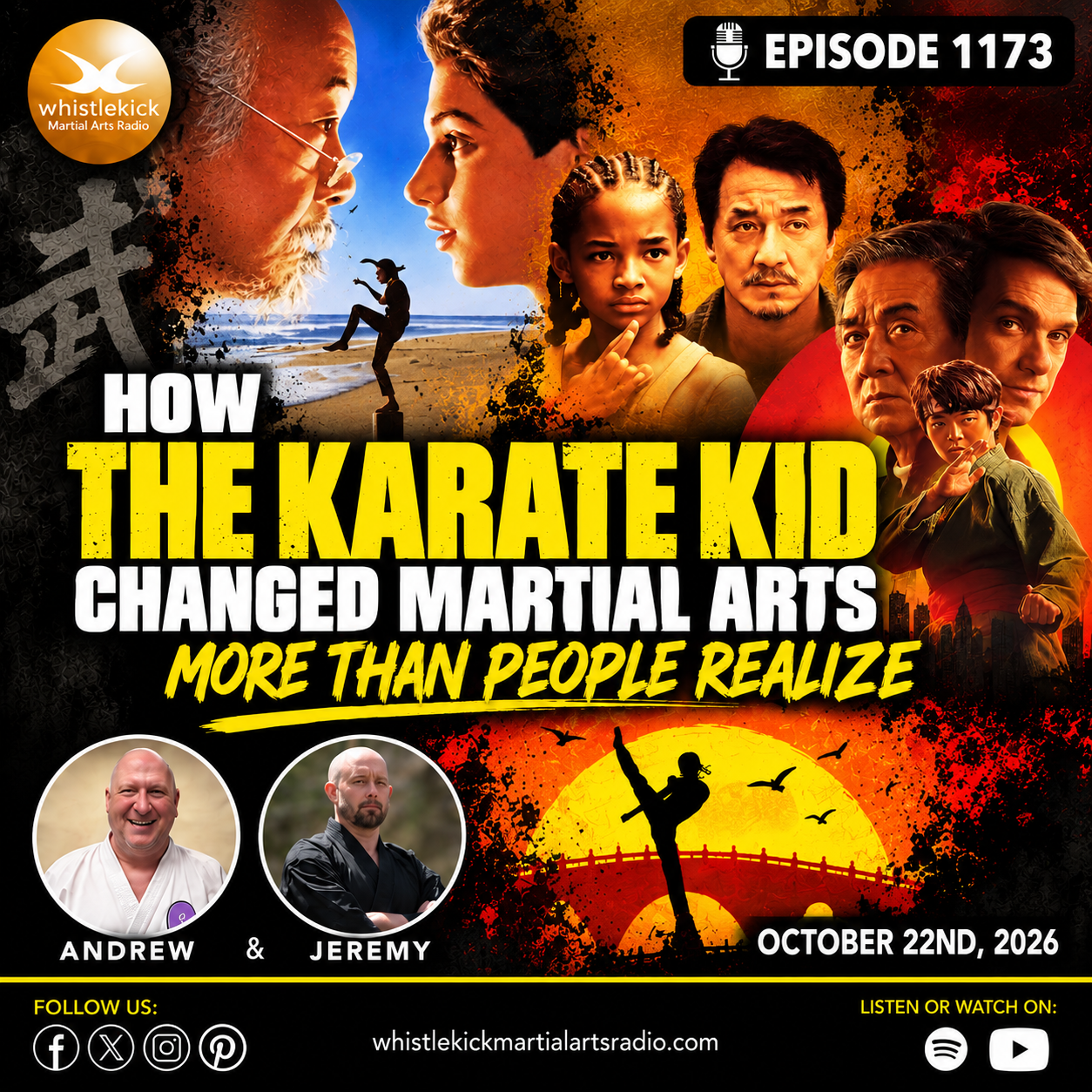
Today, Jeremy and Andrew discuss the Karate Kid and how it changed martial arts, perhaps more than people realize it did.
How The Karate Kid Changed Martial Arts More Than People Realize - Episode 1173
SUMMARY
This conversation explores the profound impact of the Karate Kid on martial arts and pop culture. Jeremy and Andrew discuss how the film shaped public perceptions of martial arts, the unrealistic expectations it created, and the significance of characters like Mr. Miyagi. They also delve into the modern interpretation of martial arts through the lens of Cobra Kai, examining the evolution of martial arts instruction and the relationship between students and instructors.
TAKEAWAYS
The Karate Kid significantly influenced public perception of martial arts.
Mr. Miyagi represents an idealized martial arts instructor.
The film created unrealistic expectations about learning martial arts quickly.
Cobra Kai offers a more nuanced view of martial arts instruction.
The relationship between instructors and students is crucial in martial arts.
Martial arts techniques in the film were surprisingly accurate.
The cultural significance of the Karate Kid extends beyond the original movie.
The underdog theme resonates strongly with audiences.
Martial arts schools vary widely in teaching styles and philosophies.
The legacy of the Karate Kid continues to shape martial arts today.
CHAPTERS
00:00 Introduction to the Karate Kid's Impact
03:02 Cultural Significance of Martial Arts in Pop Culture
06:01 Lessons Learned from the Karate Kid
09:13 Expectations vs. Reality in Martial Arts Training
12:07 The Role of Mr. Miyagi as a Martial Arts Instructor
15:03 Cobra Kai: A Modern Perspective on Martial Arts
18:01 The Realism of Martial Arts Techniques in Film
21:01 The Relationship Between Instructors and Students
23:57 What the Karate Kid Got Right and Wrong
27:06 The Future of Martial Arts in Film
Join our EXCLUSIVE newsletter to get notified of each episode as it comes out!
Subscribe — whistlekick Martial Arts Radio
After listening to the episode, it would be exciting for us to know your thoughts about it.
SHOW TRANSCRIPT
Jeremy (00:33.42)
Hey, what's going on, everybody? Welcome or back to another episode of Whistlekick Martial Arts Radio, the world's top-ranked traditional martial arts podcast. Now in our 1100th year. Not just 11th year. 11th year? I don't know. We've been doing this a while. And that's why there are so many episodes. And we still come up with fun new stuff to talk about. Like today's topic, how the Karate Kid changed martial arts even more than people.
Realize. My name's Jeremy Lesniak, founder here at Whistlekick, joined by good old Andrew Adams. Hey Andrew. Nope, that's why I said all.
Andrew Adams (01:15.924)
Are you calling me old?
O-L-E, okay, that's not old. Okay, good.
Jeremy (01:22.058)
Or or OL apostrophe.
Jeremy (01:27.234)
Good all.
Andrew Adams (01:28.904)
think it's OLE. Ye olde. Yeah, I don't know. Who knows? Doesn't matter. I'm old. Whatever.
Jeremy (01:33.898)
Anyways, you're not old because if you're old I'm right behind you and I'm not ready to be old. And so there we are. But you're still good and I'm glad you're here.
Andrew Adams (01:37.3)
You
Andrew Adams (01:44.402)
Yeah. And I'm still in Radams.
Jeremy (01:47.202)
You are still at you atoms. And I'm glad that all of you are out there watching, listening, whenever you are. We do these shows twice a week because we love martial arts and we want you to think about martial arts and train martial arts. And we're giving you material to to fill in in between training and maybe to get you to think about your training a little bit different. Or as some of you email me about from time to time.
to get you to resume training. That every time I get one of those emails, it really warms my heart. It's it's truly the best part of my day when I get those emails. So if anybody out there has started training because of martial arts radio, I hope you will email me and tell me that.
If you want notes, whistlekick marshalarts radio.com. If you want all the stuff that we do, events, products, you name it, whistlekick.com. All right, Andrew, karate kid. I think if if we were to make yeah, right? If we were to make a hierarchy of the most influential pop culture material.
Andrew Adams (02:47.027)
Thank you.
Jeremy (03:02.765)
From general pop culture and its impact on into and out of martial arts. I think we would collectively put Bruce Lee's material at number one. And then we could make an argument about Ninja Turtles and Karate Kid for second and third. Would you agree?
Andrew Adams (03:23.027)
Yeah, absolutely. I was going to say, was not going to rank them per se, but I would have said in the top five in the world, would have put Bruce Lee's stuff would have been in there, Ninja Turtles, Karate Kid, probably Chuck Norris as well. They're the biggest, I think, cultural things that we have, martial art-wise.
Jeremy (03:48.738)
Yeah. Yeah. And and I think, you know, when you when you look back at our decade plus of interviews, when you look at what people what interview guests say as the reason for them to start training, it is overwhelmingly Bruce Lee. And then we'd have to go back and and dig in. But second and third are Ninja Turtles.
And Karate Kid and the derivatives of Karate Kid. And that's what we're going to talk about today, because Karate Kid wasn't a single movie in was that '83? '84, thank you. A single movie in 1984. There were four original movies. Some people won't claim the fourth one, that's fine. And then we've got the fifth movie, the sort of reboot, and Cobra Kai, and all of the other things.
Andrew Adams (04:24.859)
84, I believe.
Jeremy (04:45.899)
And we're gonna talk about all of them today because they changed martial arts. They changed what people expect in martial arts, they changed what non-martial artists think of martial arts. It is still, many years later, an incredibly recognizable piece of hulture, because we're we're we're speaking of it collectively beyond the first movie. I don't want to call it just cinema because it's more than just that first movie.
And so that's that's where we're going today.
Andrew Adams (05:16.871)
Yeah, yeah, I think it was one of the first things that was enjoyed by non-marshall artists. That's what made it so popular.
Jeremy (05:24.725)
Yeah.
Jeremy (05:28.481)
Yeah, and and so anytime you're talking about non-martial artists experiencing something that at least is purported to be martial arts, they're gonna come away with thoughts, opinions of it. What what was it that the Karate Kid taught the general public about martial arts?
Jeremy (05:49.193)
Yeah, yeah. I I'm asking you, what what what would you say non martial artists learned about martial arts from the Karate Kid?
Andrew Adams (05:57.269)
that there are only two kinds of schools, really, really like mean schools and like private one-on-one schools. And that all good martial arts teachers need to be like Mr. Miyagi.
Jeremy (06:01.575)
No, no.
Mm.
Jeremy (06:14.295)
Yeah. How how many of us still, decades later, after maybe seeing the first movie, romanticize that one-on-one martial arts instructor relationship? It it's it still happens. How many martial arts in martial artists look at any manner of commercial school as inappropriate?
How much of that roots back to karate kid? I don't know how much, but some, that's important.
I think too, we can say that the general public learned or believes that traditional martial arts is
Far easier to gain enough skill to
Overcome a dramatically larger opponent than is than is real. Right? In in most traditional martial arts schools, we talk about, you know, if you're attacked by a larger person, which you're probably going to be attacked by a larger person, because it probably won't be a smaller person. But in in and it's not this isn't just karate kid, but because karate kid was enjoyed by so many non-martial artists, this is an important thing to bring up.
Jeremy (07:43.766)
Well, if you train for, you know, a few weeks to months, which seems to be a recurring theme within all of the karate kid material. no, I have a competition or a confrontation upcoming, you know, tomorrow. Let me cram for this exam and I will be able to apply, you know, a couple techniques and overcome.
Andrew Adams (08:04.296)
Yeah.
Jeremy (08:15.745)
That was st that
That theme was so commonly received from the first movie that we've got the crane kick. I don't know about you, but when I was a kid, God, even be even after college, so we're talking, you know, twenty years after the movie comes out, when people found out I did martial arts, they would, you know, they would show me a crane kick.
Andrew Adams (08:44.595)
Yeah. Yeah. Yeah. I think it's one of the unrealistic expectations that Mr. Miyagi created for the viewing public that the expectation was you can learn karate in a couple of months and be ready to fight in the black belt division in a karate tournament. And I think, I think that it has some part to play in schools
advertising how quickly you can get a black belt. And I'm not saying that that's good or bad, but I think there was this perception amongst the general public that you should be able to get it quickly. so schools started using that as a hook and a marketing ploy as to how quickly you can get your black belt.
Jeremy (09:17.181)
Mm.
Jeremy (09:33.175)
Yeah.
Jeremy (09:38.837)
Yeah, it I I I would I would agree.
there there's a very complex relationship in the karate kid universe with rank, you know, just like there's a complex relationship with rank outside of the Karate Kid universe, right?
Andrew Adams (09:55.411)
Sure. Yeah, I was gonna say it doesn't have to be a karate kid.
Jeremy (10:01.121)
But what we see time and again are white belts with what seems to be high-level skill, or what we are taught to believe is high-level skill, executing technique with force on other people. I don't know very many schools that have white belts act like the white belts within the Karate Kid universe and
You know, I I don't I don't know how many
Jeremy (10:34.195)
I I think I think collectively Karate Kid has brought more people into martial arts, but I've got to imagine there are people that have watched and said, If this is what a martial arts class is, I don't wanna do this. I don't wanna get the snot beat out of me on day two.
Andrew Adams (10:49.8)
Yeah. Yeah. And it's, it's, I would have to go back and watch the movie because it has been a number of years since I've seen it. But I, if I'm remembering correctly, when they go to the Cobra Kai dojo in the movie, I'm talking the first movie, the first class that Daniel walks into, everybody, there's a black belt.
Jeremy (11:14.623)
I do like that sounds familiar. Yeah.
Andrew Adams (11:17.256)
You know, everybody in that class was a black belt and Daniel's walking in having done a couple of months at the Y before he like in New Jersey, before he moved to Recita and the tournament is only in a couple of months and he's fighting all these black belts in just a couple of months.
Jeremy (11:36.782)
Yeah. Yeah. It's you know, it's it's not the the job of Karate Kid, the writers, anybody to put out accurate information about martial arts. It's up to us as an industry. And the fact that Karate Kid has been so powerful does suggest that maybe we all need to do a better job about
communicating reality. Right?
There are pl it because the counterexample here is if you look at a lot of other kind of niche industry movies, we know they're not true. Right? You look at you look at movies about, you know, what's a good subject that more people would know.
Jeremy (12:38.38)
No, I I
Every example of it.
The examples I can think of are not necessarily are not universal. You know, I can watch movies about race cars and say, you know, here are the places that it's not accurate. But if you showed me a movie about I don't know,
High-end cooking, you know, be being in a a fancy restaurant, I wouldn't know what that was like. But people aren't signing their children up to go cook in a high-end restaurant. People are signing themselves and their kids up for martial arts. So we we just we need to take some responsibility. You brought up Mr. Miyagi and and and we talked about maybe the realistic or unrealistic expectations that that character lays out for.
For so many of us, you know, where where did that go right and wrong?
Andrew Adams (13:37.108)
So I think it went right in terms of letting.
the public understand that not all martial arts instructors are the same, right? Not all martial arts instructors are going to be like John Kreese or Terry Silver, right? But, and he was very empathetic and gave his attention to his student, which is, those are all really good things. So, I mean, I think
Jeremy (13:54.231)
Mm.
Andrew Adams (14:08.73)
as an instructor, and I'm trying specifically to stay away from what he was teaching for a second to really stick to who he was as a teacher. But I thought it did a good job of of that, of showing that, you know, this is a type of teacher that can be really good for students. Empathetic understanding. You know, can be more than just a teacher, can be your friend and someone that you can count on.
Jeremy (14:27.253)
Mm.
Jeremy (14:35.627)
Yeah. W what I what I wish happened, and and this is just the nature of TV and movies, that we end up with these strong polarities. But what I wish we had was three or four different instructors to show that it's not this black or white binary choice between the calm, wasn't always calm, but generally calm, one-on-one, family style kind of.
What I think a lot of us consider old school martial arts instruction and large commercial aggressive, even violent martial arts environment, martial arts instructor, because those are extreme versions that very, very few of exist. And unless you're actively hunting them down and willing to travel, you're not going to find them.
For for all for the and and this isn't typically our audience, but there are plenty of places out there who want to claim that, you know, every school around them is a McDojo and that they're all John Creese and you know they're all violent and everything, you know, be except for them. You know, and that's that's not the reality. But if we had one or two others to mark out not a not a binary but a continuum, I think that would have been would have been helpful. And unfortunately
when we when we kind of fast forward time wise and we look at Cobra High, we s we started to get that.
Andrew Adams (16:06.546)
Yeah, that's what I was going to bring up that in the later seasons of Cobra Kai, definitely became, you know, with with Daniel and Johnny and Cho-Sen kind of all teaching together, it became a little more realistic.
Jeremy (16:26.573)
Yeah, I think there there are plenty of problems in there as well. But but you know, having having that contrast I think is really really helpful.
Andrew Adams (16:29.204)
Yep, yep.
Jeremy (16:41.013)
I don't think there are too many people these days that walk into a school for the first time and think it's going to be Mr. Miyagi.
Jeremy (16:53.655)
But I do think, and I, you know, I wasn't around, so I don't know. But we often see there are these memes that pop up, and martial arts instructors say, you know, you hear all the things that I am as a person. I'm a life coach, I'm a fitness coach, I'm a this, I'm a that. And it's not just I teach martial arts, it's a very long list. And I'm going to.
You know, I don't know if Mr. Miyagi was the first time that the the general population saw that.
Jeremy (17:32.665)
w widely encompassing role, but I'm going to guess it's the it's the point where most the most people saw it for the first time. And I don't think that always serves us as an industry.
Andrew Adams (17:41.416)
Yeah.
No, I would definitely agree. Yeah.
Jeremy (17:48.822)
I'm a I'm a pretty good martial arts instructor. But some of the things that students have come to me for, I'm not nearly as good, definitely not as qualified, to help them with. I try because they ask.
Andrew Adams (18:01.908)
Yeah, yeah, and we've talked about this quite a bit on
Jeremy (18:07.552)
The earthquake.
Andrew Adams (18:09.004)
No, it was an earthquake. I hit it with my chair. In past episodes, both just you and I actually, we did an episode with Jerry DeSanto just a month or so ago. We talked about this exact thing that I consider myself a good martial arts instructor, but I can't help you fix your car. You're having car trouble? mean, it stinks that you're having car trouble, but I'm not the one that can help you with that. And we shouldn't.
Jeremy (18:10.411)
I know.
Jeremy (18:36.588)
Right.
Andrew Adams (18:38.042)
expect our instructors to be more than martial arts instructors.
Jeremy (18:48.417)
The movie the movie, you know, and then s you know, our our notes here really talk about Karate Kid as the first movie, but I think it's difficult to talk about the subject without thinking of it more as an umbrella. Because I think Cobra Kai had a not not not as large of an impact over the last few years as the the original cop Karate Kid movie.
But I think there's enough impact there that it would be silly for us to not talk about it. Maybe we need to do a sequel that talks more specifically about Kobakai. But for as many things as weren't maybe represented well, there are a bunch of things that were represented really, really well. And the one that comes to mind for me the most, and and this this occurs in I think almost every iteration.
In a variety of ways, some of which are not healthy, instructors taking a strong interest in the success of their students and wanting to see them succeed.
Andrew Adams (19:51.092)
Okay, yeah, I can see that
Jeremy (19:54.583)
You know, s s some of it's to just downright toxic.
But I think I I don't know that I have collectively engaged in any industry where my coaches, instructors, teachers had more genuine interest for how I was doing with the material in and outside of class than in martial arts.
Andrew Adams (20:23.988)
Yeah, okay, I hadn't thought of that but I see it I see it
Jeremy (20:33.185)
I've had martial arts instructors, plenty of them, come to, we'll call them extracurricular, come to tournaments, come to training events, come to seminars. Even if they weren't, you know, competing or teaching, sort of a thing. They came to support. And maybe they weren't just supporting me, they were supporting a bunch of us. I can't say how many of my
High school teachers went to my soccer games, or the only math teacher that ever went to math meets, yes, I'm I'm that kind of nerd. It was only the math teacher that was the coach, which is kind of a strange thing to have a coach for a math team. But anyway, you know, my my other math teachers weren't showing up to math meets. My, you know, humanities teachers weren't showing up to debate meets.
Andrew Adams (21:12.126)
Ha
Jeremy (21:32.171)
But my martial arts instructors show up to non-class martial arts things.
Andrew Adams (21:37.875)
Yeah. Interesting. And I wonder if that has more to do with martial arts is for most people an extracurricular and going to school and doing math is a requirement. Now, becoming a math lead and going to math competitions, that's not a requirement, but school math is an expectation and a required thing you have to do, whereas martial arts isn't. Maybe there's something
to be said there.
Jeremy (22:08.557)
Perhaps, perhaps I think regardless of the reasons, we see it. We see that passion that the instructors have in every iteration. And again, I'm not making excuses for the some of some of the rough spots that come through in in the Karate Kid universe, but we can't argue they care.
Andrew Adams (22:14.13)
Yeah. Yep.
Andrew Adams (22:32.806)
No, no, it's true. Now, let's talk about what the movie got right, like in terms of the martial arts and things that they were actually teaching. Let's delve a little bit into the actual art that they were teaching.
Jeremy (22:42.677)
Mm.
Jeremy (22:55.423)
When you look at what they do, and and my knowledge of this is I I would say I have the best I'm most comfortable saying this about the first movie because it's the one I've seen the most. I've seen I've seen the first Karate Kid movie probably consider time equal to all the other Karate Kid material. Like I've seen I've seen the first movie that many times.
Jeremy (23:19.497)
It's good and it's simple. It is very classic, basic.
Andrew Adams (23:22.196)
Mm-hmm.
Jeremy (23:28.939)
whatever art label we want to put on it, it's there and it's good. You see, you know, when you see Daniel throwing punches at a horse dance, it's a decent horse stance.
Andrew Adams (23:41.928)
Yep. Yep.
Jeremy (23:43.787)
His punches are good. He's pulling his hand back. It looks it It looks good. It looks a heck of a lot better than than
Jeremy (23:57.218)
than a lot of what you see in other material. I've never made that statement. I've never made the statement about the quality of technique coming out of, let's say, Power Rangers.
Andrew Adams (24:10.132)
Sure. Yep, that's fair. it's interesting as a sidebar that almost all, if not all, of the actors that did Power Rangers were all very well accomplished martial artists. Daniel Lawrence, Daniel Lawrence, no, LaRusso, combines Johnny Lawrence.
know, Ralph Macchio was not an accomplished martial artist. So that that's interesting. I would agree. The simplest the simplicity. There we go. Of what Mr. Miyagi was teaching in terms of martial art was really good. The I think a lot of the tradition, especially when you then get into the second movie where, you know, he has his home dojo in the backyard and Daniel comes in and the setup of it and.
Jeremy (24:43.245)
Right.
Andrew Adams (25:08.03)
having the past instructors slash family members on the wall. Some of the tradition and the cultural aspects I think they did a really good job of as well. And so I thought that was really cool in the third movie as well, like when they first introduced kata or forms, like it was an actual martial art form that you can learn and know from the Goju-Ru system.
Jeremy (25:33.826)
Yeah.
Andrew Adams (25:37.364)
And I thought that was cool as well that you could watch that and be like, you know, so for those that were in the know, it was like kind of an Easter egg for them, right?
Jeremy (25:46.135)
Yeah. Yeah, I I I think it did a
Jeremy (25:54.36)
good, at least passable job of representing some of the technical elements of what many of us train to say, I recognize that. Even if it's not a one for one, I I can see how they got there. I can s I see some of what I do in that. And that's cool.
And I think that that is part of the this the ability to point at what's going on on screen and say, I can see some of what I'm doing and what they're doing on screen is a massive piece of why it has made such an impact because you don't have to train for 20 years to see some of what you're doing in karate kid. You can train for two weeks and start to see some similarities.
Andrew Adams (26:38.344)
Yeah. Yep. Now, some of the other things I think that they got surprisingly right or mostly right is the Cobra Kai school itself. Like, I don't think there are lots of schools out there that have a John Kreese type of instructor, but in terms of a larger commercial school with lots of students all lined up in rank and teaching a class like Kreese did, not his ab-
Jeremy (26:49.557)
Mm.
Andrew Adams (27:06.324)
his mannerisms and the, know, strike first, strike hard, no mercy. Like I'm not talking that, but in terms of a large school, large organization with lots of people in the room and there's a guy at the front and he's yelling out what to do and they do it and he yells out the next thing and they do it. Like that's also pretty realistic to a lot of schools.
Jeremy (27:26.475)
Yeah. They would agree.
Jeremy (27:35.373)
We talked a little bit about this and and I'll ask it because it's in our our notes here. Was there anything else that we want to add to the list of stuff that it got wrong? That it distorted, it simplified. I I I think that we talked about it earlier. The big one for me is how dangerous someone can be in such a short time. I don't agree with how that was that's been represented.
Andrew Adams (27:59.047)
Yeah, yeah, I would agree with that. That's probably the biggest thing.
is how quickly you can learn it and become effective, I think was super unrealistic. That's the biggest thing. I don't know that there's a lot else there that was, know, the relationship that the two of them formed, the two of them being Mr. Miyagi and Daniel, like, I could see that type of relationship building up, especially if, you know, the teacher only has one student, like, they're gonna become close and personal and...
Jeremy (28:14.369)
Yeah. Yeah.
Andrew Adams (28:36.916)
Yeah, I could see that. I don't know that there was a lot else they didn't get I mean I and Learning martial arts techniques through non martial art things. That's also realistic, right? I mean I See that for sure
Jeremy (28:51.477)
I have all of the students at our school wash my car.
Andrew Adams (28:56.124)
Yep.
Jeremy (28:59.541)
Every one of It's spotless. And if you ever see me in a parking lot, you know how much of a joke that is, because I will have the dirtiest car. And it's not because the students right. Especially it's not because the students at our school are terrible. It's because I don't have them wash my car.
Andrew Adams (29:08.466)
Yeah, especially because you live on a dirt road.
Jeremy (29:19.189)
We talked about how influence on how people look at karate schools and we talked about it it's funny, we put together th this tends to happen for us, right? We put together these notes and we just get going and we tend to hit the points and I always find that interesting.
impact on people walking into schools today. We we talked about that.
He here's here's one more thing that I think
is important. Would the karate kid still work if it came out today?
Andrew Adams (29:53.075)
not I don't think it would if it came out as it originally came out and here's why I say that the Cobra Kai series is very very different from the original Karate Kid movie and if if it if they thought when they were making the Karate the Cobra Kai series if they thought that it would work they would have done it that way they didn't
Jeremy (30:08.865)
Mm-hmm. Mm-hmm.
Andrew Adams (30:23.06)
I think we live for better or worse. We live in a society that understands violence more. I think again, for better or for worse, we live in a society that for a lot of people is they want that violence more. And so I think that if it came out the way it did originally in 1984,
July, I think, of 84. I don't know that it would work. What about you?
Jeremy (31:02.029)
I don't think so for a number of reasons. And and for anybody who likes to to go deeper on this sort of stuff, we had John Hurwitz on episode 514. if you don't know him by name, he was one of maybe even kind of the the the spearhead writer to getting Cobra Kai off the ground. And he came on, I think it was after season one, maybe it was after season two. I'm sorry, I forget the timing. But a good episode. Shout out to John, thanks for coming on. I think there are a few things that made Karate Kid
kinda special for what it was and the time. The first one is
The 80s were kind of the premiere for rooting for the completely unqualified, never should have been in the first there in the first place, hero. You go through 80s, and I think that's part of why 80s martial arts movies all follow such a similar plot, because we love rooting for the underdog. I think, I think Western culture has abandoned rooting for the dramatic underdog. We still want the underdog to win, but when the underdog is that underqualified,
Andrew Adams (31:47.45)
Good point.
Jeremy (32:10.197)
We kind of pass it off. It's like, that's not realistic. We know it's not realistic, but we don't want to root for them in the way that we did. And, you know, 1983, that was that was how we did it. We we saw ourselves, regardless of age, in Daniel. We wanted to overcome. We wanted to get the girl, you know, whatever that represented. We wanted to defeat the bully.
Andrew Adams (32:12.563)
Mmm.
Jeremy (32:36.979)
We wanted to find family wherever we could find it, right? All of those things. And I've said it before many times. Karate Kid, if you look at any of the individual elements of the movie, none of them are great. They're okay, but they come together in this sum is greater than the whole is greater than the sum of the parts. It it is a great movie, but it almost doesn't have business being a great movie. To me, it's if you you've you've heard the
the saying give give enough give monkeys a typewriter and enough time and they'll they'll write Shakespeare. To me, it's almost one of those. Not not not that I'm passing judgment on anybody involved in the movie. I'm not saying that they're monkeys. I'm saying that once in a while something pops out that it just how did this happen? And to me that movie is one of those things.
Andrew Adams (33:30.716)
Yeah. Yep. I agree.
Jeremy (33:36.299)
how do you feel, those of you out there in whistle kick land?
Jeremy (33:44.567)
Do you agree with these things? Do you disagree with these things? Are there elements that we missed? I know many of you out there have very strong opinions on the movie and the Karate Kid verse, if you will. Do you want us to do a follow-up with Cobra Kai? We might have to have someone else on because I did not watch all of it at the end. And I'm not going to tell you why in this episode. But I'll rewatch the original Karate Kid trilogy.
Pretty much any time. Maybe we need a viewing party.
Andrew Adams (34:15.348)
I just realized you said trilogy, not four.
Jeremy (34:22.583)
True. Because, you know, what's her name? She did a fine job. Hilary Swank, thank you. But it's not the same.
Andrew Adams (34:27.934)
Hilary Swaggs.
Jeremy (34:34.477)
Not the same. It's it's in the same way that I liked the Jackie Chan movie, but it's not the same.
Andrew Adams (34:44.318)
Yep, yep, I get it.
Jeremy (34:48.417)
Okay. So how do you let us know about things that you want to tell us? And you're at jeremy at whistlekick.com. Join the Facebook page, Martial Arts Radio. Leave comments on YouTube or Spotify. Make sure you subscribe. We drop two episodes a week. Tell your friends, and if you have guest suggestions or topic suggestions, let us have them. Thank you everyone. We appreciate you being here today. And until next time, train hard.
Andrew Adams (35:13.47)
Smile.
Jeremy (35:15.423)
And have a great day. I thought we were gonna do the end together. Have a great day.
Andrew Adams (35:19.284)
Have a great day. Have a great day.
Jeremy (35:23.415)
Have a great day.