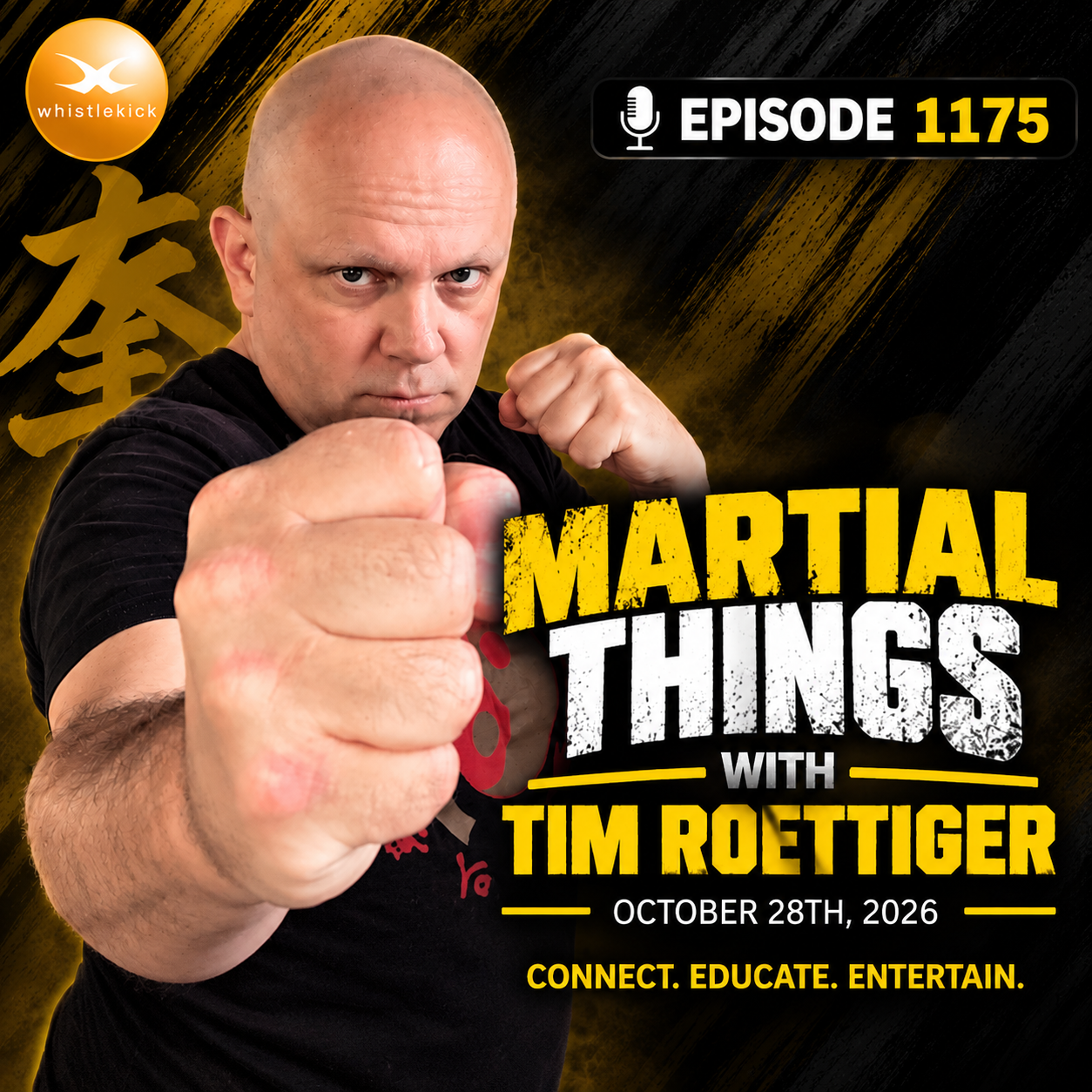
In this episode join Andrew in whistlekick’s Martial Things series. This week he sits down and chats with Tim Roettiger with a plan to talk about……. nothing. No plan, just a conversation to see where it takes them.
Martial Things with Tim Roettiger - Episode 1175
SUMMARY
In this episode of Whistlekick Martial Arts Radio, hosts Andrew is joined by Tim Roettiger and they discuss various aspects of the martial arts community, including updates on their personal journeys, the importance of planning and flexibility in teaching, and the significance of clear communication in class descriptions. They also emphasize the value of eclecticism in martial arts training, encouraging instructors to be open-minded and adaptable in their approaches. They explore various themes in martial arts, including the value of learning beyond mastery, insights from training with Guru Dan, the impact of age on martial arts practice, the debate surrounding junior black belts, and the common ground found in diverse martial arts practices. They emphasize the importance of personal growth, community, and the unique experiences that shape martial artists.
TAKEAWAYS
Planning is crucial for effective teaching at events like Martial Summit.
Flexibility in teaching allows for better engagement with students.
Clear class titles and descriptions can attract a wider audience.
Instructors should avoid using jargon that may alienate potential students.
The martial arts community benefits from eclecticism and cross-training.
Learning from different styles can enhance one's own practice.
Tim emphasizes the importance of being prepared for varying class sizes.
Instructors should view themselves as learners as well.
Open-mindedness in training can lead to unexpected insights.
Learning can lead to unexpected benefits in practice.
Approach new experiences with an open mind.
Understanding your audience is crucial in teaching.
Martial arts history is not universally known among practitioners.
Cultural context can shape martial arts practices.
Age should not limit one's involvement in martial arts.
Different schools have unique ranking systems.
Junior black belts serve as placeholders in their own curriculum.
Comparing ranks across schools can be misleading.
Commonalities in martial arts can foster community and collaboration.
CHAPTERS
00:00 Introduction
01:59 Updates from the Martial Arts Community
05:56 Planning for Martial Summit
10:00 Flexibility in Teaching
11:59 Understanding Class Titles and Descriptions
15:59 The Importance of Eclecticism in Martial Arts
22:08 The Value of Learning Beyond Mastery
26:41 Training Insights with Guru Dan
30:48 Age and Martial Arts: Breaking Stereotypes
31:35 The Debate on Junior Black Belts
43:36 Common Ground in Diverse Martial Arts Practices
Join our EXCLUSIVE newsletter to get notified of each episode as it comes out!
Subscribe — whistlekick Martial Arts Radio
After listening to the episode, it would be exciting for us to know your thoughts about it. Don’t forget to drop them in the comment section down below!
SHOW TRANSCRIPT
Andrew Adams (00:20.27)
Welcome, you're listening or watching to another episode of Whistlekick Martial Arts Radio. And today we've got a martial things episode with my good friend Tim. Tim, how are you doing today?
Tim (00:47.188)
I'm doing great. How you doing?
Andrew Adams (00:48.852)
I'm great. It's it's it's a lovely fall day. It's a couple weeks before Martial Summit, so a little stressed. I've got a lot of plates spinning, they're up in the air. I'm trying not to drop any of them, but w life is good. We're we're gonna make it through. For those of you listening or watching, if this is your first episode, welcome. Thank you for being here. You can go to whistlekick martial arts radio dot com to find out all of the information on all of the episodes that we have.
Tim (01:07.244)
Yeah.
Andrew Adams (01:18.632)
Over eleven hundred and seventy episodes at this point. They're all there completely for free. You can find transcripts, you can find video links, you can find audio links, photos of our guests, all that stuff you can find there. You can also sign up for our exclusive newsletter. And if you go to whistlekick.com, you'll find out about all of the other things that Whistlekick does. Maybe you want to buy some sparring gear or training equipment or uniforms, or maybe you want to attend one of the multiple events that we host around the country, like
Martial Summit. All of that stuff you can find at whistlekick.com. Okay, I'm done. I got it. I think I I don't think I missed anything.
Yeah. Tim, so let's let's go. Where where are you at these days? What's going on with you? What's what's new in your life in the martial arts world?
Tim (01:59.403)
Right. Yeah.
Tim (02:08.702)
gosh, you know, as far as martial arts specifically, you know, a pr pretty much stay in the course. might be picking up a couple new students here, had some people contact me, so we'll see about that. yeah, gosh, earlier this year I went out and
Andrew Adams (02:19.469)
Mm-hmm.
Tim (02:34.846)
went to one of Dan Inasano's seminars, which was something I'd always wanted to do, you know, because I'd come up kinda on the original side of Gundo and Dan was the concept side and never the twain shall meet. so it was interesting to get out there and and to to see him and such and
Yeah, you know, I'm getting ready for Martial Summit back for the fourth year, which is amazing. It's really cool that you guys are having me back and trying to map out, you know, what I'm gonna do. You know, you always have kind of a little bit of an idea, but I'm one of those people that I have to have my little cheat sheet with me and I usually print that up and hand it out to the attendees also. So they got something to take.
Andrew Adams (03:24.471)
Sure.
Andrew Adams (03:28.629)
Yeah, yeah, yeah. It's you know, it's I've I have found it's an interesting to look at Martial Summit a l you know from the outside a little bit looking in. the different types of presenters that we have, there are some that are like super and I don't mean this in a bad way, but super aloof and they're like, I I don't know what I'm gonna I'm gonna teach I don't know this thing. I'll
I'll figure it out when I get there. That sort of attitude. And there are others that are like show up and and this is not an exaggeration with a b every minute, like a three minutes to do this warm-up, and then three minutes to do this and five minutes of working on this. Like some are super duper detail oriented about what they're going to present. and you know, most people are are in the middle that you know they have they they know what they're gonna present, but the way they do it might kind of
Tim (03:57.909)
Mm-hmm.
Andrew Adams (04:25.358)
Fluctuate a little bit depending on who's there and whatnot. Do you find yourself more in the middle or leaning towards one of those ends?
Tim (04:35.819)
I definitely lean toward the more planned side. that kind of goes back to my prior career, you know, as a fish biologist and dealing with the public and such is the author Pat McManus once said, I always come up with the perfect response just three days later. And
Andrew Adams (04:38.67)
Mm-hmm.
Andrew Adams (04:58.156)
Ha ha.
Tim (04:59.135)
That's kinda a bit of me. So I was the guy that always had things mapped out when I'd go talk to a group of bass fishermen or whatever. my boss in Florida, John Fury, he was amazing. We literally got a couple of ambush interviews and it was amazing how well he could handle that. That was a skill I never had. I always have to plan. And so that carried over into the martial arts stuff. So and and I always plan a little extra.
So like the very first year I did Martial Summit, I had three people in my group. So we got to go through a lot more than I'd planned. And then last year, I don't know how many we had, but you know, I show up and I'm like, I'm like, there's like six people there. And I'm like, okay, this is a good size, like six or eight. I'm like, we're gonna be able to cycle through everything. And then like in the last two minutes before it starts, like 30 people pile in.
Andrew Adams (05:35.168)
Mm-hmm. Yep.
Tim (05:56.469)
Which was awesome. It was it was a lot of fun. I'm I'm glad people you know, were willing to give me the opportunity. And but then of course by then, you know, so we got to maybe like half of what I'd planned, which is perfectly fine, you know. I gave them the little handout and okay, th they can see what we went over and then they got more to to look into on their own. So yeah.
Andrew Adams (06:19.305)
Yeah, yeah. That's that's cool. And for those listening that are like bass fishermen, what is he talking about? you we we don't have to go into the whole thing because listeners or viewers can go to episode nine zero two and go to the interview that Jeremy did with with Tim. So you can hear all about that there. so we'll leave it kind of as a teaser. But yeah, I I am kind of more in the middle. Like I
Tim (06:24.694)
Yeah. Mm-hmm.
Tim (06:33.024)
Mm-hmm.
Tim (06:38.708)
Yeah. Yeah.
Andrew Adams (06:48.853)
I know what I'm going to present. Like I have the the class description and or the title of the class and a short description. And what I'm going to present, I have likely presented a bunch of times. whether it's in my own classes that I teach or at other seminars. But how I go about it definitely changes a little bit and how obviously how quickly I run through it. I mean, I would
I would have a hard time being so detail oriented, like three minutes of doing this and then five minutes of this. Because you know, if the class is running a little slow or maybe I'm my class is full of people that really get it really quickly, I'm like it stresses me out knowing that I'm not s quote sticking to my script, you know?
Tim (07:19.94)
Yeah. Yeah, that's all.
Tim (07:38.059)
Yeah. Mm-hmm. Yeah. No, I I I I definitely s see where flexibility is is key, you know, because there's gonna be things that that happen, or you just find something that people like, you know. that you know maybe wasn't a tangent you planned for, but f you know, people really seem to
want focus on that more than maybe as an instructor, whatever you originally intended, but it's okay, you know, hey, let's run with that. If the group wants to do it, let's run with it. So yeah. It's definitely good to have some flexibility there.
Andrew Adams (08:14.402)
Yeah, yeah.
Tim (08:14.59)
Especially, I mean, these people are all new for the most part. and that's the great thing about Martial Summit. And I I tell this and that, you know, we a lot of our patients that come in, you know, they we always put up in the lobby of our waiting area and such. And I always tell them it's like this is your opportunity to try something totally different for free, you know.
Irish stick fighting, remember that? I mean holy cow, I think of the hundred and eighty attendees, I think a hundred and sixty were in that group in in the gym there.
Andrew Adams (08:40.48)
Yeah.
Andrew Adams (08:47.694)
Yeah, that was that was John Border, I think three or four years ago he was here pr Yeah, so so it that was a lot of fun. And we always have some I mean it's difficult running an event like this, and you know, we often will have new presenters, and you've been multiple times, so you already know, but we have new presenters that will say, you know, how many people do you have signed up for my class? And it's like
Tim (08:54.046)
Yeah, it was the first year I was there, yeah.
Andrew Adams (09:17.422)
we our event is free and there's no I mean, yes, there is a registration. It there's a pre registration you can do, but it's just to tell us who you are so that we know you're gonna be there. And the biggest reason to be honest, it's to sign the waiver. It just makes it easier the day of. but no one is signing up for when they re when they do the registration, it's not like, I'm gonna sign up for Tim Ruddiger's class and then I'm gonna sign up for Andrew Adams class. Like
Tim (09:19.456)
Yeah.
Tim (09:34.346)
Yeah. Yep, yep.
Andrew Adams (09:46.475)
No, you're just telling us you're coming. And then on the day, you know, that year, you know, four years ago, we had 180 people or so. we I didn't know that 160 of them were and it wasn't really 160, but it felt like it. But but we have no idea. And you know, it it's it's a difficult thing to manage, and some presenters have a hard time understanding that, and they might be, you know, if there's 300 people.
Tim (10:00.448)
Yeah. Yeah, it was a big group.
Andrew Adams (10:16.288)
in a couple of weeks at Summit and there's six classes, you know, two hundred of them could be in one room and then the other one hundred could be split amongst the other five rooms. we we just or could be evenly split. It really is tough to say.
Tim (10:23.607)
Mm-hmm.
Tim (10:31.999)
Yeah. Yeah. And and I think, you know, in a way that's a good experience, you know, because even though you're a a session leader or instructor, however you want to say it, you're learning too and
It's like that old quote from Willie Nels, I think it was Willie Nelson where you have to learn to sing to an empty room. Is you have to be prepared whether you get three people or three hundred, you know, you gotta be ready to go. And if you won't like that for sure, I had only three. Okay, so we got to go farther than what okay, we've already done kind of the basic front hand lead stuff that was planned.
Andrew Adams (10:52.451)
Yeah.
Andrew Adams (11:00.204)
Yeah.
Tim (11:12.447)
Okay, let's let's do a little bit of counter to it. Let's do a little bit of trapping just for the fun of it. You know, we got people here, let's do some trapping. So yeah, it's I I think if you go into it as a a session leader instructor
Andrew Adams (11:15.586)
Yeah.
Tim (11:30.611)
with the idea that I'm kind of here to learn too, it makes it easier rather than thinking, you know, I am the guest of honor and I must produce, is, you know, I'm gonna be here with and I've got an idea and here's a group of potential new friends that and I get a chance to say, hey, you know, this is what I like to do. This is what I think is really cool. but there's gonna be an exchange there. Yeah.
Andrew Adams (11:33.454)
Hm.
Andrew Adams (11:38.902)
Yeah, yeah, yeah.
Andrew Adams (11:49.869)
Mm-hmm.
Andrew Adams (11:59.692)
Yeah, yeah. We I've also found that there has been a lot of education with amongst the presenters of understanding how to put what their class is going to be on paper so it's so it's understandable to the audience and that they really want to do it. Here's a perfect example. not a specific example, but an example. Someone let's say someone is going to
Tim (12:00.503)
You have it.
Andrew Adams (12:28.982)
They they are coming to summit, which is open to anyone from any style, any ability level, right? You could have white belts, you could have kung fu white belts in your class and you know fifth degree black belts in karate in your class that you're presenting, right? We we don't limit it to anybody. It's we're not get don't gatekeep it. And if you title your class Naifanchi Bunkai. Now I
Who train in an Okinawan style of karate, I know what Naifanchi is and I know what bunkai is. So I would go to that class and understand completely what I'm going to learn. But someone who does kung fu or taekwondo or jikun do, they might have they might not have any idea what Nai Fanchi is and what bunkai is. And so
Tim (13:20.01)
Yeah, man. Mm-hmm.
Andrew Adams (13:23.582)
You are limiting the people that are going to come to your class because they just don't understand what it is. But if you use a description of horse stance, I think is a a stance that most all styles are gonna understand, horse stance applications, something like that, you're still teaching the same class, but it's more easily understandable by the audience.
Tim (13:51.573)
Yes, yes. And and I I I think you get to a point of one of the things that can be a little limiting, well, not only in martial arts but in any pursuit, I think, you know, as I've done different jobs, is there's a tendency to want to be a little insular, like I'm gonna use the jargon because I don't want people to understand me, not like you know, I'm weird, but I want to not understand me because that makes me special. You know? And
Andrew Adams (14:18.955)
Yeah, yeah.
Tim (14:21.78)
That's not always or well, I don't think it's ever really a good thing. But it and and you're making a really good point here is that because we can have anyone, we gotta think outside the box. Like if I said something like the art of Bruce Lee.
There's a lot of people out there that ain't gonna mean a whole lot too. I mean, he's been gone a long time. And let's face it, G Kundo was never that big a deal. it never, you know, I mean, Bruce had great ideas and then he died young. And you know, e even I who was kind of a young kid on the and caught the tail end of the Bruce Lee wave, you know, I didn't come into this till much later. And it's
Andrew Adams (14:43.596)
Yeah. Sure.
Tim (15:08.35)
It's not a big thing. So when you make those descriptions and stuff, you know, you can maybe throw in there, you know, Gkundo basics or whatever, but maybe also make sure that you make it obvious that you're you're learning combinations and or something like that. We're okay, it's a JKD thing, but I'm gonna put it out in a way that it makes sense to you. And
I mean, I think again, you know, that's the s the strength of this the Martial Summit and the free training is that it is very easy to go and do something else that you've never done. And if nothing else, you find out maybe it's just not for you. But you never know. You may find that scrap of information where you're like.
Andrew Adams (15:46.978)
Mm-hmm.
Andrew Adams (15:54.061)
Yeah.
Tim (15:58.12)
ooh, ooh, ooh, yeah, I like this. And and that's the way you gotta go into it. And I'm I I'm a little disappointed that some of my colleagues in G-Kundo are basically like, well, we don't need to look at other styles. We've already got it. And granted, that is a little bit of if you want to be a super hardcore originalist, but I think it's also
Andrew Adams (15:59.758)
Yeah.
Andrew Adams (16:16.705)
Mm.
Tim (16:26.699)
You know, I I mean they make that argument, that's fine, but I think maybe it's a bad way of looking at things. It's self limiting, you know, because
Andrew Adams (16:36.01)
And and I would say it's counterproductive to what Bruce Lee did and thought. You know, he was very open minded. And if you go back, like forget Bruce Lee for a second, you know, I tr most all of my training is in Japanese or Okinawan styles of karate. And way back when all of those ma quote air quote masters, they all worked with each other.
Tim (16:53.343)
Mm-hmm. Yep.
Tim (17:01.227)
Yeah. Yeah.
Andrew Adams (17:03.266)
They all tra they had students that they worked with everybody, and that's just the way it was. There was no problem with you were training with, you know, Chojin Miyagi, and then, you know, for a few years, and then you went and trained with, you know, Mitosi or not Funakoshi or whoever. Like that's just the way it was. It was not a big deal. And Bruce's whole philosophy was I'm gonna learn all of this stuff and take what I want.
Tim (17:06.743)
Mm-hmm.
Tim (17:23.137)
There you go.
Andrew Adams (17:32.206)
And if you even if you believe that JKD in the Bruce era took all the best stuff and made it JKD and that it can't evolve ever, I think that's so limiting to your pot your potential, right?
Tim (17:50.722)
Yeah. Mm-hmm. Yeah. And I I think a little bit of it kind of Bruce brought on in a way because when you know, he he was a a showman and a presenter in a lot of ways. And so, you know, he he'd say things like, JKD is it. You won't need anything else. Only one in ten thousand will understand it. And you know, that's nice and fun for the hype, but when you look at how he functioned.
Andrew Adams (18:11.479)
Yeah, yeah.
Tim (18:16.435)
with himself. he was very much in that that Chinese philosophical tradition of eclecticism. And I think that sometimes that gets lost. They see the the public persona where he's hyping things up without seeing the background. And
Andrew Adams (18:23.608)
Mm-hmm.
Tim (18:37.289)
You know, I I learned, I think I I mentioned this in the other one, where my my first JKD lesson, first official, learned three punches, three kicks, and he said, okay, that's it. Now spend the rest of your life perfecting it. And yeah, it's I always say it's almost not an exaggeration. because it's great to have that that founding and that grounding, but then also
You know, I wrote that article, I think, I think it was for Martial Journal was practice what you can't do. And you know, and then, you know, like I always say, my motto, be eclectic in your learning and syncretic in your practice. It's like, you know, that's like like Clint Eastwood and fistful of dollars, a man's whole life depends on a mere scrap of information. So you go out and look for the scraps.
Andrew Adams (19:06.638)
Mm.
Andrew Adams (19:23.426)
Ha ha.
Yeah.
Tim (19:26.651)
And I mean it it was, you know, like for me, it was really great training with the Muay Thai guys, because they come at you so differently than what you're used to in like JKD sparring. so it was a lot of fun. And they learned some of their weaknesses and I learned some of mine, and we got to exchange ideas. And you know, I've I came up with some new combinations that work for me. and so I think
Yeah, I I just don't get that attitude. I I think sometimes instructors are afraid to l of losing a student, you know. And you know, my wife's in the horse world and you see that in the horse world too, where there's instructors. If you take a clinic with another instructor, they can get pretty torqued off. And I I you know, as someone who, you know, okay, granted I probably could have used a better little b my life would have benefited from better focus, but
Andrew Adams (20:02.786)
Yeah.
Andrew Adams (20:12.856)
Mm.
Tim (20:24.457)
You know, as someone who enjoys just learning a lot of different things, you know, I I don't see the the point in that, especially 'cause you might bring something back to class that everyone would benefit from. So
Andrew Adams (20:40.054)
Yeah. And and you might pick something up that you don't quite get the benefit of right then and there, but later you will. Like I've I I I I think I've told this story on the the show before. So my my dad plays bagpipes. Unsurprising if anybody knows me because I'm involved in the pipe band world pretty heavily. But but so my dad plays bagpipes and he was telling me that he was gonna be going to a seminar
Tim (20:47.733)
Never.
Andrew Adams (21:09.376)
A week long bagpipe camp. Yes, everybody, those things exist. He was gonna go to this week long camp, and it was being taught by some of the best bagpiper instructors in the world. And he went for the week and he was all ex he was all excited to go. And he went and he came back. And I I was on the phone with him and said, So how did it go? And he's like, you know, I'm I'm never gonna go back. It was horrible. Like I didn't learn a thing, like it was so dumb.
Blah, blah, blah. And he went on and on about how it wasn't a good event and that he's not going to go back. And I was like, wow, okay. Well, that's unfortunate. That's surprising, right? These are some of the best pipers in the world. But I'm, you know, it's unfortunate you didn't have a good experience. And my thought was he wasn't that open minded about things. Well, about five or six months later, I'm talking to him on the phone again. He said, you know, registration came out for that week long camp. I'm going to sign up to go next year.
And I was like, what what are you talking about? You spent yeah probably 45 minutes telling me how bad it was and you didn't learn anything. And he said, you know, I thought about it a lot more. And since then, in the last five months, I would be at my band practice and something would come up at band practice, and something that had been said or we worked on at camp came up and it actually helped me remember something. And
I was able to do something a little bit better, but I didn't realize it at the time. Right. So I've had people say to me, like, why should I bother to go to, you know, a seminar or, you know, or Martial Summit or any event like that where I'm gonna learn judo for forty five minutes. Like, why bother to learn judo for forty-five minutes? I'm not a judo person. I'm not gonna I'm not gonna be able to leave that forty-five minute class and be able to say, I know judo. And
They are correct. I'm not able to leave that class and say, I know judo, but I'm able to leave that class and say, I have a better understanding about what they do. And maybe there's one thing that I picked up that I can use in my training. And maybe there's not, but did I have fun for 45 minutes learning something new?
Tim (23:29.079)
Yeah.
Yeah, yeah, definitely. it's yeah, it's it's it definitely you have to approach it in that spirit, I think, is that, you know, get in there and and give it a try and you just you never know when it's gonna come around, you know.
Andrew Adams (23:47.245)
Yep. Yeah. the other thing you said which was interesting was that, you know, keeping in mind what you're not what you're presenting, but how you're putting it down on paper like Bruce Lee, whatever, because s your audience might not that might not be relevant for them. And I don't know that
Tim (24:04.183)
Uh-huh.
Andrew Adams (24:09.888)
My my thought is I I'm kind of relating it to I was having a discussion with a nineteen or twenty year old martial artist and I mentioned Bill Wallace. Now, you and I have been around long enough. We know who Bill Wallace is. We know why he is a famous martial artist. Most of our listeners probably know that as well. But this particular nineteen year old had no idea who Bill Wallace was.
Like didn't even remotely register. And you know, Bruce is getting to that point. I mean, I I think most people still have a an understanding of who Bruce Lee was, but I don't think it's gonna be much longer where martial artists won't necessarily know who he is automatically.
Tim (25:00.619)
Yeah. No. And and I think too is that when people do know him, they know him just as the actor. Yeah. And and they don't really think of him as a martial artist per se. because e even like you think of Chuck Norris, my dad loved Walker Texas Ranger, but I guarantee you he never knew what martial art Chuck specialized in. Yeah. So yeah.
Andrew Adams (25:14.787)
Mm.
Andrew Adams (25:27.768)
Sure, that's a great point. That's a great point. Yeah.
Tim (25:30.332)
Well so whereas like if you're a Bill Wallace fan, it's 'cause you saw him in the ring or something, you know. And yeah.
Andrew Adams (25:36.812)
Yeah. That's fair. Yeah. Most people don't know Bill Wallace because he did like two or three movies or or however many movies he did. See, I don't I couldn't even tell you how many movies he did. I just know that I just know he died. I just know he died in the movies. He was always good at dying.
Tim (25:43.606)
Yeah.
Tim (25:47.787)
Yeah, I only can think of one.
Tim (25:53.687)
Yeah. Well that that's like Bob Wall in almost every movie appeared in Bruce kicked him in the groin, you know. It's like Does he get a bonus for that or
Andrew Adams (26:01.462)
Ha ha ha.
Andrew Adams (26:05.486)
Now I wonder what it would have been like if Bob Wall and Master Ken had ever gotten together. Cause he's used to being kicked in the groin.
Tim (26:11.062)
Ooh, ooh.
Yeah, I know. Master Ken would have hu met his match.
Andrew Adams (26:17.23)
so what w how was training with Guru Dan? Like we you know, I know we had a a couple of guests on the last couple of weeks that have trained with with Dan and Asanto and and you know Rick Faye came out a couple weeks ago and was really pivotal in his training. What was it like to to finally be able to train with?
Tim (26:41.726)
it was you know, it was interesting almost more for the non-martial art part. as you know, Dwight Woods mentioned, and actually Dwight Woods was there in this session with me, and he said, It's a little bit of a fire hose, isn't it? You know, because so much comes out. And the JKD part I I was able to keep up with pretty good. Then the next day it was the the Cali sticks, and it's like wow.
Andrew Adams (26:47.79)
Hmm.
Tim (27:09.24)
was just at sea. Fortunately there was a fellow there named Rick who was one of the regular students and he's like, all right, he's like, let's go back to the beginning and we'll start this over. And so that was a a big help. The the the regular students that were in the session were actually quite helpful to people like me who were, you know, just should just showed up. But it was interesting to hear Dan talking about his life growing up, particularly, you know
Andrew Adams (27:25.614)
Mm.
Tim (27:38.201)
How there was like this hierarchy of minor minority groups within the society and and how he dealt with that as a kid and a teenager and whatnot. And then some of his interactions with Bruce and things like that. And and one of the more interesting things he said that I haven't followed up on, admittedly, is he's like, You gotta find your own culture's martial art. So for him that was, you know, the the sticks and and then
some other things. And I sit there and I think, well, yeah, I'm, you know, mainly German. I couldn't tell you what the German martial art is, you know. I'm sure there's gotta be something out there if I could research it. So that was an interesting thing that made me think and
you know, like I said, as as far as actual basic the art itself, the drills we did, whatnot, you know, they were, you know, you know, mostly things I'd done before, maybe a little bit of variation here and there, but it was more interesting almost just to hear him talk in between the little the you know, the little subsets. And it would have been I think would have been great to be able to have sat down with him a bit, but yeah.
That was one thing that they didn't do at this session that some of the other ones I'd been to is like if it was a Saturday, Sunday thing, like Saturday night they'd meet at like, you know, one of those buffet style restaurants and everybody just sit around and you could talk to everybody. And you know, so there there's been to some where, you know, the instructors would kind of go table to table and sort of meet everybody.
And so so that's kind of a cool thing. you know, depending on the situation, that's not always feasible. but yeah, so it was it was good. it was I was glad to kind finally meet him. You know, it was just before his 90th birthday, and it's it's pretty cool that he's still out there doing that. that is one thing that I was raised in that was a bit unfortunate, is
Andrew Adams (29:25.655)
Yeah, yeah.
Tim (29:52.513)
You know, kind of the I don't know, the attitude of my family, my you know, my social group, whatever, it was like thirty-five, you're middle-aged. Fifty, you better start shutting it down. And you know, it was so weird, you know, having people, you know, like I love heading out to the Boundary Wars canoe area. In fact, I went just last month in September.
Andrew Adams (30:03.651)
Mm.
Yeah, yep.
Tim (30:21.202)
fifty seven years old and I soloed for a week and I have had for the twenty plus years ago I was told I was getting too old to be going out by myself. You know, and so it's pretty cool to see someone like you know Dan Andesano at ninety, still kicking literally. So yeah.
Andrew Adams (30:45.508)
Yeah, yeah.
Tim (30:48.066)
Course he talked about that. He said, you know, he said when he was young the kick was up here and then it was down to here and now it's down to here, so
Andrew Adams (30:56.547)
Yeah, I I've definitely found in my older age that my my the height of my kicks has definitely gone down.
Tim (31:03.362)
See, I I'm lucky with that. Mine actually went up for a while. I don't think they're gonna go any higher. because I came from a track and field background, so I never had great lateral flexibility, so I had to establish that. So I was actually able to get my kicks up a little higher because because I didn't start young, you know. So
Andrew Adams (31:18.563)
Wow, that's
Yeah. anything else going on? What el I mean, what else can we talk about martial art wise that that where where can we go that we haven't?
Tim (31:35.041)
Well, I mean there's there's a million issues out there of things to talk about. I don't know, you know, controversial or whatever, but you know, like like one thing that I've seen popping up a bit, and I don't know if you've done anything on on the radio show here with Jeremy, like rankings for kids and things like that. And that's one thing,
Andrew Adams (31:59.352)
Mm.
Tim (32:02.696)
Some relatives of mine, they'll send me a video of like a 10-year-old kid who's got a black belt with you know five or six little gold dude dads on there, and they're like, This kid would kick your butt. And so that's an an an an interesting thing because you know, where we come where I come from in the JKD, we do the ranking very differently.
And I guess, you know, you've been more in something that focuses on belts and then with the kids and such. And so what is your take on like multi level black belts in young children and things like that? I'd be curious to know.
Andrew Adams (32:43.085)
Yeah, so that's a great question. And we we did an episode
Andrew Adams (32:53.839)
Probably five years ago at this point, on on junior black belts. And Jeremy and I talked about it. but my thought and my feeling is first off, rank in my school means nothing to you if if you're not in my school, right? my black belts, adult or otherwise, should not be compared to your black belts in your school.
Tim (32:56.256)
Mm-hmm.
Mm-hmm.
Tim (33:12.416)
Mm-hmm. Yeah. Mm-hmm.
Andrew Adams (33:23.501)
because they are completely different schools, different curriculum, different expectations. All of that stuff is completely different.
So if another school decides to promote a ten year old to black belt,
Okay, as long as in the instructor's eyes within the curriculum that student has surpassed what he needs to to get that rank, great. I don't care. It doesn't change anything I'm gonna do at my school.
And you know, they could be a fifth degree black belt. Well, I don't think anyone on the planet, including an instructor who promotes a 10-year-old to fifth degree black belt, which I want to be clear, I personally would not do. But even if I went to that instructor and asked this question, I think every single person would agree. Do you think that fifth degree black belt that's 10 years old is
the same ability level as this 30-year-old black belt who's fifth degree, right? Even the inst even that instructor is gonna say, well, no, obviously not. He's a junior black belt. Okay, great. So we are already setting the the example or the precedent that under a junior black belt is not a black belt. It is just a placeholder where they are in their own curriculum, not in anyone else's curriculum.
Tim (34:40.953)
Yeah. Mm-hmm.
Tim (34:59.885)
Uh-huh.
Yeah.
Okay, now when they go from being a junior to a senior, then do they start over or do they carry that rank with them?
Andrew Adams (35:13.601)
A again, that depends on the school. And I don't care what other schools do. It doesn't mat for me, and and I want to be clear, I have not personally had a junior black belt turn 16 or 18 or whatever and go for black belt. But in the schools that I have been a student of, we did have someone who got their their junior black belt at 14.
Tim (35:18.009)
Is it?
Tim (35:42.019)
Mm-hmm.
Andrew Adams (35:42.244)
He had been training since he was five or six years old. So, you know, nine, eight or nine years consistently going to class. And he, and I'm speaking just for this particular student in my school, he deserved his junior black belt. When he turned 16, he had to retest for black belt.
And it was for the adult black belt. So from 14 to 16, he worked on the material that he would need to get his adult black belt. And the curriculums were different. For junior black belt, you needed this stuff. For adult black belt, you needed this stuff, and then some more stuff. So he worked on that more stuff. And then he tested for his showdown, his black belt, and he his adult black belt, and that's what he got. And he might even
Tim (36:15.939)
Yeah.
Andrew Adams (36:36.6)
He he might not even have been sixteen. He might have been seventeen by the time he tested for it, now that I think about it. But but it it doesn't matter. I don't care what another school does. And I think it's insane that people on the internet worry so much about what other schools do.
So that's my philosophy on it.
Tim (36:58.039)
Yeah. Yeah. No, and I and I think that's a really good thing because or or I think that's a good way to to to look at it. And I think as as humans we like things to be nicely standardized. And so if we see a symbol here, it means the same thing over there. And you know, I think maybe that's where you know, confusion, whatever comes in.
And you know, because if if you are from outside a particular school, you don't know what their system is. And yeah, one thing is is you know, that was what Bruce Lee tried to really try to get pretty standardized with you know the ranks in JKD. I I don't think it quite worked the way he hoped it would. but you know
Andrew Adams (37:35.216)
Correct, absolutely.
Andrew Adams (37:52.782)
Ha ha.
Tim (37:56.1)
'Cause I look at like the ranks I've been awarded and such and some people historically and it's like, wait a second, I was two ranks above that guy? No, I don't I don't think that would quite have worked. But yeah, so it is a it is an interesting thing and I get that a a a fair bit from you know, people who know me but aren't martial arts people. Yeah. So
Andrew Adams (38:17.743)
Yeah.
Yeah, it's differ it's different. That you know, everybody's gonna do things differently. They're gonna do it their way, and I think we should let people do it their way.
Tim (38:28.951)
Yeah, yeah. And yeah, I remember, gosh, thirty years ago when I was in graduate school, there was a guy at now defunct karate junction who was a red belt, and that guy was a wrecking machine. I was like, How is he not a black belt? And what are the black belts in this school? you know, and then years after that I saw another girl, same discipline Tang Shoto, and she was a red belt and she was like twelve. And
Clearly she was very skilled, but not in the sense that this other fellow was. And you know, but different schools, different ways of doing things, so
Andrew Adams (39:08.302)
Absolutely. I remember going to a school as a I I was traveling, I was on vacation and I went to you know, I contacted the school in the area and I said, Hey, I'm gonna be coming to your area. Do you mind if I come in for a class? I done some training, blah, blah, blah. And he the instructor's like, Absolutely no problem. We'd be happy to have you and I showed up.
and I got ready for class and I stepped out on the floor, and there are a bunch of people wearing red belts. Now, in traditional karate, there isn't red belt. in the the first instance that I saw red belt was taekwondo, and taekwondo uses okay, most taekwondo uses red belt as essentially karate's brown belt, the belt just before black belt.
So if you're red belt in Taekwondo, you've been training a long time. You're you're gonna be going for your black belt soon. So I I step onto the floor, and this is a karate school, it's not a taekwondo school, and there are a bunch of red belts, and I was like, wow, that's and then they are not moving like I would expect a red belt in Taekwondo or brown belt in karate. They weren't moving, and I was like, wow, that's really weird. Well, come to find out at this particular school.
You you start out at white belt and then your next belt is red. That's just the way they do it. And that's fine. They're allowed to do it any way they want to. But it definitely was a little like, wow, it okay. It's interesting. Their their red belts are not as skilled as I would have thought, but that's okay. And then come to find out, it would have been what in my school would have been like a yellow belt or or you know, a a white belt with one green stripe or whatever.
Tim (40:34.423)
Yeah.
Tim (40:56.237)
Yeah. Yeah. Yeah. And it's it's like you said, it's always different. And I know I've gone to different schools and I'm I guess a little on the kind of shy side or whatever you want to call it. And so when I'm with a new group in a new school, I tend to kind of hang back and I don't push real hard and such. And
Andrew Adams (41:20.016)
Mm-hmm.
Tim (41:23.961)
'Cause I I don't want him to s feel like I'm coming in there like I'm gonna beat you guys up. No, I mean I hear you it's totally different. It's all new to me. but I I remember one time I was doing that and I was kinda going in and I remember behind my back I hear the instructor say, you know, he's actually better than he thinks he is. And it's like, you know, 'cause but you know, that sometimes you get that where you're you know, like if you're in a different school, you don't know what you know, what their things are or
Andrew Adams (41:41.84)
Ha ha.
Tim (41:53.132)
You know, you know, like e even when it goes on to like sparring, you know, I've like I came up through with a system, you know, we're getting a little a little far off on the original topic, but you know, if you had a person in a situation where they were compromised where you could knock them in the next week, you know, you break
Andrew Adams (42:05.498)
That's okay.
Tim (42:14.475)
Reset, you know, because you you don't want to, it's sparring. You're not it's not killing, it's sparring. and I was with these guys at another school, and I got a guy, and you know, basically the only move left was me to either break his leg or let him go. So I go break, I let him go, and I step back and he just blocks me in the face. And I was like, Whoa! And like, hey man, you never give up. And I was like
Andrew Adams (42:17.999)
Yeah, yeah.
Tim (42:44.257)
Well what would you want me to do? You know, because I had him tied up and other than just stomping on his and busting his shin, there wasn't much left to do. So I think, you know, and I and I'm sure that their school maybe they had something like that, but I don't think it was quite that extreme because it was pretty obvious that I called a break and I stepped back with my hands. So I think that was more maybe just him little ego hurt or something, but
Andrew Adams (42:52.088)
Yeah, yeah, yeah.
Andrew Adams (43:07.811)
Yeah, yeah, yeah.
Tim (43:13.913)
again, you know, different people have different concepts of what's appropriate and what's you know, what's appropriate, what's not, you know, what's the the ethic I guess in the
Andrew Adams (43:25.762)
Yeah, yeah. Definitely a bit a bit of the extreme there for sure.
Tim (43:29.281)
Yeah. And but yeah, you know, it's like you said, everything's different but that's part of the fun of it, you know.
Andrew Adams (43:36.654)
Yeah. Yo, you're absolutely right. And and but there's still more that connects us than separates us, all those different styles and how we do things, you know?
Tim (43:44.716)
Yeah. Yeah. And I think that's you know, that's really true in and especially in the JKD community where you've got you know, like he said, the what's the shirt say, no style and strong opinions about it, that shirt you guys made. you know, and that's one of the unfortunate things. And and and truthfully that's part of the reason, you know, I mentioned that why I wanted to see Dana Nasano is because I came from
Andrew Adams (43:59.727)
Ha ha.
Tim (44:12.491)
A milieu where some people really disliked him and but didn't seem to have a good reason for it. And you know, again, I did some work with Terry Tom, not so much martial arts work as nutrition work, but again, Ted Wong said she was his best student. And so, but then other people were like, how can a girl be your best student? That literally is what someone said about her, which means like you've just missed the whole boat, buddy.
Andrew Adams (44:41.327)
Yep.
Tim (44:42.649)
And you know, so I can be a bit of a contrarian that way. If so if somebody's trashing someone else, I'm like, hmm, I better check this out. Yeah. So yeah, it's I I think you're right. We we've got a lot more in common and we can do a lot more for each other if we let ourselves. So yeah. Mm-hmm.
Andrew Adams (44:49.422)
Hmm.
Andrew Adams (45:03.64)
Yeah. That's a great place to end. Tim, thank you so much for for being here. I hope you, the audience, have enjoyed this kind of no specific topic direction. We just kinda went wherever. That's the whole mindset of these Martial Things episodes. it's kind of like we talked at the very beginning of the different kind of presenters at Martial Summit. You come in with a plan or you come in with no plan. Our plan was no plan. So
thank you for for rolling with the punches, as it were, Tim. I appreciate it. Thank you. And and for you guys watching or listening, Whistlekick Martial Arts Radio dot com is where you can go to find transcripts on this and every episode we've done. Go to whistlekick.com to find out about all the information on the other things that we do. We appreciate you being here. And as always, train hard, smile, and have a great day.