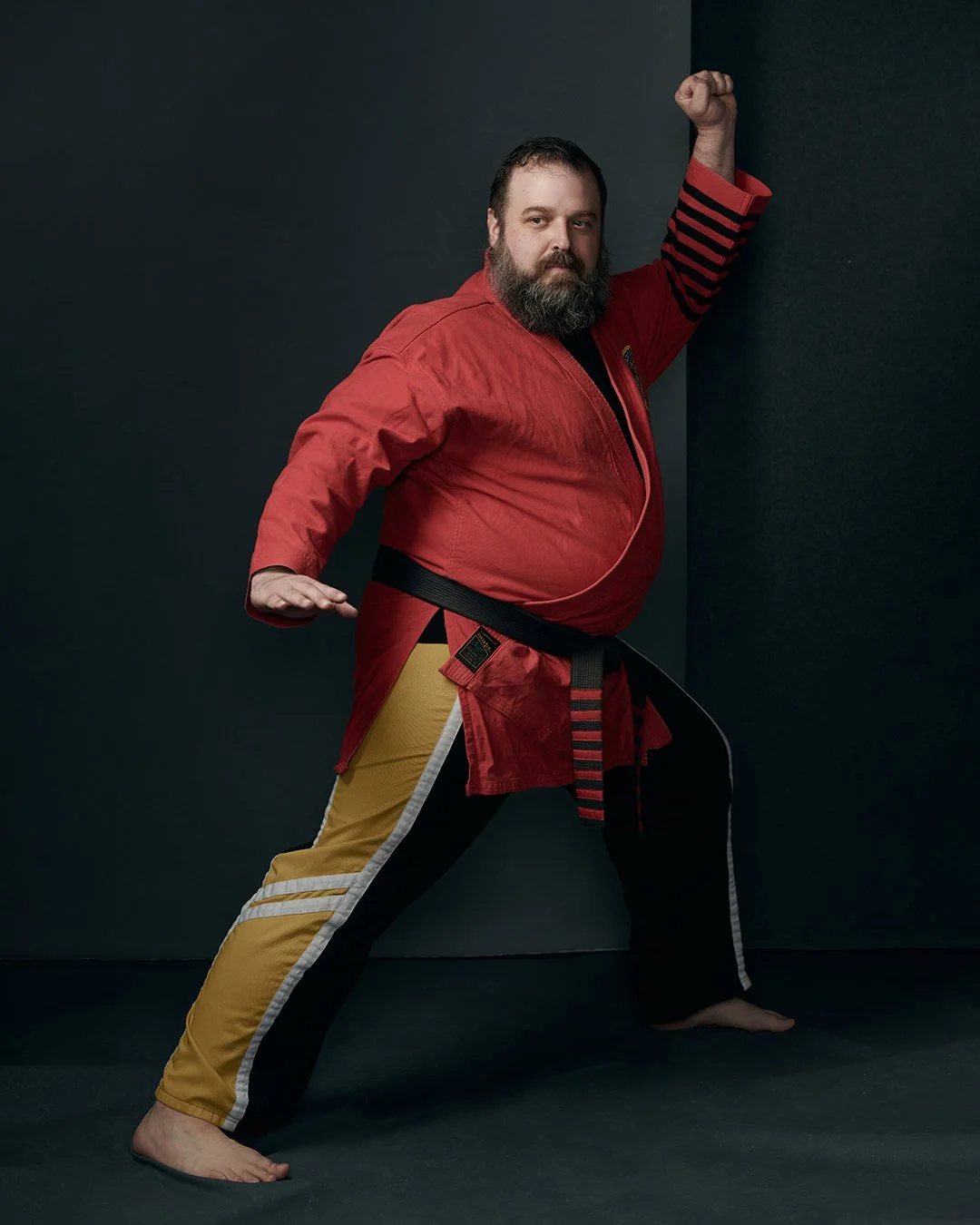
In this episode Jeremy talks with Master Alan White about his journey into martial arts, martial arts in pop culture and online training.
Master Alan White - Episode 1176
SUMMARY
In this conversation, Jeremy and Master Alan White explore the intricate relationship between martial arts, human psychology, and cultural influences. They discuss the emotional landscape of martial arts training, the physiological need for connection, and the journey into martial arts as a response to childhood experiences. The dialogue also delves into the evolution of children's programming, the impact of cultural phenomena like Ninja Turtles, and the marketing strategies for modern martial arts schools, particularly through the lens of engaging themes like lightsabers. In this conversation, Master Alan and Jeremy explore the intricate relationship between martial arts, teaching methods, and the evolution of instruction in the digital age. They discuss the importance of connecting martial arts to history, the challenges of adapting traditional teachings to modern methods, and the significance of spatial awareness in teaching. The conversation emphasizes the need for effective communication and the value of showing up and caring in education, ultimately highlighting the importance of understanding diverse perspectives and building connections within the martial arts community.
TAKEAWAYS
Martial arts history is often a blend of various traditions.
Online discourse can perpetuate animosity between martial arts branches.
The evolution of martial arts lineages reflects broader societal changes.
Cultural phenomena shape our childhood experiences.
Lightsabers create a unique engagement in martial arts.
Luck plays a role in success, but positioning is essential.
Martial arts connects us to history in a tangible way.
Teaching methods can evolve while preserving tradition.
Online learning has changed perceptions of martial arts instruction.
Spatial awareness is crucial for effective teaching.
Understanding diverse perspectives fosters connection.
CHAPTERS
00:00 Navigating Personal Challenges in Martial Arts
03:01 Cultural Differences in Communication
06:03 The Evolution of Martial Arts Lineage
08:51 Understanding Martial Arts Schools and Communities
12:03 The Complexity of Martial Arts History
14:57 Generational Trauma in Martial Arts
17:48 The Psychology of Conflict and Identity
25:32 The Emotional Landscape of Martial Arts
28:59 Human Physiology and the Need for Connection
30:54 The Journey into Martial Arts
33:49 Cultural Phenomena and Childhood Influences
37:59 The Evolution of Children's Programming
40:55 Lightsabers and the Art of Engagement
45:51 Marketing Martial Arts in a Modern Context
54:30 Connecting Martial Arts to History
56:30 Teaching Traditions vs. Modern Methods
57:51 Adapting to Online Learning
01:02:05 Spatial Awareness in Teaching
01:05:56 Effective Communication in Martial Arts
01:10:02 The Importance of Showing Up and Caring
To connect with Master Alan White:
www.gokempo.com
Level Up Sabers – LUL
Join our EXCLUSIVE newsletter to get notified of each episode as it comes out!
Subscribe — whistlekick Martial Arts Radio
After listening to the episode, it would be exciting for us to know your thoughts about it.
✅Subscribe to whistlekick Martial Arts Radio on the following platforms:
🎧Apple Podcasts: https://apple.co/3mVnZmf
🎧Spotify: https://spoti.fi/3yHVdHQ
✅You can find whistlekick on all social media platforms using the handle @whistlekick or visit our website at https://www.whistlekick.com or https://www.whistlekickmartialartsradio.com
Show Transcript
Jeremy (00:01.895)
So for the benefit of the audience, Alan and I have just agreed to to some conversational terms given that both of us are having we're having a time. And we we don't have to go any further than that, but
Master Alan (00:09.57)
You do.
Master Alan (00:20.118)
Okay.
It's kind of a day. It's you know, just
Jeremy (00:30.469)
It it's it's like, hey, here here's something painful in my life that's gonna impact the show. And then the other of us was like, here's this other thing that's painful in my life that's going to also impact the show, but now
Now we're both coming from a similar place and I think that's important. Right? I mean, what's what's more martial arts than that, right? Like we gotta get down in the muck with the other people.
Master Alan (00:57.454)
Well and it's also like the
If you if you are a martial artist for a long time, life happens. Like that's the there are there are going to be things that take place that either make it hard to train or make you have to take a break or make you have to look at finding a new school. Like there are there are things that happen. And like as a as a martial artist lifer, I have had several things that have made it to where I had extended periods of time where I wasn't training. my best friend who recently passed away,
Jeremy (01:19.155)
Mm.
Master Alan (01:33.153)
He found my school because he had moved here as a as a part of medical school. He didn't have friends in town. He didn't have you know, a network or anything. He had started martial arts when he was an undergrad in Virginia. And like that was something that was like, this is this is something I miss. I need to I need to find a school locally. Cause he was starting to kind of struggle with, you know.
I all the all the mental health stuff you struggle with when you're in intensive education. and and so we we became friends in no small part because it was just like, all right, I cannot find a studio that does the martial art that I did. I can't have what I had. And even if I could find it, it would be different because it's in a different place. This place, I liked the vibe from my first class. And so this is going to be my place. I'm gonna start doing martial arts here.
and that is that is no small part of how we became friends. I'm in Louisville, Kentucky. No, yeah. Good call. So we are we are in the ville, as the locals say, or the 502. for those of you that are not from the Louisville, Kentucky area.
Jeremy (02:32.966)
Mm, cool. W where's here, by the way? You said you said here. Okay.
Jeremy (02:44.146)
The veil
You know.
Master Alan (02:53.27)
You will hear sports broadcasters refer to it either as Louisville or Louisville. And that is how we can tell you are from out of town.
Jeremy (03:01.19)
Right. I I am not surprised that you had to abbreviate it down to the Ville because the way I hear locals pronounce the front half of that city name requires the creation of new vowels.
Master Alan (03:18.986)
It's you're mashing together. It's not it's like it's a particle accelerator, but vow.
Jeremy (03:20.962)
Yeah. Yeah. It it's it sounds like you're saying it with rocks in your mouth.
Master Alan (03:28.812)
Well, and like and I say this as a I I say this as a damn Yankee that had to learn to speak Southern. So there are two pronunciations of Louisville, depending on which part of town you're in, 'cause like somewhere in the neighborhood of one third to one half of Louisville is a Midwestern city, and then the other part of Louisville is a southern city. If you like if you really kind of look at
Jeremy (03:29.608)
What I will.
Jeremy (03:35.094)
Jeremy (03:46.918)
Really? this sounds like it causes extreme conflict.
Master Alan (03:52.117)
Well, it's like it's Louisville is just very different as a southern city. If you look at other cities that are like around the same latitude and and history and other stuff, so like we are less Midwest than Cincinnati, but we are more Midwest than Lexington. And those are like two very easy comps. and so like the social social norms in different parts of the country are very, very different.
Jeremy (03:56.162)
Okay.
Master Alan (04:20.246)
And depending on where you grew up, wherever you grew up is what's normal. And whatever the other parts of the country are like, it's weird because reason. And so I am from New England where we practice full contact sarcasm. Full contact sarcasm is incredibly rude in the South because, like in the in the South, the the first order of like social norm is public-facing politeness. And so the
Jeremy (04:29.404)
Mm-hmm.
Jeremy (04:33.327)
where?
Jeremy (04:38.938)
Yeah.
Master Alan (04:48.866)
The southern charm also comes with like the southern passive aggressive is the the other part culturally that everybody just accepts is like this is how you do things. You don't directly come at somebody because it's rude. You can come at somebody kind of sideways, you can come at some, and those things are perceived as polite. And so, like in different parts of the country, coming at somebody sideways is is perceived as rude. And depending on where you grew up, one of those things is okay, one of those things is not okay.
And like and then if you end up transplanting, then it takes a while to shift because like no.
Jeremy (05:24.722)
Have you seen the nice kind matrix? Yeah. Yeah, that's what I was thinking about when you're talking about. Right. New England, I I I'm in Vermont. I grew up in Maine. Is kind but not nice. okay. Yeah. You are you are the
Master Alan (05:28.148)
that's 'cause the 'cause the Midwest is nice and kind.
Okay. All right.
I am a mass hole. I am from Springfield. I'm from the Springfield where I don't have to say which one, because we were the first one. Everybody else has to specify.
Jeremy (05:51.974)
Yeah, but there's no way The Simpsons is set in that one. It wouldn't work.
Master Alan (05:55.951)
but he
Jeremy (06:03.426)
I got hold on, I broke you. I'm I'm gonna take a bit of pride in that.
Master Alan (06:07.886)
you can't have it. but my my my friend is he grew up primarily in kind of Atlantic, like Atlantic Coast, Virginia and DMV, which is what locals refer to DC. They call it the DMV because it's Delaware, Maryland, Virginia. And so and referring to DC as the DMV is also like I it it fits in it fits on many levels. Sorry.
Jeremy (06:09.585)
Okay.
Jeremy (06:27.48)
that's a weird acronym. Yeah.
Jeremy (06:35.47)
Okay. You you wait a long time to be abused for
Master Alan (06:38.222)
It takes forever to get anywhere. Once you once you get there, you're not sure that you wanted to be there in the first place, but it's too late to go back now. Once you get there, you're gonna find out there was something you needed before you got in line, but you didn't find out till you got there. So now you gotta go back. Go get that thing. And anyway. But so he he grew up with more of that culturally.
Jeremy (06:42.64)
bureaucratic reasons.
Jeremy (06:47.73)
Yeah.
Master Alan (07:08.246)
And so the fact that I am sort of a in the South they would refer to it as more direct, right? but it's but I am I'm culturally a more direct person. And so he was as well. And so like one of the things that both of us in terms of our like our our way that we interact with friends is a little bit more like.
Master Alan (07:31.822)
the the sarcasm directed at them and like in you know a poking fun kind of way. and in
Jeremy (07:37.51)
Yeah. Yeah.
Master Alan (07:43.765)
in Kentucky that is that throws a lot of people off because that is bullying behavior from the social norms that they're from. And the the the bless your heart stuff, like the the standard southern charm, like this, that sort of thing is from where we were from, is is rude because like passive aggressive is it just it come at me or don't come at me.
Like, you know, like this is the and and the the difference of those things is also why sometimes we would feel like a fish out of water and part of how we became friends because like we were very easy like we had a very easy time right from the beginning of like going at each other in a way that other people would be like because they're not used to friends talking to each other in that kind of way or something. I don't know. But
Okay.
Jeremy (08:44.216)
Okay. So so you said you have a school. You found your school. What is what is your school?
Master Alan (08:51.112)
so we are Louisville is subdivided into several like class three and and other allocation of cities. And so we are St. Matthew's martial arts. There is a little city that Louisville eventually ate. It was called St. Matthews, so it's a little section of town. yeah, that's like two square miles.
But we're right we're right in the middle of that, more or less. We are one street over from the main drag of St. Matthews. and my instructor opened that school.
Jeremy (09:27.642)
What let me guess that the ba the main drag of Saint Matthews has a sign on how to get out of Saint Matthews. Is it that sort of a spot?
Master Alan (09:33.451)
it's it's more like it's so like in at least in in Louisville, and I'm sure there are other cities that have the same thing, the like the little the sub cities that had grown up that then got eaten as this as the city sprawled, they basically they will have like a central street where there are businesses on both sides and no parking.
Jeremy (09:56.68)
okay.
Jeremy (10:00.317)
Super convenient.
Master Alan (10:01.934)
Well, it was when it was like a bunch of neighborhoods around a central drag and people would just walk places. Then it worked. Now now it doesn't take a show. Or it's just like it's it's hard. And so like the businesses in those spaces, it's the things that actually survive are always like really specifically niche and have ways to make money outside of foot traffic.
Because if you're reliant on turning over foot traffic rapidly, you don't have a way to get it because they don't have a way to easily get to you. and that's, you know, I mean, it you're in New England, you know what the like the way that there'll be like a series of towns where like it behaves kind of like a mid-sized city, but it's like each town has something that you go to it for. Like, you know, like the and that kind of
You know, everybody's got a grocery store, but like one person has the big grocery store or whatever. And or like, you know, one town does. yeah, especially in like the in when you're in the the Appalachians or Appalachians, depending on which part of the country you're in. the the the way that geography makes it so that a city can't just you know, and so things end up in pockets and stuff like that.
Jeremy (11:13.798)
Hmm, yeah. Sure. Sure. Okay.
Jeremy (11:23.494)
We got sidetracked. Tell us about your school.
Master Alan (11:26.35)
yeah.
Jeremy (11:27.826)
This is gonna happen. Th to the audience, this is gonna happen if if if if you don't enjoy if you don't enjoy tangents, you're probably not a fan of this show anyway.
Master Alan (11:33.871)
Well, and it's also like there's so much like in the in the martial arts industry, like there's there's so much conversation that happen there's so much discourse that happens online that is like people basically like the first thing they want to do is talk about how they're an expert. And they'll talk about their system and why they're and like the the most exhausting thing to me is when somebody wants to talk about why their system is the best system, and and other stuff like that. And I don't ever want to be like I hate being like
adjacent to that type of you know what I mean? Like you're not asking me to. No, no, no, I know. You're not, you're not asking me to. But like anytime I'm gonna be like, I am of this built and of this system, I'm just like, crap, I'm gonna be like one of those guys. but the the family that we are a part of.
Jeremy (12:06.022)
Well, I'm I'm not I'm not necessarily asking you about curriculum and and lineage. It's more like
Jeremy (12:21.22)
It is it is a martial arts podcast. It is appropriate to have these conversations. It's not like you it's not like you stopped me on the street and said, let me tell you about the stripes on my belt that I'm wearing over my jeans.
Master Alan (12:26.155)
It it is. And it's
Master Alan (12:33.164)
It's also it's also relevant for someone to have context for anything else I'm gonna talk about. Like if I'm gonna talk about martial arts and I am not a martial artist, then like frankly, like if I'm if I'm going to wax poetic about martial arts and I'm not a martial artist, I'm an asshole. Not exactly, but it's like, you know, if I especially if I'm gonna talk about like what other people should do or what I feel like the systems are anyway. but the the the family that we were a part of.
Jeremy (12:36.722)
Sure. Yeah.
Jeremy (12:47.548)
That would that would be weird. Yeah.
Master Alan (13:02.822)
Is Shaolin Kempo karate, which is a a many branching tree. we we trace our roots back functionally to Hawaii in the the middle of the 1900s. and for anybody that's unfamiliar, basically like Hawaii became a martial arts melting pot in the the middle of last century because there were multiple civil wars, there was World War II, there were
a number of other conflicts where people from especially Southeast Asia needed to go someplace where the world was not on fire. And Hawaii was one of the places that people would go first. Cause it's not like trans-Pacific flights were easy to come by in the 30s and 40s and 50s and so forth. And and then there were GIs going in the other direction. And Hawaii was like the the first stop for many of them because again, like
We're sending them on boats. We're not sending them on trans-Pacific flights because the the cost benefit was not there. And so you had all of these young men, primarily in their twenties, stopping in Hawaii on their way to some place where they were gonna fight. And you had all of these people, many of whom were martial artists, that were looking for someplace else to be, and they would just end up in Hawaii for extended periods of time together. And so you had a ton of martial arts mixing that happened.
In that place at that time because there were so many people from so many different backgrounds all blending together. and so some people describe our s our system as an American system. the the the contribution that America made initially was students, not martial arts tradition. Right. But it's like the the history of our system is some Japanese tradition, some Chinese tradition, some Philippine stuff all kind of swizzled up in a blender.
Jeremy (14:56.914)
Mm-hmm.
Master Alan (14:57.378)
and that's that's what we're born out of. And then it came to the United States from our branch of the tree's founder and became what it is that I'm practicing. but we are we are connected to the same lineage as like Ed Parker. And if you watched somebody that's from his branch of the tree and somebody from my branch of the tree, and you looked at us side by side, you would not assume that we were related. and that's
Jeremy (15:14.897)
Mm-hmm.
Jeremy (15:24.114)
Mm.
Master Alan (15:29.322)
That that then gets muddied that in martial arts, like every every system's history is oral history, which is really interesting. But also then like
I wasn't there, so I don't know what's true.
Jeremy (15:45.553)
So if you are New England Shaolin Kempo, there are I mean there there's more than two possibilities, but statistically there are two strong possibilities of your roots, and one of them came out from the under the other and took a couple big steps in differentiation. which one are you?
Master Alan (16:05.986)
So I am so I'm part of the Valari family. my instructor learned primarily from Art Singer and John Fritz, who learned primarily from from Fred. and John Fritz passed away actually like basically basically six months before Valari, just a few years ago.
Jeremy (16:30.416)
I really wanted to have him on the show. I I did I did a lot of things to try to make that happen and couldn't get it.
Master Alan (16:34.89)
He's he is an interesting interview.
Jeremy (16:39.43)
Uh-huh.
Master Alan (16:43.515)
Right.
The the splintering that's happened over the years, because like every martial arts system, you you basically you have like a core person and then once it starts branching, it keeps branching. The longer the longer it'll stay together, like people it's it's like it's like a married couple staying together for the kids. And then and then once it starts splitting, that initial split is the one that has the most friction.
Every split after that, you've already split once. So it's not as hard to split again. which then you know is part of the reason that like there are some styles that the discourse online gets so toxic because people from one split have this animosity towards people from another split if there's like the generational animosity from the person that they are derived from, their lineage. now in in the last
Master Alan (17:48.311)
in the last five or six years, some of some of the an animosity that existed online for our community had play, at least between like the various branches of the tree, some of that had sort of lessened because a lot of the people that the the initial like the clash of egos that caused the splits, like some of the some of that stuff had finally like people had reached the point where that had kind of waned.
Jeremy (18:12.926)
As and you know, not to be insensitive, but as people die off, the the cults of personality do seem to fade a bit.
Master Alan (18:23.118)
Well, but the like when you're when you think about the toxic interactions online, like the the animosity that somebody will point at another person, that is it's a very, very small section of the people that create that toxic interaction. and and so then those those people, those individuals, when the individual like the the central figure when they die.
Jeremy (18:30.226)
Mm.
Jeremy (18:41.19)
Yes. Okay. I see where you're s where you're going.
Master Alan (18:52.67)
then one of the things that is left for that small group of people, one of the things that is left for them is to defend the memory of the individual that's gone. And so then some of the some of the stuff then becomes even harder to move. Because then for somebody to stop instead of it being about like their progress, their growth, their journey, their path.
then it becomes about holding the memory of the person that's gone. and you like are you a basketball fan?
Jeremy (19:35.106)
Little bit.
Master Alan (19:36.991)
So we could we could go to pick a social media platform right now and we could find somewhere between three and seven individuals that are on a live right now arguing about Kobe Bryant, Michael Jordan, and LeBron James. it would not it would not be the answer is Bill Russell. You cannot be from New England and try to say that it's not Bill Russell. The man was the first African American coach in American professional sports.
Jeremy (19:52.326)
And LeBron. Yeah. And the answer is Jordan.
Jeremy (20:06.288)
Let's knock it sidetracked.
Master Alan (20:07.342)
The answer but The answer is also tied to your memory of the the figure. And once the figure's retired, or in Kobe Bryant's case, once the figure's dead, then then acknowledging anything else becomes a betrayal of this memory that's like a core feature of how you experience something. And martial arts becomes such a core feature for people that it's
Jeremy (20:16.228)
Yes. Yep. Absolutely.
Sure.
Master Alan (20:35.84)
Like that's that becomes this this island that they must defend to the last. which unfortunately, like Shayland Kempo is going to continue to have those individuals. there's gonna be there's gonna be sideways comments and direct comments, and that's gonna go on for eternity because there are people that have carried the like it's generational trauma. Like, you know, there are instructors now that have their instructor's trauma regarding an argument with somebody else that.
you know, it's Hatfield's and McCoys or whatever other, you know, example you want to use. And they and they pass it intentionally or unintentionally to their their students.
Jeremy (21:17.322)
It it's such an interesting thing. Not just in martial arts, but the idea that someone will pick up and be part of conflict with someone else. You know, and it happens all over the place. I mean, when whenever there's an and I'm I'm gonna ask that we not be more specific than this statement, because of rules that we have in place here around politics. There are wars happening and
Master Alan (21:21.089)
Yeah,
Master Alan (21:38.237)
Ha ha ha.
Jeremy (21:46.137)
Some people get really wrapped around one side versus the other as if they are on the battlefield. Like they will pick that up and make it part of their identity. And I've never really understood that. I mean, I I I can I get it from a psychological place. I'm just, I guess I'm not wired that way. But at the same time.
Master Alan (22:11.072)
I mean jingoism has been a thing for a very long time.
Jeremy (22:14.844)
Sure. But at the same time, you know, there are people that I I know and love and have their back. And you know, I d I I've never felt like well, no. Th there there was a particular person who, of course, is in the Kempo world.
Who was maligning another person in the Kempo world? And and I and I No, no, it's it's you know, it's not three to seven, it's it's at any given time. It's you know, a much larger number, I think. and and I and I and I rose to his defense, you know, it it was ineffective, of course. But
Master Alan (22:42.924)
Not hard to find. Not hard to find.
Yeah, that's just
Jeremy (23:00.454)
I I I guess I'll walk back my statement. I I can I see it I see it more than I realized I did. Okay, keep going.
Master Alan (23:08.344)
Well, so and so two things that are that jump off of this tangible. The the first one, like the reason, and you understand this psychologically, I'm sure. But the the reason is because it's easier to get people to show up and fight than it is to get people to show up and care.
Jeremy (23:12.894)
Yeah.
Jeremy (23:22.633)
Mm.
Master Alan (23:24.966)
And one of the reasons that it is so easy to find people that are ready to argue is because
Master Alan (23:39.702)
Those those people, for a variety of reasons, they don't care if they win. They care if they get to fight.
And if they are outnumbered, that isn't a
That isn't a clue that, maybe there's something about my point of view that I need to recalibrate. If they are outnumbered, then that makes them more righteous in their anger because they are standing up for the right thing against insurmountable odds.
Jeremy (24:17.658)
Mm.
Jeremy (24:22.16)
Wh when how old were you when you start? Okay. Yeah.
Master Alan (24:23.131)
deep.
the the internet the internet provides you infinite opportunity to be in fights where the stakes of losing are low, but you get the rush of being in a fight. And so
Jeremy (24:34.642)
Yes
Jeremy (24:40.902)
They just want to feel something.
Master Alan (24:42.542)
It's that's because they, for whatever reason, have not have not learned to process their feelings, have not have not have not figured out a way to experience feelings other than like especially with especially with young men, angry and sad are the two feelings that they are sort of allowed.
Jeremy (25:08.786)
Mm-hmm.
Master Alan (25:09.366)
Well, angry especially, but angry and sad are like the two feelings they're allowed to have. because if you're too happy, then that's not okay because you are pick a generation's term, cringe. and if you are it how how dare you try at something that you enjoy, lest you be a tryhard? like that's the like there's it's
Jeremy (25:20.922)
Mm-hmm.
How dare you enjoy life?
Jeremy (25:32.027)
Yeah.
Master Alan (25:37.485)
There's there's this very, very narrow band in which they can operate, which then means that you have like the the big emotional swings, and a lot of stuff ends up just sort of funneling towards anger. And then you have to point that somewhere, and you are spending so much time pointing it internally that every opportunity you have to point it at somebody else is a vacation.
I I can articulate the problem, I cannot solve it. But
Jeremy (26:04.082)
Sure. Sure.
Jeremy (26:11.346)
I don't know that there is a solution. It's, you know, I I and I I think this becomes an important realization when when you're teaching martial arts or even training martial arts, this idea that physiologically we were built to overcome a very simple but difficult set of problems. And it is incredibly rare in modern life that any of those problems exist.
But the physiology is still designed to hunt for and overcome the problems.
Master Alan (26:47.118)
the original human hunter, we we think about the the the past human hunter in a very different way from how we were. so the the original like the original spread of humans, we were walking along the beach digging clams and mussels.
Like we can we can trace the journey of man like we did coastlines first because that's so there wasn't there's like it's hunting in terms of it's an animal and not a plant.
Jeremy (27:21.808)
Right. But it didn't try to eat us back.
Master Alan (27:24.334)
And and and a lot of the like a lot of the things that we think about in terms of like the the way that other animals hunt and fight, human beings very rarely hunted that way. we did not hunt and fight. We fought with each other and we fought when attacked by things that were scarier than us. And most of the time, if we were attacked by things that were scarier than us, we didn't win. The tribe won, but we would not.
And that is a like the the the image of you know like the the spears and and a single combat with a bear or whatever. Like we we have we have always been we've always been trappers more than we have been hunters. sorry.
My neighbor is walking their dog and my dog has objection.
Jeremy (28:26.897)
Ha ha.
Master Alan (28:29.796)
but that it's but that's that's that's where we came from. And then we we end up with this these idolized conversations about alpha wolves, which was based on bad science and you know, like like having to having to to fight tooth and nail to survive. But like the reason the reason why our species was effective is because we work together like as individuals, we are in like just incredibly squishy.
Jeremy (28:40.882)
Mm-hmm.
Jeremy (28:59.282)
Here's the example that I I will give people. because I I the the the work that I do in and out of martial arts requires an understanding of psychology. And helping people, especially outside of the martial arts, you know, I do some some business consulting, especially in the marketing space, and getting people to understand that.
Master Alan (28:59.534)
Yeah.
Jeremy (29:25.974)
There's a whole psychological element to being a human that is rooted in the fact that we are really, really, really bad as individuals protecting ourselves. And if you want evidence of this, look at how we are physically built. We are oriented to see, smell, hear, and function physically in front of us, which suggests that somebody's behind us.
Jeremy (29:55.993)
And how many martial arts concepts and drills are rooted in step to the side, get to the back, move around, come in from behind, or you know, if we are
Master Alan (30:10.798)
Turn in such a way that you can scan what's around you and not just what's in front of you.
Jeremy (30:13.778)
Yeah, we got that. Or, you know, how how how many of us have have taught a back kick and a student found this, well, you know, if I turn a lot more, I can kind of chase people down with my back kick? And it's like, yeah, you could, but
Master Alan (30:36.299)
Now you're giving them kidneys.
Jeremy (30:36.7)
How how how are you going to use your hands in that position? They're like, right. It's we we need we need other people. We evolved for other people. There's no getting around that.
Master Alan (30:51.828)
you were gonna ask me how old I was when I started. fifteen minutes tops. Fifteen minutes tops. All right, so but so
Jeremy (30:54.578)
I w I was like a half hour ago. That's okay. That's okay. That's okay. We now are well, all right.
Because I because I think that's relevant. We we're yeah.
Master Alan (31:08.586)
In the in the long ago days of the the late 1900s, it was 1993, and I was the fat kid with asthma. So there weren't outdoor sports that I could do and breathe. There weren't a ton of indoor options yet. and the ones that existed, I could not do those and breathe. And so the
The beginning was it was a couple of miles from my parents' house. My dad was driving by it on the way home from work and was like, we'll check it out. And so I took my first class. It was early October of 93. I was a fifth grader. And then depending on how generous you want to be, I became a dojo rat. Or I
I became a part of the the the bones of the dojo.
Jeremy (32:06.418)
Mm-hmm.
Master Alan (32:09.518)
'Cause that's that's what Dojo rats really are. It's not the the critter that that won't leave. It's
Jeremy (32:13.574)
How how would it how sure? Talk to me about the selection process that had you end up with martial arts. Was this a a parent driven thing or a you watch Ninja Turtles and said, Mom, I want to do this? or you know, where?
Master Alan (32:26.637)
I mean
I'm the right generation to have been influenced by Ninja Turtles, but I came to Ninja Turtles late because. So in in elementary school, I was bullied a lot, not physically, socially. because I talked differently. I I I had all of these things, like all of this stuff socially that.
was different from how everybody else was socially and I was undiagnosed, neurospicy, and still am. I have no idea what my diagnosis would be, but it's and so like the combination of those things. Right. And then
Anything that was considered cool by the the group of people that rejected me.
Then I reject it because fuck them, basically. and so with the the rise of Ninja Turtles, I skipped it because other people were on board. The rise of Power Rangers, which was just a little bit after that, same thing. Like, it's like, no, no, no, that's it's that's fine that you guys think that's cool. I think it's dumb because reasons. and now like there are there are things that I I
Jeremy (33:24.37)
Mm. Yeah.
Master Alan (33:49.571)
Came back to later. Like the Ninja Turtles was a phenomenally constructed television show. I there are there are so many martial arts adjacent things that I wish they would just take Ninja Turtles and give it that paint job. Like I wish, as somebody that does a lot of stuff in the Star Wars space, I want a Star Wars show that is Ninja Turtles with a Star Wars paint job. I want it so bad.
Jeremy (34:12.733)
Mm-hmm.
Jeremy (34:17.65)
Could could that show exist today? When so, you know I I
Master Alan (34:26.294)
Well, which things do you feel like are the limiting factors?
Jeremy (34:30.342)
There is a simplicity to shows from that era. You know, we we w the world just lost Peter Cullen, the voice of Optimus Prime, right? I I was shocked that I shed tears over that. but it makes sense because that voice was was the voice of my childhood. I mean, that was
Master Alan (34:46.954)
I it's the the roots of the roots of that plant are wrapped around so many childhood characters.
Jeremy (34:54.18)
Yeah, so
I've been reflecting on could something like that happen today? Could Transformers happen today? And what I see, well, I don't think any of those shows could, because they all have an inherent simplicity that makes it easier for the world to find identity. We were all a Raphael or a Donatello or a Michelangelo or a Leonardo. We all were.
Master Alan (35:05.518)
Transformers probably not.
Jeremy (35:27.844)
And the reason we were willing to find ourselves in there is because we didn't have anything else to watch.
So it became this cultural phenomenon. And when you look at G.I. Joe and Transformers and He-Man and if you want to go back a little bit before that, GoBots, right? There was all of them had this bit of like Thundercats, sure. Thundercats. That we all
Master Alan (35:48.547)
We can't leave out Thundercats. We can't. We have to like I loved mask and dino riders, but that's a sip.
Jeremy (35:57.223)
Yeah, we we those for for those of us that were a certain age at a certain time, all of those cartoons, I'm not gonna call them animated shows, because they were cartoons. Because that's all we had to watch, and because that's all everyone was watching. It be there there ended up a a portion of our identity that was exchanged. And there are now so many options.
That I feel like anybody who designs a show keeps trying to one up everybody else to stand out. Back then it just needed to be all right, we've got a toy line. How much money do I have to pay to create this cartoon that's gonna have, you know, 13 episodes and we're gonna run it for seven years so I can sell the toys.
Master Alan (36:38.2)
Who's the
Master Alan (36:51.02)
And the the economics is flipped now because like in so in our era, all of the kids' shows were like there were like the the studios that produced the kid shows were mostly like
Jeremy (36:53.135)
Sure.
Master Alan (37:06.366)
Like pretty pretty aware, like from a a media to children education standpoint. Like there were certain there were certain norms that would not stand now. Like the amount of the amount of shooting that happens in G.I. Joe and Transformers and stuff like that. Like you're never gonna replicate that in a kid's show now. Like that's not gonna happen. but
the like all of those shows, all the like Dino Riders and Mask were both victims of the the legislation that passed that made it to where it's like, no, no, no, you can't run a television show that's just a commercial anymore. and that's part of why they were so short run, was because the legislation happened before they could really take off. you know, whereas like G.I. Joe and Transformers had already been pretty long established when that hammer came down.
Jeremy (37:44.326)
Right. Right.
Master Alan (37:59.631)
The way that those shows made money was off of the sales of the toys. And now, like the revenue stream that happens from the toy is very, very different from the way it used to be. just because of the way that I the I mean, the the amount of options that are available for kids now.
Jeremy (38:07.27)
Mm-hmm.
Jeremy (38:15.238)
Yes.
Master Alan (38:23.95)
but then but then also like so the way that a TV show gets to be long running now is that you develop an a a dedicated audience. And that either means that you have to have adults that are on board. and so as a parent, I don't know if you're familiar with a television show called Bluey. yeah, it's a it's an Australian
Jeremy (38:43.302)
I've heard of it. Yeah, I don't have kids.
Master Alan (38:47.52)
Yeah, it's a it's an Australian animated show that really took off during COVID here in the United States. it is masterfully done. but it's but it is popular with kids and it is popular with adults because it is it's something that like when adults watch it, they're like, No, no, no, I'm on board. This is like I'm on board with this. Versus there are lots of kid shows that adults aren't going to be on board. And so then they either
Jeremy (39:04.858)
Mm.
Master Alan (39:15.97)
They either linger because they've got such dominating popularity, like you look at like Paw Patrol, and that kind of thing, or they reach an audience that will be able to be the audience that spends money that keeps them alive. Like SpongeBob relatively early on grabbed like a teen and early 20s some audience. And that's part of how Spongebob has been able to be resilient, in ways that
other other sh other Nickelodeon shows haven't been able to to to accomplish the same thing. and the so the the thing to me that is the limiting factor on a new Ninja Turtles, because we've had we've had a lot of things that are a new Ninja Turtles, they're just packaged differently. There is a there's a Spider-Man television show, the animation's a little bit like the all the characters have giant heads and kind of little bodies.
Jeremy (39:46.448)
Yeah. Yeah. Well.
Jeremy (39:57.522)
Mm-hmm.
Master Alan (40:09.608)
There's a Spider-Man show that hits a lot of the same notes. It's the four humors archetypes. It's like there are characters that are like positioned to be the one that's like the wisdom character that is like, all right, I'm gonna watch you screw up. I'm not gonna judge you. I'm gonna teach you. You're gonna go out there, you're mostly gonna do your best, and it's gonna be enough that you did your best. But sometimes you're gonna screw up because of whatever the lesson of the episode is. And then we're gonna learn that lesson, except if it is a a lesson that you need to learn that is foundational to your archetype.
it's not gonna go away. It's just not going to be the reason that you fail next time. Like something else will be the reason. and that's like that's the that's the Ninja Turtles, like the core of it that for me, I would love with the Jedi. and
Jeremy (40:55.162)
Yeah, so so let's let's let's talk about Star Wars because we've talked about Star Wars here here on the show a few you know over over the years. And I I think it holds some particular relevance for you because if I remember from from your guest forum, you've got what what does that say?
Master Alan (41:13.644)
Level up sabres.
Only lightsaber guaranteed better than a stick. Because you don't get to choose what you go viral for. It just happens to you. And then you either roll with it or you don't. And I went viral for a little TikTok video back in 2020 that guaranteed somebody somebody was like waving a stick around and was like, Can can anybody tell me where to get a lightsaber better than this stick? And then
Jeremy (41:24.7)
Mm.
Master Alan (41:44.468)
I can make that funny. And I did.
Jeremy (41:50.779)
I'm I'm checking on something. I'm checking on something. I I think you and I have a have a connection that I I want to confirm before I say it publicly. how how does one get into the world of of lightsaber beyond simply saying, Well, this is a more enjoyable to swing around stick that makes me feel like I am part of cinema history?
Master Alan (41:53.323)
Yeah.
Master Alan (41:59.815)
okay. All right.
Master Alan (42:16.928)
Okay. so it started with a sword class. now I realize I look at I am a quarter Japanese. my grandmother, for those of you that haven't heard this part, my grandmother passed away Friday. she is originally from Okinawa. and so her maiden name was Meimoto M-A-E-M-O-T-O. for those of you that want to look up the kanji.
and that is ironically enough, not a part of the genesis of my joining a martial arts system that had karate in it. Like the the reason that the the dojo I went to, like it was geographical convenience. And so I ended up there. but I have taught a samurai sword class for a number of years. And so if I if I take a boken and I hand you a boken and I say, pretend this is a sword, most people can get to like an eight.
You know, a lot of people are at like the six or seven. Like it's because it looks kind mostly like a sword. It feels mostly like a sword. Like, okay, it's a sword. If I hand somebody a lightsaber and say, pretend it's a lightsaber, I'm at the pr and they're at 11, like they're making the noises along with the lightsaber. They're figuring out what color they want it to be and like taking a lot of time to decide, unless they are somebody that has a very specific lock.
Jeremy (43:14.546)
Mm.
Jeremy (43:33.082)
Mm.
Master Alan (43:40.693)
in favorite color that they have held on to since elementary school. because there's like a percentage of the population that is just like, nope, it's orange. Whatever. statistically it's most likely to be red or blue. So those are the two most common favorite colors. not just of lightsaber, but like stuff. but that's that's that's how it happened. I found a I found a company that made
Jeremy (43:59.347)
Mm.
Master Alan (44:08.396)
like durable dueling quality lightsabers. And then I started teaching my sword class as a lightsaber class. and then COVID happened and in between fits of existential dread and teaching on Zoom and recording YouTube classes and some other stuff like that. I did some research on companies that manufacture lightsabers. there's there's three factories. They're all in Wuhan. They all hate each other.
But that's that's it. That's the list. Like there are there are hardly any hardly any companies in the United States even mill their own aluminum anymore, just because the the at least for this type of this type of product because it's it's functionally it's not worth it. but so I picked the manufacturer that I liked, and then I built out a part of the website for
students to buy lightsabers bowl. so then it was just like all right and then I'll take care of you and you know whatever. and then I went viral on TikTok and it's gotten complicated since then. but that is that is how.
Jeremy (45:20.636)
Nice. Nice. so my my message to Victor, who is part of our team, Victor is in Kansas City. I I I message him, I said, Who's who's the guy that you were getting those sabers from? And it's you. He's like, I don't know his last name. His social name is Master Allen. And and I said, I'm interviewing him right now. And he said, glad to see he finally got on the show. Haha. So shout shout out shout out to Victor. It's, you know.
Master Alan (45:27.246)
Okay.
Master Alan (45:33.886)
Yeah.
Master Alan (45:43.982)
How like it?
Jeremy (45:51.301)
I find it fascinating how all it takes to create a very because I watched this happen with his school. Victor and I talked about this. How all it takes to get a different group of people to step in and try martial arts is change the context. This isn't a sword, it's a lightsaber. now I want to do it.
Master Alan (46:19.328)
I Magic the Gathering and Lego have both used it to create money machines.
Jeremy (46:24.38)
Yeah.
Do you have any
Jeremy (46:32.344)
insight. Because, you know, our show hello, strange red bug on my computer. I promised you tangents, folks. Well, probably. Red red bugs usually mean don't eat them. Not that I was gonna eat them, but
Master Alan (46:40.718)
That's probably fine.
Jeremy (46:50.826)
Most of our audiences skews higher rank. There's a good percentage of school owners out there.
So there could be a lesson in here for them that might be valuable.
Do you have insight as to what this phenomenon is? And for schools that might say, I don't have sword experience or I am unwilling to call, you know, to take my Yado and turn it into lightsaber, how they might capitalize on that phenomenon.
Master Alan (47:25.762)
Well, and that's a like, so there are lots of ways to do this. Like the the the way in which I got to kind of hook a bandwagon to the phenomenon, so to speak, was just, you know, the e-commerce rather than you know, like creating customers rather than creating students. although my my lightsaber class has been growing in the last couple of years as I have done more vending, I get more opportunity to meet people that maybe wouldn't have thought about.
doing the martial arts. And so, you know,
the
Master Alan (48:11.744)
Advice is always that's one of those things where
There there's so many and you do consulting and so you understand this. It's like ad advice is always like relevant to where the person is rather than where you are. And there are so many people that it's like they give advice from, well, I just did this and then, you know, to to reference Michael Jordan because you brought him up, you know, recently. you know, it's like, no, no, no, you just jump over the guy and then yam on his head. Like you just you just jump over him.
Like I realize he's standing there, but that's that's an ish him, not an ish me. and so what you have to do is you just you just dunk on him and then it's fine. and sometimes
Jeremy (48:57.894)
Because when you are there and them, it is that simple. I am five seven, I am dunking on no one. Not literally, maybe maybe maybe maybe metaphorically, but that's as far as it's gonna go.
Master Alan (49:04.366)
Exactly.
Master Alan (49:12.654)
Yeah, or or somebody's in a somebody's in a situation where it's like, well, so what I did was and then they list everything they did, and then you get a little bit more context and it's a town of five hundred thousand people. There is one other kid's activity, and that person recently had like some type of very, very public incident of children not being taken care of well. And so you're you're it. You are the only game in town for half a million people.
And sometimes like what you did right was that you got lucky. but that is not to diminish that in order to get lucky, you have to be in a position to get lucky. I got lucky because I went viral. I put myself in a position to go viral. Right. And so it's like so we can't like success without luck doesn't exist. Like you need you need the dominoes to line up. You need things to break right. If you don't position yourself, you it they can't break right. And so like it's
Jeremy (49:55.612)
Yeah.
Master Alan (50:09.41)
To to sit in a position and be like, well, he just got lucky. And it's like, well, yeah, but he positioned himself to be, or they positioned themselves to be. or they got unlucky is also something that can happen. And you can do everything right and you can get unlucky and it cannot work. And so that is like I say all of that before I say, if you are not comfortable teaching something, my saying something isn't gonna change that. You know, like if you're and so like if you don't have weapon background.
Jeremy (50:16.209)
Well.
Jeremy (50:33.138)
Mm.
Master Alan (50:38.186)
My saying, well, just get some. Like that doesn't that's not helpful. skill issue. Like, you know, then all right. but if you if you have skill set and you haven't thought about teaching it in different contexts, offering special classes that teach something you know how to do in a different context can be really, really awesome. I've got a lot of
Jeremy (50:51.61)
Yeah.
Master Alan (51:06.444)
Philippine like stick and knife work in my background. And there is a ton of that that works really well for stage combat type work. because with Japanese sword and with Hima, you are either very far apart or very close together. And that makes recording difficult for for social media and and other things that people like to produce of themselves.
Jeremy (51:09.042)
Hm.
Jeremy (51:21.362)
Mm.
Master Alan (51:31.607)
And so like Philippine short stick work works really well. Cause one of the one of the reasons that we are forever going to see reverse grip in film choreography, like reverse grip of massive swords that it doesn't make sense to reverse grip them, is the problem that you have when you are recording is that you need to fit the talent's face and the fact that they are holding a weapon and the opposition and their weapon in the frame at the same time. And if the weapon they are holding is more than three feet long, you physically can't do it.
And reverse grip lets you put everything closer together so that it fits in frame in a better way. and that's that's why we are never gonna see a lot of spear in in movie combat, except for, you know, when you have when you have two people that are really, really good martial artists are the ones doing the fight scene, they might incorporate spear. But that's that's it. Cause it's cause you have to be so far away. And it's also like just in and of itself, like using a spear is so dangerous.
Jeremy (52:07.514)
Hmm.
Master Alan (52:31.18)
But s in stage combat. It's really hard to do safe play. You've got to be really good. all right. And so
Jeremy (52:31.676)
Yeah.
Jeremy (52:37.002)
The idea that that what we all have can be applied in different context or, you know, I like to think of it in tr how how is it packaged, right? There th there's a there's certainly a contingent out there who is likely rejecting this out of hand. And to them I would point out self-defense seminar. Cause I know nobody's out there doing that the way they start teaching their arts. And if
Master Alan (52:48.31)
Yeah. Marketing window.
Jeremy (53:06.414)
If you do, that means every self defense seminar looks like day one of your martial arts class. And if you're doing both of those things the same way, you are incredibly ineffective at one of them. Yeah. Yeah.
Master Alan (53:17.302)
Something's something's wrong. Like, you know, if you if you if you teach kids differently than you teach adults, you're doing one of those things wrong, but probably both. Like you use your you'll use your language differently. You'll use different vocabulary and some other stuff like that. But like brains learn how brains learn. And there are there are certain things that kids' brains can do when they are learning that adult brains can't, because kids' brains are more they they can
Jeremy (53:27.185)
Mm.
Jeremy (53:34.961)
Mm-hmm.
Master Alan (53:43.287)
They they they so like there are certain things that you can get away with when you're teaching kids that won't work on adults. But if you teach kids to remember the way you teach adults to remember, they remember better. Like, and so it's like, you know, context, right? And so I I like the self-defense example.
Jeremy (53:54.362)
Mm.
Sure.
Master Alan (54:04.46)
Because nobody teaches their self-defense class like they're teaching a first class white belt class. There are some systems where the difference might be a little bit more negligible. Like there are certain systems that are, you know, very, very combat first, or like some of the military systems, like it wouldn't it wouldn't necessarily be that different. But there's also going back to the the individual that is ready to fight online.
Jeremy (54:18.567)
Mm-hmm. Sure.
Master Alan (54:30.51)
To get a break from themselves. There's also the individual that what they want to teach, they want to teach it in a way that is a connection to history. Because one of the things that's really cool about the martial arts is that it connects us to history in a very tangible way. like you can you can trace back through, okay. So my instructor was this person, they learned from this person, they learned from this person. Like you can, you can follow that back decades.
in some people's cases, they can they can trace that back to to you know the the Ueshibas and the Funakoshis and and so forth. and so like having the having the piece of history that they themselves are connected to, having that be delivered in the way that they feel like it was given to them, so that then they are this. It's it's a little bit like being an archivist. It's a little bit like being
preserving history. And so then some people are very, very hesitant to either abandon that.
Jeremy (55:31.059)
Mm.
Master Alan (55:41.262)
to to teach it in a different way. Or to teach it in a different way whilst also teaching it in the old way and have have the new way become a more significant part of their business and thus like
Jeremy (55:43.197)
Mm-hmm.
Jeremy (55:56.935)
It it feels like you're cheating on your art.
Master Alan (55:59.871)
Right.
Jeremy (56:01.755)
It feels like you're being unfaithful. And I get that. And I and I get that. But
Master Alan (56:02.482)
I don't I mean like I don't I don't personally agree, but I can understand how somebody can can feel that way. And I think if I put if we put words to it, I think then somebody can also then have an honest conversation with themselves. because it can also like the farther away you get from how it was given to you, can also be where you venture into that
Jeremy (56:10.749)
Yes.
Master Alan (56:30.144)
The imposter syndrome. Like if you if you feel like you are, for lack of a better word, teaching pop martial arts, then it becomes very easy to then also feel like you're a carnival barker or like something that takes away what you feel like is your legitimacy because you you are, you know, it's it's very easy for somebody to do that. It's like, God, I'm clown, which isn't isn't a fair judgment, but
Jeremy (56:53.469)
Yeah.
I I I think every instructor, if they have not asked themselves questions around what is it they do, why do they do it, then it becomes difficult to to make these decisions. But if you're if you're if you see your role as I am going to take this curriculum, this fixed set of things, and my primary allegiance is to maintaining that and passing it on as accurately as possible in
as compared to how it was given to me, then no, you're probably not going to offer thematic classes around Star Wars or anything else. But if you see your job is to convey martial skill to as many people as possible, using whatever vehicles are available.
Then perhaps you would. Prior to the pandemic, everyone was down on distance learning and online videos and so forth. And then so many of these folks were presented with the dilemma of, I do this or I close my school. And all of a sudden, their opinions on the legitimacy of that sort of learning change.
Master Alan (58:13.108)
And and being forced to being forced to figure out how to do it also then becomes because the way that the way that martial arts videos like from the the various like you know the first thing that comes to my mind is like century and their catalog because they produce so many like how to DVDs and things like that. but the like the first thing that comes to mind with those is how like
Is like how sanitized the instruction is, how like how it how it's not, you know, it's not organic, it's not live. And and all of these things that we experienced from it's like, okay, well, somebody's teaching a form or somebody's teaching a trick or, you know, a movement or whatever. And it's like that's not I don't teach that. My stuff doesn't translate to this. Well, when all of a sudden we had to be through a screen interacting with a human being and figuring out how to help them understand what to do with their feet when
We we exist three-dimensionally and like we talked about evolutionally, evolutionary anyway. we our brain uses the slightly shifted perspective of our two eyes to figure out where things are in space. And then we are experiencing through a camera that only has one perspective. And so like we don't realize when we're first teaching online how much that skews spatial understanding.
Jeremy (59:35.325)
Yeah. Yeah.
Master Alan (59:36.918)
And so figuring out where to place the camera to fix spatial understanding, figuring out I I learned very early on. so like a lot of martial arts is done wearing black pants. And so I started wearing pants that are striped because it makes it really, really easy to visually tell the difference between one leg and the other.
Jeremy (59:51.123)
Mm.
Jeremy (59:55.175)
That that I've never heard that. That is brilliant. That makes so much sense.
Master Alan (59:59.491)
Yeah, it's like
and putting the putting the camera at angles that are above an angle down so that people get a different perspective on the feet versus just like so many things get filmed more or less like straight horizontal or slightly up, because those are
Jeremy (01:00:14.417)
You mean don't show people how to do their movements from here? Because I see that.
Master Alan (01:00:17.91)
Well, and but like even if it's well, but even if it's like, you know, far enough away that you're looking at my body, because of the because of the perspective, where where feet are positioned, it becomes meaningless. because there's no there's no reference point to understand where feet are positioned. You know, and we have a unicolor floor. but like you think about the people that had puzzle mats. I saw a few people that they would have the puzzle mats where each side of the mat was a different color.
And they would normally have their school as all one color. Well, they'd flip it so that it was like a chessboard so that it was easier to place feet to have an understanding of how far apart the things were. And this these are these are adaptations that all of a sudden when we have to convey information, and we have a way in which we have to convey information, that we figure out how to do it better. and we see things that people are doing that it's like, okay.
Jeremy (01:00:55.976)
Yeah.
Master Alan (01:01:16.27)
You know, I mostly I teach barefoot. in videos I would I I switch to always being in various shoes because it's the same thing. It helps you it helps you visually figure out which foot's doing what, because one side of the shoe and the other side of the shoe look different. And so, you know, and then it also makes it clearer which way feet are pointed because toes show up pretty well in person through a camera.
Jeremy (01:01:29.459)
Mm.
Yep, makes sense.
Jeremy (01:01:37.341)
Mm-hmm.
Master Alan (01:01:41.785)
They really, really struggle. And if you can't control what quality screen the person is viewing from, that affects it too. I had a bunch of students that I was teaching them. They were on an iPad. I was on a laptop with great resolution and had a cool, like a really, really good camera. They're on, they're on their parents' old iPad. So we're on a screen that's like four generations back.
Jeremy (01:01:48.456)
Mm.
Master Alan (01:02:05.248)
And there's only there is but so much resolution that that can provide and thus so much detail. So it's it's back to the the Mickey Mouse gloves thing. Like Mickey Mouse wears gloves because hands are really difficult to animate to show what's going on. So you make it bigger, you give it fewer fingers so that everything's a lot more clear and like and then and then that can be conveyed through television and et cetera.
Jeremy (01:02:07.751)
Yeah.
Jeremy (01:02:12.936)
Mm.
Jeremy (01:02:26.675)
Did these discoveries of what worked well or better for online education change the way you teach in person?
Master Alan (01:02:39.366)
to a certain extent, I got rid of right and left. but that was already something I was starting to do before. so most martial arts techniques, we we convey them right and left, but there are a healthy portion of the population, our brains don't process right left well. and if you think about either like on a on a ship or on
Jeremy (01:02:45.267)
Hmm, what do you mean?
Master Alan (01:03:08.02)
like stage right stage left like if you're if the directions that you are taking are not in terms of right and left because the right and left the the the defining like the the thing that sets the perspective is you so you have your right and your left and then if I am looking at someone I have to translate if it is their right or their left to give them the instructions and then they have to know whether I have translated it or not.
Or whatever. And so in in film, there is stage right, stage left, upstage, downstage. So your framework then becomes rather than your perspective, your framework becomes the space that you're in. And we can our brains can process that information a lot faster. on a ship, it's port starboard. You know, like so then whichever way you're facing on the ship, you know which way to go. You know to go to the port side, you know to go to the starboard side, rather than
My right, you're right. Which way is the guy facing that is telling me like, you know, so it it makes it makes that all more clear. And so I started using terms that define the the space that you're operating in and how you need to move spatially. and and functionally, like we already had in our system, we already had jargon around that. And if you think about it, there's you know, the lead hand side, the backhand side. There's the open side and there's the closed side.
Jeremy (01:04:31.475)
Mm-hmm.
Master Alan (01:04:34.842)
the way that people like when you're sparring, people will talk about like open facing and closed facing is closed facing is one of the terminologies I've heard for if you are mirroring the person. So like if they have their right foot forward, you have your left foot forward, that's open facing is the word that they use for that. and if you are balancing them where they have their right foot forward, you have your right foot forward, that's closed facing. and so I I leaned even further onto that terminology.
Teaching online. because the the cameras, like what I am looking at is reflected, so that I can know which way to easily move my right. And so, like, the way that I'm looking at me is reflected, and I don't know how the person on the receiving end is receiving my video. And so then I can know, well, okay.
If I say, if I say this way, if I say that way, we don't have to translate it. We can do other things. And so like with kids, you know, whatever room they were in, we would set landmarks in the room. Like there would be the there's the red wall, there's the window wall, there's the door wall, there's the front wall. Like, so then it's we're using
Jeremy (01:05:43.773)
Yeah. Yep. We do.
Master Alan (01:05:56.469)
the the frame of reference of the space around you to tell you how to move. And then teaching techniques, I do the same thing and I teach people to start encoding in the same way. and that's like, go ahead.
Jeremy (01:06:06.47)
Mm-hmm. Yeah, we often throw out four colored bean bags. Red, blue, green, orange, you know, whatever. we pick up on Amazon, you get an assortment. They're pretty cheap. And that changes everything for little kids. You go, okay, blue. Where's blue? I'm facing blue. What foot is close to blue? My blue foot, my whatever, right?
If we have to, if it's a particular drill, we might put down blue and red next to their feet. this is my red side. This is my blue side. Right. Like it's it's a cheap way to to work with the reality of of that.
Master Alan (01:06:50.326)
And it's and and it and it creates it creates an external, easily quickly processed way to describe direction. and it's and those are like you mentioned that you work in marketing, like the way that we as people communicate, the longer it takes someone to understand what we're trying to explain, then the less time you have.
For whatever it is that you were trying to do. Like if I'm if I'm trying to explain to you how to do something, the longer it takes you to understand what I'm trying to explain, the harder it's going to be for you to do whatever it is I'm explaining. Now, if my ad is confusing, I'm not going to get the results that I want from whatever the ad is. at least probably not. and so then with students.
being able to quickly reference, you know, we have the way that our the way that our dojo is set up basically like the way that we have facing front, there is the window on the student's left side, there is the wall on the student's right side. So then we do sidekicks from the window to the wall. And if I do that with a straight face and call it off correctly, there will be at least one Snicker from the waiting room.
Jeremy (01:08:04.731)
Like I just did. Yeah.
Master Alan (01:08:06.966)
Right. All right, everybody ready? Sidekicks? Okay, good. Now that way, good, land, switch, sidekick, go, good. All right, now to the window, go, good, land, switch to the wall, good. And you just straight face, keep it moving, and then there'll be somebody in the waiting room like
Jeremy (01:08:23.987)
Yeah. Some of you don't get it, and that's okay. Some of you in the audience do not get it. That's quite alright. It's it is a it is a reference, it is a pop culture reference to a song that would be horribly inappropriate to play in front of children. That's fine, and we will say no more about it. That's what makes it funny. And and burying those sorts of Easter eggs in your kids' class for adults that are watching, they love that. my man.
Master Alan (01:08:27.254)
That's my it was the turn of the century.
Master Alan (01:08:40.268)
What makes it funny?
Because you don't share any of the inappropriate parts.
Master Alan (01:08:51.948)
Why the Shrek movie was very successful.
Jeremy (01:08:53.765)
Yes, yes, it is this it is the formula to every Pixar Phil. And and non-Pixar, right? Shrek Shrek is DreamWorks, right? Yeah. Yeah. Okay. we're we're we're we're gonna shift into our our final phase of of the show here, and we're gonna have to have you back. I think I think having you back
Master Alan (01:09:03.586)
So many other things.
Master Alan (01:09:09.091)
Yes.
Master Alan (01:09:15.982)
Bring it. All right. I love it.
Jeremy (01:09:22.995)
somewhere around the subject of of of these teaching dynamics, because you're saying things that I don't hear very many people talk about and I think the audience would appreciate it, but as we
Master Alan (01:09:34.989)
I'm happy to show up for a slightly more structured structured event where both of us are in a a different space. Uh-huh. martial arts teaches you that like some days are not the day to force it. This is yeah.
Jeremy (01:09:41.255)
I'm glad we weren't trying to do that today. That would have gone not well.
Jeremy (01:09:50.983)
Yeah. Yeah. You always show up, but you've gotta take it as it is, right? Sometimes it's a full moon and Johnny's been out for th six weeks, and his best friend Clyde had, you know, celebrated two birthdays at school and both of them had cake and they haven't seen each other.
Master Alan (01:10:02.006)
You're
Master Alan (01:10:16.76)
Halloween is on a Saturday. Like. Yeah.
Jeremy (01:10:20.847)
Right, and you just you put all those things together and you're like, This is not the day to teach the new form. Or or whatever, right? You you you as as martial artists we have to we have to address the reality in front of us and this was our reality today.
Master Alan (01:10:28.983)
Yeah.
Master Alan (01:10:33.774)
the the context of the student it affects what they are able to what they are able to learn, how they are able to participate and connect. And if you show up and care, then then that is the that is the pathway.
Jeremy (01:10:49.703)
That's what matters most. let's start here. How do people find you online? What if they want to check out and buy lightsabers or find your school or your socials or etcetera?
Master Alan (01:10:54.382)
All right. So for
Master Alan (01:10:59.654)
So for the martial arts program, we are St. Matthews Martial Arts at GoKempo.com.com. to reference our other conversations about the the the splitting and the the growth of our tree, there is like the one of the very, very early divergences is the N versus the in Kempo. And we are on the branch.
Jeremy (01:11:21.275)
Mm.
Master Alan (01:11:28.062)
for lightsabers, we are levelupsabers.com. I am I am going to begin the migration from our current architecture. We are going to be switching to Shopify. It's gonna be gonna be kind of an ordeal. but that is that is a thing that is taking place that is gonna help with some of the bugs that I have not been able to sort out on my own. but but WordPress.
Jeremy (01:11:53.201)
Hmm. WordPress.
Master Alan (01:11:57.275)
WooCommerce and all all manner of other things. but you can find me on our the lightsaber social media is level up light one on TikTok level up light at instagram and level up sabers on YouTube. If you search level up sabers we will come up. the
Jeremy (01:11:58.995)
Mm-hmm.
Master Alan (01:12:25.586)
each one of those channels I am slightly different. I am starting to get better at posting consistently because the the the days of TikTok being what it was when I initially went viral, those are many years bought got gone by and I have to I have to more effectively
talk about the stuff I want to talk about if I'm gonna grow the dojo and continue to reach people about the lightsabers and all that kind stuff. but those are those are the websites, those are the social media channels. you can find me in my comment sections or whatever is whatever is easiest for you to track me down.
Master Alan (01:13:07.544)
Yeah.
Jeremy (01:13:08.573)
I always ask the guests to close us up.
Master Alan (01:13:11.51)
All right.
Jeremy (01:13:12.839)
But that's that's a choose your own adventure. So how do you want to close us up? What do you w you know?
Master Alan (01:13:15.874)
Okay.
All right, so
Master Alan (01:13:27.058)
One of the one of the phrases that I have found myself using a lot in across the last three years, especially, is show up and care. because as a as a as an educator, and especially an educator that works primarily with, you know, people under the age of twelve, the way that the way that you reach those people isn't always the way that you think will work.
when you've been doing it for a while, like, you know, sometimes you can have kind of the intuition to like know what you're getting into very early on with a student. but most of the time, they change so much, even in like a three to six month span at that age. so much about their perspective and their understanding and their ability to to encode information, everything else. Like, and so there's not, there's not really anything.
More than show up in care that can help you do it effectively. and it conveniently branches out to everything else. like any any problem.
Master Alan (01:14:43.124)
Any any problem that we as a society, we as a a group of species that we we've talked about, we function better as a team than we do as individuals. any any problem you show up to help with, more so than show up and work, show up and help, show up and talk, show up and listen. It's if you show up and care, then you're also showing up predisposed to have your ego set to the side.
So that when you show up, you are showing up to care about what's going on, not showing up for accolades, not showing up for recognition, not showing up for good press or whatever. And that is the that is the place where if more people care about more people, that it really doesn't matter.
Master Alan (01:15:40.095)
what the economic system is, it doesn't matter what the political system is, it doesn't matter, like all of those things don't matter because if we do that, then things work. If we don't do that, it doesn't matter what the system is, things don't. And so that is the the the thing that I have gotten as an instructor. and the thing that I have gotten as a quasi internet personality.
because I have had a chance to encounter so many people with such a different background from me that
Master Alan (01:16:25.542)
It it helped me have more grace for someone that might might be starting out from a place where I would have immediately discounted their opinion on anything. and so like when I when I encounter someone that has an opinion that I I have like a it's it raises a red flag, so to speak, that
I have I have space to understand where that person arrived at that. And I have been surprised at how many times when I have given somebody an opportunity, it is it is not it ends up not being a red flag. that that comes from show up and care.
Jeremy (01:17:13.747)
Mm.
Master Alan (01:17:19.962)
counter to a lot of like a lot of self-defense training you end up like assume the worst is sort of like how you how you kind of get wired to it's like, well, I don't know if this person has a knife, so I have to assume they have a knife. I don't know if this person has friends, so I have to assume they have friends, right? Like so you're like, you you assume all of these things within the conflict. And if in interpersonal interaction, if I assume somebody has a good reason.
And then I give them the opportunity to tell me their reason. It it may end up that they don't have a good reason because I've encountered tons of those people. And it's like, your your your good reason is rooted in prejudice. Got it. Okay. but there there will be there will be other people where it is not. And show up and care gave me more opportunity to experience that and learn about myself.