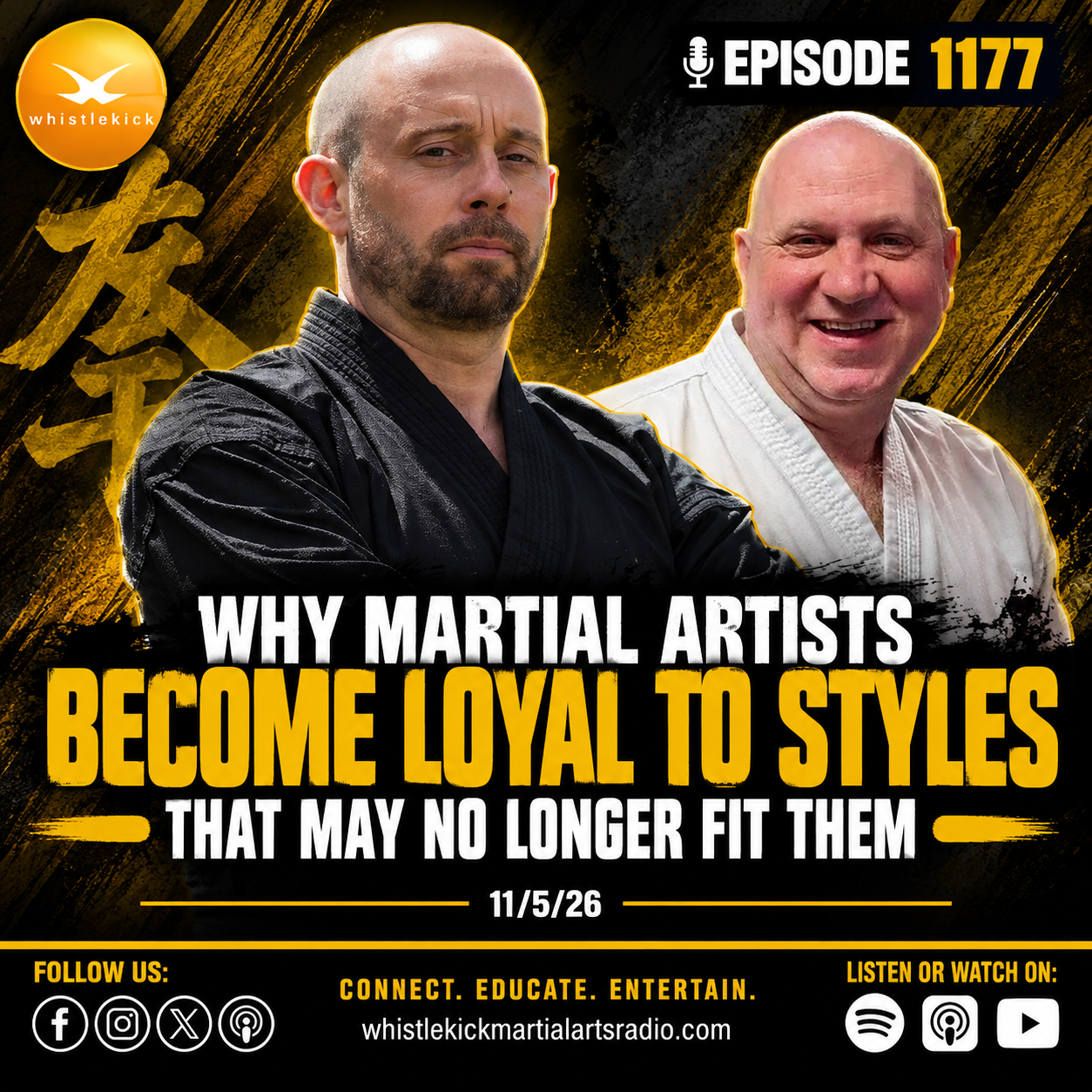
Today, Jeremy and Andrew discuss why students stay involved in a particular style (or school) when it no longer works for them.
Why Martial Artists Become Loyal to Styles That May No Longer Fit Them - Episode 1177
SUMMARY
In this episode of Whistlekick Martial Arts Radio, Jeremy and Andrew explore the reasons behind martial artists' loyalty to styles that may no longer serve them. They discuss the psychological aspects of identity and comfort that contribute to this loyalty, the challenges of transitioning to new styles or schools, and the importance of aligning training with personal goals. The conversation encourages listeners to reflect on their own training journeys and consider whether their current style meets their evolving needs.
TAKEAWAYS
Loyalty to a martial arts style can stem from comfort and identity.
Many martial artists stop training rather than switch styles.
False loyalty can prevent personal growth in martial arts.
The fear of starting over can hinder training choices.
Personal goals should dictate training style and school.
Sunk cost thinking can trap martial artists in unfulfilling situations.
Cross-training can feel like betrayal but is often necessary for growth.
It's important to evaluate if a style still fits your lifestyle.
Leaving a school doesn't mean abandoning what you've learned.
Open communication with instructors can ease transitions.
CHAPTERS
00:00 Introduction
04:10 Understanding the Roots of Loyalty
10:00 The Impact of Identity on Training Choices
15:00 The Dilemma of Staying vs. Leaving
19:51 Navigating Change in Martial Arts Training
24:57 Finding the Right Fit for Your Goals
29:56 Conclusion and Audience Engagement
Join our EXCLUSIVE newsletter to get notified of each episode as it comes out!
Subscribe — whistlekick Martial Arts Radio
After listening to the episode, it would be exciting for us to know your thoughts about it.
SHOW TRANSCRIPT
Jeremy (00:03.406)
Hey, what's going on, everybody? Welcome back to another episode of Whistlekick Martial Arts Radio. And in today's episode, Andrew and I are talking about why martial artists become loyal to styles that may no longer fit. Stick around. As always, we're looking forward to a great conversation. If you are new to what we do, thanks for spending some time with us. I'm Jeremy Lesniak, founder here at Whistlekick, joined by my great friend, co-host, producer extraordinaire.
Andrew Adams, Andrew. It's nice to see you.
Andrew Adams (00:35.969)
You too. I don't know th if it's extraordinaire, but definitely producer.
Jeremy (00:42.552)
Producer adequate.
Andrew Adams (00:45.209)
Well hopefully.
Jeremy (00:47.554)
No, you do a great you do a great job and everybody knows you do a great job. So I appreciate the humility, but I also know you're proud of the hard work that you do. So we don't we don't need to go there. and to everybody out there, again, if you're new or maybe you just need a reminder because we live in a world that that does not operate this way, when we do these episodes, it is never to tell you what to think or what to do. It is always and only to get you to think.
We want you to think. We want you to consider yourself, your place in the martial arts world, your training, all of these things. And so as we unpack today's episode, please let that be the motivation. As you hear what we say, let it make you think and then see where that takes you. And if it takes you back to the exact same place when you're done, cool. If it doesn't, that's fine too. The important thing is that you take a step back from your own reality.
And contemplate. Now, Andrew, this topic here, loyalty to styles that might no longer fit someone, it does f for for per for both of us, it does fly a bit against how we look at martial arts. You and I individually are not big on style versus style versus style.
Andrew Adams (02:15.586)
Mm-hmm. Yep. Yeah. I I would agree, neither of us are stuck on that. I mean, I have, I am currently training in a school that has a specific style. and I have in the past, but I am not, I don't feel like I have this dogma around having to still like if if if I moved tomorrow, I would not feel obligated to have to find a shore and root.
Karate school.
Jeremy (02:47.062)
And in fact, there are so many people who are beholden to that style that I I've seen a sad number of them. Something changes in their life. They can no longer attend the school that they love. And rather than train something else, they stop training altogether. And I think that is that is very, very sad. So that it yeah.
Andrew Adams (03:09.208)
Complete.
Yep, I see that.
Jeremy (03:14.402)
That that's not where this episode is going to go, but I I wanted to kind of put that I guess I'll call it a disclaimer out here at the top, because I I want the audience to understand that this conversation we're having might be about you, but it's not really about there isn't gonna be a ton of personal experience for Andrew and I, I I would say. All right.
Andrew Adams (03:37.273)
And this episode might also not be about you. Right? You you might listen to this this episode and and and realize that what we're discussing doesn't describe you, and that's okay, because maybe in the future something will change in your life and your training, and something that we talk about today resonates with you and it might allow you to think, which we want you to do,
Jeremy (03:43.138)
Hmm. And that's okay too.
Andrew Adams (04:05.74)
back on this and it might help you out in the future. Who knows?
Jeremy (04:10.04)
So I think the first place we go is why this happens. Why is it that style becomes such a core part of someone's identity or self-worth that they will remain in a place dedicated to that style when it even after it stops meeting their goals?
Andrew Adams (04:32.928)
Yeah. I mean, I I think the reason that I keep coming back around to is that people like what they know and feel safe and comfortable with what they know, and anything outside of that is foreign to them, even if it's just to a certain degree, and so they can find themselves unwilling to look at other things because
They feel safe and warm and cozy in what they know.
Jeremy (05:07.526)
I agree. I think for a chunk of people, and if you had asked me a year ago, I would have said it was a small chunk of people. I'm gonna say it's the majority of people now who feel safe and warm. They feel safe and warm in this situation because of their place in the grouping that is the school and the style.
is such a core part of their identity that they lack the ability to let it go.
Andrew Adams (05:43.062)
Yep. Yep.
Jeremy (05:44.3)
They will remain in a in a style. And and again, we're talking about style, not school. And I know for a lot of us that line gets kind of blurry, but you know, let's let's think about style in kind of a macro, not karate, but you know, Andrew, you mentioned prior, shornroom. Right? Like that is that's a generally accepted style. Okay. people will keep pursuing their training.
In a style that no longer serves them because and and again, I've heard this so many times. I don't want to start over. I don't want to be a white belt again. I don't want this. I I had friends in a taekwondo school that that school shut down. And
They started train, and this is multiple people, started training at other schools that they did not like, that were far away, rather than come train karate with me around the corner. Because well
Andrew Adams (06:49.869)
Hmm. Yeah.
Jeremy (06:56.92)
Can I keep my black belt? Well you can train as a black belt, but you're not a black belt in karate, you're not a black belt in my school.
Jeremy (07:07.926)
And I think that this becomes a big part of it, right? Like I know who I am because I put this belt around my waist, I know the people around me, I know the material, right? You said it safe and and cozy. And to start over is scary. And so plenty of people would rather not.
Andrew Adams (07:30.231)
Yeah. Yep. And I I think, you know, w we we titled this why they become may become loyal to styles rather that may no longer fit them or their lifestyle, right? That's the other thing that you know, I I do think if y the example you just described, student was very happy in their taekwondo school and the taekwondo school closed.
Jeremy (07:43.446)
Yeah.
Andrew Adams (07:54.661)
And that person decided not to do training five minutes down the road at a karate school because they are staying loyal to a style. It's not so much that that style doesn't fit them. They still love taekwondo. That's great. But that style doesn't fit their lifestyle right now or their circumstances because there isn't a school nearby.
Jeremy (08:19.48)
Right. And and
more common in that school that closed was that people stopped training entirely.
Andrew Adams (08:27.478)
Yep. Yep. Completely.
Jeremy (08:29.804)
And I see that often. And it it it is it is sad. It makes me sad. And
What what I often hear from people is it can be loyalty, but it can also be false loyalty. I hear people say, Well, you know, I really loved my instructor, I loved the training, I loved the people that I was training with, I loved the forms, I loved the way we sparked, I loved some collection of what we did. Maybe I loved everything.
Andrew Adams (08:49.035)
Hmm.
Jeremy (09:04.992)
And since I can't have that, I don't want to be unfaithful to that thing that I love. So I'm not going to train. Now, I imagine that there are some people for whom that is genuinely true.
I don't think I've ever met an instructor who would rather their former students not train. Right. So the loyalty I think is misplaced. But but when I say it's false loyalty, it kind of goes back to the first point that we were making.
The idea that
It's about wanting to remain safe and cozy and being at home not training is safer and cozier than training in a strange place doing strange techniques wearing a different belt.
Andrew Adams (10:00.311)
Yeah. Yeah. And and I think the other way that I that I have personally seen it come up is if we go rather than, you know, macro, we go actually really micro that I I had an instructor who was we were training Sean Roo and one lineage of Shoren Rue and his instructor passed away. Very unfortunate and for years and years and years that my instructor didn't have another instructor.
And he had the opportunity to train under someone else and ultimately and it would have been Shorn Rue, but it was a different lineage and would have had to do his forms slightly differently and would have had to change some things, but it was easier to just stay with what he knew rather than doing something that might better himself as a a martial artist because he didn't want to change what he did.
Jeremy (10:58.38)
And in that case and in so many of the other cases, what we find is
When and and honestly, as I I'm slowly wrapping my head around this and and the timing of this episode is is really interesting. I'm having a bit of a personal crisis as I come to realize that the number of martial artists who cr who actually are dedicated to their personal growth as martial artists on an ongoing basis is dramatically smaller than those who claim to be. For so many people, they reach a tipping point.
Where it stops being about their own growth and it's more about their place in the world.
Andrew Adams (11:40.748)
Yeah, interesting. Okay.
Jeremy (11:42.124)
And they will forego right the example you gave. And I I know the situation. We don't need to talk about the specifics any anymore, but you know, I know who you're talking about. And to look at that situation, say, okay, I could continue to train slightly differently under someone who genuinely knows more than I do and who would supervise, foster my continued growth as a martial artist.
Or I cannot do that. I cannot have any instructor. And we've we did an episode on why everyone needs an instructor. The subjects come up quite a few times. And I'm not gonna take a new instructor and instead I'm going to continue to maybe do a little training on my own, but mostly teach.
Because that's my place in the world. I'm a martial arts instructor and I know what I know and I surround myself with people who are subordinate to me and I
In ma I'm not gonna say most, in many cases, I delude myself into believing that I am continuing to progress.
Jeremy (12:58.06)
Because what has become most important to me is that safe, cozy feeling.
Andrew Adams (13:01.921)
Yeah. Yep. And I think for a lot of people, they feel so much is invested, so much of themselves and their time is invested in this thing. that I mean it almost becomes like like a a a car, right? You've got so much time and money into this car, but it's got this major problem. At what point do you realize you've got this sunk cost of like I've already put all of this.
Jeremy (13:17.774)
Mm-hmm.
Andrew Adams (13:28.289)
time and money into this car. So I mean I'm I've gotta get it fixed because I've already put so much into it. and I think that sunk cost thinking kind of can affect martial artists a as well. That we have this time and training in with this particular s style or school or instructor, whatever, that I I have to stick it out because of whatever. Because i I I I don't wanna try and
Do something different even though it might be better for me.
Jeremy (13:59.554)
Yep. A and and we didn't really talk about the reasons that a style might not fit someone anymore, but real they it in every case, because we've talked about it this way, you should be training in such a way that it is reflective of your goals. You get clear on your why, and that informs your what, your when, your who, your how, your where.
If my goals ch if if I I'm at a school and I progress and it's great and my goals change, there is a very good chance that I can no longer meet those goals at that school. Because if I could, then the school probably wasn't meeting my prior goals.
It's very difficult. Any martial arts school who claims to meet the needs of everyone equally is meeting the needs of no one ever.
Andrew Adams (14:51.481)
Mm. Yeah.
Jeremy (14:54.732)
Right. Doesn't mean you can't be you can't find value.
But if we think about what is most important to each of us with our training, if you've trained in a bunch of different schools, you know that some schools were better for some things. And to pretend otherwise is just, it's it's crazy. So when when I reach the point where the school no longer fits, and we've had numerous episodes about leaving a school and cross-training and all that. And I'm not saying it's not.
Andrew Adams (15:14.467)
Yeah.
Jeremy (15:27.97)
That it it I'm not saying it's easy to do. It's a very challenging thing to do. It it can be gut wrenching to leave the school.
Jeremy (15:38.584)
But to sit there and say, Well, you know, I've been here for ten years or twenty years or thirty years.
I might as well just keep going. What you're really saying is I might as well accept training that does not serve my goals until I die. That's what you actually mean when you say that. And that is ridiculous. Remaining in any kind of arrangement that is overall not meeting your goals, whether it is a personal relationship, a professional relationship, romantic, platonic training, I don't care.
Andrew Adams (15:55.8)
Yeah.
Jeremy (16:15.914)
If it doesn't serve your needs and your needs are reasonable, I don't want to train at this school because they didn't give me a crown. Well, that's not reasonable, right? If you want to find a school that crowns people instead of putting belts on, that's fine. But No, it's not fun. It's insane. Okay.
Andrew Adams (16:35.62)
Ha ha.
Jeremy (16:40.11)
If what is most important to you is personal growth, is professional growth, it's martial arts growth, you need to seek out a school that facilitates that. There's only so much that you can do adjusting yourself. Right? It's easiest to change ourselves, right? When we're when we when we reach something, you know, in a school, you know, this school isn't, I'm not, I'm not getting my needs met. Well, how can I show up differently?
Can I train harder? Is there stuff I can practice at home that's gonna, you know, make class time a little different for me? That there are options there. But if you get to the point where no, it doesn't matter what I'm doing because this is going in a different direction. For example, I've known people who really wanted to pursue full contact combat, whether it's whether you want to call it MMA or kickboxing or whatever, and they are at schools that spar very infrequently.
Now, maybe there's some cross training. I don't know. But I've also known quite a few people have said, you know, I love training here, but this is not what I want anymore. I want to go over here with these people and train in this way to meet this goal. And the instructor, in most cases, says, I understand. That's great. Sad to see you leave. You're always welcome back. Good luck. Because that's what a healthy instructor does. Right.
Andrew Adams (18:01.719)
Yeah. Yep. Yeah. And and there's not and maybe that first school was meeting your goals when you joined them and your goals changed. You decided you wanted to do full contact sparring and your school doesn't do that. Like that's okay. There's nothing wrong with that. I think for some people that cross training can feel like a betrayal. And I think I think when that happens, it more so is a reflection on
And here's a little hot take. I think it is more of a reflection on the instructor than it is the student.
Jeremy (18:39.552)
It can be. I have known and I've been in situations where I have felt far more loyalty to my instructor than they felt to me. That's just that's how I'm built. The loyalty is really important to me. So if I choose someone, you know, if if I choose you as a friend, or I choose you to be, you know, part of the team, or I choose you as my instructor, that's a that that's significant to me.
Andrew Adams (18:48.727)
Mm.
Jeremy (19:13.368)
But I know not everyone's built that way. So it could it y I'm not saying what you're saying is untrue. I'm saying it's not all the time. What I think I'm hearing you say is that there are instructors who will make you feel guilty about leaving or cross training because they're trying to cultivate some false loyalty.
Andrew Adams (19:32.353)
Yes, that's what I'm saying. That if a student starts to do some cross-training and they feel like it's a betrayal, I say, in my personal opinion, that it is likely that stems more from what their instructor feels that they are projecting that onto the students.
Jeremy (19:51.246)
It it absolutely can be. But it can also just feel like betrayal. You know, I I I've I've had some difficult conversations that I thought were going to be really difficult. And I bring them to the instructor. They're like, Yeah, no, it's fine. We're good. Yeah, go go train with them. That's you just show me what you learn.
Go ahead. I wish you luck. Right. And so where does that come from? It goes back to the warm, cozy feeling of some recognition that I feel safe in this environment. I'm going to step out of the environment. And there's a part of my brain telling me this is scary. You should not do it.
Jeremy (20:39.126)
Right. And of course there's a there's a difference between
We'll call it
that growth, that evolution in your training and abandoning.
Andrew Adams (20:54.369)
Mm.
Jeremy (20:56.652)
Right. I I've known martial artists who reach a point and in order to justify their departure, usually because they had a great instructor and they trained with great people and they did well, they cultivate some and again, not all the time. There are people but that's no, that's fine. It's we're not talking about you then. It's okay. We we can talk about people that aren't you. It's not all about you.
They cultivate some scenario or they
Overblow a situation to justify leaving. That they can't accept, you know what, this is good. I just I need a change so I can reach my goals, and I'm gonna set this down and look at how far it's taken me, and I'm gonna go over here. And the easiest examples to think of with this have to do with romantic relationships. You know, a relationship isn't
Andrew Adams (21:59.416)
Mm-hmm. Sure.
Jeremy (22:02.07)
You know, maybe it's not what either person wants. Maybe they're kind of struggling to piece it together, it's okay, and something happens and one of them just loses their mind and makes it a makes some situation a huge deal so they can justify their feelings and their desire to leave.
Andrew Adams (22:21.943)
Yeah, yeah, absolutely. And I'm sure all everybody listening if have not been through that themselves, they've seen it in in other places. Yeah.
Jeremy (22:35.288)
But how do you do that right? Even the example, let's let's take this this figurative example of the person who trains in a very traditional low contact style and they want to become a full contact kickboxer.
Jeremy (22:52.514)
I think if you're doing this in the right way, if you're doing it in a healthy way.
Two things are gonna happen. you know, this is coming more naturally to me because of this training, because of this drill, because of what instructor so and so said or did for me or with me.
And or they're showing us how to do it like this. If I put this small twist on it based on my training and this other thing, that gives me an advantage because other people don't know that.
Andrew Adams (23:29.697)
Yeah. Yeah. All everything you have learned up until that point can help, I don't want to say dictate, but can help shape how you do things in the future. I mean, a perfect non martial arts example is how many people had a job and then lost that job and got another job, maybe completely different, but realized some of the things they learned in the first job helped them with that second job. The same is true with martial arts.
You know, and
I remember Jeremy, you talking about that you started martial arts doing karate and you did taekwondo for a long, long, long time. But people would say to you that you did taekwondo like a karate person because it's what you were used to and comfortable in and it shaped how you did your taekwondo a little bit. So Well well. So I mean
Jeremy (24:22.358)
More than a little.
Yeah, if if you if you watched me, it was more than a little, no matter how much I tried.
Andrew Adams (24:29.239)
Yeah. So all of that stuff, all the stuff you've learned up until then, like even if you're leaving a traditional school and you're gonna go do full contact, it's still going to shape to some degree how you do things. And it could be in a bad way, but likely not, because you're gonna use what works for you. So it's it's only gonna help help you and make you better.
Jeremy (24:52.19)
Right. The the metaphor that we've used on the show often has to do with language and accent. The first martial art you learn tends to become the way you you you think and talk about martial arts movement. And that gives you an accent. I very much went to Taekwondo with a karate accent. And
Andrew Adams (24:57.569)
Mm.
Jeremy (25:14.686)
There are people, you know, when they when they move, right? Someone moves from country A to country B that speaks a different language. There are people who say, you know what, I I'm gonna speak the language of of home with friends and family from back home. I don't mind that I have an accent. I'm gonna learn the language, you know, I'm gonna be bilingual, and that's cool. And then you have other people who move to the second country.
And they pretend the first country doesn't exist, they don't don't talk to their friends or family, or they work really, really hard to drop their accent. They they're embarrassed by it. And I've known martial artists like this too, that they go on, you know, I used to train in right? They're disparaging about it.
Andrew Adams (25:51.374)
Mm-hmm.
Andrew Adams (26:02.903)
Yeah, yeah, yeah.
Jeremy (26:06.03)
Doesn't have to be that way.
Andrew Adams (26:07.383)
No, you you can outgrow a school and an an you know, a an inv a training space and leave without disrespecting it.
Jeremy (26:19.722)
Now we've spoken very generally about some of this, but when we think about style and with the caveat that you can train a single style in a variety of different ways
we can we can apply some specifics here. So
For example, if I am in a Krav Maga school and I want to compete in open forms competition, that Krav Maga school is not gonna be where I should be. The style of Krav Maga is training Krav Maga is not gonna help me get better at forms.
Andrew Adams (26:55.491)
Mm-hmm.
Andrew Adams (27:10.243)
Sure. Or Muay Thai is not going to help you get better at forms.
Jeremy (27:16.76)
Vice versa, I've known plenty of people who were training in a very traditional, you know, karate style, and they get some exposure to Krav Maga and self defense stuff, and they're like, This is really what I want. I want the what is most important to me, my biggest goal right now, is being the most capable, prepared, street self defense person that I can be.
That is not like I I've had students come to me. That is not my school. I will get you somewhere along that path, but it is not the fastest route. If that's what you want, you shouldn't be training with me.
Andrew Adams (27:50.829)
Yep, sure.
Andrew Adams (27:56.109)
Yep. Yep.
Jeremy (28:02.946)
Here's a Krav Mag school over here. Go do that. That is much closer to your goals.
Andrew Adams (28:08.237)
Yep. Yep. I an another example would be weapons. I know people who in their school, their school don't doesn't do any weapons training whatsoever, which is totally fine. But this particular person, every time they go to seminars, they are so excited to do weapons, whether it's bow or whether it's nunchaku or what whatever it is, they're just Yeah. I you notice I did say Bo, period. Left it at that.
Jeremy (28:19.502)
Mm. Mm-hmm.
Jeremy (28:32.023)
Steph stick.
Jeremy (28:35.938)
I did. I did.
Andrew Adams (28:38.061)
But th they were complaining to me that I really, you know, I really wish our school did weapons. I really, really, really enjoy it. and and I I'm finding that I'm enjoying doing weapons more than I'm enjoying doing, you know, the karate that I'm doing in my school. Well, maybe your school isn't meeting the needs that you want. Like that style doesn't do any weapons and you really want to do weapons, then you maybe need to look for a different style.
Jeremy (29:10.72)
If you find that you leave class routinely saying
That was a good class, but I wish we did more of this. And you're constantly saying that?
And the and the this that you're saying doesn't change, then it's a sign you might want to might want to look elsewhere. Now, if you're someone who's just never happy and on forms nights you wish you'd done more sparring, and on sparring nights you wish you'd done more forms, and on basics nights you wish you'd done self defense, then then you're just a disagreeable person and and and you need to learn how to be happy with your trading. But if you're always leaving class saying,
Andrew Adams (29:43.757)
Or break breaking or whatever.
Jeremy (29:56.334)
I feel like I'm not prepared for this, or I feel like I'm not reaching this goal, or every time you come up for evaluation or testing, you're finding there are deficiencies in your your training that get passed along. You might ask the question. I'm not saying that this the style is not right for you. I'm saying it might be, and it warrants thought.
Andrew Adams (30:23.865)
Sure. It some evaluation.
Jeremy (30:29.464)
I would love to hear from the audience about people who have been through this, because I know we've got a lot of people who've been through this. What was it that made you decide that the style you were training no longer fit you? And I'll be honest, I have changed styles, but not because I changed styles, but because I changed schools. It is a different problem and solution.
But I know people that have changed styles. I want to hear from you. Email us, jeremy at andrew at whistlekick.com, or you can post on the Facebook page, martial arts radio. you can leave comments on YouTube or Spotify. I feel like the more personal anecdote we can get in here, the more helpful it will be for others.
Andrew Adams (31:14.509)
Hm. Yep.
Jeremy (31:18.326)
Anything we missed? Anything to add? Okay, cool. Well
Andrew Adams (31:20.107)
No, I think that's good.
Jeremy (31:25.974)
We're gonna call it then. I wanna thank everybody out there. Thanks for spending some time with us. As always, you can go to whistlekick martialarts radio.com for the transcripts and show notes for every episode. Make sure you're subscribed in the podcast apps on your phone. Make sure you're checking out the video versions on YouTube. We are everywhere that you can find podcasts. And we are proud to be the world's number one traditional martial arts podcast. So thank you for helping us get and remain there.
Until next time, train hard and have a great day.
Andrew Adams (31:58.723)
Smile. Have a great day.