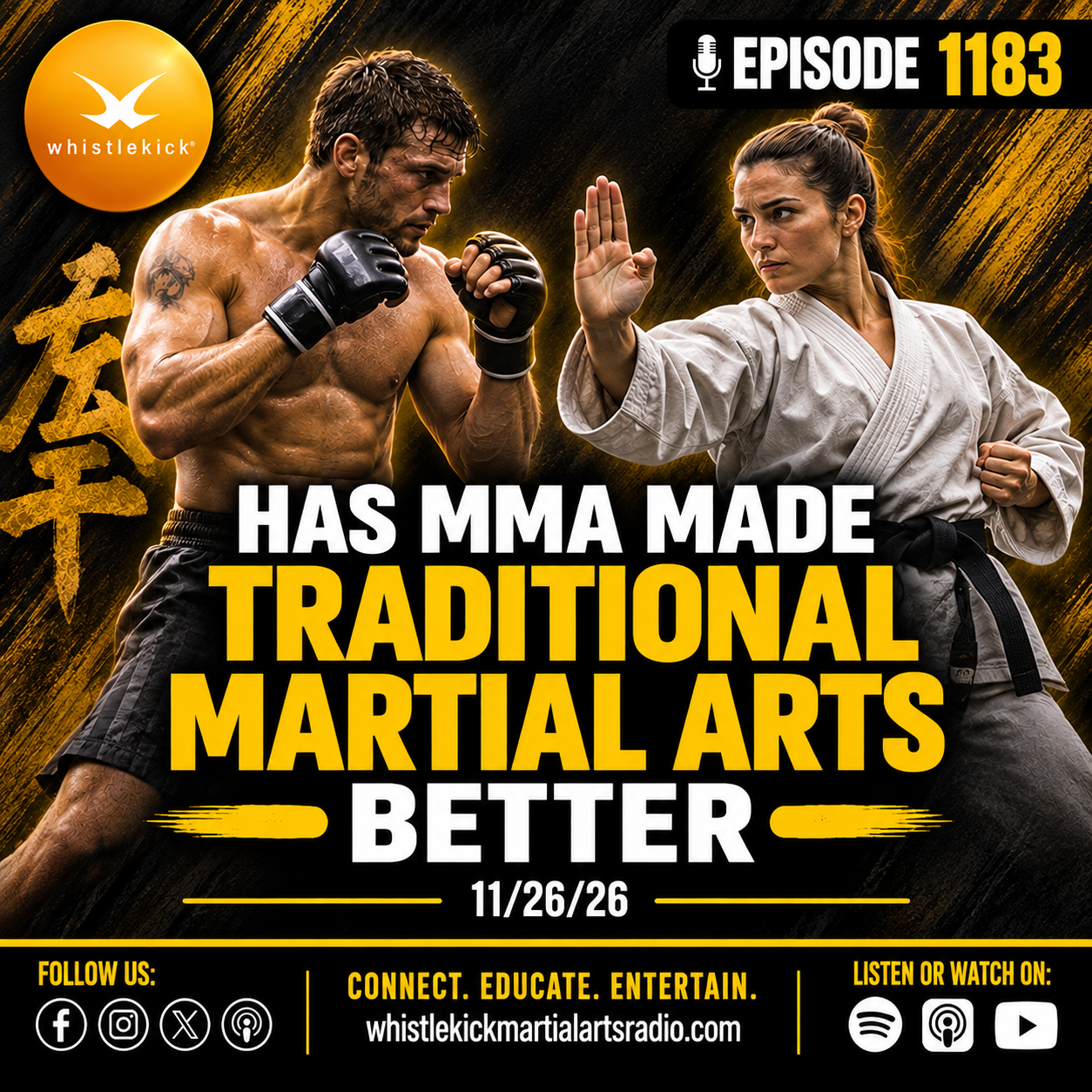
Today, Jeremy and Andrew discuss whether MMA has made traditional martial arts better.
Has MMA Made Traditional Martial Arts Better - Episode 1183
SUMMARY
In this episode, Jeremy and Andrew explore the impact of MMA on traditional martial arts, discussing how MMA has influenced training methodologies, the importance of pressure testing, and the evolving relationship between the two disciplines. They delve into the benefits and drawbacks of MMA's popularity, emphasizing the need for traditional martial arts to adapt while maintaining their core values.
TAKEAWAYS
MMA is often misunderstood and has different meanings for different people.
The existence of MMA has prompted traditional martial artists to refine their training methods.
MMA focuses on what works in real combat situations, which can benefit traditional martial arts.
Traditional martial arts can learn from MMA's pressure testing techniques.
The popularity of MMA has led to more data points for traditional martial artists to analyze.
Not all traditional martial arts schools need to abandon their roots to adapt to MMA.
Fighting ability should not be the sole measure of martial arts value.
MMA and traditional martial arts are beginning to converge in some aspects.
The labeling of traditional programs as MMA can create confusion in the martial arts community.
It's important for martial arts schools to have open discussions about their identity and training methods.
CHAPTERS
00:00 Introduction to MMA and Traditional Martial Arts
01:28 Defining MMA and Its Impact
03:36 Training Methodologies: Traditional vs. MMA
12:05 Pressure Testing and Realistic Training
14:06 The Shift in Traditional Martial Arts
16:51 The Convergence of MMA and Traditional Martial Arts
19:07 The Broader Implications of MMA's Popularity
Join our EXCLUSIVE newsletter to get notified of each episode as it comes out!
Subscribe — whistlekick Martial Arts Radio
After listening to the episode, it would be exciting for us to know your thoughts about it.
SHOW TRANSCRIPT
Jeremy (00:07.854)
Hey, what's up, everybody? Welcome back, or maybe welcome for the first time to another episode of Whistlekick Martial Arts Radio. This is episode 1183. Has MMA made traditional martial arts better? Andrew and I are going to talk about that. Who's Andrew? Who am I? Well, Andrew is Andrew Adams, producer, extraordinaire, great friend. And I am Jeremy Lesniak, founder here at Whistlekick, where everything we do is in support of the traditional martial arts.
And we do what we do because we believe martial arts, traditional martial arts, brings out the best of us. If you love what we do, please consider supporting us. Patreon, buy something at whistlekick.com, subscribe, tell people about us, or you could join the email list, go to whistlekickmartialarts radio.com, sign up for the email list, get some some behind the scenes, get every episode emailed to you, audio and video. So
This is what we do. Thank you for being here. And with that, Andrew, I think we should jump right in. Has MMA made traditional martial arts better? Now I know when we were talking about this earlier, you you kinda had a I don't know if I want to call it a disclaimer, but something that you wanted to throw on the pile, so to speak, before we dug in.
Andrew (01:28.268)
Yeah, y the the words MMA or the word or the the anagram MMA whenever has different meanings for different people and I think it's important that we get out early and say that we are thinking when we say MMA in this episode, we are talking about what the majority of the world thinks of when they hear MMA, which is
You're getting into an octagon, whether it's things like the UFC or Pride or K one or those types of things. There are schools out there that say they teach MMA, but it's more of a multi-martial arts. So like they have a class in Taekwondo and they have a class in Kung Fu and they have a different class you can go to for boxing and a different class for Muay Thai. It's not that to me is not
mixed martial arts. It's kind of multi martial arts. And I I think we're talking about a v a specific kind of MMA, which is what most people think of.
Jeremy (02:36.532)
Right, right. We are talking about this big, financially successful, popular on television behemoth. It's not limited to any one promotion, but it is the broad pursuit and an awareness of this full contact combat sport. That is what we were talking about when we say MMA. And the question is: has that, as the existence of that
And the pervasiveness, the awareness of that, has that made traditional martial arts better? And it's an important question because so often there's comparison, there is there's discussion, even in your disclaimer, it suggests how important it is because there are people using the term in different ways, maybe to kind of capitalize on the popularity of the term.
Right. And you know, maybe maybe there a good place for us to start is the place that everyone else seems to start, which is the notion of whether or not MMA has refined the way traditional martial artists train, at least sometimes, with respect to what is and is not we'll call it effective.
or realistic combative training. What do you think?
Andrew (04:10.69)
That that's a good question. you know, I I think that
Andrew (04:18.808)
Traditional martial arts
looks at I think fighting and I'm putting fighting in air quotes.
Jeremy (04:28.322)
We did an episode recently on that word. Yeah, yeah.
Andrew (04:31.012)
looks at fighting a little bit differently from MMA and I think that that I mean and that's obvious, right? I mean MMA s people are gonna look at fighting differently than traditional martial artists, but I think that for some s I I think some MMA has kind of opened the eyes up of traditional martial artists in regards to their for some schools some pr potential unrealistic training that they were doing
To get people ready to be involved in a confrontation.
Jeremy (05:04.206)
Yeah. I think the biggest the biggest thing on that front that MMA did is it was not beholden to anything. It was only what works, what works in this situation, what works for me and my body against this person in this rule set. It was it it it doesn't have to be. Well, this is what I was taught.
We do this technique because so so. We do this because it's in this form. It is in that sense, I think, much more pure.
It is simpler. And I think that there is value in that. And I that doesn't mean for me that we throw out everything that traditional martial arts is, even though some people have decided to do that. I think it means that it's another perspective on how we look at training.
Andrew (06:04.94)
Yep, yep. And I think even the training not the word not the word methodologies, that's not the right but the thing the ways that traditional the not the ways that MMA trains has definitely carried over a little bit into traditional martial arts. I mean I many, many, many traditional martial arts schools use equipment that are used in MMA and they didn't really become
I'm not gonna say they weren't around before, but they weren't as popularized. I mean, a lot of traditional martial arts schools will use a heavy bag, right? Or they'll have a heavy bag in their school. But a lot of these schools are using newer, whether they're hand mitts or or like forearm shields or
Jeremy (06:55.566)
Sort of tie pads, yeah. Yeah, there's definitely been some adjustments in how drills are are done because I I think I think both the unconventional, unconventionally trained martial artists that succeeded in MMA, as well as the karate taekwondo.
Folks who stepped into MMA and did well. I think a lot of us learned a lot there because prior to MMA, a lot of what we the closing of the loop of training to application was theoretical for a lot of us. Now most of us aren't going to step into the ring. Most of us don't want to. For most of us, that is not our what. That's okay.
Neither Andrew or or I have any desire to step into, unless something's changed for you, my friend, step into some full contact stuff, you know, in in the upcoming weeks, months, years. Our training to application is still very theoretical, but we now have more data. And I think that that data is the most important part that traditional martial arts schools have. We can watch fights.
And or matches or whatever we're gonna call them. And we can kind of work backwards and say, hmm, given this situation, look at what happened, look at this technique, look at this technique selection, look at this defense, look at this combination, look at whatever it is. And no, it doesn't mean that it's the be all end all because it's a single situation, and we need to remember that. But it an anecdote of one is better than a theory of zero.
Andrew (08:43.979)
Exactly.
Jeremy (08:46.966)
It gives us something to look at.
Andrew (08:49.612)
Yep. Yeah. And we have a lot more data points to watch now, look at, l literally look at, with MMA becoming more readily available and accessible for people to watch. So it it gives us the ability to look at what has worked and has not worked, which was a lot more difficult for us traditional martial artists to be able to determine what did and didn't work before.
Jeremy (09:18.104)
Right. Right. And and I think that this is this is where the healthy adaptation of traditional martial arts schools has has occurred. Because it doesn't mean that we have to throw everything out. Just because this other thing exists and it gives us some information doesn't mean I have to stop doing forms. Doesn't mean I have to stop doing anything. But it does mean that if I a core of my training.
Or a a s rather a component of my training. And I think at most traditional martial arts schools, there is a component of training that is meant to readily translate to defense, to self-defense. Whether that is high-level competition or whether that is what in my school we call the heaven forbid situation, right? You're outside, someone attacks you.
Andrew (10:08.748)
Yeah, yeah.
Jeremy (10:10.722)
By having more of this information, we can refine what those drills look like. We can refine the scenarios. you're being attacked with a knife. Does that person just step in and stand in place? Or are we taking more of a I would say a realistic approach to how that person conducts themselves? What if they step in and punch?
There's a difference between a drill where they step in and punch and they freeze, which most of us grew up with some form of that in our training. But not all of us had something beyond that. What happens when they don't freeze? How do we take the the these drills and progress them in a direction that is more I don't love you using the word realistic here, but I think it's probably the best one.
Andrew (11:04.64)
Yeah, yeah. And you know, and what traditional martial artists have been able to gain from that to determine whether something was effective or not. Right? You know, the the we we have a way now to be able to watch other people doing techniques that will hurt other people, right? I mean, we talk about this all the time on the show that you know, when I go into my a school and I'm training with someone, I don't want to hurt the other person.
And in an MMA match, their goal is to win, which there is some inherent you are likely going to get hurt. They are trying to hurt each other. Now they're not trying to kill each other, right? But they are trying to hurt the other person, which is not what I'm trying to do in my school. And so it allows me to see what can be a little what can be effective and and proving some effectiveness in there i is useful.
Jeremy (12:05.836)
Yeah, getting getting some exposure to consequences of of application, I think, is is really valuable. And in a lot of that falls under the heading of pressure testing, right? It's a it's a buzz term that gets thrown around a lot in our space, this idea of pressure testing. Well, are you pressure testing? How do you pressure test? Well, you know what? It's all pressure. It's a question of amount of pressure. And there are
Times when we want as little pre pressure as possible. If I'm trying to teach some things to a group of six-year-olds, I don't want a lot of pressure. If I'm trying to teach something to someone on their first day, I don't want a lot of pressure. But there are times with, for myself or higher rank students, I want to kind of whittle down some of what we're working on so we can add pressure. We did that last night. We did a drill that was entirely focused on.
The pressure of dealing with multiple attackers. Were they punching each other in the face? No. No, we restricted the drill. It was all about tapping on the shoulder. We cultivated a high pressure situation that also had a lot of safety. To me, that for for from my exposure, that's been some of the best stuff that's come out of my understanding of what's happening in MMA gyms. How do I add the pressure?
in a way that everybody's gonna go home tomorrow, but they still learn.
Andrew (13:39.042)
Yeah, exactly. 'Cause like you y you don't want them to have to leave your school and have to go to the hospital.
Jeremy (13:45.622)
I don't want them to go home no I want them to go home today. I said tomorrow. I'm sorry, I cut you off.
Andrew (13:52.768)
No, no. I I mean I'm j I'm just you agreeing you want your students to be able to go home and and be able to go home and not have to go to the hospital because they got really hurt at class, right?
Jeremy (14:06.964)
This can often lead to the notion that fighting ability is the most important thing. And this is a place, not that the title of the episode is where has MMA made traditional martial arts better and where has it made it worse? But if it was that title, this is the place where some traditional martial arts schools are struggling.
Because they are bringing in some of the benefits of MMA style training and some of the exposure MMA has brought to the world. And they're trying to turn their traditional whatever school into a fight gym.
Andrew (14:44.28)
Yeah, yep.
Jeremy (14:46.166)
And that's that's not what you've got. Those aren't your tools. If you want to switch it up, if that's what you want to do, that's fine. But if what you teach is karate and it's traditional pick your flavor of karate here, and you let's say it's Shotokan, you know, it's a style that you and I are both familiar with. It's a popular style of karate. And you stop doing kata. And you stop doing three step sparring.
Andrew (14:54.934)
It's
Jeremy (15:17.467)
And you stop doing traditional warm ups.
And you st talk smack about Funakoshi. Are you really teaching the Shotokan karate program? You might be teaching something else. You might see it as evolution. And I might not even argue that point.
But when fighting ability becomes the primary why
That disconnects you from a lot of what had come before. And I would argue also disconnects you from why most people are training. Mm-hmm.
Andrew (15:55.852)
Yeah. Fight fighting effectiveness, it's not the whole conversation about martial arts. There are lots of other reasons to be training martial arts and you know, fighting your ability to fight is not the only measure of your martial arts value, of your style and your ability as a martial artist. It doesn't have and this could be and has been other episodes, right? but but I do think that's one like I would agree, that's one thing that
MMA hasn't helped us. So that would be a different episode. So let's let's talk about the you know, one other thing I want to get into is whether if if traditional martial arts has started taking some things from MMA, are traditional martial arts and MMA starting to become a little more similar and meaning in the middle?
Jeremy (16:51.606)
I I think they are definitely taking steps towards each other. I don't think they're becoming one in the same. Yeah. Because it's not just traditional martial arts that are are learning from MMA. MMA is learning from traditional martial arts. There are a lot of MMA, excuse me, MMA programs out there that have added belts.
Andrew (17:12.023)
Yep, okay.
Jeremy (17:14.156)
There are MMA programs out there that spend time thinking about how to address people, like titles and whatever. Now, a lot of those schools use coach, but not all of them do. That's a conversation that comes out of traditional arts. And
I don't think there's anything wrong with two things becoming more similar, because inevitably that means the and you know, I've said it on here plenty of times. I'm a free market economist. I I I believe not that I'm a formally an economist. I believe in free market economies. And I believe that ultimately, if people are given enough choices about the martial arts schools that they want to train at, they will.
Something will respond, something will give them what they want. And if people want belts and ranks and titles, most schools are going to end up with belts and ranks and titles, regardless of whether they call themselves traditional or mixed. If people want realistic fight training, most martial arts programs will end up with those things. The fact that we don't have that is proof that most people don't want that. And I believe that over enough time.
We will see more and more of this sort of borrowing and experimentation and some stuff will get thrown away. And we will see what it turns into, but I don't think it will ever stop turning into. It's gonna continue to shift as it should.
Andrew (18:48.568)
So the answer to the question is yes.
Jeremy (18:53.358)
Yes. They are becoming more similar. You're right. They are becoming more similar.
Andrew (18:58.872)
I was thinking more in terms of the question, has MMA made traditional martial arts better? I think the answer is yes.
Jeremy (19:07.954)
Yes, but I'm actually gonna point out a place where it has not, and I think that this is really important. I don't know if we're coming out of this yet, but the there there has become because people like acronyms. MMA is a is a fun acronym to say. It's easy to say. Martial arts, prior to MMA, there's no acronym. Nobody prior to MMA, nobody referred to
Traditional martial arts as TMA. I've never seen that before. And nobody uses it. Even within our industry, we're not using the term. Well, we're TMA. We don't use that. Because there is no counterterm, there are plenty of people who refer to the entirety of martial arts as MMA.
Jeremy (19:59.148)
Because that has become so acceptable to do. I just had somebody, where did I see this? It was an email yesterday. I'm trying to remember the context.
Jeremy (20:10.358)
I think it was even about my school. Somebody was referring to what we did as an MMA program. And it was very clear because it wasn't from martial artists to martial artists, it was between two people who are not martial artists. It was very clear within the context that they meant a martial arts program.
Andrew (20:32.96)
Interesting. Okay.
Jeremy (20:34.85)
When that term is applied broadly, and people who do not train and have never been in a school, especially if those people are adults with children, and they have been considering having their child train, and the entirety of what they are exposed to is television martial arts, which 50 to 1 is going to be an MMA match.
or reality show, does that make the parent more likely to want to put their kid into a traditional Taekwondo program?
Andrew (21:12.856)
Hm. Yeah, that's a really good point. Yeah.
Jeremy (21:15.884)
I would say no. And so that is not traditional martial arts fault. It's not even really MMA's fault.
But there are schools, and you we kind of started out with this, that because of that broad umbrella term, because of television exposure, there are traditional programs that have no issue labeling what they do as MMA.
Andrew (21:42.348)
Yeah.
Jeremy (21:43.286)
It it is similar to the way through the six it happens even now. Someone teaching Tang Sudo calls it karate. It's Korean karate. Well, yeah, but it's also not. It's the same reason that there are plenty of people through the eighties that were teaching taekwondo and the sign outside said karate. Even though it wasn't. It's a term that people understand.
And you do have to meet people with it w where they're at and I get that.
But I do think that there is a disservice done. I do think it is disingenuous. I do think it complicates the entire industry and the communication that we have when a traditional program is willing to say that they are in MMA school.
Andrew (22:32.63)
Yeah, that's a that's not something I had thought of, but I agree with you for sure.
Jeremy (22:41.462)
And now, what do you think, those of you out there? Do you agree? Do you disagree? What do you agree and disagree on? This is an important topic, and everyone's opinions are relevant. Just because you agree or disagree with us doesn't mean the question and asking the question of yourself is irrelevant. If you have a school,
And you have not had this conversation with your students, especially your high-rank students, double, especially anyone that teaches or is program director deals with the public. You really should be having this conversation. Because a true understanding of what the world is talking about with respect to what we do and how we do it, and where there could be confusion is pretty important. Anything to add, my friend? No.
Andrew (23:36.023)
I think that's good.
Jeremy (23:38.102)
All right. If you want to reach out to us, if you have feedback, the best place for it is the Facebook page, Martial Arts Radio. If it's feedback you want to share privately or maybe you're not on Facebook, I am Jeremy at Andrew is Andrew at whistlekick.com. Whistlekick Martial Arts Radio.com is the website. It's where you're going to find transcripts and show notes and links and all the other good stuff. And while you're there, make sure you subscribe for the email newsletter so you can get the every episode emailed to you. We're not going to send you junk. We just drop you a couple emails a week that says, hey,
Here's an episode. Check it out.
Alrighty. And with that, it is time to wrap on today's episode. Until next time, train hard and have a great day.
Andrew (24:19.746)
Smile.