Episode 1067 - Unconventional Martial Arts Training Equipment
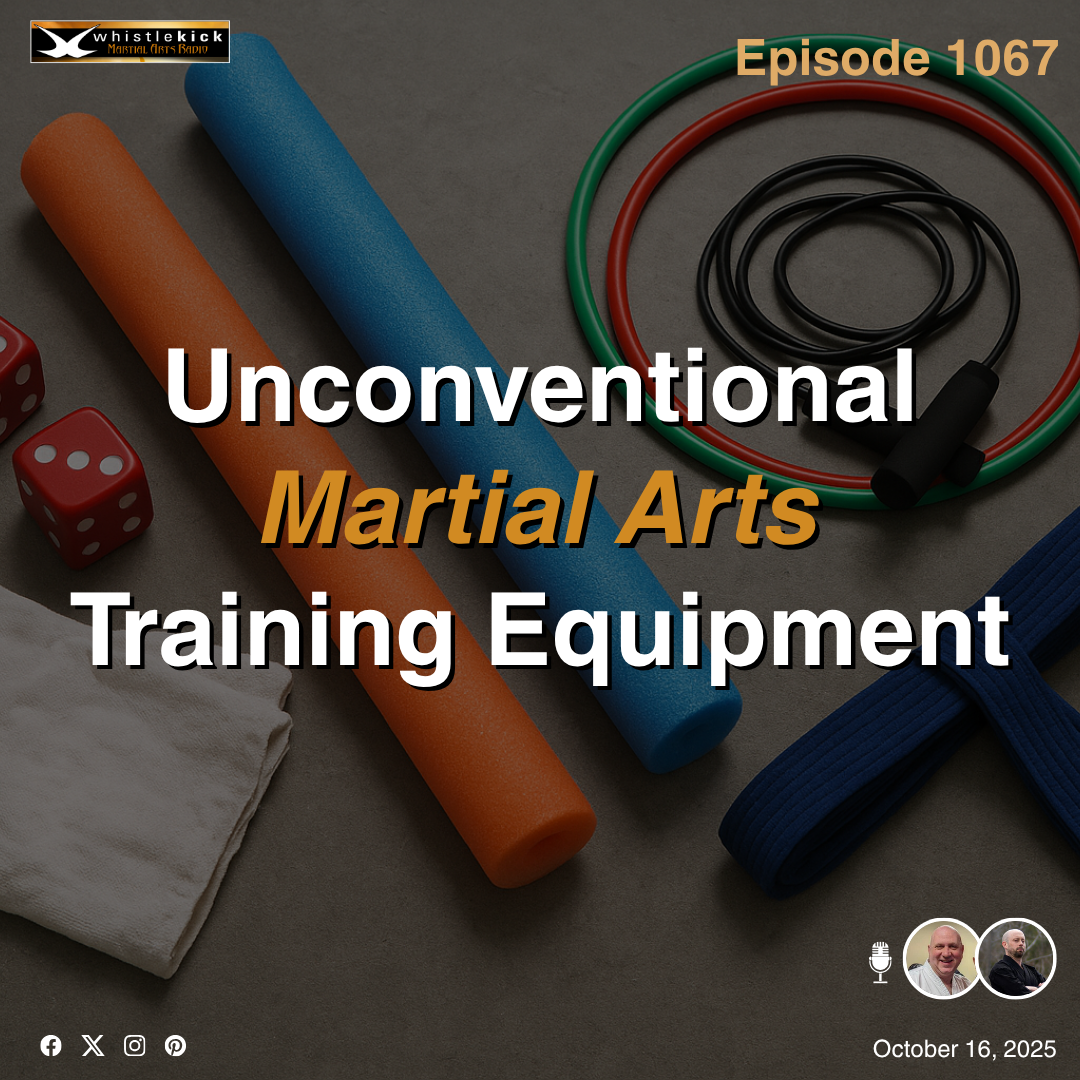
In this episode Jeremy and Andrew continue their discussion on martial arts training equipment, this time discussing some of the unconventional items that can be used.
Unconventional Martial Arts Training Equipment - Episode 1067
SUMMARY
In this episode, Jeremy Lesniak and Andrew Adams explore various unconventional training tools used in martial arts. They discuss the importance of variety in training, how to engage students through fun drills, and the benefits of using randomization in practice.
The conversation covers specific tools like dice, bean bags, foam balls, hula hoops, foam noodles, bandanas, x-ray films, and painter's tape, highlighting their creative applications in skill development and engagement.
TAKEAWAYS
Engagement is key to effective training.
Randomization in drills can enhance enjoyment.
Using dice can break negative associations with training.
Bean bags can be used for coordination and fun games.
Foam balls provide immediate feedback for technique adjustments.
Hula hoops can facilitate communication and teamwork.
Foam noodles are less intimidating for beginners.
X-ray films can be used for timing drills.
Painter's tape is versatile for marking training areas.
CHAPTERS
00:00 Introduction
01:52 Exploring Training Tools
03:41 Using Dice for Randomization
07:46 Engaging with Bean Bags
11:22 Incorporating Foam Balls
13:49 Creative Uses of Hula Hoops
15:33 Foam Noodles in Training
18:06 Utilizing Bandanas for Skill Development
20:44 Innovative Use of X-Ray Films
22:25 Combining Tools for Sparring Practice
23:47 The Versatility of Painter's Tape
After listening to the episode, it would be exciting for us to know your thoughts about it. Don’t forget to drop them in the comment section down below!
SHOW TRANSCRIPT
Jeremy Lesniak (00:09.294)
That was good, that was in time. I was really impressed. I was like, uh oh, I'm drumming next to a drumming instructor crap. No, that was good. Was it? Yeah. I alright? Yeah. I really did not do well with the drums on rock band. Rock band and guitar. I could do the guitar part nearly at the most difficult level. was the top difficulty level I couldn't do because I have little hands.
And so anything recently that Pinky was tough. I could not do with Rock Band the drums on the basic level. Really? couldn't. No. It was like, I wouldn't even get halfway through a song. It was like, you're done. Believe it or not, I struggled with drums on Rock Band. Really? Because it's not really like playing drums. Oh, okay. I mean, yes, the timing I was good at, but like drum set is a very specific pattern. Yes. You know, right hand doing one thing, left hand doing something else.
Right foot doing certain things and your hands are crossed and the rock band drum kit is not set up like that at all So I actually struggled with it. Okay. I feel a lot better. Okay good. Oh Hey, hey people. We're recording an episode. What's up everyone out there? I wonder if you're gonna have that clip that you'll probably put that at the end or put in bonus videos. Maybe I'll put it in If you're not on the Patreon. Patreon.com slash whistlekick to see what just happened. If you're new to the show, you're
probably already hung up. But if you're not, you're still here and you're saying, there goes those two crazy guys without any hair between them. Yeah. And thanks for being here. We appreciate you. Whistlekick MarksWorks Radio over the last 10 years has become the number one traditional MarksWorks podcast because of you and because you help Garrett. Jeremy Lesniak joined by Andrew Adams. We have a great time when we record this show. We do two episodes a week. We appreciate your guests and topic suggestions. Please keep them coming.
Jeremy at Whistlekick.com, Andrew at Whistlekick.com. And on today's episode, we're going to follow up to an episode we did long ago. About a month ago. About a month ago. About training tools. So in that episode, we talked about contemporary or conventional training tools. And today we're going to talk about some conventional training tools, things that we use and we see that may spark some ideas for you. Because let's face it, variety is really beneficial.
Jeremy Lesniak (02:29.612)
when you're trying to develop skill among people. And the reason you don't do the same drill all the time, you do a bunch of different drills to attack the same skill in different ways. But it makes it more enjoyable. But it can make it a lot more fun. You can't learn without having fun. I challenge at least being engaged. And for most people, fun is the simplest way to bring engagement. Yep. And a lot of what we're going to talk about will give you some ideas.
We always ask for feedback, but this is one where I know we're not going to even scratch the surface of all the options out there. No. So please, whether it's in the Facebook group, Mark Lark Radio, page, the Facebook page, Mark Lark Radio, on Spotify as a comment, in the YouTube comments, wherever you consume the show, or email us. Let us know the tools you use and why and what you get out of them and how you use how you get out of them.
This is something that we could absolutely do a series on and maybe even do like we could collect video from people like that could be a lot of fun. I don't know where we're going to take this, but I think that this will be a lot of fun. So hopefully you enjoy it. Now without further ado, let's start with the one that you brought up as an example. Dice. Now we actually do two different kinds of dice in my school. We have regular dice, which we started with, you know, little plastic.
monopoly dice, sided dice, six sided dice. And we graduated to larger like four to six inch foam dice. And what we do with that is in a lot of the classes we will have if we're doing let's say we're crisp up or burpees as part of our conditioning in beginning. I found it made a massive difference between me saying we're going to do Quinty and me saying
everybody in the front row is gonna roll one of these. It came from everything. It became random. They were wearing on the dice to roll in a certain way and it really broke this negative association with me saying you're going to do 20, 30, 10 of this thing. And let's face it, in most Marks and Marks schools,
Jeremy Lesniak (04:49.294)
We are used to doing things in groups of 10. There's only one reason I can possibly think of to do them that you would want to always do them in a group of 10, which would be you're teaching how to count to 10 in the language of the school. Outside of that, does it really make a difference if you do 10 push-ups or six? Yes, mean, it's four less push-ups.
But I think the better argument is 10 versus 11. Yeah, whatever. But if you're rolling, we're going to do this many put-tops today. I'm going to roll two sticks out of dice, right? And it becomes eight, because whatever. So what? But it makes it more enjoyable because it's the variety of not knowing. And here's the truth that it changed everything. People wanted to roll the dice. Yep. Instead of saying, no, I don't want to do any more put-tops, they're like, I'll roll.
Yep. And then sometimes we would mix it up a little bit, you know, we're going to roll one more, you know, they're tired. Who wants to roll it? And so now it becomes like a responsibility thing, like, oh, you know, somebody's got to roll it. Yeah. But we play it up in every turn. Now, we also have a second set of dice that we use. My fool does things a little bit differently. We talked about it on the show. have.
five picks, punches, strikes, blocks, stances. And so we have a set of six-sided dice that I bought blank on Amazon, and I used a thin Sharpie. You write the names of the techniques, and we use them in first to develop random combinations. And what's awesome is sometimes you end up with ridiculous combinations that you would have never thought of, and we've got to figure out a way to make it work. It's also a great self-turning tool.
Yeah, yeah, because you could use them yourself and figure out how to make them. Yeah, right. One of my students, Irvin, you know Irvin, went on Etsy and had somebody make him an engraved metal set of Wow. Like they're like one and a half inches. They're really nice. They've got some good weight to them. And yeah, yeah, we've used those. We've used those too. So dice. Now, of course, dice come in a variety of numbers. You can have four, six, and
Jeremy Lesniak (07:08.834)
Well, eight, oney, there is eight, right? Eight sided. I've seen hundreds and you could, because you're not going to fit whatever you're trying to do, unless you're just, how many of these are we going to do? You could have a cart right now, you know, 100, you could have a hundred drills. What are the drill? What's the world we're going to do today? number 37. It's on the cart. We're doing this. Yeah. Right. And I love the randomization for two things.
One, I already talked about it breaks that negative association. And two, it helps round out what we do because most of us tend to gravitate towards certain things that we really like or this is what we're working on. And there are times in class where you need some randomization to make sure that a student's involvement, education rather, is more complete. Yep. And it makes it fun. It does make it fun. Random is fun.
So that's dice. Here's a really, really simple one. Bean bag. What do you do with bean bags? We use bean bags. curious what you do with bean bags. So we have, you'll have, yes, we have a dog in front of us. there's a note. Yep. You're a good girl. So we can have the bean bags lined up and people on either side of a bean bag.
In a push-up position and when the whistle is blown the two people are fighting to who can get the feedback hungry hungry hippos Yeah, that's a great analogy hungry hungry hippos, right? Another thing we do it for in the kids class and we often will because again, I'm talking kids class here. Yeah We'll end the class with jump rope. Daisy's moving our camera. Don't move the table We'll end the kids class with jump rope, right and the kids that
You know, and we're teaching coordination and... my goodness! What are you doing? We gotta suit you though. We gotta suit you. Okay. We'll end the class with jump rope. And the kids that get it and are doing well at jump rope will say, person not jumping rope, take the beanbag and toss it to the person jumping rope and see if they can catch it. And we're still working on hand-eye coordination. And again, we're talking about tossing, not rowing, right? Don't... don't at me.
Jeremy Lesniak (09:37.006)
But it's a useful tool for catching while you're doing things. Yeah. We use beanbags and we use them in a few different ways. One of the ones, I think we've talked about this game before and it came as an act that we call stand up, down. And it started as a, I needed something. What we were doing, what was on the lesson plan was not working. was like, I need to buy myself some kind of like, sit down, stand up.
sit down. Yep. Okay. And the kids had a blast with it they came in the next class, right? Are we going to play that sit down stand up game? And I was like, are you kidding me? And it's actually become a core thing that we do because there's a, there's a lot of, there's a cardio piece in there, right? It's a simple, it's a simpler burpee, but you could also add a lot of things in there. And one of the things that we've done is we've added directing changes. And the way that we've found is easiest for directing changes is we have four different colored bean bags and we lay them.
around the room and so we can say, hunt red and they have to face red and hunt. So it's not them moving around, they're building awareness and the different colors in there become really important. Now of course there's other things that we do with them but those I would say those are the main ones that we're using. Yeah so those are a couple of things I mean we've used them for other things as well.
But those are the main, those are the biggest ones I can think of is Hungry Hungry Hippos is really fun. And they, what's nice about it is they don't realize they're holding, essentially a plank. I mean, they're not on their elbows. But it's a really active plank. Yeah, yep. And they're holding it for much longer than they realize because they're so focused on the beanbag and like waiting to hear the whistle blow to grab it. And then
And then, like, that's only half of it. Then once they got it, like, they scored a point, but they then have to put it back. And they have to cry and stay in that pickup room more time. So that's a really fun one. There's a lot really there. I like that a lot. Similar to beanbag for us are foam balls, like things like Nerf And we've got some in different sizes, different densities. And we use those for a lot of things, but the main thing we're using them for is coordination.
Jeremy Lesniak (12:04.458)
and the ability to hit something. So on Wednesday, we had students lined up and we were giving them different techniques that were part of what we were working on that day and having them hunt or kick them with the goal being to get it to travel straight and down the road. Now, nobody's going to get hurt. Exactly. There's immediate feedback on timing and directing. And because that feedback's immediate,
They can adjust on the fly. We don't need to tell them. Hey, your punch did this. It was supposed to be this because the ball went that way and they understand that. Yeah, and that worked so well and there was wraps. We did this for 10 minutes and there was rapid progress across that block. Yeah, that was what I was going to mention when we when we had. Dog balls essentially like that, but there were we use them for that for dog ball, right? The end of a kid's class kids love it. They're jumping around and having fun.
But then we realized, we can use this for actual, okay, I'm gonna toss the ball and I want you to punt it or kick it. And so it's working the accuracy of, can you throw your technique where it needs to? It's great if we're standing still and we're punching the air and we're always punching the same spot, but you might have to be, you might be physically moving around, your opponent might be moving around. So that ability to target is crucial.
We will also do it where the instructor pitches the ball to them. You're being a real pain in the butt right now. I'm moving you. Dog break. There we are. We will also pitch the ball, allows us to get them to train awareness. There's a little bit more variability when a ball is pitched.
Right? And that's why there's a picker in baseball and even a pitching machine has given me some variability to it. And that has worked really well. It can be a lot of fun. There's also, surprisingly enough, the kids love picking up the balls after. that allows us to practice listening skills and a whole bunch of other things.
Jeremy Lesniak (14:23.95)
everybody go get a certain number or color or whatever, right? Like there's a lot that we can do to mix that up. And the nice thing about everything we've talked about so far is it's very inexpensive. Yeah. Yeah. And small, easy to transport. Mm hmm. hmm. Who? We don't use hula hoop. How do you use them? We have used them as again, a bit of a fun game where you'll have a row of 10 kids.
Holding hands and you'll take the hula hoop and put it on the arm of the guy on the end and they've got to pack it all the way down So you have to use communicates in with your partner to like figure out how to move it. We've also used it I've actually used it in some cause I haven't used it. I have heard of other instructors using it as placing the Hula hoop on the ground and it was a larger hula hoop not not your quite typical size a little bit bigger
for people who have been physically assaulted. And the only person that is allowed to go inside that hula hoop is the person that that person feels safe with, usually the instructor. Other students don't go inside that bubble because it really gives them a physical, you can see it on the ground, barrier that makes them feel safe. And it's a very unconventional training tool that...
I could see, I've never used it myself, but I think we all can see that it would be a very valuable tool. I could see that. Yeah. If you have the space, I think people who have Hula Hoops have dedicated spaces, it's one of the things about my school is we're in different locations, we don't have our own dedicated space. But Hula Hoops also lend themselves to a lot of games. We could imagine that...
having students shadow far out of, you know, in the hula hoop. One foot's gotta remain out of the hula hoop. You've got to navigate, you know, you put a bunch of hula hoops down and they've got to go around them. And actually as I'm saying this, I Corey might have some hula hoops and maybe I just don't see them all the time. But hula hoops are pretty inexpensive. Yep. Foam noodle. Foam noodle. Yeah. Yep.
Jeremy Lesniak (16:48.664)
So we've got noodles that we put more or less than half, maybe a little less than half, that are stuck onto PVC pipes. And we use those as, I think Sensory calls them blockers, right? It's a budget version of that. And what's really nice about it is we keep the foam, they're not glued on or anything, you could glue them on, but we keep the end of the noodle out a little bit.
So can also strike out and it's roughly the size of a hand, of a small hand. And what we have found is that for a lot of people, not just kids, that is less intimidating to engage with, especially early on. fist, you talked about assault in the past. There are people who are going to find your hand or your foot, no matter how slow and gentle it is, a throwback to a poor experience in their life, some trauma. And so having this...
thing that is blue, all of our noodles are blue, you know, to swing at them or to strike at them makes them feel a lot more comfortable. And we've used that as a great bridge between someone's newer experiences and getting them started. Yep. Yep. And we have used Cool Noodles in the past for the same thing. We didn't start with them on anything. It was just the noodle itself. But we weren't we weren't striking with them in the same way.
But we would use them for at the end of class, we'll set up an obstacle course where they have, know, where they have come here and do so many punches, go here and kick the bag three times and then go here and they have to roll over. We would use a pool noodle because that way if they didn't do it and they knocked it on, it's not going to hurt them, right? It's not like a rigid pole or you have to crawl underneath it. But if you hit it, it's just a pool noodle or whatever, good user for that. And then
I used to do foam sword combat, often called LARPing. And so I already had a bunch of these foam swords. So I would bring those in and I would use them. And for those kids that were comfortable with it, you can actually hit them. Now I'm putting hit in quotes. wasn't hard, but it's like, okay, you got to do your overhead block because the sword's coming in and it would, their arm would stop it. it, and the joke was,
Jeremy Lesniak (19:11.98)
You've got stop my supercar razor sword. But of course they see that it's foam and obviously it's go. And then it led to other fun games where using the sword, they had to dodge out of the way and things like that. Yeah. It's funny you bring that up that. Training a rising block. I have found that. Even on day one, if. We swing this foam.
sword at a new student and just say without moving how would you block this they get pretty close to all their basic block yep yeah it's pretty intuitive when you do it with a punch or a kick the intimidation factor very start to overthink very and so getting them okay i i guess i would do this yeah what if it's low i don't know i'd like do that okay well what if it comes from that side but you got to use that i don't yep or maybe their hands open right so there's some
Press locks, you know, stuff going on, right? But we didn't put school noodles on the end of things until COVID. And we put them on the end of a six foot bow. So we could now attack them straight away. The other way that we use that I found this is really effective for people, whether it's trauma or youth, is we use, I mean, it's just coming out of Filipino martial arts, breast-dab strength. And so we initiate that concept.
pretty early in our school, but we have them rock the noodle, grab the noodle, punch the noodle. And that works much better because they tend to flail when it's a person. And it ends up being slap, slap, punch the shoulder. Let's slow down. Rock, grab, and they punch the noodle and they get it. And it works really well. Rag. Like bandanas? Yeah, just bandana or an orc.
Yeah, headbands, rags. In our school, we had lots of rags to clean and we would take clean ones and use them in class. You didn't use the dirty ones in class? No, we didn't use those. And so sometimes the game that was most often done was you'd put the flag in the student's belt and the students had to try and get it and then you'd put the flag in the student's belt and the other students would have to try and get it from them. And so that's a fairly common one. But the other one we would do is
Jeremy Lesniak (21:39.086)
Taking, know, standing in for us would be like a, for us would be like a box dance. And you'd hold the rag up with one hand high above your head and then drop it and shift your stance into a forward stance with a punt through, but your punt came and you had to grab the rag before it hit the ground. So it worked on speed, it worked on.
shifting of your weight, but and it gave you something to actually physically grab and sometimes the rag wouldn't fall completely straight down. So you had to work a little bit on your accuracy and you know, depending on the rag you got, if you got like a peri-quass, like a wacquass, it was pretty heavy and it would fall straight, but a bandana sometimes might end up moving and so you had to adjust. And so was really useful for that. Yeah. In order to that, and I bet you've used this before, x-ray films. No. You haven't used x-ray films?
So what's fun about X-Ray film is it's really cheap and somebody holds the film for you and drops it and you've got to hit it and it falls way faster than you'd ever imagine. Really? Yeah. Yeah. Once in a while it'll cut, you like the band, you talked about the bandana, but usually it falls a lot faster than people think. And so the further away you are, you've got to go super fast. And so it's a great drill for timing.
It's something when I had my original school 20 years ago, which is a weird thing to be able to say. We use that all the time and students got fast with that. In fact, as I'm talking about this, we've to get some extra cool stuff. Does it make a cool sound when you hit it? It does. Okay, that's cool. It does. There's a wonderful, there's a little bit of physical feedback, but the audible feedback is significant. That's cool. That's cool. And it's something that it's really safe. Like you're not going to hurt yourself with it. So it's one of those drills that
you can hand that free film, can pair people up and, you know, do five and then trade off and, you know, start with punches and how far back can you go? And, you know, could be a sparring drill if you're, you know, okay, I'm going to drop this and how far away can you make contact with that before it drops below waist level or whatever you.
Jeremy Lesniak (23:53.774)
There's a lot that can be done creatively. Yeah, yeah, it's cool. That's really cool. Yeah. Thinking about what else is in, we call it big bag. It is a very large duffel bag that we bring from venue to venue. we talked about most of the other things that are in there last time, but combining them. So we will use a mitt and the cord.
And we've used it in a bunch of different ways. And again, it's usually to bridge the gap between being new and getting comfortable with sparring. Yeah. But sometimes we're doing it with more advanced students just because we want them to put down the typical scraps that even cranes slowly and gently arises from sparring. So if you and I are sparring and I've got a focus mitt or a paddle or a shield and a sword.
This is my strike. This is my block. maybe you're trying to hit this, or maybe I'm trying to use it to defend you while I'm attacking you or while you're dodging. There's a lot of ways you can do that. we use these swords as well. For the record, I love fighting sword and shield when I was sword fighting. I believe that. You seem like that type. I don't like using a shield. I'd rather have a second sword.
That's more my style. Next I'd rather have a... probably like a long dagger. Like a main goat. Probably. Anyway, we digress. We do digress. We tend to digress. A lot. The last one, we've talked about this a bunch, this is the last one I'm thinking of right now. Painter's tape. Painter's tape, which by the way, is more useful than duct tape. Duct tape is great at what it does, but...
If you ever use duct tape for something that you wish you hadn't used duct tape for, you're very sad. Yep. And yes, you could buy gaffer tape, which is the amazing baby of duct tape and painter's tape because of the residue with you. But painter's tape is really cheap. And gaffer tape is not. Gaffer tape is not cheap. 20 bucks a roll versus, you know, three to four bucks at Home Depot for some painter's tape. In fact, we're using painter's tape in an event this weekend.
Jeremy Lesniak (26:18.092)
Painter's tape is great to mark out spots on the floor. It's great to mark out spots that you want to hit on a wall. I tell my students, like, if you're working, let's say you're working pick height, have a piece of painter's tape and you have to pick above that. Even if you're not hitting the wall, it gives you a visual. Probably don't hit the wall. Probably don't hit the wall, but maybe you want to. And then over time, you can raise that painter's tape. And if you decide you want to take it off the wall, it's fine. It's not going to damage anything. Yeah, I could see that being really useful.
Not something I personally use, but I could see the variety of uses that would come with it. You could also use painter's tape if you wanted to play a more gentle game of tag. You know, and I stick it on you and it's stuck there. And so we know I stuck it to you. There's no... Because typically how do people make sure that they make the tag? Whack! If you really are... So if we were playing some games like that.
That's not a thing we've done that's been on the back of my mind though. Yeah, so we've talked about a lot of stuff. There's a bunch of them. There's a lot more. I'm curious what you guys... really want to see what people write in. What do you use and how do you use it? Comment wherever you're watching or listening. If you would rather, you're welcome to email us. jeremy at andrew at whistlekick.com
And bonus points, super bonus points, if you send in a video of a drill. That would be so cool. Yeah, and maybe we can get a few of them together and we can, we can post them. Awesome. So yeah. Thank you for watching or listening. Thanks for spending some time with us today. We're always happy to hear your comments, your suggestions, your feedback, even, even your critical stuff, which we don't get a lot of because we're amazing. Yeah, that's it.
think we do a really good job. We work hard to consider all opinions. Yeah, when we get in just to stop I think people feel respected. You know, we're pretty even-skilled about that. Yeah. Yeah, we're not we're not rage-baity That's not really our style But of course if you do have suggestions for topics or guests or anything else We genuinely do want to hear them. So let us know whistlekick.com whistlekick martial arts radio comm or the number one martial arts podcast for a reason and that's because you all keep watching with me until next time
Jeremy Lesniak (28:40.91)
Train hard, smile, and have a great day. We're so good at that.