Episode 1091 - Martial Things with Sensei Ando
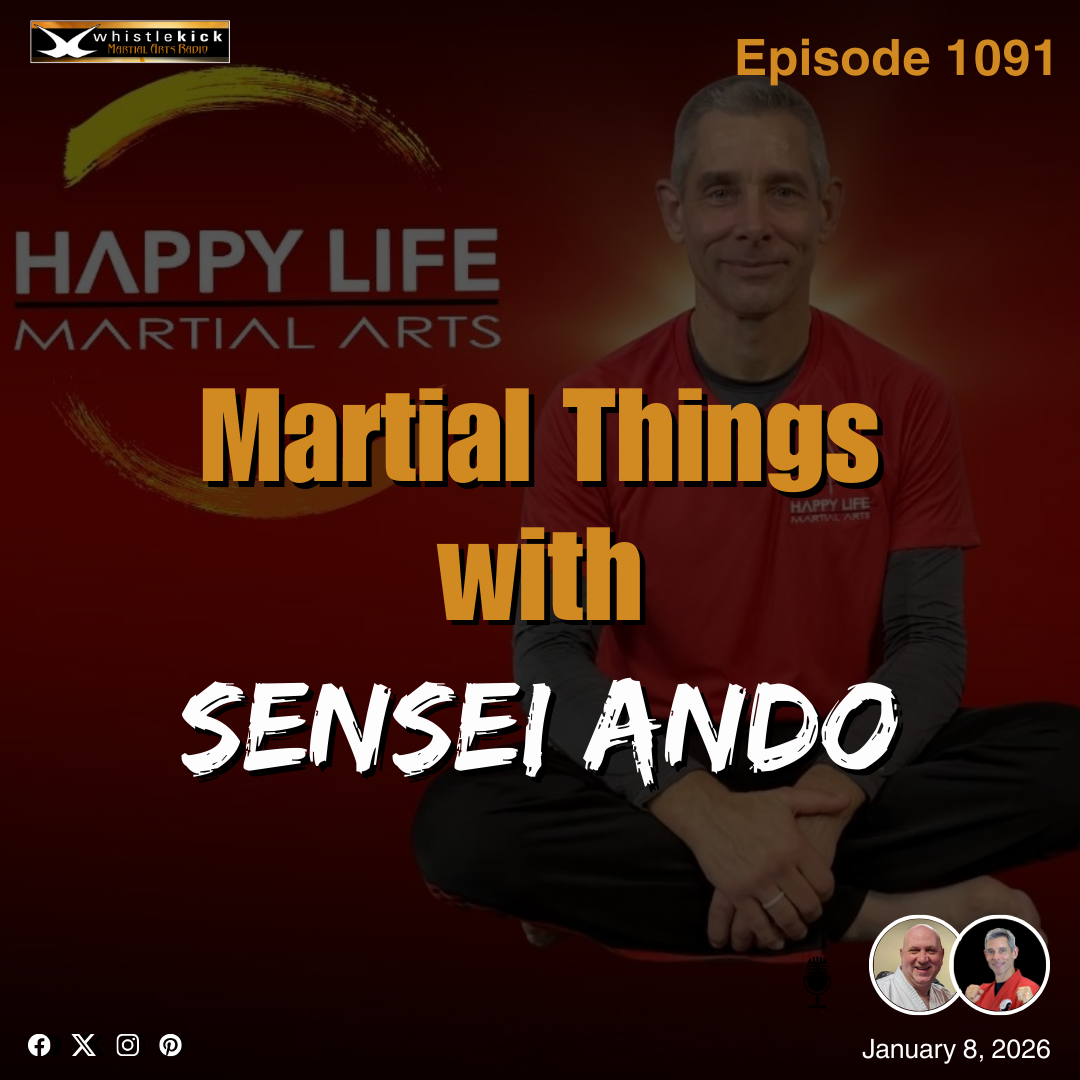
In this episode join Andrew in whistlekick’s Martial Things series. This week he sits down and chats with Sensei Ando with a plan to talk about……. nothing. No plan, just a conversation to see where it takes them.
Martial Things with Sensei Ando - Episode 1091
SUMMARY
In this engaging conversation, Andrew Adams and Sensei Ando explore the multifaceted world of martial arts, emphasizing the importance of continuous learning, the challenges faced by students, and the role of instructors in guiding their students. They discuss the significance of tailoring techniques to individual needs, the misconceptions surrounding the best martial arts, and the impact of music in training environments. The dialogue culminates in a reflection on the responsibilities of teachers to provide meaningful experiences that prepare students for real-life situations.
TAKEAWAYS
Continuous learning is essential in martial arts.
The 'Wednesday Wall' is a common challenge for students.
Techniques should be tailored to individual students' needs.
Not every technique works for every person.
Martial arts is not just about showing up; practice is crucial.
Music can distract from the focus needed in training.
Defining martial arts can vary based on personal experiences.
Teachers should guide students towards deeper understanding.
Exposure to real experiences is vital for student growth.
The goal is to provide as much value as possible in training.
CHAPTERS
00:00 Introduction
01:50 The Journey of Continuous Learning in Martial Arts
06:18 Overcoming the 'Wednesday Wall' in Training
09:07 The Importance of Tailoring Techniques to Individual Students
12:28 Debating the Best Martial Art: A Common Misconception
14:51 The Role of Music in Martial Arts Training
20:22 Defining Martial Arts: Sparring vs. Fitness Classes
25:41 The Teacher's Role in Guiding Students
32:40 Conclusion and Future Directions
Join our EXCLUSIVE newsletter to get notified of each episode as it comes out!
Subscribe — whistlekick Martial Arts Radio
After listening to the episode, it would be exciting for us to know your thoughts about it. Don’t forget to drop them in the comment section down below!
SHOW TRANSCRIPT
Andrew Adams (00:02.402)
Hey, good morning, Ando. How are you?
Ando (00:03.031)
Good morning.
How are you Mr. Adams, how's your day going?
Andrew Adams (00:07.728)
It is a great day because believe it or not, I woke up handsome again.
Ando (00:14.317)
How about that? Wait a minute, maybe my camera's not. no, that is you. Yeah, you're handsome. OK, Uh-oh. I am equally handsome, equally in a good mood. I see we both have the Shoji screen studio system here. Excellent. Boxed right in here. You're not claustrophobic. Good.
Andrew Adams (00:21.984)
And how are you this morning?
Andrew Adams (00:30.302)
Love it. Love it.
Andrew Adams (00:36.232)
No, no, although my dog hates it.
Ando (00:40.074)
Your dog's in there with you.
Andrew Adams (00:41.082)
she can be, she can, she can make it away. Like you can't see, but like I have a little, if I closed it off completely where she couldn't get to me, she'd be like, I don't like this, but there's like a space of about a foot where if she wants to, she can come in and look at me and I can pet her.
Ando (00:53.385)
Interesting.
Ando (00:59.349)
Okay, all right. So you both have some issues. Excellent.
Andrew Adams (01:02.396)
Yeah, basically. thanks for being here. I really appreciate this. This will be, this will be fun. We've been, people have enjoyed this type of format where, you know, for years and years and years, our Thursday episodes have been Jeremy and I or Jeremy and someone or whatever group of people discussing a very specific topic. And, I said, why don't we do some unscripted content? Like.
Ando (01:23.595)
Mm-hmm.
Andrew Adams (01:30.45)
just hang out. mean, we talk about how we're just, every episode is just people hanging out talking martial arts. So let's just do that with people.
Ando (01:39.851)
Right.
Andrew Adams (01:40.266)
So here we are. If you're good with it, we're just going to keep rolling. I think this has been great. really quickly, in case there's anybody new listening or watching, you can go to whistlekickmarxlargeradio.com to find out all of the episodes that we do. You can subscribe for our newsletter there, so you'll get notified of every episode as it comes out. And whistlekick.com as well, you'll go to find out.
Ando (01:46.955)
Let's just keep rolling. That's fine by me.
Andrew Adams (02:05.6)
everything that we do because this podcast is but one part. Okay, now that's out of the way. What's going on in your life these days and oh martial art wise? What are you what are you working on? What are you doing? What excites you?
Ando (02:19.591)
Boy, that's a lot right there. Yeah. I'm excited about progress. I'm 55, but I'm still making progress. I'm still keeping notes and asking questions. it's funny, you can either think of the endless search for knowledge as good news or bad news. The bad news is it's never over. There's always more to learn. You're always going to feel like a beginner in some way. Or
That's the good news. There's always something more to learn. You're always going to feel like a beginner, and I find that exciting. So I've got the bug. Clearly, you've got the bug. Hopefully, anybody who's listening has got the bug. Be addicted to the improvement. think this is a great journey to be on.
Andrew Adams (02:58.452)
Yeah, yeah, I would agree. I, so this is kind an interesting story. It relates, but it's not martial art wise. So I used to go to a bag piping and drumming summer camp for a week. It was a week long, very intensive. I'm a drummer. So I would, was there learning drums and there was this thing. It was started on Sunday and it on Friday. It was a full week long. And there was this, this thing that the instructors would call the Wednesday wall where
Students would get to Wednesday and or late Tuesday Wednesday and just start breaking down because they're so I don't know stressed isn't the word but they're being pushed so hard and I remember the first year I was there that somewhat happened to me on Wednesday. I was like And I was fairly new and I felt like why am I doing this? Like I'm never gonna be as good as these guys and I think that and I had to work through like gay
Ando (03:37.771)
Mm.
Ando (03:49.183)
Ha!
Andrew Adams (03:57.044)
They were at one point where I am right now and they worked through that and that kind of helped me. And the same is true for martial arts. Like so many students I've seen will get to this point where they're learning and they're like having fun. And then they feel like I'm never going to get it. And you just have to work through that because it's never, I tell people it never gets easier. It just looks better.
Ando (04:15.191)
Mm-hmm.
Ando (04:26.757)
it. Losing always looks crappy to me.
Andrew Adams (04:30.598)
Well, but I mean learning. Like, it's not easy. There's always stuff to work on.
Ando (04:37.067)
Absolutely, the wall that you speak of, Everybody's got their breaking point of how bad do you want this and how good do you want to be? And it's a fair point that everybody comes to martial arts for different reasons and everyone has a different level of, well, how far do you really want to go? You can delude yourself and they go, no, we all want to be great. We're all dedicated students. But you look around at any dojo, no, no. There's only a couple people there who are lifers, who are really just endlessly in student mode.
And other people have their own, like, this is where I get off. This is where I stop. Unfortunately, then, that leads to people having opinions, however, that are sometimes not justified. Because they'll say, wrist locks don't work. Or, you can't do a hip throw and a real throw in a real fight. So their opinions are based on the level of work that they've put into it. But then if they pass on those attitudes to other people, that's not fair. So can give you a quick example? I just thought of it.
I was teaching a couple of senior students in the youth program and I showed them, you know, just kind of a fun move, dropping down and doing like a spinning sweep, I call it the dragon tail sweep. And so they practice it for like for a class or two, it's the new toy, so they're having fun with it. Then of course they get excited, they want to try it in sparring and they don't know how to set it up, they don't know the right timing or the distancing, so it doesn't work. They did it once, maybe twice, and then that's it. They say, that move doesn't work.
Now, that's one thing if they want to believe that. But then I heard them talking to other students, like, what's that? you're spinning. What's that? it's the dragon tail, but it doesn't work. And you're like, whoa. Now, it's one thing for you, who only have been practicing this for a day or two, done it once or twice in sparring, to pronounce this doesn't work, but to then pass on that belief to other people who are brand new and have no idea to say, I'm starting with a new belief. That doesn't work. Don't even do that.
I think that happens at the adult level as well. So you have people who have, I've been teaching karate for 30 years, but they haven't actually done extra work or extra exploration to figure out what really works and what really doesn't for them. And then they pass on beliefs to their students. Well, this guy's been doing karate for 30 years. He said hip throws don't work. He said wrist locks don't work. He said high kicks don't work. It's like, no, no, no, they just don't work for him. You don't know what work they did or didn't do or what questions they asked or didn't ask.
Ando (06:57.534)
And that's where I think it becomes a problem. So that Wednesday Wall, yeah, I like that term. I'm going to keep that in my head. I like that.
Andrew Adams (07:03.07)
Yeah. And, know, I often correlate learning techniques and things like that, work, like you're talking to the dragon tail. It's learning another language. And when you, like, I don't speak another language, right? I, English is my only language. I speak a little, some Japanese, some French, but I'm not fluent in anything. But if you give me a paragraph written in French,
You can come back to me a month later and I will be able to recite it back to you perfectly. And anyone who speaks French will know exactly what I'm saying. And the, the diction will be perfect. Does it mean I speak French? No, it doesn't. It means that I've learned, I've regurgitated a couple of words. don't even know what they mean. And so learning the dragon tail for a day, I've learned a couple of letters, but I haven't learned how to put them together into words.
Ando (07:43.305)
Hmm.
Ando (07:51.945)
Mm-hmm.
Ando (07:58.408)
Thanks
Andrew Adams (08:00.425)
or how to say full sentences or paragraphs. It's just like another language.
Ando (08:07.389)
Right, right, absolutely. So how do we judge these people who don't want to go all the way, the people who are not lifers? How do you deal with them? How do you let them know that they can't afford certain techniques? They want to drive the Lamborghini, but you have to say, you know what, based on your account of practice, you're never going be able to afford that car. As teachers, it's challenging to be able to give everybody something that's fun, that's challenging to their skill level.
but then not have to show them things that they're never going to be able to do, because that's when people get into trouble. As martial artists, we're responsible on some level as a teacher to present the material honestly. Say, well, this technique's kind of for fun, or this technique's if you're athletic. But I think it can be trouble when you're saying, OK, let me demonstrate some really cool skills here that have taken decades to work on, and I've tested under pressure. And now you're just kind of a, you come twice a week, come for an hour.
Andrew Adams (08:39.392)
Mmm.
Ando (09:04.093)
and I'm expecting you to do that too, or you're expecting to do that too, I we have to be very honest about like, look, here's like a high level technique, and here are techniques that everybody can kind of do early on. I think that's another classification we have to put our techniques through so people are not feeling they got baited and switched. Like, what's this, Marcel? Well, I can do all this stuff. The teacher's fantastic. But if you're not willing to come in here five days a week and spend three, four hours a day on this,
Andrew Adams (09:08.308)
Yeah, exactly.
Ando (09:33.245)
you're not going to be able to do this. I think it's fair to say that. Because I a lot of people walk around with the wrong idea that martial arts is just magic. If you put that belt on and you show up a couple times, you will magically have these powers that the teacher does. It's like, no, no, not even close. You wouldn't do that in piano. You don't just show up to a piano lesson on Sunday, don't practice the rest of the week, come back the next Sunday and say, OK, ready for my next lesson. It's like, well, when did you improve magically? It's like, you don't just get better by showing up.
You gotta go work at it. So I think that might be missing in some martial arts schools.
Andrew Adams (10:06.624)
think so too. I think the other thing that I think is missing is a lot and I'm not going to say every instructor because obviously there are exceptions, but I think a lot of instructors fail to recognize that not every technique will fit for every person. know, like one of the things I loved about my Shotokan instructor is, know, Shotokan has a lot of forms. It's like 26 forms.
Ando (10:24.295)
for
Andrew Adams (10:35.532)
And, know, he had a prescribed, you learn them in this order, this up to black belt. But after black belt, actually it was after EQ, like for just before black belt for your black belt test, you had, you had had to perform X number of Cata in this order. And then for your black belt test, you had to be able to perform those ones and any two other ones that you chose for yourself.
Ando (10:52.829)
Mm-hmm.
Andrew Adams (11:01.092)
And I asked him once why that was the case. Like, you know, this person going for Shodan is going to do these two forms, but this person for going for Shodan in the same test is going to do separate forms. And he said, well, it's really easy. There were some forms that that person over there will never do well. It is not for that type of person. And that really stuck with me because it makes, it makes sense when you think about it. So I think a lot of instructors fail to recognize that.
Ando (11:18.887)
Mm.
Ando (11:31.496)
Mm-hmm. Yep, absolutely. mean, if my reading of history is correct, I believe in the old days, a master wouldn't have 26 kata. They might have one or two. And each style would be suiting your body type or your personality type. It was very individualized. Same thing in choila foot and kung fu. I there's over 100s of forms. But you're not expected to master all of them. That's not the point. If you're a tall, skinny guy, that's different than if you're a short squat kind of fellow.
different techniques are going to appeal to you. Then you have personalities. Maybe you're very fiery tempered. Maybe you're very passive. So you want to find an art that fits you and hopefully allows you to develop. Ultimately, it would be nice to have a wide range of skills so that if you are the taller one one day, but the shorter one the next day, you've got tools for whomever you come up against. But by and large, you're going to try to pretty much find a style and a form and training exercises that suit your capabilities at that time of your life.
Because Lord knows when I was in my 20s, I was far more flexible than I am now. And I figured that out when I was taking taekwondo back in the day. Like, I'm not going to be able to do this forever. My teachers are in their 30s and 40s. They're already complaining about their backs and their hips. They're aching, they're going, oh, and they warm up. They're taking forever. So if this is my path to the future, I don't like it. I want to practice movements and techniques that I can still do 50, 60, 70, and beyond, hopefully.
So I realized that taekwondo was not the art for me just based on that alone. was like they're asking me to do things that I already know is going to be difficult decades from now. And yes, you can always cherry pick and say well that guy's in the 70s and he can still do a full split. Good for him. The amount of conditioning that that guy has to do, I'm not doing. I'm going to do something else. I'm investing my time in something else. So that was what changed my martial arts path even in my early 20s I figured that out.
Andrew Adams (13:24.372)
Yeah, so what you're saying is taekwondo is not the best martial art ever. Because let's pick one right now. I'm kidding, I'm kidding.
Ando (13:29.627)
Haha, good, can we start trouble? It's a nice way to say that it's not the best martial art for me.
Andrew Adams (13:36.117)
For me, I love it. Yeah, absolutely. You know, I hate those debates online and I see them all the time. I'm sure you do. I'm sure our listeners or viewers do. And if you're not watching, you should go to YouTube because you can watch this on YouTube rather than just listening to it. But I hate that. see it all the time. Like, you know, what do you think is the best martial art for this? And it's like, why? What is the perfect or which is better, this or this? It's like, well,
It's such a stupid question because there are so many variables that you can't answer.
Ando (14:12.134)
Yeah, well, it's a beginner's question. It's something that you ask in the beginning. If you don't know anything, you'd like to say, well, what's the best? What are the normal questions you would ask me? Trying to buy a car or a computer? Well, what's the best computer? What's the best car? It's a normal question. I just have to understand that that's their level. Now, that question is still being talked about when someone's, I've been doing martial arts for 20 years, and they're still saying, this is the best, then you're still talking to a beginner. They've been in it for 20 years.
But again, they hit that Wednesday wall and they didn't go past the Thursday, Friday. So they're just talking about everything from a Tuesday perspective. So, and that's okay. You just have to recognize that when you see it and say, okay, that's fine. And, know, frankly, I it's arrogant, perhaps, but, you know, the higher you go on that ladder or the pyramid, however you want to look at it, the fewer people you're going to be able to talk to in that way because they don't understand. If you're a 30 year trial lawyer,
Andrew Adams (14:48.522)
Yeah, I love it.
Ando (15:09.55)
it's very difficult to express all of your wisdom and all of your experience to someone who's just starting law school. The person who's just starting law school says, I want to be a lawyer, because they have this idea of what being a lawyer is like. But the 30-year trial lawyer is going to be able to say, well, some of that's true and some of that's not true. There's a lot more of this than that. And your perspective is really skewed by movies or what your dad told you, your mom told you. Something's off. So the same way as a martial artist, you've been doing this for decades and you've been working at it.
to be able to convey to some beginner like, well, you don't need that. And this is important, not that. They don't understand. It's like talking to a six-year-old about compounding interest and IRAs. they don't understand what you're talking about. And they can never. So you just have to let them have their own experience, offer them guidance when they look for it, and try to be a good role model. But outside of that, they're going have to make their own mistakes and figure these things out for themselves. It's just the way it is.
Andrew Adams (16:03.806)
Yeah, and I'm 50, I still don't understand compound interest in IRAs.
Ando (16:08.837)
I was bluffing, yeah, me either. He's sitting in front of a marble mausoleum here instead of his paper shoji. Clearly I don't understand finances either.
Andrew Adams (16:21.824)
Well, I mean, we all know that you got into martial arts because you can make a crap ton of money doing it,
Ando (16:28.799)
yeah, of course, yeah. Just don't ask my wife, yep.
Andrew Adams (16:35.344)
so here's something that I've been talking to a bunch of people about and, and coincidentally, we, a bunch of them were here on Marshall, Marshall things with, but music during training. What are your thoughts on playing music while you're teaching or while you're, alternatively while you're yourself being a student or working on some.
Ando (16:55.788)
No, don't do it.
Andrew Adams (16:56.36)
Really? Interesting.
Ando (16:59.333)
I just want to start some trouble. Yeah, I'm not, if I'm in the kids program, the youth program, sure, I'll turn on music, do a circuit training, do an obstacle course, turn on some music, keep it fun, keep it vibrant. In my adult class, I don't play music. And I was raised in one particular kung fu school that believed in playing music because the teacher believed that subconsciously it loosened people up a little bit, it allowed them to find rhythm in their movement, which I respect, but.
I don't agree with because ultimately I want them paying attention to what they're doing. I want you to hear your breathing. I want you to hear your partner's breathing. I want you to feel as much as you can. In any distraction, the senses, especially with the phones, we're wired to be looking around all the time and get distracted. I think it's a big problem. There's more than enough to pay attention to in your practice if you're being mindful about what you're doing. And turning on music to me is just, it just gets in the way. It just gives them an out.
Andrew Adams (17:51.932)
And it out music to me just...
Ando (17:57.636)
It's just not good. Not good. It's not gonna hurt anybody. Do what you want. know, if it's part of the hit. But I'm just saying in a pure philosophy, ideally, no, we're quiet and we're working. That's what we're doing.
Andrew Adams (18:03.553)
Yeah, yeah.
Andrew Adams (18:11.329)
Yeah. No, I get it. And I'm, I feel very similar to the way you feel. And, there are a lot of friends of mine who they do play music when they, when they teach. And again, it's fine. It's, but I was not brought up that way. And I've, I've tried to do it. I will. I didn't want to be so close minded and say, no, I'm not going to. So I tried it. I went to one of these particular schools where a friend of mine usually teaches with music.
And I was hired to come in and teach a couple hours seminar. Um, I was teaching a form and some bunkai, some applications for the forum and he had music going cause I showed up at the end of his class and he said, you want me to leave the music on? And I said, I thought to myself, you know what the students are used to it, but they're used to having music playing. So I said, you know what? Yeah, sure. Go ahead. Leave it on. And I think I made it 10 minutes. And I said, you know what, can you turn the music off? just.
Ando (18:42.468)
you
Ando (19:01.091)
Mm-hmm.
Mm-hmm.
.
Andrew Adams (19:10.459)
I'm not used to it and it distracts me and I just I couldn't do it and Going the complete opposite direction. I remember taking a class as an adult where There was zero talking the instructor didn't talk at all the entire class was taught in a hundred percent silence and it was very different and then about 15 minutes into the class
Ando (19:15.291)
Hmm
Ando (19:33.122)
Mm-hmm.
Ando (19:37.163)
Mm-hmm.
Andrew Adams (19:39.539)
he turned on music, but it wasn't rock music, wasn't pop music, it was very light, instrumental music, and there was no talking. And that felt very different as well.
Ando (19:50.367)
Mm-hmm.
Ando (19:54.435)
Mm-hmm. Absolutely. There you go. So yeah, if you're gonna play music, then there should be some thinking behind which music and why. I don't think it should just be turn on the radio or turn on your favorite, you know, cardio track just to keep the heart pumping. And again, this is probably a less popular opinion to believe this about having no music or specific programmatic music. Because again, most people are probably just coming once or twice a week. They just want to come in, have some exercise.
Their goal is not to be a lifetime martial artist and make it part of their lifestyle. They're just looking for something kind of different to do. They don't want to do yoga anymore. They want to do a little martial arts. So for that type of crowd, they're going to want music. They're going to want something that's a little more fun that way. But the more serious you get about it, think, I need to focus. I need to focus. And it's not that, oh, well, we should be able to block that out. Yeah, yeah, but like I said, I want to hear. I want to feel. I want to just be in that moment. I don't want to be triggered.
Oh, that song was my favorite back in the 80s. now, oh, I'm sorry, were we sparring? Sorry. It's just why we have this little limited amount of time to transform ourselves and to find something new. And it's very hard to do that if you're playing something old at the same time. I just want to be in the moment the best I can when I'm training. I don't enjoy music while I'm training, no.
Andrew Adams (20:54.273)
Mmm.
Andrew Adams (21:14.079)
Yep. Now I could see playing devil's advocate. I'm teaching class on how to do techniques while you're distracted. Like if you're in a club, like I could see that I could say, or my wife did kickboxing for a long time. not, the cardio kickboxing in a room. Like it was a room full of heavy bags and it was a full, full on kickboxing class and they played music all the time, but it, it's no, they weren't. And that's the thing. that's.
Ando (21:23.265)
Yeah, yeah, that's right.
Ando (21:37.666)
Are they sparring each other? So that's not full on kickboxing class. Okay.
Andrew Adams (21:42.473)
No, but I meant as opposed to we've all seen the cardio kickboxing, the aerobic kickboxing. That's what I'm talking about. Like it wasn't that kind of class. and I think, but that's a different type of class. They're, they're working on something different and they're not working with another person.
Ando (21:48.662)
Yeah, yeah, of course.
Ando (21:58.69)
All right, let's go all the way here. Would you call that a martial arts club?
Andrew Adams (22:01.697)
I think it would vary. I mean, I do consider kickboxing the martial art. We're getting there. So one of the six freedoms of martial art is that everybody can decide for themselves. So whether I think it was a martial art class or not is irrelevant, but I will say
Ando (22:08.322)
Not the question, that class, music hitting bags, no sparring, it's not a martial arts class.
Ando (22:22.818)
That's one of your six freedoms. That's not everybody's six freedoms. Go ahead. Let's go. I see.
Andrew Adams (22:24.885)
You're right. You're right. One of whistle kicks, six freedoms. I do think her class was a martial art class. And here's why I think that way. The instructor of the class specifically talked about and worked on, okay, yes, you're going to kick here, but then you're going to come in and you're going to elbow. And I want you to visualize that this is a person's face. There's like, they were visualizing on the bag, an actual person.
but they just didn't do it with an actual person. I think it would be different if it was just a cardio kickboxing class where you are just kicking the air, you're not kicking anything and you're like the 80s style workout. Like I don't know that I would consider that. I would have a harder time considering that a martial art class. Yeah.
Ando (23:17.877)
How you, How dare you? What happened to the freedoms? Tybo is not a martial art. How dare you,
Andrew Adams (23:21.185)
but again, it's everyone is allowed to decide for themselves what a martial art is. I don't for here's a great example. I don't consider basketball a martial art. Okay. I don't, but it's me personally, I don't consider basketball martial art. If someone over there is a basketball player and wants to consider it a martial art, they're allowed to, if they want to, that's their, that's their prerogative. That's their choice. They're allowed to decide for themselves. Now I.
I don't believe it is a martial art, but that's not up to me to decide for them.
Ando (23:56.129)
You don't have that power even if you didn't agree. Who cares what you think? I don't care. That's fine. I will allow you to consider basketball and martial arts. I was just asking you as a martial artist, would that be enough for you as a martial artist to do a kickboxing class where only hitting bags and there's no partner practice? Just asking.
Andrew Adams (23:59.423)
No, that's fair too.
Andrew Adams (24:05.983)
What?
Andrew Adams (24:17.365)
Yeah. And I think there are a lot of schools that don't do a ton of partner work. I don't know that I would say they're not doing a martial art. I would say maybe they're not, they are missing out on a lot of martial art aspects. I think. I trained in a school for a while where they did forms and we did sparring.
Ando (24:35.432)
Yes.
Andrew Adams (24:44.587)
Like we full on put on gear and we sparred, but we never did any drills or technique practice ever. Like we did our forms, but they were completely separate from it. We never learned what the form, like we never learned any applications for the form. Not once did I have a student, like, would I stand at attention to have a student come at me and I actually did a technique. Not once.
Ando (24:50.824)
Mm-hmm. Mm-hmm. Mm-hmm.
Ando (25:10.016)
Mm. Mm.
Andrew Adams (25:12.201)
I feel like that's something that those students and I missed out on by training there, but I don't know that I would say that wasn't a martial art class.
Ando (25:17.915)
Mm-hmm.
Ando (25:22.012)
Okay, because you're a guy. We're just waking up. I'm just waking up here. I'm poking the bear a little bit just to see what happens. Troublemaking. Well, look, I'm on record. I've got videos if someone wants to check out my channel. Martial arts, martial arts. There should be a martial component to it. It doesn't mean I don't want to get hurt. I'm not looking to hurt anybody in practice.
Andrew Adams (25:24.063)
Okay, so give me your opinion. We're here to just talk about martial things.
Ando (25:50.346)
But if there is not part of your class where you can get as close as you can to the fire, and that doesn't mean concussions, I even just touching people, even if you're just cooperatively moving through moves, like what does a choke actually feel like? What does being shaken a little bit feel like? What does being pinned down the ground feel like? You can do that safely and slowly and calmly. You can build people up step by step so it's not triggering to people who've had traumas. That should be.
all of our material that we're working with. If it's only the idea that I can explosively hit something, that is not martial. That is exercise. That's fantastic. And yes, you can use those tools in a fight, but to not face another human being and to not engage in a relationship, which is what a fight is, it's a relationship. It's the extreme violent expression of a disagreement, conflict. I'm not sure.
how we gain the wisdom or the calm or the clarity to employ any of those tools that you've been practicing. You can kick a bag as hard as you want to. When do you throw it? How far away are you? How are you going to feel when you're about to throw that? Can you breathe? Can you see? Where is your wisdom at this moment? You've been slapped in the face and you've never been touched on the face. Forget slap. Someone just, you don't know in a class just, okay, let's put our hands on each other's necks. Just stay there, breathe, feel that.
You know, what can you do? What can you not do? What can you move? What can you not move? To not go over those kinds of basic ideas, I don't understand how that's a martial arts class. mean, what in the world? I at least would not feel very prepared. I love anybody doing anything under the martial arts banner. Of course, I'm supportive. I just hope that a teacher uses whatever that was that got them into the school, a brand new person, I just want to hit some bags and turn on some music. Great.
But I hope as a teacher that as you get to know that person, if they stay three months, six months, a year, and they're still having a good time, and now they trust you, that you're able to open up the next door and say, hey, since you like that, let's try this a little bit. Maybe take that kick and watch, put it on my leg instead. okay, hey, next time, you know what, you kick my leg and then I'm gonna touch your leg with my kick. Let's just go back and forth and just kinda just see what that's like with the distance and hey, let's move around a little bit. See if you can touch my leg, let's make it a game.
Ando (28:14.941)
I'll try to kick your leg, you try to kick my leg. And just step by step, leave them closer to the fire, which is, I think pays off more. If you're gonna do martial arts, I want as much bang for that buck as possible. You showed up, you paid the money, you're here, maybe you're wearing uniform. I wanna give you as much as I possibly can. And there's a lot more to offer you than just smacking a bag and getting a sweat. That's just such a small level of what we can offer. I just don't wanna stop there, I can't. I can't, I won't.
Andrew Adams (28:43.394)
Yeah, no, I get it. think the thing for me that I've recognized recently because, so I've been a martial arts student since I was in high school. started training in high school. I'm now 50 years old. So I've done a lot of training and only recently have I started doing formal teaching. I've taught in classes all the time where, you know, instructors out for the day. Hey, can you teach class tonight? No problem. I've done that a lot.
Ando (28:59.998)
Mm-hmm.
Andrew Adams (29:12.374)
But I've never been the guy in charge until recently, which I'll talk about in a second. But what I recognize now that I am the guy in charge of a, of a class. So I trained in a school where we did lots of forms and we did sparring. We, you know, put on gloves. We did lots of sparring and we did lots of kicking of bags and heavy bags and things like that, but we never practiced.
specific techniques. Hey, grab this arm and I'm going to do a wrist lock or, and we never did that. And I felt like I was missing that. I started training in another school where we did technique training all the time. And that was great. Like we would learn a form and we would learn applications for every single move in the form with a person, with a partner, we did body conditioning. like,
Ando (29:40.891)
Mm-hmm.
Hmm.
Ando (29:50.653)
Hmm.
Andrew Adams (30:02.195)
I was used to people kicking my legs, like with increasing intensity so you could feel what that felt like choking. Like you talk about, we would do all that stuff. I was there for about eight or nine years. And I think I can count on one hand, the number of times we actually put on sparring gear and sparred. So I felt like I was really missing out on that. But in the other school, we sparred all the time. And I didn't realize until I started running my own club and it is a, it's a club at a
Ando (30:19.981)
Mm-hmm.
Andrew Adams (30:31.553)
college. We just meet once a week. It's very informal. Students don't have to wear uniforms or no one's testing for belts, but it's a karate club and I'm teaching karate. I never realized how difficult it is to be able to do all of those things, learn forms and do applications and practice technique and get some sparring done and real world applications. It's hard to do in a curriculum, especially in my case when I'm only teaching.
Ando (30:42.621)
Hmm.
Andrew Adams (31:00.807)
one day a week. And these students are only coming in for a class one day a week.
Ando (31:02.64)
Mm-hmm.
Ando (31:06.429)
Mm-hmm. Yeah, you work with what you got. That's okay. Yeah, they don't even get to Wednesday wall because they're just Monday people. So that's a very different situation. Same as if you're teaching a weekend self-defense seminar or a two-hour presentation in some club somewhere. There are certain parameters, of course. That's why I preface it by saying like once they've come three months, six months, their year, if this is going to be, oh, you've made a dedicate, you've dedicated yourself to this schedule.
Now let me open up new doors for you. I think that's just what we should do. In your situation, as long as they're coming back and you're able to introduce them to martial arts, that class is more of an introduction to hopefully they'll go find another school and sign up or maybe they'll seek you out for private lessons in addition to that class. The hope I think of every teacher is that they catch the bug and they want more just like you did. That's how we became teachers and became senior people anyway, just because we stuck.
Andrew Adams (31:58.612)
Absolutely.
Ando (32:03.547)
I wanted the extra attention. wanted the extra information. Most people don't want it, and that's fine. I just want to be clear about what I'm teaching them. Like, OK, we're here for this hour, two hours, whatever it is, once a week, whatever you got. I just want to make sure I'm giving you as much as I can. I have a couple of private students that I only see once a week. So same thing. I get an hour once a week, a private student. I've known them for years. So I would be crazy, though, to show up there and just have pads. OK, let's just do your big power elbows and your big power knees.
Get your sweat and I'll go because that would drive me nuts because as a teacher I know that this is very limited. You're not really getting much out of this. You're stuck in a cycle here. I've always pushed them to say, let's do a little bit more. OK, I'm going to try to grab this week. OK, let's get on top this week. OK, we're going on the ground this week. And over the year or two or three, you can still lead them to more. Because what's this all about? It's really just about exposure. If I believe all martial arts should
work their way back to self-defense. And only real fighting is real fighting. So everything else is an approximation, even if sparring and hard sparring, everything else is an approximation. So my job is to try to set up experiences that will inculcate you to be more and more comfortable if something bad really happened to you. And you can do that with humor. You can make it fun. You can make it very personalized to someone's emotional level and what they can handle at any time. That's the art of being a great teacher.
But the idea is like, hey, I want you to feel in a safe place with somebody you trust what a choke feels like, and what a strike feels like, and what being pinned feels like, or being picked up feels like. And if we can give you that sensation, that experience here now, then if, God forbid, anything ever happened to you, it won't be the first time you've been held down. It's not the first time you've been picked up. Because that is a very different psychological process that you go through.
if it's the first time it's ever happened to you. The first time I got punched, like in real life, is very different from what it's gonna feel like today. Now if you get punched in the face, it's probably not that big of an emotional deal. It's not gonna probably go, what the, whoa. When people are new to something, it's like, well it came out of nowhere. It happened all so fast. And at this point in your training, that should be completely the opposite. Like, no, didn't come out of nowhere, I saw that coming. I felt that coming. Or yeah, it didn't happen so fast, in fact time slowed down.
Ando (34:30.139)
and I could see what was happening. This should be a completely different perception than we're in. Oh, well, with the adrenaline rush, you can only use gross motor skills. Well, then what's your training? If you're training 20 years, 30 years, and you're still the victim of an adrenaline rush, where you can only do gross motor skills like some beginner, then what kind of training have you been doing all this time that you can't calm down and use your fine motor skills? I mean, the whole point, anyway, is the, think, should be martial arts.
That means self-defense, self-protection, or protection of others. And that means as safely as we can, introducing as many dangerous experiences as we can to our students. think that's responsible.
Andrew Adams (35:08.95)
Yeah, that's fair. Well, Ando, I want to thank you for being here. This has been a lot of fun. How can... No, no, no, it's all good. Well, we've been going a half an hour now. I don't want to take away too much of your time from your day, but I do want to make sure that if people want to connect with you, how can people get in touch with you?
Ando (35:14.629)
That ends it?
Ando (35:20.635)
You
Ando (35:29.775)
Hey, SenseiAndo.com, HappyLifeMarshalArts.com, Ando on YouTube. You can find me. all over the place. I had a little hiatus, but I'm back now. A pleasure to talk to you, sir. I always enjoy your podcasts, you and Mr. Lesniaks. You guys do great work, such a positive force in the martial arts world. So a big fan, as you guys know. I've been connected with you guys for many years and hope to continue, even if that last part went over the top and you had to disconnect the conversation.
Andrew Adams (35:55.134)
it didn't go over the top at all. We've had way more controversial things said and way more controversial people on this show than you. yeah, not a word. So thank you guys for listening or watching. If you are not watching, please go to YouTube. You can check it out online. You can see the video. You can see the cool haircut I got today.
Ando (36:05.035)
Indeed. I'll try harder next time. I'll try harder.
Andrew Adams (36:20.744)
And if you're there, YouTube, click the like and subscribe button. really means a lot. helps the algorithm. It's so dumb that we need to ask people to do that, but it really makes a difference. And check out whistlekick.com for all the stuff we do. Whistlekick, martial arts radio.com for everything about this podcast and all other episodes. Thank you so much and we'll see you next time.