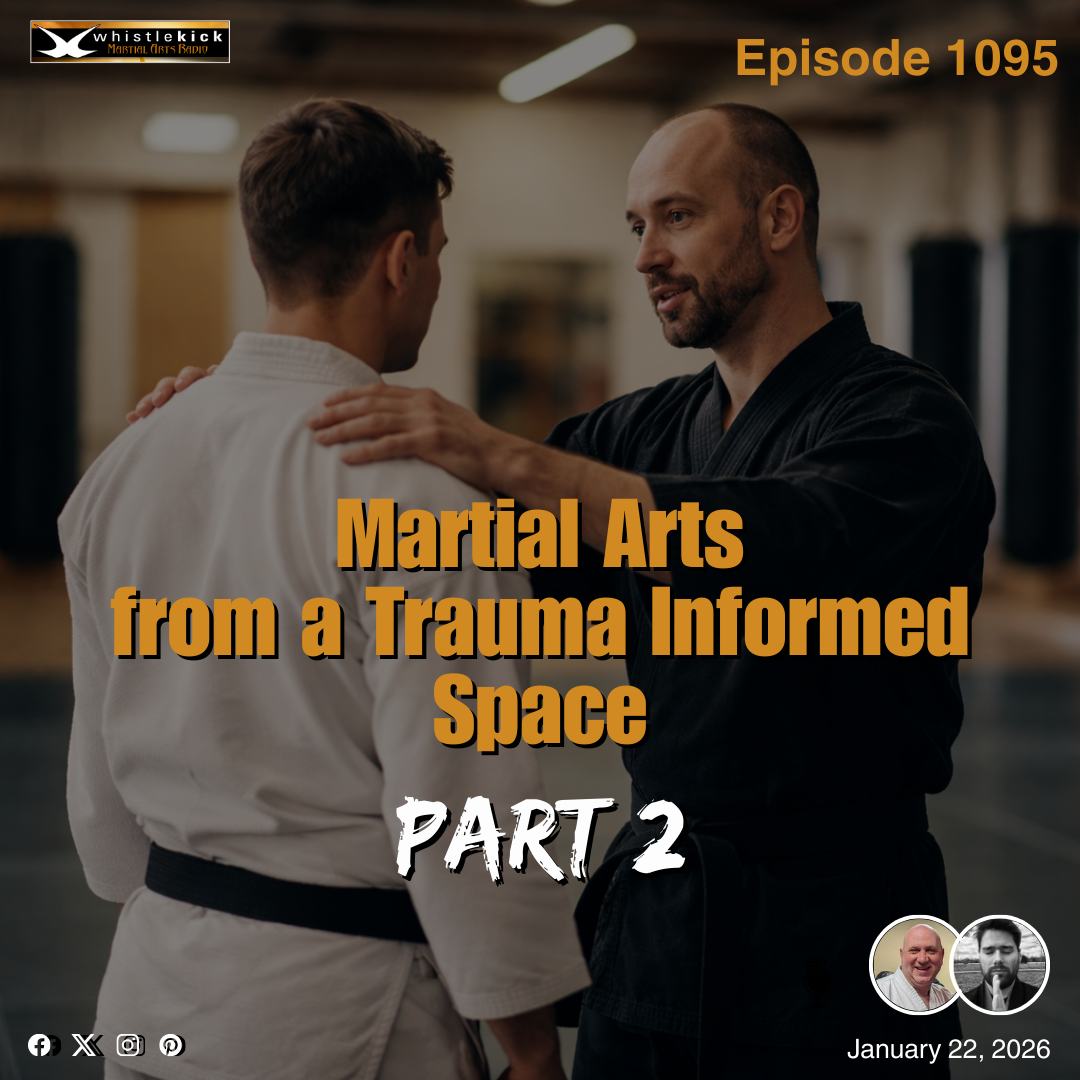
In this part 2 episode, Andrew is joined again by Paul Coffey to discuss martial arts, but from a space of understanding trauma.
Martial Arts from a Trauma Informed Space: Part 2 - Episode 1095
SUMMARY
In this Part 2 conversation, Andrew Adams and Paul Coffey discuss martial arts from a trauma-informed perspective, emphasizing the importance of understanding the physical and psychological aspects of self-defense. They explore various techniques that can be used to de-escalate situations without resorting to violence, highlighting the distinction between ceremonial and non-ceremonial violence. The discussion also covers the need for martial arts instructors to adapt their teaching methods to accommodate students with trauma backgrounds, ensuring a safe and supportive learning environment. They delve into the complexities of violence, self-defense, and the importance of realistic training in martial arts. They discuss the different types of violence, the necessity of teaching practical self-defense techniques, and the significance of training in everyday clothing to prepare students for real-life scenarios. The conversation emphasizes the need for martial arts instructors to create a safe learning environment while also encouraging problem-solving skills in their students.
TAKEAWAYS
Martial arts can be approached from a trauma-informed perspective.
Physical techniques can be adapted for students with trauma.
Non-ceremonial violence requires more responsibility from martial artists.
Ceremonial violence in the dojo differs from real-world situations.
Space and separation are crucial in self-defense scenarios.
Understanding the difference between strikes and pushes is important.
Instructors should present material that meets students' needs.
Crisis intervention techniques can be effective in self-defense.
Teaching should focus on de-escalation and control rather than aggression.
Training in street clothes can be very different and should be practiced.
CHAPTERS
00:00 Introduction
02:05 Physical Techniques in Martial Arts
05:01 Non-Ceremonial Violence vs. Ceremonial Violence
08:08 Techniques for De-escalation and Control
12:39 Understanding Violence: Opportunity vs. Emotion
15:54 Teaching Self-Defense: Practical Techniques and Scenarios
19:44 The Importance of Realistic Training
24:40 Adapting Techniques to Everyday Clothing
27:06 Nonviolent Techniques and Space Control
29:10 Problem Solving in Martial Arts Training
Join our EXCLUSIVE newsletter to get notified of each episode as it comes out!
Subscribe — whistlekick Martial Arts Radio
After listening to the episode, it would be exciting for us to know your thoughts about it. Don’t forget to drop them in the comment section down below!
SHOW TRANSCRIPT
Andrew Adams (04:22.011)
Welcome, you're listening or watching to part two of our discussion with Paul Coffey about martial arts for my trauma-informed space. Paul, again, welcome to Whistlekick Martial Arts Radio. Super excited to have you here joining us.
Paul Coffey (04:37.964)
Thanks for having me. Happy to be here.
Andrew Adams (04:40.029)
Yeah, it's great to have someone knowledgeable in this topic, something that we discussed a bit last week that I don't have as much knowledge about. If you are new and you didn't listen to last week's episode, that's okay. You don't have to, but maybe if you didn't, maybe pause, listen to part one, and then come in and listen to this episode. You don't have to listen to them. It's not like it's a primer to listen to this one first, but...
Paul Coffey (05:06.36)
Mm-hmm.
Andrew Adams (05:08.253)
You may get a little bit of context out of that first episode If you are brand new to whistle kick, please check out whistle kick martial arts radio comm to find out about all of the episodes that we do Over 1,000 episodes coming up on a 1100 at this point all for free Cost you nothing. We don't put it behind a paywall because we feel this should be accessible to everyone Now if you would like to help out we'd love for you to join us through patreon
patreon.com forward slash whistle kick and help make this show happen. But whistle kick martial arts radio is about one small thing that whistle kick does go check out whistlekick.com for all of the things that we do. But let's get into it. So Paul, we chatted last week and talked about martial arts from a trauma informed space, but it's a broad topic. There's a lot of things to talk about. we recognized at the end of last week that you know what?
Maybe there's enough here, not maybe, there's definitely enough here for us to go in and chat about some other stuff. So that's what we're here to do today.
Paul Coffey (06:09.783)
sure.
Mm-hmm.
Okay, so I wanted to talk about the physical aspect of it because we talked a lot about the mental aspect, a lot about listening to the students, making sure you're paying attention and also the framework of how we present technique. But there may be a student that was abused when they were younger that has a problem with punching somebody in the face or kicking somebody or slapping somebody in throat. I know that's really hard for fellow martial artists.
to understand. And I had a moment in Summit last year. I was teaching and one of the younger students, one of the teenage student goes, why are we trying to not hurt them? And it's like, okay, not everybody gets it. But I feel it very disingenuous of us as instructors to not.
Andrew Adams (06:47.037)
Mm-hmm.
Paul Coffey (07:13.454)
present material that is genuine to what somebody needs. And instead we're going, I did this thing and now you do this thing. so like punches, kicks, they're great, but not everybody's going to do them. And I'm not saying that I'm not saying that these students shouldn't learn punches and kicks because there's value in that that goes beyond punching somebody in the face. But I think that they need to have just as much of their curriculum be
Andrew Adams (07:22.514)
Yeah.
Andrew Adams (07:37.009)
Mm-hmm.
Paul Coffey (07:43.124)
less violent, least violent. I don't use the nonviolent term any longer because there is a small minute bit of violence with every interaction. But if I can get a nonviolent student to push or to do a take down that's not like a judo throw where we just slam somebody on the mat, but more of a sit down so that I can leave. Or head steering with the body.
So we push the head out of the way and then that gets an attacker off of you without that violent force.
Andrew Adams (08:19.707)
Hmm. Well, and, and, you know, we are looking at this through the lens of being informed about students who may or may not have had trauma, but let's face it, there are times and we've done an episode on this. can go back about a month ago. We, did an episode on, you may just not want to actually hurt the other person that like, whether not even looking at it from through the lens of
Paul Coffey (08:30.114)
Mm-hmm.
Andrew Adams (08:46.877)
I have been a victim and I don't want to be violent towards someone. You could be at a wedding and your uncle is drunk and getting handsy, right? So there are other reasons to be able to subdue someone or deal with a situation and not have it be quote as violent, right? And putting it in air quotes. I mean, we're looking at it from a trauma perspective. And I think we should continue that. But I think a lot of these things that we're going to discuss
Paul Coffey (09:01.677)
Mm-hmm.
Paul Coffey (09:07.384)
Mm-hmm. Mm-hmm.
Paul Coffey (09:11.862)
Mm-hmm.
Andrew Adams (09:16.315)
would be relevant in any situation.
Paul Coffey (09:20.302)
Sure, I tell a lot of my peers and I also tell my students, like, first of all, this is 2025 and fisticuffs don't rule the land. There's not people that are dueling or let's go settle it in the streets. That's just not what happens anymore. So us as martial artists, we have to be more responsible with our, I have a new term, Andrew, with our non-ceremonial violence.
Andrew Adams (09:45.166)
Ooh.
Paul Coffey (09:48.942)
because the violence, the violence that we do within the dojo is ceremonial violence. So, but with the non-ceremonial violence that's out in the streets, we have to be careful. And I'm not saying that for standpoint of the other person, but very much for us, because the line of what is self-defense now is much less than what it was in the 80s, 97, you know, like, so we do have to be more careful in that regard.
Andrew Adams (09:49.275)
interesting.
Andrew Adams (09:55.133)
How interesting.
Paul Coffey (10:18.418)
Also for anybody that I teach that's in law enforcement, anybody that's ex military or in the reserves or active duty, but is home, I'm still teaching them like you, you might get in trouble. I don't, I don't want to see you be the next person on the news for doing the wrong thing and would rather see you be able to handle that situation with care, you know? And it actually, I will also say.
Andrew Adams (10:37.905)
Mm, mm.
Paul Coffey (10:46.956)
I talked too much, Andrea. I'm I it, it, it, this started decades ago because there was a situ I'm from Louisville, Kentucky, for those who don't know. And there was a situation in Louisville where, two police officers shot and killed a guy who was already in handcuffs because he had a box cutter. And I got furious about that for the simple
Andrew Adams (10:48.143)
No, no, no, it's good.
Andrew Adams (11:11.772)
Hmm.
Paul Coffey (11:16.748)
point that law enforcement is probably the hardest job in our society. And it's the most under supported and underserved job. my opinion, you can come at me. I've had plenty of people already on the internet unhappy with that opinion, but I think that the things that we see that are negative in that light are a direct result of the lack of support. And the fact that those two police officers
Andrew Adams (11:28.157)
Mm-hmm.
Paul Coffey (11:45.418)
seeing an assailant in front of them that was handcuffed with a box cutter, thought that the only way to handle that was to shoot that person, means that in my opinion, they are not trained well enough to deescalate that situation or to subdue that attacker without harm to them or to the attacker.
Andrew Adams (12:07.389)
Now, so getting back to your non-ceremonial violence, I like that. I have chosen to use in the past, consensual violence. That when I'm in the dojo, we are agreeing to be violent with each other. And I put violent in air quotes, right? I I ask a student to step back and get ready to punch me. Like, I know the punch is coming, but...
Paul Coffey (12:13.442)
Mm-hmm.
Paul Coffey (12:20.332)
ooooh, okay
Mm-hmm
Andrew Adams (12:35.805)
Yes, maybe if I don't block it quickly enough, they might hit me, but there's some consent there. There's consensual violence. I think we are discussing non-consensual violence, violence that happens out in the street. And there are definitely thoughts and tactics that one can consider that will lend itself to be more palatable, for lack of a better word.
Paul Coffey (12:35.832)
Mm-hmm.
Paul Coffey (12:40.376)
Mm-hmm. Mm-hmm. Mm-hmm.
Paul Coffey (12:47.34)
Yes, absolutely.
Paul Coffey (12:57.262)
Mm-hmm.
Andrew Adams (13:05.297)
to someone who chooses not to be violent.
Paul Coffey (13:05.399)
Mm-hmm.
Paul Coffey (13:09.502)
Mm hmm. So some of the techniques that I specifically teach, one, the very first one is the heads of steering wheel, the body. So if I cut the back of the head and pull it forward, the body is following. If I get under the chin, push it to the side, the body is following. And what I like about that technique is that even somebody that knows how to fight and fights as they're fighting around, they're still losing.
whatever grasp they had on their attacker, they're also losing a little bit of ground or balance. And so it's really good in that capacity. Other things that I teach, the most dirty one is probably the nose that we all know. Just press it up on the nose. That one gets a little bit of a pushback because that one does hurt. But, you know, okay. But at the end of the day, if you just did that and you didn't break his nose, the cops come and it's a bad situation, you could still probably work around.
but, the big thing for me is the, the manipulation of the spine, of the balance and of the stance of the other person. And I argue that even people that are okay with violence, if you learn how to handle somebody in this way, it makes you more efficient at the violence that you didn't want to do. So that's, but, if I can manipulate their hips so their hips are offline.
And I say manipulate like I don't teach people punches, but hey, we can take this punch. I do teach people punches. We can take this punch and we can press it into the hip and by pressing it into the hip. Now look at what that does. And we do a lot of drills where we're just one person is against the wall. The other person, we don't even start on a choke. We just start hands on shoulders. And it's like, okay, now all I want you to do is just with your fingertips.
Andrew Adams (14:45.725)
You
Paul Coffey (15:06.798)
push at different parts of their body. Try the hip, try the thigh, see what happens to the ribs. Try two different angles in and down or in and to the side and see what works. And then by learning what works, we can like move around that. And then the other thing, like I said, was the spine. So like if I can get him to turn his hip instead of continuing that motion around for the hip, I may go to the spine next because then I can push him.
Andrew Adams (15:12.093)
Mm-hmm.
Paul Coffey (15:35.88)
away from me in a, in that capacity. The other thing that I'll say before I give you the floor is the, every time that every time that I do these, our goal is as much room and separation as possible for the victim because space is what's important. They've encroached on my space and I want that to stop existing.
Andrew Adams (15:50.461)
Yeah, yeah.
Andrew Adams (15:58.236)
Yeah, yeah. And I think the biggest distinction that we are making here is that there is a difference between
for lack of better words, there's a difference between a strike and a push, right? You can push someone with a fist that's not a strike, right? Now, most of the time you could also just open the hand and use it as what one would look at and typically see as a push with an open hand, but striking and pushing are two very distinct, different actions.
Paul Coffey (16:15.113)
Absolutely.
Mm-hmm
Paul Coffey (16:24.94)
Mm-hmm
Mm-hmm.
Paul Coffey (16:38.101)
Mm-hmm.
Andrew Adams (16:39.517)
create completely different responses from your opponent and exploring those.
Paul Coffey (16:43.662)
And we argue that like the average so like we're we're we start from the conversation that everything has fits into a box, which it doesn't. But you have you have the violence here, which is a violence of opportunity. Somebody is.
desperate they they they need a meal. They're trying to get 10 bucks out of it. I mean whatever cash you have etc. Etc. Right this violence that exists here is in some way shape or form less dangerous because the only emotion out of it is desperation and so with this violence.
If somebody comes up to you, hey, I need your wallet. And they, you know, grab you by the shirt or they, they grab you by the throat and push you against the wall and you react and start manipulating their body. By the time you have moved to their hips and gotten to their spine, they're like, wait a second. We, let's talk about this. Let's talk about this. I'm sorry. I didn't know what I was doing. You know what I'm saying? Like, like, because they're out there, they're doing a job. And then you have the more dangerous ones, which are the.
Andrew Adams (17:43.175)
Yeah.
Yeah.
Paul Coffey (17:57.566)
emotionally driven ones. Somebody that knows somebody and is, you know, doing that sort of thing. Somebody that wants to actually hurt the identity of the person. Those are a little bit more tricky. And for those I'm teaching just very simple falls. There's, there's, some stuff that I've gotten out of Kenpo where you wrap one side and throw them to the other side. And it's the idea is all of these, all of these throws are not incredibly damaging.
Andrew Adams (18:04.923)
Mm-hmm.
Paul Coffey (18:26.702)
to the person, they also spread that person's body out because if you spread an opponent's body out when you're throwing them, it takes them just a little longer to get up. You know, like I don't want somebody to throw in or fall in a nice controlled way so that they can just sort of shrimp and stand up. I want them to have to collect themselves. And so those little like taking the arm and doing a round throw of some capacity.
Andrew Adams (18:39.421)
Yep.
Andrew Adams (18:47.792)
Yeah.
Paul Coffey (18:56.046)
pulling the head in and setting them down to the ground. Sometimes just manipulate the hips and an extra push to the thigh is all it takes. Those sort of things. And then I did also want to mention or talk to, I have tried to encourage as many martial arts students as I possibly can and teachers to do this. And that's that if you own a martial arts school and you are teaching new students self-defense in any capacity.
have some of your senior students come into that class and they're not there to help you teach those individuals. They're not going to do that. They're there to learn. But what they are there to learn is how can their technique intervene in a dangerous situation if they were needed to. And so then they have to apply these same principles. They're going to break up a fight, but if they break up a fight by just running up and hitting somebody.
Andrew Adams (19:44.061)
Mm.
Paul Coffey (19:54.134)
Now that's an assault charge. They have to worry about those same things. So it's how can I manipulate a body away from another body as efficiently as possible.
Andrew Adams (19:55.633)
Hmm.
Andrew Adams (20:04.935)
So talk a little bit more about that, like some of the specific things that you do for your students to be able to figure those things out.
Paul Coffey (20:13.716)
Sure. So the easiest one is also you got somebody against the wall being choked. You see somebody with their hands around somebody's throats. That's a very simple situation. It is one that in some capacity I have dealt with out in the real world in non-consensual violence multiple times. Now our gut instinct as people or maybe even also as martial artists is just, hey, hey, hey, break it up.
If you think about two people that are standing here, this space between them is minimal. And the space that exists between them also potentially is a bubble that somebody has been traumatized in a capacity because now they're having a traumatic event happen to them. So if you insert yourself into that situation, you are actually adding to the danger that exists for that attacked individual, that victim.
Andrew Adams (21:13.756)
Mm-hmm.
Paul Coffey (21:14.326)
So what everything that I'm doing is like thread a needle in between the arms of the attacker, wrap the arm up that's closest to you, grab a hip and pull the hip to you. Because when I pull the hip to me, I can pivot and I can place the person on the ground and they're on the ground now 45 degrees from where they were away from that situation. And I taught that in summit and they had a beautiful question come up of like, well, what if it was like a fight?
and you just happen to see the part where this guy got shoved against the wall and is now being, you know, and so like, I wrap this guy up, I grab this hip and I pull it toward me and I do my turn. And they said, what do you do if that other person comes after? And I was like, well, first of all, I reevaluate then. Second of all, that's another reason why I purposefully remove that one person because in removing the one person, I've also put myself between the two.
So if something were to happen, if this other person starts to come, he now has to come through me to get to the other person. So I can still kind of manage the violence that exists within the space. So that's pretty much it. We drill a very simple technique that comes from a technique that's taught in jails called handle with care.
And in Handle with Care, you take both hands and you go up over a person's arm and then wrap through the back. I only use one arm so that I have the other arm to actually manipulate the body, you know, as opposed to just trying to force them over. And what I've done is we start with the person against the wall being choked, the other person choking, work on that. And after we got that, then we play around with it. Well, what happens if that person's now on the ground?
Andrew Adams (22:43.367)
Mm-hmm.
Andrew Adams (22:48.722)
Sure.
Andrew Adams (23:07.218)
Mm-hmm.
Paul Coffey (23:07.638)
You can do the same technique, but now you have to modify it. You have to be conscious of how you're doing it. And it can get more dangerous in some ways, less dangerous in other ways. And we play around with that. Maybe we'll play around with the attackers got his head against the wall. And you think that wouldn't change anything. What actually does, because now heads against the wall getting hurt. So now we have more pressure. So we have to scoop and immediately remove. Whereas we didn't necessarily have to immediately remove.
Andrew Adams (23:12.53)
Yeah.
Paul Coffey (23:36.866)
You know, just stuff like that. And I will also say I am very, very welcome to have more people have this conversation with me because I cannot expand this idea by myself.
Andrew Adams (23:48.136)
Hmm. Well, and I also think it's important to recognize that if you want your students to learn a skill, you have to practice that skill. Regardless of what it is, if you are teaching a form and you want your students to learn how to do it, you have to teach them the form, right? If you, Coffey, want your students to have the ability to assess the situation,
Paul Coffey (24:00.435)
Absolutely. Absolutely.
Paul Coffey (24:09.568)
Mm-hmm.
Andrew Adams (24:17.145)
an altercation out on the street where there is some non-consensual violence happening and be able to interject themselves and extricate one of the two people, you have to practice that. And so that's what you're doing. I find all too often martial arts instructors somehow miraculously think that their students will just magically know how to do things.
Paul Coffey (24:17.761)
Mm-hmm.
Paul Coffey (24:22.089)
Mm-hmm.
Paul Coffey (24:29.432)
Mm-hmm. See you.
Andrew Adams (24:44.571)
that aren't practiced. And sometimes it's as simple and silly as, and Jeremy and I have talked about this before, instructors who on their black belt test will have a student expect a student to do something that they've never practiced in school before. Something as simple as we expect you to, in order to test for your black belt, you have to, I don't know, do a hundred pushups in
Paul Coffey (24:46.411)
Mm-hmm.
Paul Coffey (25:04.59)
Mm-hmm.
Paul Coffey (25:14.19)
Hmm
Andrew Adams (25:14.513)
you know, five minutes or whatever. Well, if you never do pushups in class, it's unrealistic for you to expect them to do that. Right. And I think the same thing can be said of a, these skills and B and I harp on this quite a bit. How often do you, as a martial arts instructor, and I don't mean you, Paul coffee, I mean people listening, but how often do you, as a martial arts instructor, tell your students to show up in jeans and.
and do techniques wearing street clothes. I think it's one, maybe I won't go so far to say one of the biggest, but it is a huge downfall, I think, of us martial arts instructors teaching self-protection or self-defense or whatever you want to call it, is that we get to our school and the first thing we do is put on comfy PJs to work out in.
Paul Coffey (25:55.79)
Mm-hmm.
Paul Coffey (26:02.478)
Mm-hmm.
Paul Coffey (26:11.266)
Mm-hmm. Mm-hmm.
Andrew Adams (26:13.895)
But if you're out on the street, not wearing your comfy white PJs or whatever color you wear in your school, it can be very different. And it's a skill that has to be practiced.
Paul Coffey (26:24.89)
Well, okay, so the other thing is conceptually, if we think about jujitsu for a second, right? Jujitsu has a collar choke. Collar chokes work. Do they work with this hoodie that I'm wearing right now? Not as well because it's very soft. You can get it. You have to work harder for it. But like, I wouldn't know how to put a collar choke on with a hoodie if I didn't work with somebody that had a hoodie on. I wouldn't know how to
Andrew Adams (26:49.917)
Mm-hmm.
Paul Coffey (26:53.976)
get out of that situation if I didn't work with somebody while wearing a hoodie. You know, so that same thing, it's a universal application. Whenever I don't teach self-defense classes or seminars, I teach what is called a self-defense clinic and it is mandatory for anybody that they come to at least six weeks. It's like, if you don't want to do martial arts, that's fine, that's fine, but I need you to commit because it's...
Andrew Adams (27:00.497)
Of course.
Andrew Adams (27:14.781)
Mm-hmm.
Paul Coffey (27:21.27)
I can't teach you it in four hours. can't, you know, and I'm hoping that the repetition helps them stick. And most of them stay around longer than six weeks. But I tell them, I don't want you to wear workout clothes. You're not coming to the gym. I don't want you to wear a gi. I'm not going to give you one. I want you to wear the clothes that you wear when you walk to the office. I want you to wear the clothes that you wear when you go to the mall. I want you to, we have a class that I do.
Andrew Adams (27:24.721)
Nope.
Andrew Adams (27:42.429)
Mm-hmm.
Paul Coffey (27:50.55)
that we call bar night. Wear clothes, wear, wear clothes that you're going to wear when you go out, when you go to the bar, when you go on a date, when you do those sorts of things, because people don't practice in dress shoes. People don't practice in, you know, so like all that stuff. Yeah. High heels or, you know, or a woman's like fancy flats you, I don't even know what they're called. Maybe they're just called flats, but you know how they, they have the
Andrew Adams (27:53.39)
interesting. Yeah.
Andrew Adams (28:00.819)
Mm-hmm.
Andrew Adams (28:07.495)
high heels.
Andrew Adams (28:15.421)
Mm-hmm.
Paul Coffey (28:20.534)
the type of soul that's similar to a man's dress shoe that wear it like it'll slide. How do you fight when it slides? You have to know those things.
Andrew Adams (28:24.807)
Mm-hmm. Yeah. Yep.
Andrew Adams (28:30.213)
Yeah, yeah, absolutely. so taking time out of your class to teach those types of skills can be very, very valuable for sure.
Paul Coffey (28:40.788)
Absolutely, absolutely. I will also say that if you are a martial arts instructor and you're like, I already teach that. If you aren't specifically saying that, you're not specifically saying that. If it's inferred, it's still not taught. It needs to be bluntly said. It needs to be in their face so that they can get it in the same capacity that
Andrew Adams (29:04.923)
Hmm.
Paul Coffey (29:05.408)
If they did the sidekick wrong, they drill the sidekick for a half an hour until they got the sidekick right. It all needs to be very blatantly said and out in public. Boom. So that people can get it.
Andrew Adams (29:19.835)
Yeah. Your BJJ collar choke is a great example. It's one of the things that I love about BJJ is they will often have a no-gi and gi class so that, they are training with not someone who's not wearing a uniform or something that we in New England have talked about. Jeremy and I have talked about being here in New England that you probably don't have to deal with as much.
Paul Coffey (29:34.092)
Mm-hmm. Mm-hmm.
Paul Coffey (29:40.096)
Mm-hmm.
Andrew Adams (29:48.882)
but we've got snow and ice on the ground right now. I don't go outside right now wearing just a t-shirt. Like I'm wearing a big puffy jacket because it's cold or big winter boots and moving and manipulating my body while wearing those boots is very, very different.
Paul Coffey (29:51.66)
Mmm.
Mm-hmm.
Paul Coffey (30:07.042)
You know, the other point that that brings up is temperature. If you were if you were to get attacked in that big poofy jacket, how quickly your body temperature rises and then the ability for you to regulate that response of being too hot while also fighting, you know, we don't have we don't have snow on the ground currently. It did just drop to 20 degrees.
Andrew Adams (30:09.245)
Absolutely.
Andrew Adams (30:23.835)
Mm-hmm.
Paul Coffey (30:34.954)
we have what we call moody weather around here. Because yesterday it was 50, today it's 20. But the point of that is one of the things that I have done for my entire tenure of martial arts is take students outside from time to time. And we don't do that in the dojo enough. Like, we're not going to spend the whole class outside, but it's 20 degrees. Let's go outside for 10 minutes. You've got to feel the difference.
Andrew Adams (30:41.637)
Yeah, yeah.
Andrew Adams (30:51.549)
Mm-hmm. Yep. Yep.
Andrew Adams (30:59.395)
Mm hmm. Yeah.
Paul Coffey (31:01.262)
You gotta be able to breathe when it's cold or when it's hot. You gotta be able to keep moving and keep going.
Andrew Adams (31:06.961)
Yeah. So we kind of stepped away a little bit from specifically trauma informed martial arts, but, I think getting, getting back to it, if there's a skill that you want your students to learn, you have to practice that. And if you have students that are hesitant or downright don't want to be violent towards someone else or cause violence upon someone else, learning those types of skills can be very valuable.
Paul Coffey (31:10.092)
Yeah, we did.
Paul Coffey (31:17.41)
Mm-hmm.
Paul Coffey (31:22.35)
Mm-hmm.
Paul Coffey (31:28.554)
Mm-hmm. Mm-hmm.
Paul Coffey (31:37.67)
Absolutely. And when I was in summit, Sarah Beth said that one of her favorite nonviolent skills is, you know, what's that? And just point to a spot on the floor and it makes people look away. I have said that one of my favorite nonviolent techniques is to paint brush somebody's face. If somebody is close enough and you just go like that, not in a violent way. I'm not stabbing, poking eyes. I'm literally just doing this.
Andrew Adams (31:47.005)
Mmm.
Paul Coffey (32:08.586)
it makes them rethink a lot of things. One, because you can reach their face.
Andrew Adams (32:13.009)
Yeah, they realize how close they are. Yeah.
Paul Coffey (32:15.106)
Yeah, yeah, you have touched their eyelids, but you still touch their eyes. You know, they're very don't worry about scratching somebody's eyes. We're all human and we all do this like, no, something's come to my eye. So you don't have to worry about that. But it is impressive how quickly it can slow things down.
Andrew Adams (32:20.381)
Mm-hmm.
Andrew Adams (32:36.263)
Hmm. Yeah. What are we missing? What did we not chat about that we want to make sure that our audience takes away from this conversation?
Paul Coffey (32:45.942)
I, I don't know that we're missing anything. The biggest thing that I want people to take away there's two things, Andrew. And one is when you're dealing with somebody that has been victimized in the past and trying to teach them how to fight, how to defend themselves, how to carry forth the thing that they are most concerned with usually is space because what's uncomfortable is somebody else in my space, somebody else coming in my space and invited.
Andrew Adams (33:10.492)
Mm-hmm.
Paul Coffey (33:15.372)
what is happening in my space. So being able to allow them to control the space, to gain space back is important. The other thing is the mentality that I regret exists so often than not. And that's a, won't work. Because if I say, if I say this won't work, I'm shutting it down and I'm also degrading it for somebody that it might work for. And it would be better to say, let's figure out how.
Andrew Adams (33:32.39)
Mmm.
Paul Coffey (33:44.92)
to make it work. You we as martial artists are problem solvers. And so I am saying the problem is we have to end this fight without punching or kicking. How do we do it?
Andrew Adams (33:56.125)
Hmm.
Yeah, I dig it. dig it. If you're listening or watching, give us your thoughts. Tell us what you thought of this episode. These two episodes, they're both up on YouTube. You can leave your comments there. Maybe if you're only listening in audio version, you can email me, andrew at whistlekick.com. You can email Paul at
Paul Coffey (34:06.552)
please.
Paul Coffey (34:22.062)
KeepKickingPod at gmail.com.
Andrew Adams (34:25.159)
There you go, keepkickingpod at gmail.com. Paul, thank you so much for being here. As always, appreciate all of your insights on this at times what can be a difficult discussion.
Paul Coffey (34:30.542)
Thank you for having
Paul Coffey (34:39.106)
Thank you, thank you. I'm happy to do this. I am taking this up as my life's work and I'm just trying to boost the signal so that we can get more people.
Andrew Adams (34:49.135)
Awesome. Awesome. if you're listening or watching at home, go to YouTube. As I mentioned, you like and subscribe, follow us there. follow us on, everywhere you can find us Spotify, Apple podcasts everywhere. you can also, if you want to help the show happen, you can do that by going to patreon.com forward slash whistle kick. just send us a couple of bucks a month. It really would make a difference. You can also sign up for a newsletter.
whistlekickmartialarcheradio.com. There's a little button that says subscribe and you'll get an email notification when every episode comes out. And until next time, train hard, smile and have a great day.