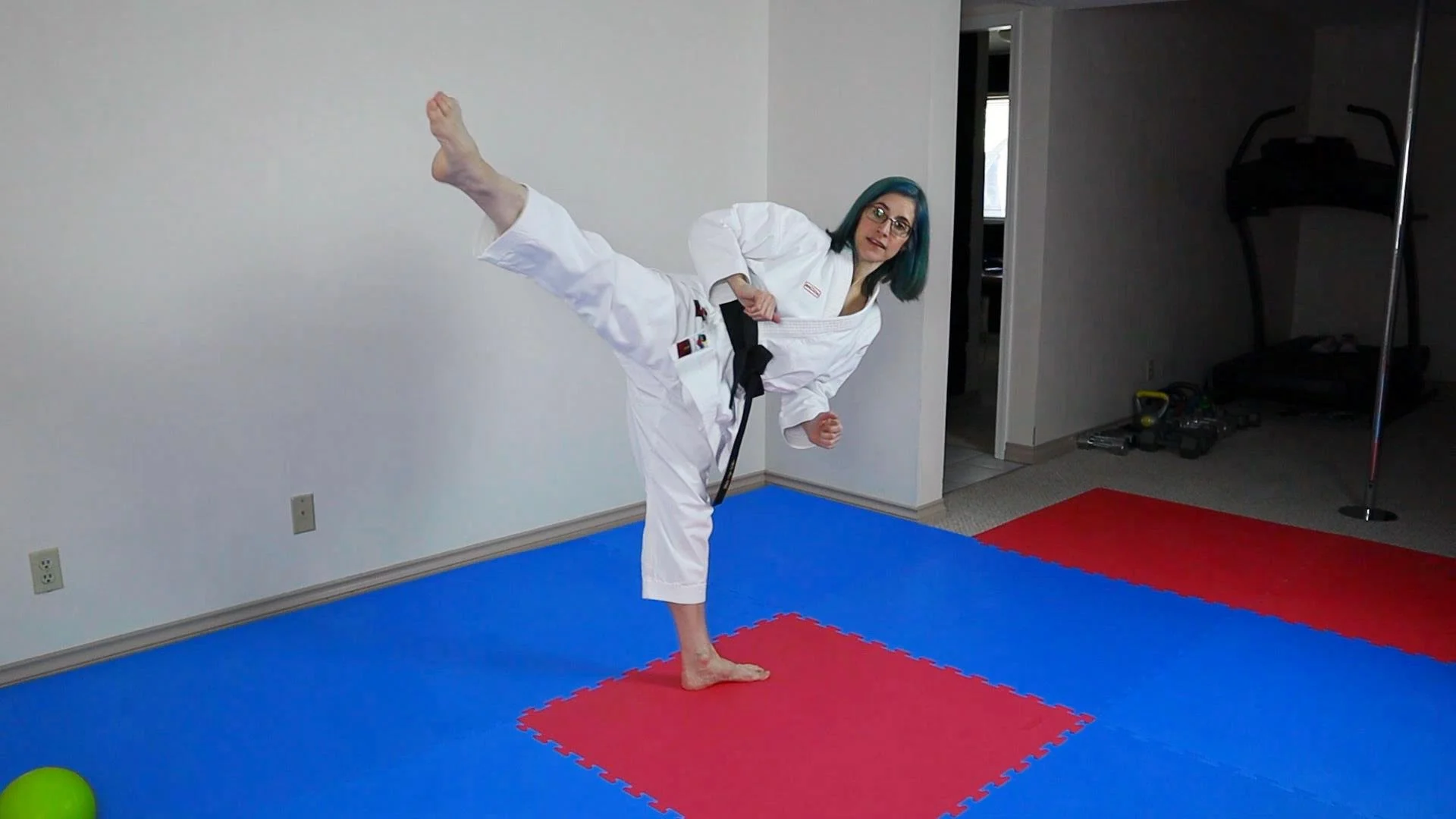
In this episode Jeremy chats with Sabrina Bliem, aka The Karate Shrimp, about starting martial arts later in life and becoming a content creator.
Sabrina Bliem aka The Karate Shrimp - Episode 1096
SUMMARY
In this episode, Sabrina Bliem, aka The Karate Shrimp, shares her transformative journey into martial arts, starting at age 41, and how it became a vital outlet during challenging times. She discusses her transition into the online martial arts community, the challenges she faced, including dealing with a stalker, and how these experiences shaped her relationship with martial arts. Sabrina emphasizes the importance of creating a conducive training environment at home and shares her insights on maintaining consistency in practice, even amidst life's challenges. In this conversation, she emphasizes the importance of having a dedicated training space, the value of consistency, and overcoming the stigma associated with solo training. She discusses how personal experiences and challenges have shaped her approach to training and teaching, highlighting the significance of sharing stories and building an online community. Sabrina also reflects on rediscovering her passion for martial arts and the impact of being authentic and vulnerable in her content creation.
TAKEAWAYS
Sabrina started karate at age 41 as a coping mechanism.
She found a supportive community in martial arts.
The online space can be liberating when starting out.
Facing fears is a recurring theme in her journey.
Dealing with online negativity is part of making an impact.
Training at home requires creating a conducive environment.
Consistency can be achieved through small, manageable steps.
Five minutes of training is better than none.
It's important to prioritize mental health and well-being.
Solo training can be just as valuable as in-person training.
Overcoming stigma around online and solo training is essential for personal growth.
Rediscovering passion for martial arts can come from being authentic and vulnerable.
You are stronger than you think, and resilience from martial arts translates to life.
CHAPTERS
00:00 Introduction
03:01 Sabrina's Martial Arts Journey
06:11 The Online Transition
09:03 Facing Challenges in the Online Space
11:50 Impact of Online Presence on Offline Training
14:53 Dealing with Stalking and Personal Struggles
21:00 Navigating Relationships in Martial Arts
25:58 Finding Balance and New Training Methods
29:03 Consistency in Home Training
33:17 Creating a Dedicated Training Space
37:29 The Importance of Consistency in Training
38:20 Overcoming Stigma in Solo Training
43:32 The Value of Home Practice
47:06 Building a Community Online
50:27 Rediscovering Passion for Martial Arts
53:15 The Impact of Sharing Personal Stories
56:31 Finding Your Unique Voice in Martial Arts
To connect with Sabrina Bliem:
https://youtube.com/@thekarateshrimp
https://www.instagram.com/thekarateshrimp
https://www.facebook.com/thekarateshrimp
https://www.thekarateshrimp.com/
Join our EXCLUSIVE newsletter to get notified of each episode as it comes out!
Subscribe — whistlekick Martial Arts Radio
After listening to the episode, it would be exciting for us to know your thoughts about it.
✅Subscribe to whistlekick Martial Arts Radio on the following platforms:
🎧Apple Podcasts: https://apple.co/3mVnZmf
🎧Spotify: https://spoti.fi/3yHVdHQ
✅You can find whistlekick on all social media platforms using the handle @whistlekick or visit our website at https://www.whistlekick.com or https://www.whistlekickmartialartsradio.com
Show Transcript
Jeremy Lesniak (00:26.512)
What's going on, everybody? Welcome back to another episode of Whistlekick Martial Arts Radio. Today I'm joined by Sabrina Blime. You might know her by another name. I'm not going to tell you what it is, but if you know that name, you probably recognize her. And if you're not watching, you should be watching, because all the best stuff happens in the video version of this show. I'm Jeremy Lesniak, host here for the show. And if you are unfamiliar with Whistlekick Martial Arts Radio, we have nearly 1,100 episodes as of this recording. We've been doing it for a decade.
Some people say we're doing a really good job and I'm one of those people, because it takes a lot of work and we're gonna keep going. If you wanna see all the episodes, whistlekickmartialartsradio.com is the place to go. Make sure you sign up for the emails, because we drop behind the scenes stuff and all sorts of things you're not gonna find elsewhere into those emails, as well as just make it easy for you to get the episodes. Twice a week we release them and Sabrina, thanks for being here.
Sabrina Bliem (01:18.67)
Hi, thank you so much for having me. I'm totally honored. You guys are awesome.
Jeremy Lesniak (01:21.916)
I'm glad. I'm glad you're here. I'm glad you're here. We try to be awesome. don't don't like. Work, we're trying, we're trying, you know, it's the world. The world needs more people trying.
Sabrina Bliem (01:27.552)
You are! You're doing great work!
Sabrina Bliem (01:36.398)
Absolutely, absolutely. you know, helping encourage that martial arts community online. Like, there's so much ego online, but you guys are proof that, like, there's so many wonderful, awesome, salt of the earth people.
Jeremy Lesniak (01:42.182)
Yeah.
Jeremy Lesniak (01:46.716)
I, well, thank you. know, ego has been a fascination of mine for a long time. And you, as someone who has spent a fair amount of time online, I mean, I spend a lot of time online, but you have spent time online as a content creator. you know, I've seen some of the things. I can only imagine the things I don't see.
Sabrina Bliem (01:56.579)
Mm-hmm.
Sabrina Bliem (02:14.222)
There's a lot, yeah.
Jeremy Lesniak (02:16.028)
wow!
I think, you know, I don't know if anybody out there uses, I'm sure a lot of you use Spotify. Spotify offers, you know, their wrapped thing, you know, what you listen to most on your Spotify account in the year. Well, for podcasts, they also have a wrapped for us. And they did, I think it was three videos. And one of them was just us laughing. And it was just like 90 seconds. I think we put it out on the social media of all the things edited together for laughs.
Sabrina Bliem (02:31.427)
Mm-hmm.
Jeremy Lesniak (02:52.986)
But if there was one for what I say the most on TikTok comments, it would be the statement, it's a drill.
Sabrina Bliem (03:01.528)
Yeah.
Jeremy Lesniak (03:03.672)
It's not representative of how they might fight if some random person attacked them on the street without rules. It's a drill.
what made you want to even step into this online world of martial arts? was it, did you lose a bet?
Sabrina Bliem (03:20.392)
online part of it.
Sabrina Bliem (03:24.91)
Well, I, okay, so I'll tell you about my journey first, my martial arts journey, just to give it context. So I started karate at age 41. So I'm 50 now. So it's coming up on nine years. And I'd always been interested in martial arts when I was young. My family was really into kung fu movies and that kind of thing. But it was something that I thought, oh, it'd be really cool to try it, but I never had. I did try Tai Chi for a few months in my 20s.
Jeremy Lesniak (03:28.536)
Yeah, yeah, let's. Sure.
Sabrina Bliem (03:53.518)
It was great. It just wasn't the right fit for me though. I like something more aggressive. But yeah, when I was 41, I'd been struggling with grief. My mom had been diagnosed with cancer the year before and I was having a really difficult time coping. And also around that time, my kids were struggling. My oldest was being bullied and my youngest, I was struggling with shyness and I was concerned about her starting kindergarten and not talking to people. And I thought one day, you know, I was really struggling. I thought,
maybe I should get back into Tai Chi, maybe I should do something like that. So I went online and looked up different martial arts dojos in town and I came across, it was actually the Facebook page for the karate dojo that I ended up starting at. And I got a really good vibe from them. thought, karate, would actually, that could be a good fit for all of us. For me, with my grief and my stress, for my kids with dealing with bullying and shyness, this could be a good outlet for all three of us.
And so I signed us all up for free tried out class on one day and we all loved it. It was just like, and I thought to myself like right away, I thought I have no idea where this path is going, but I know I have to be on it. There was something about karate that just spoke to me and it surprised me. I thought, this could be fun. This could be a good outlet, but I didn't realize how I didn't expect it to be so like such a good fit for me. Right. And
I never felt like I fit in anywhere. I never felt like I found my people or my thing, my passion. No, like I was into fitness. I'd been running. I was never into sports. Like I was really clumsy as a kid and I was always picked last for teams and that kind of thing. Never athletic, but you know, I wanted to be fit, right? And just interested in fitness and nutrition and health and that kind of thing. But I was never comfortable putting myself out there.
Jeremy Lesniak (05:21.338)
had you been doing other sports or, you know, movementy things?
Sabrina Bliem (05:43.192)
competing, performing, anything like that. And so it scared me starting, right? It did scare me, but the theme all the way through for me has been if it scares me, I have to do it, right? It's like today, I felt nervous coming on here, but you don't have to do it, right? Like every step of the way. So that kind of led into my starting the online thing. So it was a few years into it. I think it was 2020. Yeah, it was just after COVID lockdowns and I was...
I was going through a divorce. None of us could leave the house. was working exactly, well, I was working at the dojo at the time. I was an assistant assistant instructor. And I was going through a divorce and I had been for years helping my ex run a body shop. And so I was looking for something new, right? And I love teaching and I'm interested in nutrition. have a background in nutrition and interested in psychology and health and all sorts of things.
Jeremy Lesniak (06:12.444)
But none of us could leave the house. So you're like, I might as well do this.
Sabrina Bliem (06:41.454)
and in writing as well. And I thought I could put this all together and start a blog. That was actually the first step. I was gonna start a blog. And so thought, well, I'll start a YouTube channel as well to drive traffic to my blog. That was gonna be the focus. And I quickly realized that YouTube is actually the thing and making videos was something that it scared the crap out of me going online, like being a kind of a quiet person, not liking being the center of attention. But again, it was that thing, if it scares me, have to do it.
Right. And so that became, it just became really exciting for me. It's, it's not so much the being online, but like, love video production. I love the challenge of it. And I knew nothing. I knew nothing. And I still feel like I know nothing. Right. But just learning something new and being able to take all the pieces, like being interested in, know, my passion for martial arts and my interest in nutrition and psychology, all these different things in writing and being able to put all that together into this online thing that I'm doing. So that's how we got to this point.
Jeremy Lesniak (07:40.476)
And in stepping into the online world, were there goals? it simply, I'm bored, I'm bored in my house and I need to do something? Because let's face it, there were a lot of people who, we saw them for about a year and then they could leave their house again and we didn't see them again in the martial arts world and at all. So was it that or was it something more?
Sabrina Bliem (07:44.878)
Mm-hmm.
Sabrina Bliem (07:49.262)
Hahaha!
Sabrina Bliem (07:59.756)
Yeah. Yeah.
Sabrina Bliem (08:04.826)
No, I need a creative outlet. Like I've always needed that ever since like I've done, you know, I've been, I guess a writer since I was little, always, always writing something. And I need, I love the creative process that it's kind of like giving birth the violence of it, right? Like it takes a piece of you, you put so much into it and it takes a piece of you at the end of it, right? And I love that process. And so just anything that I've done that's like been where I'm creating something, I love that process. Like I,
Jeremy Lesniak (08:07.26)
Mmm.
Sabrina Bliem (08:33.9)
you know, have like my first degree was in English lit and I did a lot, wrote a lot of papers. I love the process of throwing myself into writing a paper and it's difficult. It's stressful. It's, know, I'm sweating by the end of it, but there's something about that creation that I love it. So that's, that's what it is for me. It's not so much the, do want to connect with people and I do want to help people. And that's a big thing for me as well. But I also just need to create so that my soul doesn't die. I need to create something.
and putting it out into the world like that, it scares me. I do that just to, it's important to me to face my fears and overcome.
Jeremy Lesniak (09:13.062)
So your comment about blog plus YouTube makes me wonder like, were you spending much time on YouTube as a consumer of content prior to that?
Sabrina Bliem (09:21.934)
I was, but not excessively. Being online too much isn't necessarily good for me. And I've always known that. It's not good for any of us. And I get that disconnect, I dissociate that kind of thing. And so there was that concern too. And that's been something I've had to manage all the way along. It's like, yeah.
Jeremy Lesniak (09:24.731)
Okay.
Jeremy Lesniak (09:31.548)
I don't think it's good for any of us.
Jeremy Lesniak (09:37.275)
Yeah.
Jeremy Lesniak (09:44.924)
The reason I'm asking that's a precursor question because it.
Jeremy Lesniak (09:55.61)
Did you know what you were stepping into? The world of online content in any niche is rough.
The online martial arts content world seems to be rougher than average. And then creating as a woman seems to carry a unique.
complexity within that space as well. Did you know any of this was true before you start? I'm curious. Okay, good.
Sabrina Bliem (10:23.352)
Yes.
Yes.
Sabrina Bliem (10:29.908)
I did, I did, but I also knew that in the beginning, no one was going to be listening or watching or reading. And so that, and I quickly realized that too, like at first I was terrified putting myself out there going online. And then I quickly realized, no one's watching, no one's reading. it was liberating. like, well, I could make all my mistakes. And it, it paralleled my, like the feelings that I had when I started karate as a white belt feeling like,
how liberating it was to be a beginner when no one expected anything of me, right? And I love that. And so that's what I realized is like, no one's watching, no one cares. So that for a long time, I felt that anonymity, right? And then it's only, you know, after a while I started growing that I realized, oh, oh yeah, no, no, this is gonna affect me too. I knew it would, but you know, it's just like, you know, my following's been pretty small. It's still pretty small, right? But.
from, you know, it took a long time to grow it to where it is now. So, and a lot of effort. So it kind of cocooned me a little bit from that, right? I didn't have to deal with the hate so much. But yeah, it's definitely, yeah. When you actually deal with it, it's like, I can handle it, but it's still you have to kind of compartmentalize a little bit, right? And not let it, you can't just...
Because when you're when you're reading comments online and dealing with that kind of thing, there's something about it that it just you internalize it like it's your own voice reading it. Right. And so it is it is hard to, you know, but I've realized along the way that when you're dealing with jerks online, when you're dealing with hate, when you're dealing with all of that, and the being a woman when you're dealing with that aspect, too, it's like, if you're doing something that's making an impact, you're going to get that
Jeremy Lesniak (12:17.082)
Yes. And I think that that's such an important thing. It's something I continually remind myself. If everyone's happy with what you're doing, you're not making an impact. You're not moving the needle. not happy. They're actually indifferent. But if 10 to 15 % of the people in the space aren't mad at what you're doing, you're probably not working to your potential.
Sabrina Bliem (12:22.904)
and
Sabrina Bliem (12:28.162)
No, you're, yeah.
Yes.
Sabrina Bliem (12:43.842)
Yeah, I agree with that. I think, it's also with tribe building. If you wanna build your tribe online, you have to have other, right? You have to have us and them. You do, and then you're gonna have people who are really loyal to you, right? And that's just part of it. Yeah, if you're gonna have a strong stance on anything, you're gonna deal with the hate, you're gonna deal with, for sure. Especially on the internet where people tend to be louder than in person, right? So yeah, it's absolutely part of it.
Jeremy Lesniak (12:49.51)
Mm.
Jeremy Lesniak (12:53.424)
Yeah.
Jeremy Lesniak (13:16.122)
How did this exploration affect or did it affect what you were doing offline, your training, how you saw martial arts, your relationship to karate, et cetera?
Sabrina Bliem (13:28.792)
So how did the online part of it affect it?
Jeremy Lesniak (13:30.552)
Yeah, yeah, yeah, obviously the offline led to the online, but did anything start to come back?
Sabrina Bliem (13:38.866)
well, there was something very specific as I had a stalker. So yeah, we can get into that if you want.
Jeremy Lesniak (13:45.276)
Oh, OK. Wow. If you're willing to, I would like to. I'm sorry that happened. I didn't know that happened. So that wasn't me fishing for that.
Sabrina Bliem (13:51.907)
Yes. And obviously not, not. Okay. No, for sure. No, I've had, no, and I was trying to think, okay, like that's the most, that's the thing that really stands out in my mind of, yeah, it's kind of significant. And it's a big part of my journey. Like I think my journey has, it's supposed to be difficult and it has been all the way through. and I don't mind talking about any of it. I'm totally comfortable with that. And obviously I'm not naming names. I'm not shaming people. Like I don't want to do anything like that.
Jeremy Lesniak (14:04.912)
kind of significant.
Jeremy Lesniak (14:12.732)
Mm.
Sabrina Bliem (14:20.812)
That's not my focus here. So yeah, I was training at this dojo. So I was training in Meibokan, Gojiru, karate, Ruku, Kobo-Do, Tesshin-kan and Japanese Jiu-Jitsu. I was working at the dojo on a tournament team for karate. Like I was in, I was all in. This was like my second home.
Jeremy Lesniak (14:38.556)
What general area of the country are you in? Okay, okay. Then you are in a different country. What area of the world are you? You're in BC, got it, okay.
Sabrina Bliem (14:41.336)
I'm in British Columbia in Canada. Yeah, yeah. I'm in a, yes.
Sabrina Bliem (14:52.238)
I'm in Canada. I'm in Western Canada, British Columbia. Vancouver is the closest city. So I am. Yeah. So I was all in right. This is my passion. I was working at the dojo. It was just awesome. Loved it. And then everything kind of went sideways and there was my mom was dying. So right. I told you like I got into karate because she had cancer. She ended up passing away.
2021. But so it was 2021 was the hardest year of my life. And my mom was getting sicker. And she had multiple myeloma. And then she got diagnosed with stomach cancer as well ended up in emergency with a stomach rupture. And it was just bad, like lost her in five weeks. And during that time, one of the students at the dojo started stalking me and it was because of the online thing.
I had at the time, I don't have a blog anymore and I had a podcast for a while. I no longer have that. I'm just doing YouTube and social media, but I would send out a newsletter, my blog newsletter, and he would come to the dojo and say, oh, I read the email you sent me. And so everything that I was doing online, it was like he was seeing it as for him, right? And he started obsessing about me and reaching out. Like in person, it wasn't so weird at first, it was more online and it was making me uncomfortable.
and so I had a talk with that sensei that I ended up having a falling out with him. over this, so over this, yeah, yeah, yeah. So, and, and, you know, I was just for context here, like I was apart from that sensei, I was like, I, no one was at the dojo more than me. Like this was my passion, right? I love that place. It was like, I love
Jeremy Lesniak (16:24.348)
Over this? Ooh, okay.
Jeremy Lesniak (16:40.828)
You were all in.
Sabrina Bliem (16:42.156)
I was all in, I loved everyone there, like everyone who knew me there, like they knew how much I loved it, right? And so I, so this guy was stalking me, my mom was dying. And I was trying to deal with all this. And there was actually one night at the dojo we were sparring and this guy, he hit me really hard in the face, like punched me hard in the face and knocked me down and hurt me. And there was other stuff like he was just acting really sinister and kind of staring at me.
And my kids were always there with me. Like my oldest was volunteering at the dojo. My youngest used to take karate, but she was there with me when I was working, when I was training. And I felt really uncomfortable with this guy there, right? And then my mom passed away and he was still continuing to stalk me. And I was dealing with all this stuff with my mom. There was like possible medical malpractice. And then this whole big story of this shady funeral home stole her body from hospice.
and refused to release her without getting paid money. It was like this horrible, horrible time, okay? High stress. So I'm dealing with all this stuff, dealing with the stalker. And then during this time, my sensei at the time, he started getting kind of weird. And I think COVID did a number on him as it did for a lot of dojo owners. I can only imagine how stressful that would be owning a dojo and all the closures and whatnot. But it started to come out and like...
at the dojo and how he was treating people, the Sensei. And so I talked to him about the stalker guy and at first it was like he didn't believe me. And then he had to talk with him. said, yeah, he's crazy. So the stalker guy was having all these delusions about me. There was another, there were very few, I was the oldest member of the dojo. I was older than my Sensei at this time. And it was mostly teens and people in their twenties and kids.
And so there was one other male adult at the dojo and this married guy, right? A yellow belt. And, you know, I'd work with him, like I was working there, right? I would teach him whatever. And the stalker guy got it in his head that I was with this married man. And he was telling the sensei that I had gotten pregnant a few times by him. I was 44, 45 at the time. Okay. Yeah. I've had my two kids anyway. Yeah. And then I was engaged to this guy.
Sabrina Bliem (19:05.932)
there was one black belt test in meeting where he called up all the senseis and was congratulating me on my wedding. And like, I just went on and on and on. And meanwhile, he was reaching out to me. So the sensei said to me, Okay, look, he's crazy. I'm gonna keep an eye on him. If anything, you know, if it gets weird, we'll kick him out. Like, okay. I was uncomfortable. But I'm like, what do I do? Right? Like I was, I was scared. And I was also like, stressed and dealing with my mom and you know, all this stuff, right?
And then it was about maybe a month after that. And I said to the Sensei one night, said, I have no idea how to navigate any of this, but I just, can't, like, I feel so stressed out when I'm with him. I can't be in class with him. It's just, and I'm thinking about my kids and there were nights when I had to lock up and I'd be running the dojo and I'd have to lock up and he would be there and he'd be waiting and he wouldn't leave and everyone else is gone and I'm there with my kids.
and he's staring at me and he had hurt me before, right? So it was really stressful for me and I didn't know what to say. So I'm like, just like, I don't know what to do, but I just can't, sorry, I can't, I'm really uncomfortable. And he ended up kicking the guy out. And then the next time I was at class, he said to me, yeah, I kicked him. I asked him what happened. He said, I kicked him out. And he said, that was the hardest thing I've ever had to do. He was crying, his dad was there. And this guy was like in his forties, his dad was there. He had other, this guy had mental health stuff.
going on, obviously. But yeah, so the sensei felt bad for him and was mad at me. And he over the next month, yeah, over the next month, he started treating me worse and worse. And he would like change my shifts on me and cancel my shifts. And he would, we had a Facebook group for our tournament team where we had all of the information. He blocked me from the group at one point, because he kept changing the practice dates. And like I was a, you know, single full time parent.
And I said, Hey, can you just give us warning with the, you know, with the changes? And he got mad at me for that and blocked me from the group. And so he was doing all this passive aggressive stuff. And finally, one day I went into the dojo when it was just the two of us. said, Hey, look, like we have to have a talk about this. I said, you know how much I love this place. Like, why are you treating me like this? And it came out that he thought I was giving him an ultimatum telling him you got to kick the guy out or I'm leaving. And I never did. Like I, and the thing is he had the guy. Okay. So this guy, the stalker for context too.
Sabrina Bliem (21:30.316)
He was on the tournament team, full on like I was with martial arts training and all of the martial arts always there. We had done a tournament trip to Vegas in 2019 and that guy got detained at the airport. Turns out he had a criminal record. Okay. We didn't know what for. It was from a different province in Canada. And the Sensei at the time was angry about this, but kept him on. I think it was fraud or something like that. He had him volunteering at the dojo.
as an assistant instructor teaching kids. He kept him on as a volunteer even after he knew the guy was stalking me. So I think the sensei was struggling with his own mental health stuff and spinning out and saw me as some, I don't know, the problem. like I was the victim of all this, right? And, but I got treated like I was a problem. And I have a feeling there was some sexism involved there that, perhaps if I had been the stalker that I would have been kicked out promptly.
Jeremy Lesniak (22:15.868)
Yeah.
Sabrina Bliem (22:28.686)
Right. I have a feeling just from the way the dynamic was going. so I ended up quitting everything with that conversation that I had with him. And it turned out, you know, I realized, you know, he thought that I was trying to engage in this power struggle about it. And really, I was just scared. I was just scared. And I said, you know, this guy is a liability or he was a liability. He's like, I know that now, but still you were, you know, so I'm like, I can't do this anymore. So I quit the job, left my keys, took our weapons. I pulled my kid out and I'd already had to talk with my kid. My kid was going to be
Jeremy Lesniak (22:29.478)
Mm.
Sabrina Bliem (22:57.976)
do for their black belt test soon. said, look, whatever you want to do, if you want to keep training here, I'll support you, but I can't go anymore. I can't like if this conversation goes badly, I have to leave. And my kids said, no, if you're leaving, I'm leaving. So pulled my kid out, left the tournament team left my, second home, basically, right? It was the hardest, like such a hard decision. And then that was it, you know, and I haven't, I, I've seen him around town. I've seen the stalker around town too, but it's quieted down. I've blocked the stalker everywhere.
Jeremy Lesniak (22:59.953)
Mm.
Jeremy Lesniak (23:10.524)
Hmm.
Jeremy Lesniak (23:16.666)
Yeah. Yeah.
Sabrina Bliem (23:28.215)
and you know, it's, it's, it's quiet now, but I.
Jeremy Lesniak (23:30.97)
Did the stalking persist after he was kicked out of the school? It did.
Sabrina Bliem (23:34.593)
Yes, it did. And he was still reaching out to all the senseis and try, excuse me, trying to, you know, join other dojos in the organization. There's a several Maboukan dojos in British Columbia. And, you know, none of them wanted anything to do with him, right. And still reaching out to me and he would, what he does now all he can do now, I haven't blocked everywhere, but on YouTube, he will constantly subscribe and then unsubscribe and subscribe. So I get the notification, but I have that.
Jeremy Lesniak (23:43.548)
Mm.
Sabrina Bliem (24:02.188)
I don't have notifications on there because I don't want to see that. like he would, he would sign up to my, I have courses for sale. He would sign up there and try to try and talk to me there and say, congratulations on your wedding. And you know, I want to go back to karate and it was just, yeah. And so like I had the police involved and they went to his house and told him to stop and he never stopped. And, but it was the blocking everywhere that finally, yeah, it did eventually stop.
Jeremy Lesniak (24:27.067)
Hey.
Sabrina Bliem (24:27.724)
Yeah, big one. So so then I quit that dojo. Yeah, yeah. Don't do any of those things.
Jeremy Lesniak (24:31.046)
So school owners, don't do any of those things if you know you have someone that is a liability. It is rare, but that's about as textbook for cause for removal from a martial arts school as you get. Docking and violent tendencies, not a good combination. Definitely don't have them working with kids. Like, come on.
Sabrina Bliem (24:54.708)
Absolutely. Because he would be there then like even after the sensei had the talk with him the next very next night, I was booked for a shift. And that guy was there, volunteering and teaching classes. And I was shocked. I was shocked.
Jeremy Lesniak (25:10.492)
And what I find fascinating that you didn't say was ignoring this situation and students leaving. Right? Because this is generally the sort of thing that people are going to gossip about. And I would imagine that if I was parent to a child in a school like that, zero notice, zero, I don't care. I'm done. I'm out. It's such terrible judgment that somebody would keep that person on.
Sabrina Bliem (25:40.204)
Yeah, and for me, think like the lag between, you know, all this happening and me quitting was just that I was so overwhelmed by grief, right? And I needed something and I didn't know what to do. And it was just, right?
Jeremy Lesniak (25:52.593)
wrapping your head around leaving the thing that had been the coping mechanism for all of this challenge, right? Like that just, that's, I mean, that sounds like a, like a horror movie, like, ha ha, karate's not actually helping you, it's making your life worse. Like that just, that sounds horrible. So did-
Sabrina Bliem (25:58.713)
Yeah. Yeah.
Sabrina Bliem (26:08.108)
Yeah.
Sabrina Bliem (26:16.227)
Yup.
Jeremy Lesniak (26:19.28)
Did it discolor your view of martial arts? did that? No.
Sabrina Bliem (26:23.05)
No, no. And I think like with that sensei, he's not a bad person. I think he was struggling. I think he was struggling with mental health stuff. And from what I've heard, he seems to be better now. But there were other people that he kind of screwed over as well at that dojo that during that period of time, like from COVID until then. I think it was, yeah, I think it was a bigger issue than just me. But yeah, no, I...
I love martial arts and I love the people and I just think some of it, it's like, yeah, ego comes into play. And then concerns about, I'm sure there were concerns for him about losing students after COVID, right? Worrying about money and that kind of thing. And maybe that was, I think we're all human. Yeah, and there are jerks and there are, just like with any, in any discipline, right? There are gonna be people in martial arts who, yeah, behave.
less well than they could. But I still love the discipline. And I, I'm so impressed by how many wonderful, wonderful people I have met by doing this and how many wonderful people I've met online. So I think it's Yeah, sorry.
Jeremy Lesniak (27:32.454)
So what, what did training turn into for you after that?
Sabrina Bliem (27:36.687)
Yeah, well, after that, I was really sad for a long time and it was hard. I was initially I was looking for another dojo. I wasn't ready to try a new style of karate though. And for me to train in the same style, I would have to drive a lot. And with being a full time single parent, because then like I went through this messy divorce and I ended up having my kids full time, also during this time. I
Yeah, and there was stuff there that happened to my kids went through that all in the same year. So I, I really wanted to prioritize, you know, my relationship with my kids and taking care of my kids. And so I had to, if I was going to find another dojo, it had to be convenient, right? It had to be local. And I didn't really find anything that, or I just, just doing online searches and word of mouth and that kind of thing. I couldn't find anything that immediately fit for me. And so I just trained on my own at home and I have my
home dojo space and I've stuck with that. I did get back into Jiu Jitsu for a while and trained at one of the, it was that Sensei's Jiu Jitsu Sensei and I went to his dojo for a bit. But again, it was too much of a drive. It was too far and just with having my kids and it wasn't realistic. So yeah, so since that was November, 2021 till now I've been training mostly at home on my own and I haven't competed. And so it's just been the karate and the Kobudo, but I actually really
it now and it's I think this chapter of my life it works really well like I loved competing I loved it I love I love sparring and I like I do miss sparring I love just the connections you make with people in the ring it's just an amazing experience right I love that and I love having an outlet for my aggression but this chapter of my life I think it's it's been really enjoyable just to train at home and be there with my kids and and I'm really enjoying this right now I'm doing the online thing and
I am enjoying it. think I'm not done with, you know, finding another dojo or competing or anything, but it's for now. I'm really enjoying this. It's working for me.
Jeremy Lesniak (29:41.884)
Mm.
Jeremy Lesniak (29:45.412)
I don't know too many people who stay consistent with home training for years. Do you have secrets or tips?
Sabrina Bliem (29:50.651)
huh.
Sabrina Bliem (29:58.646)
Yeah, like I'm really interested in behavior and behavior change and the psychology of it and motivation and all of that stuff is really interesting to me. I've struggled for sure. And there have been times where I just didn't want to do any of it. There have been times I wanted to quit wanted to quit the online thing martial arts, everything I mean, but I've had those struggles with consistency from the start, like ever since I got into fitness in my early 20s or whatever. And I what
works for me is when I'm struggling is like realizing that stuff that's really interesting to me is, you know, we talk about laziness and say, you know, you're lazy, you just need to suck it up. And, know, you need discipline to stick with your training. And studies have been done on this, our brains are wired for laziness, right? Like when given a choice between two tasks, our brain is going to say, like, do the tasks, it's easier. It just energy conservation, it makes sense in that context, in a biological sense. So why would we
waste energy doing something where we can take an easier path, right? So if you have a choice between training in your living room and watching TV, if watching TV is the easier thing to do, you're gonna do it, right? So what's important for me is to set up an environment at home where training becomes the easy choice, right? So like having a space available. And I used to train in my kitchen. So when I was at the dojo in the beginning, like when I was, I think it was a week after I started karate, I signed my kids and I up for our first tournament.
I was terrified. So I thought we got to do it. We got to do it right as white belts. It's the best time. Oh my gosh. All in. thought, right. It was like, well, we're white belts. No one's going to expect anything of us. So rather than doing a, you know, first competition as a black belt where there's high expectations, right? Let's do it now. And it was such a great experience for all of us, but so it was a weekend and I was going to be doing kata and weapons. So was going to be doing a bow kata. I didn't even have a bow. So at home I would practice with a broom handle in my kitchen.
Jeremy Lesniak (31:28.156)
Talk about all in, jump in head first.
Sabrina Bliem (34:08.096)
After competition. so I would train in my kitchen. So I'll start with that. So I would do my training in my kitchen because I didn't have a space. And so I was getting ready for this first tournament. I was going to be doing a bocata, right? And so I use this broom handle and it was a Gandalf staff my kid had made. had a feather on the end and it was wrapped in like zebra, not zebra. It was turquoise leopard duct tape.
and then it had this fake gem on the end, right? It was like a bathroom handle, bathroom knob, this sort of glass thing. Anyway, I didn't think about the knob. I wasn't thinking about that. It was glued on. So my first time practicing this, Kata, there's a part where you have to spin the bow. The knob flew out of the end, narrowly missed my head, narrowly missed our kitchen window.
Yeah, dumb luck, dumb luck. But anyway, so after that, I knew to be more careful, right? But but yeah, so I would practice in my kitchen. I, it wasn't convenient. But you know, I had, it wasn't a great space, but I had a mirror on the wall, and a little mirror, and I could do my training there. In between cooking tasks, I could run through my kata, I could do my basics, that kind of thing, right. So for me, it's all the way along, it's been even if I don't have a convenience space, like, well, how can I make my environment more conducive?
Jeremy Lesniak (35:03.211)
Thanks.
Sabrina Bliem (35:29.39)
to training so that training becomes the easy task and whatever other distractions, watching TV, going on my phone, so that that's more difficult. So for me, that really leads to consistency. And consistency isn't necessarily sticking with it every single day, day in, day out, but like over time, doing it more often than not. You can have missed days, that doesn't mean you're a failure. No all or nothing thinking for me, because yeah, when I go with all or nothing, I was like, well, I have to do my workouts all the time or it doesn't count.
I end up more often than not skipping it, right? So for me, it's keeping my expectations low. Five minutes counts, five minutes matters. And if my motivation is low, taking that small action can help get my motivation back, right? So yeah, making the environment conducive to training and being easy on myself rather than, you know, if I can't do the full workout, it's not worth it. And then I miss what months, years at a time, right? Which some people do just, well, what can I do for five minutes? Or what's the...
the smallest, easiest step I can take right now. Like I used to do a lot of running outside. What would be the easiest step? Getting my running shoes on. No expectation to run, but just getting my shoes on, that's the smallest, easiest step. And if you make it small and easy, like it seems dumb to not do it, right? And then when you get your shoes on, you're more likely to head out the door, that kind of thing.
Jeremy Lesniak (36:49.771)
One of the things I used to tell myself going to the gym, if it was a day I didn't want to go, I say, I am not going to set a requirement of how long I have to be there or what I have to do while I'm there, but I have to go and I have to do something. And that would always feel more approachable. And so I would go and sometimes it'd be a half hour. Sometimes it'd be the full hour, hour 15 that I would plan on doing because once I got there, it got easier.
Sabrina Bliem (37:00.438)
Mm-hmm. Yes. Yeah.
Sabrina Bliem (37:17.944)
Yes.
Jeremy Lesniak (37:18.867)
So I would imagine that, you you talk about having a dedicated space, you probably don't have to move stuff out of the way to use it. It's not, you know, it's not, I've got to move this couch and then this and that, no, it's ready to go all the time.
Sabrina Bliem (37:31.971)
Yes. Yeah. So yeah, I have my dedicated space now, but I mean, for a long time, even with having my channel and I would, you know, some of my videos are tutorial videos. had my, so the space I have is downstairs. It was a rec room, but I had the TV there at a couch. had stuff on the way and I was still training in there. wasn't convenient, right? But I made it work because while I, I was filming and so there was that kind of, you know, self-imposed obligation, right? That I have to get something up. But then I,
ended up later on, cleared out that space and I bought some dojo mats or some puzzle mats and created some space. I thought I needed, I need a good space for training and for filming and that kind of thing. And yeah, having that space, it's like I come downstairs, it's all there. You know, I have my treadmill, I have my weights, I have my weapons, I've got everything there. And then I have my, all my filming stuff, my office, everything is downstairs. So it's, it's easy to do. But I think even if I didn't have that space, I would make it work somehow. But it's just having something visual like,
you know, maybe if I only had my kitchen, I would keep, you know, my weapons upstairs somewhere where I could see them and it would be that visual reminder to train, right? And like setting aside time to do it. If you don't have a big space, you can still get a lot done in a small space, but it's making it easy and whatever obstacles are in the way, making those harder to do, putting my phone on, do not disturb hiding in another room. You know, if I feel like in the evening, I'd rather watch TV than
Jeremy Lesniak (38:53.961)
Mm-hmm.
Sabrina Bliem (38:57.998)
practice while I could make it harder to watch TV, unplug the TV, hide the remote or take the batteries out of the remote, make it more difficult so that training is the obvious step, obvious choice to make.
Jeremy Lesniak (39:09.259)
Yeah, there's another thing that you pointed out that I think is really important. We've talked about it on the show a number of times, this idea that training doesn't have to be an hour. It can be five minutes. It can be two minutes. If the biggest thing holding you back in your training is, let's say, flexibility, spend two minutes working on one stretch. If you can accumulate a...
Sabrina Bliem (39:18.252)
Yeah. Yeah.
Jeremy Lesniak (39:34.313)
Two minutes a day ends up being an additional four to six weeks of training across a year the way most people train.
Sabrina Bliem (39:39.374)
Mm-hmm. Yep.
Jeremy Lesniak (39:43.135)
What if that's five minutes? Now we're adding months. What if you're doing 10 minutes? What if it's two five minute segments? Five minutes in the morning, five minutes at night. Now you're basically adding six months of training across the year to your life. That's a lot. That's another 50%.
Sabrina Bliem (39:57.303)
That adds up. It matters. that's consistent. If it allows you to be consistent, that's more important than the two hour session you did six months ago, right? Right? Like doing that and building it up. And then it's this proof to yourself that you could do the thing even if you didn't feel like it, right? And then it builds up your confidence and then you like taking that small action that leads to motivation, right? Rather than waiting for motivation to strike for some big workout that you never end up doing because motivation is fickle.
Jeremy Lesniak (40:29.887)
Now I'm curious, because solo training, online training, right? These are, these are things that are.
pre-pandemic were actively and aggressively looked down on in the end.
Sabrina Bliem (40:47.66)
Yes. And I think still there's a lot of that. I still see a lot of that.
Jeremy Lesniak (40:51.167)
There is still some stigma, but what I found fascinating, because I've always operated under the premise that some training is better than no training. I believe that wholeheartedly. you're training on your own, I would rather you find a book. I would rather you found the worst book and trained yourself on that than you didn't train. And there are people out there who do not agree with me. That's fine. They're entitled to their opinion, but training makes us better. I want people training.
Sabrina Bliem (41:09.55)
Mm-hmm.
Yes.
Yeah. Yeah.
Jeremy Lesniak (41:20.511)
through the pandemic, we saw quite a few people who operated schools that would have been some of those aggressively, actively saying, training on your own or training online. And then they were assigning individualized homework and they had Zoom classes, right? You're kind of interesting in that you didn't have a lot of time before that. So, and I'm guessing you weren't aware much of that stigma until you started doing it yourself.
and possibly in combination with the content you were creating. So you've got a little bit of a unique perspective and I'm curious what that was like for you as you that route.
Sabrina Bliem (41:53.132)
Yeah, exactly, that comment.
Mm-hmm
Yeah, well, I did train. mean, I was at the dojo for four years and eight months. So I mean, that I felt like I got a good foundation there, right? Like I didn't start learning on my own. learned from, mean, he was, yeah, no, no, no. No, okay. Yeah. And, and like, and I totally think I agree with you that, you know, some training is better than nothing and however you need to learn. And I really think that
Jeremy Lesniak (42:13.033)
And I want to be clear, I'm not dismissing that training and I'm not saying that nearly five years of training is insignificant.
Sabrina Bliem (42:28.36)
learning on your own first online as some people do or learning from a book or whatever and then later on down the road you might end up you know joining a dojo or whatever and then getting those little corrections that you you might need and that kind of thing but for me I found it yeah I didn't know that know about the stigma until I was online and on my own but sorry what was your original question?
Jeremy Lesniak (42:56.019)
It was basically what because so I'll ask it again in a different way
Sabrina Bliem (43:01.292)
Yeah, yeah, okay.
Jeremy Lesniak (43:03.615)
I've been training a while. And if you go back a while, the stigma was everybody knew about it. You don't learn martial arts from a book. And then, you know, there were the VHS and the DVDs people lay out. All right, those are fine. But you know, supplemental and you got to make sure that you train with the person right like, but you didn't have that backstory.
Sabrina Bliem (43:25.645)
Mm-hmm.
Jeremy Lesniak (43:30.583)
And we've already talked about how hateful the internet can be. And so I guess the question I'm trying to get to is, did you come into this new chapter of your martial arts training, not realizing that people were gonna crap all over it? And did they crap all over it? Because I'm guessing some of them did.
Sabrina Bliem (43:45.615)
They did. And I started my online journey as a brown belt. And so that was a concern too. Like I was thinking, that part of it, I expected, okay, I was thinking, who's gonna listen to me? I'm a brown belt. And even now, like I got my showdown in 2021, I haven't tested, who knows if I'll ever test again, right? So I mean, I'm still, and not quite nine years, like I'm a newbie, I consider myself a beginner at this, right? And some people have been doing this for years and years and years.
for their whole lives. And so I expected a certain amount of that. But I think, I did come, I was surprised by some of the commentary of me training on my own and it's not worth it and you don't count. But once I started sharing my story, because I didn't share that at first, because I think being a like being a victim of harassment and that kind of thing, and what I'd gone through with having that falling out with my sensei,
I didn't want to talk about it. felt this shame around it, you know, even though like I was the victim, I felt this, yeah, victims do carry that shame, right? You don't want to talk about it because you're concerned you're going to have people saying, it's your fault. It was your fault. What did you do? And I did have that. And so when I finally, it was maybe a couple of years after I think I made a video on what happened and it was so freeing for me to do that. I was terrified to make that video, but I shared it.
and talked about what had happened. And I was really surprised by how many people were like, I mean, I wasn't surprised that people were supportive, but I was surprised then by how many people were like, yeah, you training on your own, I totally understand. And you know, it's valid. whereas before then that in between period of time there, I was hearing that, you you're training on your own, it doesn't count. And you're only a brown belt, you're only a black belt or a showdown or whatever it is.
And especially just and being a woman online, what you're doing doesn't count because I did hear that kind of thing, right? People not taking me seriously. But people did come around once I shared my story and I think I've seen that in others sharing their context, like people saying, you know, yeah, I train online and maybe they get bashed. But then they say, well, like, I don't have the money. I don't like, you know, I don't like financially, I can't afford it or my work, my environment.
Sabrina Bliem (46:07.88)
the context I'm in, I don't have anything available to me and here's, here's the details of my life. And then people, you hear more and more people coming out and I've seen this coming out, supporting that and say, I totally get you. Right. So I think it's me being vulnerable online. I started to get more supportive people saying, okay, you doing this on your own. I totally get it. And that's valid. That's valid. And it's given me a lot more, I'm, I'm a lot more appreciative of other people's like,
when I hear about other people training online for the first time, and I've had that thought too, at times, like, well, okay, like how, if you're learning for the first time from a book or from, you know, a video, it's not going to be as good as in person, right? And in person is going to be, you know, you get all of that in person, real time feedback and all of that stuff. But you could also end up with a bad sensei and learn everything poorly too. There's that.
Jeremy Lesniak (47:02.315)
I would say it's not, I don't think we can be as broad as to say it's not as good. I think we can say it is not as efficient a learning environment. However, if the alternative is an inefficient drive or
Sabrina Bliem (47:09.346)
Yeah.
Sabrina Bliem (47:17.11)
Okay, yes. Yes.
Jeremy Lesniak (47:32.041)
going without food because you're scraping pennies to make it to make it work as is right it's an option and when people get paint with that broad brush it's not as good it's not worth the time etc i get i get really bent out of shape about it because
Sabrina Bliem (47:39.384)
Mm-hmm. Yep.
Jeremy Lesniak (47:52.355)
Most of us that came up in, I I started training in the 80s. I was very young. And even then the dynamic that I was raised in was old school. was training in the 80s, but it was much more from doing the show and talking to people. I would describe it more as a 70s flavor, but in a progressive way, because in the 70s, there weren't a lot of kids classes. We had kids classes from day one.
Sabrina Bliem (48:03.0)
Great.
Sabrina Bliem (48:19.458)
Right. Okay.
Jeremy Lesniak (48:25.253)
We were taught that the best thing to do was to come to class, learn your new stuff, and then go home and practice the crap out of it. So that when you came back, you could be refined. And that if your only training existed within class time, it was not going to be an effective way to progress because the amount of stuff that you had to learn. And if you weren't remembering it, because you were going home, forms, right?
Sabrina Bliem (48:48.558)
Mm-hmm.
Jeremy Lesniak (48:53.919)
How many people out there struggle to learn a form because they do it only in class and they don't go home and practice it and they're relearning it every few weeks, right? Like that's a common story. So the idea that this thing that most of us were raised, we've been training a while, is a necessary part of training is somehow also a wasteful part of training is just insane.
Sabrina Bliem (49:21.638)
I agree with that. Yeah, I think about that too. Like anytime I would learn a kata, I learn anything at the dojo. You know, when you're drilling, drilling, drilling and learning and you feel like I always felt like my brain is made of Swiss cheese and there's all the holes in it. And then I would always go home that night. And like, you know, I'd still be in my gi all sweaty, you know, getting my kids to bed and I'd be in the kitchen in my kitchen, my with my lino, my little mirror, practicing that kata over and over and over until I felt like all the holes in my Swiss cheese.
cheese brain were filled in, right, but it took that practice at home and then I could go back the next day and okay, I still feel a little rusty, but then it would start to gel, but it's that at home training. Absolutely is super, super important. Yeah.
Jeremy Lesniak (50:05.363)
Repetition is the mother of skill.
Sabrina Bliem (50:07.51)
Absolutely, right? You're creating those neural pathways in your brain, right? And the more you use that pathway, the stronger it gets for sure. Yep.
Jeremy Lesniak (50:11.178)
I
Jeremy Lesniak (50:16.649)
I tell my students, if it, okay, great. You've learned the form tonight. So we're gonna bow out. I want you to go do it in the corner. I'm not gonna watch it. This is for you. Go do it in the corner before you put your shoes on. Go home. As soon as you take your shoes off, do it again. And then before you go to bed, do it once or twice. And then when you wake up the next morning, the first thing, know, do what you gotta do when you roll out of bed.
Sabrina Bliem (50:26.168)
Yeah.
Sabrina Bliem (50:32.739)
Yes.
Jeremy Lesniak (50:42.613)
but as soon as humanly possible, do it one or two more times. And if you do that, it is most likely gonna be locked in there. That is what I have found for people.
Sabrina Bliem (50:49.852)
yeah. Yep. Yep. So just obsessing about it in the beginning. Absolutely. Yep. It's that. And then you get that muscle memory and yeah.
Jeremy Lesniak (50:58.719)
those repetitions.
Jeremy Lesniak (51:06.075)
Now that you're training on your own and you've developed a reputation and a following and there are people out there and from my observations of your content because you're one of the few people that comes on the show that I actually knew who you were beforehand, right? Like we've interacted a little a lot.
Sabrina Bliem (51:22.286)
Yep. We've interacted, yes.
Jeremy Lesniak (51:33.19)
most people seem to be supportive.
Jeremy Lesniak (51:38.315)
Is there anything that's come from interactions with people online that has changed what or how you train on your own?
Sabrina Bliem (51:50.679)
I don't think directly. think the only thing is just being online. There's that motivation to be consistent, right? Like I need to, it's an accountability thing, right? If I'm online, I need to, because for a while there when I, after leaving that dojo, I felt like a fraud. I felt like, and I've hardly worn my belt since then.
Jeremy Lesniak (52:14.539)
Mm.
Sabrina Bliem (52:19.04)
And that's been a struggle for me is getting back in my uniform consistently. And like, I don't have to train in my uniform at home, right? And, there's something about it that, you put on your uniform and your gi and your belt and you just feel that, it just feels so good, right? But I really struggled for a long time with feeling like what I was doing wasn't valid or because I had left a dojo and left a tournament team and all of that, that it didn't count. And, or I thought that people would look at me that way.
right, that it didn't count and I was internalizing all of that. I know it's not true, but it's that voice, right?
Jeremy Lesniak (52:51.667)
You know that's not true, right? Okay. And you believe that you've, you, do you finally believe that that's not true?
Sabrina Bliem (52:58.35)
I know it's not true. I know it's not true. And it's a habit, right? It's like, I developed a habit of not putting on my gi, right? And it's a habit that I just, I can create a new one, right? And create new memories and new associations with wearing that rather than remembering that time and that stressful time. And I think that was part of it too, is going to the dojo and wearing my gi and dealing with my mom's death and the stalker and all of that. And so that it was like, I kind of wanted to shield myself from that, but.
I think, yeah, being online, it's that accountability that like, no, need to, I share my stories and I share the things that I struggle with. And so I have to do something about it. And so it's helped me be consistent with my training. It's helped me face my struggles and fears and realize, okay, well, am I working as hard as I'm encouraging other people to work? am I doing all the things that I'm telling people, right? But I don't think I've had anything.
like dealing with haters and negative comments and stuff, I don't think that's really changed anything that I do. Other than I'm a lot less concerned about what other people think. And I think just, yeah, like being online and going through, you know, losing a dojo home, right? And losing that community. And then I went through a really ugly divorce and losing that part of my community. I've stopped being so concerned about what other people think because I've lost so many people.
Jeremy Lesniak (54:09.131)
That's great.
Jeremy Lesniak (54:16.331)
Mm.
Sabrina Bliem (54:27.538)
And so now it's like, I feel free to be me. And so that's, think the online thing has really helped me just like, it's helped me rediscover my passion for martial arts too. And like separate from all the grief and everything. Cause that was so tied up with that is, you know, my training and like, I loved it, but I would just, it brought up so many bad memories for me too. So I struggled with it. And,
Yeah, just being myself and being online and not being, you know, sharing my stories, it's helped me find that passion again for karate and stick with it. And so I don't think there's been anything specific with my training that it's changed, but it's just that, like, it's kind of revived that feeling again, that feeling that I had in the beginning, you know, I have no idea where this path is going, but I know I have to be on it. And yeah, I think it's helped me with that.
Jeremy Lesniak (55:21.771)
You mentioned that your, I think it was your older child was on the verge of testing for their black wall at this time. So that gives me an idea of how long they were training. Actually, you said you all started together. know, near five years, which tells me they're old enough to have some observation of what happened and what is happening.
Sabrina Bliem (55:26.018)
Yes.
Yeah. Yeah.
Jeremy Lesniak (55:47.699)
What do the kids think about what you're doing? Your training and your content stuff?
Sabrina Bliem (55:52.675)
They're supportive and they like, I mean, I'm quirky to online. have a goofy sense of, I have a goofy sense of humor. And I've definitely been letting that out more and more as I've gotten more comfortable with being online and stop being so concerned about what other people think. So that's kind of freed me just to yeah, be my goofball self. So, and my kids, my kids are goofballs too. So they're used to that. But like they loved karate in the beginning and both of them and my youngest, think.
Jeremy Lesniak (55:57.983)
I had no idea.
Sabrina Bliem (56:22.304)
she quit because I think she had, it was issues with the sensei. She saw it before any of us did and she didn't feel comfortable with him. And then my oldest, yeah, like they don't wanna do the karate thing anymore, but they support what I do and they think the online thing is cool. they're into performing, they're in a dance group. do, they're in an idol, it's an idol group. So they perform at conventions, they wear cosplay. And so they like,
Jeremy Lesniak (56:44.811)
Yes.
Sabrina Bliem (56:51.448)
having my space for their dance practices and like, you all my film equipment, they're like, Hey, can we make a tick tock or whatever? they like it, it benefits them.
Jeremy Lesniak (56:54.185)
Yeah!
Jeremy Lesniak (57:05.291)
What haven't I asked you about these things in your life? What would people want to know?
Sabrina Bliem (57:07.67)
What haven't you asked me?
Sabrina Bliem (57:15.734)
I think it's important just to say to people, if you're, one thing is, so my online thing that I'm doing, from the beginning, was my focus was people who are already interested in martial arts. I wasn't trying to recruit people or anything like that. And my focus has been all the things around our training that affects our performance on the mat. So our sleep, stress management, nutrition, the mental game, all of that stuff has been really interesting to me.
And that was interesting to me as an athlete, right? Becoming an athlete and thinking, okay, well, what can I do so I perform better at this tournament, right? And so that was my intended audience. And along the way, I've been surprised by how many people have either gotten interested in martial arts because of me or who have gotten back into martial arts after an absence. And I've had so many people reach out and it's never been a goal for me to do that. I just thought, I'm targeting people who are already excited about it, like me.
And I've realized, no, there's a lot of people struggling. And me sharing my stories and me talking about, it's okay to do five minutes and that kind of softer approach to coaching. They really appreciate that. And I've had so many people reach out, like people are way more experienced than me in martial arts and say, it's because of you I've gotten back into it. Or people saying, I've never been interested in martial arts, but your lighthearted approach, your goofy sense of humor, you've gotten me interested in this. And so that's been a...
like amazing side effect for me, right? It's like, I didn't intend to recruit anybody or, you know, get people motivated to get back into it. But that's I think just because I'm being a goofball, I think it makes it more approachable. And because I am taking that softer approach, like it's okay if you skip training, it's okay if you don't feel like it's okay if all you can do is a couple of punches, you know, lying down in bed, like that's totally valid, right? And I think because there's so much like stuff online that
Jeremy Lesniak (58:41.803)
awesome.
Sabrina Bliem (59:09.41)
that is ego driven and it is suck it up buttercup. And that's not all of the martial arts community, but that's so loud. So that's what we see, right? That's what we hear that a lot of people are put off by that and they maybe don't want to start, don't want to try it. So that's been a really cool part of all of this is like, just seeing how many people actually like really are interested in this. When we take kind of this goofball, when I take a goofball approach, it really helps to that. But yeah.
I can't remember what we started off talking about. I've got talking in circles here. I'm sure.
Jeremy Lesniak (59:42.795)
If I had a nickel for every time somebody said that while I was it while they were on the show I'd have many dollars
Where do people find your content? Where are the spots?
Sabrina Bliem (59:53.473)
Okay, so I have a YouTube channel, it's the Karate Shrimp. I have my Instagram account, that's where I have the biggest part of my following. It's again, the Karate Shrimp. And then I Facebook, I'm not gonna be posting to my Facebook page for much longer, I don't care for the platform, but I am on there, my page will still be there. I do have TikTok, but I don't use it anymore. So yeah, the best places are YouTube and Instagram. Instagram, I do respond to DMs, so that's a good place to reach me.
And then I have my website, sorry. And then I have, sell online courses. So that's all linked on my website.
Jeremy Lesniak (01:00:31.881)
which is.
Sabrina Bliem (01:00:32.962)
TheCarotishrimp.com.
Jeremy Lesniak (01:00:34.773)
Okay, and where does this name come from? Are you, you know, four foot two?
Sabrina Bliem (01:00:38.094)
I could, I'm five foot two. And actually it's an interesting story. So it was my former sensei gave me the nickname shrimp and he had a habit of giving students jabby nicknames, like teasing nicknames. And I had been teased as a kid for being small. And so was one of the things like, you know, yeah, he gave a lot of students nicknames they didn't care for and I didn't like it. And it was definitely a job based on my size cause he's six, four to my five, two.
And but when I was trying to come up with a name for all of this, I thought the karate shrimp, I can do it like a take back the night thing, know, like, take that nickname that I don't like and make it my own. And now I love it. And he very quickly stopped calling me shrimp. So it worked out. So yeah, I just I took a name I didn't care for and I made it my own. And I am a shrimp.
Jeremy Lesniak (01:01:33.299)
There's, you know, it's, it's funny, funny is not the right word. is interesting to me. This seems to be, there seems to be this recurring theme for you of just, I'm going to roll like whatever it is, I'm going to, I'm going to roll with it. I'm going to make the best of it. And
You know, it's it's such an important skill and it's one that I think we've all learned in varying degrees. You we can't stop life. Life is going to happen and we can try to hold it back and it's just going to run us over. But you can survive. what I 20, 25 was the hardest year of my life, and some of the things were actually similar to some things that you had talked about. You had more in there. You had more stuff.
You had more stuff simultaneously.
we can always find a way forward, right? Like there's always, it's...
Sabrina Bliem (01:02:29.688)
Absolutely.
Sabrina Bliem (01:02:33.826)
We're stronger than we think.
Jeremy Lesniak (01:02:34.315)
There's, yeah, there's something in, you know, I read this at a religious context, but I think it applies equally outside. If you know you're gonna pass, it's not really a test. It has to be hard or it's not a test.
Sabrina Bliem (01:02:48.79)
It has to be. I agree. Yeah, and that's where the value comes in, right? Yeah, it is supposed to be difficult.
Jeremy Lesniak (01:02:57.469)
And so, you know, I was raised, my black belt test was meant to be so difficult that for the rest of my life, I would be able to look back on and say, I made it through that. I can get through this.
Jeremy Lesniak (01:03:15.293)
If you can get through that year of your life with all those things happening, I can't imagine what would be too much for you. I I hope you never have to go through anything like that again, but wow, like you are obviously an incredibly strong and resilient person and one that I'm finding a great deal of inspiration talking.
Sabrina Bliem (01:03:28.034)
Me too, thank you.
Sabrina Bliem (01:03:39.054)
Thank you. Yeah, I think that is it.
Jeremy Lesniak (01:03:41.109)
So how do we wrap this? What do you want to leave the audience with?
Sabrina Bliem (01:03:45.123)
I think that is it. You're stronger than you think. And that your martial arts, all the resilience you develop in martial arts, that translates. That translates to your life as a whole. when things go down, you can do it. And if you're still here, there's more right in your life than there is wrong. And you can get through it. You may not feel like you can. You may not want to, but you can get through it. Yeah.