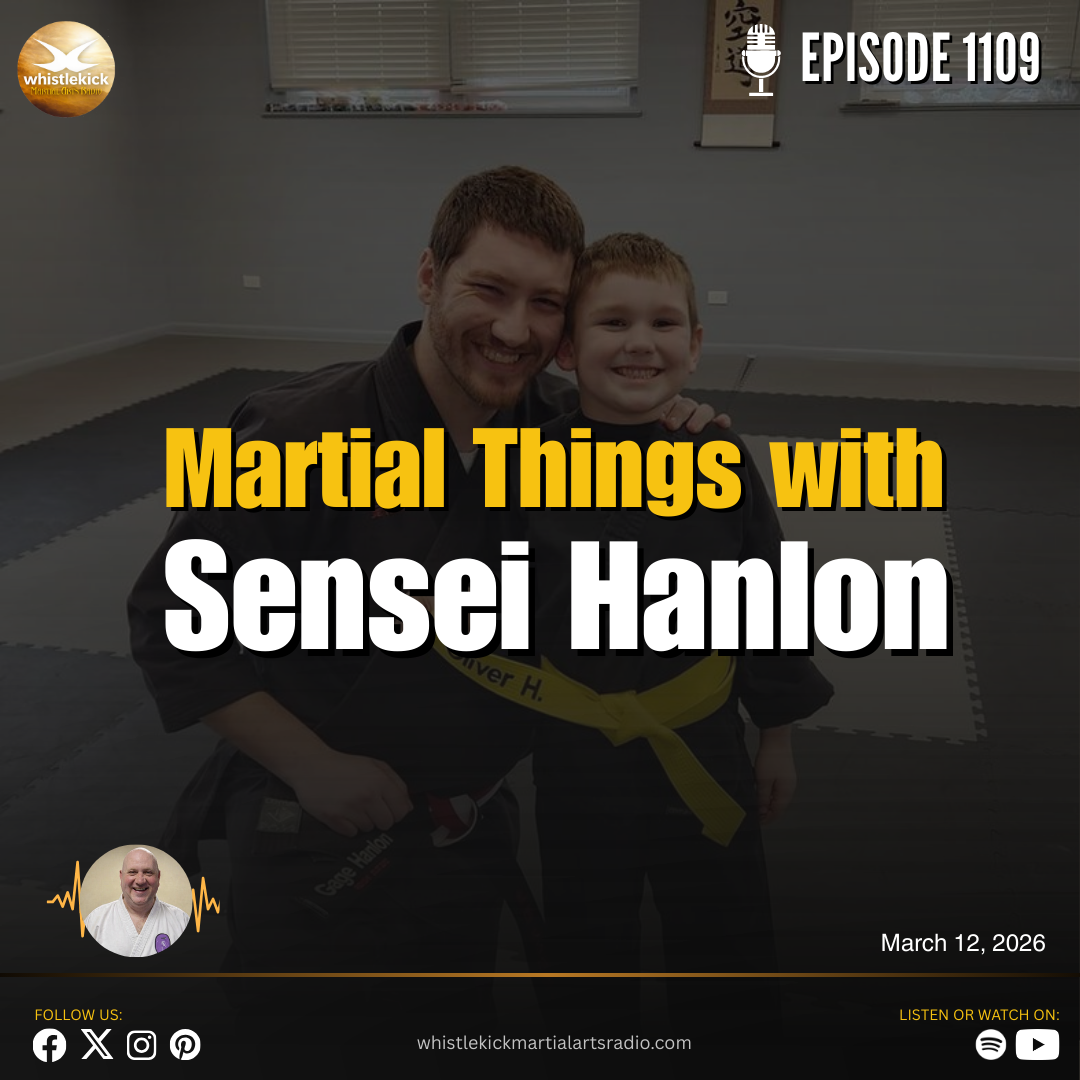
In this episode join Andrew in whistlekick’s Martial Things series. This week he sits down and chats with Sensei Gage Hanlon with a plan to talk about……. nothing. No plan, just a conversation to see where it takes them.
Martial Things with Sensei Hanlon - Episode 1109
SUMMARY
In this conversation, Andrew Adams and Gage Hanlon explore various aspects of martial arts, focusing on the importance of community, cross training, and competition. They discuss the dynamics of training together, the benefits of learning from different styles, and the significance of fostering friendships within the martial arts community. The conversation emphasizes the value of stepping outside comfort zones for personal growth and the role of instructors in guiding students through these experiences. In this conversation, Gage Hanlon discusses the importance of embracing discomfort in martial arts training, particularly in sparring, and how it contributes to personal growth and resilience. He emphasizes the role of instructors in guiding students through their journeys, fostering accountability, and creating a supportive community. The discussion also covers the dynamics of building a competitive team culture, mentorship among students, and the significance of collaboration within the martial arts community.
TAKEAWAYS
Cross training events enhance community and learning among martial artists.
Instructors can gain insights from training with other schools.
Competition training fosters team bonding and personal growth.
Friendships formed in martial arts can transcend competition.
Respect and sportsmanship are vital in martial arts culture.
Encouraging students to compete can help them grow.
Stepping outside comfort zones expands personal boundaries.
Instructors should communicate growth messages to parents as well.
Community-based training events can benefit all participants.
Growth comes from embracing discomfort.
Accountability is essential for personal development.
Instructors should model vulnerability and humility.
Structured discomfort cultivates resilience and tenacity.
Students may grow to love what they initially dislike.
Mentorship enhances the learning experience for all.
Competition can foster a healthy team environment.
Community collaboration is vital in martial arts.
CHAPTERS
00:00 Introduction
02:39 Cross Training and Community Building
10:30 Competition Training Dynamics
17:23 Expanding Comfort Zones in Martial Arts
22:24 Embracing Discomfort for Growth
25:28 The Journey of Sparring and Accountability
30:43 The Role of Instructors in Personal Growth
37:35 Building a Competitive Team Culture
40:49 Mentorship and Leadership in Martial Arts
48:35 Community and Collaboration in Martial Art
Join our EXCLUSIVE newsletter to get notified of each episode as it comes out!
Subscribe — whistlekick Martial Arts Radio
After listening to the episode, it would be exciting for us to know your thoughts about it. Don’t forget to drop them in the comment section down below!
SHOW TRANSCRIPT
Andrew Adams (00:02.679)
Hey Gage!
Gage Hanlon (00:05.747)
How we doing?
Andrew Adams (00:06.946)
I'm great, how are you?
Gage Hanlon (00:09.036)
Doing good. Got back from a walk with the dog. So feeling energized, ready to rock and roll.
Andrew Adams (00:15.598)
All right, ready to chat about martial arts. All right. Are you familiar with our martial things series?
Gage Hanlon (00:17.44)
Yes, sir.
Gage Hanlon (00:24.158)
I am not. I know that's something that's somewhat new.
Andrew Adams (00:27.564)
Yeah. So the thought is the thought process was this. We have typically always done our Thursday episodes with a specific topic. We'll bring a guest on and we let the guest know we're going to talk about this thing, whatever that thing is. And it really is very different from our Monday.
Gage Hanlon (00:38.422)
Mm-mm.
Andrew Adams (00:50.656)
interview episodes, which are very free flowing and the guest gets to talk about, mostly their journey in martial arts. But the thing that we, Whistlekick, was missing with these, with the martial arts radio was missing was that free flowing just talk about martial arts with a guest. And so not necessarily, let's talk about Gage about his experience doing martial arts, because that was your interview episode. Instead, let's just talk martial arts, like
you know, what's going on in your world martial art wise? What's going through your brain? And let's just see where it takes us. Maybe we talk about this topic or this topic or something else, and we just have a fun conversation. So that's the plan.
Gage Hanlon (01:36.264)
Okay, sounds good.
Andrew Adams (01:38.463)
It's the plan of not having any plan.
Gage Hanlon (01:41.708)
It's gotta be adaptable, right?
Andrew Adams (01:44.172)
Well, I mean, they say in martial arts, that's the goal, right? You got to be able to roll with the punches, as they say. So if you're cool with that, we'll just jump, we'll just keep going. We'll just leave that in. Maybe we'll have a new listener who is like, what is this martial thing? So now you know. Now you know. And if you are new, first off, thank you for being here. We appreciate that. You can check out all of the over 1,100 episodes we have at martialartsradio.com.
Gage Hanlon (01:50.089)
Yes.
Gage Hanlon (02:01.319)
Absolutely. Cool.
Andrew Adams (02:12.398)
whistlekickmarshallartradio.com. All 1100 episodes are there. They're free. You can get transcripts. You can see photos, contact information for so many of our guests. All that stuff is there. You can sign up for exclusive newsletter and you can go to whistlekick.com to find out all of the other things we do. Maybe you want to attend one of the events that we host around the country or maybe you want to purchase some apparel.
Maybe you want to buy a book, all of that stuff, whistlekick.com. But let's get into it in our plan to have no plan. What's going on in your world these days, Gage? Marshall Hartwise.
Gage Hanlon (02:50.558)
Well, so we are.
actually coming up on a cross training thing this weekend. have most of my competition team and I are going to be driving about four and a half hours south. So I'm in Northwest Indiana, which, you know, I'm about an hour outside of Chicago and we have a, a contact, I'll say like good friends. I actually met after I came on board with Kotaro and we started our sponsored athlete program.
And this was one of the first people that we brought on for the program. He was in his mid teens at the time. So not only was I talking with him, but I was talking with his mom and he started his own school. I think he had started it by the time we actually had a conversation. So that was 10 years ago now and they've got their own school and we talk about, you know, getting together and training. So we had a
Andrew Adams (03:47.683)
Mm.
Gage Hanlon (03:54.956)
group training together at their school in October and it was amazing. Like it was great for both schools athletes. You know, I gave my perspective on things to their students, which of course, as instructors, we know that oftentimes what I say and what you say are going to be the same thing. But when somebody else says it's like, whoa, really, really mind blowing stuff. And it was, was a good training opportunity. Like we spent
Andrew Adams (04:10.446)
Yeah
Gage Hanlon (04:22.976)
my gosh, I want to say it was like six hours of training across all aspects, you know, whether they were doing traditional weapons, traditional kata, creative stuff, sparring. And so we talked about, we need to do another one. And it just so happened that this upcoming weekend at time of filming here is what it worked out for both groups. So we're getting ready to do that training.
Andrew Adams (04:27.246)
Wow.
Gage Hanlon (04:50.502)
and I'm very excited. My son is now part of our competition team. So, he went to the training last year, but mainly because like, let's go do something father and son ish and we'll, you we get to hang out and now he's going as, as part of the team. So I'm excited for that opportunity. And I have a couple of students who weren't able to make the training last year are going to make it to this one, including a new competition team member. so it's, it's, it's, it's a big.
exciting moment for all of us just to again get together and swap ideas and just give some feedback that you might otherwise not get at tournaments or have someone else's perspective and work with you.
Andrew Adams (05:23.982)
Mm-hmm.
Andrew Adams (05:33.886)
Yeah. Yeah, I mean, for sure. Anyone listening that has been a teacher, whether you're a martial arts teacher or another teacher, I couldn't agree more that, yeah, I tell my students this, and then someone else comes along and tells them the same thing. They're like, oh, okay. I'm like, I already mentioned that before. So hearing it from someone else can mean something for sure. So I'm curious, the school that you're going to do this cross training with, how
Gage Hanlon (05:52.201)
Yup.
Andrew Adams (06:01.876)
stylistically different is their school martial art than from your school martial art.
Gage Hanlon (06:08.14)
Sure. So over, say like overarching connection is the sport karate base. we compete at the same type of events here in the U S. his main style is Shotokan based and mine is more, like a hybrid system ultimately between, Ishinru and my, original Chundu Kwan Taekwondo.
and my Goju Ryu background as well. So I have a mix into all things that I'm teaching. of course you could look at the similarities between like my original taekwondo training is very similar-ish to Shotokan. And he's actually trained with Ariel Torres, was his kata coach. And for those who don't know, he went to the Olympics in Tokyo. And I think if I'm not mistaken, he came out with bronze for US.
Andrew Adams (06:56.664)
Hmm. Hmm.
Andrew Adams (07:05.985)
I should know this, but I don't remember.
Gage Hanlon (07:07.274)
Yeah, I should too. I bring up people's famous names and then I don't know facts about them out there. But you know, so he's had experience with world level coaches in that aspect. And so even though it might be like more Shotokan based, like that's what their curriculum is based on, having that perspective of no matter what the style is, just how it plays across and learning more about like the strength.
Andrew Adams (07:09.998)
you
Gage Hanlon (07:36.554)
You know, I grew up on twist fist. That's what I grew up training. And now with my history background, I've made the change one way or the other. I never say what you do is right or wrong. It's just what works best for you and what the philosophy and intention is behind it. So there's little things like that, but overall we're relatively on the same page.
Andrew Adams (07:53.176)
Sure, sure.
Andrew Adams (07:58.743)
Yeah. And are you working just competition stuff? like, you know, you'll watch their demo team or competition team, not demo team, sorry. and giving them pointers and vice versa, or is it like, just also let's train and do technique stuff, or is it just competition?
Gage Hanlon (08:15.818)
Yeah, so this is specifically a competition training event. So that's why like, you know, I only offered this to our competition team. It wasn't a dojo wide invite. I'm not sure how many people from our dojo would be interested in traveling that far for a training thing. But of course, you know, everybody has their own preferences or, know, like, yeah, that might be kind of cool, but this was something we specifically discussed. We wanted to have for our competition team. You know, think of it like.
You know, there are competition training camps at other schools throughout the year that you might go to. And so this is our version of that, right? We don't have lots of coaches coming in and it's not like a three day intensive. It's one day of training. We break it up with a lunch break and we all hang out. yeah, so we're just working competition specific stuff. we both do, point fighting, but, they,
I learned recently that they teach it more of continuous style and then they take it to the point fighting divisions. And I am now expanding what we teach our students to be from the point fighting into the continuous style. And even our black belts, we're now getting into the like light full contact, I'll say. We've started working like some grappling and take downs and, and all that in there. So it's kind of a nice time to.
have those ideologies. So I'm excited to have our competition team look at it from a different perspective and take that back to our school to work on, not just with them, but with our students in general. So yeah, it's definitely competition focused. But obviously if something comes up, we'll hang out, we'll have a good time and discuss things that might be outside that realm as well.
Andrew Adams (09:53.165)
Mm.
Andrew Adams (10:02.508)
Yeah. And, and what I'm hearing as well is, and I want anyone again, who's listening or watching on YouTube, that is an instructor that you take your competition team to this thing, but you yourself are gleaning stuff from it, right? This isn't just for your students, right? You get something out of it too. And I would suspect if the other instructor from the other schools here, they would say the same thing. You know, it's really a win-win all the way around.
Gage Hanlon (10:26.655)
Absolutely. Yeah.
Andrew Adams (10:30.67)
which is awesome. And then the other cool aspect to that is your competition team becomes more bonded with each other, right? Because they are a team, right? The whole, we've all seen best of the best and, know, a team isn't a team if they don't give a darn about each other, you know? So I think that's great. Anything you can do to help solidify that because they're going to help foster each other along.
Gage Hanlon (10:51.382)
Yeah, that's right.
Gage Hanlon (10:59.636)
Yeah. And we even take it a step further of making a point like, we're coming down, essentially like we could, we could do the same at our school, right? We could invite them to come up, but we are invited guests. You know, we're being invited. it's not a requirement that they're hosting us, right? They're going out of their way to set this up so that we could train together. one of the coolest, I'll say underappreciated in my opinion.
Aspects of martial arts competition are those friendships that you make and that connectivity I I have met people from all around the world because we share this one interest this one hobby that's one passion and now I've got people all over the US that Can message me or I message them be like hey you got anything going on? know, how are you doing? You know checking in even if it's not martial arts related and so You know, I'm very big on the sportsmanship thing
Andrew Adams (11:41.703)
huh, huh.
Gage Hanlon (11:58.272)
My whole life I've been presented with opportunities to embody the respect aspect of martial arts training, instruction, all that stuff. And it's been a big component of my personal philosophy. And this sportsmanship is a big thing. We're going to their school. Let's be gracious guests. Let's be very respectful and see if we can make some friends.
Because then when we go to the next tournament, maybe we'll see some people there and we're not going to make friends to say like, Oh, hey, I'll take it easy on you. Cause we're in the same division, but Hey, I know you like, let's amp each other up. Let's, let's really go out and have a good time. And then we can chitchat about whatever after the tournament. So that's, that's a, aspect that I'm a big proponent of and one of the benefits of doing this kind of cross training and, and community based.
Andrew Adams (12:54.958)
And I wish personally, and I think I can speak for Whistlekick as a whole when I say this, that we wish that other schools had that same mentality, not just with competition. know, those friendships you can build with other schools, whether it is over competition or not, can benefit your students and their students. It doesn't matter if you were in the same town, right? I think...
Gage Hanlon (12:55.204)
cross training with each other.
Gage Hanlon (13:09.1)
Mm-mm.
Andrew Adams (13:23.264)
And you know, the other thing I'll mention is you mentioned, know, you're not becoming friends with them. So they'll go easy on you. Bill Wallace has said that, you know, one of his best friends, he and Joe Lewis, when they would get in the ring, they didn't go easy with each other at all. They hated, I'm putting this in air quotes for those people that are only listening, they hated each other when they were in the ring, only because they wanted themselves to win. But as soon as that bell rung and the match was over, they were the best of friends, you know? And that
Gage Hanlon (13:50.496)
Mm-hmm.
Andrew Adams (13:53.941)
you can use that to push yourself to work harder because you want to do the best you can. And it doesn't matter whether they're your friend or not. So why don't you consider inviting them to your school?
Gage Hanlon (14:02.377)
Yeah.
Gage Hanlon (14:09.056)
dojo space. They're there. Yeah, they're they're training space. I think that they have the equivalent of three rings worth of training space. You know, they're in a nice retail shopping center space. So they've got the square footage, you know, and we're in a historic Carnegie funded library building in the basement.
Andrew Adams (14:10.712)
Alright, that's fair. Alright, I got it. That's fair. That's fair.
Andrew Adams (14:23.343)
wow, really big.
Gage Hanlon (14:38.156)
I have enough mats to make one seven by seven count puzzle mat ring and then the audience area, which is like 16 chairs and then that's it. That's all that we've got. So accommodating space there. would love to. And we've, we've had, you know, in the past, I've invited this instructor and his mom who both run the business. I've invited them up for our in-house tournaments that we've hosted before in our dojo.
Andrew Adams (14:43.948)
Yeah.
Andrew Adams (14:49.578)
Yeah, yeah, yeah. That totally makes sense.
Andrew Adams (15:05.666)
Mm-hmm. Mm-hmm.
Gage Hanlon (15:07.788)
And last year is when we actually opened it up to being more invitational based. I invited them. had my Ishinoru Sensei, I invited their school because they're close by. And then my Taekwondo instructor, he drove down from South Dakota all by himself and brought mats and everything. it's a, it was like a 12 hour drive for him. But we, got to a point where we could still pull off this in-house tournament in literally our
dojo, but we had to spread everybody out through sessions and it was definitely like an all day ordeal, you know, starting at eight o'clock in the morning for those of us who were black belts competing and going till eight o'clock at night to finish off the grand. Very cool. You know, all that stuff, but like, Hey, you know, let's, let's get some more space. And if we're going to do that, then let's, you know, invite. And I don't have it as an open tournament right now. I don't know if it ever will be. And it's not.
Andrew Adams (15:53.23)
Hmm.
Gage Hanlon (16:07.34)
It's not a thing where I'm doing it because I don't want it to be open, but our in-house tournament is not just for our competition students. It's for our entire dojo. Some of these kids have never competed. Some of my adults have never competed. And when we opened this up to be more invitational, it was, okay, I have a personal relationship on a deeper level with
Andrew Adams (16:17.848)
Mm-hmm. Sure, sure.
Andrew Adams (16:22.894)
Mm-hmm.
Gage Hanlon (16:35.798)
these three schools, these three instructors. And I know that we're all gonna be on the same page of what the goal is of this tournament. We're not here to crown the world champion. We're not here to run a best of the best type event, right? We're here to provide an opportunity to compete against other people and maybe even provide you an opportunity to compete the first time if you never have before.
And so that's something that we're even getting ready to do in June is have our second invitational tournament here. So that's another inspiration for this training. So I'm inviting them up in that way to kind of it back into this cross training event.
Andrew Adams (17:16.45)
Yeah,
Andrew Adams (17:23.212)
Now is your competition team something that, okay, gonna reword my question. Is your competition team limited in the number of students that you would have on it?
Gage Hanlon (17:35.496)
No, it's limited with the space I have, I haven't gotten to that problem yet. We're pushing it. I have 12 right now. I have 12 right now that are on the competition team and they fill up all of the designated squares that we have for students to come out and stand in when we get ready to bow in. I do it a little bit differently than maybe what some other schools do. I don't line people up by rank. I grew up.
in that and my first two schools, I did do that. This one, I just have everybody, we have designated color tape stripes on our floor. So I've got red and blue as the primary colors and of course, like they're offset of each other. So it helps me say, I have eight students in this class. Everybody go to red because I know that the red is for even number of students. You guys go there. It says, I don't care if you're tall, short.
Andrew Adams (18:17.87)
Mm-hmm.
Gage Hanlon (18:33.516)
White belt, blue belt, whatever it may be. Our classes are broken down where we do have it rank set based for all the kids classes. So all of our beginners are with beginners, all of our novice are with novice, intermediate and advanced, et cetera. The adult class is all mixed because we're all adults. The teens, same thing, because they're old enough we can handle different ranks. But that's how we do that with them. I have a...
backup colors as well. I've got purple and orange. And if you listen to those four colors, I just said red, blue, purple and orange. Those are the four Ninja Turtles. Yeah. Yeah. So, Ninja Turtles, is the whole reason I got started in martial arts. So, you know, little nuance things that I can throw in there, as we keep going. But I have literally all of those colored stripes filled up. Not to say that I have no empty squares on the mats, but with 12.
Andrew Adams (19:10.55)
Yeah, yeah, yeah, that wasn't lost on me.
Gage Hanlon (19:29.546)
we're, we're at a very full competition class, which is a great problem to have. if we get 20, maybe I got to have two competition, you know, classes a week instead of just one. but no, I'm not limiting it, as far as how many people do the competition team. In fact, that's part of the inspiration for having our, in-house invitational tournament that we do is say, I'm going to push you outside your comfort zone. If you.
Andrew Adams (19:34.69)
Yeah.
Andrew Adams (19:40.366)
Mm-hmm. Sure, sure.
Gage Hanlon (19:59.572)
Like, I don't really want to compete. Well, I'm going to make you compete. You got to do it once. You got to do it yearly just so that way you can't say that I never showed you what else is out there. And I have had people do the tournament who have been said like, I think I might want to try competition. And then we set them on that path. And every person who has done that has become a full-time member of our competition team. So, you know,
Andrew Adams (20:03.246)
Mm-hmm. Yep.
Andrew Adams (20:10.732)
Yeah, absolutely.
Andrew Adams (20:26.54)
Wow. You know, there's something to be said for that, that stepping outside of the comfort zone and, and, the way I explain it to my students, cause I have done similar things. I haven't forced them to compete, but we've been in class and maybe there's a drill that they don't feel comfortable doing. And, know, we, we talk about it and we work through it, but we, as people live in a bubble, right? We, this is, and we feel safe inside this bubble and
when you step outside your comfort zone, and this is just the way I describe it to people so they can visualize. When you step outside your comfort zone, you're putting your foot outside that bubble. And your body and your brain is like, I don't know that I like it here. And you go back to your bubble. But if you put yourself outside that bubble for just long enough, your brain starts to realize, you know what? This is, okay, I can handle this for a little bit. Okay, I'm gonna go back to my bubble now.
And all a sudden your bubble starts to get a little bit bigger. And then you still have a bubble, but now you can go here. Now you can go a little further. I'm a little scared. This is, I don't like this, but it's not so bad. Okay. And then you come back to the middle of your bubble. You're great, but you realize that your bubble gets bigger. That's what we're doing with our students when we're asking them to do things. And please notice people listening, asking, right?
I'm not like you're gonna be kicked out of the school if you don't do this, right? We talk about it. But it's all about getting outside of that comfort zone and it will help you grow. And so that's really cool. That's really cool.
Gage Hanlon (22:05.162)
Yeah, yeah, I tell students, but this is also a big point to communicate to the parents. Like I almost talked to the parents by proxy through the students, right? Like the message that I'm putting out on the mats isn't intended for their ears only. It's not just for the students, it's for the parents that are out there too. And I always come to, especially on the drills that are physically challenging,
Andrew Adams (22:18.2)
Mmm.
Andrew Adams (22:24.277)
Sure.
Gage Hanlon (22:34.732)
or mentally a roadblock might be in the way for the drill or whatever it is that we're doing, I always come back to him and say, growth comes from embracing that discomfort, that our bodies literally get stronger physically by putting it under stress. If you never push your point to where like, oh man, my arms are sore, or last week we were working on punching strength.
And so we did knuckle pushups and we did board breaking with, with punching. And I told everybody like, yeah, your, your knuckles are going to be a little bit sore and you might feel it for a couple of days, but eventually your body's going to heal and it's going to be like, I endured something that I didn't know that I could. And now it's going to be less shocking. And the same thing goes for those who despise sparring.
I hated sparring as a student. I didn't like it. My first instructor, we rarely did it. And when we did, I didn't feel like I was necessarily being taught how to spar, more or less I was being taught on how to be the punching bag. And so I despised sparring, any chance that I got to not do it at competitions, I took that opportunity. It wasn't until
Andrew Adams (23:35.918)
I still do.
Gage Hanlon (24:02.836)
I had people, I was already like a, I think a second degree black bulb at this point, and I still hated sparring. And it wasn't until I left my first instructor and I was working with others outside before I got to opening my own school, where they started saying, well, you have to learn how to spar. You need to put in the time. If you're gonna be here, this is part of our training. And I had people work with me and they pushed me outside of the comfort zone. And then I learned how to find my sparring style.
out of what was there. And now, sparring is one of my favorite things. I love all aspects of training. I used to not. And I know that I have color belt students right now who don't like the idea of sparring. And I have one in particular that I'm thinking of. And most of the time, like they're back in a way they're shining off, right? They don't engage with it, but they still keep showing up to class. Part of it's probably because mom and dad are saying, nope, you need to do it. And...
I'm so thankful for the parents that we have in our dojo because they all seem to understand the journey aspect to it. Like it might years before someone gets confident or comfortable with something, but we can't make strong, accountable people that engage in their community. If we don't start holding them accountable in those moments of discomfort, Hey, I know you don't like doing this, but
Andrew Adams (25:10.126)
Hmm.
Gage Hanlon (25:28.812)
You need to keep doing it because overall we all agree that this is going to be good for you in the long term. So whether it's pushing them to do a competition on a yearly basis, it's pushing them to do sparring, pushing them to do whatever kind of drill, right? That element of structured discomfort and stress allows us to use that as a, I'm going to call it like a safe environment to cultivate perseverance.
persistence, right, even resilience and tenacity. Other than me just, you know, okay, you're, 18, you've graduated high school, out you go into the real world, and you have no idea how to handle these things that you never even fathomed before. One of my favorite stories that I have is, I remember I had a coworker who was going through some stuff and he's, he was, gosh, I don't know, five, seven.
Andrew Adams (26:11.019)
Yeah.
Gage Hanlon (26:27.372)
10 years younger than me, I have no idea. And he was explaining all these things that were on his mind, stressing him out, et cetera. And I had another person who is older than me talk about, well, they don't even know what it's like to really be stressed about life. And I'm like, you can't hold that younger person to your standards because yes, you're looking back at it. And like, now you realize, oh, this isn't that important. I've got a house mortgage and I've got this.
Andrew Adams (26:50.104)
Okay.
Gage Hanlon (26:54.826)
They don't live that life yet. So to say like, well, you don't really know, they have to learn how to endure those smaller things to that way they can learn that lesson when they find those more, you know, dramatic or heavy weighted aspects to then say, yes, I did stress out about that. Now I see it's small, but I learned how to overcome that small thing and now I can do bigger stuff.
Andrew Adams (27:17.134)
Yeah. And it's about that learning. And it's great that you tell the story that you used to hate sparring and now you love it. And that's an important story for students to hear because you could have a student who hates competition and they tried a few times, they hate it. Okay. But then a couple of years go by and they might love it. How many people grew up hating something as a food?
I hated eggs. When I was a kid, I hated eggs. I didn't care how you gave them to me. Scrambled, fried, poached, sunny side up, over easy, didn't matter. I hated the taste of eggs. I love eggs now. Eggs are great. I eat them fairly often, but you never know until you do it. And you showed your students that by saying, and I have absolutely done this as well, I don't like sparring.
We have a competition coming up and I'm not a huge competition person. I've gone to a handful in the last five years or so, but I let my students know right away. I don't like sparring. I'm going to enter the sparring division. I have the ability not to, I could just not sign up for it, but I want you, my students, to see that I'm also stepping outside of my comfort zone and I'm going to do something that I'm not super comfortable with.
Gage Hanlon (28:29.888)
Mm-hmm.
Andrew Adams (28:43.34)
so that you can understand that it's okay to do the same.
Gage Hanlon (28:46.156)
Yeah, a hundred percent. think that's a big lesson that us as martial arts instructors, black belts, whatever you may be, that we have to be mindful of how we present ourselves and how people perceive us. think that, you know, if you are a high quality instructor, your students, the parents are going to hold you up on this pedestal. Right. Like we can all think of somebody that we
admire for their inspirational talks or anything of that capacity, right? And I, again, like just the way that my life has went, I've had to be reminded on living that respectful journey. And part of the respect is respecting the audience that I am encountering and respecting myself to not grow an ego so big that I then think that I'm infallible or people perceive me as infallible.
Andrew Adams (29:43.95)
Mm-hmm.
Gage Hanlon (29:46.506)
And so reminding our students, the parents, like, I'm not comfortable with this or I'm not good at this. It's weird because you have to find this balance between like, I'm going to humiliate myself and telling a story that shows like, I am just a person. It's great that we have a level of respect and rapport, that you listen to me and you hold some weight behind the words that I'm telling you. But I have to earn that and I have to continually earn that.
not just by being the perfect black belt or the perfect instructor, but by being a real person. So if I tell you we're gonna work on this, my left leg is horrible at this. I'm gonna show you my left leg. It's gonna suck. Try to do better than I do. And I show it to you. Now here's my right leg. See, my right leg is better. know, me personally, I've had a couple of car wrecks that my shoulders are really just weak.
And I've always struggled with rebuilding any strength in them. And pushups suck. I hate to push up because it hurts. It really does. And so there are times where it's like, OK, I'm asking students to do this. Like, all right, I'm going go out there, too. And you might see me fail at the task, but I'm willing to go out there and show you that failure. I'm willing to take that step towards being humble, but real. So that way, know, like, it's not impossible to.
this task. It might take you a few tries. Look, it's still taking me a few tries. I'm still on this path of progress over perfection.
Andrew Adams (31:19.598)
Sure. Yeah. Now, something that I was just thinking about when we talked just a second about a second ago about so many things run through my head. I can't talk about the size of your competition team, right? That you don't have a limit on it. I'm wondering what it would be like if you did have a limit on it. Like, let's let you have 12 right now. Let's say you will only have 12 and you let your students know.
Gage Hanlon (31:30.271)
No, no.
Andrew Adams (31:47.328)
I wonder if that would cause a little bit of, in a good way, competition to get on the competition team.
Gage Hanlon (31:54.814)
Right, yeah. I think that too, it's dependent on who it is, right? Like many of the students who might be interested might hear that and like, well then I'm not just gonna, I'm just not gonna try. So there's that aspect and there's a like, well, I wanna see if I can boot somebody off, you know? Like there might be, it might encourage some in-fighting as it were, but you know, that friendly competition, as you say. So yeah, it's a very interesting aspect. I don't think that that's the route that I would go, but.
Andrew Adams (32:05.958)
that's fair. Yep.
Gage Hanlon (32:23.85)
Certainly I'll feed that to my alternate universe self and let him play that out and see what happens.
Andrew Adams (32:27.918)
Yeah. You know, one thing that, uh, a little bit of a guilty pleasure I'll say for the listeners, uh, may not know of me when I was in my 20 late twenties, maybe early thirties, one of my favorite TV shows. can't believe I'm going to say this on air was making of the Dallas Cowboys cheerleaders. And it was a react.
Gage Hanlon (32:51.606)
okay. I'm familiar with it. can honestly say I've never watched it, but I'm familiar with it. Yep.
Andrew Adams (32:55.22)
It was a, it was a reality show. put reality show in air quotes, but it was a reality show on people that would be trying out for the Dallas Cowboys cheerleaders. And the one thing that I will say that, I really enjoyed about it was you could have been a Dallas Cowboys cheerleader for the last five seasons, but you still had to try out every single year. Didn't matter that you were good enough last year. You might not be good enough this year. And so it did.
Gage Hanlon (33:16.491)
Absolutely.
Andrew Adams (33:23.246)
create a little bit of competitiveness amongst the people that were trying out. But, and it was always a big deal when a newcomer came in, it was her first season trying out for the, for the team and she got a spot and someone that had been there five or six years didn't. But what it did do is the cheerleading team that they got every year, they felt like that was the best that they could be because everybody tried really hard. But.
Gage Hanlon (33:40.268)
Hmm.
Gage Hanlon (33:51.027)
Absolutely.
Andrew Adams (33:53.419)
Even talking through it and I hadn't thought of this until we started chatting about it But I see I see that you would not want that sort of infighting within a dojo Right the the two Dallas Cowboys cheerleaders the one that didn't make it and the one that did there They may very well never see each other again And so they can go through life and hate each other you wouldn't want that in a school. So I get that
Gage Hanlon (34:11.668)
Right.
Yeah. And I think like that's the difference between maybe a team that's built out of, you know, your school's students only versus what we would call like a national team. mean, we'll just use team Paul Mitchell as an example, right? They've got competitors from all over, U S and maybe even outside, I don't know, quite detailed, but you know, that's, that's a spot that people are vying for. They are trying to show I'm worthy to be.
Andrew Adams (34:29.527)
Yeah, sure.
Gage Hanlon (34:45.376)
brought onto the team and maybe that warrants somebody getting kicked off. My version, I guess I would say of, you know, the vetting and all that is we have several, I'll say like requirements, stipulations and checkpoints that we have with the team. So they have to, this is something I do with all of our new students is we have a new student promise sheet. They promise that they're going to try their best.
whether it's in school, at home, or in the dojo, that they're going to take care of their uniform, that they're going to listen, follow directions, all these basic life skills things. And essentially what we tell them, especially for the kids, is mom and dad are making a financial commitment on your behalf, so you need to make a character commitment on your behalf. And so we do that. We take their picture with the promise sheet. We say, you need to put this up somewhere you're going to see every day to remind you of
Andrew Adams (35:35.374)
Mmm.
Gage Hanlon (35:42.344)
what your mindset is going to be for the day. So we have that for all of our new students. And then for our competition team, I have a competition team member promise sheet and they fill that out. We just did this not too long ago. We do it on a yearly basis with everybody. You know, I'm going to do my training. I'm going to be coachable. That's a big one. I'm going to respect my teammate and my coaches and my parents.
And there's a couple other aspects to it. And so we do that. Some people might look at that. you're just doing some, something symbolic. Well, yeah, I'm making them say, this is my promise to the team. That's promise to myself. So we have that. Something I implemented over a little over a year ago now is training logs. we have required training logs. have to do some sort of training every day. You're on a team. That means that you're.
saying that I'm going to go above and beyond the bare minimum expectations, the bare minimum requirement of being a martial arts student here. I want to represent my dojo on a competition level. So here's a tool where you have to record what day, what you did, how long it was, and if you are a kid under 18, you have to have a parental sign-off on it to say, yes, I did in fact witness them doing this.
Andrew Adams (36:43.362)
Hmm
Gage Hanlon (37:06.397)
and they have to turn their training log in every week. If they don't turn in their training log, there's consequences. I make them do burpees or stance, whatever it is. But if they continue to fail at turning in their sheet, filling it out or actually practicing, then they start moving into probationary. Like, okay, this is something that everybody else is doing. If you want to be a part of the team, you need to be doing this. Now you're on probation. So after a set amount of offenses, we'll say, then they're
Andrew Adams (37:23.406)
Mmm.
Gage Hanlon (37:35.286)
kicked off for a season or a cycle. We do 12 weeks on, one week off for our cycles of the dojo. It lines up very nicely with school, like Christmas break, spring break. So they are kicked off or removed for whatever the remainder is of that cycle. And then they can come back if they want to recommit to it. So there's those aspects that we have to it that I would say are the checks and balances. And then on top of it, we have
Aspects where people enjoy benefits of being on our team. Like we have pair night out events. Hey, you're part of the competition team. You're making this extra commitment. You get first grab at, you know, I only have so many slots for a night out event. Here you go. This is a benefit of you saying, I'm going to put in the extra work. You can also get rewarded with some of the other stuff that we do. And then, uh, we did something for the first time at the end of the year, we had a team vote on team awards.
Andrew Adams (38:16.803)
Mm-hmm, mm-hmm.
Gage Hanlon (38:34.496)
So we had a vote on who is the competitor who has had the most growth this competition year, the competitor who has been the most inspirational, the one who said, yes, yes. And I didn't vote. It was everybody who's on the team. And they get to vote. So it's a reflection of how their team feels about them. And of course, we do like other stuff in class, like, okay, we're doing some bonding here or some of these trainings, but.
Andrew Adams (38:34.539)
cool.
Andrew Adams (38:47.448)
So like some superlatives, that's great.
Gage Hanlon (39:04.33)
I'd say like, I'm not doing the elimination factor the same way as like, you're making the Dallas Cowboys cheerleaders, but we have the version of checks and balances of accountability at play.
Andrew Adams (39:16.482)
Yeah, that's great. Yeah, I really dig that. That's really cool. Now you have students of all ability levels on the team. you, whether you have initiated or have you found that it just came about organically of kind of people on the team partnering up as like kind of a mentor, an older or more advanced student, not necessarily age, but ability.
teaming up to help out younger. are you seeing that being fostered within the group?
Gage Hanlon (39:50.404)
manufactured and organically. So, we have three aspects of, of our programs. We've got our main program, you know, everybody comes in and does classes. I've got the competition team. Anybody can elect to try out for competition team. We have a trial period that they do it. You got to come to all the practices. They're the most intense classes that I teach, because
Andrew Adams (39:55.23)
that's great.
Andrew Adams (40:18.573)
Mm-hmm.
Gage Hanlon (40:19.724)
here to work out, here to physically improve for competition purposes. And then, we've got like private lessons that we schedule and things like that. So they have to go through that process and they have to go compete at one tournament before their, trial period is up. That way they get the full experience of the culture of being part of the team. Because sometimes you may be you know what, this is, I'm not ready for this kind of commitment. You know, we, we make people compete at four tournaments a year. And I have my list of required, of course, like I'm flexible.
but we have our required events that we have them do and then they got their supplemental ones that we can go to. So have to make lots of commitments. It's sometimes it's a big change for people. So I have them try it out rather than be like, okay, it's either yay or nay, you're in or you're out kind thing. Let's try it. Let's just see. And then so we have that aspect. And then we have our leadership. Some might call it like their Black Belt Club. I used to call it Black Belt Club at my previous school. But these are the students who are showing
an exemplary level of what it means to be a
Ideal student, not like, if you aren't this, then you're not a good student, right? But this is someone you can look to. We put a black stripe throughout their entire belt, if they're part of leadership. And that's to indicate for those, when you're in class, I can look to this person if I'm unsure, and maybe any of the instructors aren't available to help me, I can look to this person. And sometimes that's all it is, but.
Andrew Adams (41:51.566)
Mm-hmm.
Gage Hanlon (41:53.746)
Most of the leadership students also say, well, I want to also help teach. So this is our avenue for that. They start coming to, we have our monthly trainings where we go over how to be an instructor. And then we have open gyms where they get to practice being an instructor. They work with students. And then if they come and help out with other classes, they can elect to come to other classes. They don't have to. But if they do, then they get paired up to work with that. And then you see those skills that we've cultivated out of the leadership.
side of things become more natural for them. We've given them the opportunity to see, okay, how do I connect with other people in a mentorship level? I have several that I can think off the top of my head that they just give feedback. Even if I say you don't have to give feedback to anybody, that's not the task, they're so helpful, they're very giving with their knowledge and experience that...
They want to see people succeed as much as they want themselves to succeed. So again, I've seen it both ways. I had to kind of cultivate it almost to give them permission to do that because you know most people if you've never done that before you may want to but you might be unsure is this okay? So I almost had to them permission and show them like here's your your guard rails, know, don't go out, you know off this tangent here But as long as you're within this you can you know, you could be
helpful however you deem necessary. So it's very cool. We're getting to that stage in all of our students, the competition team. I have four, I've got four black belts students underneath me now. I say underneath, I hate the hierarchical type stuff. We've got four other black belts other than myself. And I've got one who's getting ready to test for her junior black belt in October.
but she already acts like a black belt. And we're getting to that point where I'm not a critical piece anymore, where I have to be at every class or part of every lesson plan or every interaction in order for it to take off or proceed the way that we want. Of course, it's not going to be the exact same as how I would do it, but that's also part of the point, right? It should be a living, breathing, evolving piece to it. I've got my way of doing it.
Gage Hanlon (44:16.542)
Not everybody has to do it the same way that I do. I have my charms, but I've also put in the time to build that up, right? Not everybody has to teach the same way that I do. So yes, very long-winded answer to your question, but this is how I'm seeing things. Like I'm sure, you know, we're coming up on five years of the dojo being open. And I'm sure in the next five years, it'll be a thing where...
Andrew Adams (44:28.334)
Well, it's okay.
Gage Hanlon (44:41.728)
Maybe there's a day I don't have to be in at all. I might skip out on some of those events, not because I don't want to be there, but because I have a lesson in personal growth, stepping outside my comfort zone. I need to take a step back. I need to not be so hands-on all the time, and let's see what comes of that.
Andrew Adams (44:59.63)
Yeah, that makes sense. This has been great. We almost could have made this a topic show because we ended up just talking about mostly competition team, but it was really enjoyable to hear the ins and outs. I've never been a part of a competition team. I've never been a part of a school that had one. And I suspect there will be a lot of people listening or watching that would be the same. And by the way, if you're watching on YouTube, click that like and subscribe button, hit that notification bell, all those things help us out. Appreciate it. Thank you.
Gage Hanlon (45:05.772)
Yeah.
Andrew Adams (45:29.902)
But this has been great. If anyone listening or watching wants to reach out to you, Gage, how can people get in touch with you?
Gage Hanlon (45:37.74)
I'm a millennial, so I'm on Facebook. So we've got our, I've got my personal profile, of course, I can reach out there. I'm pretty selective with the friend requests that I approve, but you know, Messenger works now. I work for Kataro, if anybody wasn't aware of that. Kataro Custom Martial Arts Products. I am the marketing director. I've been on board for 10 years.
Andrew Adams (45:41.301)
Okay.
Gage Hanlon (46:07.128)
So gage at Kotaro that's K A T A A R O dot com. That's my email. We have a Facebook and Instagram page for the custom products side of things. And then we have a Facebook page for our dojo. So anybody can, can reach out there and you know, I obviously I like to talk shop. It's, it's something that, I, I don't necessarily look at things like I have the best way of doing it. I have done it.
from scratch numerous times. Like I said, I took over for a school when I was 14, which was a very unexpected takeover. Christmas happened and after the new year and we came back, the head instructor of the school stopped showing up. And so I was this 14 year old that was teaching classes and then had another black belt come back that used to teach. And so, you we were trying to figure it out and then...
the head instructor who was the owner of the building showed up one day and said, I sold the building, I got to get out in two weeks. We hadn't heard from him since that point. And so I've started, stopped and restarted schools multiple times. And each time I've done it, I've done something just a little bit different. So, you know, my biggest thing that I say is I'm happy to talk shop because I like hearing what other people are doing. And of course, like it's up to me if we want to incorporate that as is, or I want to try a variation of it, or if I say, yeah, I don't think that's for us.
And I would hope that anybody who wants to have the conversation is also the same mindset. You I think that, you you were talking about earlier at the beginning of, you know, having these rivalries and the lack of community between schools if they're in the same town. You know, that's a relic of the past, I would say. It should be anyway. It's no longer about that. It seems that if we're all teaching
martial arts for the general same goal, which is to put out the most successful, most contributive members of society who positively impact their community. Then it doesn't matter if you're teaching them karate, kung fu, BJJ, judo, MMA, Krav Maga, your own hybrid unique system across the board. If we all have that same goal.
Andrew Adams (48:25.539)
Mm-hmm.
Gage Hanlon (48:35.05)
then we should all just be sharing in that mindset. And so I hope everybody takes that little nugget home with them.
Andrew Adams (48:40.864)
Yeah, I couldn't agree more. if people listening or watching want to hear more from you, they can always go to episode 818. That was your interview episode. And you did mention Kataro. We, Whistlecake, have had a great relationship with Kataro for a few years now, and we value and appreciate your support and that you get what we do. And that's awesome.
Gage Hanlon (49:05.127)
Absolutely. Absolutely.
Andrew Adams (49:06.68)
people listening or watching again, whistlekickmarshallartsradio.com for this podcast and every other episode we've done. We put them all there behind no paywall whatsoever. If you'd like to help support the show, you can do that a number of ways. You can purchase stuff from whistlekick.com. can share this episode or any episode, send it to a friend. It costs you nothing. And if you really want to support us financially, whistlekick.com
has its own Patreon, patreon.com forward slash whistle kick and we would love your support there. But if not, like I said, just send this episode to somebody. We'd love it. Gage, thank you so much for coming on the show and I can't wait to chat again.
Gage Hanlon (49:45.888)
Yes, absolutely. Always a pleasure, Andrew.