Episode 1119 - Martial Arts is NOT Fighting
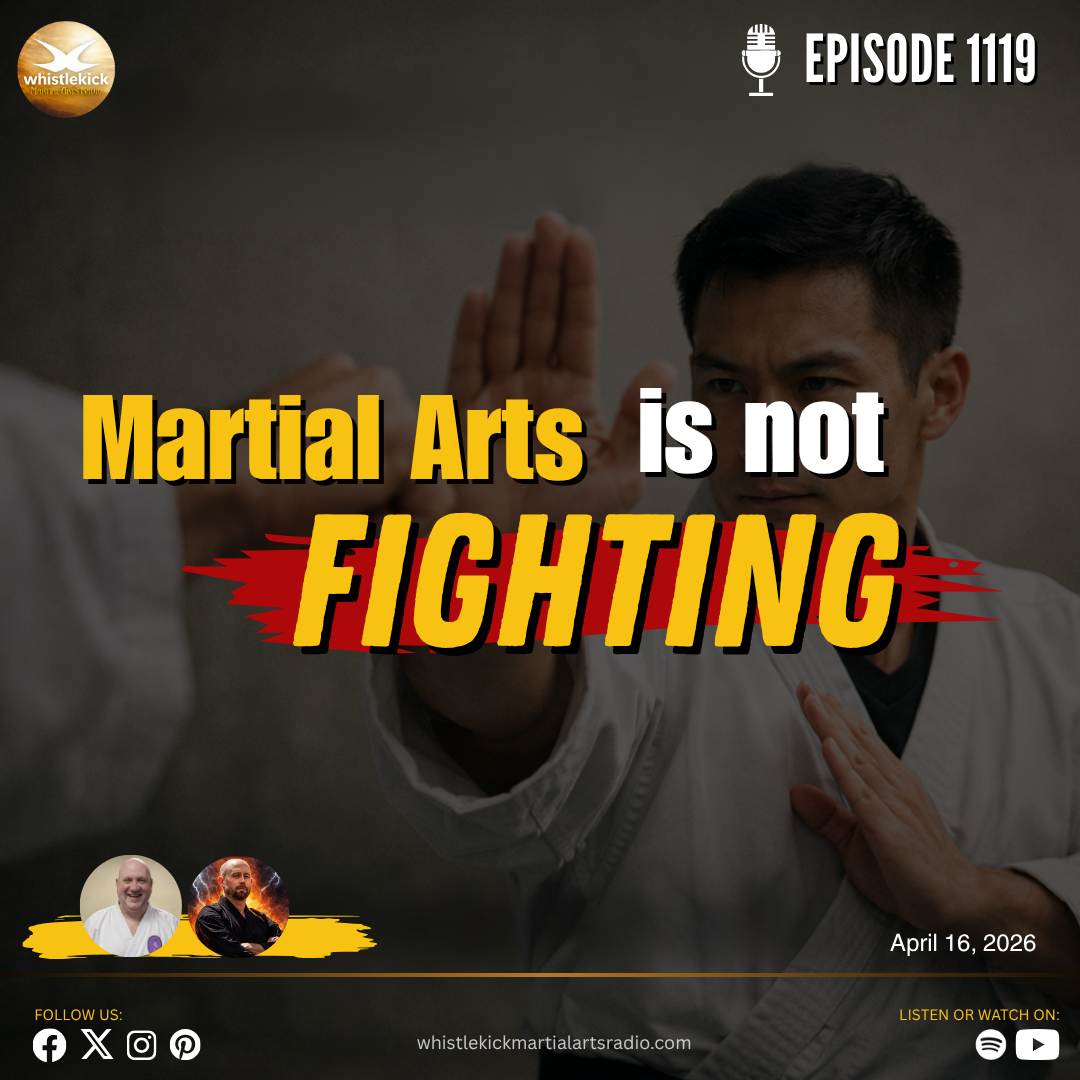
In this episode, Jeremy and Andrew discuss the concept that martial arts is not fighting and thus trying to correlate one to the other doesn’t really work.
Martial Arts is NOT Fighting - Episode 1119
SUMMARY
In this episode, Andrew Adams and Jeremy Lesniak delve into the often-debated distinction between martial arts and fighting. They explore the misconceptions surrounding the two, emphasizing that being a martial artist does not inherently make one a fighter. The conversation highlights the importance of understanding different types of combat and the role of training in martial arts. Through their discussion, they aim to clarify the relationship between martial arts practices and real-world fighting scenarios, ultimately advocating for a broader understanding of what martial arts encompasses. They discuss the importance of understanding the context and rules of combat, the carryover of skills from traditional martial arts to fighting, and the criticisms often faced by martial artists. The conversation highlights the value of self-awareness and the personal goals of individuals in martial arts training, while also addressing the trolling and negativity present in discussions about martial arts.
TAKEAWAYS
Martial arts and fighting are not the same.
Being a martial artist does not mean you are a fighter.
Many people believe they can fight without training.
Fighting is often misunderstood by those outside martial arts.
Sparring is a key aspect of martial arts training.
Not all martial arts training involves fighting.
Professional fights operate under agreed-upon rules.
Combat can be categorized into different types.
Training in martial arts can have various goals beyond fighting.
Fighting and martial arts are distinct concepts.
Being a good martial artist does not guarantee fighting skills.
Context and rules play a crucial role in combat.
Training can be enjoyable and educational beyond just fighting.
Martial arts can be about personal growth, not just combat.
CHAPTERS
00:00 Introduction
02:21 Defining Martial Arts vs. Fighting
05:58 The Misconceptions of Fighting
12:30 Different Types of Combat
14:29 The Complexity of Fighting
16:08 Martial Artists vs. Fighters
18:30 Understanding Rule Sets in Combat
19:52 The Carryover of Skills
23:50 Defining Martial Arts and Fighting
24:37 Criticism and Understanding in Martial Arts
Join our EXCLUSIVE newsletter to get notified of each episode as it comes out!
Subscribe — whistlekick Martial Arts Radio
After listening to the episode, it would be exciting for us to know your thoughts about it.
SHOW TRANSCRIPT
Jeremy Lesniak (07:17.738)
Hey, what's going on, everybody? Welcome back to another episode of Whistlekick Martial Arts Radio. And today, Andrew and I are tackling the subject, the oft-debated, argued about across the world. Martial arts is not fighting.
Stick around, we might make all of you mad in some way as we do this. We'll find out. If you're new to the show, you picked a good one to show up for. I'm Jeremy Lesniak, founder here at Whistlekick, joined by my good friend and often co-host, Andrew Adams, as we talk about martial arts as we've been doing for over 10 years. Andrew, this is gonna be episode what, 11?
Andrew Adams (08:10.19)
1119
Jeremy Lesniak (08:14.718)
Yeah, so we've been doing this a while. There's a lot of them out there. You can go back and you can check out every single episode we've ever done by visiting whistlekickcommercialartsradio.com. While you're there, you might notice that we have transcripts, which makes it easy to search for things. We have video and audio versions. If you go way back, somebody actually told me they went and they checked out an episode. Actually, one of my students had checked out an episode of me interviewing a local.
martial artist that she also knew. And it was episode, what was it? 31, something, Freddie LaPan. And then I said, oh, I need you to listen to one that's newer, please. I've gotten better, I promise. And so if you do hang out there and check out past episodes, just know that the show has improved. And not to say that the old ones were bad, but we've gotten better. Audio quality's gotten better. And we have video now. We didn't do that back then. But while you're over there checking out
these past episodes, you might also get on the email list. Why? Because we email you the episodes so you don't have to go look for them. You have it right there because let's face it, we've all got our email on our phone, on our computers. It's right there. So you're never more than a couple clicks from the latest episode. And if you forget that we drop an episode every Monday and Thursday, well, that's the easiest way to remember. We'll send you the link to the audio. We'll send you the link to the video and you'll have everything you need. So.
There you go. Sign up anywhere you find our show notes or at whistlekickmarshallargeradio.com.
Andrew.
Andrew Adams (09:49.08)
Jeremy.
Jeremy Lesniak (09:50.49)
martial arts, and fighting. Is there a subject?
Andrew Adams (09:53.763)
Yes.
Jeremy Lesniak (09:58.932)
that is as loudly discussed within the martial arts world, or the world in general, as the comparison and contrast.
of those two things.
Andrew Adams (10:11.758)
I might make a snarky comment and say I don't know that it's disgust it is It is usually people Yeah, yeah, yeah, yeah, no, I think it is probably the number the number one Type of comment that you see online when anything martial arts is related Has something correlating back to fighting
Jeremy Lesniak (10:18.978)
I was being I was being I was being polite.
Jeremy Lesniak (10:39.85)
The only other two subjects I can think that are even close are, here are the three ways if you want to make a group of martial artists start to fight even within themselves. Bruce Lee wasn't that good.
Andrew Adams (10:52.131)
Mm-hmm.
Jeremy Lesniak (10:55.176)
that person doesn't deserve a black belt.
that person isn't a good fighter.
Andrew Adams (11:01.804)
Yeah, or that wouldn't work on the street.
Jeremy Lesniak (11:03.656)
or that wouldn't work on the street, is, I think we can, kind of similar.
Andrew Adams (11:06.894)
Kind of is with the last one. Yeah.
Jeremy Lesniak (11:12.026)
And it's a, it's a subject that I think is discussed so often for, a couple of reasons. One, people outside of the martial arts have an interest in combat sports. The majority of people who watch boxing are not boxers. The majority of people who watch UFC are not MMA fighters or even train MMA. And that is not the case. you have, if somebody is watching a forums competition.
Andrew Adams (11:24.558)
Mm-hmm.
Jeremy Lesniak (11:42.334)
They probably train martial arts, even if they watch karate combat, they probably do some form of traditional martial arts. And so you've got this whole group of people out there who think they know, think they understand, and they throw their opinions in. And there's one other piece I think that we need to throw on this pile as we start to discuss it. Fighting is the only thing that people without experience believe they can do well.
Andrew Adams (11:49.644)
That's a good point.
Andrew Adams (12:11.412)
Absolutely. I was going to bring up something similar that no, no, no, no, it's totally fine. That if yet let's do it. No, let's martial arts about it.
Jeremy Lesniak (12:14.768)
I'm sorry for stealing that from you. Wanna fight about it? Let's martial arts about it.
Andrew Adams (12:24.044)
That, you know, and I think it was past guest of the show, Sensei Seth did a video on, you know, going up to random people and asking them if they thought they could, you know, if they weren't good at fighting and they would say, yeah, I can fight. he would probe them a little bit more. Like, have you had any training whatsoever? And it was always no. Well, then why do you think you would be good at fighting? Right.
Jeremy Lesniak (12:48.343)
And I think even more relevant, how many fights have you been in? Right? You can be good. And this is, I think this might be a great place for us to open.
Andrew Adams (12:51.406)
Sure.
Jeremy Lesniak (12:58.794)
You can be a very good fighter without training martial arts. There are people out there. They get in fights all the time. They've never done a karate class or a taekwondo class or a jujitsu class or some manner. They've never been to a boxing gym and they know how to fight. If that's possible, then martial arts and fighting are not the same. And we can close the episode right here. Okay. Thanks for joining us. No, of course not.
Andrew Adams (13:06.062)
Mm-hmm.
Andrew Adams (13:20.462)
Okay, that's it. Thank you so much for listening.
Jeremy Lesniak (13:28.756)
But I think what becomes really interesting is how quickly people outside of the martial arts and even inside the martial arts want to equate the two, martial arts and fighting.
Andrew Adams (13:45.091)
Yeah, I mean, first off, we're completely glazing over the fact that there was, mean, if we're gonna look at fighting within martial arts, we obviously we're gonna correlate that to usually sparring, right? I don't think most people are going to say that doing line drills or doing forms, like they're not gonna correlate that necessarily to fighting.
the argument could be made that there are aspects of that there, but there's a whole other aspect of doing martial arts that is not fighting. And I think most people would agree to that. And so how, yeah, I don't know where I'm going with this, but.
Jeremy Lesniak (14:28.554)
If let's let's take let's first blow up the silly Claim that is primarily outside the martial arts industry, but does exist sometimes within That if it's not if it is not fighting it is not martial arts Okay, so what would a martial arts school look like that operated in that way full contact no rules all the time
You roll in on day one as a white belt or whatever, and people just start to punch you in the face when you walk in the door.
Andrew Adams (15:06.882)
Sounds like a fun school.
Jeremy Lesniak (15:08.17)
That school doesn't exist.
Andrew Adams (15:11.339)
Exactly.
Jeremy Lesniak (15:13.98)
So if that's true, then we can logically say there are things that are relevant and are not fighting. Even if you're one of these schools that is 100 % of my training becomes combat related. Great. How many days a week can you get punched in the face and not be injured? Zero.
Jeremy Lesniak (15:41.694)
So that's why most people, including those who fight for their job, aren't getting punched in the face full contact for the majority of their training.
Andrew Adams (15:52.451)
Yeah. And maybe this isn't the place to bring it up, but the other, you you mentioned people who fight for their job. you almost could make the argument that, and, and let's say, for example, we're talking about someone who is in the UFC professional, you know, gets, gets paid to do these fights and they consider that their job. Yep. I.
Jeremy Lesniak (16:12.422)
It is their primary source of income.
Andrew Adams (16:16.084)
almost feel like you can't call that a fight because they're working on mutually agreed upon rules. There are things they are allowed and aren't allowed to do. You could, one could make the argument that that's not really a fight.
Jeremy Lesniak (16:29.554)
Right. And this is a discussion that comes up too, when it is a common response when someone says, you know, your forms, your karate kata don't have any application on a fight. So you shouldn't do them and you should, you know, be training MMA. And I've seen, cause you know,
I lurk in these conversations. I don't get involved in them too often because I don't see the point.
Sometimes you'll see people from a traditional martial arts band saying, well, that's also if you're if you're saying a fight is something without rules, then the then professional MMA is also not a fight.
Andrew Adams (17:16.078)
Yeah, that's my point.
Jeremy Lesniak (17:18.356)
But I think we could imagine.
Let's say combat is an umbrella term.
There are different types of combat. There's mutually agreed upon combat as you brought up. Hey, Andrew, you and I, we are going to fight under this rule set in this place at this time to test our skills, each other, maybe to make money, to impress TV audiences, whatever all the reasons are, right? We could do that. That is very different than
Andrew Adams (17:32.886)
Mm-hmm. Absolutely.
Andrew Adams (17:42.862)
Mm-hmm.
Jeremy Lesniak (18:01.564)
Hey, Andrew, you you got 10 minutes after class. Like let's I want to work on that thing we did. You want to spar? Right. Whether that sparring is no touch or point contact or, you know, more moderate or even full contact, that's very different. You and I, I mean, we've trained together plenty. We're good friends. We could spar pretty hard and it would still look nothing like what a professional MMA match looks like.
Andrew Adams (18:27.552)
Absolutely. Yeah.
Jeremy Lesniak (18:29.16)
And then you've got the far side, other side of that continuum where I'm not going to tell you we're going to fight and I'm going to wait outside your house and you're going to go to your car and I'm just going to, I'm just going to sneak up behind you and punch you in the back of the skull. That's a different fight. I will probably, I will probably hurt my hand, but it'd be worth it.
Andrew Adams (18:43.81)
You might hurt your hand. You might hurt your hand. might not want to do that.
But you're right, those are two completely different scenarios.
Jeremy Lesniak (18:52.178)
Yeah. And so when we talk about fighting, it's, you know, this is another example of people wanting to be lazy with their words to make their argument because it makes them feel better. It takes a lot of energy to use nuance and detail and specificity when you are talking about any subject. All this or that.
Andrew Adams (19:16.046)
Mm-hmm.
Jeremy Lesniak (19:18.29)
Almost never true. All forms are stupid. All karate is useless. All fights go to the ground. All fights start standing up. We can find counterpoints to all of those, of course.
Andrew Adams (19:33.098)
Yeah, yeah, rarely, rarely do we live in a world where it's just black and white.
Jeremy Lesniak (19:38.302)
Yeah, absolutes are, again, I will not say absolutes are never true because there's some things in science that are absolute.
Andrew Adams (19:47.16)
Well, then you're making an absolute statement.
Jeremy Lesniak (19:50.9)
some things in science. Right? The logic on that starts to get a little sketchy, but we're not gonna, as much as I would like to sit and have a fun discussion about logic and philosophy, I don't think most people are gonna wanna listen to that.
Jeremy Lesniak (20:08.894)
So when we talk about this whole idea that being a fighter is not the same as being a martial artist, it allows us to say, being a good martial artist does not mean you are a good fighter. If those two things are different, you can be a good, even a great martial artist and a terrible fighter.
Jeremy Lesniak (20:30.632)
But how often is that true?
For most of us, the ability to defend ourselves successfully is one of the whys, one of our reasons for training. And for people who want to be able to successfully defend themselves should an altercation occur, they have some awareness of how their training applies to that. And if their training has no application to that, they're probably gonna do some different training.
Jeremy Lesniak (21:01.22)
I don't know very many martial artists who want to get in fights and prove their skills.
Andrew Adams (21:08.736)
a very valid statement.
Jeremy Lesniak (21:15.412)
How else do we know?
I haven't been in a fight since fourth grade. Proud of that. I don't want to change that.
Andrew Adams (21:22.978)
Yep, yep, was in, I was in, yeah, I was in high school.
Jeremy Lesniak (21:28.459)
Do you feel like you're less of a martial artist because you haven't been in a fight?
Andrew Adams (21:32.084)
No, certainly not.
Jeremy Lesniak (21:34.398)
I don't know you, I've had plenty of opportunities. I've had plenty of people want, you do karate or just people being jerks and yelling at me or whatever. I've managed to diffuse it all. We've talked about that on this show. I'm proud of that.
Andrew Adams (21:43.288)
Mm-hmm.
Jeremy Lesniak (21:49.694)
But if someone says, you know, how good of a fighter are you? I don't know. I think I could handle myself, but I might be very wrong. Because I've been wrong before.
Andrew Adams (22:02.658)
Well, we as martial artists, every time we do, and I'm putting this in air quotes for those only listening, every time we do fight, right? Every time we spar, we are working from a set of rules. Maybe those rules are point sparring rules. Maybe those rules are, you know, lightest touch. Or if you're an underrank in some schools, it's no touch. You can't actually touch the opponent, right? But we...
Jeremy Lesniak (22:26.474)
Mm-hmm.
Andrew Adams (22:30.846)
always are working from a set of rules. If I get jumped on the street by a bad guy, quote unquote, they're not going to be using those same rules. So I'm, I'm not used to that rule set because I don't practice that rule set. Someone who's very good at fighting. I mean, actual fighting out on the street, a mugger, someone who mugs and beats people up. I'm not talking UFC type fighting.
that person is used to a completely different rule set.
Jeremy Lesniak (23:07.87)
Yeah, and you know, you could draw an equivalency with racket sports. Ping pong, badminton, pickleball, tennis.
They're all hitting the thing over and at with a racket. You can argue which one of those is, I don't know, most likely to show up on the street. I don't know, right now it's pickleball.
Andrew Adams (23:34.306)
Pick a ball.
Jeremy Lesniak (23:37.86)
There is carryover in some of the skills between them.
but a professional, a very high level pickleball player is probably not going to become an Olympic badminton player overnight. There's enough difference in there.
Andrew Adams (23:58.701)
Yep. But they're going to have a lot of skills, like an incredibly good, like, I don't know that pickleballs in the Olympics, but an Olympic level pickleball player could probably step in and be a very good bad-bitten player fairly quickly.
Jeremy Lesniak (24:14.366)
Yes, yes. And I think it's okay to say both of those things side by side. They are not the same, but there is carry over. And if they chose to train, they would be. Now, why is that an important thing to say? Because it's okay as a martial arts. And I want all of you out there to feel like you have the ability to feel this and say this if it's appropriate. Just because you've been training in some traditional martial art for some period of time.
that somebody else decides should qualify you to be a great fighter does not mean you have to believe you're a great fighter.
Unless your goal in joining that school was to become a great fighter. There's no there's no need to do that. It is OK to admit that, however, we do see that there is enough carryover from traditional martial arts training that plenty of folks who are professional fighters. Have traditional martial arts background now did some of them.
Andrew Adams (25:02.626)
Yeah. Yep.
Jeremy Lesniak (25:22.224)
start training in whatever and say, you know, I want to go this MMA route. Yes. Did some of them start in an MMA path and then say, you know, I want to round out my skillset by doing these traditional things. Also, yes. If both directions of that statement are true, then there is carry over. is some, there is validity for that in what we're training, but I don't pretend to be a fighter. Hey, how, how, how would you do in a fight? I don't know.
haven't been in one in a very long time, don't wanna be. Do you think you could handle yourself? Yes. And that's where I leave the conversation because I believe that I could get away. Cause that's my goal if somebody jumps me is to get away with my safety.
Andrew Adams (26:11.532)
Yeah. And whenever I've seen this most often online, that wouldn't work in the street, whatever. That's not real fighting. My response is usually, and I also don't tend to get involved online, but like in my head, my response would be, so what?
So what? That wouldn't work in the street. Okay, I'm not on the street. So I'm not like, I'm not expecting that it would work on the street. I'm doing a form or I'm showing this technique on a student so that they can learn something that wouldn't work on the street. Okay, we're not in the street. We're in the dojo.
Jeremy Lesniak (26:52.404)
You know what we should do? You know what we should do? This would be a lot of fun. And those of you out there, if you want us to make this video, let me know and we'll make it happen. We should go around, we should film a video that takes the notion of martial arts hate that wouldn't work on the street and brings it elsewhere. Bust into somebody's kitchen in their house. That wouldn't work in a restaurant.
Andrew Adams (27:18.732)
that's funny. Yeah. That would be really good.
Jeremy Lesniak (27:21.854)
That wouldn't work in NASCAR. You know, somebody eating chips while they're driving down the road.
Andrew Adams (27:24.674)
Yep.
Yep. Yeah, that's really funny. That's really funny. Yeah. I mean, are driving on a NASCAR circuit track and driving in town, are they related? Yeah. But I don't think you would anybody. Yeah, that's true. Keen has lots of roundabouts. But I don't think anyone would say they're the same thing.
Jeremy Lesniak (27:40.71)
especially in Keen with all the roundabouts. A lot of roundabouts, a lot of left turns.
Jeremy Lesniak (27:50.93)
No, no. Although interestingly, there are plenty of people who think they are great drivers and could, you know, just, you know, I just, if I had the car, I could step out there with those guys and I could hang. They don't understand the skill and the physical requirements to do that. Similar to cooking. I don't know about you. I've known plenty of people who think they are good cooks.
Andrew Adams (28:05.143)
Yeah.
Andrew Adams (28:15.79)
Or someone painting. That wouldn't get hung in the Louvre.
Okay.
Jeremy Lesniak (28:24.936)
Right. Here's what I want you all to do. We're not quite done yet. But if you like this idea, email your thoughts on the elements that we could throw in this video. And Andrew and I will find time to make it. Yeah.
Andrew Adams (28:37.1)
Yeah, or leave it in the comments on YouTube. Tell us. Let us know you're here. Let us know you're watching your listing on YouTube. Tell us other fun ones. That would be good.
Jeremy Lesniak (28:41.94)
Yeah.
Jeremy Lesniak (28:50.066)
Everything we're talking about today can be summed up in a very simple single statement.
Fighting is not martial arts. Martial arts is not fighting. And being good at one is not necessarily to say you are good at the other. There is carryover, but how much overlap there is depends on who you are, what your training has been.
Jeremy Lesniak (29:20.776)
and how you choose to implement that training.
Jeremy Lesniak (29:26.406)
Some people have more of an affinity for getting hit. I'm not one of them. If I liked getting hit, I've had instructors who are like, yeah, it kind of wakes me up. kind of, yeah, I think that's weird. But if I was that person, all the rest of my skills being the same, I would be better. I don't pretend otherwise. No, my instinct is let's...
Andrew Adams (29:32.288)
You
Jeremy Lesniak (29:53.946)
Get out of the way. Let's diffuse. Let's run away. My ego's intact.
Andrew Adams (30:00.855)
Yep. And if you're listening and you're, you're, you see something online and your response is to think, to message that, they wouldn't work. Just don't, just don't cause it doesn't matter.
Jeremy Lesniak (30:16.008)
It's a drill. It's all a drill. All drills are an approximation of some form of what we are doing as martial artists that could be combined to be applied in a combat situation.
Jeremy Lesniak (30:37.908)
but you got to take some part out of it. Otherwise we go back to the example of you walk in the school, you get punched in the face your first time. That is, that's the only way you run a school that is a perfect correlation. Actually, that's not even perfect because now there's a day and a time and they know that they're stepping in there. It would be.
Andrew Adams (30:45.26)
Mm-hmm.
Andrew Adams (30:57.783)
Yeah, yeah,
Jeremy Lesniak (31:01.756)
sign up for martial arts classes here, give us your address, your work address, your car, and we might at some point, someday, try to punch you in the face. I think that's the closest you can get. And that's ridiculous, right? So that's not gonna happen. We're hoping that when we combine all the skills that we've learned from the various kinds of sparring and the drills and the forms and the conversations,
Andrew Adams (31:11.416)
Yeah, Give us your schedule. Yeah, let me let us know where you're to be. Yeah.
Jeremy Lesniak (31:31.676)
that when push comes to shove, we can apply some of
That's the hope. And a good school is continually looking at how do we combine all these different elements, you know, the intensity, the stress response, the need for speed and for strength and for physical response to someone's inputs, their attacks or movements towards you, right? We're constantly looking at how do we combine those things in ways that are interesting and enjoyable and safe and educational.
The vast majority of people that I see out there criticizing what other people do are, I'm going to say, very unqualified to make those statements.
Jeremy Lesniak (32:21.298)
They.
One of a few things is true. They've never trained, which is probably most of them. They've trained very little and think that that has given them a good understanding of what martial arts really is.
Or, and this is very small group of people, but I do see it I'm thinking of some right now that actually like and look and really respect.
because they are so hyper-focused on the fight preparation aspect, whether it's for real world confrontation or for combative sports, that they forget that for some people, martial arts...
Jeremy Lesniak (33:06.73)
can be and they want it to be enjoyable and broadly educational. Right? Not just education for fights, not just education for self-defense. They want to learn more about themselves. They want to have a good time. They want to hang out with people.
Jeremy Lesniak (33:28.774)
I enjoy training with people who are 20, 30, 40 years older than me. They want to get punched in the face less than I do.
Andrew Adams (33:36.417)
Hahaha
Andrew Adams (33:41.176)
Yep, no, I couldn't agree more. I couldn't agree more.
Jeremy Lesniak (33:45.226)
Have we missed anything?
Andrew Adams (33:46.754)
Well, if you are listening, please let us know if there was stuff we missed.
Jeremy Lesniak (33:51.464)
Yeah, let us know your thoughts and.
Jeremy Lesniak (33:57.258)
I think the last thing I want to throw in.
You don't have to defend traditional martial arts. You can.
But we all know what's going on when these arguments are made. It's trolling. People get attention doing it. How do you get rid of trolls? You don't give them attention.
Andrew Adams (34:13.518)
Mm-hmm.
Jeremy Lesniak (34:24.002)
My most common response when someone says something very critical is, well, why do you say that? What makes you say that?
Jeremy Lesniak (34:36.21)
I very rarely get a reply.
Andrew Adams (34:40.086)
Interesting. Yeah. Yeah.
Jeremy Lesniak (34:40.19)
because they don't know why they say that.
Or they're just looking for an argument.
That's fine.
Let him argue with somebody else. You've got better stuff to do with your time.
Jeremy Lesniak (34:58.366)
That it? Okay. All right. right. Jeremy at Whistlekick.com, Andrew at Whistlekick.com. Find all of our episodes at WhistlekickMarshallArchRadio.com. Make sure you've subscribed. Spotify is where we're growing the most, but we are also available in video on YouTube. And you can also subscribe to the audio feed anywhere that you find podcasts. So Apple, Stitcher, don't know. There's a bajillion of them. But.
Andrew Adams (34:59.352)
Sounds good. think I've got nothing else. That was great.
Jeremy Lesniak (35:28.19)
What's the best way? Sign up for the emails. And we will get those too. And sometimes we throw other stuff in there. I'm not going tell you what that is. You'd have to subscribe to find out.
All right. Are we going to see how this goes, Andrew? Are you ready? All right. All right. Three, two, one. Until next time, train hard, smile, and have a great day.
Andrew Adams (35:45.134)
Let's do it. We're going to do it together.
Andrew Adams (35:50.734)
Train hard, smile, and...
Jeremy Lesniak (35:57.706)
Ha ha.
You weren't expecting me to say the until next time part.
Andrew Adams (36:03.766)
Yes, correct. That's okay.
Jeremy Lesniak (36:05.642)
But it's okay. We'll see how it comes out in post.
Andrew Adams (36:09.439)
I'm going to totally line up the audio, so it's going to sound perfect.