Episode 1133 - Martial Things with Kellie Thomas
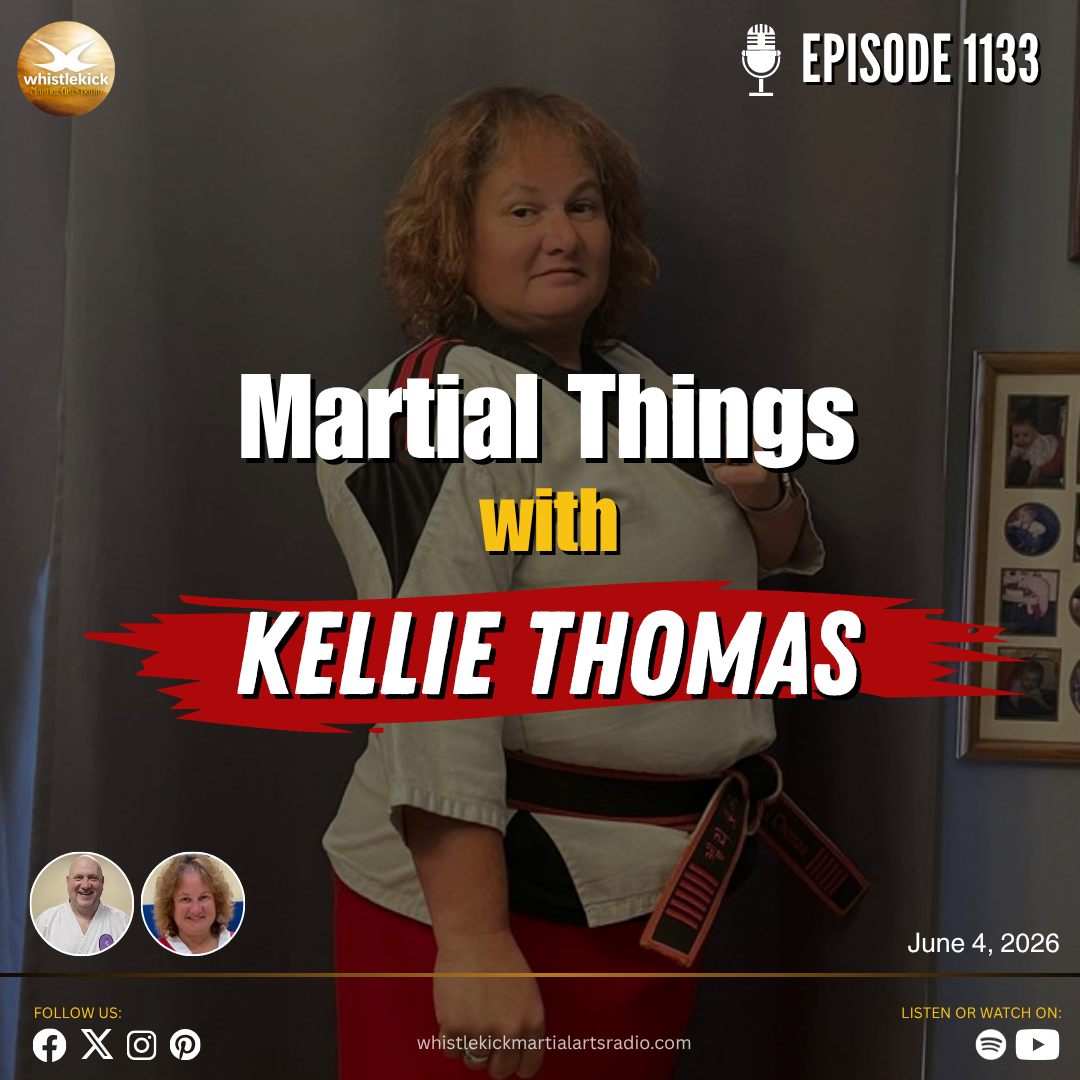
In this episode join Andrew in whistlekick’s Martial Things series. This week he sits down and chats with Master Kellie Thomas with a plan to talk about……. nothing. No plan, just a conversation to see where it takes them.
Martial Things with Kellie Thomas - Episode 1133
SUMMARY
In this engaging conversation, Andrew Adams and Kellie Thomas explore various aspects of martial arts, focusing on teaching methods, the importance of technology, and innovative approaches to black belt testing. They discuss the significance of creating a supportive learning environment, the concept of 'leveling up' instead of traditional testing, and the journey beyond black belt. The conversation highlights the importance of student engagement and retention, as well as reflections on the martial arts community.
TAKEAWAYS
The conversation is free-flowing and spontaneous, reflecting the nature of martial arts discussions.
Technology, such as video cameras, can enhance the learning experience in martial arts schools.
Presence and control in teaching are crucial for effective martial arts instruction.
Innovative black belt testing can include personal demonstrations to showcase students' personalities.
Creating a supportive learning environment fosters student engagement and retention.
Changing the terminology from 'testing' to 'leveling up' can reduce anxiety and promote a positive mindset.
Encouraging students to practice and prepare empowers them to take ownership of their progress.
Involving students in judging and presentations enhances their learning experience.
The journey in martial arts continues beyond achieving a black belt, emphasizing lifelong learning.
Student retention can be influenced by their engagement and the community within the martial arts school.
CHAPTERS
00:00 Introduction to Martial Things
03:01 The Role of Technology in Martial Arts
06:02 The Importance of Presence in Teaching
08:58 Innovative Black Belt Testing
12:04 Creating a Supportive Learning Environment
14:54 The Concept of Leveling Up
17:47 Encouraging Student Engagement
21:04 The Journey Beyond Black Belt
23:55 Reflections on Student Retention
26:55 Conclusion and Future Endeavors
Join our EXCLUSIVE newsletter to get notified of each episode as it comes out!
Subscribe — whistlekick Martial Arts Radio
After listening to the episode, it would be exciting for us to know your thoughts about it. Don’t forget to drop them in the comment section down below!
SHOW TRANSCRIPT
Andrew Adams (00:25.135)
Yeah. Well, good morning, Kelly. How are you doing this morning? I am great. I'm excited to chat. Are you I know we have some guests that might not know what the Martial Things episodes are like. So the plan today is we have no plan. Martial Things is we just get on and talk about whatever comes up, whatever's going on in our lives martial art wise. And
Kellie Thomas (00:29.216)
I'm good and how are you?
Andrew Adams (00:53.381)
We see where that takes us and it might roam and we might sidetrack and go over here and you know, we might be talking and there's a squirrel over there. Like it can be, it can be for sure.
Kellie Thomas (01:02.402)
Sounds very dangerous. And actually I just saw a squirrel watching the squirrels at my bird feeder.
Andrew Adams (01:10.609)
is that something you do often? Watch nature.
Kellie Thomas (01:15.382)
I do, I do. I have a couple of bird feeders right by my window here and also for Christmas Andy got me one that hooks onto the window and it's got a camera and a video. So you can get some really good really good pictures, but I do like the squirrels. I think they are s you know, I know most people don't like them, but man, they are just the funniest little things.
Andrew Adams (01:24.081)
Okay, sure.
Andrew Adams (01:38.639)
Yeah, yeah, yeah. so little cameras so you can watch them when they're doing their things, right? some martial arts schools have video cameras in their schools. Do you? No. Thought thoughts on those? Schools that do?
Kellie Thomas (01:44.396)
Yep.
Kellie Thomas (01:49.507)
No.
I think it's a great idea, but I don't have a permanent place. So yeah. Yeah, but no, I think it's I think it's interesting to to do that. And then like if well of course this all came up with like Zoom, right? And you if you connect to Zoom, somebody who can't make it to class can still, you know, participate and feel like they didn't miss anything because it's it's so funny. Like a student will miss one class or something and you'll like
Andrew Adams (01:58.295)
Mm, that's that's right. I knew that. I knew that.
Kellie Thomas (02:21.57)
Covers something like, wait a minute, I don't know how to do that. And it's like, Well, you missed a class.
Andrew Adams (02:26.041)
Yeah. Yeah. Yeah. No, I I totally get it. And yeah, I I I obviously in two thousand twenty a lot of schools started doing more things online. but I was in and that makes sense too, but I was thinking in terms of if you have a permanent location, right and your dedicated space that's just yours. I know a lot of schools that have video recording just to peace of mind for both students and the
for parents and for the teachers so that they have a recording of as what's going on in their school at all times. it can be but if you don't have a space, it makes it a little more challenging.
Kellie Thomas (03:01.708)
Yeah. And you know, my school is open, parents come in, they they stay and watch. you know, I'm I'm a control freak. I'm there for every class. So you know, it's you know, so it's but I could see where like I know some schools they don't allow parents in, except for certain things and yeah, I mean absolutely and unfortunately in this day and age you kinda need that. just to, you know
Andrew Adams (03:05.232)
Mm-hmm.
Kellie Thomas (03:30.712)
Protect yourself. CYA is what they k say.
Andrew Adams (03:34.917)
Yep. Yep. Now you'd never take a you you said you're you're a control freak, you were at every class. Does that mean you don't take any like what happens if you're sick?
Kellie Thomas (03:45.91)
If I'm sick, then I do have people that cover for me. You know, I I'm there for every class, but I have because also my classes, they're all family style. So like in one class, my youngest is three and my oldest is seventy-five. and they're all doing class, but obviously they've got to do things differently. So I have, you know, s so many I'm blessed with so many black belt and red belt helpers that, you know, we split the class. So
Andrew Adams (03:48.131)
Okay, okay, good, good.
Andrew Adams (04:01.794)
Mm-hmm, mm-hmm.
Andrew Adams (04:13.274)
Mm-hmm.
Kellie Thomas (04:15.842)
You know, I've got like a second in command, you know, if I find if I'm sick now, but that's only been recently. That's probably been only the last two years. you know, that I c that I've got people that I'm like, Hey, you know, I'm not well. Here's here's the key, 'cause that's the other issue, 'cause they've got to get a key to get in.
Andrew Adams (04:24.401)
Mm.
Andrew Adams (04:34.969)
Yeah. Yeah. I just know that having to be or having feeling the need to be at every single class is difficult because we get burnt out. Like you're you're you're allowed to take breaks, right? And if you have this constant n feel that you have to be there, then that means you can't take a vacation. You know, if you're sick, you still feel the need to come in. So it's good that you have that that that ability to take a break if you need to.
Kellie Thomas (05:03.97)
Yeah, and we'll you know, we'll take a vacation, we'll take a week here or there and sometimes, I usually take the week off just before school begins and I just shut down to give everybody like, Hey, just take the week off. We haven't closed, give the inst you know, the the assistants the time to get ready for the push on fall and you know, run with it. And when I take time off in the spring, students run it and
Andrew Adams (05:14.351)
Mm-hmm.
Andrew Adams (05:34.745)
Yeah, that it's good that you have that though, so that you you don't feel that s be that feeling of being stuck. Yeah.
Kellie Thomas (05:43.03)
Right, right. You know, I love being there, so that's you know, that's important. you know, there are some days like what are we gonna do? But it's like it's like when I was when I was training too as a student. It's like those days that you didn't wanna go oftentimes end up being your best class.
Andrew Adams (05:46.392)
Mm-hmm.
Andrew Adams (06:02.149)
Absolutely, absolutely. I actually I was recording with actually she will her episode will be coming out soon. Someone that both you and I know. I'm not gonna say the name because it's you you gotta you just gotta wait. but someone that you connected me to. And I was recording with her, and we talked specifically about that. That you know, I very rarely have I ever had for myself or talked to a student who has
Kellie Thomas (06:14.317)
Who?
Andrew Adams (06:30.299)
felt like they didn't want to go to class and then went to class and at the end of class said, You know, I still feel like crap. Every single time you feel better. Now, you might still not be feeling the best, but you feel better after class. It's just the way it is.
So just go.
Kellie Thomas (06:47.02)
There's something magical about the martial arts, you know. We're I'm biased of course, but you know, there's just there's just something there.
Andrew Adams (06:54.681)
Yeah, yeah. Magical is good. I'm still waiting for my ability to fly. I keep going to class, hoping that's the magical thing it'll give me, but I can't fly. Yeah.
Kellie Thomas (07:04.258)
I don't know. They you gotta wait to grow wings.
Andrew Adams (07:07.257)
Yeah.
No, you need Red Bull for that.
Kellie Thomas (07:12.14)
That was gonna yes. So that red bull for wings.
Andrew Adams (07:14.755)
Yeah, yeah, yeah. You do need the Red Bull. Red Bull gives you wings. now you mentioned you have your, you know, high level red or or black belts. You if you're okay talking about it, I we have talked a little bit about your black belt test and it's a little different in a really cool way. And I'm wondering if you are okay talking about it a little bit.
Kellie Thomas (07:38.089)
yeah, of course. We we've got my next one's coming up June twentieth.
Andrew Adams (07:42.649)
Yeah, and I saw that posted. It's what made me think of it because you and I have talked pr privately about how you run your tests and I think it's cool and I think some other of our audience might be interested to hear. So if if you're okay with it, I'd love to chat about that.
Kellie Thomas (07:57.922)
Yeah, of course. so twice a year, I test for students for high red and for black. other color belts are four times a year, which we've got that coming up on Saturday as well. But for black belt, black belt testing is eight hours long. And it's also maintenance testing, so any anybody who's a black belt's gotta come.
Andrew Adams (08:21.412)
Mm-hmm.
Kellie Thomas (08:27.99)
We've arranged it now so we start in the morning and get done about five o'clock because before it was, you know, seven, eight o'clock at night and that's that's too late. So we've we've rearranged things a little bit so that in the morning we do like all the sparring and the pattern work, you know, any self-defense I want to do, so that at lunchtime those students who are just maintaining
can go home. So and then as we're having lunch break, I ask all of my black belts that they do a personal demonstration. And that is any presentation on a non-taekwondo related topic. so it kind of gives us a little glimpse into who they are outside of the the school. and
Andrew Adams (08:58.705)
Mm-hmm.
Andrew Adams (09:24.913)
Mm-hmm.
Kellie Thomas (09:27.468)
I've thought oftentimes about getting rid of it because it does take up so much time. 'cause like I think I think I've got f fifteen or sixteen going for a black belt rank. So even at five minutes apiece, that's a big chunk. but everybody really enjoys it. And
Andrew Adams (09:46.181)
Now, can you give some examples as to what people do?
Kellie Thomas (09:49.826)
one of my favorites, and this was many, many years ago, a girl sang a Japanese song, a cappella. I've had students come in and you know play their instruments. I've had students come in and of course the kids, a lot of times kids will talk about, you know, their gaming, you know, what they're doing for their gaming.
Andrew Adams (09:59.378)
Mm.
Andrew Adams (10:16.771)
Yeah.
Kellie Thomas (10:18.638)
I've got kids that will talk about book series that they're doing. I've got vet tech will come in and talk about, you know, working with animals and that sort of thing. you find I found out one of my students is a major Star Wars fanatic and probably has every figurine
possible. you know, I've got another student who I didn't realize runs marathons. and doing so it's it runs the gamut of all of all kinds of things. some of my little kids will do it on their pets, you know. anything that they're passionate about, you know, to come up and and talk to us about it.
Andrew Adams (11:03.91)
Mm-hmm.
Andrew Adams (11:12.753)
I I absolutely love this for a multitude of reasons. One, it allows you as the instructor and all the other students to connect to that student on a slightly different level socially, right? And we have often talked here at Wizard Kick about creating a culture within your school and
you by doing this type of thing you are creating a culture of of i mean inclusion is not the right word of of learning and sharing amongst everyone which is really cool the second reason i really love this and if anybody listening or watching you know don't forget about that you have the ability to do this type of thing for your school too but
One of the biggest fears people like if if I were to poll a hundred people and ask them what their biggest fear is for most people, it's going to be public speaking. and this helps them get past that in a smaller setting, talking about something that they are passionate about, whether it's a a 10-year-old or 12-year-old talking about their pet, or whether it is an adult talking about their hobby of music or whatever. But they're getting a chance to do that in front of a slightly smaller crowd, which
At this point, I mean, if they're going for a black belt, they've been with you and the other students for years. So it's people that they feel a little more safe and comfortable with. So it's kind of a baby step towards giving them that public that ability to speak in front of public or do things in front of public. And so I absolutely love that.
Kellie Thomas (12:56.033)
Yeah. And I've told them that, you know, because you know, once you become a black belt, you are a teacher. Whether you're actually teaching class or not, that's how other students look at you. So, you know, you need to be able to to be able to speak and and be okay with that. And one of the advice my instructor gave me is she said, to teach from your heart. And you know, it allows them
when they're teaching, when they're talking about something that they're passionate about, it allows them to be emotional about it. It's not like they're, you know, giving a speech. It's something that, okay, I can I can be passionate, I can be excited when I'm talking in front of a group of people and, you know, and that's okay. And, you know, like I said, I I don't want it to be taekwondo related because, you know, what they do outside also comes back inside.
You know, so your your martial arts training doesn't end when you walk out the door, right? And all the stuff that you do outside, you bring it also and you use that experience to teach and to relate to other people and and everything else.
Andrew Adams (14:08.975)
Yeah. And and it helps to showcase a a to some degree a well-rounded student. They they do other things. you know, I I've often heard it said, and I've not done the research on this, so anybody listening or watching, if you want to at me, go ahead. Andrew at whistlekake.com. but I've often believed that back in feudal Japan, when you were samurai, you yes, you learned all of your fighting arts and
you know, the what it needed what you needed to do to be a samurai, but you also were required to learn things like calligraphy and i Ikibano, the flower arranging and things like that to help make you a well rounded person. And so you are essentially helping do that as well for your students.
Kellie Thomas (14:54.551)
Yeah, it's it's really it it's really fun. I remember my instructor, Grandmaster Diane came once, again, many, many years ago. And he's an old school where, you know, I think testing would run for like an hour. You know, I mean you get in, you get it done, boom, boom, bang. And the t I had s less students, so it was gonna be like five hours. And he's like, What on earth can you do for five hours? And I started telling him that they do these presentations, you know.
Andrew Adams (15:20.369)
Mm.
Kellie Thomas (15:24.481)
And he's like, Do you want me to show you my presentation? And I'm like, no, sir. That's all right. You know. And but once we got started, it was his favorite part. He kept saying he wanted another show and tell, you know, and he just thought it was, you know, like I said, it it takes time, but it's very enjoyable. and it's and it's funny. a lot of times they're funny. One of my students, who helps me teach, he's fifteen. he plays
Andrew Adams (15:29.371)
Yeah.
Andrew Adams (15:34.193)
Mm, interesting.
Andrew Adams (15:43.355)
Yeah.
Kellie Thomas (15:53.763)
D and D, but he has this obsession with dice. So he brought like these bags and bags of dice. And you know, it it's just, you know, he gets picked on a little bit and you know, but it's it's a little insight to, you know, who they are.
Andrew Adams (16:10.641)
Mm-hmm. Now, do you have a heads up ahead of time what they're doing, or are are you completely in the dark until they show up for their presentation? Okay, cool.
Kellie Thomas (16:18.614)
I'm usually in the dark. there yeah, there are some times, you know, where they'll ask me, can I do this? Or they'll get too excited, you know, to to tell me what they're going to do. But for the most part I I have no idea. until they until they do it.
Andrew Adams (16:37.669)
That's great. And is that the last part of the test or is there more after that?
Kellie Thomas (16:41.128)
then we do board breaking. Yeah. But I mean, you know, most of the the physical, physical stuff is is done in the morning and then the, you know, the presentations and then those going for black belt rank have to do three breaks. those going for high red have to do one break. but the high red is like, you know, six months potentially for black. And so, you know, when you tell somebody, yeah, your black belt testing's eight hours long, they kind of look at you like,
Andrew Adams (16:42.885)
Okay, yeah.
Kellie Thomas (17:10.812)
my God. But like I said, it's important that they do it before they have to actually do it to see that it's, you know, it's just it's fun. It's you know, a a friend of ours came and and tested with me. And they were like, I've never had fun at a testing before, you know. So, you know, so it's good for them to to see it and be like, my, we did it. You know, it's not as bad as it.
It's more like a seminar 'cause it's the only time I get all of my my advanced students together in under one roof.
Andrew Adams (17:45.395)
Because and and I know the answer to this, but I'll for the audience that doesn't, because you have multiple locations. So there are black belts that you might only see at this location, but for your black belt tests, all of your schools are under one roof, which is really cool. I thought of another benefit to doing this type of portion of your test as well. When if you've got, let's say, to make the math easy, you've got
10 people going for black belt and they've got five minutes each, we're looking at 50 minutes, right? So we'll s we'll we'll round it up, say we've got an hour. So nine people are gonna sit there for just under an hour just watching, right? So I work with a dance company with kids, and one of the things that we talk about in our dance classes is how to be a good audience and how what are the appropriate ways to be an audience member. And so you are also inadvertently
helping to showcase that as well. Cause I have to imagine when person one is doing their performance, you don't allow everybody sitting down to just goof around and talk. They have to sit, I suspect, quietly and pay attention. So you are also helping to promote a a good audience member, which especially for kids can be really important.
Kellie Thomas (19:03.33)
Yeah, and they get to ask questions, you know, so that's yeah, yeah, they get to ask questions. That's sometimes I have to, especially with kids, you know, you gotta be like, you know, okay, nope, that will you can check later, you know, but it allows them to stay involved. you know, and and it really is, it's it's a great time, you know, it's a lot of work. They're very nervous, you know, but it's it really is a a great, a great time.
Andrew Adams (19:05.676)
great. I didn't know that. That's cool.
Andrew Adams (19:15.088)
Yeah.
Mm.
Andrew Adams (19:26.898)
Mm-hmm.
Andrew Adams (19:31.922)
Awesome, awesome. I I love that. Thank you for for sharing with the audience that. Because I I I see a lot of benefit to doing that type of thing. Does it make the day long? Sure. But I I just I think that's awesome. That's so cool. All right, where do we go to next? What what are you working on, Mark Slartwise, right now?
Kellie Thomas (19:51.975)
well this Saturday we've got our leveling up for our colour belts. that's going on. I no longer call it testing. I changed it to leveling up. when I when they are ready to be promoted, I make a list of students that are potentially eligible. It's like the first draft, and then we kind of go through and only students who are ready are able to attend. And I've always done that.
Andrew Adams (19:56.955)
Okay.
Andrew Adams (20:01.932)
Okay.
Andrew Adams (20:10.289)
Mm-hmm.
Kellie Thomas (20:21.714)
but so calling it a test kind of gives you the idea that it you can fail. and since that wasn't the case and just the word test would get people really kind of freaked out, we decided to change the name.
Andrew Adams (20:38.246)
Hmm. I I love that. Just the the language is such an interesting thing that just changing what you call something can absolutely change what it means to people in their mind. or can promote discussion and dialogue over it, right? Especially if it's a word they don't understand. So I I totally get that. So
that leveling up, changing from the word test, you're you're right. Test is something you can pass fail. And if you are only putting up people, and I'm putting this in air quotes to test that you know are going to pass, calling it a test can give anxiety that that you might not necessarily need. So calling it a leveling up ceremony is really interesting. That's cool.
Kellie Thomas (21:26.68)
Yeah. And I put more of the emphasis on their practice and their preparation. Cause I remind them, you know, they have to, you know, know their their form or their kata. Depending on their age, they have to know all the old ones too. and of course, you know, maintain their attendance and whatnot. But I'll remind them, especially kids, because kids don't necessarily like to practice. I'm sure you've you've run into that yourself. and so I remind them, I say, well
Andrew Adams (21:31.394)
Hmm.
Andrew Adams (21:40.978)
Mm-hmm.
Kellie Thomas (21:56.794)
Who decides if you if you level up or not? And the kids will point to me and I'll say, No. I say, you decide. If you decide not to practice, then you are deciding not to level up. I'm not mad, but don't come crying to me because you didn't do the work. And so I said at leveling up, one mistake at an event does not erase all the hard work you did.
Andrew Adams (22:06.873)
Yeah.
Kellie Thomas (22:23.811)
So that's where I try to put the emphasis on is, you know, it's more of a celebration of what they've done, what they've already accomplished and the belt is the reward for that, as opposed to, you know, this is, you know, a make it or break it. You know, if you if you make a mistake, then, you know, you're done.
Andrew Adams (22:43.622)
Yep, yep. Now, is that the same? I mean, you might still call it the same, but I could understand if there was a slight difference in your mind when someone's going for their black belt or higher rank black belts. Could someone not pass their black belt exam because they performed poorly?
Or is that like they just it's a it's a given. They've come enough and they've like learned they've shown you enough that they've earned their black belt and they're just they're just they've done all the hard work, they're just collecting the belt. Yeah.
Kellie Thomas (23:17.177)
They yes, yeah. 'Cause like I said, you know, I put them basically I pre test them six months before, for their first degree. And then for their other degrees, they have to maintain every six months, you know, so I watch their progression and, you know, their forms, their patterns, what they're doing. And it but it can be the same thing. You know, I'll start with the potential list,
Andrew Adams (23:21.468)
Mm-hmm.
Andrew Adams (23:32.231)
Uh-huh.
Kellie Thomas (23:43.95)
You know, 'cause we'll do another one in December. So after this one I'll kind of go through and say, Okay, these are the people who are potential. You've got this is and I give them a letter, it's called Black Belt Boot Camp. And I said, These are all the things that you're supposed to do over the next six months. You know, we have a special class on Saturday morning for those students so that we can work on, you know, specific things that they want to do, whether it's, you know, self defense or kneeling sparring or board breaking.
Andrew Adams (23:55.269)
Yeah.
Kellie Thomas (24:13.049)
You know, I can justify taking time in class to do that, where if they're in a regular class, I can't. but it also again with that whole family thing, you know, most of them are now training together in the same class for like six months and you know, working off each other and learning from each other. So, you know, they're you know, I but I will take people off. Yep. Yeah.
Andrew Adams (24:19.825)
Yeah. Yeah.
Andrew Adams (24:28.882)
Mm.
Andrew Adams (24:37.459)
Sure. And that makes sense if you know they're not quite ready. So a word that you have gotten rid of from your school lexicon is testing. It's now leveling up. I'll tell you a word that I've gotten rid of from my lexicon in the school is I try not to use the word black belt anymore. I will use the word shodon or nidon or sandan for those that don't train in Japanese arts.
Kellie Thomas (24:55.855)
Hmm.
Andrew Adams (25:04.487)
First level, first degree black belt, second degree black belt, third degree black belt, so on and so forth. And I'll tell you why. So I find and have found that a and I know I suspect you've seen this as well. So many people get to black belt and then they stop. And the number of times that I've talked to people who had no idea that there were different levels of black belt, they think once you get to black belt, you're done.
You've you've learned everything you need to learn because you got there and they see that as the end. And so if I'm talking to a new student and I say, you know, my friend Kelly, she's gonna be testing for her Shodon. Well, what is what what is that? What's Shodon? Shodon is the first level of black belt. Now I've already told them first level of black belt. They now know that there's multiple levels. And so if I just say, Kelly's going for her black belt, then they think, great.
Kelly will get a black belt and then she's learned everything she needs to learn. But if I say, no, Kelly's going for her first level of black belt, it implies that there are more levels. So I don't use the term black belt anymore. Or I I try not to. It's a hard I've done it for so long, but it words change when you use them in different ways, and they can make certain people think of other things. And so that's why I got rid of it.
Kellie Thomas (26:14.106)
Right.
Kellie Thomas (26:26.704)
That's a great idea. we like we'll first don or first degree and then when my students receive their first degree, I get them an embroidered belt and they have the stripes. So when they wear them, you know, a lot of times students like, what do those stripes mean? You know, and so that kind of gets that going. And then whenever anybody becomes a red belt, which is you know about a year from getting their first degree black belt.
they're invited and encouraged to start judging. So they sit at the judging table for when we have our learning tournament and for when we have our leveling ups, so that they start to kind of see the the other side of the table stuff. and that gets them very, very excited because it's like, yeah, we get to do this. and you know, I've got people, so our
Andrew Adams (27:11.205)
Yeah.
Kellie Thomas (27:24.026)
Testing will run Saturday from eight until six. And I'll have people that just stay all day. And a lot of them kids. A lot of the ki you know, they just wanna be because it's then cool to hang out with all the, you know, the other the other adult black belts and, you know, to be on that side of the table and and watch the magic on from the other end. So I think by inviting them to start doing that earlier, has helped retain.
Because they're like, this is whole other thing now that I get to do.
Andrew Adams (27:58.726)
Mm-hmm. Yeah, it's like an extra added perk, a a benefit. Yeah, that's really cool. I'd take that.
Kellie Thomas (28:08.9)
But I do find, because like I'm looking, I've got a bunch of young students who will be testing for their second degree, and they're like eleven, twelve, and most of them are like, you know, we're gonna take time off. And it's like but you get to that point where, you know, once they hit middle school, all the sports are every night, games on the weekends, and I really I can't blame them, you know. It's you can't get a scholarship from martial arts here, you know.
Andrew Adams (28:31.005)
Yeah.
Andrew Adams (28:37.479)
Yeah. Yep.
Kellie Thomas (28:38.274)
you can't get all of these other awards and recognitions. And so, you know, the hope is that they'll just, you know, they'll come back again. but, you know, it's their own it's their own path. They did what they, you know, were supposed to do and the door's always open. So
Andrew Adams (28:54.067)
Mm-hmm. Now you've been you've been teaching a long time, so have you had an an a a decent number of students leave in their teens and then come back later?
Kellie Thomas (29:07.268)
I've had a few. I've had a few. or I get their kids. Right? You know, you know, but you know, they'll they'll come in and they'll come out, or a lot of my adults, I didn't have them as as young kids. they left their art or what are their school at some point and you know, are now back. you know, because
Andrew Adams (29:15.388)
Yeah, sure. Which is great.
Kellie Thomas (29:35.704)
life opened up for them and there was something still missing. So
No. I did I did hear I had a student years and years ago, he graduated high school and I hadn't probably seen him in like six or seven years. And his parents saw me and he says, he went and found a taekwondo school and is now starting all over again as a white belt adult, you know, 'cause he found a school and wanted to start again. You know, and you're like, That's cool. That's really what you, you know, you hope that that they want to do.
Andrew Adams (30:09.499)
Yeah. Yeah, that's great. Yeah. And you know, you've passed it along to so many people, your art to so many students that naturally they're you're always gonna have some that leave and then hopefully come back when they get older, but leave and just move out of the area. So naturally they're gonna that they're gonna find other things and that's great.
Yeah. Well, this was fun. Kelly, I've had such a great time chatting and I'm really excited to see pictures perhaps and hear stories from your upcoming leveling up because it's not a test. It's a leveling up on June twentieth. anything else you want to chat about before we head out?
Kellie Thomas (30:45.123)
A test.
Kellie Thomas (30:53.68)
Squirrels.
Andrew Adams (30:54.675)
Squirrels. Well th if you have made it to the end of this episode, thank you so much. if you're watching on YouTube, comment squirrels at the end. Yeah, let it let us know you were here. We really appreciate that. If you are watching on YouTube, click that like and subscribe button. It really, truly I don't understand how the algorithm works, but I know that the more people that comment and like and subscribe and hit that notification bell. It really, really helps.
Kellie Thomas (31:04.078)
Yes, please.
Andrew Adams (31:20.325)
if you go to Whistlekick Marshallartsradio.com, you can find out the transcript for this episode. You can find out all of the other episodes we've done, over eleven hundred at this point. They're all for free, not behind a paywall, which is huge because all this knowledge we just sending to you for nothing. So we appreciate you being here. You can also sign up for our newsletter there. You can also go to whistlekick.com to find out about all of the other things that Whistlekick does. You could purchase a book, you could
Get a good training program, buy some merchandise, maybe some sparring gear or uniforms. You can buy uniforms now on our site. or you can find out information on all the events that we host around the country. So that is all at whistlekick.com. and the best thing that you can do to help us out is share this episode with a friend. Share this episode if you love it. Even if you hate this episode, share this episode and be like, look what these jerks talked about all day.
Kellie Thomas (32:16.186)
They don't know what they're talking about.
Andrew Adams (32:16.327)
But share it. Mate, find another episode that you love. Share it with a friend. It really would do a lot to help us out and help us spread the word of traditional martial arts. Kelly, thank you so much for being here. I really appreciate it.
Kellie Thomas (32:29.338)
Thank you. Enjoy the rest of your day.