Episode 1141 - Why Some Martial Arts Schools Feel Better Than Others
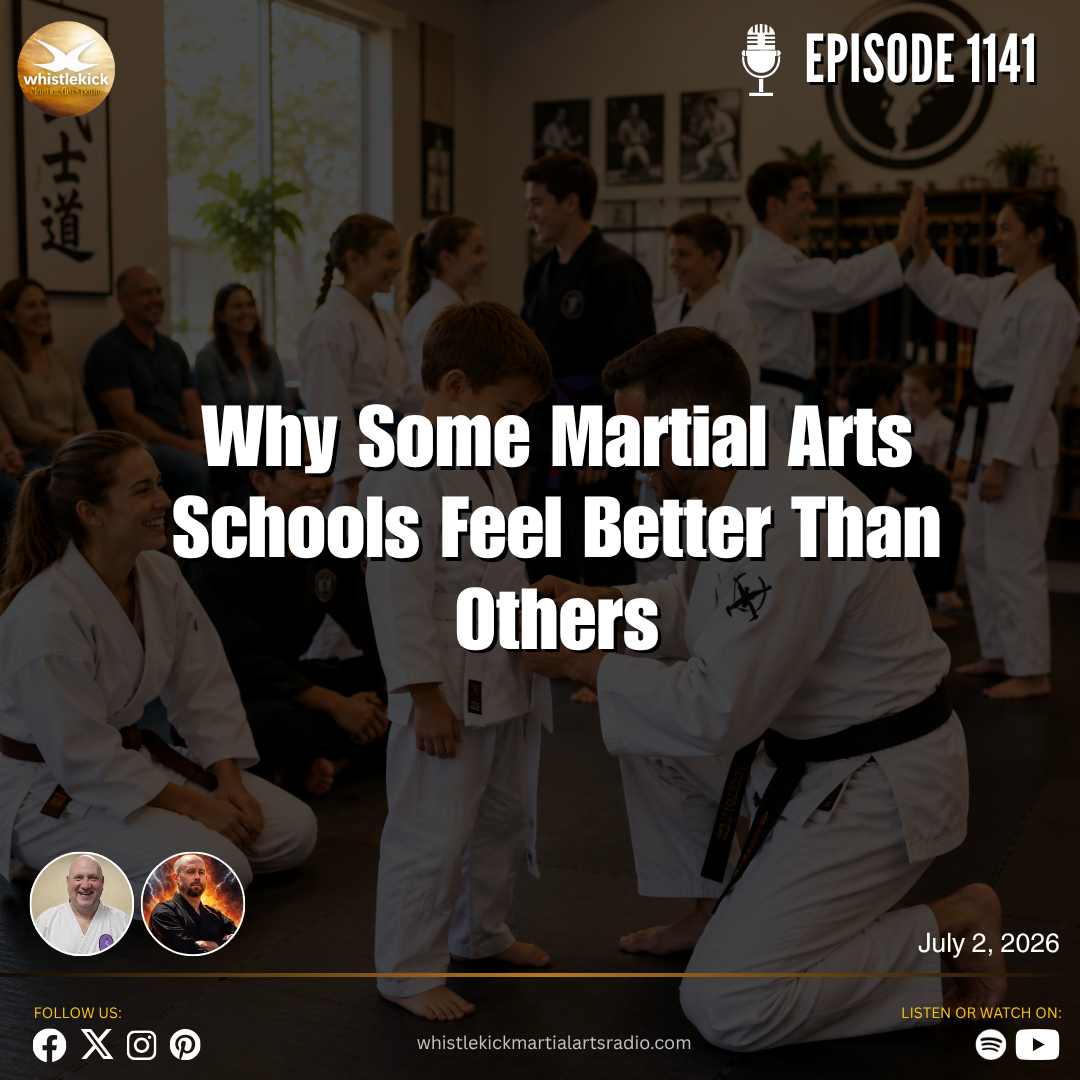
Why do some martial arts schools feel better than others? Join Jeremy and Andrew as they discuss culture and curriculum as some of the potential reasons.
Why Some Martial Arts Schools Feel Better Than Others - Episode 1141
SUMMARY
In this episode of Whistlekick Martial Arts Radio, Jeremy and Andrew discuss the subjective nature of martial arts schools and what makes some feel better than others. They explore the importance of both curriculum and culture, emphasizing that culture often plays a more significant role in student retention. The conversation delves into the interactions between instructors and students, identifying red flags that may indicate a negative environment. Finally, they highlight the characteristics of good schools, including attention to student needs and fostering a sense of community.
TAKEAWAYS
Some martial arts schools feel better than others.
It's all subjective.
Culture is what gets people to stick around.
The instructor plays such a huge part in that.
If it's a school that feels better, it has fewer or no red flags.
Good schools consistently get it right.
You have to take care of yourself and your own training.
CHAPTERS
00:00 The Subjective Nature of Martial Arts Schools
06:30 Curriculum vs. Culture in Martial Arts
11:41 Understanding School Culture and Interactions
17:00 Identifying Red Flags in Martial Arts Schools
21:50 What Good Schools Get Right
Join our EXCLUSIVE newsletter to get notified of each episode as it comes out!
Subscribe — whistlekick Martial Arts Radio
After listening to the episode, it would be exciting for us to know your thoughts about it.
SHOW TRANSCRIPT
Jeremy (00:16.334)
Hey! Welcome back to another episode of Whistlekick Martial Arts Radio. And on today's episode, Andrew and I are talking about why some martial arts schools feel better than others. Double emphasis on the feel part. It's gonna be very subjective. We're gonna talk about this, and I've got a feeling that you might have stuff to add to our list that we don't even think about. If you're new to the show, thanks for being here. If you're back,
Thank you for joining us again. We appreciate you spending some time with us. My name's Jeremy Lesniak, president, founder of Whistlekick, and joined by my great friend Andrew Adams. And we co-host martial arts radio, the world's number one traditional martial arts podcast. If you want to check out all of our episodes, you can find them at our website, whistlekickmartialarts radio.com. That's where you're gonna find the show notes. It's where you'll find a place to subscribe to the emails. What do you get in the emails? Well, twice a week.
When we drop episodes, we email you and say, here, here's the audio version, here's the video version, here's the show notes. Make it nice and simple for you so you're not chasing them around. Because some of you are really consistent in your listening. You have a podcast player or you have, you know, a certain time on YouTube and you watch or you listen. Cool. Some of you are bouncing around, you're in different places. Sometimes you want to watch, sometimes you want to listen. And that's what those emails are for, because that way you've got both versions ready to go.
without having to go grab anything. We're doing what we can to make it easy for you. And thanks for helping us get to ten million episodes or wherever we're at now.
Andrew Adams (01:54.855)
One thousand one hundred and forty one.
Jeremy (01:58.11)
1140 is out what today is. Thank you for helping us to get to 1141. 1,141 episodes. That's
Jeremy (02:09.527)
We are in our eleventh year of recording. Wild. Well, Andrew.
We've both been at quite a few schools. We've trained at I don't I I don't even know how many schools I've trained at. I've probably trained at a good twelve to fifteen schools formally, you know, not just popping in for a class or two. Where where are you at? Pro in that ballpark?
Andrew Adams (02:34.231)
No, no, no. Not anywhere even close to that. Like I've I've earned rank at
three almost four schools really, but have spent a few months here, a few months there, like didn't necessarily in rank. Yeah.
Jeremy (02:45.056)
Okay.
Jeremy (02:49.607)
Yeah, that's that's what I that's what I mean. You know, more than just one or two classes. 'Cause you know, one or two classes doesn't doesn't really answer the question that we're going for today. You need to be there for a few weeks to get a feel.
Andrew Adams (02:58.971)
Mm-hmm. Yeah. Okay. So then yeah, probably a dozen or so. Yeah.
Jeremy (03:04.811)
Okay. And you know, when I when I say which of those schools felt better and which felt worse, I'm not asking you to literally answer the question, but you have answers. You're thinking, okay, this one felt the best, this one felt the worst, and you're piecing it together in between, aren't you?
Andrew Adams (03:18.437)
Yep, yep.
Andrew Adams (03:23.236)
Mm. Yeah, absolutely, absolutely.
Jeremy (03:25.205)
Yeah. And and if you ask me the same question, I would I would answer it in the same way. Okay, that one was the worst, and here's why. And this one was the best and here's why. And none of them have anything to do with lineage or other credentials or any of the other reasons that people will say, you know, this is what makes a school better than another school.
Andrew Adams (03:42.791)
Mm-hmm.
Andrew Adams (03:54.63)
Yeah, yeah. I mean, for the most part, I would agree with that for me. For me, I'm not telling you you're wrong. for me, I wouldn't say that lineage plays anything into it. but some schools feel more comfortable because there are less unknowns. So, like it might be a style that I'm used to, even though it's a completely different school. And so it feels a little more comfortable for me because I have some.
Jeremy (03:55.05)
It's all subjective.
Andrew Adams (04:23.537)
familiarity with the maybe I know the instructor, even though I haven't trained there, but I've met them through Whistlekick or or wherever. And so I I do think for me sometimes that can play a role. And it might be the same for listeners and viewers as well.
Jeremy (04:44.811)
Well, one of the first things that we can say then is part of what makes a martial arts school feel good is that it has what you want.
Andrew Adams (04:53.571)
Yeah, absolutely I would agree.
Jeremy (04:56.082)
If I
prefer grappling as my martial arts training and I show up at a Shotokan karate school, I it's probably not gonna feel good. Showing up in in in Majudo Ghee and and you know, I walk in and you know I'm wear the mats.
Andrew Adams (05:05.756)
Mm-hmm.
Andrew Adams (05:09.445)
Yeah, yeah, absolutely.
Andrew Adams (05:19.739)
Yeah, exactly.
Jeremy (05:20.447)
Wha why why why is no one throwing each other?
Right? Or maybe I show up in my my BJ J Gee and I'm shrimping across the floor.
Andrew Adams (05:31.175)
Yeah.
Jeremy (05:32.621)
You know, I it it doesn't fit, right? Because what I'm for something to feel good, it has to be something that I want.
w now we could we could could split that, you know, what you believe you want versus what you actually want, you know, like those those are different things. But we can sum it up as if the school doesn't offer what you want, it's not going to feel good training there.
Andrew Adams (05:54.792)
Sure. Yeah, absolutely. And so those things can help, but that's not the to be all end all. You know, may maybe I want to start, you know, maybe I do Shotokan and I want to start grappling. So I'm gonna walk in and it's gonna feel uncomfortable only because it's all new, but that doesn't mean it's a it doesn't mean that it's not a bad place to train. I just have to get comfortable.
Jeremy (06:19.319)
Discomfort and feeling good are not necessarily the same thing. That they're and they're also not mutually exclusive.
Andrew Adams (06:28.123)
Yeah, yeah, I would agree. Yeah.
Jeremy (06:30.269)
Yeah. Well, that's at least some of, and we'll go deeper into it, that's some of the curriculum aspect, but there's also a culture aspect, right? We've got culture and curriculum that that that play in here. And this is the place where I think it gets the most subjective. It's the way the classes are run. I know people who want a two-hour brutal class that they can barely walk out of.
Andrew Adams (06:51.783)
Mm-hmm.
Jeremy (07:00.585)
I know people that love that. Sometimes I do love that. But I also know other people who say, you know what? I can barely find an hour a week. And I'm chasing my kids around the rest of the week. And I coach this thing over here and I do that thing over there. And I have this other love that is also physical. And while I want to train, if I have to drag myself on my hands and knees out of there at the end of class, that doesn't fit with the rest of my life.
Andrew Adams (07:29.339)
Yeah, i exactly, exactly. What what everyone's looking for is different, which we've discussed at length in various other episodes. And so that's certainly gonna play a part in how comfortable people feel in that class.
Jeremy (07:42.232)
Yeah. In fact, I would say when we're talking about culture versus curriculum, it's culture that is most important. Culture is what gets people to stick around. It's not curriculum. Why? Because they don't know the curriculum. It's not until you're looking back that you understand curriculum, but you can understand culture in the moment.
Andrew Adams (07:50.769)
Food.
Andrew Adams (08:00.027)
Exactly.
Andrew Adams (08:08.123)
Yep, yeah. And I think the only time that curriculum might play a role is if you are a longtime experienced martial artist in a, you know, black belt example as an example, a black belt in a school and you're transferring to a new school, you moved or whatever, curriculum might play a part in it because it might be something you're familiar with. But f I would say for the vast majority of people for sure, cult culture over curriculum for sure.
Jeremy (08:37.963)
Yeah. Let let's talk about the role of leadership and interactions, emotional tone, between instructors and students and students and students.
Andrew Adams (08:47.687)
Mm.
Andrew Adams (08:53.413)
Yeah. Yeah. the instructor plays such a huge part in that for sure. and and we've talked again in other episodes about how to create a good culture. And if you don't create a culture, one will be created whether you want it to or not. And so you as the instructor definitely play a part in that for sure.
Jeremy (09:18.699)
W when when I think of the schools that I and and ranking them, right? When I when I look at them through this lens, the best schools had the best leadership.
Andrew Adams (09:31.355)
That's not surprising.
Jeremy (09:33.139)
It's not just the most competent instructors. It's they were the people who inspired me to do my best.
Andrew Adams (09:41.125)
Mm.
Jeremy (09:43.412)
schools that didn't did not inspire and and I don't just mean for me, but you know, I'm thinking of a couple of schools now that really didn't inspire anyone. It was you show up, we're gonna check off your days that you are here and
Jeremy (10:03.157)
You know, eventually we'll put a different colored belt on you.
Andrew Adams (10:06.373)
Yeah. Yeah.
Jeremy (10:12.139)
I I think most of us.
And this connection with the culture piece, we want to be part of something. And when we talk about martial arts, one of the things that's really fascinating is unless you are the instructor, or at least one of the instructors at a higher rank in a school, you're you remain there on faith that you are being taken care of, that the leadership is helping you progress in ways that connect to your goals.
Andrew Adams (10:18.695)
Mm-hmm.
Andrew Adams (10:39.452)
Mm-hmm.
Jeremy (10:45.035)
Because you don't know. You know, think the the first day you show up at a school, you're like, I don't know anything. I'm just here. I'm here and I've read good things or I've heard good things or maybe I don't even know enough to know what good things are, but this clook place is close to my house and I'm gonna give it a shot.
Andrew Adams (11:00.389)
Yeah, yeah. I I think that that culture aspect is so big that students will feel and understand the culture of the school before they actually understand the the training and what they're gonna be learning. You know, because as a first, you know, your first class, you know, white belt, you're in your first class, you don't understand anything that you're doing, but just those first couple of classes, that culture is gonna be inherent and they're gonna figure out what that is.
Jeremy (11:28.173)
Absolutely. What are some of those ways that a beginner might pick up on things that are either healthy or unhealthy within within a school, you know, culture but could be more than culture.
Andrew Adams (11:36.592)
Andrew Adams (11:41.423)
Yeah, I mean it's how the instructor interacts with the students can be can play such a huge part.
And how the instructor interacts with other instructors as well.
That's that's one for sure.
Jeremy (11:58.838)
Yeah. Yeah, I I I think one of the things that happens for most beginners, they don't fully understand the hierarchical expectations. Now there are some schools that as part of their intro classes will make a big deal out of this and they'll they'll sit the prospective student down and they'll say, Okay, you know, you you you you always do these things, you never do these things, you call this person this title, you call this person that title.
you know, don't look in the eye or, you know, whatever ridiculous things they they might they might say.
Andrew Adams (12:31.206)
Ha ha.
Jeremy (12:33.453)
And people pick up on those rules and those interpersonal interactions, and they draw an opinion of it. Doesn't matter if why those things are there. And here's a great example. There are people, because of how they look at bowing, don't want to be part of a school that bows. Now
Andrew Adams (12:45.895)
Mm-hmm.
Jeremy (13:00.491)
That doesn't mean bowing's wrong. It means that a martial arts school that has bowing isn't going to feel, remember that we chose this title intentionally, that school is not going to feel as good to that person as a school that doesn't have bowing. It's subjective.
Andrew Adams (13:14.873)
Exactly. Yep. Yeah, absolutely. and we could say that about, you know, i about anything.
Andrew Adams (13:26.651)
I'm not to not to say that jumping jacks are the to be all and all, but maybe you would absolutely hate jumping jacks. They're the worst thing f for you or whatever. Yeah.
Jeremy (13:33.643)
Maybe it's the only thing the instructor does in the warmup. Maybe it's the most boring, monotonous warmup ever. It's a thousand jumping jacks, and then you start class every day.
Andrew Adams (13:41.829)
Yeah, exactly. And that would make someone feel uncomfortable if that if they didn't enjoy that. Yeah, it would make me feel uncomfortable too.
Jeremy (13:48.639)
I I I don't know that I would last at a school that started every class with a thousand jumping jacks.
Andrew Adams (13:53.51)
Yeah, yeah. I mean with my foot I have a hard time just doing ten jumping jacks. Let alone a thousand.
Jeremy (13:59.97)
You could lean.
Jeremy (14:03.941)
It's like a kickstand. You're on w you're on your good foot.
Andrew Adams (14:08.773)
Hmm. Okay.
Jeremy (14:09.505)
And then you can use the bad foot to kickstand. Anyway.
Andrew Adams (14:14.071)
Ha ha ha.
Jeremy (14:17.973)
Red flags. Now a lot of these are going to be subjective, but are there any that you would say are almost universal?
Andrew Adams (14:26.179)
Yeah, I think so. you know, we talked about we we talked about how the instructor interacts with students. There can definitely be red flags in how a instructor handles a student. you know, I I always recommend not a requirement, but if someone's gonna go check out a new school, there's nothing wrong with asking to just sit and watch and not have to participate and
Jeremy (14:28.362)
I got one.
Andrew Adams (14:53.551)
So if you do that and you see some interactions that are like, ooh, I would not want to be talked to that way, that's for sure a red flag.
Jeremy (15:06.473)
I have seen schools I've been part of schools where sparring gets really close to bullying. It's almost like stratification in the pecking order. Like, you know, this might be everybody's rank, but we all know that so and so is is is a better fighter and they make sure they prove it every single class.
Andrew Adams (15:17.383)
Mm.
Jeremy (15:29.953)
Right. When when that goes so far as to become at least violence adjacent and people are genuinely getting hurt, that's an issue.
Andrew Adams (15:36.953)
Mm-hmm. Yep. Yeah. Yeah. That was the next one I was gonna bring up was getting peop people getting hurt, not not being safe in class.
Jeremy (15:46.849)
Yeah. there are also schools where it becomes a where the
Out of class relationships?
Andrew Adams (15:57.575)
Mm-hmm.
Jeremy (15:59.726)
are constantly on display on the floor, whether that is romantic or maybe platonic with a lot of favoritism or something like that. I've seen schools that do that and that makes a lot of people really uncomfortable.
Andrew Adams (16:12.219)
Yeah, yeah, that's fair. and to be clear, you are not saying strictly in student instructor, but just student to student as well. Yeah.
Jeremy (16:23.021)
Student to student, sure, sure. I I've been in schools where, you know, husband and wife had a fight and they're both in class and everybody knows that they had a fight. That's not okay. That's not and and if that if that persists, right, that's not cool.
Andrew Adams (16:33.253)
Yeah, yep, exactly.
Andrew Adams (16:40.047)
Yeah. Yeah. So th I think those are definitely some red flags to keep in mind.
Jeremy (16:44.029)
And and yeah, and there are more, you know, but I what I think is most important is, you know, if it's a school that feels better, it has fewer or no red flags. They're red for a reason.
Andrew Adams (16:56.931)
Of those things. Yep.
Jeremy (17:00.971)
Otherwise, they're yellow flags.
Andrew Adams (17:03.527)
Hmm.
Jeremy (17:05.805)
Right. Let's let's flip this. We've kind of gone negative. What things do good schools consistently get right?
Andrew Adams (17:13.915)
Hmm. I think the attention.
equal attention to I'm gonna say a majority of students
And the reason I'm saying majority is I would understand a little more attention to the brand new people.
Jeremy (17:32.469)
Mm-hmm. Quite agree.
Andrew Adams (17:34.651)
But that in in general across the board, everyone is getting worked with, there's stuff for everyone, and no one is feeling left out.
Jeremy (17:46.442)
I I I'll say it a little bit differently, but I think schools that make it a priority to make sure everyone's needs are met at as many classes as possible. A great school makes everyone feel like that class was designed for them.
Andrew Adams (17:55.43)
Mm.
Jeremy (18:06.753)
And that's hard. That's really hard. It takes a lot of experience. It takes pre-planning for those of you out there who don't like to plan your plan your classes ahead of time. It takes assistant instructors and it takes great students. If you have all those things, you can get there. And I I've been part of schools that do that often, and that's it's just an amazing experience. But I think those schools also
Andrew Adams (18:14.513)
Mm-hmm.
Jeremy (18:33.301)
Recognize that everyone's goals are different.
Andrew Adams (18:37.125)
Yep. Yep. Yeah. I think the other thing is that, you know, you're looking that the school has what you're looking for. you know, we mentioned earlier that everybody wants to feel like they belong. And so having some sort of social component to that, I think, for some people is an important thing. now that's not to say that there's a potluck after every single class. but you know, schools that have like
end of the year celebrations or or or you know a a summer barbecue, like those types of things, I really appreciate and I enjoy being a a part of a school that has those outside of the school get togethers. and for a lot of people that's a that's a very important thing. And for some people they could care less. but I think that being a part of a community like that can be important.
Jeremy (19:31.638)
Yeah, I agree. I think at a good school, the instructors train and not just in class. They are working on their own things, they have their own training, and they continue to progress in ways that line up with their own goals. They're passionate, and that passion trickles down through class. To me, and I I'm gonna guess this is true of most people.
Andrew Adams (19:48.764)
Mm-hmm.
Jeremy (19:58.434)
There's almost there's no better energy in class than when an instructor says, I want to show you the stuff I've been working on.
Andrew Adams (20:05.535)
Mm. Yeah. Or I will go into class with my instructor and he'll say, we worked on this last week with Sensei Dave And I'm like, you know, great. Like and then we'll work on whatever it was that he worked on. Yeah, for sure.
Jeremy (20:20.513)
Yeah, be because
Jeremy (20:24.703)
Schools that are uncomfortable often have instructors that are not passionate about their own training anymore. They're just presenting what they know. They're not getting better outside of maybe some refinement. They're not learning new things. But when they learn new things and they want to share those new things with you, ugh. It's so much fun. And I do that sometimes too. I'll take something that I've been working on and share it with my students, and they're excited, even if it's way over their head.
Andrew Adams (20:38.071)
Mm-hmm. Yeah.
Jeremy (20:53.493)
I've tried to find a way to to break at least some of it down for them. And we have a great time. And I think that that that leads to another another thing good schools get right is everybody understands everybody else is imperfect. Everybody's getting better. The instructors aren't magic. They haven't maxed out their their skill levels.
Andrew Adams (21:13.231)
Mm.
Andrew Adams (21:24.347)
Yeah, yeah, g yeah, 'cause th the when the instructor has given permission to ever when the instructor has given permission for everyone to make mistakes, themselves included, it helps to encourage an environment of growth.
Jeremy (21:24.727)
There's always more.
Jeremy (21:43.701)
Sure does.
Jeremy (21:48.287)
Is there more? Is there more we should say?
Andrew Adams (21:50.652)
There's there's probably more we should say, and I'm going to ask that our audience tell us what did we miss? What makes a a good school feel better for you?
Jeremy (21:56.524)
Hm.
Jeremy (22:03.053)
Yeah. If if you if you could design the the school that you want to be at, you know, regardless of style or location, right? What are s what are we talking about the soft skills of being a martial artist. These are sort of the soft skills of being a school. What is it that makes it feel better to be there?
Andrew Adams (22:23.313)
Hmm. Let us know.
Jeremy (22:25.473)
And I I yeah, email us, Andrew at Jeremy at whistlekick.com. You can also find our Facebook page, Martial Arts Radio, because we post every episode there. That's a great place to leave comments. And bunch of you leave comments on Spotify. That's always cool to see. But whatever works. If you want to share it publicly, do that. If you want to share it privately, email us, do that. If you don't want to share it, at least think about it.
Because I think these are important subjects for us to all consider, especially if you have or plan to ever have a school. If you don't plan to have a school, if you don't have a school, if you want to remain a student forever, that's okay too. But I think understanding what it is about where you're at that you love and why is important because if it changes, you'll spot it.
Jeremy (23:23.147)
You gotta take care of yourself and your own trainer.
Jeremy (23:30.411)
And with that, we come to a close of another episode. Hey, if you haven't been around for all 11 years, there are episodes you probably haven't heard. In the early days, we were audio only, but for years now, we've been audio and video as separate versions of these shows. And that's why we send you the emails twice a week if you're on the newsletter list. Go to whistlekickmartialarts radio.com. Sign up at the top of the page to get these emails. You can follow us on social media. We're at Whistlekick Everywhere.
And if you have a topic or a guest suggestion, we want to hear it. You've got to email us, or there's a guest form over on the website as well. And just as a it's funny. I'm gonna say this. The people who need to hear it are not the ones watching this episode, but I'll say it anyway for the benefit of those of you who watch.
Andrew Adams (24:13.671)
Okay.
Jeremy (24:24.649)
If the in if if someone pitches an episode, whether it's for a person or a topic, and the entire justification
resides in something that you have made and want to settle.
You will not be on the show. We're not pay to play. We won't take your money. We have never accepted money to have a guest on this show. And we won't.
Andrew Adams (24:59.335)
Absolutely.
Jeremy (25:00.417)
Plus it's a lot of money. And then we do something cool for all of you too. I don't know what that would be. We would probably take that money, do that episode, and then I don't know, go fly somewhere to to do an episode with somebody live. I I don't know. We'd do something cool. We'd find a way.
Andrew Adams (25:05.37)
Ha ha.
Andrew Adams (25:16.516)
Yeah.
Jeremy (25:19.797)
And with that, we're gonna wrap it up. So until next time, train hard and have a great day.
Andrew Adams (25:25.425)
Smile.