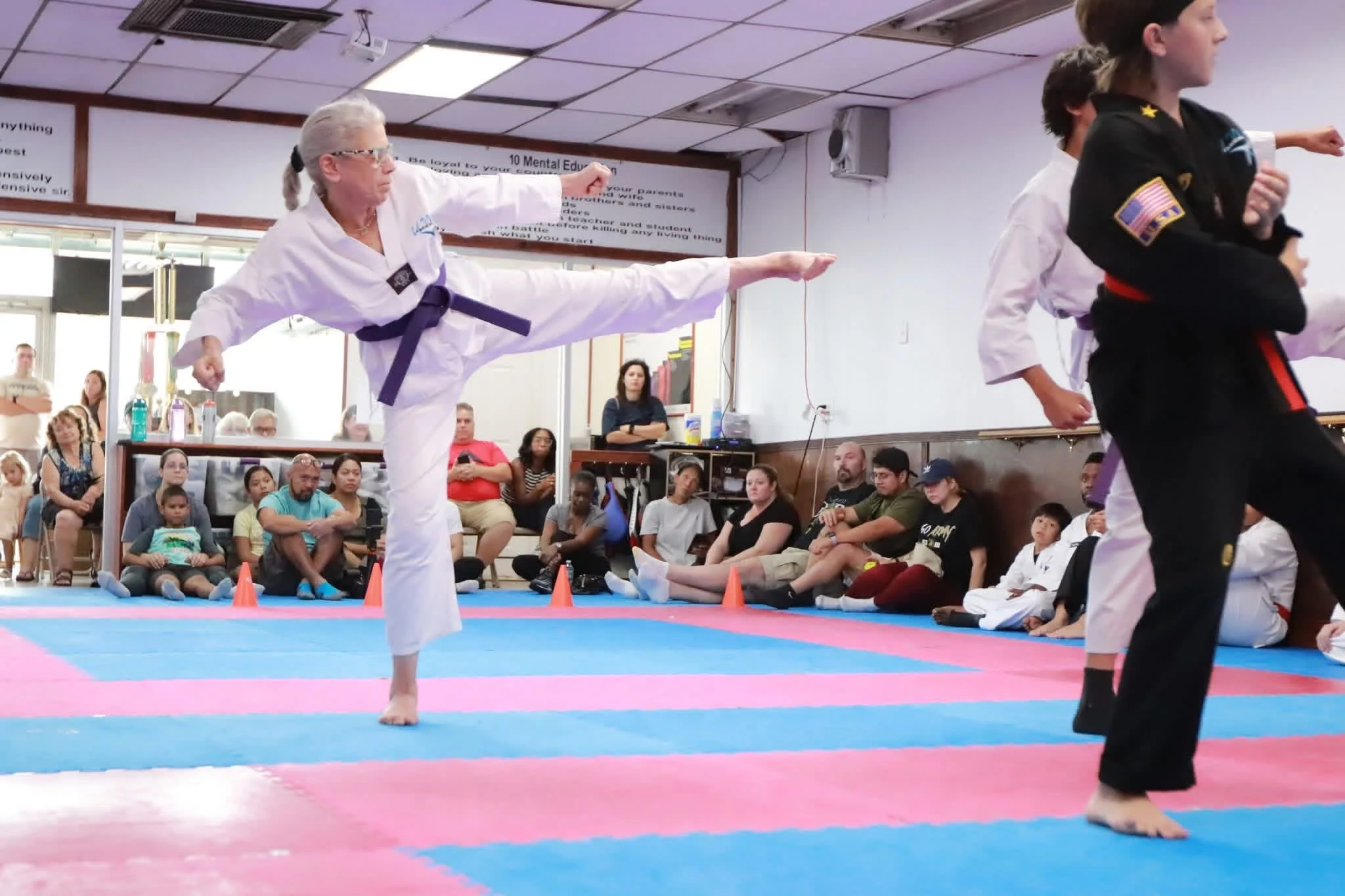
In this episode Andrew chats with Anastasia Solberg, a Tae Kwon Do practitioner who was raised in Korea as a youth, then took up the art much later in life. They discuss her passion for forms, sparring and weapons, as well as how music helps martial arts.
Anastasia Solberg - Episode 1160
SUMMARY
In this episode, Anastasia Solberg shares her unique journey in martial arts, beginning with her childhood in Korea and her early experiences in Taekwondo. She discusses her return to training as an adult, the challenges she faced, and her passion for forms and sparring. Anastasia also reflects on her competition experiences and her exploration of other martial arts, culminating in her recent training in Korea. Her story highlights the importance of perseverance, cultural connections, and the joy of martial arts at any age.
In this conversation, Anastasia shares her experiences training in Taekwondo both in Korea and the U.S., highlighting the differences in class structure, training intensity, and cultural approaches to martial arts. She discusses her love for weapons training, her musical background as a violist, and how music influences her martial arts practice. Anastasia also reflects on her aspirations in martial arts, including competing at the national level and achieving her third dan, while addressing the challenges of aging and injury recovery.
TAKEAWAYS
Anastasia's early exposure to Korean culture influenced her martial arts journey.
She trained in Taekwondo for eight months in her twenties before life took over.
Returning to Taekwondo as an older adult presented new challenges and opportunities.
Anastasia's favorite aspect of training is perfecting her forms.
She has competed in martial arts tournaments, often against younger opponents.
Anastasia values learning from different martial arts styles.
Her recent trip to Korea allowed her to train in Taekwondo again.
She emphasizes the importance of cultural connections in martial arts.
Anastasia's journey reflects the adaptability of martial arts for all ages.
She believes that every experience in martial arts contributes to personal growth.
Weapons training varies significantly between schools.
Music has a rhythmic influence on martial arts performance.
Teaching requires a deep understanding of the art.
Future goals include competing at nationals and achieving higher ranks.
Cultural differences shape martial arts training styles.
Personal growth in martial arts is a lifelong journey.
Injuries can impact training but also provide opportunities for growth.
Mentorship is a key aspect of martial arts development.
CHAPTERS
00:00 Introduction to Martial Arts Journey
01:05 Early Experiences in Taekwondo
06:15 Returning to Taekwondo as an Adult
11:04 Favorite Aspects of Training
15:12 Competition Experiences
17:18 Exploring Other Martial Arts
18:11 Training in Korea
22:36 Training in Korea vs. the U.S.
30:00 The Role of Weapons in Martial Arts
31:38 Musical Background and Its Influence
41:07 Teaching and Mentorship in Martial Arts
43:00 Future Aspirations in Martial Arts
To connect with Anastasia:
anastasiasolberg@gmail.com
Join our EXCLUSIVE newsletter to get notified of each episode as it comes out!
Subscribe — whistlekick Martial Arts Radio
After listening to the episode, it would be exciting for us to know your thoughts about it.
✅Subscribe to whistlekick Martial Arts Radio on the following platforms:
🎧Apple Podcasts: https://apple.co/3mVnZmf
🎧Spotify: https://spoti.fi/3yHVdHQ
✅You can find whistlekick on all social media platforms using the handle @whistlekick or visit our website at https://www.whistlekick.com or https://www.whistlekickmartialartsradio.com
Show Transcript
Andrew Adams (05:35.234)
Welcome, you're listening or maybe watching on YouTube another episode of Whistlekick Martial Arts Radio. And today I'm excited to be joined by Anastasia Solberg. Anastasia, how are you today?
Anastasia (05:46.219)
I am wonderful. How are you?
Andrew Adams (05:47.691)
I'm great. I'm excited to get into a chat. We met last year and and I'm excited to know more about you. But in case you listening or watching, this is your first episode, welcome. We're happy to have you. we whistlekickmartialarts radio.com is a place you can go to find out about this episode and all over eleven hundred other episodes that we've produced. All of the stuff you can find there, you can find transcripts on every episode, you can find photos of all of our guests, contact information.
All of that stuff, whistlekickmarshallarts radio.com. You can also sign up for our exclusive newsletter. We're not going to send you a ton of junk emails. You're only going to get emails when we release a new episode. That way you won't miss any. So that's pretty cool. You can also go to whistlekick.com to find out about all of the other things you do. Maybe you want to purchase some sparring gear or a t shirt or attend one of our events. all of that stuff can be found at whistlekick.com. All right, Anastasia.
Here we are. We're ready. All right. I want to start in our conversation in the most basic plain way ever, which is how did you get started training in martial arts?
Anastasia (06:47.849)
Okay, I'll breathe.
Anastasia (06:57.868)
Okay.
Anastasia (07:06.092)
So it's a long story. okay. as a child between the ages of three and seven, four and eight-ish, I lived in Korea. And my father was doing his graduate studies at Yungse University in Korean literature. And therefore there is this very strong Korean connection. And I don't know exactly how that
Andrew Adams (07:09.025)
Love it.
Anastasia (07:35.24)
evolved into this, but when I was living in New York City in the nineteen eighty, I was in I was in the Korean connection in the Korean community. I was with the Age of Society and going back and forth between things. I don't remember how the connection happened, but I went into this Taekwondo studio, Master Cho. I told him who I was and who my father was and he gave me classes gratis.
So I spent about eight months doing taekwondo there when I was how old was I? twenty-three. That was my first introduction. and I did about eight months long, I did five days a week. And since then I still have the same uniform that I wore then. I still have my belt that I had then. It came with me everywhere.
Andrew Adams (08:28.995)
Wow.
Anastasia (08:32.595)
So when I was housed in Seattle for some reason, we won't have to go into details for a short period of time. I found a taekwondo school there and I went for it was about three weeks only. And in the interim I'd been in Europe. It's it's it's it's a whole very complicated thing. But anyway, I went to a taekwondo school there for about three weeks. But he was doing new style. So Masacho was still influenced by the Japanese, so it was very hard and strict and
Square is the the best way to pronounce pr maybe describe it. And so then I went to this other school and they were all doing like there was a fighting stance and everything was completely different. And this was like this was the beginning of the changes that happened. I spent only it was only three weeks there, that was it. Then I went to when I moved to Germany, I found a taekwondo school in a neighboring village and I did not even a month.
the instructor and I had a major fight because he actually physically hit me, not just, you know, like in jest or in get it together, but really hit me hard. And and I said, that sorry, I can't I can't go with this. So I quit that school and that was the last time that I officially did any Taekwondo. So basically I had eight months of training.
Andrew Adams (09:44.342)
Mm.
Anastasia (09:58.2)
Then, you know, life went on. I had kids. I went to school. I was in concerts and life and moving from one country to the other, back and forth. And when I was in the States again, I I always wanted to go to Taekwondo again, but there was no possibility financially and there was absolutely no time. As a musician, you don't have time for you know, there's no time ever. So as you probably know. So so yeah, and I have four kids.
Andrew Adams (10:23.805)
I can definitely relate.
Anastasia (10:27.71)
So that sort of, you know, added to it. so then, you know, every time I moved to another place or another place, I was always finding out where is the Taekwondo schools. But if it wasn't a Korean conductor, a conductor, Korean instructor, I sort of shied away. I would, you know, I would look at with longing, no time, no money. Okay, finished. So then my kids all, I only had one left.
at that point and I had a granddaughter and we were in Kingston and they were doing Subacto and it was non-contact. So I did and I would had a studio in that same building. So after I would teach I would go in there and do a class here and there. That went on for about I don't know maybe a couple of months. And that was the end of that. And then I moved to Newburgh.
To cut the story short, I moved to Newburgh for various reasons. And then I thought to myself, you know what? I have the financial means and I'm sure there's a taekwondo school here. And I looked online and I said, there's one in New Windsor. there's two in New Windsor. So I went to the number one. I was in my uniform ready to go. I went to number one and she sat me down and said, you know, we don't do adults and
older people, we don't do that. It's only for young. She was like second generation Korean. Her father owns a studio. It's a pretty it's in it's also in Sultan County. And we had a long talk. It was very lovely, but I wasn't going to be in that school, obviously. So I went up the road to the next school, which was just a little very much smaller scale than that one. And I Master Pak I asked him and he looked at me like
Really? Because they have a two-class free thing. I said, Yeah. Okay, you can do the two classes. He never thought I would come back again. I was in for two times and that was it. And but that wasn't what happened. And I am now this is my fourth year, and I'm a I'll be testing for my second dan in December. So
Andrew Adams (12:30.2)
Ha ha.
Andrew Adams (12:45.654)
Mm-hmm. Wow. Now what was it do you think? And maybe it was just coincidence, but you know, you you grew up in in Korea as a young child. You eventually got into Taekwondo when you were living in New York. Were did you seek Taekwondo out because you knew it was Korean, or was it completely coincidental?
Anastasia (13:06.409)
Yes. No, absolutely not coincidental. I d would not nothing Japanese was like totally forbidden. I come from the old school. We're the old school, which is like we're too close to that war and we're not we're not interested from that occupation. That's like taboo. nothing Japanese. The Chinese I would be maybe more open to, but for me it was like it's Korean or it's not. It's the
Andrew Adams (13:30.35)
Mm-hmm.
Anastasia (13:33.048)
I'm very s yeah, that my whole life has been that way with with yeah. So
Andrew Adams (13:39.468)
Yep, no, no, I I get it. I understand. And you know, there are a lot of schools like that. And it makes sense. You had an understanding of the culture as a child. So it it makes sense. I just wasn't sure if it it was something you specifically sought out. Which it was. Yeah.
Anastasia (13:46.797)
Mm-hmm.
Anastasia (13:52.311)
I did. I did specifically seek it out. And I didn't realize I didn't actually realize until I mean, I always wanted to dance so when I was a when I was young, when I we came back to the States, I had to choose between being a musician or being a dancer. And I chose to be a musician. And I and every once in a while, you know, I'll do a dance class here. Or for a while I did some ballet as an adult and I you know, I would and I love to dance. But
I didn't realize until this last this just recently that actually I'm very physical and very physically oriented because now I'm doing interval training in the morning three times a week, as well as doing taekwondo five days a week. And I can't get enough. It's just like that's where I want to be all the time. So
Andrew Adams (14:37.263)
Mm-hmm.
Andrew Adams (14:42.703)
Yeah. So, all right. So you trained eight months or so in your twenties, and then life happened, which a lot of people listening will be able to relate to. you have kids, they grow up, you have grandkids, you decide I'm gonna get back into this. What was it like for you going back? Because you had a bit of a knowledge, some knowledge going into it, but not a lot. But so what was it like going back as an older person?
Anastasia (14:54.42)
Mm-hmm. Mm-hmm. well, it was it was so different because when I trained then it was a hard wood floor.
There was no protection even with sparring. It was bone on bone. And of course I couldn't do bone on bone now. I can't even I'm not even allowed to spar. So that's different. And I, you know, it's hard for me to work on a hard floor because of just because of my my spine. but so at first it was like, what is this? This is like babying everything. Is this really for real? That was my first initial response.
but I've gotten, you know, I've obviously acclimatized myself to that. And it has actually allowed me to go further because as my body ages and I have multiple issues that come up, at least this allows me to continue training. Whereas if it was a hardwood floor it would really be difficult for me to continue.
Andrew Adams (16:13.571)
Hm, yeah. And I get that. I I have often said that, you know, karate, taekwondo, those ty types of traditional arts are ones that you there's so much to them, there's so many aspects of them that there's always something you can do regardless of your age, whether you're six or sixty six, you know, or a hundred and six. There's there's still something you can work in. So I I get that. what's your favorite aspect of training?
Anastasia (16:20.406)
Mm-hmm.
Right. So my favorite aspect always was
sparring which I'm not allowed to do. So and my other favorite aspect is really the Pumze. I just I love my forms, I do them every day. I I want to be I want to be perfect in my forms. This is what really really and I love kicking, but you know, but really the forms is what I really, really, really that's my thing. And that's also what I can I know I can do for the rest of my life. So
It's like Yeah.
Andrew Adams (17:17.665)
now you want to be perfect to your forms. Did you use your forms as a way to get into competition at all?
Anastasia (17:24.96)
Yeah, I've been doing competitions with forms. Yeah.
Andrew Adams (17:27.853)
And and let talk about that a little bit. You know, it it's you know, you started re started I'm putting in air quotes excuse me, for people only listening, at a you know, you did eight months, but it wasn't a lot. You restarted as a as an a as an older person and competition can be scary. And so let's talk about that a little bit.
Anastasia (17:47.518)
I did my first competition as a my teacher jumped me straight to yellow belt basically. He let me train for about a month or two without any belt and then he gave me the yellow belt and that and I did a competition immediately with the yellow belt. Yeah, and that was interesting because I was
Andrew Adams (18:03.343)
So right away, yeah.
Anastasia (18:10.267)
I was actually competing not with anybody my age, nor was I competing with anybody in my belt. It was a brown belt. And it was a I don't know, maybe sixteen or seventeen year old. and I got first prize. So that was an interesting and I was I was like I couldn't even breathe. I was hyperventilating because I was so nervous 'cause it was my first for my first competition. And I still do at the compet at the at the tournaments I still
do hyperventilating. or I start getting a panic and think I forgot my foreign. I I I don't know. Do I actually turn this way or that way? You start to overthink everything and it's all gone. And then you start looking at everybody else and trying to figure out what did I do in my brain. That was the last tournament. But then I've done I don't know how many tournaments I've done, all the the things are upstairs. But then the one the one that
they had I think I've done a couple where it's been in there's been at least two or three that have had something in my age range at least within twenty years instead of being with kids. and and that's different, but there's nobody ever my age so far. And because it's always been the smaller ones, I'd like to do one where it's more
Andrew Adams (19:20.9)
Mm-hmm.
Anastasia (19:37.241)
And th the last one I did, they had nobody over the age of eighteen in the women's forms.
Andrew Adams (19:43.277)
Wow. Wow. Yeah, that makes it it it definitely makes it a very different type of event. for sure.
Anastasia (19:50.243)
Yes, because you're not being compared, really. They can't and they have to give you a prize regardless. And I don't feel like it's justified. I'd rather have a breakdown of, you know, this, this, this, this and but I guess that happens only when the black when you're the black belts and you get a you have to go to a specific tournament where they do the point system so then you actually know what your what point you get.
Andrew Adams (20:16.717)
Yeah. I mean I'm I'm not a big tournament person, but I know yeah, go going to larger tournaments you're likely to get more competitors. And so they're more likely to to split it out. That that that makes sense. And and I I can relate to the forms things. Forms are are some of my favorite parts of of training as well. So all right, now let's talk about you started training in Taekwondo because Korean arts, yes, yes, yes.
Anastasia (20:24.015)
Mm-hmm.
Anastasia (20:28.123)
Yeah.
Andrew Adams (20:42.521)
Japanese starts, no, no, because there was this friction, especially way back in the day. what about now? Are you are you working on anything else other? Is it still strictly Taekwondo and nothing else? Nor the twin twain shell me, right?
Anastasia (20:59.271)
well when I went to Whistlekick the seminar last last year, which is where I met you, it was really interesting. There's nobody doing my Taekwondo anyway. They was doing ITF or it was karate and or there was some Chinese things and Tai Chi and all those. So I found it really interesting and informative to try all the different types of forms to see where they cross over and where they differ. And and that interests me in general.
So I don't think I can go this year because I have a conflict, but but I would go again because I find the more you know, the more you know. I mean it doesn't matter where you and I would be interested in knowing more. I'm not it's not about it's not about a country or a person. It's more about a general
Andrew Adams (21:45.753)
Yeah.
Anastasia (21:53.292)
It would be like saying, Okay, I only do ballet and I don't want to know about this or that or I only play classical and I don't want to hear bluegrass and I don't want to hear Irish and it's like that kind of distinction, which I I'm not going to do. And I f I find everything you learn from everything and everything is interesting and I think it's important also to understand that different cultures and the different people, the way the forms develop also in is informative in that direction.
Andrew Adams (22:18.595)
Yeah, I love to see the similarities in forms from Taekwondo and some of the karate styles because they will often share the same form. They will call it they might call it something different, but the the you watch them side by side and you can see that they are in air quotes the same form, but they're not, right? They're definitely the stylistically they do it. And I also I enjoy that too quite a bit. all right, cool. Now
Anastasia (22:29.72)
Correct. Right. Right. Yeah. Yeah.
Andrew Adams (22:48.353)
You've trained and you've traveled the world. You already talked about you were lived in Germany for a while, you you know, obviously New York, you were in Seattle, you gr you know, born and raised in Korea. have you trained out like now that you started as an adult, restarted, have you now traveled to do training in other places?
Anastasia (23:11.427)
I was just a month in Korea last month.
Andrew Adams (23:13.914)
my gosh. All right. Well we gotta talk about that for sure.
Anastasia (23:16.876)
And I found there happened to be a taekwondo school three minutes walk from my up my Airbnb. And so I did three weeks of Taekwondo in Korea.
Andrew Adams (23:29.633)
Okay, so let's talk about that for did what so okay. Sorry, I'm really excited because this is really cool. Was it so it wasn't Taekwondo that brought you to Korea? Okay. What just w went to Korea for three weeks? Okay. And just decided to bring your did you have plans to train when you were there?
Anastasia (23:44.009)
I just went to clear. Yeah, my mom.
Anastasia (23:54.171)
I what I was doing this time. So the first time going back to Korea was a couple years ago. I went back for the first time in 60 years. So and so that was a lot of those I also met my daughter there. We did a little bit of traveling. I only had really ten days to myself, so by myself, so it was more of a r just seeing what was this all about.
How's it changed? What's different? yeah, it was a it was a totally different experience than this time. This time I went there with with the with in mind that I'm going there and I'm going to live there for a month. I'm not going there as a tourist. I will do some things, but I'm just gonna go live there. I have friends there. I'll contact them, see if they have some time, and then I'll just do things. So
As I was walking, I went to synagogue on Friday night, which happened to also be about 10 minute walk from me. And on Shabbat on on Saturday when I went to show as well, on my way back, I saw this sign said Taekwondo. And I'd already looked online, and online it seemed like most of the schools all train only Monday through Friday, Saturday and Sunday there's nothing. Now this is Saturday. And I hear something from the building, the door's wide open. So I, you know.
I'm not exactly I I'm very hesitant about new things. It takes me a long time to get in the door or to talk to people or anything like that. So I stood outside and gave myself a pep talk. So I started to walk to the door and then I walked back. And then I started to walk to the door again and then I walked back and then I slapped myself in the face to just get up there. So I did. I went up there, I opened the door, they were in the middle of training.
Andrew Adams (25:26.263)
Yeah.
Andrew Adams (25:31.766)
Yeah.
Anastasia (25:46.876)
Pumze, and the one of the instructors came to me and asked me, and I just said what I was there for, and he said you can come back and watch, and then you can talk to the headmaster afterwards. So that's what I did. I ended up staying there for two hours watching them training. The only reason they were there that day was because they had black belt testing on Sunday at Cookie Wong, and they were training, they were doing a
Andrew Adams (26:12.535)
Mm.
Anastasia (26:16.889)
So at that particular school, the grandmaster is a ninth degree black belt, and he used to work at Cookie Wan as well. So he d he it's his school, but he doesn't I mean, I don't know if he teaches other classes at other times there. But he basically comes in, everybody, you know, s greets him, and then sometimes he talks to the group, sometimes he just goes in the office and goes back out again.
Sometimes he's there early and does a talk with everybody, checking in with everyone. And he has there's another person, another teacher who's below him, an older gentleman. He also at when I was there was not doing any actual teaching, but he would start and he would end the classes all. And then there was a younger man who was I'd say mid twenties, late twenties, and he did all of our classes.
I was I was there Monday through Friday from seven thirty to eight fifteen nine nine ish. Nine, nine fifteen, depending on the depending on the you know, ha we go over time, we start late, whatever. So, the
So then I you know, you say come back on Tuesday 'cause I couldn't come on that Monday. And we'll see how things are is basically what it was. And I came back and and and I just ended up paying for three weeks and did three weeks of classes. And I did I only in the three weeks maybe I missed two or three. That was it. and
The classes are of course longer. Here the classes are what forty-five minutes, fifty minutes classes as as an average. The classes there are an hour and a half ish. and I can't tell you about other schools because I didn't go to other schools. But this was a this was a strictly Korean school. There were no foreigners, there was no you know, any of that kind of thing, at least not in and and he did
Andrew Adams (28:16.96)
Mm-hmm.
Anastasia (28:35.274)
He did basically about forty five minutes. It was basically a training of a a cardio type thing, interval training type thing for about forty five minutes and then he would work break down depending on whether you do more forms, but basically he would just break down parts of the forms or parts of our kicking techniques, punching techniques and we would do impairing and work that out and then there would be something at the end to just make us feel like, we're finished now. We're all dripping. no, no, we're not finished. Here, do some planks, okay? You know, it's like
Andrew Adams (28:59.095)
Yeah.
Anastasia (29:04.44)
You never knew what was gonna come. But it was all all high school students except for one other woman who was who had just gotten her black belt and she was fifty. So and yeah, it was I really enjoyed the training there. And it pushed me to another level also because it was there was a lot more exactitude for certain things and there was a lot more repetition of the same thing because you had the time and
it's a different mentality. Here you keep on moving and and just the length of the class. So I felt like I felt like I was getting a whole thing. So when I'm here though, I was able to see what is what is similar and what is different. For example, in my school, there's of course more movement and there's different exercises, but it in the bigger picture it
gets to the same point in the end. It's just the path is slightly different and modified for this culture. So if you are able to take a harder path, then my teacher will give it to you, which is what I get. But you know, but if you're not able to take that, then you either, you know, then he but he has just it's just slightly modified.
Andrew Adams (30:05.786)
Yeah.
Andrew Adams (30:28.26)
Gotcha. Now, when you stepped in, so first of all, I'm going to make an assumption you speak Korean.
Anastasia (30:35.196)
somewhat.
Andrew Adams (30:37.122)
En enough to get by at least. So that was obviously a huge help for you when you were there. But you walked in, didn't see any foreigners, as you said, strictly Korean school. Do you feel like you got treated differently because you were a foreigner?
Anastasia (30:44.266)
Yeah.
Anastasia (30:55.858)
No. Absolutely not. There was no differentiation in treatment to me or anybody else. The only differentiation was that there were some things that sh he would exempt or lighten for the other woman who was fifty. And then he would assume it would it would apply to me too, because of age. Sometimes it applied, sometimes it didn't apply, depending on the situation.
Andrew Adams (31:21.792)
And and the you mentioned the training being different there than it is here. Can you talk a little bit about the differences in the training in Korea as compared to the training that you do here in the States?
Anastasia (31:34.121)
I don't know if I can actually generalize because I can only speak for this particular school.
Andrew Adams (31:38.522)
Sure. Well well I mean but let's talk the school that you did there and the the school that you're training in here.
Anastasia (31:44.837)
Here's maybe twenty minutes of warm-up, so to speak. it's not clearly in an interval training s he has his basic exercises and there's some changes, but basically it's the same type of thing. It it does that kind of thing. You do some things that are more to get yourself going and some things that are slowed down. There it's very specifically organized. He like he'll take one week, it'll be
Andrew Adams (31:49.456)
Mm-hmm.
Anastasia (32:14.333)
This is gonna be the focus, it's gonna be the core. This week the focus is gonna be strengthening the legs. This week's and then all of the interval training type things that he would arrange would be according to whatever the focus of the week is. And yeah, so that's and he has more time. So that would be 45 minutes of the class rather than 20 minutes of the class. And we didn't do so. I don't know if I was there for longer, whether there was other classes that worked all
On the forms. Also, everybody was integrated. So that's a little bit different here. When I'm out and can't do like last week, I couldn't run because of my back. if I was in that school, I'd be on the floor holding planks or doing something else that I can do, while everybody else was doing the other exercises. So it's not like you can just sit on the side and twiddle your thumbs. So anybody who couldn't do some particular thing or or
had finished like when he does running. They don't do running every day like we do. But they when they do the running, it's a long run. It's like nonstop. It's basically till everybody drops. So as you drop, as you drop from the running, you go in the middle and you hold planks. Or y you do exercise you actually you hold planks because you're not gonna you're not gonna run, then you're doing something else. So that's
Andrew Adams (33:38.064)
Mm-hmm.
Anastasia (33:41.872)
It's a different, you know, culturally it's a different different way of thinking. the pairing off, you know, he our teacher would have us but he had us each of us paired off together and we would use each other as a as a a holding crutch for all the things. We did a lot of holding on and working all of our kicks, our you know, getting our what do you call it? Our ch getting our chambers in, holding and then breaking each each kick down like
Andrew Adams (34:08.27)
Mm-hmm.
Anastasia (34:11.715)
just chambering and holding and then ten times, twenty times, who knows, and then chambering and just the initial kick and holding. And then that would be twenty. Then chambering and kick. It's like always with the count and a lot of that kind of breakdown, which was really grueling but really good. Because you've really learned exactly how everything has to fit together. You do that here, we we do it sometimes
We're told how to kick, but there's so much time in between because there isn't just isn't the time in the class to do it. It's not to have anything to do with the instructors. But yeah, so so I don't know how much is really so different and how much is just that we have an hour and a half rather than forty minutes.
Andrew Adams (35:02.315)
Sure, that makes sense. Now how about the forms? Were they were they drastically different or just slightly different?
Anastasia (35:08.848)
Same forms. No s the no difference. Forms are the forms. The forms are the forms. Because it's Kookie One, 'cause that Taekwondo school is Kookie One. is our school too, so my belt is from Kookie One.
Andrew Adams (35:17.059)
Yep, yep. Okay.
Andrew Adams (35:22.061)
Yep, yep, same lineage. I I wasn't sure. That makes sense. Now, how about s something that many martial artists get into and some are like, no, I have no interest, weapons.
Anastasia (35:24.464)
Yeah. Yeah. Yeah.
Anastasia (35:34.243)
I loved weapons. Well, I don't have a lot of experience. I just started doing numchucks and because of my broken arm it was a little bit, you know, difficult to hold and wield when I had to start doing them. And so I practiced them, I try to practice them regularly because now I'm able to do the movements almost fluidly, the basic movements that we had to learn. It seems like every Taekwondo school has their own form of numchuk. There's no general anything with that.
Andrew Adams (35:37.923)
Mm-hmm. Mm-hmm.
Anastasia (36:02.678)
And how they use the weapons, it seems to be also somewhat random where it is who does what. but I enjoy that. And the next in our school anyway, the next would be the sticks, using the sticks. after the numchucks. I'm hoping that I can do more with the numchucks and with the sticks later. But it's a time thing. We only get to do numchucks once a once a once every couple of weeks.
Andrew Adams (36:17.136)
Mm-hmm.
Anastasia (36:32.612)
that we have classical thumbtucks. So it's sad. I'd like to do more. Because it involves it involves something else with the forms, with the form form movements. It's a combination of things. So I really I like that.
Andrew Adams (36:50.192)
All right, let's talk about let's delve into the other side of stuff you do because I think there's a lot of synergy between the two, but music. You are a musician. Let's talk a little bit about your background and history with music, and then I wanna talk about how bringing it into martial arts.
Anastasia (36:58.231)
Mm-hmm.
Anastasia (37:08.992)
That would be interesting. How am I gonna do that? Okay. let me think about this. I'm a violist.
I trained I trained in Germany. So I lived in Germany for fifteen years. And I'm I'm essentially a chamber musician.
I did a lot of orchestral work when I was in Germany as basically as a means to earn money.
And when I came back to the States I didn't intend on staying here, I intended going back because I had a chamber group in Europe that was doing a lot of tours and performing a lot. And I tried to keep that up and do the travelling back and forth and all of that. But in in the end, it didn't really work out for long term. So I still have ties to Germany and music.
But I haven't performed there for a while. So anyway, when I came back to before I went to Germany, I was involved in the microtonal music world in New York. So when I came back, I rejoined that group, the American Festival of Microtonal Music, and I worked with them for about twenty years. And so that was my main mm my main focus. and now when I moved away from the city, I moved upstate.
Anastasia (38:44.658)
I opened a music school which I ran for twenty years as well and and yeah, and basically ran basically for the purpose was really the community orchestra to serve all the people that were just random musicians who wanted to play but didn't have any cohesive
And played with different people around here. I now have a violin viola duo. That is my main focus. and I also have a violin violin duo. And I play with guitarists and I I did an Irish band for five years. I played an Irish band for five years. That that I do violin, I don't do viola. And now I have another guitarist, singer, songwriter that I'm working with on a fairly regular basis and yeah, but
What the future holds, I don't know. yeah.
Andrew Adams (39:42.725)
Okay. So one of the things that we at Whistle King have noticed that there tends and this is all just anecdotally, this maybe it's coincidental of the people we talk to, but there is a higher percentage of martial artists that are musician that are high level musicians as well. And I'm curious if you have found, if you've thought of in any way, how your music has helped your martial arts.
Anastasia (40:09.325)
Mm-hmm.
Anastasia (40:18.428)
I think that so when I was doing the martial arts in the city when I did my first eight months, I had just come back from a grueling year of study in Germany, where I had basically for no other way of putting it, felt as if I had been beaten. so I had developed a me who had never ever had
nerve problems in my entire life as far as playing. Not that, you know, it was so long because I was still young. But I was the kind who just, you know, I just played, played, played, whatever. But all of a sudden I had serious, serious problems with my nerves and I couldn't play without my bow just shaking off the string. And I couldn't control it. I couldn't do anything. And the only way I could play was by doing forms before I performed.
Andrew Adams (41:10.734)
Mm.
Anastasia (41:12.335)
So that became a real go-to for me for a longer period of time. So even though I didn't s I wasn't didn't have taekwondo anymore after these eight months, I did use forms as a means of keeping my core in place. And I feel like in in taekwondo there's always a rhythm, at least I mean in martial arts I think in general, there's a there's a rhythm that needs to be followed.
And if you don't have that rhythm core in you, it's gonna be more difficult to even find a rhythm, let alone be with a rhythm. So I'm sure that I mean I never thought of it before, but I did I do think of it a little bit because I'm I'm on I'm on the demo team, the the demo team, but they d they do the music forms. And I really wanted to do that even though my teacher did not want me on there because what do we do with this old lady on this music team music?
Andrew Adams (41:53.104)
Hmm.
Andrew Adams (42:11.172)
Yeah.
Anastasia (42:13.234)
So I fought for a long time to get on there and I I practice a lot because I you know you can show me those moves but they go in one side and they go out the other. So I listen to the music and I figure out where all the forms so I can, you know, I can jump. If I miss a move, I can jump to the next one with beat and be there. But it's not always the same with everybody else who's in the group. There's those who have musical background, have some kind of musical training.
Andrew Adams (42:33.602)
Sure.
Andrew Adams (42:38.778)
Yeah.
Anastasia (42:43.244)
And they can understand how that fits together. And there's those who just don't have that concept. And it's much more difficult for them. They have to go from a different angle. But yeah. but I think rhythm is really important because when you do the forms also, you know, you have the you have once some moves that go faster, some moves that go slower, and you have to have a consistency. You can't just like go step one and then hang out and think about it for a while. Because as soon as you hang out and think about it, that's a minus point in a tournament.
You have to have your rhythm and it has to stay through the whole. You start one speed and that speed has to continue all the way through. You can't just do whatever. as far as music in general and taekwondo, I think that I would think that many musicians I mean for me my true outlook would have been dance.
Because I need a physical outlet that also combines the creativity and the and the music, of course. but now I and and I've always had to be physically active.
Because I don't function otherwise. So
I think that it's a it's a you know, you s you you're when you're playing music, you're either sitting in a chair or you're standing, you're in one position, you're you're stationary. And in order to balance that, you need something else. And I feel like maybe musicians need also a creative aspect and they need some kind of like we practice, we're self-disciplined, we have to practice on our own. And with the ty with the martial arts, you if you really want to succeed, you also have to practice on your own. And that kind of that kind of thinking
Anastasia (44:30.678)
And needing to practice on your own is also the important part. So it must draw it must draw musicians. I can't see it from a musician point of view because I'm so involved in the Korean point of view. So but I can see how I could I can imagine how that might work.
Andrew Adams (44:43.022)
Hmm.
Andrew Adams (44:49.304)
Yeah. And I was gonna ask the next question would have been, how has your music helped you being a musician? And one of you have already given away one of those things, which is that you used your forms, your punse, to help regulate your nerves before you were gonna go out and perform on the viola or violin or whatever. Are there other ways that you think those martial arts have helped you as a musician?
Anastasia (45:07.21)
You can
Anastasia (45:21.097)
I think that the way that the it would have had I used it had I done martial arts earlier, I think it would have helped me perhaps organize better. The combination of organizing your practicing, organizing your the order of things, how you're gonna work things. Had I had it before, then I would have it would have been a combination of working them together. Now all my practice techniques
I applied to my Taekwondo. So it's more like the reverse rather than the other way around. And
Because when I was before when I would be doing a lot of really long practising, I would have to find physical things to break up the practicing so that I could keep myself, my body in some kind of normal shape. So, but had I had the taekwondo then, that would have been my outlet. So that's just yeah.
Andrew Adams (46:22.872)
Mm. Now, how about another aspect of martial arts that many but not all of people get into is actually teaching themselves. Is that something that you've dabbled with? Do you do any instructing in your school now?
Anastasia (46:37.099)
No, I do not.
the first time I did anything was a couple of weeks ago, like last week I think it was, there was a new person for the music forum and I was asked to help him learn the first part of it. So that was a lot of fun. That was that was basically an honor as far as I was concerned. 'Cause I feel like I'm really the I'm the top person. But I s I could see
Andrew Adams (47:02.256)
Sure.
Anastasia (47:10.641)
instructing as being part of my life if I had that opportunity. because I do teach music and I have the same analytical way of thinking with the martial arts and but I don't feel like I've reached I could I can we alwa we always want to teach so that our students are better than we are. That should be our aim.
Andrew Adams (47:17.488)
Mm-hmm.
Anastasia (47:39.438)
And not that we're teaching somebody and we want to always show how we are so great. So I could teach somebody perhaps, but I feel like I need to know so much more before or not even know so much more, but be able to actually execute more correctly, consistently, before I feel like I'm confident enough to teach someone else.
Andrew Adams (47:57.637)
Mm.
Andrew Adams (48:05.189)
Gotcha. That and that makes sense. That makes sense. you know, and certainly a big honor to have been asked a couple weeks ago, you said to to help out. That's great. Now let's talk about the what you're working on now in martial arts. You're still training, right? Which is great. I I I I we haven't known each other a long time, but I would be surprised if you ever came to me and said you're not training. So you're still training now. What what is it that you hope to
Anastasia (48:14.204)
Yeah.
Anastasia (48:20.905)
Yeah, that would be a
Andrew Adams (48:34.381)
achieve in the next let's say five years. Let's say you know, right now it's August 2026 as we're recording this. Let's say we're gonna get together in August 2030, four years from now. What are we gonna be talking about then? What have you worked on in the next or at that point in the last four years? What's what does the future hold for you in martial arts?
Anastasia (48:47.709)
Mm-hmm.
Anastasia (48:59.057)
Well, I plan to go to the Nationals next year.
Andrew Adams (49:04.269)
Okay, that's a big step.
Anastasia (49:06.697)
And I want to go to Korea and do the boot camp for over fifties. there is one. there they have different ones, but I found one that's Korean. I don't want to go to the you know the fun ones. I'm not I'm talking about the serious ones.
I would like to have my third Dan by then.
I think there's enough years in between to get it. 'Cause if I do second den in December then I have two years, two and a half years or something that I have to so and
Andrew Adams (49:47.055)
Yeah, it could doable for sure.
Anastasia (49:55.012)
Yeah. I hope that so I'm recovering from a broken arm. yeah, you know that from you saw me. I'm still not yeah, that's why I didn't do nationals this year because for many reasons, but one of them for me the big reason was that I still couldn't make a fist. And I still can't make a proper fist. So if I went and did anything now, I would get minus points because I can't I can now right now I can put my thumb and make a fist like
Andrew Adams (50:03.726)
Last year, yep.
Andrew Adams (50:23.716)
Mm-hmm.
Anastasia (50:24.826)
But I cannot make a proper fist. There's and this is painful in this position. So it's still working. And I want to say also my doctor, who took care of my broken arm, is also was is also a martial artist. don't ask me now what forms, but it's I which which form I can't remember. But he's a higher dan, but he hasn't been practicing for a while.
Andrew Adams (50:27.236)
Yep. Got it.
Andrew Adams (50:46.554)
What what forms?
Anastasia (50:55.185)
And but you know, with this broken arm, like I started doing I was started going back to training even though I couldn't, you know, I couldn't do half the things or even and doing forms with just one arm was really difficult. And then adding the second one or trying to do trying to do a do that, which I couldn't do, and then in the middle of class forgetting and just do it through the adrenaline doing it. He is
He is convinced it basically his line was, if anybody comes in with a broken arm, just give me the name of the taekwondo school, I'll send them over there. As far as he's concerned, that's what healed me. Because even though I'm doing PT and everything other than my PT thinks the same way because it pushed me so far beyond any kind of and was like that yeah, I was doing things that you know you wouldn't do or think about doing. And so
Andrew Adams (51:32.644)
Ha ha ha.
Anastasia (51:55.33)
That's that was I don't know why we got on that. That how did we get on that?
Andrew Adams (52:00.733)
you're talking about going to nationals.
Anastasia (52:02.628)
yeah, right, right, going to Nationals. Yeah, so I want to go to Nationals. I want to go to Korea and do this boot camp thing. and I'm hoping that as I get older, which is a joke, that I actually I really wanna be able to break with this with the with the whatever it's called, this the the kicks, the round the the
with the T. Anyway, anyway, all the different kicks where you're turning, the turning kicks, all the turning was the spinning or back or whatever, those I haven't haven't been able to get that under control yet because I had a another injury. I had a tornisca just before my black belt test. And so I couldn't I couldn't do anything turning. And so I'm still afraid, even though I'm I can turn now
Without pain, I'm I'm a f I built a fear. So I have to get past that fear. So I'm trying I'm working on that. That's what I want to get past, so that I can just I can I can you know how you you well, you don't know because you're not my age. But anyway, as you get older and you do stupid things like I do and break things, then you start to become a little bit more cautious. Like I'm a kind of person who runs all the time, run, run, run, run, run, run, run.
Andrew Adams (53:19.105)
Yeah.
Anastasia (53:29.683)
And then and I'm always in a rush and I'm always late and I gotta get going and I got and I got a hundred things to do, right? So when you're like that, the likelihood that you're gonna trip over the string, you're gonna do that, you're gonna do that, happens all the time. So I've been just trying to become more conscious of the fact that you don't have to run everywhere, anywhere. Just not running. The only problem is then that builds a a cautiousness in your system that I don't need when I'm in Taekwondo. I want to just go.
So I have to get past that. That's my goal. So that I can do everything that I want to do. That's
Andrew Adams (54:07.653)
N now, what made you decide to go to do nationals? That's cause that is a big jump.
Anastasia (54:15.033)
well my instructor asked me if I was interested in doing nationals. So I he wouldn't ask me if he didn't think I could do it.
Andrew Adams (54:23.077)
Okay. Yeah that that makes sense.
Anastasia (54:25.707)
So it's also it's just like I I wanna go where I'll get scored.
These little ones in Jersey you don't get scored. There we did one. We d we I remember what we did when I did my yellow belt. That one, the black no, they didn't get scored. Yeah, they did. This black belts got scored. So I'd like to be able to go to ones that get scored and build from there. But I really want to really contain these pumse as if they're just mine. I want to be able to do everything. Yeah. It's like it's like
How do you say it? Then whenever and I have to I have to balance this because I want to be able to do everything as if I'm I don't want any exemption for my age. That's my theory. But of course I I know that I am constrained by my age, physical age. but I still want to try to be as good as those who are not my age. So
I have to find a balance between acceptance of what I can do and what I have not yet been able to do yet, just because I haven't got there.
Andrew Adams (55:38.191)
Hm. Now where and when are nationals this year? Or next year?
Anastasia (55:42.756)
Mm. They were already next year, May. I last year they were I think they're always in Georgia.
Andrew Adams (55:48.847)
Okay. Well we you will have to keep us apprised of how how things go, for sure.
Anastasia (55:54.525)
Yes. Yes. They're usually they're usually Memorial Day weekend in May.
Andrew Adams (56:01.201)
All right. Now, if someone listening or watching, and I encourage you to go online, go on to YouTube. You can watch all of our our videos there. and you know, sometimes you'll catch things that that you can see that you can't necessarily hear. So for example, I have this cool little three D printed thing, but if you're not watching on YouTube, you wouldn't know what this is. So go to YouTube and watch. But
if someone listening or watching wants to reach out to the to you, maybe you said something that resonated, maybe they're they're an older martial artist as well and wanna connect, how can how can someone get in touch with you?
Anastasia (56:40.813)
I guess the best way is through my email. So that's my full name at gmail.com.
Andrew Adams (56:48.102)
Okay. And your full name will be in the show notes there. So we'll we'll have that so everybody can can can link that. but before we we wrap up, I want to just thank the guests. the not the guests, you're the guest. I want to thank the people listening for for being here and enjoying this conversation with the two of us. again, whistlekick martial arts radio dot com is where you can go to find out all of the information about this particular episode and the over eleven hundred other ones that we have. You can sign up for our newsletter.
And then go to whistlekick.com. We whistlekick do so much more than this podcast. and if you go to whistlekick.com, you can find out all of the stuff that we do. We host events all over the country, tournaments and training events that we we spoke about earlier. but you can also purchase sparring gear, you can purchase t shirts or hats or maybe a mug or you can even get whistle kick shoes if you really want to. They're there.
But all of that stuff you can find at whistlekick.com. Anastasia, I want to thank you so much for being here. But I want you to close us out today. I want, you know, this this episode is about you. people have heard from me enough. What do you want to leave the the audience with today? What can be maybe a single word, it can be maybe a sentence or a whole paragraph, but what do you want to leave the audience with today after listening to our conversation?
Anastasia (57:52.961)
Don’t give up.