Episode 1162 - Rick Barrett
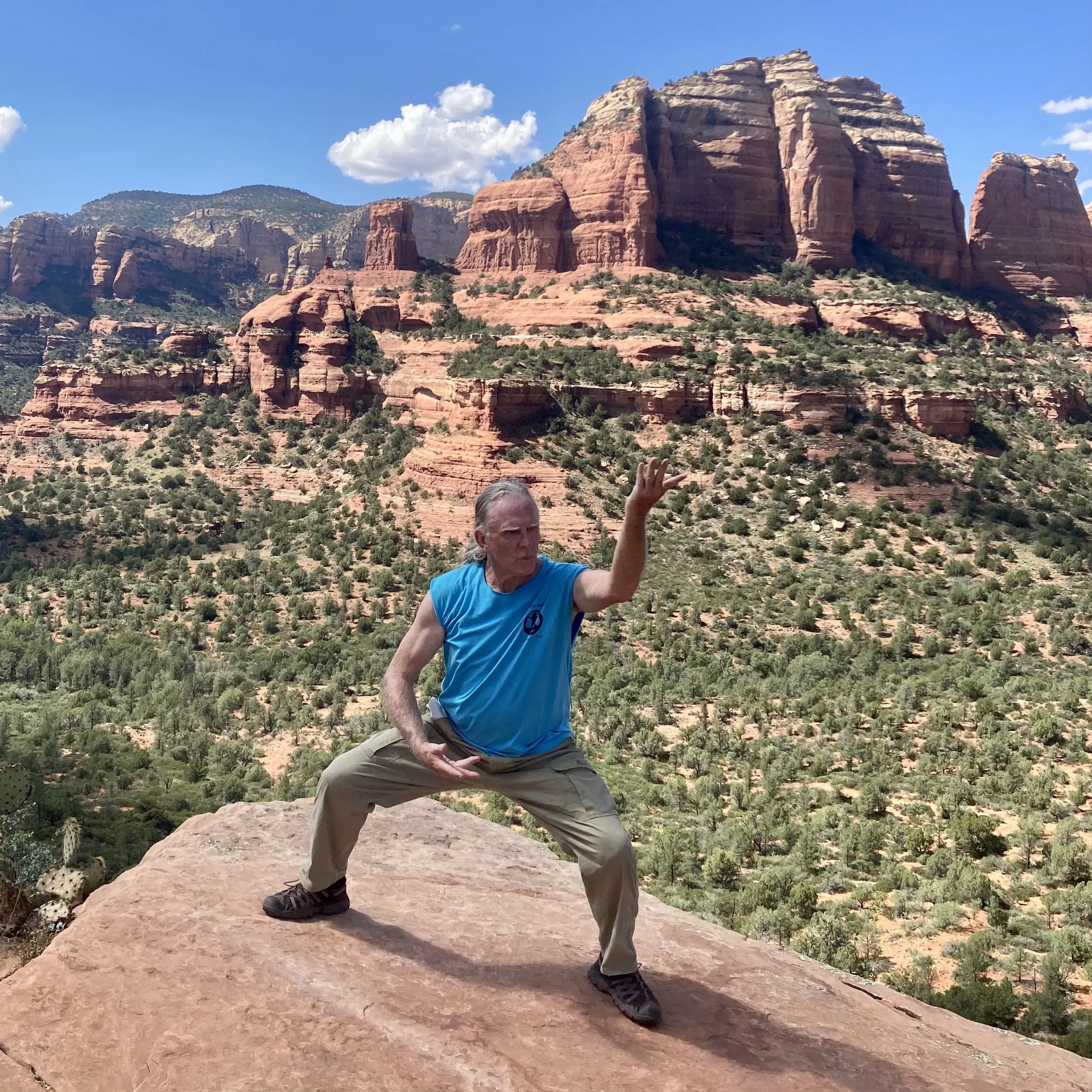
In this episode Andrew chats with long time Tai Chi practitioner Rick Barrett about his martial arts journey, the health benefits of Tai Chi, and the difficulties in writing.
Rick Barrett - Episode 1162
SUMMARY
In this episode of Whistlekick Martial Arts Radio, host Andrew Adams speaks with Rick Barrett, a seasoned martial artist with a rich background in Tai Chi and other internal martial arts. They discuss Rick's journey into martial arts, the health benefits he experienced through Tai Chi, and the concept of hemispheric synchronization. Rick shares insights on his experiences in push hands competitions and the importance of integrating body, mind, and spirit in martial arts practice. The conversation highlights the transformative power of martial arts and the continuous journey of learning and growth. In this conversation, Rick Barrett shares his journey in martial arts, the inspiration behind his writing, and the challenges he faced in the writing process. He discusses his latest book, 'Tai Chi: A Path to Becoming Superconscious,' exploring the concept of superconsciousness and how it can be accessed through Tai Chi. Rick emphasizes the importance of self-empowerment and the ability to create one's life actively. He also hints at future projects focused on participatory consciousness.
TAKEAWAYS
Rick Barrett started his martial arts journey at 29 due to health issues.
Tai Chi helped Rick overcome chronic pain and improve his movement.
Hemispheric synchronization is key to balancing the body and mind.
Rick emphasizes the importance of conscious awareness in martial arts.
He has explored various Chinese internal martial arts beyond Tai Chi.
Push hands competitions taught Rick to rely on mind and energy over muscle.
The journey of martial arts is about continuous learning and exploration.
Rick believes in creating the biggest effect with the least effort.
Martial arts can lead to a state of superconsciousness and flow.
Writing a book can be daunting, but it's rewarding.
The blank page can be intimidating for writers.
Rick's writing process evolved over the years.
Superconsciousness is a state accessible to everyone.
Tai Chi can help individuals access their highest abilities.
The importance of raising one's spirit in martial arts.
Structural tension is crucial in the writing process.
Rick's latest book aims to demystify Tai Chi for a Western audience.
Future projects will focus on engaging life with one's whole being.
CHAPTERS
00:00 Introduction
01:05 Rick Barrett's Martial Arts Journey
05:05 Health Transformation Through Tai Chi
09:46 The Importance of Hemispheric Synchronization
14:54 Exploring Other Martial Arts
20:03 Push Hands Competitions and Personal Growth
27:44 The Journey of a Martial Arts Practitioner
29:18 The Inspiration Behind Writing a Book
34:15 Challenges in the Writing Process
40:40 The Evolution of Writing Experience
43:39 Introducing the Book: Tai Chi A Path to Becoming Superconscious
51:31 Accessing Superconsciousness Through Tai Chi
52:36 Future Plans: Participatory Consciousness
To connect with Rick Barrett:
rick@rickbarrett.net
Join our EXCLUSIVE newsletter to get notified of each episode as it comes out!
Subscribe — whistlekick Martial Arts Radio
After listening to the episode, it would be exciting for us to know your thoughts about it.
✅Subscribe to whistlekick Martial Arts Radio on the following platforms:
🎧Apple Podcasts: https://apple.co/3mVnZmf
🎧Spotify: https://spoti.fi/3yHVdHQ
✅You can find whistlekick on all social media platforms using the handle @whistlekick or visit our website at https://www.whistlekick.com or https://www.whistlekickmartialartsradio.com
Show Transcript
Andrew Adams (04:58.849)
Welcome, you're listening or maybe you're watching on YouTube another episode of Whistlekick Martial Arts Radio. And today I'm joined by Rick Barrett. Rick, how are you today?
Rick Barrett (05:09.822)
I'm doing great. Great to be here. Great to great to be talking with you.
Andrew Adams (05:13.491)
Awesome. I can't wait to get into it. But just before we get it there, I want to make sure to introduce the audience to what it is that we do here. Obviously, you're listening to Whistlekick Martial Arts Radio, and you can go to Whistlekick Martial Arts Radio dot com to find out all of the info on all of our past episodes. We have over eleven hundred and fifty episodes at this point. You can go there and find transcripts, pictures, videos, audio, everything you can think of for all of our guests and and episodes we've had.
You can also sign up for our exclusive newsletter. We're not going to send you a ton of emails, guys. We're only going to email you when a new episode comes out. We just don't want you to miss any. That's all. And you can also go to whistlekick.com to find out about all of the other things that we do. Obviously, we have this podcast, but we also have maybe you want to purchase some equipment, maybe some tra sparring gear or some apparel, or maybe you want to find out about our events that we host around the country. All of that stuff you can find at whistlekick.com.
Okay, I'm done. Rick, it's so great to be here. it's nice to see that both of us kind of color coordinated our shirts to our background.
Rick Barrett (06:15.172)
Ha ha ha.
Rick Barrett (06:23.079)
Beautiful. We had our fashion people chime in on this.
Andrew Adams (06:30.007)
That's right, yes. And and and hair and makeup and everything. Yeah, they they were involved. So if we're gonna have a conversation about martial arts, which that's what we do with this podcast, that's kind of our bread and butter, we need a a starting point. Where should with your martial arts journey, what is your starting point like?
Rick Barrett (06:33.713)
That's right.
Rick Barrett (06:47.453)
Okay.
Rick Barrett (06:54.461)
My starting point
Rick Barrett (07:01.789)
Twenty nine years old. I'm a contractor in New York City and my back and neck are totally messed up and I'm
looking for all kinds of things to fix it and eventually I had this realization like maybe I'm doing it to me and maybe I should learn a different way of moving in this world than I already am doing. You know, I had gone the route of getting really strong and played football and all that kind of stuff. But I so I tried this
Tai G thing. My brother actually had tried it first, and he says, Hey, you got to check this out. And then I started to look into William C. C. Chen, was my first teacher, and and I went in there and I started to play around with it, and within a few months all the symptoms that I'd been experiencing were gone. And I said, Okay, I'm still not looking at it as a martial art yet, but that was like an introduction.
What else is possible here? What 'cause I'm looking at the people around me and I'm seeing they're carrying themselves differently than I am. There's a quiet confidence about them. There's a sense of kind of flowing through life rather than elbows and and shoulders and and and bumping into stuff. And I said, Okay, let's let's let's see about this. But
Andrew Adams (08:23.061)
Yeah.
Rick Barrett (08:41.649)
The martial aspect didn't actually kick in until I discovered push hands, which is a Chinese, which is a Tai Chi ex two-person exercise where you're you're inculcating the principles of the of the art in a two-person exercise, which is can be done at all levels of cooperation or competition, depending on, you know, what the mutual agreement is. And for me it was like,
Andrew Adams (08:47.157)
Mm.
Rick Barrett (09:11.761)
I'm coming. Yeah, I've I've I've come home. This is this is perfect. And so yeah, with that and I was I got into sparring. You started boxing with yeah, we we d the Taiji boxing. We the did a lot of work with sixteen ounce gloves so we could really smack each other really hard and and the damage was was superficial. There was no, you know, rearrangement of skeletal structure with the with with that.
That which was great. And so you learn you're able to learn a lot. And so that was kind of my introduction to the martial art of it. So coming from a Tai G perspective, which is a little different than you know, what we call external arts. You know, this is an internal art. There's there's a way of a whole different approach to how you're you're generating power in in the in the internal arts.
Andrew Adams (10:05.899)
Okay. Now you mentioned that you were having some some health and body issues and within a few months of starting Tai Chi you're you started to notice those symptoms go away. Can you talk a little bit about what if you don't if you feel comfortable, talking about what the it was and w how the symptoms slowly manifested into leaving?
Rick Barrett (10:28.389)
Okay, well I can only explain it from the perspective I have now. At that time it was just mad at that time it was just magic, you know, that it that it happened. So I can look back from what I know now and see what happened. And part a big part of Taiji is there is a whole body connection and particularly
Relevant to this is a you're you're you're learning hemispheric synchronization. That is you're learning how to get the two parts of your brain, the left side of your brain controls the right side, the right side controls the left side. So, and you're learning how to get them to cooperate at a very high level of integration. So up to that point, I was you know right-hand dominant and very strong on the right.
But not so much on the left. So consequently, things kept getting more and more skewed as I as I went through my daily appearance, because I wasn't terribly terribly cognizant of my effects on my body as I'm lugging around ninety-pound sacks of cement on my shoulders and a couple couple of jugs of five-pound compound, five cal gallon compound buckets and stuff like that, hauling those up five flights of stairs.
It was you know, that it was I was not cognizant of my left right symmetry. And so what changed for me was learning to move and to be c aware of both left and right simultaneously. It's a skill that I've I've come to discover is rare amongst humans. It it's
Andrew Adams (12:02.125)
Mm.
Andrew Adams (12:17.249)
Hmm. Now how do you cultivate that?
Rick Barrett (12:21.882)
Well, I've developed exercises since then to actually accelerate the process. And I can do one right now. It's it takes just just just you know so the idea right now is you you place your right hand on your left wrist. Okay? And now you want to f feel your left wrist with your right hand.
Andrew Adams (12:27.373)
Mm.
Rick Barrett (12:48.634)
Now feel your right hand with your left wrist.
So you have to use two different sides of your brain so you're going back and forth there. So now fill your wrist with your hand. Now fill your hand with your wrist. Anyway, so this is just a simple introduction to the process of learning to control the two hemispheres of your brain. So part of part of what my my new book is about talks about learning to control your brain.
Andrew Adams (13:05.885)
Yeah.
Rick Barrett (13:23.12)
And one of the exercises is to be able to just to be able to shift consciously from that. Because we develop habits through our lives. You know, one of the things I noticed was that my legs were, you know, there there's an imbalance there. And I noticed that that I always stepped up, walked upstairs with my right leg first.
Andrew Adams (13:43.693)
Mm.
Rick Barrett (13:45.959)
Something I'd never noticed before, but this, you know, this awareness of that. So take that over 100,000 steps walk to my life or more, you know, then you're establishing certain patterns in your body. You're getting you're favoring one side over the other, which creates this imbalance. And so whenever you start to consciously address it by starting with your left leg, then you begin this process of activating the other side of your brain.
And so this is happening organically within Taiji Chuan. This is by every movement is requires conscious doing and conscious feeling. You every movement requires that you be there present with what is happening in your body. And so it's ordinarily taught not even expressed that way, but that's that's how I express it in in my current language.
Andrew Adams (14:21.557)
Mm.
Rick Barrett (14:46.29)
And it just happens to be built into the system where you you have to learn how to do that to be effective in it, particularly whenever you start to spar or you start to play push hands. Where if you are one side dominant, that's okay, but then they say, Okay, switch sides, and it's like, you know, suddenly like your your your whole your whole system collapses. So this way you're
Gradually learning how to balance your nervous system, which has unseen positive effects throughout everything. Just that it starts off very simply with that, you know, that idea, but that once you start to create this hemispheric synchronization, then you start to be able to your brain starts to act in a highly coherent way.
And so you are opening up to
energy and information that is hidden from our normal rational thinking. We our rational thinking is very limited. And I'm gonna take your your advice and I'm gonna continue talking here a little bit about this 'cause it's this is kinda cool. The you know
Andrew Adams (16:05.173)
Yeah, we we we often say that tangents are the the hallmark of this show, so by all means.
Rick Barrett (16:10.226)
Well, this is a a a a neat little factoid which kind of sets a sets a a foundation for a lot of what I want to talk to today, talk about today, and that is that our preconscious mind, that is the the awareness that we have, which is is below the level of consciousness. That is, and I define consciousness here as knowing that you know, right? I'm a conscious of you.
Right now on this screen talking with you, and but I'm not conscious of what's happening in the room unless I decide to, right? That I'm aware of it, it's in my peripheral vision and it's it's coming in. So that pre-conscious mind, that energy and information we get from that, that we get about a billion bits of information per second from our senses, from our five senses.
So our conscious mind is able to process
Between 10 and 40 bits per second, usually less than 10. So there is a you know a significant like a hundred million to one reduction in the amount of information coming in and the amount that we're able to even remotely recognize. But in by using martial arts and bringing conscious awareness to
your your feeling and your action, you are opening up to a whole different way of being in the world. And this is something that athletes call like being in the zone. You know being in a flow state, right? Where it's like, I don't have to think about it. It just the ball is going where I want it to go. My my drive off the the ninth T is it's going right
Rick Barrett (18:11.899)
To exactly where I intended it to go. Whatever it is that you you your your your medium is, there's a a place where you're in that that spot, your your rational mind has taken a backseat. It's not hasn't gone anywhere, but it's taken a backseat to this whole brain coherence. So whenever martial arts is done at its at its highest level, I believe that we are engaging this this this state.
And there's a state I call superconsciousness. That is it is it's an integration of body and mind which then opens up what I call the eye of spirit. That is those things which it are we know but we don't have to think about.
Andrew Adams (18:57.045)
Mm-hmm. Yeah. Wow. Now there's a lot there for us to certainly delve into and and I definitely want to get there, but I just wanna go back really quickly. So you started training Tai Chi at twenty-nine. You are not twenty-nine now. Anyone watching can tell you're older than twenty-nine. I'm not gonna ask your age, but you've been training for a long time, right?
Rick Barrett (19:21.017)
I'm I'm seventy five. So I'm seventy five and and and the the best is yet to come.
Andrew Adams (19:22.721)
There you go. Okay. So
Andrew Adams (19:28.853)
Yeah, no, I d wholeheartedly agree. In that time you started tight chip training Tai Chichuan, you're still training. In the middle between when you started and now, have you dabbled or or gotten interested in other arts at all, or has it always only been Tai Chi Chuan?
Rick Barrett (19:50.052)
I pretty much strictly been Chinese internal martial arts. And so with that I include Xing Yichuan and Bogwa Zhang and Loshenjiang and there's a thing called the Wu Dong Tai Yi, which is kinda similar to Tai Chi but it's but it's different. Qigong Ichuan, so there's
Andrew Adams (19:54.605)
Mm-hmm.
Rick Barrett (20:18.345)
a whole slew of Chinese internal martial arts, which is kind of fits in more with my personality and my my my curiosity is how we can integrate body, mind, spirit to to make these things happen. So yes, I've dabbled a lot. I'd say probably the first 20 years of my life of my practice was strictly Taiji. And and which point I
was starting to get a little provincial in my attitudes also about it. And and then I started to explore other Chinese internal arts and and found that all the assumptions I made as being rock solid true were not true in those. And I had to s to reevaluate everything with each new exploration I went into.
And I had to kind of say, okay, this is true in this circumstance, in this art or in these under these conditions, this is true. So yes, I've I've explored a lot of them and continue to. I'm still studying. You know, I'm 75, but I'm I'm still I still I have a a a great teacher that I've been with for twenty-five years, who is I consider one of the the the best martial arts teachers and practitioners that I've ever met.
And so I get to I get to go and hang with him, you know, a coup every couple of weeks. And that's that that's great.
Andrew Adams (21:52.128)
Now, i if you d you're welcome to but don't have to say who this was, but can talk a little bit about how you found that person and how you decided at that time this is the person for me.
Rick Barrett (22:06.416)
That's a it's a good story. The the the teacher's name is Yang Fu Kui. And how I discovered it was I was a I had just retired from competition in push hands, which is a whole other story which we can get into. But the and now I was putting on a new hat as a judge slash referee. And I was in a tournament in Baltimore and I was
Judging Chen Stao Taiji, which I actually hadn't practiced at that point, but they but I I kind of knew enough about it to be able to to see it. And this guy comes on, this Chinese guy comes on, and he performs this Chen Style routine that was so far beyond anything I had ever seen before. In terms of it, particularly in terms of his energy, his presence, his spirit, everything would just like.
Andrew Adams (22:56.853)
Mm.
Rick Barrett (23:05.125)
But his the fluidity, emotion, the explosiveness of his punches, everything was just so you know above above the the norm that I was like, my goodness, this is this is the real deal here. So afterward I went up and I talked to him and I said, yeah, that's that's great, really, really love your performance, etc. And nothing I did no contact there because I didn't even know where he lived or anything like that. So a year later, my friend
and I were talking about learning chen style. And I said, Well, there's only one person that I would really want to study chen style with, but I don't know where he is or anything. I I asked around and it turned out that he was in New York City, which is where I live. And I had I have a an office, I had an office in in Greenwich Village. My friend had an office in Chelsea, so there's you know, only like 20 blocks between us. And
Halfway between us was his studio, you know, in in in Manhattan. It's like, okay, this is a good sign. And and so we started studying with him at that point. And I started to go through a whole slew of of different martial arts with him. So at that point I have been studying exclusively with William C C Chen, who is a fantastic teacher, but is exclusively Tai G.
And at that point, I was ready for what else is possible. I was ready for the, you know, give me the whole smorgasboard here of Taiji of Chinese internal martial arts. I wanted to and this guy knew knew them all. And he was a champion in China and comes from a a a family who's had a school operating for 135 years, you know, and yeah, and so
Andrew Adams (24:41.633)
Yeah.
Rick Barrett (25:03.928)
He's he comes from very rich tradition. He learned from his grandfather and his his great uncle and so he's he has this very deep, deep understanding of the intern internal art. So that's that's the the story there. So that's that's who he is and how I got into that.
Andrew Adams (25:22.913)
Wow. Now you also mentioned you had been competing in push hands competitions. We've we certainly if you know if there are avid listeners of the show, we've had some some push hand world champions on our show. I would love to hear how you got into those and then what that was like for you.
Rick Barrett (25:41.466)
Well, as I said before, it was like you know, I was I was like a a penguin on a water slide when I first when I when I first discovered push hands, like 'cause I came from a a tradition from high school football in western Pennsylvania where we like to knock heads, you know, a lot. And so that was, you know, it was, you know, you know played middle linebacker. so I loved the contact. And
Andrew Adams (25:51.268)
Ha ha ha
Rick Barrett (26:10.799)
Between that time and the time I discovered push hands, there hadn't been any legitimate way to touch people in in that physical way. you know, since then. So I whenever I discovered that that was great. And then I got into some tournaments. I I won a bunch of them basically just on athleticism and and will and spirit, you know, and which was
But I I reached a point where it's like
This doesn't look like Tai G, though. This looks like this looks like sumo. This looks like you know, and and that wasn't that wasn't the essence of what we're trying to do in push hands. Push hands is can I create the biggest effect with the least amount of apparent effort? You know, that's you know, that's it. So I got into I had to revise my whole approach to open up to
Andrew Adams (26:45.345)
Mm.
Rick Barrett (27:12.386)
a whole new way of doing things. And I wasn't immediately successful with those, but as I c I persisted. And then I got into it and going for my first national championship, you know, I had this point I'm I'm I'm ready to go into the finals and like, my goodness. Everything that I've ever counted on is gone. I was like this total blank slate. It was like I there was an emptiness there.
And like I felt weak. I felt like like I felt like you know, like as if I had I was sick with the flu and I just had no muscle and everything that I was like, okay, you know, I I don't know what this is. I I can't find it. And then this voice came to me and said, This is what you've been looking for. And I was like you know, said, Trust it.
Andrew Adams (27:45.089)
Yeah.
Andrew Adams (28:04.981)
Mm.
Rick Barrett (28:10.321)
So I went in and I and I and I won the and I won the championship and and it opened up this whole new way of of being in the world where I'm using more mind intent and energy than my muscle power. And that was that was a very dramatic for me introduction to that. And then from then on I I said, okay, I'm gonna test this out.
Andrew Adams (28:28.737)
Mm.
Rick Barrett (28:39.862)
And I said, it worked for me as a middleweight, you know, 173 pounds. I'm like, you know, I feeling just fine on that. How about in the unlimited class? So then I entered into tournament. And up to that point, nobody had done that. Nobody had gone up to classes to the unlimited, you know, and I said, Well, if it works.
it worked it doesn't matter how big they are. So I went through the whole whole murderer's row of of of super heavyweights, you know, ranging from fifty to a hundred pounds. Actually one guy I didn't play, but he was in there. He was over like a hundred and fifty pounds more than me. But the the guy I played in the finals was was six foot five and two hundred and seventy pounds. So he had a hundred pounds on me and and big arms and he was also
Andrew Adams (29:10.967)
Sure.
Rick Barrett (29:37.932)
a a multiple champion. So he was not a slouch in in this, but whenever I won the tournament, you know, he picked me up like I was a child, lifted me over his head, and and he was beaming. He was just he was he thought it was hysterical that that this little guy had just beaten him. But it was I was trusting my my recent epiphany in terms of the internal aspects of the art.
Andrew Adams (30:07.799)
So
Rick Barrett (30:08.142)
Then I did that a few more times. I did that a few more times just to test it out. Okay. This is not a fluke. And then the next time I tried a different tournament, I I I beat this guy who was an ex collegiate wrestler, super heavyweight ex collegiate wrestler at a Shaolin black belt and he was and and I and I won that too. And so it was like, okay. Then I started to get some confidence that yes, okay, this this what a this is the right track.
Andrew Adams (30:37.463)
Okay. Now I'm gonna go out on a limb and I'm gonna make a a a a a prediction, and I and I could be wrong. And and you you could tell me if I am. you were doing push hands with someone six foot five, super in the super heavyweight division, loved the he had been a former world world champion, had but when he lost, picked you up and was super happy. Is this the person that introduced us?
Rick Barrett (31:08.015)
No.
Andrew Adams (31:08.999)
wow. Okay. So there's two of them. okay. All right.
Rick Barrett (31:11.981)
I mo more than two. More than two. But the person introduced us and I'm actually wearing this shirt as a as a signal to him. this is it's a t shirt that he made for us in a seminar that we taught in two thousand eight called the Chinese at the the Staten Island Chinese Scholars Garden. And we used to teach these seminars together, these scholars garden seminars. We did that for about ten years, and he made this shirt for me and
Andrew Adams (31:32.941)
Mm-hmm.
Rick Barrett (31:40.099)
And that person is Steve Watson that you're talking about here, who is you know, we go back a long way. We go back, you know, twenty five years or so and so but yes, we we've trained together many times.
Andrew Adams (31:41.719)
Mm-hmm.
Andrew Adams (31:53.304)
So avid avid listeners of the show will will know Steven Watson. great person, was a great guest. We he's a a strong advocate and friend of the show, so we're we're happy to call him friend. Talk a little bit about just because he is such a character, talk, if you don't mind, a little bit about how you met him and what that was like.
Rick Barrett (32:15.433)
He was referred to me. Now, at that time, Steve was not much bigger than me. And now he's a he's he's a giant, but at that time he wasn't much bigger than me. And he came to he was referred to me by our mutual friends and Ramsey and Jim Jim Yoon were the two guys. They they said, no, no, you gotta check this guy out. And I introduced Steve.
to some of the the key elements of my practice, particularly energetic coherence. And and I was able to to to demonstrate that. And and then I just watched Steve grow. He just you know, until his push hands ability surpasses mine now by quite a bit. He's he's he is he really
integrated, you know, his his gung fu into into all aspects of his martial arts. So yes, but but we've we've gone from that point from him being my student to being partners in teaching seminars, you know, to you know, so it's and he wrote a fabulous fabulous review for my for my new book and
So he sees remains a a great friend and a great inspiration.
Andrew Adams (33:48.61)
Yeah. Yeah, he's a great person. I'm sure at some point he'll listen to this. And so this is us saying, Hey Steve. Thanks for thanks for coming back. Now you you mentioned you mentioned a book. Let's talk a little bit about about for not let okay, pause, Andrew. Collect your thoughts. Let's talk a little bit not quite yet about the book itself, but what made you decide to write a book? Lots of people think that they're gonna write a book and they can't follow through. It's difficult.
Rick Barrett (33:56.047)
Hey Steve
Andrew Adams (34:18.827)
What made you think I've got to put these thoughts down on paper?
Rick Barrett (34:25.091)
Good question.
Andrew Adams (34:26.815)
I only try and ask the good ones.
Rick Barrett (34:30.861)
You nailed it. This is my third book. So so my initial thing I first of all just start off I never wrote more than a page about anything until I turned fifty. So I had retired from competition push hands, you know, and I'm now judging and rapping and blah blah blah, teaching, doing all that kind of stuff. But I you know, I'm you know
Andrew Adams (34:34.785)
Okay.
Rick Barrett (35:00.513)
I I I I stopped competing at like age forty eight. And I kind of s at that point I said, All right, I got nothing more to prove. I've I've won what I w needed to win. Anything anything I do from here would just be ego. And so I just kinda got out of that and I said, All right, so what lessons did I learn from this? So that was that was the initial inspiration there. It's like up until age fifty I really didn't have anything to say. Not in terms not in a long form format, like a
Like a book. So at that point though I said, okay, so this trick that I I I developed to summon that state that I had first encountered in that epiphany, excuse me.
Rick Barrett (35:54.999)
what makes that work. So then I go and I look into excuse me. The look into the scientific literature, I look into the Tai Chi classics and try to find some indication there of is there a precedent for what I was doing? Or is there a scientific explanation for what I was doing that is not included in the normal conversation about these things.
And that's what inspired us. Like, I finally had something to say. So the most recent book was is kind of a sequel to the to the first one.
Because the first one was called Tai Ji Chuan through the Western Gate. And so the idea there was that most of us are limited by what I call the Western Gate. That is the scientific materialism that dominated and still dominates to a large degree, but around the turn of the century was dominating most of these explanations of what makes makes the martial arts work. It's all
levers and pulleys and and forces and counter forces and where's your center of gravity, etc. Now it's going through the Western Gate means that we're going through that into this whole other way of looking at it, which goes beyond the rational mind. And what I wanted to do was
Take the I wanted to demystify the excuse me. Haven't talked so much in a while.
Andrew Adams (37:51.917)
That's right, take your time.
Rick Barrett (37:54.187)
Excuse me.
wanted to demystify things. At the same time bring the mystical into the ordinary.
Rick Barrett (38:11.769)
So that was the that was the thing. The next book, this current book is Tai Chi A Path to Becoming Superconscious. And that was based on the idea what is it like to live beyond the Western Gate? What is it like to go there at will?
Andrew Adams (38:31.583)
Mm. Okay.
Andrew Adams (39:09.173)
Now, the process of writing a book is something that can be very daunting to people. It's you know, I mentioned it a bit ago. A lot of people think that they want to write a book and realize how difficult it is. For you, what was the most difficult thing about getting that first book out? And was it an issue when you did this most recent book, your third book?
Rick Barrett (39:43.7)
Repeat that question.
Andrew Adams (39:44.974)
Sure. So writing books is difficult. That's why so many people think they're going to and don't. What what was the most difficult thing for you when you wrote your first book? And then was that same issue also an issue when you wrote your third book?
Rick Barrett (40:03.566)
Good question.
So
Rick Barrett (40:12.813)
The the the first time is like you're you know, it's the the blank page, you know, that is that is is so scary. It's like you know, you've got ideas, you've got experiences, etc. But it's it's all abstract. And so how do I organize these
billions of thoughts and put them into a form that would be interesting to somebody else. That's the so that's the the the challenge there. The challenge exists in every book I've written, you know, of like how do I take all this information and and do that? And so my solution to that was who am I writing for? And I start to
Andrew Adams (41:07.277)
Mm-hmm.
Rick Barrett (41:10.526)
Narrow that down, you know, I'm writing for Andrew. I want Andrew to understand what I'm saying. So if I look at writing, not as just Rick blurting out words because he knows words, but it's a communication. That is, I want to create an effect on Andrew by choosing words.
Andrew Adams (41:27.021)
Ha
Rick Barrett (41:38.998)
That Andrew will understand and resonate with something that we might have in common, a shared reality that enable us to to do that. And then I have to then say, okay, so I've gotten gone too far out on the limb here, and I have to go back to where the shared reality is and reestablish that before we go into another tangent.
Andrew Adams (42:05.773)
Mm.
Rick Barrett (42:06.549)
And which is exactly what you're doing in your interview. You keep pulling us back toward toward the center, which is which is terrific. And but it's it's it's the same it's the same idea. What it requires is commitment to actually you know you envision something. One of the processes I think I'll tell you a a secret and it's your your readers your listeners may
May appreciate this. I I read a book called The Path of Least Resistance, and the name skips my mind right now, but I'll I'll try to try to remember it. But in in it there was a a description of how you create structural tension. That is by
Andrew Adams (43:02.85)
Yeah.
Rick Barrett (43:05.482)
Assessing where you are now, what resources you have, and and you just make a decision what you want to create, and you envision what it is you want to create. And this isn't just like you know manifesting things in your thoughts or whatever. This is you're creating something by creating an energetic pull between here. I am now, here's where I want to go.
And holding those two poles in opposition, which is very similar to the way I teach Taiji, is holding poles in opposition, and that the discomfort that you feel with that structural tension there is what pulls the the project forward.
Andrew Adams (43:57.357)
Mm. Okay.
Rick Barrett (43:59.338)
And where most writers, you talked about people give up, it's where they cannot tolerate the structural tension. And they start to make excuses or make bargains. You know, they say, I really didn't want to do that anyway, or nobody's gonna want to read this, or blah blah blah, whatever it is that they whatever it goes through their minds, they start to find some way to dissolve the structural tension without taking it to full completion.
Andrew Adams (44:27.661)
Mm. Okay.
Rick Barrett (44:29.049)
So you have to learn to sit with the the that you know with it for for years. For me if we was is for years. Yeah, it took the first book took about five years, the second book took about five years to go from start to finish, from from the idea to the to the actual physical object. It took about five years to go to the completion. Not all that was, you know, the initial effort.
Andrew Adams (44:37.206)
Yeah, okay.
Rick Barrett (44:59.031)
the part of it's the publishing, you know, takes takes about a year of that to
Andrew Adams (45:01.085)
sure, sure. Now, that book, The Path of Least Resistance, was written by Robert Fritz. Yeah. now f no I look no I cheated. I looked it up.
Rick Barrett (45:09.089)
That's right.
You're you're familiar with it? You're familiar with it?
Okay, yes. Robert Fritz. It was a brilliant brilliant book. It really changed changed everything about it. I guess that probably more than anything gave me permission to do this, you know, g to follow through.
Andrew Adams (45:29.165)
Okay. So if there are any if there are any aspiring writers out there, there you go. There's a book for you. Now was it easier this last book?
Rick Barrett (45:40.15)
It was more fun.
Andrew Adams (45:41.331)
Okay, all right. Talk about that a little bit. 'Cause th fun is not often something that we hear in regards to writing for most people.
Rick Barrett (45:50.109)
No, no, more more like it's more like a fever dream the f you know, for for f you know, it is to me it was like, you know, writing was like, you know, only slightly better than a hemorectomy, you know, it the first time around. You know, it's a you know, but that's my intolerance of that structural tension. Right? It's like martial arts. If
Andrew Adams (46:15.745)
Sure. Okay.
Rick Barrett (46:18.57)
If you've never been hit in the face, then you're afraid of being hit in the face. But after you've been hit in the face a couple thousand times, then you know it's it's not such a big deal anymore. You know, and but it so now this is that was twenty years ago that that one was published. So it's twenty years between those those two books. And so now I approach it much differently. F now I
engage the process joyfully and not to say there wasn't some angst and hand wringing and and sense of futility and and how many rewrites do I have to do and don't ask how many because it was beyond counting. All writing is rewriting, you know. But every everything is serving the idea of how can I express these these ideas to Andrew? How can I
How can I get Andrew to understand what it is that I'm saying? And whether he agrees with them or not doesn't matter. It's you your ability to get Rick Barrett. And this is how Rick Barrett views the world. We all have our own unique perspective. And this is Rick Barrett's version. And if it's valuable to you, great. You know, that'd be that'd be awesome. So the
Andrew Adams (47:35.885)
Mm-hmm.
Rick Barrett (47:44.213)
I divided it up into three separate phases, and the first one was actually writing the book. Something that I was happy with and didn't matter if anybody read it. I was, you know, got it. Second phase, get it published. Now I have to I have to find somebody who wants to take a chance on this. And I got a great publisher, YMAA Publications, terrific martial arts publishing house.
Andrew Adams (48:11.991)
Mm-hmm.
Rick Barrett (48:12.82)
And so which was fantastic. And then third step is now what we're doing now, which is, you know, getting it out there, getting it see seeing see seeing if other people wanna wanna read what I just wrote.
Andrew Adams (48:20.949)
And and talk about it.
Andrew Adams (48:26.699)
All right. So let's talk about the book now itself. the what's the title of the book and talk a little bit about the book itself and and why people might be interested in in it.
Rick Barrett (48:39.851)
Here's the here's the book. It's called Tai Chi A Path to Becoming Superconscious. Okay, and
Rick Barrett (48:52.959)
At some point I realized that for internal arts to be done at the above and intermediate level.
You have to enter into a different state of being.
You can't just go perform the motions, think the thoughts and and and expect the magic to happen. 'Cause there is magic. There is there are psychic phenomena that are not available to you.
unless you make that that jump. And it occurred to me that there w wasn't language that was easily communicated to a Western audience that fully encapsulated what I was trying to say. And most of my you know people I've encountered along the way says, Well you can't talk about this to people until they've been actually at this for decades and then then
You just kinda nod sagely and and say, Yeah, that that thing, you know, and but to be able to express it to somebody, because I'm writing for people who maybe don't have decades to wait for the light bulb to go off. I want when a student walks into my class, I want them to see what I'm doing the first day. I want them to feel it.
Andrew Adams (50:05.429)
Yeah.
Rick Barrett (50:31.424)
The feel that transition. I would say most people when I do that to them, they run away screaming. But the but the few that get it and they say, Okay, I want so I want more of that. And so the superconscious idea is what happens when we bring body, mind, spirit together.
Rick Barrett (50:54.47)
What are the emergent qualities, the emergent abilities that come from that? And I before I previously mentioned the you know, being in the zone or in a flow, that that kind of thing. Those things happen by accident for most people though. You say, Okay, I want you to go to the zone now and it's like, I don't know. You know.
Andrew Adams (50:59.17)
Mm-hmm.
Andrew Adams (51:15.725)
Sure, that that I think most people listening or watching get that that the concept, yeah.
Rick Barrett (51:22.09)
Yeah. So I wanted to create a methodology where people could go there at will. Where you could go to that state. You may not be able to, you know, play basketball like Michael Jordan, but you know, y at least you're able to occupy that state of being where you're able to access your highest abilities based on your
experience and teaching and and practice up to this point. Your kung fu. You know, where wherever your kung fu will lead you right now, you're able to access that whole library of information in an instant. Where you're able to learn to know without thinking. And that's a key aspect of superconsciousness. I wanted to I wanted to f to be able to share that with it. And part of writing the book was to
Teach myself how to talk about it. Because I when I started, I really had these ideas, but I didn't know how to express them. And so it's been a gradual process working with my students, testing it out on them, what language actually resonates with people. And then, you know, I was able to gradually synthesize that into a way of
Andrew Adams (52:24.557)
Hm.
Rick Barrett (52:48.49)
describing this method methodology that communicates to most people. So the well let let's le let's leave it at that and then we'll go. Next question.
Andrew Adams (53:01.389)
We don't want to give all the secrets away.
Rick Barrett (53:06.048)
Well, I I'm I'm happy to do that, but it's it's still worth reading the book. So anyway, so Yeah. So I guess what w w the question was what what's what's special about the book basically. And I I think it is you I think I I think it's unique. Well, I I think I think it's unique. I think it's what people will get out of it is the ability to raise their spirit. Okay.
Andrew Adams (53:11.051)
No, absolutely, absolutely.
Andrew Adams (53:18.925)
Well I mean just you know w what what people will will get out of it, yeah. Yeah.
Rick Barrett (53:32.244)
And that's that's a key element in Taiji. Taiji talks about so you must first raise your spirit. And then and that those words, what does that mean? And so I get into exactly what it means, particularly from that perspective, from the Chinese martial art perspective, what it means, spirit, and it's something that it's accessible to all of us. Superconsciousness is accessible to all of us, and how to actually
Consciously raise your spirit so that you're able to shift out of your the limitations of your rational mind. I mean, how many times have people said to you, I'm stuck in my head? You know, I need you know, that that's those are the people I'm I'm trying to talk to. And what if you are stuck into your head, this is one
Andrew Adams (54:16.864)
sure.
Rick Barrett (54:29.196)
proven effective way of getting out of your head and into the game. And one thing, you know, going back to what I was saying earlier, it's like you know, that processing that billion bits of information and through the rational mind takes, you know, you're you're you're having this, you know, a hundred million to one reduction, it it takes time. It takes time for to h come up with a thought. And there's, you know, the
Traditionally talk about a half second delay between the time that you perceive something and are able to conceptualize that which you are seeing. You hear a noise and it takes that was a firecracker going off. It takes a it takes a half a second for you to to come up with that idea. And that half a second in martial arts is an eternity. In any sport, it's like it's it's an eternity. If someone is serving
Andrew Adams (55:00.802)
Mm.
Andrew Adams (55:26.305)
Yeah, yeah.
Rick Barrett (55:28.052)
a a hundred and thirty eight mile an hour serve in tennis, you don't have time to say, that looks like it's got you know, it's coming in at this trajectory with this kind of side spin on it and no, no. It's it you you you have to know. You have to know without thinking based on your kung fu, your practice up to that point. So so getting out of your head and into the game
Andrew Adams (55:53.014)
Okay.
Rick Barrett (55:57.212)
Is a a major part of this book, raising your spirit, learning how to control the rational mind.
Andrew Adams (56:07.885)
Cool. All right. Now you mentioned it's pub published by YMA where and you know, we're listeners of the show might be familiar. We've had the we had the
the owner on the on the show in the past. but where where can people purchase the book if they wanna get it? If they're the 'cause there's gonna be people that are like, I wanna get this book.
Rick Barrett (56:28.27)
yeah.
Yes! Thank you. any bookseller. You can order through any bookseller. It's only been out l about a month. And it's it was released a month ago, so it's you know real hot off hot off the presses. I have heard of some sightings on the shelves and in a Barnes and Noble, so and prominently displayed, so that's
Andrew Adams (56:44.47)
Okay.
Andrew Adams (56:57.613)
Great.
Rick Barrett (57:00.713)
That's a good sign. But I'd say if you know, if it's not there, you just go online and whatever your favorite bookseller is, be it Barnes and Noble or Amazon or or wherever you can you can order them and get it delivered. So that's that it's it's that it's readily available. Or also the YMAA Publications booksite. The
Andrew Adams (57:23.871)
Awesome. And do you have plans for
Rick Barrett (57:28.519)
YMA Publications website, you can go there too.
Andrew Adams (57:31.329)
Okay, great. And do you have plans for a book four?
Rick Barrett (57:36.267)
I do. I do. I'm going to spend the next six to twelve months really working on the phase three of this book and gathering my thoughts for the next one. But I would say that my working idea is a book on participatory consciousness, and that is being able to engage life with your whole being.
Andrew Adams (58:00.078)
strange.
Rick Barrett (58:06.82)
And it's it's kind of shoots out of this, but it's a you're learning how to, you know, move from a a passive observer to life and to be an active creator, which you know, you embody, you're a world class drummer. And every every every time you you sit down at the kit, you know, it's an opportunity to to go to heaven.
Andrew Adams (58:33.934)
Yeah. Yep. Yep.
Rick Barrett (58:34.431)
You know, it it right? It's like boom, it's like there is nothing more immediate. You are you are the time maker at that in in that in that role. You are the creator of time. And and so yeah, and you do the podcast, you got your martial arts, etcetera. We are creating our lives. So this is this is what the I would like for more people
Andrew Adams (58:55.861)
Mm-hmm. Sure.
Rick Barrett (59:02.783)
particularly who are feeling kind of pushed around by life, which I would say is the majority of people.
you know, say, no, no, make these changes and you can start to shift your your your your your your the direction, your vector, you know, and you can you can shift your position from effect to cause and just start to create your life rather than watch it happening and slowly watch the years ebb away.
Andrew Adams (59:38.007)
That's great. All right. Now someone listening or watching wants to reach out to you. You maybe you said something that really resonates with them and they want to tell you, is there a way people can get in touch with you? What's the best way?
Rick Barrett (59:51.851)
you can contact me through Facebook, through you you can Rick at rickbarrett.net is my you know an email you can you can write to. You can I have a YouTube channel. You can communicate through that. but I would say just send me an email and I'd be happy to happy to to respond.
Andrew Adams (01:00:14.239)
I will I we'll make sure that all that stuff goes in our show notes. So you know, I I wanna thank you, Rick, for being here. I'm I'm gonna let you close us out here in just a second and and I'll let you think about a little bit what you wanna wanna end with today. But in case you're made it all the way to the end of this episode, viewer or listener, thank you so much for being here. We certainly appreciate it. Whistlekick Martial Arts Radio is where you go to find out all of the information on this and all of our other episodes.
Rick Barrett (01:00:32.883)
Mm-hmm.
Andrew Adams (01:00:41.387)
And go to whistlekick.com to find out about all of the stuff that we do, whether it's apparel that you can purchase or sparring gear, or maybe you want to purchase some of our books that we have available there, you can find everything there, whistlekick.com. and if you are watching on YouTube, it really means a lot to us to hit that like button, subscribe. if you are watching, then you'll know this cool little 3D printed thing that I have right here that I fidget with sometimes. But if you're only listening.
You have no idea what I just showed the screen. Sorry, you missed out. Rick, thank you so much for being here. What do you want to leave our audience with? What what words do you want to close out the episode with today?
Rick Barrett (01:01:24.295)
Hmm, good question.
Superconsciousness is inherent in all of us. It's not it's not only ascended masters and gurus and things that it is every one of us has the capacity of cultivating this higher state of being that enables us to access our full range of awareness and abilities. And that's
Empowering to everybody, self-empowerment, learning to to actually be more in the world, be more involved in your life.